

🇳🇺 Niue at a Glance
🌍 Overview — the Rock
Niue is 261 km² of uplifted coral limestone sitting alone in the South Pacific, 2 400 km north-east of New Zealand and about 600 km from its nearest neighbour, Tonga. It is one of the largest raised coral islands in the world and one of the smallest self-governing states — and the number that defines it is not its area but its population: around 1 650 people, against roughly 30 000 Niueans living in New Zealand.
Everything about the place follows from being made of coral rather than volcanic rock. There is no surface water at all — no rivers, no streams, no lakes — because rain goes straight through the limestone into a freshwater lens. There are essentially no beaches, because the island is a cliff. And the water offshore is extraordinarily clear, because there is no runoff and no river silt to cloud it.
Where it is
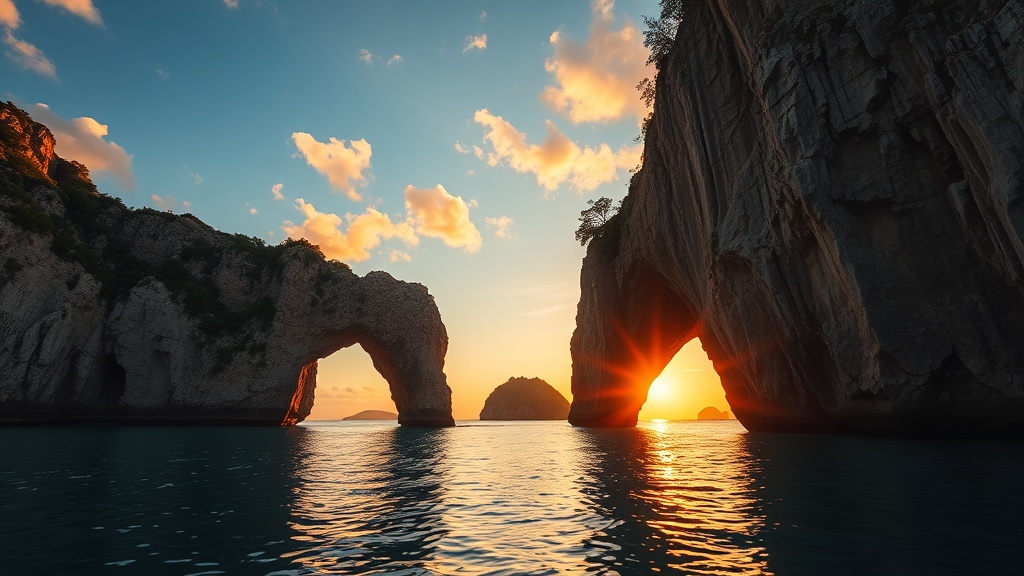
19° south, 169° west, in the triangle between Tonga, Samoa and the Cook Islands. It sits east of the International Date Line despite being west of Tonga, which means it is one of the last places on earth to see each new day — Niue is UTC−11, 23 hours behind Tonga, so a call to Tonga is effectively a call to tomorrow.
What it is made of
A raised coral atoll: an old reef pushed up by a tectonic bulge, ringed by two terraces, with a shallow saucer in the middle where the lagoon used to be. The rough, fissured limestone is called makatea, it is savagely sharp, and it is why nothing here looks like the Pacific of the brochures. See the geology section.
Who lives here
About 1 650 people in 14 villages around a single 64 km ring road, with roughly a third of them in and around Alofi. Overwhelmingly Niuean, a Polynesian people closest to Tongans and Samoans, with a small number of New Zealanders, Filipinos and Fijians on work contracts. Every Niuean is a New Zealand citizen by birth.
How it is governed
Self-governing in free association with New Zealand since 19 October 1974. Niue runs its own government and makes its own laws; New Zealand handles defence and, on request, foreign affairs, and funds a large share of the budget. The Niue Assembly has 20 members — 14 elected one per village and 6 on a common roll — and there are no political parties. Dalton Tagelagi has been premier since 2020.
Is it a country?
Yes, with an asterisk that Niueans themselves find tiresome. It is not a UN member, but it is a full member of UNESCO, the WHO, the Pacific Islands Forum and the Pacific Community, it signs treaties in its own name, and in September 2023 the United States formally recognised it as a sovereign and independent state and established diplomatic relations. See the section on status.
⚠️ Getting there
One airline, one route. Air New Zealand flies Auckland–Niue once a week, with a second weekly flight in the high season — currently two a week until 19 October 2026, reverting to Saturdays only after that. If you miss it you wait seven days. This single fact shapes everything about visiting: see getting there.
🏷️ Behold the Coconut, and Savage Island
Niue
The usual reading is niu (coconut palm) plus e (behold) — "behold, the coconut" — said to be what the first voyagers called out when the palms came over the horizon. Etymologies of Polynesian place names are rarely settled and this one is not either, but it is the version Niueans tell and it has the merit of describing exactly what you see from a boat: a low green rim of palms on a wall of white rock.
Niue Fekai
The ceremonial full name, usually translated "Savage Niue" or "wild Niue", and worn with pride rather than embarrassment. It refers to a reputation for fierce independence — the island resisted invasion from Tonga and Samoa, and it resisted Europeans for nearly a century after Cook.
⚠️ Savage Island
James Cook arrived in June 1774 and tried three times to land. Each time he was driven off by warriors, and he recorded that some had teeth and lips stained red — which he took for blood and which was almost certainly the red hulahula banana. He named it Savage Island and sailed away, and the name stuck on European charts for the better part of two centuries. Niueans have been correcting it ever since, and the story is now told as a joke about the difference between what a visitor sees and what is happening.
"The Rock of Polynesia"
The modern self-description, and the honest one. There is no volcanic peak, no lagoon, no palm-fringed sandbar. There is a rock, and it is the whole country — the tourism board leaned into it rather than pretending otherwise, which is why Niue's marketing is notably less dishonest than most island destinations'.
What Niueans call themselves
Tagata Niue. The language is Vagahau Niue — literally "Niue speech" — and calling it "Niuean" in English is fine, but the local term is used constantly and is part of the revitalisation effort. See the language section.
Alofi
The capital, on the west coast, sheltered from the prevailing south-easterlies — which is the whole reason it is there, since Niue has no harbour and ships have always had to be worked from open water. It holds perhaps 600 people across Alofi North and Alofi South, and it is the smallest national capital on earth outside the Vatican.
🪨 The Makatea — How a Reef Becomes a Country
Niue is the clearest example anywhere of what happens when an old coral reef is lifted out of the sea, and its geology explains its water, its farming, its caves and its politics of drinking water all at once.
How it got up there
Not by rising on its own. Niue sits on the outer bulge where the Pacific plate flexes upward before diving into the Tonga Trench — the same forebulge that has lifted Nauru, Makatea in French Polynesia and parts of the Loyalty Islands. The reef was pushed up in stages, which is why the island has two distinct terraces: a coastal shelf at around 25–30 m and an inner plateau at 60–70 m, with a low cliff between them.
The saucer
Stand in the middle of Niue and you are in a shallow basin — the floor of the old lagoon, now dry, with the raised rim of the fossil reef all around it. The centre is where the deepest soil is and where taro is grown. The highest point on the island is only about 68 m, and from the air the whole thing reads unmistakably as an atoll that got out of the water.
⚠️ Makatea
The rough weathered limestone of the terraces, and one of the more hostile surfaces on earth to walk on: a lattice of pinnacles, blades and holes, sharp enough to cut through a boot sole and to take skin off in a fall. It is also the reason the forest survives — you cannot easily clear or plough it — and the reason every coastal path on the island is a marked "sea track" rather than a stroll.
No surface water
None. Not a single permanent stream on 261 km², because rain drains straight down through the limestone into a freshwater lens floating on seawater beneath the island. All drinking water is pumped from boreholes into that lens, which makes it the island's single most vulnerable resource — over-pumping draws salt up into it, and there is no alternative supply.
Caves and chasms
Water moving through limestone dissolves it, so Niue is riddled with caves, chasms and collapsed dolines — some open to the sea, some far inland, several with stalactites growing where a reef used to be. They are the island's principal sight and they are described in their own section.
Why the water is so clear
Three reasons compound. No rivers, so no silt. No lagoon and almost no shelf, so the bottom drops away to hundreds of metres within a short distance of shore. And no plankton bloom, because there is no nutrient runoff from the land. Divers routinely report visibility in the range of 50–80 m, and Niue's marketing claim of "100 m+" is at the very top of what is occasionally measured rather than a typical day.
🌊 The Coast — Cliffs, Reef Flat and Sea Tracks
What a Niuean coast looks like
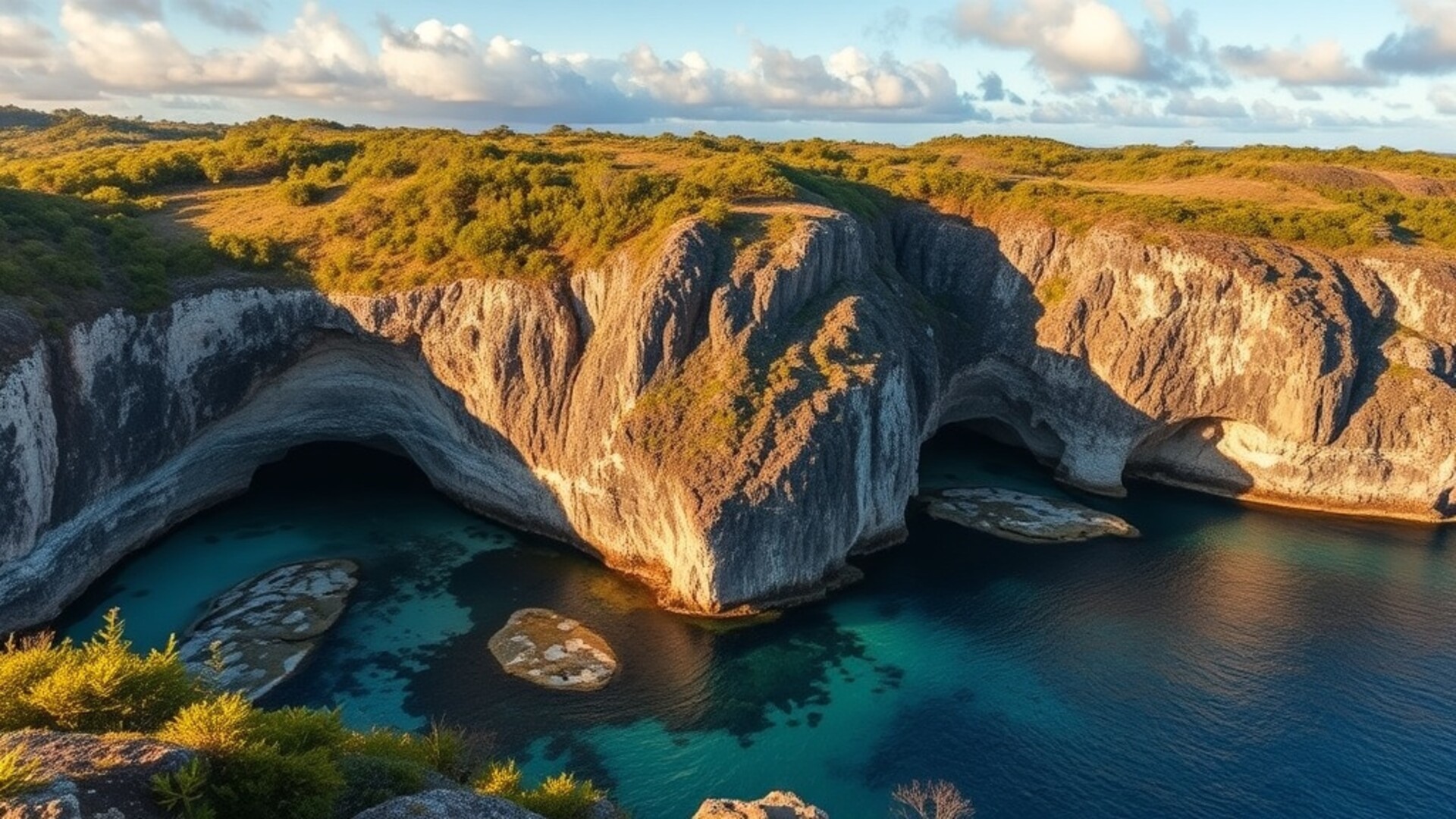
A low forested plateau ends in a vertical wall of white limestone, typically 20–25 m high. At the foot of it is a reef flat — a shelf of coral rock exposed at low tide, full of pools and channels — and then the reef edge, and then several hundred metres of water. The wall is undercut by wave action into notches and caves, and in places it is arched, collapsed or pierced through.
Sea tracks
The way down. Fourteen villages each maintain tracks from the plateau to the reef flat, cut and stepped through the makatea, often through a cave or a chasm. They are the island's sightseeing infrastructure and they are genuinely steep, slippery and unrailed in places. A track that is a twenty-minute walk on the map can be a serious scramble.
Tides matter more than anywhere
Everything on the reef flat — the pools, the tracks, the snorkelling — works at low tide and is dangerous or impossible at high tide or in a swell. Niue's tourism office publishes tide tables and every accommodation has one on the wall. Plan your days around the tide, not the clock; this is the single most practical thing to know about the island.
The few beaches
There are small pockets of sand — Hio, Avatele, Namukulu, Tamakautoga — and they are coves at the foot of the cliff rather than beaches in the Polynesian sense. Avatele in the south-west is the largest and is where Niueans actually swim. Nobody comes to Niue for a beach holiday and the tourism board does not pretend otherwise.
No harbour
Niue has never had one. Ships anchor offshore at Alofi and cargo is worked by barge and crane in open water, which stops entirely in a swell. The crane on the wharf lifts small boats in and out because there is nowhere to moor them. A country whose supply chain depends on the sea state is a country that runs low on things, and Niueans plan accordingly.
Whale season on the doorstep
Because the drop-off is so close to shore, humpback whales come extraordinarily close — they are regularly seen and heard from the cliff tops at Alofi between July and October, and the calving ground is effectively in the front garden. See the whale section.
🛶 Settlement — Two Waves and Fourteen Villages
When people arrived
Archaeology puts first settlement at roughly 900–1000 CE, probably from Samoa, with a second and culturally decisive arrival from Tonga perhaps five hundred years later. Niuean oral tradition preserves both, and the language shows both: Vagahau Niue is a Polynesian language with clear Samoic and Tongic layers, which is unusual and is one reason linguists find it interesting.
Why it was a hard place to settle
No surface water, no soil to speak of on the terraces, sharp rock everywhere and a coast with no safe landing. Early Niueans lived off taro grown in the central basin, fish worked off the reef flat and from canoes launched down the sea tracks, coconut, and the uga — the coconut crab — which is still the island's prestige food.
The two districts
Traditionally the island was divided into Motu, the northern half, and Tafiti, the southern, with a long history of hostility between them. The division is still the organising frame of Niuean social geography and shows up in sport, in church rivalries and in the seating at any large gathering.
The fourteen villages
Each village has its own council, its own sea track, its own church and its own show day, and returns one member to the Assembly. Going clockwise from Alofi: Makefu, Tuapa, Namukulu, Hikutavake, Toi, Mutalau, Lakepa, Liku, Hakupu, Vaiea, Avatele, Tamakautoga and Alofi itself, which counts as two.
The patu-iki
Niue had no paramount chief for most of its history — authority was village-based and contested — and only in the 1700s did a line of island-wide kings, the patu-iki, emerge. The last, Fata-a-iki and then Tongia, are the ones who dealt with Britain and New Zealand; the institution lapsed after 1917 and has not been revived, though there is periodic talk of it.
Hakupu
The largest village after Alofi and the one most often described as the cultural heart of the island — the last to accept Christianity, the strongest in Vagahau Niue, and the home of some of the best-known hiapo barkcloth. It is on the east coast, which is the wild side, facing the trade winds and 12 000 km of open ocean.
⛪ Cook, the Missionaries and Nukai Peniamina
1774
Cook's three attempts to land and his "Savage Island" naming, described in the name section. What matters is the result: Europeans left Niue alone for the next sixty years, which is a long time by Pacific standards and is why Niuean society entered the nineteenth century largely intact.
The missionaries who could not land
The London Missionary Society tried repeatedly from 1830 — John Williams among them — and was refused every time. The Niuean position was consistent: outsiders brought disease, and they had watched it happen elsewhere. The LMS eventually solved the problem the only way it could, by training Niueans abroad and sending them home.
⭐ Nukai Peniamina
A young Niuean taken to Samoa, educated at the LMS seminary at Malua, and landed back on Niue in 1846 at Uluvehi, Mutalau. He was nearly killed; the village of Mutalau took him in and defended him, and from there Christianity spread across the island within a generation. Peniamina Day, on 26 October, is a national holiday, and Mutalau's claim to have protected him is a live point of village pride.
What conversion did
The usual Pacific pattern, faster than most: the village churches became the organising institution of Niuean life and still are, the Ekalesia Niue (the LMS successor church) is the majority denomination, and the Bible was translated into Vagahau Niue — which fixed the language's written form and is a large part of why it has survived. Sunday on Niue is genuinely quiet and the expectation that visitors respect it is real.
Blackbirding
The dark half of the century. Peruvian blackbirders raided the Pacific for labour in 1862–63 and Niue lost men to them; the island's exposure to this, and to the diseases that came with any contact, is the background to the Niuean kings' repeated requests for British protection — which were, for years, ignored.
Asking to be annexed
Both Fata-a-iki and his predecessor wrote to Queen Victoria asking for protection, in 1879 and again in 1895. Britain finally declared a protectorate in 1900 and annexed the island; in 1901 it was transferred to New Zealand, initially as part of the Cook Islands, and separated administratively in 1904. Niue is one of the few places in the Pacific that lobbied for annexation and got it late.
🇳🇿 1901–1974 — the New Zealand Years
How it was run
By a Resident Commissioner appointed from Wellington, with a Niuean island council beneath him. It was, by the standards of Pacific colonial administration, small-scale and undramatic: New Zealand spent very little, extracted almost nothing — there was nothing to extract — and the island's economy stayed subsistence with a copra export on top.
The 1918 influenza
The pandemic reached Niue by ship and killed a large share of the population in weeks. It is remembered as the island's worst single catastrophe before Heta, and it is part of why Niueans' historic suspicion of visitors is not treated as quaint — the fear that outside contact brings disease had repeatedly been correct.
⚠️ 1953
The one violent event of the colonial period. Resident Commissioner Hector Larsen was murdered in his house by three Niuean prisoners who had been detained over a theft. The killing shocked New Zealand and led to a rapid review of how Niue was being administered; it is also, awkwardly, one of the events that accelerated the move toward Niuean self-rule.
The war
Niue raised a contingent for the Māori Pioneer Battalion in the First World War — around 150 men, a very large share of the island's young men — and most were invalided out in Europe with illnesses their bodies had never met. The memorial in Alofi is the most visited monument on the island and the episode is remembered with more ambivalence than pride.
Building the airstrip
Hanan International Airport was cut into the plateau and opened in 1971, and it changed everything twice over. It ended the island's isolation, and it gave every Niuean who wanted to leave a way to do it — which, within a decade, most of them took. See the next section but one.
The road to 1974
New Zealand, under United Nations pressure to decolonise and with no appetite for keeping a territory it was subsidising, offered Niue a choice. After an observed act of self-determination in 1974, Niueans chose self-government in free association rather than independence or integration — keeping New Zealand citizenship and New Zealand's budget support while running their own affairs. The constitution came into force on 19 October 1974.
🤝 Free Association — What It Actually Means
"Self-governing in free association with New Zealand" is a real constitutional category, not a euphemism, and Niue's version of it is unusually generous to Niue. It is also the arrangement that makes the island's demographic problem structurally unsolvable.
What Niue controls
Everything domestic. Its own parliament, cabinet, premier, budget, courts, police, immigration, education, health, taxation and law. The Niue Assembly can and does legislate on anything; New Zealand cannot legislate for Niue without a Niuean request.
What New Zealand provides
Citizenship — every Niuean is a New Zealand citizen with the full right to live, work and claim in New Zealand. Defence. Assistance with foreign affairs, on request rather than by right. And budget support, which funds a large share of government spending; the arrangement is periodically renegotiated and is the single biggest line in the island's finances.
⚠️ The catch
New Zealand citizenship for 1 650 people whose island has one flight a week, limited jobs and no university is, in practice, a permanent open door out. It is the thing Niueans most value about the arrangement and the thing that has emptied the island. Nobody has proposed a serious alternative, because the alternative is taking the citizenship away.
Can Niue leave?
Yes, unilaterally, at any time, by its own constitutional process — free association is a choice Niue renews rather than a status imposed on it. The subject comes up periodically and goes nowhere, for the obvious reason that independence would mean giving up New Zealand citizenship and the budget in exchange for a seat at the UN.
How it compares
The Cook Islands has the same formal status and has pushed it much further — its own citizenship debate, an extensive treaty network, and in 2025 a strategic partnership with China that caused a serious rift with Wellington. Niue has been the quieter of the two. Tokelau, the third, is still a New Zealand territory and has twice voted narrowly against self-government.
The 2026 meeting
On 28 August 2026 the leaders of all four parts of the Realm of New Zealand — Prime Minister Christopher Luxon, Premier Dalton Tagelagi of Niue, Prime Minister Mark Brown of the Cook Islands and the Ulu-o-Tokelau, Alapati Tavite — met in Auckland to discuss the constitutional arrangements between them. It was the first meeting of its kind and it happened because the Cook Islands–China agreement had made the question of what free association obliges each side to do unavoidable.
📉 The Emptying — 5 200 to 1 650
This is the central fact of modern Niue and there is no way to write about the island honestly without leading with it. In 1966 Niue had about 5 200 people. Today it has about 1 650. In the same period the Niuean population of New Zealand grew to around 30 000. Roughly nineteen in twenty Niueans live somewhere other than Niue.
Why they left
Jobs, schooling, hospitals and a bigger life, available without a visa a four-hour flight away. New Zealand actively recruited Pacific labour through the 1960s and 70s; the airport opened in 1971; and the 1974 constitution confirmed the citizenship that made it permanent. No single push — no war, no famine, no expulsion — just a door that was always open and a small island on the other side of it.
What Heta did
Cyclone Heta in January 2004 destroyed a large part of Alofi, including the hospital, and killed two people. In its aftermath several hundred more people left and did not come back, and the population dropped below 1 500 for a time. A single storm can move a percentage point of a country this size.
What an empty village looks like
Abandoned houses with the roof gone and the frangipani still flowering in the yard, all round the island. Niue has far more houses than households, and many belong to families in Auckland who come back for a funeral or a show day and keep the section cleared. It is not dereliction exactly — it is a country held in trust by people who live abroad.
What the government tries
A long series of repopulation schemes: subsidised land and housing for returning Niueans, recruitment of Niuean-descended New Zealanders, work permits for Filipino and Fijian staff to fill the jobs nobody is there to do, and a push to make the island a place you can work remotely from — which is where the free island-wide wifi, installed in the 2000s, started. Population has stabilised rather than recovered.
The New Zealand Niueans
Around 30 000, concentrated in South Auckland — Ōtara, Māngere, Manurewa — and increasingly New Zealand-born, English-speaking and marrying out. Niuean culture on the island and Niuean culture in Auckland have started to diverge, and the question of who gets to define the culture is a real one at Niuean festivals in both places.
⚠️ The honest version
Depopulation is not a problem Niue can solve with policy, because the cause is a benefit nobody wants to withdraw. What the island has done instead is build an economy and a set of institutions that work at this size — a marine park funded by foreign sponsorship, a tourism sector sized for one flight a week, and a diaspora that sends money and comes home. That is adaptation rather than reversal, and Niueans generally describe it that way.
🌀 Cyclone Heta, January 2004
What happened
Tropical Cyclone Heta struck Niue on 5–6 January 2004 as a category 5 storm, passing close to the west of the island. Winds were catastrophic, but the damage that mattered came from the sea: waves ran up the 25-metre cliff at Alofi and over the top of it, which is not a thing anyone had planned for.
What it destroyed
Much of Alofi South, including the hospital, the government offices, the museum and its entire collection — irreplaceable hiapo barkcloth, artefacts and photographic archive, gone. Two people died: an elderly woman and her granddaughter, in a house on the cliff edge. Around 200 houses were destroyed or badly damaged across the island.
⚠️ The museum
Worth naming separately, because it is the loss Niueans mention first. The Huanaki Cultural Centre and Museum held the island's material memory in a country whose population was already leaving. Nearly all of it was destroyed. A replacement Taoga Niue collection has been built slowly since, partly from pieces returned or lent by museums abroad and by families in New Zealand, and it is now housed in a new building well back from the cliff.
What was rebuilt
New Zealand funded the reconstruction: a new hospital, relocated inland; government offices moved back from the edge; and a substantially revised building code. Alofi South was not rebuilt where it stood. Driving through it now you pass cleared house sections with nothing on them, which is a deliberate choice rather than neglect.
What it did to the population
The immediate exodus was significant and the return was partial. Heta is the reason Niue's population chart has a step in it rather than a smooth decline, and it is why the island's climate adaptation planning is unusually serious for a place this small — they have already had the event everyone else is modelling.
Since
Cyclone Ofa (1990) and Heta are the two that Niueans date things from. The island is south of the main cyclone belt and gets hit rarely, which means each hit is a generational event rather than an annual nuisance — and which means the infrastructure is not built for it. Cyclone season runs November to April.
🏛️ How 1 650 People Govern Themselves
The Assembly
20 members: 14 elected one per village, on village rolls, plus 6 on a common roll covering the whole island. Terms are three years. The Assembly elects the Premier from among its members, and the Premier appoints three ministers — a cabinet of four people running an entire country.
No political parties
There have been parties in the past and there are none now. Candidates stand as individuals, campaigns are conducted largely face to face in villages of fifty to two hundred people, and governments are formed by personal alliance rather than by bloc. It works at this scale and it means Niuean politics is unusually personal — a village of a hundred people choosing between two cousins.
The premier
Dalton Tagelagi, premier since 2020 and re-elected since. His predecessor Toke Talagi held the job for twelve years and was the dominant figure in modern Niuean politics. Turnover at the top is low; turnover among ordinary members is high, because the pool of candidates is small.
The village councils
The layer that actually runs daily life: each of the 14 villages has an elected council responsible for its land, its sea track, its meeting house, its show day and a great deal of dispute resolution. Land in Niue is almost entirely customary, family-held and inalienable — it cannot be sold to non-Niueans — which is the single most important thing to understand about why the island looks the way it does.
What a government of four does
The same things a government of four hundred does, with the same treaty obligations, the same reporting requirements to the same international bodies, and the same climate finance applications. The administrative burden of being a country falls on small states in a way that has nothing to do with their size, and Niue is the clearest illustration of it anywhere: the entire public service is a few hundred people.
The courts
Niue has its own High Court, and appeals go to the Niue Court of Appeal, which sits in Auckland and is staffed by New Zealand judges — with a final appeal, in theory, to the Privy Council in London. A country of 1 650 people with a line of appeal to the Judicial Committee of the Privy Council is the kind of constitutional detail that is genuinely charming and genuinely practical.
🌏 The Realm, and Who Recognises Niue
The Realm of New Zealand
A single sovereign realm under King Charles III, containing New Zealand, Niue, the Cook Islands, Tokelau and the Ross Dependency in Antarctica. Niue is inside the Realm and is also self-governing, which sounds contradictory and is simply what free association means: shared head of state and shared citizenship, separate government.
⭐ US recognition, 2023
On 25 September 2023, at the Pacific Islands Forum summit in Washington, President Biden issued a statement recognising Niue as a sovereign and independent state and establishing diplomatic relations; Secretary of State Blinken and Premier Tagelagi signed the joint statement. The Cook Islands was recognised the same day. It was a straightforwardly geopolitical move — Washington competing with Beijing for Pacific alignment — and it was also, for Niue, an enormous constitutional clarification delivered for free.
What Niue belongs to
Full member of UNESCO, the WHO, the Pacific Islands Forum, the Pacific Community, the Asian Development Bank and a long list of conventions including the Paris Agreement, which it signs in its own name. It is not a UN member state, which is a decision Niue has not sought to change.
China
Niue recognised the People's Republic in 2007 and has taken Chinese development assistance — a government building in Alofi among other things. It has stayed well clear of the kind of security arrangement that caused the Cook Islands' 2025 rupture with Wellington, and its diplomatic posture is best described as carefully unspectacular.
The passport question
Niueans travel on New Zealand passports; there is no Niuean passport. This occasionally causes confusion at borders and is the most concrete way in which Niue's statehood is qualified. It also means no Niuean has ever needed a visa for anywhere New Zealanders do not.
Why any of this matters to a visitor
Practically, very little — you get a 30-day permit on arrival and nobody will quiz you about constitutional theory. Intellectually, quite a lot: Niue is the clearest live example anywhere of a state that is fully self-governing, internationally recognised by some and not by others, inside another country's realm, and entirely functional. Constitutional lawyers write about it far more than tourists do.
🌐 The .nu Fight — Twenty Years, and Niue Lost
Every country gets a two-letter internet domain. Niue's is .nu, which means "now" in Swedish, Danish and Dutch — and that accident has been worth a great deal of money to somebody who is not Niue. The story is the best-documented case anywhere of what happens when a small state's ccTLD is taken care of by other people.
How it started
In 1997 an American entrepreneur, Bill Semich, obtained the delegation of .nu from IANA and set up the Internet Users Society-Niue to run it. The arrangement, as Niue understood it, was that .nu would generate revenue and Niue would benefit; what Niue actually got, over the following years, was internet infrastructure — including the island-wide free wifi that Niue still advertises — rather than the registration income.
Why .nu was worth money
Because in Swedish, Danish and Dutch, nu means "now". A .nu domain reads as a word in three European languages, and it became genuinely popular in Sweden in particular — hundreds of thousands of registrations, overwhelmingly to Swedish registrants who had never heard of Niue and had no connection to it.
The Swedish transfer
In 2013 the operation passed to the Swedish Internet Foundation (Internetstiftelsen), which also runs .se, and in 2020 IANA formally redelegated .nu to it. From Niue's point of view its national domain had been handed from one set of foreigners to another without its consent; from Sweden's, the registry was being run properly for the first time.
⚠️ The lawsuit
Niue sued in the Stockholm District Court in 2018, arguing that .nu is a sovereign asset taken and monetised without the government's consent, and claiming damages of around US$20 million. The case went up and down the Swedish courts for years — the Supreme Court allowed it to proceed at one point, which Niue read as vindication.
How it ended
In March 2024 the court ruled in favour of Internetstiftelsen, finding it had acted in accordance with the applicable rules. Niue's claims failed. The foundation does pay into a Niuean fund and has made undertakings about the domain's future, but the legal position now is that a Swedish body owns the operation of Niue's national domain and Niue has no enforceable claim on it.
Why it matters beyond Niue
Because ccTLDs were handed out in the 1990s to whoever asked, on the assumption they were a technical courtesy rather than an asset, and several small states are in the same position. Tuvalu's .tv is the famous profitable example; the .io domain's relationship to the Chagos Islands is the famous uncomfortable one. Niue's case is the one that went to court and produced an answer, and the answer was not the one small states wanted.
💵 The Economy — Aid, Vanilla, Noni and Fishing Licences
The shape of it
Tiny, open and heavily supported. GDP is on the order of US$25–35 million — a rounding error in any other national account — and New Zealand budget support plus other aid funds a very large share of government spending. The public sector is the dominant employer. There is no commercial bank competition: the Niue Development Bank and a single Kiwibank agency are the financial system.
What it exports
Very little, and the list has changed repeatedly as one crop after another has been tried and abandoned. Taro to New Zealand, which is the most reliable. Vanilla, which Niue has pushed hard and which grows well. Noni juice. Honey — and Niue's bee population is genuinely notable: it is one of very few places in the world free of the varroa mite, which makes its queens valuable.
Fishing licences
Niue's exclusive economic zone is about 317 000 km² — more than a thousand times the land area — and licence fees from distant-water tuna fleets are a real revenue line, coordinated through the regional Parties to the Nauru Agreement vessel-day scheme. The trade-off between licence income and conservation is the live economic argument on the island; see the marine park section.
Tourism
Around 10 000 visitors a year at the high end, and it is constrained by exactly one thing: aircraft seats. One weekly flight caps the market absolutely, and the trade-off — more flights would mean more money and would change the island — is discussed constantly and resolved slowly. The Scenic Matavai is the main hotel; the rest is guesthouses and self-catering.
What went wrong before
A long list of failed ventures that Niueans recite with weary humour: passion fruit in the 1970s, lime, a tapioca factory, a sandalwood plantation, offshore banking that had to be shut down under international pressure in the 2000s, and the sale of postage stamps and phone-sex prefixes. Small islands are repeatedly sold schemes; Niue has bought more than its share.
What actually works
Three things, and none of them is a commodity. Diaspora remittances and diaspora investment. Selling ocean conservation — see the marine park. And New Zealand's continuing obligation, which is a political relationship rather than an economic one. Niue's honest strategy is to be a country worth supporting rather than a country that pays for itself, and it says so.
🌊 The Marine Park — Selling the Ocean by the Square Kilometre
Niue owns an ocean more than a thousand times the size of its land, and in the 2020s it did something with it that no one else had tried: it protected 40 % of it and then sold sponsorship of the protection, one square kilometre at a time.
⭐ Nukutuluea
The Niue Nukutuluea Multiple-Use Marine Park covers the country's entire 317 000 km² exclusive economic zone. 40 % of it — around 127 000 km² — is a no-take zone closed to all commercial fishing, and the whole of the 12-nautical-mile territorial sea is reserved for Niueans. For a country that earns real money from fishing licences, closing two fifths of the ocean was a genuine sacrifice, not a gesture.
How it is paid for
Through Ocean Conservation Commitments — OCCs — run by the Niue Ocean Wide Trust, a public-private partnership between the government and the local non-profit Tofia Niue. Anyone, anywhere, can sponsor one square kilometre of Niuean ocean for twenty years for NZ$250. The money goes into an endowment that funds monitoring, enforcement and management.
Who has bought them
More than you would expect, and the geography is telling: Germany has supplied the largest number of individual sponsors, which is a fair indication that this was designed as a consumer product and works as one. The Bezos Earth Fund put in US$4 million. By 2026 the scheme was reported to be earning Niue millions and had become the model other small island states were studying.
Why it is clever
It converts a liability into an asset. A small state's enormous EEZ is normally a burden — you cannot police it and you cannot fish it yourself, so you sell licences to fleets that empty it. Niue instead monetised leaving it alone, found buyers outside the fishing economy entirely, and locked the money into an endowment rather than a budget line. It is one of the more genuinely original ideas in conservation finance.
What is in there
Humpback whales, spinner dolphins, grey reef and whitetip sharks, and the katuali — Niue's endemic flat-tail sea snake, found nowhere else. Plus a coral reef that has so far escaped the worst of the bleaching that has hit the western Pacific, partly because Niue's waters are deep, clear and nutrient-poor.
The honest caveat
A no-take zone is only as good as the surveillance behind it, and Niue's is thin — satellite monitoring through regional programmes and occasional patrols by New Zealand and Australian assets. Illegal fishing in a 127 000 km² closed area with no navy is a real problem and the trust says so openly, which is more than most such schemes do.
🌌 The First Dark Sky Nation
What happened
In 2020 Niue became the first entire country accredited by DarkSky International (then the International Dark-Sky Association) — certified simultaneously as an International Dark Sky Sanctuary for its rural areas and an International Dark Sky Community for its settlements. Other places have dark sky reserves; Niue is the only country that is one from end to end.
How it got there
Not by accident. Accreditation requires a lighting ordinance, an audit, a retrofit programme and public education, and Niue did all of it — replacing the island's street lighting with shielded, warm-temperature fixtures and writing the standard into law. The whole thing was driven by the tourism office and the power company together, which is the sort of coordination possible in a country of 1 650 people and almost nowhere else.
What you actually see
The Magellanic Clouds, which most northern visitors have never seen and which look like torn-off pieces of the Milky Way. The Southern Cross and the Pointers. The galactic core, directly overhead in the southern winter, bright enough to cast a faint shadow on a moonless night. And the Coalsack, the dark nebula that Polynesian navigators read as a shape in its own right.
Polynesian navigation
The reason this is more than a tourism product. Polynesian wayfinding read the sky as a compass: a memorised sequence of rising and setting stars, a star path for each destination, and the same sky Niueans' ancestors used to find this rock. Niue's dark sky accreditation is explicitly framed around that inheritance rather than around telescopes.
Where to look from
Anywhere off the ring road, and the tourism office maintains designated spots. The Alofi seafront works because the western horizon is open ocean; the Liku and Hakupu sides face east into nothing at all. There is no light pollution to drive away from, which is the point.
The best time
The dry season, May to October, for clear skies — which is also whale season, so the same trip gets you humpbacks by day and the Magellanic Clouds by night. Avoid the full moon if the sky is the reason you are going; the lunar calendar matters more here than the weather forecast.
👥 Society — Church, Village and the Show Day
The church
Ekalesia Niue, the descendant of the London Missionary Society mission, is the majority denomination, with Catholic, Latter-day Saint, Jehovah's Witness and Seventh-day Adventist minorities. Church is the organising institution of village life, not just a Sunday activity: the choir, the youth group, the women's committee and the fundraising are the social fabric. Sunday is genuinely observed — shops shut, activities stop, and visitors are expected to be quiet about it.
⭐ The show days
Each of the 14 villages holds an annual show day between about March and August: a display of produce, handicraft, cooking and dance, with a queen pageant, an auction and an enormous shared meal. It is the single best thing a visitor can time a trip around, the whole island turns out for each one, and the entire diaspora calendar in Auckland bends around them.
Hair-cutting and ear-piercing
The great Niuean life-cycle ceremony. When a boy reaches a certain age his long-grown hair is ceremonially cut by relatives, each of whom contributes money as they take a lock; girls have their ears pierced in the equivalent rite. The gifts fund the child's future and the event is a very large party. It is expensive, it is obligatory, and it is one of the main reasons families abroad fly home.
The umu
The earth oven — heated stones in a pit, food wrapped in leaves, covered and left for hours. Sunday umu after church is the standard family meal, and the whole ritual of digging, heating, loading and unwrapping is the most reliable way a visitor gets invited into a Niuean household.
Fakaalofa lahi atu
The greeting — literally something like "I give you great love" — and you will use it fifty times a day. Niueans greet everyone, including strangers, including from cars; the wave from a passing vehicle is universal and not optional, and failing to return it is the fastest way to be noticed as rude on a 64 km road where everybody knows every car.
Crime
Effectively none in the sense visitors worry about. Niue has one of the lowest crime rates anywhere; houses and cars are not locked, and the island's police service is a handful of officers. What exists — as in any very small community — is alcohol-related harm and family violence, which the government treats as the country's main social problem and does not hide from.
🧠 Fifteen Things About Niue That Are True
Nineteen in twenty Niueans live somewhere else
About 1 650 on the island against roughly 30 000 in New Zealand. The population peaked at 5 200 in 1966.
It has no rivers at all
Not one, on 261 km². Rain drains straight through the coral into a freshwater lens, and every drop of drinking water comes out of boreholes into that lens.
It is a reef that got out of the water
A raised coral atoll pushed up on the forebulge of the Tonga Trench, with two terraces and a dry lagoon floor in the middle. The highest point is about 68 m.
Cook called it Savage Island and sailed away
In 1774, after three failed landings. The red stains on the warriors' teeth that he took for blood were almost certainly banana.
It asked to be annexed and was ignored for twenty years
Niuean kings wrote to Queen Victoria in 1879 and 1895. Britain declared a protectorate in 1900 and handed the island to New Zealand in 1901.
Waves went over a 25-metre cliff
Cyclone Heta, January 2004, destroyed much of Alofi including the hospital and the museum, whose entire collection was lost.
It was the first country to be a Dark Sky Nation
Accredited in 2020 as both a Dark Sky Sanctuary and a Dark Sky Community — the only whole country certified end to end.
You can sponsor a square kilometre of its ocean
NZ$250 for twenty years, through the Niue Ocean Wide Trust. Germany supplies the most sponsors; the Bezos Earth Fund put in US$4 million.
It closed 40 % of its own fishing grounds
The Nukutuluea marine park covers the whole 317 000 km² EEZ, with about 127 000 km² fully no-take.
It lost a twenty-year court fight over its own internet domain
.nu means "now" in Swedish. The Stockholm court ruled for the Swedish Internet Foundation in March 2024.
It gave the whole island free wifi before most countries had broadband
In the early 2000s, funded out of the .nu arrangement — which is also, awkwardly, the reason Niue got so little of the domain's cash.
Its national delicacy is a crab that climbs trees
Uga, the coconut crab, the largest land arthropod on earth, which cracks coconuts with its claws and is under a managed harvest season.
It has a sea snake found nowhere else
The katuali, a flat-tail sea snake endemic to Niuean waters. It is venomous, it is docile, and divers swim past it routinely.
The United States recognised it as a sovereign state in 2023
On 25 September 2023, alongside the Cook Islands. Niue is not a UN member and does not seek to be.
There is one flight a week
Auckland–Niue, Air New Zealand, Saturdays — with a second in high season. If you miss it, you wait seven days.
🏘️ Alofi — the Smallest Capital but One
About 600 people, strung along a couple of kilometres of coast road on the sheltered west side, and the smallest national capital on earth apart from Vatican City. There is no downtown. There is a road, and things are on it.
What is there
The government offices, the Niue High School (the island's only secondary school), the Lord Liverpool Hospital, two supermarkets, the Swanson Building with the tourism office, a handful of cafés and restaurants, the Niue Yacht Club — which has no marina and is a bar with a very good line in membership cards — and the wharf, where boats are lifted in and out by crane.
Alofi South and Alofi North
Two villages, two Assembly seats, and a visible history: Alofi South was where the commercial centre was until Heta destroyed it in 2004, and much of it was not rebuilt. You drive past cleared sections with foundations still visible. Most of what was lost moved north or inland.
Taoga Niue
The national museum and cultural office, rebuilt after the original Huanaki collection was destroyed in Heta. The current display is modest and the story behind it is the point: a country rebuilding its own material memory from what families kept and what museums abroad were willing to return or lend.
The market
The Alofi market runs on Tuesday and Friday mornings and is over by about eight. Taro, papaya, coconuts, bananas, fish, plants, honey, vanilla, handicraft. It is where you find out what the island has this week, and "what the island has this week" is a much more literal phrase here than most places.
Eating out
Limited and good. Hio Café, Kai Ika, Falala Fa, the Crazy Uga and the Scenic Matavai's restaurant are the regulars, plus Vaiolama on the seafront; several open only on certain nights and some ask you to book that morning so they know how much to buy. The Washaway Café at Avatele opens on Sundays only, is self-service and honesty-box, and is an institution.
The practical bit
One fuel station, one hospital, two supermarkets, no traffic lights and no public transport. You must hire a car — there is no alternative — and you need a Niuean driving licence, which you buy at the police station in Alofi for a few dollars and which is the most popular souvenir on the island.
🛣️ Around the Rock — the Fourteen Villages
The ring road is 64 km and you can drive it in about ninety minutes without stopping, which nobody does. Each village is a cluster of houses around a church and a green, with a sea track leading down to the reef. Going clockwise from Alofi:
North-west: Makefu, Tuapa, Namukulu, Hikutavake
The sheltered side and the most visited. Avaiki Cave at Makefu, where the first canoe is said to have landed; the Limu Pools at Namukulu, the best snorkelling on the island; Matapa Chasm and the Talava Arches above Hikutavake; and the Hio beach, one of the few.
North: Toi and Mutalau
Small and quiet. Mutalau is where Nukai Peniamina was landed and protected in 1846, and it holds the monument to it; the village's role in the island's conversion is a matter of considerable and enduring pride. Toi is the smallest village on the island, with a handful of households.
East: Lakepa and Liku
The windward side, facing 12 000 km of open Pacific, with the biggest swell and the fewest people. Liku has one of the most dramatic sea tracks on the island and the Vaikona Chasm track starts nearby — the hardest walk in Niue, an hour through makatea to a cave system with a freshwater pool at the bottom.
South-east: Hakupu
The second largest village and the one most often called the cultural centre of Niue: the strongest Vagahau Niue, the best-known hiapo tradition, and a reputation for having held on longest to everything. The Huvalu Forest Conservation Area, Niue's largest tract of protected primary forest, is on its land and is community-managed.
South: Vaiea and Avatele
Vaiea was settled in the 1950s by Tuvaluans from Nukulaelae and is the island's one non-Niuean-founded village. Avatele — "Avatele beach" — has the largest sandy beach on Niue, a boat ramp, and is where Niueans go to swim on a Sunday afternoon.
South-west: Tamakautoga
Between Avatele and Alofi, with good snorkelling off the reef flat and a well-used track. It is the last village before the capital and functions as its suburb, to the extent that a capital of 600 people has one.
🕳️ The Chasms, Caves and Pools
These are the reason people come, and they are unlike anything else in the Pacific: not beaches but holes in a limestone island, reached down cut tracks, half of them full of fresh water, half of them open to the sea, and most of them with nobody else in them.
⭐ Matapa Chasm
The best known. A deep cleft in the rock filled with calm, clear water — historically the bathing place of Niuean kings — reached by a short walk through forest and rock from Hikutavake. The water is a layer of fresh floating on salt, which is visually strange and slightly cold where they meet. Swimmable at almost any tide, which makes it the reliable option.
⭐ Talava Arches
A walk of about twenty minutes from the same car park, through a cave and out onto the reef platform, where a series of natural limestone arches stands over the sea. It is Niue's signature view and it is best in the late afternoon. Low tide only, and the track is rough.
⭐ Limu Pools
At Namukulu: a set of interconnected pools inside the reef platform, sheltered from the swell, with fish, coral and a cold freshwater layer running through them. The best snorkelling on the island for the least effort, and consequently the busiest place on Niue — which on Niue means there might be six other people.
Avaiki Cave
At Makefu. A large sea cave with stalactites and a pool at the bottom, entered down a stepped track, and traditionally the landing place of the first canoe. Swimming is permitted only on certain days out of respect for the site's status, and the sign at the top says which — read it rather than assuming.
Togo Chasm
The strangest place on the island. A walk across open makatea — jagged, exposed, brutal in the sun — brings you to a wooden ladder down into a sand-floored chasm with coconut palms growing at the bottom, completely enclosed by rock. It looks like a stage set and it is entirely natural. Take more water than you think and do not go in the middle of the day.
Anapala and Vaikona
Anapala Chasm near Hakupu: a narrow cleft with a hundred-odd steps down to a freshwater pool at the bottom, historically the village's bathing and drinking water. Vaikona Chasm near Liku is the serious one — an hour each way across makatea, then a rope descent into a cave system with pools. Do not do Vaikona alone or without telling someone.
🐋 Humpbacks — the Front Garden Calving Ground
Why they come
Oceania humpback whales migrate from the Antarctic to breed and calve in the warm shallow waters of Tonga, Niue and the Cooks between July and October. Niue's part of that is unusual because the drop-off is so close to land: the whales are often within a few hundred metres of the cliff, and they can be watched, and heard, from the road at Alofi.
⭐ Swimming with them
Niue is one of the very few places on earth where swimming with humpback whales is legal — with Tonga, and a short list of others. It is licensed, capped and regulated: approved operators only, small groups, a minimum distance that the whale is allowed to close but you are not, and no swimming with mothers and newborn calves in the first weeks.
What it is actually like
You are dropped into open ocean a few hundred metres from something the size of a bus that is entirely aware of you. Most encounters are brief and most are from a distance; the ones that are not are described by everyone who has had them as among the more disorienting experiences available. The song — audible underwater from kilometres away — is the part people talk about afterwards.
The argument about it
Real and unresolved. Swim tourism is meaningful income for a country with 1 650 people, and there is evidence that repeated approaches change whale behaviour and displace mothers from resting grounds. Niue's regulation is stricter than Tonga's and the operator numbers are small; the honest position is that this is a managed disturbance, not a neutral one, and the money funds the marine park that protects them.
Dolphins
Spinner dolphins are resident year-round and are seen far more reliably than whales — often from the cliff, often in large groups, and frequently curious about boats. For many visitors they are the better wildlife encounter because they are actually there in January.
When to book
Whale season is July to October, peaking August–September, and it coincides exactly with Niue's best weather and its busiest flights. Book accommodation and the swim months ahead: the island has a few hundred visitor beds in total and the season is short.
🦀 Uga, Peka and the Katuali
⭐ Uga — the coconut crab
Birgus latro: the largest land arthropod on earth, a terrestrial hermit crab that can span a metre leg to leg, climbs coconut palms, and cracks coconuts with a claw that exerts more force per weight than almost any animal. Niue's uga is the island's prestige food, the emblem on its tourism material, and the subject of a managed harvest with a closed season and size limits because the species is globally vulnerable and slow to mature.
Peka — the flying fox
The Pacific flying fox, Pteropus tonganus, and Niue's only native land mammal. It is a large fruit bat, it roosts in the forest and flies out at dusk, and it is traditionally hunted and eaten. Numbers crashed after Heta stripped the forest and hunting has been restricted since; the bat is also the island's main seed disperser, so the forest depends on it.
⭐ Katuali — the sea snake
The flat-tail sea snake, Laticauda schistorhynchus, found in Niuean waters and nowhere else on earth. It is highly venomous, entirely docile, and small enough and slow enough that divers swim past it constantly without incident. It comes ashore to rest in the coastal caves, which is how most visitors meet one.
Birds
Not many species, but the ones present are conspicuous: the Polynesian triller, the purple-capped fruit dove, the Pacific pigeon (lupe), the blue-crowned lorikeet (heahea), and the white-tailed tropicbird nesting in the cliffs. The lupe and its hunting season are a live conservation argument on the island.
The forest
Niue is more than half forested, and the Huvalu Forest Conservation Area on Hakupu's land protects the largest tract of primary rainforest — genuinely primary, because makatea is almost impossible to clear. It is community-managed, which in a country this size means the village decides, and it is one of the better-preserved lowland forests in western Polynesia.
What is missing
No native land mammals except the bat, no snakes on land, no crocodiles, no large predators and very few insects that bite. Niue also has no malaria and no dengue-carrying mosquito problem on the scale of Melanesia, which combined with the absence of stinging things makes it one of the least hazardous tropical destinations there is. The hazard here is the rock and the sea, not the wildlife.
🤿 Diving — Visibility, Caverns and the Drop
Why it is exceptional
Three things nowhere else combines. Visibility of 50–80 m, because there is no river silt and no plankton bloom. A wall that starts almost at the shore, so a dive site is five minutes from the wharf rather than an hour. And limestone, which means caverns, swim-throughs, chimneys and arches rather than just reef.
The sites
Snake Gully, where the katuali gather. Bubble Cave, an air pocket in a chamber where you can surface inside the rock. The Dome, Chimney and Limu Reef. Blade Rock and the Twin Caves. Most are boat dives launched from Alofi wharf, which means the crane, which means the weather decides.
Snorkelling
As good as the diving for most people, because the reef flat is shallow, clear and accessible on foot. Limu Pools, Avatele, Hio, Tamakautoga and Utuko are the standard spots, all tide-dependent. A mask, fins and a tide table is a complete Niue itinerary for a lot of visitors.
⚠️ The rules
One dive operator on the island, small and seasonal. There is a recompression chamber in New Zealand, not in Niue: a decompression incident here means a medevac and a very long wait. Dive conservatively, dive within your certification, and note that most travel insurance excludes diving unless you have bought the rider.
Fishing
Sport fishing off the drop-off — wahoo, mahi-mahi, yellowfin — with a handful of charter boats, and it is genuinely good because almost nobody is fishing there. Within 12 nautical miles the water is reserved for Niueans, so charter operations work within the local rules; ask before assuming you can keep anything.
When
May to October for the calmest water, best visibility and the whales. December to March brings the wet season, bigger swell, more days when the crane cannot launch a boat, and the cyclone risk. The sea, not the calendar, decides what happens on any given day.
🗣️ Vagahau Niue — a Language With 1 650 Speakers at Home
What it is
A Polynesian language of the Nuclear Polynesian group, closest to Tongan but with a clear Samoic layer underneath it — the linguistic record of the island's two settlement waves. Two main dialects, Motu in the north and Tafiti in the south, which differ enough that Niueans can place each other by accent.
⚠️ How endangered
Seriously, and by an unusual mechanism. There is no suppression and no rival local language — the threat is simply that most Niueans live in New Zealand and their children grow up speaking English. UNESCO has listed it as endangered. Fluency among New Zealand-born Niueans has fallen sharply, and the 1 650 speakers on the island are now the core of a language shared by a diaspora that largely cannot use it.
What is being done
Vagahau Niue Week (Uike Vagahau Niue) is observed in New Zealand as one of the official Pacific language weeks; Niue's schools teach in it; there is a dictionary, a Bible from the 1860s that fixed the orthography, and a steady output of teaching material from Taoga Niue and from Auckland. Whether that is enough for a language with this demographic shape is genuinely uncertain.
Some words
Fakaalofa lahi atu — hello, and used constantly. Fakaaue lahi — thank you. Koe kia — goodbye. Kai — food, eat. Tagata — person. Vai — water. Uga — coconut crab. Makatea — the raised coral rock. Learning three of these will change every interaction you have on the island.
The sounds
Ten consonants and five vowels, with a length distinction that matters — long vowels are written double and change meaning. The letter g is pronounced ng, as in "singer": Vagahau is Vangahau, tagata is tangata. Getting that one right is the single most useful phonetic fact for a visitor.
English
Universal, and the language of government and business alongside Vagahau Niue. Everybody you deal with speaks it, usually with a New Zealand accent, and often having lived in Auckland. This is convenient and it is also precisely the dynamic that is eroding the other language.
🎨 Hiapo, Weaving and the Takai
⭐ Hiapo
Niuean barkcloth, beaten from the inner bark of the paper mulberry and painted freehand in fine black line — and it is unlike any other tapa in the Pacific. Where Tongan and Samoan tapa uses stamped repeating pattern, nineteenth-century Niuean hiapo is drawn, with spiralling plant forms, grids, tiny figures and sometimes the maker's name in Roman script. The great pieces date from a narrow window around 1860–1900 and most are in museums abroad.
Why so few are left
Two reasons. The tradition largely stopped around 1900 as imported cloth arrived, and what remained on the island was destroyed in Cyclone Heta along with the rest of the museum. The best collections of Niuean hiapo are now in Auckland, Cambridge, London and Honolulu, and their return or loan is a live conversation. A revival of the practice has been under way since the 2000s, driven partly from New Zealand.
Weaving
Pandanus and coconut frond, worked into mats, baskets, fans and hats, and still entirely ordinary rather than a heritage activity — the show days are where you see the range of it. A fine pandanus mat is a major gift at a hair-cutting or a wedding and represents months of work.
Takai
The circuit — the drive or walk around the island, and by extension a Niuean word for a social round. Takai as an organised event, with villages hosting the procession as it passes, is part of the Constitution Day celebrations, and it is the closest thing Niue has to a national parade.
Constitution Day
19 October, the anniversary of self-government in 1974, and the national day. A week of events — sport, dance, feasting, the takai, and the crowning of Miss Niue — that draws the diaspora home and is the busiest week of the year. If you are going to time a visit around one thing, this is a strong candidate, with the show days a close second.
Music and dance
Log drums (nafa), seated and standing dances, and a very strong choral tradition out of the church — Niuean hymn singing in four-part harmony is loud, precise and worth going to a Sunday service for even if you would not otherwise. String bands and Polynesian pop fill the rest, largely imported from Auckland and the Cooks.
🍽️ Food — Taro, Coconut Cream and the Earth Oven
Niuean cooking is Polynesian root-crop cooking at its most concentrated: taro, coconut cream and the umu, plus whatever comes off the reef. There is almost nothing else on an island with no soil, no rivers and a supply ship that comes when the sea allows.
⭐ Takihi
The dish that is most specifically Niuean, and one almost nobody outside the island has heard of: thin slices of taro and pawpaw layered alternately in a dish, soaked in coconut cream, and baked. That is the whole recipe. It is starchy, faintly sweet from the pawpaw, rich from the coconut, and it is served at every feast. No meat goes in it, which is the detail the one photograph of it on this site gets wrong.
⭐ Uga
The coconut crab, and the prestige food. Traditionally taken at night, kept and fattened on coconut for a period before eating, then cooked in the umu or boiled in coconut cream. The meat in the abdomen is the fatty prize. There is a closed season and a size limit, and uga on a menu out of season should be questioned rather than ordered.
⭐ Ota ika
Polynesian raw fish: cubes of fresh tuna or wahoo cured in lime or lemon juice until opaque, then drained and dressed with coconut cream, onion, tomato and cucumber. It is the same dish as Tahitian poisson cru, Fijian kokoda and Samoan oka. It is never cooked with heat — which is, again, what the site's photograph of it gets wrong.
The umu
The earth oven: a pit, a fire, volcanic or coral stones heated for hours, food wrapped in banana and taro leaves, everything covered with leaves and sacking and left to steam. Sunday umu after church is the institution. Taro, breadfruit, yam, pork, chicken, fish, lu (taro leaves with coconut cream, sometimes with corned beef), and takihi.
Lu and coconut cream
Lu is young taro leaves parcelled up with coconut cream and something savoury and steamed until they collapse into something between spinach and custard — the single most characteristic flavour of western Polynesia. Coconut cream (lolo) is squeezed fresh from grated mature coconut and it is in almost everything.
What you will actually eat
As a visitor: fish, and a lot of it — wahoo, tuna, mahi-mahi — plus taro and imported New Zealand groceries, because the supermarket stocks what the last ship brought. Fresh vegetables run out. Restaurants open on set nights and ask you to book in the morning. This is not a hardship, but it is a rhythm, and fighting it is the mistake.
🍳 Four Niuean Recipes
A note before the recipes. Niue has seven food photographs on this site and not one of them is usable — the worst result this project has recorded. The one filed as uga is the wrong species of crab entirely; takihi is a meat parcel instead of a taro-and-pawpaw bake; ota ika is cooked; and three more belong to the generic filler series. They are catalogued in the author's note. So the dishes below are described precisely enough to make instead.
Takihi
Side or main · serves 6 · 1¼ hours
Ingredients: 800 g taro, peeled and sliced about 5 mm thick (peel it under running water or wear gloves — raw taro irritates skin) · 1 large firm-ripe pawpaw (papaya), about 700 g, peeled, seeded and sliced the same thickness · 400 ml thick coconut cream · 1 small onion, very finely sliced (optional, and contested) · salt · banana leaf or baking paper to line
Method: Heat the oven to 180 °C. Line a deep dish with banana leaf if you have it, baking paper if not. Lay down a layer of taro slices, slightly overlapping, season lightly, then a layer of pawpaw, and repeat until everything is used, finishing with taro. Pour the coconut cream evenly over the top — it should come up to just below the surface layer, so add a splash of water if your cream is very thick. Cover with leaf or foil and bake 50–60 minutes, until a knife goes through the taro with no resistance. Uncover for the last 10 minutes so the top browns a little. Rest 10 minutes before cutting; it firms as it cools and is better warm than hot.
💡 Taro must be fully cooked — undercooked taro is unpleasant and slightly irritant. If your pawpaw is very ripe it will collapse into the cream, which is not a disaster but gives a softer result; firm-ripe is what you want.
Ota ika
Starter · serves 4 · 30 minutes plus curing
Ingredients: 500 g very fresh tuna, wahoo or any firm white fish, skinned and cut into 1,5 cm cubes · juice of 6–8 limes or lemons, enough to cover · 250 ml thick coconut cream · 1 small onion, finely diced · 2 tomatoes, seeded and diced · ½ cucumber, seeded and diced · 1 spring onion, sliced · salt · optional: a little finely chopped chilli
Method: Put the fish in a non-metal bowl and pour over enough citrus juice to cover it completely. Leave in the fridge 20–30 minutes, no longer, until the outside has turned opaque and the centre is still just translucent — over-curing turns it chalky. Drain the citrus off and discard it; this is the step people skip and it is the difference between ota ika and a sour mess. Fold the drained fish with the coconut cream, onion, tomato, cucumber and spring onion, season with salt, and chill 10 minutes before serving. Serve cold, in a coconut shell if you are showing off.
💡 The fish must be sashimi-fresh; there is no cooking step to fall back on. Never apply heat at any point, and never leave it sitting in the citrus while you do something else.
Lu (taro leaves in coconut cream)
Side · serves 6 · 1½ hours
Ingredients: 24 young taro leaves, thick stems removed (spinach or chard works as a substitute, though it is not the same) · 400 ml thick coconut cream · 1 onion, finely diced · 1 tin corned beef, or 300 g diced pork belly, or nothing at all for the vegetarian version · salt · banana leaf or foil
Method: Stack four or five taro leaves shiny side down, one on top of the other, overlapping into a rough circle. Put a spoonful of onion and a little meat in the middle if using, then pour in about 4 tablespoons of coconut cream and season. Fold the leaves up over the filling into a parcel, wrap the parcel in a second layer of leaf or in foil, and tie or twist to close. Repeat to make five or six parcels. Bake at 180 °C, or steam, for 1 to 1½ hours — taro leaves must be cooked thoroughly, because raw ones contain calcium oxalate and will make your mouth burn. The finished parcels collapse into a dark green, silky mass.
💡 Long cooking is not optional with taro leaves. If your mouth prickles after eating it, it was undercooked; put it back.
Uga in coconut cream
Feast dish · serves 4 · 45 minutes
Ingredients: 2 large coconut crabs, or — realistically, since uga is under managed harvest and cannot be exported — 1 kg of the best crab you can legally get, including the brown meat · 400 ml thick coconut cream · 1 onion, sliced · 2 cloves garlic · juice of 1 lime · a few young taro or spinach leaves · salt and pepper
Method: Cook the crab by boiling or, better, in an earth oven or steamer, until the shell is bright and the meat set — about 15 minutes for a large one. Let it cool enough to handle, then crack it and pick out the white meat, keeping the brown meat and the fat from the abdomen separately, because that is the best of it. Soften the onion and garlic in a pan without colouring, add the coconut cream and warm it gently — do not boil coconut cream hard or it splits. Stir in the brown meat and fat until the sauce turns rich and slightly orange, then fold in the white meat, the lime juice and the leaves, and heat through for two minutes. Season and serve immediately, with taro or breadfruit.
💡 On Niue this is made with uga, the coconut crab, which has a closed season and a size limit and is genuinely vulnerable. Outside Niue, do not try to source one — use a sustainable local crab and keep the method.
🍺 Drinks — Coconut, Vanilla and One Cold Beer
Coconut, several ways
Green drinking coconuts (kaloama stage) are the everyday drink and cost nothing. Coconut cream is squeezed fresh for cooking. And the fermented version, toddy, exists across Polynesia but is not a significant Niuean tradition — anyone offering you "traditional Niuean palm wine" is improvising.
Vanilla
Niue's most promising export crop and a genuinely good one — the island's vanilla is grown in small plots under forest shade and is sold as pods, paste and, increasingly, in liqueurs and syrups made on the island. It is the souvenir worth buying, it weighs nothing, and buying it directly supports the growers who are trying to make the crop viable.
Noni
Morinda citrifolia, processed into juice and sold as a health product, and one of Niue's export hopes of the 2000s. It smells, to be frank, appalling — the fruit is called "vomit fruit" in parts of the Pacific for a reason — and it is drunk medicinally rather than for pleasure. Try it once, at a market, out of curiosity.
Beer and the rest
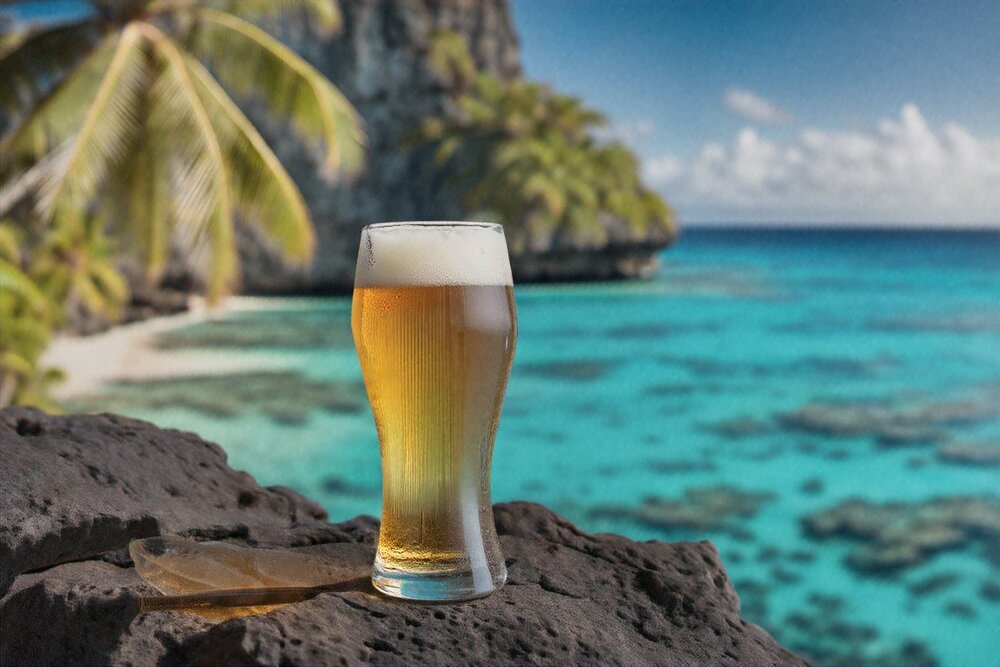
There is no Niuean brewery. What is drunk is New Zealand and Fijian beer — Steinlager, Vailima, Fiji Bitter — plus whatever the last ship brought. Alcohol is sold under licence, prices reflect shipping, and the island's drinking culture is a live social issue rather than a tourist attraction.
Where to drink
The Niue Yacht Club, which has no marina and no yachts most of the year and is the best bar on the island. The Washaway Café at Avatele, Sundays only, self-service, honesty box, where you pour your own drink and write it on a slate — and which is, by common consent, the single most enjoyable institution in the country.
Water
Tap water comes from the freshwater lens under the island through boreholes, and it is generally safe in Alofi and treated in the main system; filtered or bottled is the safe default elsewhere. Niue is also trying to reduce imported plastic bottles, so a refillable bottle is both polite and practical.
🌍 Climate, Water and the Long Term
Being a high island in a rising sea
Counter-intuitively, Niue is less immediately threatened by sea-level rise than an atoll nation — it stands 20–60 m above the water and will not be inundated the way Tuvalu or Kiribati will. What threatens it is different: storms, the freshwater lens and the reef.
⚠️ The lens
The island's only fresh water is a body of rain floating on seawater inside the limestone. Over-extraction draws salt water up into it, drought thins it, and storm surge can contaminate it directly. There is no river, no dam and no alternative source, so Niue's water security is a single geological feature — and monitoring it is one of the government's most consequential technical jobs.
Cyclones
Rare and enormous when they come. Niue sits south of the main cyclone track and is hit perhaps once a decade or less, which means each event is generational — Ofa in 1990, Heta in 2004 — and the island is not built for frequency. A warming ocean is expected to make the strongest storms stronger even where it does not make them commoner, which for Niue is precisely the wrong direction.
The reef
Niue's coral has so far come through the global bleaching events better than much of the western Pacific, helped by deep, clear, nutrient-poor water and by the near-total absence of land-based pollution. It is not immune, and the marine park's monitoring programme exists partly to catch the first sustained bleaching when it comes.
Waste
A recurring problem for an island with no landfill space, no recycling industry and a supply chain that arrives as packaging. Niue has pushed hard on reducing single-use plastic and asks visitors to take non-biodegradable waste away with them, which is a genuine request rather than a slogan.
What Niue says internationally
It signs the Paris Agreement in its own name, it argues in Pacific forums for the 1,5 °C target, and it has put its own money where its argument is by closing 40 % of its fishery. A country of 1 650 people has a negligible carbon footprint and no leverage; what it has instead is moral standing and a demonstrably better record than the countries lecturing it, and it uses that.
📰 Media, Information & Resources
What exists on the island
Broadcasting Corporation of Niue (BCN) — television and radio, and the primary news source for the island, with a website (tvniue.com) that is the place to find out what the Assembly actually did. The Niue Star is the newspaper, small and irregular. That is essentially the entire domestic media landscape, and it is a state broadcaster plus one paper in a country of 1 650 people.
Where the reporting comes from
RNZ Pacific (Radio New Zealand) is the single most useful outside source on Niue and on every other Pacific state — it has correspondents, it covers the Assembly, and its archive is free. ABC Pacific is the Australian equivalent. Islands Business and Pacific Islands Report carry the regional business and policy stories.
Official
gov.nu for government, niueisland.com for the tourism office — which is unusually honest and genuinely useful, including the tide tables you will need — and niueoceanwide.com for the marine park and the sponsorship scheme. Taoga Niue handles culture and language.
The free wifi, and its reality
Niue was the first country to offer free island-wide wifi, from the early 2000s, funded out of the .nu domain arrangement. It still exists and it is genuinely free. It is also, in 2026, slow by any modern standard — the island's connectivity depends on satellite capacity and a submarine cable connection has been a long-running discussion rather than a fact. Do not plan to work from Niue on the basis of the headline.
Reading
Terry Chapman and Margaret Pointer, Niue 1774–1974: 200 Years of Contact and Change, is the standard history. Margaret Pointer's Niue 1774–1974 and her work on the Niuean contingent in the First World War are the best single-subject books. For the hiapo, the Auckland Museum and Cambridge catalogues are where the scholarship is.
A caution
Almost everything written about Niue online is either tourism copy or a recycled list of "world's smallest country" facts, several of which are wrong — including the widely repeated claim that Niue is the world's smallest country, which it is not by area, population or any other measure. Check numbers against the Niue Statistics Office or RNZ rather than against listicles, including the ones that plainly copied each other.
💸 What It Actually Costs
Niue is expensive, and it is expensive for structural reasons that no amount of planning gets around: everything arrives by ship or on one weekly aircraft, and there is no competition in anything. The currency is the New Zealand dollar; at roughly NZ$1 ≈ 12,5 Kč in September 2026.
Beds
Self-catering units and guesthouses NZ$120–220 a night. The Scenic Matavai Resort, the island's only hotel of any size, NZ$250–400. Whole houses and villas for families NZ$250–500. There are a few hundred visitor beds on the entire island and in whale season they are all taken, so booking is not optional — you book accommodation before you book the flight.
Food
A café lunch NZ$15–25. Dinner at one of the restaurants NZ$30–50. Supermarket prices run roughly 1,5 to 2 times New Zealand's for anything imported, which is nearly everything. Fresh fish and local produce from the Tuesday and Friday market are the exception and are cheap and excellent.
The car
Unavoidable. There is no public transport and no taxi service to speak of. Hire runs NZ$55–90 a day, scooters less, and you need a Niuean driving licence — bought at the police station in Alofi for about NZ$25 on production of your home licence. It is a laminated card with your photo and it is the best souvenir on the island.
Activities
A whale-swim trip NZ$180–280. A two-tank dive NZ$200–260. Snorkel hire NZ$15–25 a day. Fishing charter NZ$500–900 for a half day. The chasms, caves, sea tracks and stargazing are all free, which is why a low-budget Niue trip is genuinely possible once you are there.
Daily budget
Self-catering in a unit, hire car shared between two, market food and free sea tracks: NZ$150–200 per person per day is realistic. Hotel, restaurants and a couple of paid activities: NZ$350–500. The flight is the dominant cost of the whole trip and everything else is secondary to it.
💳 Money
Bring cash. There is no ATM network in the sense you are used to — card acceptance has improved and the bank in Alofi can help, but multiple businesses are cash only, the connection drops, and the honesty-box economy is real. New Zealand dollars in cash, more than you think you need, brought with you from Auckland. This is the single most repeated piece of advice Niue's own tourism office gives.
🌡️ Climate & When to Go
⭐ The best window
May to October, the dry season: lighter winds, calmer sea, the clearest water, the least rain, temperatures around 21–27 °C, and — critically — the whales, from July to October. This is also when the sky is clearest for the Dark Sky Nation business. It is the obvious answer and it is right.
The wet season
November to April: hotter (24–30 °C), much more humid, heavy rain, bigger swell, more days when the crane cannot launch a boat and more tracks that are too slippery to use. It is also the cyclone season. The island is green and empty and cheaper, and a serious proportion of visitor days are lost to weather.
How much rain
About 2 000 mm a year, heavily concentrated in the wet months, and it arrives as short violent downpours rather than drizzle. The limestone drinks it instantly, so there is no mud and no standing water — five minutes after a downpour the rock is dry and you can walk again, which is one of the pleasant consequences of having no soil.
Tides, not weather
The thing that actually governs your day. The pools, reef flats, sea tracks, arches and most of the snorkelling are low-tide activities and are inaccessible or dangerous at high tide or in swell. Get the tide table from the tourism office on arrival and build every day around it.
Events to time
Constitution Day, 19 October and the week around it — the national celebration, and the busiest week of the year. The village show days, roughly March to August, one per village. Peniamina Day on 26 October. If you want the island quiet, avoid all of these; if you want to understand it, come for one.
What to pack
Reef shoes or old trainers you are prepared to destroy — the makatea will shred anything soft and walking the tracks barefoot is not an option. A dry bag. A torch for the caves. Reef-safe sunscreen. A rain shell. A refillable water bottle. And anything you specifically need, from medication to a particular brand of anything, because the supermarket will not have it and the next ship is not soon.
✈️ Getting There — One Flight a Week
⚠️ The flight
Air New Zealand, Auckland to Niue, and that is the entire list. Normally once a week on Saturdays, about 3½ hours; in high season a second weekly service runs on Tuesdays — as it does now, through to 19 October 2026, after which it reverts to Saturdays only. There is no other scheduled passenger service to the island from anywhere.
What that means
Your trip length is fixed in seven-day increments. If the aircraft goes technical you are there another week, and this happens. If you are connecting to Auckland the same day, you need a substantial buffer, because a missed Niue connection is not a missed flight, it is a missed week. Build the whole itinerary around the aircraft.
The date line trick
Niue is UTC−11 and Auckland is UTC+12 or +13. Flying out of Auckland you arrive before you left — the same calendar day, a few hours earlier — and flying back you lose a day. It confuses everybody and it is worth checking your onward bookings against it carefully.
Hanan Airport
IUE, on the plateau a few kilometres from Alofi. One runway, one small terminal, and it operates for one or two arrivals a week. Immigration and customs are quick, biosecurity is not — Niue takes it seriously, and food, seeds, soil and unclean hiking boots will be inspected, so declare everything.
Yachts
The other way in. The Niue Yacht Club maintains moorings off Alofi for visiting boats, and in the sailing season a modest number arrive. There is no harbour and no anchorage in a westerly, so the moorings are usable only when the weather is settled, which is much of the dry season and very little of the wet.
Getting around once there
One road, 64 km, around the edge; a few roads across the middle. Hire a car — there is no bus and effectively no taxi. Drive on the left, the speed limit is 60 km/h and 40 in villages, and everybody waves at everybody. Roads are sealed and empty; the hazards are pigs, dogs, crabs and the occasional pothole, and dark roads at night with no streetlights.
📋 Practical Information
Entry
Most Western nationalities — including EU citizens, the UK, the US, Canada, Australia and Japan — get a 30-day visitor permit on arrival with no visa. You need a passport valid six months, a confirmed onward ticket, confirmed accommodation and sufficient funds. Note that Niue's published waiver list is not identical to New Zealand's and does not name every EU state explicitly — confirm with Niue Immigration or your airline before booking if your nationality is not on it.
⚠️ Compulsory travel insurance
Unusual and enforced: all non-resident visitors must hold travel insurance for the full duration of their stay, and you may be asked for evidence. Given that a serious medical problem here means an air evacuation to New Zealand, this is a sensible rule rather than a bureaucratic one — and your policy must explicitly cover medical evacuation, plus diving and whale swimming if you intend to do them.
Health
No malaria, no dengue on the scale of Melanesia, no venomous land animals, and no vaccinations required beyond routine ones. The risks are the rock (cuts from makatea infect readily in the tropics — clean them properly and immediately), the sea (rips, swell on the reef flat, no lifeguards anywhere), and sun. Bring a proper first-aid kit and antiseptic.
Medical care
The Niue Foou Hospital in Alofi, rebuilt after Heta, handles primary care and stabilisation with a small staff. It is not a hospital in the sense of a European one — there is no surgeon on standby and no recompression chamber. Anything serious means evacuation to Auckland, which takes time and money and is why the insurance rule exists.
Day to day
Currency the New Zealand dollar. Power 240 V, 50 Hz, Australian/NZ three-pin plugs. Mobile coverage from Telecom Niue covers most of the island; roaming is expensive and a local SIM is cheap. Sunday is observed — shops closed, activities suspended, and noise near a church is genuinely rude. Tipping is not expected and is mildly awkward.
Etiquette that matters
Wave at every car. Ask before photographing people, and before entering a village's sea track area if anyone is around. Land is family-owned, including most of what looks like bush, so ask before wandering off a marked track. Dress modestly away from the water — this is a church-going island. And greet people: fakaalofa lahi atu, every time.
🇨🇿 For Czech Readers
Getting there from Prague
This is one of the harder places on earth to reach from Czechia and there is no way to make it short. Prague → Auckland is two or three flights — via Doha (Qatar), Dubai (Emirates), Singapore or Los Angeles — and takes 28–36 hours. Then Auckland → Niue, 3½ hours, on Saturdays only for most of the year. Realistically you fly to Auckland, spend at least a night there, and take the weekly flight out.
What it costs from Prague
Return Prague–Auckland typically 35 000–55 000 Kč depending on season; the Auckland–Niue return adds roughly NZ$700–1 100, about 9 000–14 000 Kč. On the ground, at about NZ$1 ≈ 12,5 Kč: a café lunch 190–310 Kč, a night in a self-catering unit 1 500–2 750 Kč, a hire car 700–1 100 Kč a day, a whale swim 2 250–3 500 Kč. Budget 90 000–130 000 Kč per person for a two-week trip including flights.
Entry for Czechs
Czech citizens travelling as tourists normally receive the 30-day visitor permit on arrival, with passport valid six months, confirmed onward ticket and confirmed accommodation. But check before you book: the lists Niue publishes are drawn from New Zealand's visa-waiver arrangements and do not always name Czechia explicitly, and the airline will ask at check-in in Auckland. Confirm with Niue Immigration or with Air New Zealand rather than relying on a travel blog.
⚠️ Insurance is compulsory, and check the exclusions
Niue requires visitors to hold travel insurance for the whole stay. Ordinary Czech policies routinely exclude diving, swimming with marine mammals and sometimes hiking on unmarked terrain — which between them cover most of what people come here to do. Buy the adventure rider, and make sure medical repatriation from the South Pacific is covered without a cap that a transfer to Auckland would break.
Consular help
There is no Czech mission anywhere near Niue. Czech consular coverage for New Zealand runs through the embassy in Canberra with honorary consulates in New Zealand; verify the current accreditation on mzv.gov.cz, since Pacific coverage is periodically reorganised. Register the trip in DROZD, and note the EU rule that lets a Czech citizen approach any EU member state's embassy where Czechia has none — in practice that means Wellington or Canberra.
Practical Czech notes
The 24-hour time difference means Niue is 11–12 hours behind Prague and a calendar day behind — check what day it is before calling home. Bring New Zealand dollars in cash from Auckland; there is no reliable way to get money on Niue. Your Czech driving licence gets you the local one at the police station. And accept that the flight schedule, not your plan, decides how long you stay.
✍️ Author's Note — Ten Photographs, Seven of Them Food, None of the Food Right
Every page in this collection is built after an inventory of what images actually exist for the country. Niue has ten. Three are usable and all seven food photographs are wrong — which is the worst food result this project has recorded, worse than Nicaragua's zero of four simply because there are more of them.
⚠️ The wrong crab, and it matters here
niue-uga.jpg shows an ordinary marine swimming crab with a broad flat carapace. Uga is the coconut crab, Birgus latro — the largest land arthropod on earth, a terrestrial hermit crab with a long segmented abdomen, enormous asymmetric claws and blue-to-orange colouring, which climbs trees and cracks coconuts. It is Niue's national delicacy, its conservation emblem and the thing on half the tourism material. This is the same category of error as the New Zealand "crayfish" with pincer claws, and here it lands on the single most identifying animal in the country.
Takihi with meat in it
niue-takihi.jpg is grilled meat in a banana-leaf parcel. Takihi is a baked gratin of sliced taro and pawpaw in coconut cream, with no meat at all — it is a starch dish and the alternating layers are the whole point. Not a variation; a different food group.
Ota ika, cooked
niue-ota-ika.jpg shows seared fish fillets with grill marks. Ota ika is raw fish cured in citrus and dressed with coconut cream. Applying heat is the one thing that makes it not the dish. This is the third time in five countries that the technique, not the ingredient, is what the image gets wrong.
🔍 A dish that may not exist
niue-loku.jpg is a salt-rimmed cocktail on a beach with a bee in the frame. Beyond being a generic tropical drink, "loku" is a dish name this project could not verify in Niuean cuisine at all — it appears on no menu, in no cookbook and in no dictionary we could reach. A filename may be naming nothing, which is a failure mode worth logging: not a wrong picture of a real dish, but a picture of nothing attached to a word.
✅ The filler series, and the search pattern works
niue-niue-flatbread.jpg (Middle-Eastern griddled flatbread — there is no Niuean flatbread), niue-niue-sweet-treat.jpg (a European patisserie construction) and niue-traditional-niue-stew.jpg (a meat-and-pumpkin curry with rice) are the sixth, sixth and third confirmed instances of those series. Note the doubled slug, niue-niue-. The Niger entry proposed searching the bucket for <slug>-<slug>-* as a signature; Niue confirms it, and the pattern should now be treated as reliable.
🖼️ What was shown
Three images, all captioned with their problems. The hero, 01-hero.jpg, has limestone arches over clear water — right for Niue — and offshore stacks on the horizon, which Niue does not have. The old page's hero, kept and used in the coast section, is the best image of the ten and genuinely looks like Niue: undercut terrace, sea caves, reef flat, no beach. And coral-beer.jpg is used as atmosphere with no brand claimed, because nothing in it identifies one.
On the text. Two corrections to the page this replaces are worth stating. It dated Cyclone Heta to 2003; Heta struck Niue on 5–6 January 2004. And it claimed diving visibility of "100 m+"; the honest range is 50–80 m, which is still among the best on earth. Everything time-sensitive here was checked in September 2026: the population figure of about 1 650; the Air New Zealand schedule of two flights a week until 19 October 2026, reverting to Saturdays only; the March 2024 Stockholm ruling against Niue in the .nu case; the 28 August 2026 Realm of New Zealand leaders' meeting in Auckland; and the marine park's sponsorship scheme, which by January 2026 was reported to be earning Niue millions, with Germany supplying the most sponsors and the Bezos Earth Fund US$4 million.
Support This Project 🌍
This World Travel Factbook is a labor of love – free to use for all travelers. If you find it helpful, consider supporting its continued development.