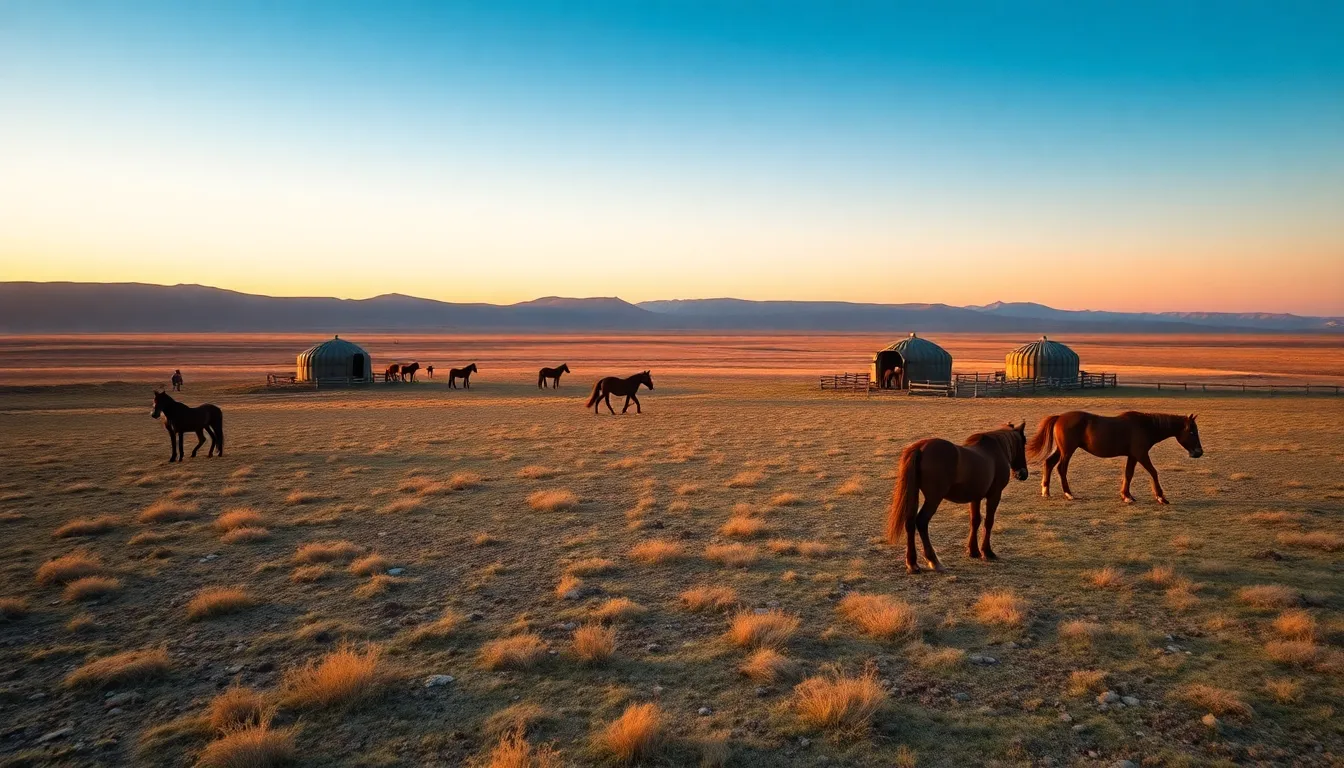


🇲🇳 Mongolia at a Glance
🌍 Overview — Space, and Not Much Else
Mongolia is 1,564,116 km² — nearly twenty times the Czech Republic, the size of Western Europe — with about 3.5 million people. That works out at roughly two people per square kilometre, the lowest population density of any sovereign state on earth. Half of those people live in one city.
It is also landlocked between exactly two neighbours, Russia and China, and has no third land border. Every road, railway, pipeline and export tonne must cross one of them. Understanding Mongolia means understanding what a country does when its entire external life runs through two doors.
Where it is
Between Russia to the north and China to the south, with 8,220 km of border and nothing else. It is one of the most landlocked countries in the world — the nearest ocean is roughly 1,700 km away across Chinese territory. Ulaanbaatar sits at about 1,300 m above sea level.
What it looks like
Three broad bands: mountain and forest in the north and west (Altai, Khangai, Khentii), steppe across the centre, and the Gobi covering roughly the southern third. The highest point is Khüiten Peak, 4,374 m, in the far west where Mongolia, Russia and China nearly meet.
Who lives there
About 3.5 million people, of whom roughly 1.6 million — close to half — live in Ulaanbaatar. Ethnic Mongols are around 95%, with Kazakhs the largest minority, concentrated in the far-western province of Bayan-Ölgii. Something like a quarter of the population still practises some form of mobile herding.
The livestock
Mongolia has around 60–70 million head of livestock — sheep, goats, cattle, horses and camels — which is something like twenty animals per person. The herd is the country's oldest economy, its social safety net and, since the goat boom for cashmere, a growing source of overgrazing and dust.
How it is governed
A semi-presidential parliamentary republic since the peaceful democratic revolution of 1990. President Ukhnaagiin Khürelsükh was elected in 2021 for a single six-year term. The State Great Khural was enlarged to 126 seats for the 2024 election. Government has been turbulent: three prime ministers between June 2025 and March 2026.
2026 in one line
Nyam-Osoryn Uchral has been prime minister since 30 March 2026, running an economic liberalisation programme called Unlock Mongolia; the economy is growing around 5% on coal and copper; official documents have been written in two alphabets since January 2025; and Ulaanbaatar was again among the ten most polluted cities on earth this winter.
🏷️ The Name, the Language and the Two Alphabets
The name
Mongol is attested from the eighth century as the name of one tribe among many on the plateau; Chinggis Khaan made it the name of the confederation he forged in 1206 and thereby of a people. The country calls itself Mongol Uls, "the Mongol State". Outer Mongolia is a Chinese administrative term from the Qing period and Mongolians do not use it of themselves.
Inner Mongolia is not this country
The Inner Mongolia Autonomous Region is part of China and has roughly four million ethnic Mongols — more than the independent state does. It uses the traditional vertical script, which independent Mongolia abandoned in the 1940s. Confusing the two is the single most common error in writing about Mongolia.
The language
Mongolian, a Mongolic language with vowel harmony, seven cases and a great deal of morphology, unrelated to Chinese and only distantly comparable to Turkic. The Khalkha dialect is the standard. Kazakh is spoken in the west, Russian is still widely understood by people over forty, and English is the foreign language of choice for the young.
Cyrillic, and why
Mongolia adopted the Cyrillic alphabet in the 1940s under Soviet influence, adding two letters — Ө and Ү — for vowels Russian does not have. Literacy is over 98%, and Cyrillic is what almost everyone actually reads and writes. Czech visitors who know any Cyrillic will find signs surprisingly navigable.
The traditional script returns
Mongol bichig — the vertical script written top to bottom, adapted from Uyghur in about 1204 — is being brought back. Since 2 January 2025 state and local government documents are issued in both scripts: ID cards, birth certificates, diplomas. The declared aim is full restoration by 2030, and it is as much an act of de-Sovietisation as of linguistics.
Names
Mongolians do not use family names in the European sense. A person carries a given name and a patronymic — the father's name in the genitive, usually abbreviated to an initial in front. So N. Uchral is Uchral, son of Nyam-Osor. Clan names (ovog) were abolished in 1925 and restored in 1997, but most people are still addressed by their given name alone.
🗺️ The Shape of the Country
The scale problem
Mongolia is 2,400 km wide and around 1,260 km deep. Driving from Ulaanbaatar to the western province of Bayan-Ölgii takes several days on roads that are frequently just tracks. Nothing in Mongolia is nearby. Any itinerary that treats it like a European country will fail.
The mountains
The Altai in the far west, glaciated and above 4,000 m; the Khangai in the centre, older, rounder and the source of most of the rivers; and the Khentii in the north-east, forested, and containing Burkhan Khaldun — the sacred mountain of the Chinggisid dynasty and a UNESCO World Heritage site.
The steppe
The great central band of grassland, treeless, rolling and effectively unfenced. This is the landscape that shaped everything — the horse culture, the mobile household, the empire. It is not flat: it undulates for hundreds of kilometres and the horizon is always further away than it looks.
The water
Rivers drain three ways: north to the Arctic via the Selenge, east to the Pacific via the Kherlen and Onon, and inward into closed basins that evaporate. Lake Khuvsgul in the north holds around 70% of Mongolia's fresh water and is 262 m deep, part of the same rift system as Baikal. Uvs Nuur in the west is a salt lake and a World Heritage site.
Land without fences
Roughly 70% of Mongolia's land is legally pasture held in common, and outside the towns there is essentially no private land ownership of rangeland. This is why you can drive across the country more or less anywhere, and why overgrazing is such a hard problem: nobody owns the grass.
Six World Heritage sites
The Uvs Nuur Basin, the Orkhon Valley Cultural Landscape (the imperial heartland, including Kharkhorin), the Petroglyphic Complexes of the Mongolian Altai, Great Burkhan Khaldun Mountain, the Landscapes of Dauria, and the Deer Stone Monuments, inscribed in 2023. Five of the six are landscapes rather than buildings, which tells you what this country's heritage is made of.
🏜️ The Gobi — Not the Desert You Are Picturing
The Gobi covers roughly the southern third of Mongolia and extends deep into China — around 1.3 million km² in total, the fifth-largest desert in the world. Almost none of it is sand.
What it actually is
Cold, rocky steppe-desert: gravel plains, low bare ranges, dry riverbeds and enough sparse grass to graze camels and goats on. It is a rain-shadow desert — the Himalaya blocks the monsoon — and it gets around 50–200 mm of rain a year. Sand dunes make up only about 3% of it.
Khongoryn Els
The exception, and the reason the sand-dune image exists. The "Singing Sands" in Gurvansaikhan National Park run for about 180 km, reach 300 m high, and hum audibly when the sand slips. Climbing one at sunset is hard work and the single most-photographed thing in the Gobi.
Bayanzag — the Flaming Cliffs
Red sandstone cliffs where Roy Chapman Andrews found the first scientifically recognised dinosaur eggs in 1923. The Gobi remains one of the richest dinosaur fossil regions on earth — Velociraptor, Protoceratops, Oviraptor and Tarbosaurus all come from here, and the Fighting Dinosaurs specimen is a Mongolian national treasure.
Yolyn Am
A narrow gorge in the Gurvansaikhan mountains that holds a sheet of ice deep into summer — a genuinely strange thing to walk into after a day of desert heat, though in recent warm years the ice has often gone by July. Also good for lammergeier and ibex.
The temperature range
The Gobi swings from around +40 °C in July to −30 °C in January, and from day to night by 20 degrees or more in the same 24 hours. Anyone coming for the desert should pack for winter as well as summer; this is the most common packing mistake visitors make.
The wildlife
The Gobi bear (mazaalai) is the only desert-dwelling bear in the world and fewer than about forty survive, all here. The region also holds wild Bactrian camels, khulan (Asiatic wild ass), goitered gazelle and snow leopards in the higher ranges.
📜 From the Xiongnu to 1990
Before the Mongols
The plateau produced steppe confederations for two thousand years before Chinggis: the Xiongnu from the third century BC, then Xianbei, Rouran, the Turkic Khaganates — whose eighth-century Orkhon inscriptions are the oldest known Turkic writing — and the Uyghurs and Khitans. Mongolia is the hearth of Inner Asian empire, not a latecomer to it.
1206
Temüjin unified the tribes and was proclaimed Chinggis Khaan at a kurultai on the Onon river. Within seventy years his descendants ruled from Korea to Hungary and from Siberia to the Persian Gulf — the largest contiguous land empire in history. Kharkhorin was founded as its capital in 1235 by his son Ögedei.
The long eclipse
The empire fragmented; the Yuan dynasty fell in 1368 and the Mongols retreated to the steppe. Tibetan Buddhism arrived in force in the sixteenth century and reshaped the culture. From 1691 Mongolia was under Qing rule for over two centuries, during which a very large share of the male population entered monasteries — by 1920 there were hundreds of monasteries and perhaps a third of men were monks.
1911 and 1921
Mongolia declared independence when the Qing fell in 1911 under the Bogd Khan, a Buddhist theocrat. After a decade of Chinese reoccupation, White Russian invasion and civil war, the 1921 revolution with Soviet help produced the Mongolian People's Republic in 1924 — the world's second communist state after the USSR.
The purges
Between 1937 and 1939, under Khorloogiin Choibalsan and on Moscow's model, Mongolia destroyed almost its entire monastic system and killed something on the order of 30,000–35,000 people, a large proportion of them lamas. Nearly every monastery in the country was demolished. This is the single most consequential event of twentieth-century Mongolia and it is why Erdene Zuu is a rarity rather than a norm.
1990
In the winter of 1989–90 demonstrations and a hunger strike on Sükhbaatar Square brought the Politburo down without a shot being fired. Multi-party elections followed in 1990 and a new constitution in 1992. Mongolia's transition was one of the few in the former Soviet bloc that has remained democratic without interruption — an achievement it does not get enough credit for.
🐎 Chinggis Khaan — the National Foundation
You cannot spend a day in Mongolia without meeting him. He is on the banknotes, the airport, the vodka, the beer, the main square and a 40-metre stainless-steel horse an hour east of the capital. Under communism his name was effectively suppressed; since 1990 he has become the organising figure of national identity.
The record
Born around 1162 as Temüjin, he unified the steppe tribes by 1206 and campaigned against the Jin, the Khwarazmian empire and the Tangut until his death in 1227. Estimates of the death toll of the Mongol conquests run into the tens of millions, and cities such as Nishapur, Merv and Urgench were annihilated. This is not a subject on which to be sentimental in either direction.
What he also did
Imposed a written law code (the Yassa), created the Yam relay post system that moved messages across a continent, granted religious tolerance across the empire, promoted on merit rather than birth, and adopted the Uyghur script for Mongolian. The Pax Mongolica that followed moved goods, technologies and plague along the Silk Road for a century.
The unmarked grave
He was buried in secret, probably somewhere near Burkhan Khaldun in the Khentii mountains, and the location has never been found — by tradition the burial party was killed and the ground trampled by horses. The area is protected, sacred, and searching it is a sensitive matter. Do not expect a tomb; there isn't one.
The statue
At Tsonjin Boldog, about 54 km east of Ulaanbaatar, a 40-metre stainless-steel Chinggis on horseback stands on a drum of columns, with a lift and a viewing platform in the horse's head. It was completed in 2008 and it is simultaneously magnificent, absurd and completely sincere.
The museum
The Chinggis Khaan National Museum opened in Ulaanbaatar in 2022 — eight floors covering the Xiongnu through to the twentieth century, well curated and with English labelling. It is now the best single introduction to Mongolian history anywhere and should be the first stop of any visit.
The DNA claim
You will read that around 0.5% of men alive today descend from Chinggis Khaan. The underlying 2003 study found a Y-chromosome lineage common in a swathe of Asia and dated it to roughly his era; the attribution to him personally is an inference, not a demonstration, and geneticists have argued about it ever since. Treat it as a striking hypothesis, not a fact.
🏛️ Politics — A Democracy That Keeps Changing Prime Ministers
Mongolia is the one post-Soviet Asian state that became a durable democracy and has stayed one. Power has changed hands repeatedly at the ballot box since 1990, the press is free, and protests bring governments down. The cost of that openness is chronic instability at the top: three prime ministers between June 2025 and March 2026.
The system
A semi-presidential republic. The directly elected President — Ukhnaagiin Khürelsükh since 2021, on a single six-year term under the 2019 amendments — has powers over foreign policy, the judiciary and vetoes. The State Great Khural holds legislative power and elects the prime minister.
The 2024 election
The Khural was enlarged from 76 to 126 seats and a partly proportional system introduced, deliberately to broaden representation. The Mongolian People's Party (MPP) kept a majority but lost ground; the Democratic Party and the smaller HUN and Civil Will–Green parties gained. A broad coalition followed.
June 2025 — the streets
Sustained youth-led protests over corruption, triggered by reporting on the lavish spending of the prime minister's family, brought down Luvsannamsrain Oyun-Erdene, who lost a confidence vote and resigned. It was a striking demonstration that Mongolian street politics still works — and that coal money and public patience are on a collision course.
Zandanshatar, then Uchral
Gombojavyn Zandanshatar was confirmed on 12 June 2025 at the head of a coalition holding 80 of 126 seats. He resigned on 27 March 2026 citing parliamentary deadlock. Nyam-Osoryn Uchral, chairman of the MPP, was elected the 35th prime minister on 30 March 2026 by 88 votes to 19.
Unlock Mongolia
Uchral's programme is explicitly deregulatory: tax relief of the order of ₮3.1 trillion, lifting restrictions on foreign investment, reforming state-owned enterprises so they stop competing with private firms, and renewable-energy auctions. In its first hundred days the government reported cancelling 9,376 planned business inspections and digitising 321 permits.
The permanent problem
Corruption, and specifically the leakage of coal revenue. The 2022 "coal theft" scandal — missing export shipments worth billions — put people on the square in winter and has never been fully resolved. Every Mongolian government since has been judged, fairly or not, against it.
💼 The Economy — Dug Out of the Ground
The shape of it
Mining is roughly a quarter of GDP and the overwhelming majority of exports; agriculture — meaning livestock — is around a tenth of output but employs a far larger share of people. Services and construction fill the rest. GDP growth is projected at around 5% for 2026 after a strong 2025.
Coal
The single biggest export. The government projects around 90 million tonnes in 2026 at an average of roughly $70 a tonne — some $6.3 billion of proceeds. Almost all of it is coking coal for Chinese steel, moving south by truck and now increasingly by rail through the Gashuunsukhait crossing.
Copper
Oyu Tolgoi in the South Gobi is the other pillar (see below), alongside the Soviet-era Erdenet mine in the north. Copper is the commodity Mongolia is betting its next twenty years on, and the bet is reasonable: electrification needs copper and Oyu Tolgoi has a great deal of it.
Cashmere
Mongolia produces around 40% of the world's raw cashmere and is second only to China. The problem is that most of it leaves unprocessed, capturing little value, and that the goat herds needed to produce it are hard on the grassland — goats crop closer than sheep and pull at the roots. It is a genuine conflict between income and land.
The vulnerability
Everything depends on one buyer and one commodity price. When Chinese steel demand falls, or a border crossing closes — as happened repeatedly during China's zero-Covid years — the state budget goes with it. Mongolia has built a sovereign wealth fund framework precisely to smooth this, and the argument about how to spend it is central to its politics.
Inflation and debt
Inflation has been persistently elevated, external debt is substantial, and the tugrik is soft. Meanwhile GDP per head is roughly $6,500–7,000 — middle-income on paper, with a large informal economy and a visible gap between the mining-adjacent professional class in Ulaanbaatar and the ger districts on the hillsides above them.
⛏️ Oyu Tolgoi — the Mine That Defines the Country
Oyu Tolgoi ("Turquoise Hill") in the South Gobi, 80 km from the Chinese border, is one of the largest known copper and gold deposits on earth. It is also the longest-running argument in Mongolian public life.
The deal
Rio Tinto holds 66% and the Mongolian state 34%. The investment agreement was signed in 2009, and the terms — how much Mongolia would actually receive, how the state's share was financed, and how the underground expansion was costed — have been renegotiated, litigated and politically fought over ever since. A revised agreement in 2022 cancelled some $2.4 billion of state debt to the project.
The underground mine
Open-pit production began in 2013; underground production started in 2023, using block caving nearly 1.3 km below the surface. At full ramp-up the mine is expected to produce around 500,000 tonnes of copper a year, which would place it among the four largest copper mines in the world. That ramp-up runs through the late 2020s and into the 2030s.
What it means fiscally
At full production Oyu Tolgoi could contribute a very large share of Mongolian GDP and government revenue. That is the promise. The counter-argument, made loudly in Ulaanbaatar for fifteen years, is that the terms were struck when Mongolia had little negotiating experience and that the benefits arrive late and diluted.
Water and herders
The mine sits in a desert and uses a deep fossil aquifer, not surface water; Rio Tinto reports high recycling rates. Local herders have nonetheless brought grievances over wells, dust and displaced grazing routes, and some reached the World Bank's compliance mechanism. Whatever the technical record, the sense of a mine imposed on a landscape is real and politically potent.
Tavan Tolgoi
The other giant: one of the world's largest untapped coking coal deposits, also in the South Gobi. Its development has been slowed for over a decade by disputes over ownership, financing and the railway to move the coal. The Gashuunsukhait–Gantsmod cross-border rail link to China is the piece that changes the economics, and it is finally moving.
The wider picture
Mongolia is also prospecting for uranium, rare earths, fluorspar and gold, and the phrase heard constantly in Ulaanbaatar is "the next Oyu Tolgoi". Whether the country can turn geology into broad prosperity rather than a narrow rent is the question its whole political economy turns on.
🌏 Two Neighbours and a "Third Neighbour"
The dependency, in numbers
Something like 90% of Mongolia's exports go to China, and the great majority of its petroleum products come from Russia. There is no third route. This is not a policy choice that could be reversed; it is a fact of geography that every Mongolian government has to manage.
The "third neighbour" policy
Mongolia's answer since the 1990s: build deliberate political, security and cultural ties with countries that are not its neighbours — the United States, Japan, South Korea, the EU, India, Turkey — to create diplomatic room. It sends peacekeepers to UN missions, hosts the Khaan Quest multinational exercise, and courts investment from anywhere that is not Beijing or Moscow.
Neutrality in practice
Mongolia has kept a careful distance from the war in Ukraine, abstaining on key UN votes. In September 2024 it hosted Vladimir Putin despite being a party to the Rome Statute and an ICC arrest warrant being outstanding — and did not arrest him. The ICC found Mongolia in non-compliance. Ulaanbaatar's defence was, in essence, that it depends on Russia for fuel and electricity.
The pipeline question
The proposed Power of Siberia 2 gas line from Russia to China would cross Mongolia as the Soyuz Vostok section, carrying up to 50 bcm a year and paying transit fees. Gazprom and CNPC signed a memorandum in September 2025, but the project remains stalled short of a final investment decision over pricing and transit terms. Mongolia has been planning around it for years without being able to count on it.
The railway question
Mongolia's main line is Russian broad gauge, China's is standard gauge, and everything crossing the southern border must be transhipped. Building standard-gauge links to China speeds exports enormously and, in the view of some in Ulaanbaatar, ties the country more tightly to Beijing. The debate over gauge is not a technical one.
What Mongolia is actually good at
Being small, democratic and non-threatening between two great powers, and monetising that position carefully. It has no territorial disputes, no proxy entanglements and a genuinely liked international brand. For a landlocked state of 3.5 million between Russia and China, that is not a small achievement.
🏙️ Ulaanbaatar — Half the Country in One Valley
Roughly 1.6 million people — close to half of Mongolia — live in one city in a valley on the Tuul river at 1,300 m. It began as a mobile monastery that moved some twenty-nine times before settling here in 1778, was called Urga and then Niislel Khüree, and became Ulaanbaatar, "Red Hero", in 1924.
Sükhbaatar Square
The centre of the country: a large open square with the equestrian statue of Damdin Sükhbaatar, the 1921 revolutionary, and behind it the Government Palace with an enormous seated Chinggis Khaan added in 2006. It was briefly renamed Chinggis Square and then changed back — a small, revealing argument about which founder the country belongs to.
Gandantegchinlen
The great surviving monastery, and the seat of Mongolian Buddhism. Its centrepiece is the 26.5-metre gilded statue of Migjid Janraisig — a 1996 reconstruction, the 1911 original having been removed by Soviet forces in 1938 and, by most accounts, melted down. Morning chanting is open to visitors; go early and stay quiet.
The museums
The Chinggis Khaan National Museum (2022) is the best in the country and the right first stop. The National Museum of Mongolia covers prehistory to the democratic revolution. The Choijin Lama Temple Museum and the Winter Palace of the Bogd Khan are two of the few pre-purge religious buildings left standing, both worth an hour.
The ger districts
Around half of Ulaanbaatar's population lives in the ger khoroolol — unplanned districts on the surrounding hillsides, mixing gers and small houses, largely without piped water or central heating. They are the direct result of decades of migration off the land, accelerated by each dzud. Most residents heat with coal stoves.
The air
The consequence: in winter Ulaanbaatar has some of the worst air on earth. Temperature inversions trap coal smoke in the valley, and on 8 February 2026 the city was again in the world's ten most polluted, at an AQI of 204 — "very unhealthy". Raw coal was banned in the capital in 2019 and replaced with briquettes, which helped and did not solve it. If you have a respiratory condition, do not visit between November and February.
Getting around the city
Buses are cheap and use a stored-value card; taxis are informal — in practice any car may stop, and the going rate is negotiated per kilometre. Traffic is genuinely bad and there is a licence-plate restriction by day of the week. The new Chinggis Khaan International Airport (UBN), open since 2021, is about 52 km south, roughly an hour out.
🏞️ Out of the City — Where You Actually Go
Almost nobody comes to Mongolia for Ulaanbaatar. The country is the point, and seeing it means long days in a Russian van or a Land Cruiser with a driver who knows where the river crossings are. Distances below are from the capital.
Gorkhi-Terelj — 60 km
The easy escape: granite tors, larch forest and alpine meadow an hour and a half from the city, with Turtle Rock, the cliffside Aryabal meditation temple and a dense supply of tourist ger camps. It is the most visited place in the country and it is still beautiful, particularly in September.
Khustain Nuruu — 100 km
The national park where the takhi, Przewalski's horse, was reintroduced from zoo stock beginning in 1992 after going extinct in the wild. There are now several hundred in Mongolia. Sightings at dawn or dusk are reliable, and this is one of the genuinely great conservation stories anywhere.
Kharkhorin — 370 km
The site of Karakorum, Ögedei's imperial capital of 1235, of which almost nothing above ground survives — the stone was carted off to build Erdene Zuu monastery. The Orkhon Valley around it is a World Heritage landscape and the historical heart of the country.
The Gobi — 550–700 km
Yolyn Am, the Flaming Cliffs at Bayanzag and the Khongoryn Els dunes are the standard circuit, usually flown to Dalanzadgad and driven from there, or driven the whole way in three long days. Camel riding, dinosaur country and the emptiest horizons you will ever stand in.
Khuvsgul — 780 km
The great northern lake, 136 km long and 262 m deep, ringed by forest and mountain, with the Tsaatan reindeer-herding Dukha people in the taiga beyond it. Beautiful, cold, and a serious drive; most visitors fly to Mörön. Visiting the Tsaatan requires care and a responsible operator — this is not a photo opportunity.
Bayan-Ölgii — 1,600 km
The far west: glaciated Altai, Tavan Bogd and Khüiten peak, and Mongolia's Kazakh province, where eagle hunting with golden eagles is a living tradition. The Golden Eagle Festival in early October is the reason most foreigners come. Fly — driving takes days.
☸️ Buddhism, and What Survived
Mongolia is historically a Tibetan Buddhist country of the Gelug school. Before 1937 it had, by most counts, several hundred monasteries and something like a third of adult men in monastic robes. Within three years almost all of it was gone.
Erdene Zuu
Founded in 1585 at Kharkhorin, partly from the stones of the imperial capital, and enclosed by a wall of 108 stupas. It once held over sixty temples; the purges left three. It is the oldest surviving Buddhist monastery in Mongolia and, with the Orkhon Valley around it, the single most historically loaded place in the country.
Amarbayasgalant
Built 1727–1736 by the Qing Kangxi and Yongzheng emperors to house the remains of Zanabazar, in a Chinese-influenced style, in a remote valley in the north. It escaped the worst of the destruction and about a third of the complex survives. It is the most beautiful monastery in Mongolia and gets a fraction of Erdene Zuu's visitors.
Zanabazar
The first Bogd Gegeen (1635–1723), head of Mongolian Buddhism, and one of Asia's great sculptors. His gilt-bronze Tara and Dhyani Buddha figures are in the Zanabazar Museum of Fine Arts in Ulaanbaatar and are worth the trip on their own. He also designed the Soyombo symbol that sits on the national flag.
Tövkhön
Zanabazar's hermitage, on a wooded ridge above the Orkhon valley at 2,300 m, reached by a stiff walk up. Small, still functioning, and the one monastic site that gives a real sense of what the retreat tradition looked like. Part of the Orkhon World Heritage inscription.
Shamanism
Never fully displaced by Buddhism and openly practised again since 1990. Ovoo — cairns of stones, wood and blue khadag scarves at passes and summits — are everywhere, and the custom is to walk round one three times clockwise, adding a stone. Do it; it costs nothing and it is genuinely appreciated.
Where Buddhism is now
Roughly half the population identifies as Buddhist, with a large non-religious share, small Muslim (mostly Kazakh) and Christian minorities, and a visible shamanic revival. Monastic numbers are a fraction of the pre-purge figure, and reconstruction has been slow, underfunded and mostly local. What you are seeing at any Mongolian monastery is a survivor, not a norm.
🏹 Naadam — the Three Manly Games
Naadam is held nationwide on 11–13 July, tied to the anniversary of the 1921 revolution but far older in substance. It consists of the eriin gurvan naadam — wrestling, horse racing and archery — and it is on the UNESCO list of intangible cultural heritage.
Wrestling
Bökh has no weight classes and no time limit: you lose when anything above your knee touches the ground. Competitors wear the open-fronted zodog jacket and shuudag shorts, and winners perform the eagle dance around the flagpole. Titles — Falcon, Elephant, Lion, Titan — are earned by rounds won and are held for life.
Horse racing
Not a track sport. Races are run cross-country over 15 to 30 km, by age class of horse, and the jockeys are children, typically aged five to twelve, riding bareback or nearly so. It is the emotional centre of Naadam and also its most criticised element; child-jockey safety rules have been tightened repeatedly, and the debate inside Mongolia is real.
Archery
Men, women and mixed teams shoot at a wall of small woven cylinders (sur) laid on the ground at 65–75 m, and judges standing beside the target sing the score in a traditional call. The bow is the composite recurve that made the empire possible.
The fourth game
Shagai — anklebone shooting — is now included: competitors flick a polished piece of bone down a wooden channel to knock a target off a board several metres away, in teams, with singing. It looks trivial and is astonishingly difficult.
Where to see it
The National Stadium in Ulaanbaatar has the biggest and most formal version, with an opening ceremony worth seeing and tickets that need arranging well in advance. But provincial Naadams — held in most sums and aimags across July, often on slightly different dates — are smaller, warmer, cheaper and much closer to the thing itself. If you can get to one, do.
Practicalities
Naadam week is the single busiest period of the Mongolian year: flights, drivers, guides and ger camps sell out months ahead and prices rise sharply. Book by February or March for July. And note that most of the country stops working — plan no administrative business for those three days.
⛺ The Ger, the Herd and How to Behave in Someone's Home
Around a quarter of Mongolians still practise some form of mobile pastoralism, moving between seasonal pastures with the five snouts — sheep, goats, cattle or yaks, horses and camels. Most visitors will be invited into a ger at some point, and there are rules.
How a ger works
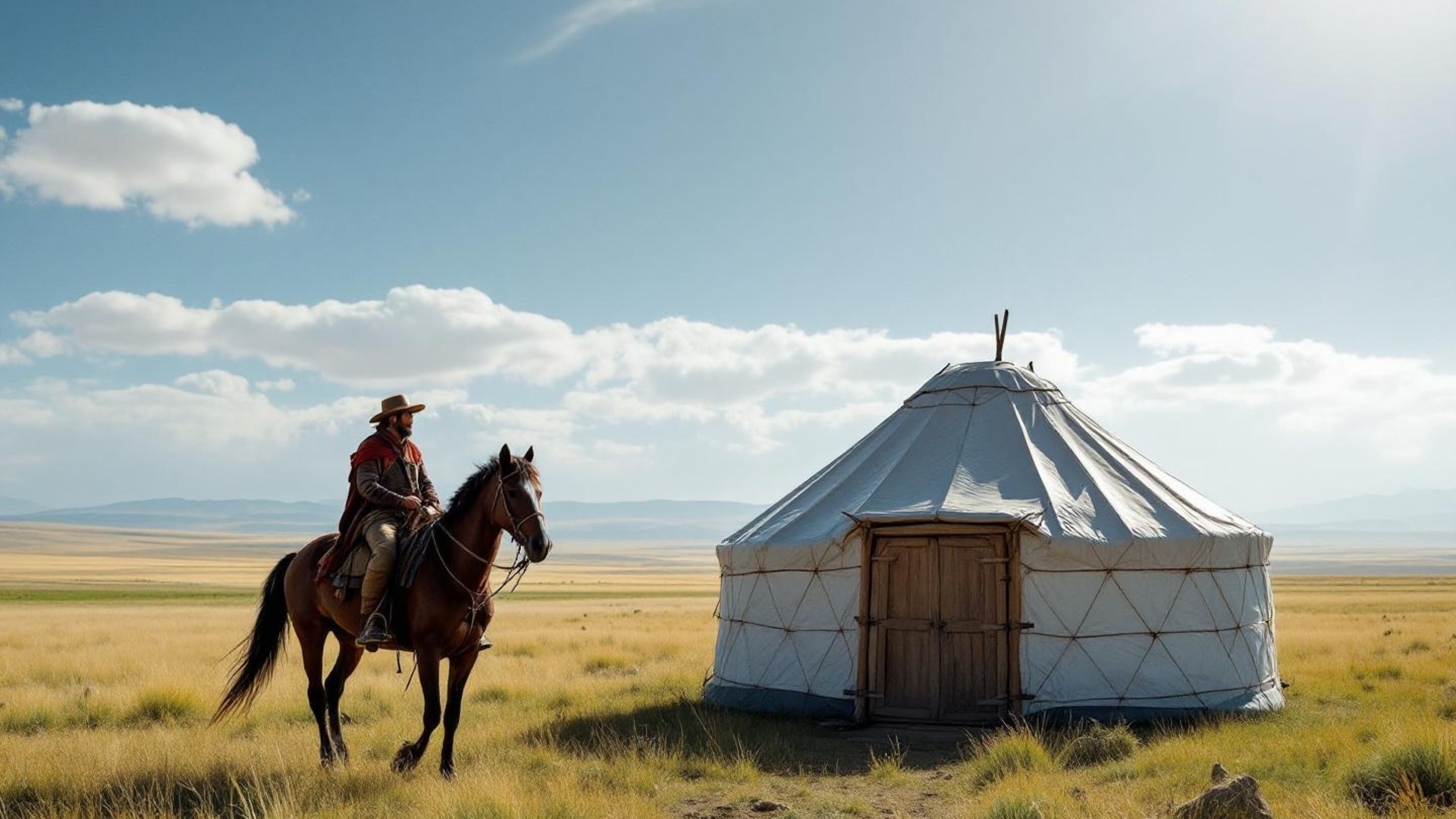
A lattice wall (khana) in sections, roof poles (uni) radiating to a crown ring (toono) that lets smoke out and light in, wrapped in felt and canvas and roped down. Two people can put one up in about an hour. The door always faces south; the north side opposite it is the honoured place, where the family altar and guests sit.
Entering
Never step on the threshold — it is a serious offence, not a superstition. Move clockwise inside. Traditionally men move to the west side, women to the east. Do not lean on the roof poles or the central columns, and do not point your feet at the stove or the altar.
Accepting things
Take anything offered with the right hand, supporting the right elbow with the left hand. You will be given salted milk tea (suutei tsai) and probably dried curd; take at least a sip and a taste, even if you leave the rest. Refusing outright is rude in a way that is hard to undo.
The snuff bottle
An older host may offer a small ornate bottle of snuff. Take it with the right hand, open it or take the stopper partly out, sniff or simply raise it, and return it the same way, right hand, with a slight bow. You are not obliged to actually inhale.
Moving
Herders typically move two to four times a year between seasonal camps, and further in an otor — a long-distance move in search of grass during drought or after a dzud. A full move loads a household onto a truck or a few camels in a morning. The mobility is not romantic; it is a technology for surviving a climate that kills.
What is changing
Motorbikes have largely replaced horses for herding; solar panels and satellite dishes are standard; children board at sum-centre schools in winter. The number of herding households falls after each bad winter and the cities absorb them. Mongolian pastoralism is not a museum piece — it is a working system under real pressure.
🐆 Wildlife — and the Marmot Warning
Przewalski's horse
The takhi is the only never-domesticated horse left on earth. It was extinct in the wild by the 1960s; reintroduction from zoo populations began at Khustain Nuruu in 1992 and now continues at Great Gobi B and Khomiin Tal. Several hundred run free in Mongolia today. Czech readers may note that Prague Zoo kept the international studbook and has flown horses to Mongolia for decades.
Snow leopards
Mongolia holds the second-largest population in the world, on the order of a thousand animals, mostly in the Altai and the Gobi ranges. You will not see one. Community conservation programmes that pay herders for livestock losses instead of allowing retaliation killing have measurably worked here.
The Gobi bear
Mazaalai, the only bear living in a desert, is down to roughly forty individuals in the Great Gobi Strictly Protected Area — one of the rarest large mammals on earth. It is a national emblem and the subject of a supplementary feeding programme that is, essentially, life support.
The rest
Argali (the world's largest wild sheep), ibex, khulan, goitered gazelle, huge summer flocks of demoiselle cranes, Pallas's cat (the manul, which is Mongolian and has a well-deserved internet career), corsac fox, wolves in real numbers, and the saiga's Mongolian subspecies in the west.
The marmot warning — read this
Tarvaga, the Siberian marmot, is a traditional food and a genuine reservoir of bubonic plague. Cases occur most years, usually from hunting, skinning or eating marmots, and they periodically trigger local quarantines that close whole provinces to travel at no notice. Do not handle, buy or eat marmot, and check for quarantine notices before travelling in summer.
Livestock and dogs
The dogs at a ger are working guard animals and can be serious. Never approach a ger on foot without calling out — the traditional shout is nokhoi khor, "hold the dog" — and wait for someone to come out. Rabies exists in Mongolia; a pre-exposure vaccination is worth discussing with a travel clinic if you plan long rural stays.
🎭 Culture — Sound, Cloth and a Lunar New Year
Khöömii
Throat singing: producing a low drone and a whistling overtone melody simultaneously, by shaping the vocal tract. It is on the UNESCO intangible heritage list, it is genuinely difficult, and hearing it live in a ger rather than on a recording is one of the things that justifies the trip. The band The Hu has taken a rock version of it round the world.
The morin khuur
The horsehead fiddle: two horsehair strings, a trapezoidal box and a carved horse's head on the scroll. It is the national instrument, also UNESCO-listed, and traditionally a ger was supposed to have one. The repertoire imitates horses — gaits, whinnies, the sound of a herd moving — with disconcerting accuracy.
The long song
Urtiin duu: not long in duration but in the extraordinary extension of each syllable across an unmetred, highly ornamented line. It is sung about landscape, horses and parting, and it is the most demanding vocal tradition in the country. Also UNESCO-listed, jointly with China.
The deel
The wrapped, side-fastened coat with a bright silk sash, worn over trousers and boots. It is not a costume — plenty of people wear it daily in the countryside, and almost everyone owns one for Tsagaan Sar and Naadam. Winter deels are lined with sheepskin and are, in a −35 °C wind, self-evidently the correct technology.
Tsagaan Sar
The lunar new year, in late January or February, and the biggest family occasion of the year. Households make hundreds and sometimes thousands of buuz in advance, build a tower of ul boov biscuits in an odd number of layers, and visit relatives in strict order of seniority, greeting elders with both arms extended under theirs. If you are invited, go — and eat.
Contortion and the circus
Mongolian contortionism (uran nugaralt) is a genuine national art form with a serious training tradition, and Mongolian performers are disproportionately represented in circuses worldwide. Ulaanbaatar's State Circus and various folk-performance evenings show it alongside khöömii and morin khuur.
🍽️ Meat, Milk, Flour — and Almost No Vegetables
Mongolian cooking is the food of a cold, dry, mobile, pastoral society, and it makes complete sense on those terms: meat (mutton above all), dairy — the tsagaan idee or "white food" — and wheat flour. Vegetables were historically almost absent and spices nearly so. If you are vegetarian, read the practical section carefully before you commit to a countryside trip.
Buuz
Steamed mutton dumplings, and the national dish by consensus. Minced or hand-chopped mutton with onion, garlic and plenty of fat, wrapped and steamed. They are eaten by the dozen and, at Tsagaan Sar, by the hundred. Recipe below.
Khuushuur
The fried sibling: the same filling in a flat disc of dough, sealed and deep-fried into a crisp half-moon pie. It is the food of Naadam, sold from tents around every stadium and every provincial festival ground, and eaten hot in the hand. Recipe below.
Khorkhog and boodog
Festive cooking with fire-heated stones. Khorkhog is mutton sealed in a metal churn with hot river stones, water and a few vegetables and cooked over a fire. Boodog is a goat or marmot cooked inside its own skin with the stones packed in. Never eat marmot boodog — see the plague warning in the wildlife section.
The white food
Dairy is a whole cuisine of its own: aaruul (rock-hard dried curd, ubiquitous and an acquired taste), öröm (a thick clotted cream skimmed from boiled milk, and genuinely superb), byaslag (a pressed fresh cheese), yoghurt, and butter. Milk from all five species is used; mare's milk is only for airag.
Suutei tsai
Salted milk tea: brick tea, water, milk and salt, sometimes with a little fat or millet. It is the default drink in every household from morning to night, it will be pressed on you the moment you sit down, and Europeans usually need a few days before they stop finding it strange. Then most of them come round.
Eating in Ulaanbaatar
The capital is another matter: Korean and Japanese food is everywhere and good, there are decent Indian, Italian and Georgian restaurants, several craft breweries, and a genuine café culture. A good meal in a mid-range Ulaanbaatar restaurant runs ₮20,000–45,000; a canteen plate of tsuivan is well under ₮10,000.
👨🍳 Two Mongolian Recipes
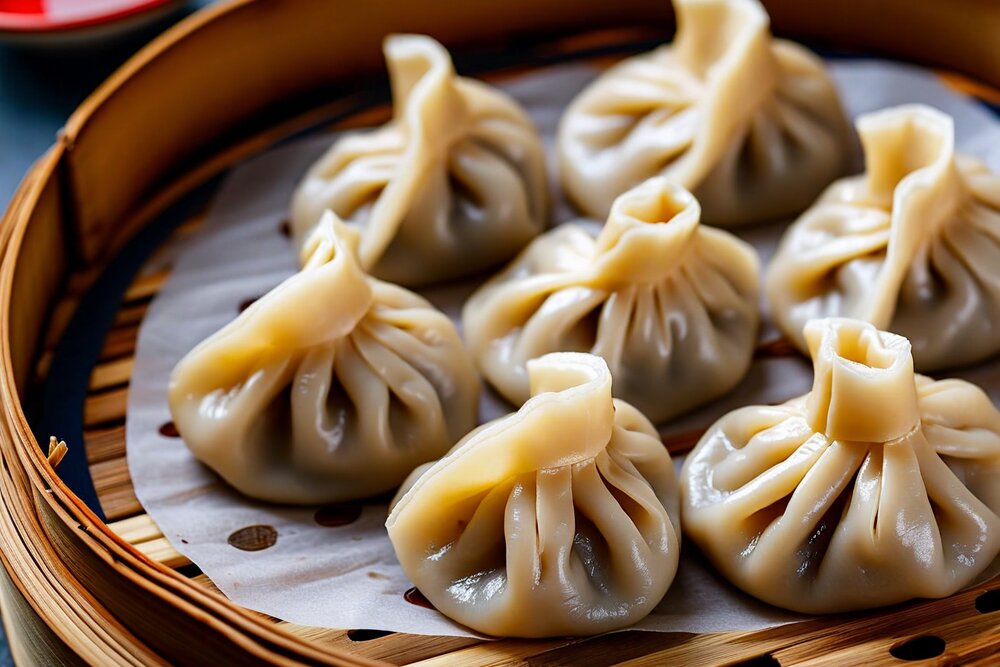
Buuz — Steamed Mongolian Mutton Dumplings
Makes about 30 · 1 hour · Steamed
Ingredients: Dough: 400 g plain flour, about 200 ml warm water, 1 tsp salt. Filling: 500 g fatty mutton or lamb shoulder (hand-chopped if you can face it, otherwise coarsely minced), 100 g mutton fat or suet, 1 large onion, 3 cloves garlic, 1 tsp salt, plenty of black pepper, about 60 ml cold water or light stock. Optional and slightly heretical: a little grated carrot or caraway.
Method: Make a firm dough with flour, salt and warm water, knead it well and rest it covered for 30 minutes. Chop the meat and the fat as finely as your patience allows — hand-chopped is noticeably better than minced — and mix with very finely diced onion, crushed garlic, salt and a great deal of pepper. Work in the cold water a spoonful at a time until the filling is loose and glossy; this is what makes buuz juicy. Roll the dough into a sausage, cut walnut-sized pieces, and roll each into a disc about 9 cm across, thinner at the edge than the centre. Put a generous tablespoon of filling on each, then pleat the edge upwards, turning as you go, leaving a small opening at the top. Oil the steamer tiers, arrange the buuz without touching, and steam over vigorous heat for 15–18 minutes.
💡 The two failures are a dry filling and a leaky base. Add the water until the mixture looks almost too wet, and keep the centre of each disc thicker so it holds the fat. Eat them straight from the steamer, in the hand, with salted milk tea or a pickle. Cold buuz are a sad thing.
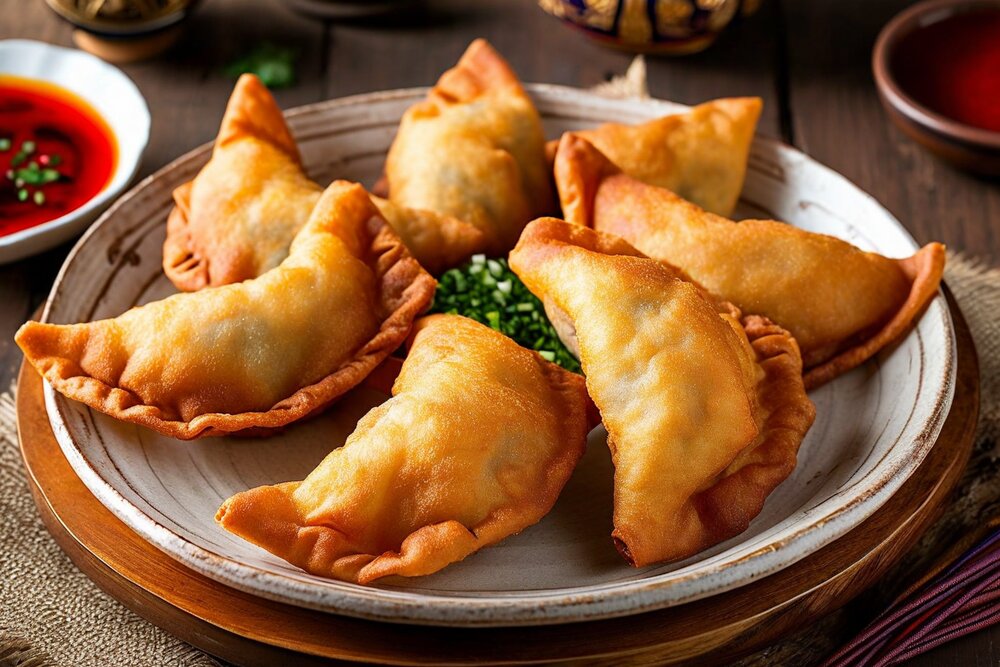
Khuushuur — Fried Meat Pies
Makes about 12 · 45 min · Deep-fried
Ingredients: Dough: 300 g plain flour, about 150 ml warm water, 1 tsp salt. Filling: 400 g fatty minced mutton, beef or a mixture, 1 onion, 2 cloves garlic, salt, black pepper, 3–4 tbsp cold water. To fry: a litre of neutral oil or, traditionally, rendered mutton fat.
Method: Make and rest the dough as for buuz. Mix the meat with finely diced onion, garlic, salt and pepper, then beat in the cold water until slack. Divide the dough into twelve, roll each into a disc about 14 cm across, put a heaped spoonful of filling on one half, fold over and press the edge firmly — with the fingers into a rope, or flat with a fork. Some cooks flatten the finished pie gently with the palm so it fries evenly. Heat the oil to 180 °C and fry two or three at a time, about 3 minutes a side, until deep golden and blistered. Drain briefly on paper.
💡 Seal the edge properly or the fat escapes and the oil spits. Khuushuur are eaten plain and very hot, straight from the pan — in Mongolia there is no dipping sauce, whatever the pictures suggest; at most a little salt or, in town, ketchup. They are also excellent the next day, split and reheated in a dry pan.
🥛 Airag, Arkhi and Salted Tea
Airag
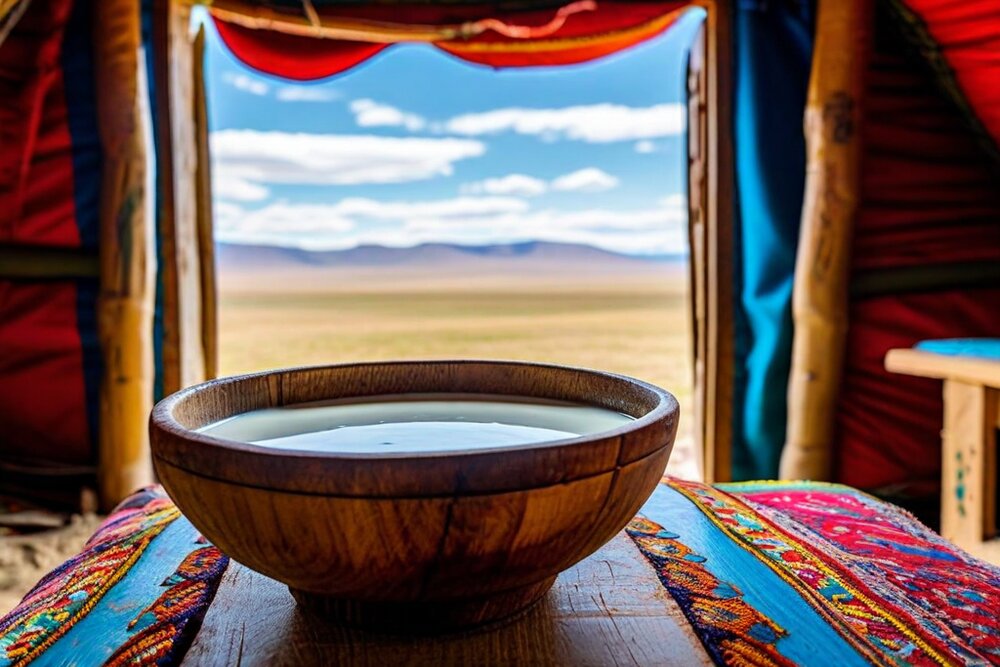
Fermented mare's milk, the national drink, sour, slightly fizzy and about 2% alcohol. It is a summer product — mares are milked only from roughly June to September — and it is made by churning the milk thousands of times a day in a skin or barrel. It is also a mild laxative on a first encounter; start with half a bowl, not a full one, and build up.
Arkhi
The distilled version: shimiin arkhi, milk spirit, traditionally distilled at home from fermented milk in a simple pot still, cloudy and around 10–15%. What is sold in shops as arkhi today is usually grain vodka — Mongolia makes a great deal of it and some of it is very good. Chinggis and Soyombo are the names to look for.
Vodka etiquette
Vodka is served in a shared bowl or glass passed round. Take it with the right hand, and if you do not want to drink, it is acceptable to touch the rim to your lips, or dip the ring finger and flick a drop upwards to the sky, once, as an offering, and pass it on. Do not simply refuse the vessel. Mongolian drinking can be extremely heavy; nobody will mind if you pace yourself, but skipping the ritual is noticed.
Suutei tsai
Salted milk tea again, because it really is what people drink all day. In the Gobi and the west you may also meet it with fried millet or a lump of fat in it. Whatever else you refuse, take the tea.
Beer and coffee
Mongolia has a solid brewing industry — Sengur, Borgio, Chinggis and a growing craft scene in the capital — and Ulaanbaatar has a proper third-wave coffee culture with roasters and good espresso. In the countryside, expect neither.
Water
Do not drink the tap water anywhere, including Ulaanbaatar. Bottled water is cheap and universal; in the countryside carry more than you think you need, and remember that a ger household's water may have come from a well or a river by hand.
🏛️ Heritage — Written, Sung and Standing
The Secret History of the Mongols
Composed around 1240, shortly after Chinggis Khaan's death, it is the oldest surviving work of Mongolian literature and the only substantial account of the empire written from inside it. It survives mainly through a Chinese phonetic transcription. UNESCO added it to the Memory of the World register, and it is genuinely readable — closer to saga than to chronicle.
Six World Heritage sites
The Uvs Nuur Basin, the Orkhon Valley, the Petroglyphic Complexes of the Mongolian Altai, Great Burkhan Khaldun Mountain, the Landscapes of Dauria, and the Deer Stone Monuments and Related Bronze Age Sites, inscribed in 2023 — standing stones carved with stylised flying deer, of which Mongolia has the great majority in the world.
Intangible heritage
An unusually long list: khöömii throat singing, the morin khuur, the long song, Naadam, Mongolian calligraphy in the traditional script, the coaxing ritual for camels — a song sung to persuade a mother camel to accept a rejected calf, which works and is extraordinary to watch — and the making of the ger itself.
The petroglyphs
The Altai rock art spans roughly 12,000 years, from hunted aurochs and ostriches on a wetter, forested landscape, through the domestication of the horse, to mounted herders — an unusually continuous record of one region's people changing their way of life. It is remote, and worth the effort if you are already in Bayan-Ölgii.
Zanabazar's sculpture
The gilt-bronze figures made in the late seventeenth century by Mongolia's first Bogd Gegeen are, by common consent, among the finest Buddhist bronzes ever cast. Most of what survived the purges is in the Zanabazar Museum of Fine Arts in Ulaanbaatar.
What was lost
It is important to state the other half: the destruction of 1937–39 erased the great majority of Mongolia's built religious heritage, its manuscript libraries and much of its art, together with tens of thousands of lives. Mongolia's heritage list is short not because the country had little, but because most of it was demolished within three years.
❄️ The Climate, and the Word Dzud
Mongolia calls itself the Land of the Eternal Blue Sky and means it: something over 250 sunny days a year, very low humidity and a hard, clear light. It is also one of the most extreme continental climates on earth, and one word governs the relationship between the weather and the people: dzud.
The numbers
Winter in Ulaanbaatar averages around −20 °C in January and reaches −40 °C; summer days run +20 to +28 °C and the Gobi goes above +40. Annual precipitation is only 200–350 mm, nearly all of it falling in July and August. Ulaanbaatar is, by annual mean temperature, the coldest capital city in the world.
What a dzud is
A winter that kills livestock on a mass scale — a compound disaster, not just cold. A dry summer leaves animals underfed; then winter does the rest. Mongolians distinguish several kinds: white dzud (snow too deep to graze through), black dzud (no snow, so no water), iron dzud (a melt-freeze crust the animals cannot break), cold dzud, and combinations.
2023–24
The worst dzud in about fifty years. More than seven million animals died — a substantial share of the national herd — thousands of herding families lost everything, and agriculture pulled national GDP growth down that year. There were reports of families losing their entire livestock in a single week. Each such winter pushes another wave of people into Ulaanbaatar's ger districts.
Warming
Mongolia has warmed by roughly 2.2–2.5 °C since the mid-twentieth century, well over twice the global average, and something like three quarters of its territory shows some degree of degradation or desertification. Springs are drying, permafrost in the north is retreating, and the frequency of both drought summers and dzud winters has risen.
What it means for you
Nothing dramatic in summer, but it explains the country. It also means you must pack for a much wider temperature range than the season suggests: a July night in the Gobi or at Khuvsgul can approach freezing, and a July afternoon can be 35 °C. Layers, a windproof shell and a warm hat, in July.
The wind and the dust
Spring — March to May — brings serious wind and dust storms off the degraded steppe and the Gobi, sometimes reaching Beijing and Seoul. It is the least pleasant season to travel in Mongolia and the one most travel writing ignores.
📅 When to Go
June — the best-kept secret
Green steppe, wildflowers, foals and calves everywhere, long days, temperatures in the low twenties and before the Naadam price surge. Some rain, occasional cold snaps. If you want the classic Mongolian landscape without the crowd or the cost, come in June.
July — Naadam and everyone else
The warmest month, the greenest steppe, Naadam on 11–13 July — and the busiest, most expensive and most heavily booked period of the year. It is also the wettest month. Come if Naadam is the point; book by February.
August — the compromise
Still warm, drier than July, the Gobi at its best, and prices easing after Naadam. Airag season is in full swing. Nights get cold towards the end of the month. For a first visit covering both the Gobi and the north, late August is arguably the single best window.
September — gold
Larch and birch turn, the light is extraordinary, the tourist camps are emptying and the air is clear. Daytime is comfortable and nights drop below zero by the end of the month. Ger camps start closing in late September; check before you plan a late trip.
October — the eagles
The Golden Eagle Festival in Bayan-Ölgii in the first week of October is the reason to come this late, and it is genuinely spectacular. Cold, clear, and a long way west. Most other camps and routes are shutting down.
Winter, honestly
November to March is for specialists. −30 °C, the Ulaanbaatar smog, most ger camps closed, many roads unusable. What you get in exchange: Tsagaan Sar, the ice festival on Khuvsgul, an empty Gobi, and a country nobody is photographing. Go only with a serious operator and serious clothing.
✈️ Getting There from Central Europe
There is no direct flight from Prague, and there will not be one. Everything goes through a hub, and the choice of hub matters more here than usual because the total journey is 12–20 hours.
Via Berlin — the Czech shortcut
MIAT Mongolian Airlines flies Ulaanbaatar–Berlin and Ulaanbaatar–Frankfurt (the Frankfurt rotation runs roughly twice a week). Berlin is about 4.5 hours from Prague by bus or train, which makes a surface-plus-one-flight journey genuinely practical, and often the shortest total door-to-door time available from the Czech Republic.
Via Istanbul
Turkish Airlines flies Istanbul–Ulaanbaatar and connects from Prague several times a day. It is usually the most flexible option and frequently the cheapest, at the cost of a long night sector.
Via Seoul or Beijing
Korean Air and MIAT fly Seoul–Ulaanbaatar with good connections from Europe, and Chinese carriers route via Beijing. Both work, both are long, and the Beijing option may need a Chinese transit arrangement depending on your itinerary — check before booking.
The train
The Trans-Mongolian runs Moscow–Ulaanbaatar–Beijing and is one of the great rail journeys. Since 2022 the Russian leg has become far more complicated for Czech travellers, in terms of both visas and advisability, and the MZV ČR advises against travel to Russia. The Beijing–Ulaanbaatar section on its own, about 27 hours, remains a fine and much simpler trip.
Visas
Czech citizens do not need a visa for tourist stays of up to 30 days. The exemption, introduced in 2023, was extended again on 31 December 2025 and now runs to 1 January 2027. It applies to ordinary passports and tourism; longer or non-tourist stays need a visa. Check the current position before booking, as this has been renewed year by year.
The airport
Chinggis Khaan International (UBN), opened in 2021, is about 52 km south of Ulaanbaatar — allow an hour, more in traffic. There is an airport bus and plenty of taxis; most tour operators include the transfer. Buy a SIM card in the arrivals hall, it is quick and cheap.
🚙 Getting Around — Hire the Driver
Mongolia has an enormous road network and very little of it is paved. Outside the main corridors, "road" means a braid of tyre tracks across grass that changes with the seasons and is not signposted. The standard and correct way to travel is a hired vehicle with a driver, and it is not a luxury.
Van or Land Cruiser
The classic is the Russian UAZ-452 van — indestructible, uncomfortable, repairable with a spanner in the middle of nowhere — or a Toyota Land Cruiser for more comfort and more money. Expect roughly $100–160 a day including fuel and the driver, split between the passengers, plus a guide if you want one.
Why not self-drive
No signposts, no fuel for hundreds of kilometres, unbridged river crossings that change weekly, no phone signal, and no help if you break an axle. Drivers navigate from memory and from the shape of the hills. Independent self-drive in the Mongolian countryside is a genuinely bad idea unless you are very experienced and travelling in a convoy.
Domestic flights
Hunnu Air, Aero Mongolia and MIAT fly to Dalanzadgad (the Gobi), Mörön (Khuvsgul), Ölgii (the far west), Khovd and Choibalsan. Fares are typically $100–250 each way, schedules are seasonal and cancellations happen. For Bayan-Ölgii and Khuvsgul, flying is the sensible choice.
Trains
The main line runs north–south: Sükhbaatar–Darkhan–Ulaanbaatar–Sainshand–Zamyn-Üüd, with a branch to Erdenet. Sleepers are cheap, slow and a fine way to travel if your destination happens to be on the line. Most destinations are not.
Buses and shared vans
Long-distance buses and shared mikr vans connect Ulaanbaatar with the aimag centres from the Dragon and Bayanzürkh terminals. They are very cheap, extremely full, and leave when they fill rather than when the timetable says. Adventurous, slow, and a real way to meet people.
Ger camps
The standard countryside accommodation: a fixed camp of tourist gers with beds, a stove, a shared shower block and a dining ger. Reckon $30–70 per person per night with meals. Most operate roughly May to late September only. Staying with a herding family instead is possible through operators and is a different and better experience — arrange it properly and pay properly.
📋 Practical Information
Money
The tugrik (₮, MNT). Very roughly 160–170 tugrik to the Czech koruna — check the current rate, it moves. Cards and the QPay QR system work well in Ulaanbaatar and in aimag centres; outside them, cash is the only option. Draw a substantial amount before leaving the capital and carry small notes for fuel, water and ger stays.
Phones and internet
Mobicom and Unitel sell tourist SIMs at the airport and in town for a few hundred koruna, with generous data. 4G is good in and around towns and along the main corridors and disappears entirely in the deep countryside. A satellite messenger is a reasonable precaution on a long Gobi or Altai trip.
Health
No EHIC — Mongolia is far outside the EU. Insurance with medical evacuation cover is essential, not optional: serious care means Ulaanbaatar, and Ulaanbaatar can be two days' drive away. Recommended vaccinations typically include hepatitis A and B, typhoid, tetanus and, for long rural stays, rabies and tick-borne encephalitis. Ask a travel clinic.
The Czech embassy
The Czech Republic has a full embassy in Ulaanbaatar — a legacy of decades of close Czechoslovak–Mongolian ties. Address: Embassy Street 9, Sükhbaatar District. Telephone +976 11 321 886, and a 24-hour emergency line on +976 99021880. It also issues Schengen visas on behalf of Slovakia, Poland, Lithuania, Estonia and Switzerland, and offers consular protection to EU citizens whose own countries are not represented.
MZV ČR and DROZD
There is no general travel warning for Mongolia, but do register in DROZD: distances are enormous, phone coverage is patchy and plague quarantines can close a province at no notice. It is exactly the kind of destination the system exists for.
Safety and the real risks
Violent crime is rare and Mongolia is a safe country. The genuine risks are road accidents (by a wide margin the biggest), extreme weather, guard dogs, marmot-borne plague, and pickpocketing in Ulaanbaatar — the State Department Store, the Naran Tuul market and crowded buses are the known spots. Take a normal city's precautions in the capital and a wilderness expedition's precautions outside it.
💶 What It Costs
Mongolia is cheap to be in and expensive to move around, because moving around means hiring a vehicle. Costs below are approximate and convert at roughly 165 tugrik to the koruna.
Sleeping
A hostel bed in Ulaanbaatar ₮25,000–45,000 (150–270 Kč); a decent mid-range hotel ₮150,000–300,000 (900–1,800 Kč); a countryside ger camp $30–70 per person with meals (700–1,600 Kč). Staying with a herding family through an operator sits at the lower end and is worth far more than it costs.
Eating
A canteen plate of tsuivan or a portion of khuushuur ₮8,000–15,000 (50–90 Kč). A good mid-range restaurant meal in the capital ₮20,000–45,000 (120–270 Kč). Beer ₮5,000–9,000. Food is not where your money goes.
The vehicle
This is where your money goes. $100–160 a day for a van or Land Cruiser with driver and fuel, i.e. roughly 2,200–3,500 Kč a day for the vehicle — divided among four passengers, that is 550–900 Kč each. A guide adds $30–50 a day. Travelling as a group of four is the single biggest saving available in Mongolia.
Domestic flights
$100–250 each way (2,200–5,500 Kč) to Dalanzadgad, Mörön or Ölgii. For the far west, a flight replaces four days of driving in each direction and is almost always worth it.
A realistic two weeks
Two weeks with a shared vehicle, ger camps, domestic flights to the Gobi and Khuvsgul, meals and entry fees, excluding international airfare: roughly 30,000–50,000 Kč per person in a group of four. Solo, the same trip is close to double, because the vehicle cost does not divide.
The whole trip from Prague
Add international flights of roughly 18,000–30,000 Kč return via Istanbul, Berlin or Seoul. A well-planned two-week Mongolia trip from Prague therefore lands around 50,000–80,000 Kč per person — not a cheap holiday, but a great deal less than most people assume for a destination this remote.
🇨🇿 Notes for Czech Visitors
Mongolia is one of the few far-flung destinations where the Czech Republic has a genuinely deep footprint — an embassy in Ulaanbaatar, decades of educational and industrial cooperation, a substantial Mongolian community at home, and Prague Zoo's part in putting the wild horse back on the steppe.
Getting there
No direct flight. The Czech-specific trick is Berlin: MIAT flies Ulaanbaatar–Berlin, and Berlin is 4.5 hours from Prague overland, which often beats any two-flight itinerary on total time. Otherwise Istanbul with Turkish, or Seoul. Reckon 18,000–30,000 Kč return.
Visa
None needed for up to 30 days of tourism on an ordinary Czech passport. The exemption was renewed on 31 December 2025 and currently runs to 1 January 2027. It has been extended annually since 2023 but is not permanent — verify before you book.
The embassy
A real one, in Ulaanbaatar: Embassy Street 9, Sükhbaatar District, telephone +976 11 321 886, emergency line +976 99021880 around the clock. It also handles Schengen visas for Slovakia, Poland, Lithuania, Estonia and Switzerland, and serves EU citizens whose states have no mission here. For a destination this remote, that is a substantial reassurance.
Insurance and DROZD
The EHIC is worthless here. Buy insurance that explicitly covers medical evacuation — the nearest hospital worth the name may be two days away by road. Register in DROZD; between plague quarantines, weather and distance, this is precisely the destination the register was built for.
The Czech–Mongolian connection
Thousands of Mongolians studied and worked in Czechoslovakia in the 1970s and 1980s, and there is still a Mongolian community of several thousand in the Czech Republic — one of the larger Asian minorities, with a visible presence in Pardubice, Havlíčkův Brod and other industrial towns. You will meet Mongolians in Ulaanbaatar who speak good Czech, sometimes when you least expect it.
Prague Zoo and the takhi
Prague Zoo has kept the international studbook for Przewalski's horse since 1959 and has flown horses back to Mongolia since 2011 under its "Return of the Wild Horses" programme, principally to Khomiin Tal and Great Gobi B. If you stand in Khustain Nuruu at dawn and watch a takhi harem grazing, some of that is Czech work. It is a legitimate thing to be quietly proud of.
🎲 Curiosities, Including One That Is Only Half True
More horses than people
Mongolia has roughly four million horses and 3.5 million people. Add sheep, goats, cattle and camels and the ratio of livestock to humans is about twenty to one. Children ride before they can properly walk, which is why Naadam jockeys are five years old.
The landlocked navy
The famous story: Mongolia's navy is a single tug on Lake Khuvsgul, the Sükhbaatar III, with a crew of seven of whom only one could swim. The vessel is real — a Soviet-era tug that hauled fuel barges up the lake and now mostly carries tourists. The crew detail is a much-repeated anecdote rather than a documented fact, and Mongolia has no navy in any formal sense. Enjoy the story, but do not repeat it as verified.
The coldest capital
Ulaanbaatar's mean annual temperature is around zero, which makes it the coldest national capital on earth — colder on average than Nuuk, Astana or Reykjavík. In January it is routinely colder in Ulaanbaatar than in northern Siberia's cities on the same latitude, because of the altitude and the continental position.
A tank brigade called Revolutionary Mongolia
During the Second World War Mongolia sent the USSR something on the order of half a million horses, along with vast quantities of wool, meat and sheepskin coats, and raised public subscriptions to fund a tank brigade and a fighter squadron. For a country of under a million people at the time, the contribution was disproportionate and is still commemorated.
The dinosaur that came home
In 2013 the United States returned a smuggled Tarbosaurus bataar skeleton to Mongolia after a court case, and it became the founding exhibit of a dinosaur museum in Ulaanbaatar. Fossil smuggling out of the Gobi remains a serious problem, and buying anything that looks like a fossil is both illegal and a bad idea.
Odds and ends
Mongolia abolished the death penalty. Its internet domain is .mn. Its literacy rate is over 98%. It has contributed troops to UN peacekeeping well out of proportion to its size. And its flag carries the Soyombo, a column of symbols — fire, sun, moon, two triangles, two bars, two fish — designed by the seventeenth-century sculptor Zanabazar.
🔮 What Happens Next
Copper, and what is done with it
The Oyu Tolgoi underground ramp-up runs through the late 2020s and should make Mongolia a major copper producer at exactly the moment the world electrifies. Whether that money builds hospitals, schools and a sovereign fund — or leaks — is the question that has decided every Mongolian election since 2012 and will decide the next one in 2028.
Political churn
Three prime ministers in ten months is not a sign of a failing democracy so much as a very volatile one. The Unlock Mongolia deregulation programme is a serious attempt at reform; whether it survives the next coalition reshuffle is a different question. The underlying stability — free elections, free press, no coups — has held for thirty-five years.
The pipeline and the railway
If Power of Siberia 2 ever reaches a final investment decision, Mongolia gains transit revenue and a permanent stake in Russian–Chinese energy politics. If the cross-border railways to China are completed, coal exports become far cheaper and Mongolia becomes more tightly integrated with the Chinese economy. Both are double-edged, and Ulaanbaatar knows it.
The herding question
Each dzud moves more families off the land, and warming makes dzuds more frequent. Somewhere ahead is a threshold at which mobile pastoralism stops being a livelihood for a quarter of the population and becomes a minority occupation. Mongolia is trying to manage that with insurance schemes, pasture management and rural services — and is not obviously winning.
Ulaanbaatar's air
Solvable, expensive, and politically unavoidable. The answers are known — connect the ger districts to heat and power, replace coal stoves, improve housing — and every government has promised them. Progress is real and slower than the problem.
Tourism at a million
Arrivals hit a record 846,000 in 2025 and 2026 is running 35–39% ahead, on course to pass one million for the first time. The declared target is two million by 2028. For a country whose main asset is emptiness, that is an opportunity and a risk in the same sentence.
🧳 Tourism — Numbers, and How to Travel Well Here
Mongolia received a record 846,103 foreign visitors in 2025, up 16% on 2024, with China, Russia and South Korea the largest source markets. Through April 2026 arrivals were running 35–39% ahead of the previous year, and the country expects to break a million for the first time.
What that actually means
A million visitors across 1.56 million km² is still almost nothing — the same number visits Prague in about three weeks. Mongolia's crowding problem is not national but local: Terelj, the standard Gobi circuit and Naadam week take nearly all of it. Move fifty kilometres off the circuit and you will not see another foreigner for days.
Go with an operator, or don't go far
Independent travel works in and around Ulaanbaatar and along the railway. Beyond that, the practical realities — no signage, no fuel, no signal, unbridged rivers — mean you need a driver, and a driver is best arranged through an operator who will be answerable if something goes wrong. Choose one that pays its drivers and host families properly and ask directly how it does so.
Staying with herders
The single best thing you can do in Mongolia, and the easiest to do badly. Arrange it through an operator that has a standing relationship with the family, pay the going rate without haggling, bring a useful gift for the household (tea, flour, sweets for children, a bottle for the head of the family if appropriate), and ask before photographing anyone.
The Tsaatan question
The reindeer-herding Dukha in the northern taiga have become a bucket-list item, and the pressure on a community of a few hundred people is real. If you go, go with an operator working under a community agreement, stay at least two nights rather than dropping in for photographs, and accept that you are a guest in a fragile situation.
Leave nothing
There is no waste collection in the countryside and burning rubbish beside a ger camp is common. Carry your own waste out — genuinely out, back to Ulaanbaatar — including batteries and plastic. Do not drive off existing tracks: tyre scars on the steppe last for years and are one of the visible costs of the tourism boom.
Simple courtesies
Walk clockwise round an ovoo three times and add a stone. Do not step on a threshold. Accept the tea. Take things with the right hand. Do not photograph inside temples without asking. And do not touch anyone's hat — it is more offensive than it sounds.
📸 Gallery — Six Files, Honestly Described
The AWS connection was unavailable again, so the image inventory was built by HTTPS probing of nearly 2,000 candidate filenames across both /images/mongolia/ and /countries/images/mongolia/, including the Abkhazian naming scheme found in Lithuania, Luxembourg and Micronesia — which does not apply here. Six files exist, and all six were downloaded and looked at before being used.
Correction: this inventory was built blind
The AWS listing came back after this page was written, and it showed that the HTTPS probing used to build the inventory had missed files in every country in this batch — it can only find names somebody thinks to guess. The real listing for Mongolia holds 12 files, not the 6 this page found — including airag-ger.jpg, a wooden bowl of airag inside a ger, which is exactly how airag is served and which has replaced the tumbler shot above; and three recipe files carrying the country name twice, such as mongolia-mongolia-flatbread.jpg. The manifest and the images above have been corrected from the authoritative listing, and the probing method is recorded here as unreliable so that no later page relies on it while the AWS connection is available.
The ger photograph — used, with a correction
countries/images/mongolia/hero.jpg, at the top of the overview, is a well-made image of a single ger on the steppe. The correction, stated in its caption, matters: the rider wears a broad-brimmed felt hat and a red cape belonging to the American West, not a Mongolian deel and sash. The generator has dressed a Mongolian scene in the wrong culture's clothes — a subtler failure than an invented building, and worth naming, because a reader who has never seen a herder would take it as documentary.
Buuz — right dish, wrong kitchen
recipes/mongolia-buuz.jpg shows steamed pleated dumplings in a bamboo dim-sum basket on parchment, finely pleated and closed. Mongolian buuz are bigger, plumper, thicker-skinned, steamed in a metal tiered steamer and served plain on a plate. The dish family is right and the presentation is Chinese. Used beside the recipe with the correction stated.
Khuushuur — the best of them
recipes/mongolia-khuushuur.jpg is the most accurate food image for this country: crimped half-moon pies, deep-fried, blistered and golden, which is exactly what khuushuur are. The one wrong note is the bowl of chilli dipping oil beside them, which is not a Mongolian accompaniment.
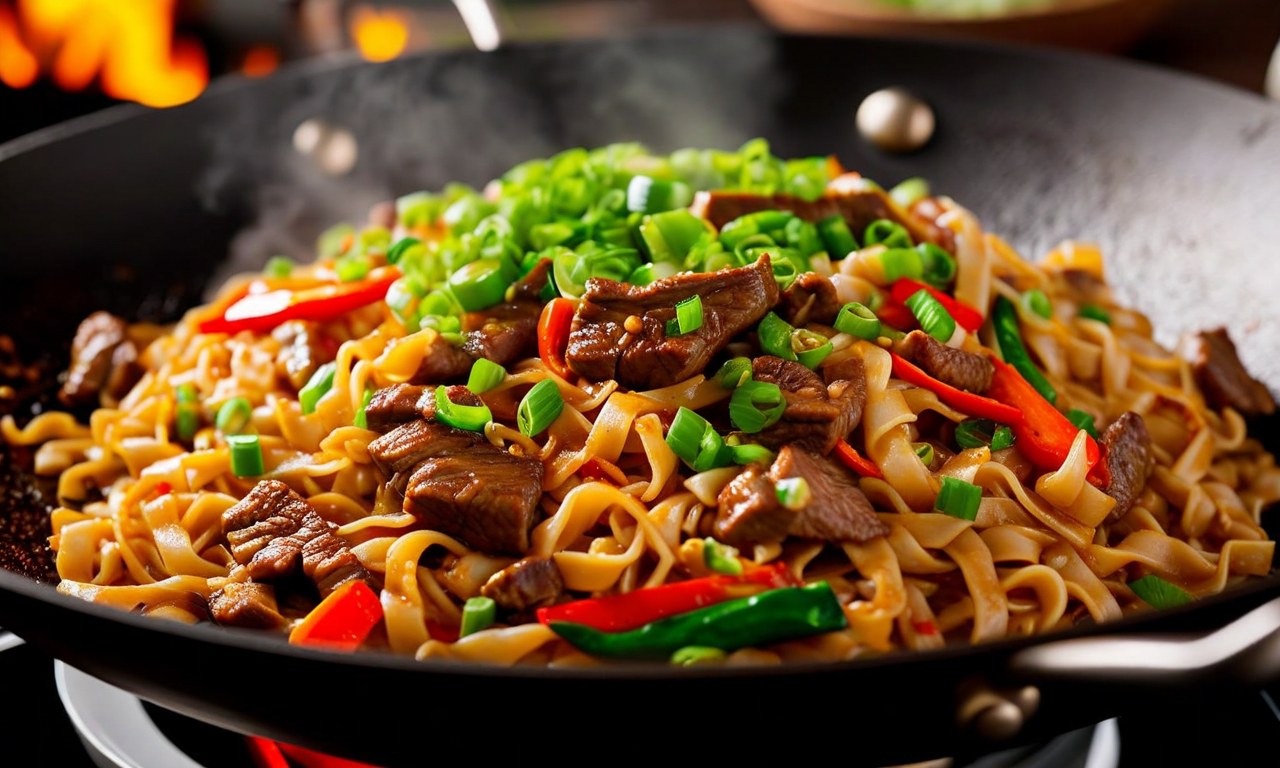
Airag and tsuivan — both usable
recipes/mongolia-airag.jpg gets fermented mare's milk broadly right, though airag is thinner and greyer and is served in a bowl rather than a tumbler. recipes/mongolia-tsuivan.jpg gets the noodles and mutton right but styles the dish as a Chinese stir-fry, with bell peppers, chilli and a wok flame that do not belong. Both are used, both with the correction in the caption. tsuivan is a PNG carrying a .jpg extension.
No dead references here
Worth recording, because it has not been true for several countries in a row: the page this one replaces referenced three recipe images — buuz, khuushuur and airag — and all three exist and return HTTP 200. The only anomaly is mongolia-tsuivan.jpg, which sat in the bucket unreferenced; it is now used. Mongolia is the first country in this run with no broken image link on its old page.
What is not here
There is no photograph of Ulaanbaatar, the Gobi, Erdene Zuu, Naadam, a Kazakh eagle hunter, a takhi, Khuvsgul or the Chinggis statue anywhere in the bucket for this country — for a nation whose entire appeal is its landscape, the visual inventory is one steppe scene, one ger and four plates of food. The sections above are written to work without pictures, and nothing has been illustrated with an image of somewhere else.
Support This Project 🌍
This World Travel Factbook is a labor of love – free to use for all travelers. If you find it helpful, consider supporting its continued development.