
🇪🇸 Melilla at a Glance
🌍 Overview — Spain, on the Wrong Side of the Sea
Melilla is a Spanish autonomous city on the North African coast, surrounded on three sides by Morocco and on the fourth by the Mediterranean. It is 12.3 km² — about the size of a large city park — and it has been continuously Spanish since 1497, five years after Granada fell and a full two centuries before Gibraltar became British.
That makes it a genuine oddity: a city of the European Union on the African mainland, using the euro, voting in Spanish and European elections, and sitting directly against a country that has claimed it since 1956 and has never stopped.

Where it is
On the eastern side of the Cap des Trois Fourches peninsula, on Morocco's Mediterranean coast, roughly 200 km east of its sister enclave Ceuta and about 150 km south of the Spanish mainland across the Alboran Sea. The nearest Moroccan city, Nador, is 12 km away and its urban area effectively reaches the fence.
How big, how many
12.3 km² and, as of 1 July 2026, 86,616 residents — down 448 on the year, which makes Melilla the only Spanish region currently losing population. The fall is entirely in registered foreign residents; the number of Spanish nationals rose.
What it legally is
A ciudad autónoma since 1995, a status shared only with Ceuta — more than a municipality, less than an autonomous community, with an Assembly, a president who is also the mayor, and a set of powers Melilla's politicians have spent thirty years asking to expand.
In the EU, but not entirely
Melilla is EU territory and part of the Schengen area with special provisions — but it sits outside the EU customs union and outside the VAT area, levying its own local tax, the IPSI, instead of Spanish IVA. That single fact explains most of its economy and most of its border politics.
Who lives there
Roughly half the population is of Rif Amazigh (Berber) origin and Muslim, the rest largely Christian Spaniards of peninsular descent, plus small and historically important Jewish and Hindu communities. Melilla calls itself the city of four cultures, and unusually for a civic slogan it is true.
2026 in one line
On 30 July 2026 the Beni Enzar crossing — the only one open — was closed for about 36 hours during the mass migration crisis that overwhelmed Ceuta; the commercial customs post is technically open but had recorded just 46 goods movements in the year to March; and President Juan José Imbroda renewed the demand for Melilla to become a full autonomous community.
🏷️ Melilla, Mlilya, Rusadir
The city has been named at least three times over, and each name belongs to a different civilisation that held the same rock.
Rusadir
The Phoenician and later Roman name — Rusaddir, usually read as "great cape" or "mighty headland" in Punic. It was a trading post on the route between Carthage and the Atlantic, and it is the reason Melilla can claim about 2,500 years of urban continuity on the same promontory.
Mlilya
The Amazigh and Arabic name, Mlilya or Mřič, still used by every Tamazight speaker in the city and across the fence in Nador. Explanations of the root vary — "the white one" is the popular reading — and none is certain.
Melilla
The Castilian form, in use since the Duke of Medina Sidonia's forces took the abandoned town in 1497. Note that Spain acquired it before Morocco existed as the state that now claims it, a point Spanish diplomats make often and Moroccan ones consider irrelevant.
What the city calls itself
La ciudad de las cuatro culturas — the city of the four cultures — on tourist signage, on official publications and in more or less every speech given by a Melillan politician. It refers to the Christian, Muslim, Jewish and Hindu communities, and it is both a genuine description and a piece of civic branding.
The disputed part
Morocco claims Melilla, along with Ceuta, the Chafarinas Islands, Peñón de Vélez de la Gomera and Peñón de Alhucemas, and describes them as occupied territories, raising the matter periodically at the UN. Spain's position is that they are integral parts of Spain whose populations have never asked to leave. No negotiation has ever taken place.
Why the comparison with Gibraltar stings
Spanish governments have argued for three centuries that Gibraltar should be returned. Moroccan governments make exactly the same argument about Melilla, in almost the same words. Spain's answer — that Melilla is older, its people Spanish, and its status not up for discussion — is very close to Britain's answer about Gibraltar, and everyone involved knows it.
🗺️ Twelve Square Kilometres and a Mountain That Isn't Yours
Melilla is essentially flat, essentially urban, and essentially full. There is no countryside, no agriculture worth the name, no river of any consequence and no natural fresh water supply adequate to the population. Everything that shapes the place is either the sea or the border.
The land
A low promontory and the plain behind it, rising to only a few tens of metres. The old town sits on the rocky headland of Melilla la Vieja; the modern city fills the flat ground west and south of it, right up to the fence. There is no room left, which is why Melilla builds upward and why housing is the city's most bitter domestic issue.
Mount Gurugú
The mountain that dominates every view from Melilla is Mount Gurugú (about 890 m) — and it is in Morocco. It is visible from every rooftop in the city, it has been the strategic prize of every conflict here since the nineteenth century, and its forested slopes have for years sheltered informal camps of migrants waiting to attempt the fence. No single geographical fact says more about Melilla's situation.
The sea
The Mediterranean on the north and east, with a working commercial port, a marina, and a handful of small city beaches — Playa de los Cárabos, Playa de Horcas Coloradas, Hipódromo — that are decent rather than remarkable. The Chafarinas Islands, a Spanish nature reserve with important seabird colonies, lie about 50 km east and are not open to casual visitors.
Climate
Hot-summer Mediterranean, moderated by the sea. Summers around 28–32 °C and dry; winters mild at 12–18 °C with what little rain there is falling between November and March. Annual rainfall is roughly 350 mm — semi-arid, and the reason water has to be desalinated.
Water
There is no meaningful aquifer. Melilla depends on a desalination plant and on transfers, and both capacity and cost are recurring political subjects. Drought years on the Moroccan side raise the temperature of the issue further, since the surrounding region has its own severe and worsening water problem.
Green space
Parque Hernández, the long central park with its ficus trees and bandstand, is the city's living room; Parque Lobera climbs a slope with good views; and the Rostrogordo pine woods to the north are the nearest thing to countryside inside the perimeter. That is essentially the entire inventory.
📜 1497, and Everything Since

Before Spain
Phoenician Rusaddir, then Carthaginian, then a Roman municipium; then Vandal, Byzantine and from the seventh century Islamic, passing between the Idrisids, the Umayyads of Córdoba, the Almoravids, the Almohads and the Marinids. By the late fifteenth century, after being fought over between the Kingdom of Fez and the Wattasids, it had been abandoned and largely ruined.
17 September 1497
Troops sent by Pedro de Estopiñán on behalf of the Duke of Medina Sidonia occupied the empty site without a fight and began fortifying it. This was Castile's push into North Africa after the fall of Granada, and Melilla has been Spanish without interruption from that day — a longer continuous tenure than most of the Spanish mainland's current borders.
Three centuries under siege
For most of the sixteenth to eighteenth centuries Melilla was a presidio: a garrison-and-penal outpost supplied by sea, confined to its walls, and repeatedly besieged. The great siege of 1774–75, in which Sultan Mohammed III bombarded the town for a hundred days and failed, is the one every Melillan schoolchild learns.
1860 — the city gets its shape
After the Hispano-Moroccan War, the Treaty of Wad-Ras enlarged Melilla's territory to roughly its present size, famously by allowing Spain the ground within cannon-shot of the fortress. The current boundary is essentially that line. It is the reason Melilla is 12 km² rather than 1 km².
The Rif wars
From 1893 and especially from 1909 Melilla was the base for Spain's campaigns into the Rif, and it paid for them. The Disaster of Annual in 1921 — in which a Spanish army collapsed before Abd el-Krim's Riffians, with losses usually put above 10,000 dead — left Melilla itself nearly defenceless and traumatised Spanish politics for a decade. Much of the city's monumental architecture dates from the money and the militarism of these years.
1936, and after
The military rising that began the Spanish Civil War broke out in Melilla on 17 July 1936, hours before it did anywhere else — the war began here. Morocco became independent in 1956 and claimed the enclaves at once; Spain kept them, granted autonomous city status in 1995, and has been managing the consequences ever since.
🏰 Melilla la Vieja and the Four Enclosures
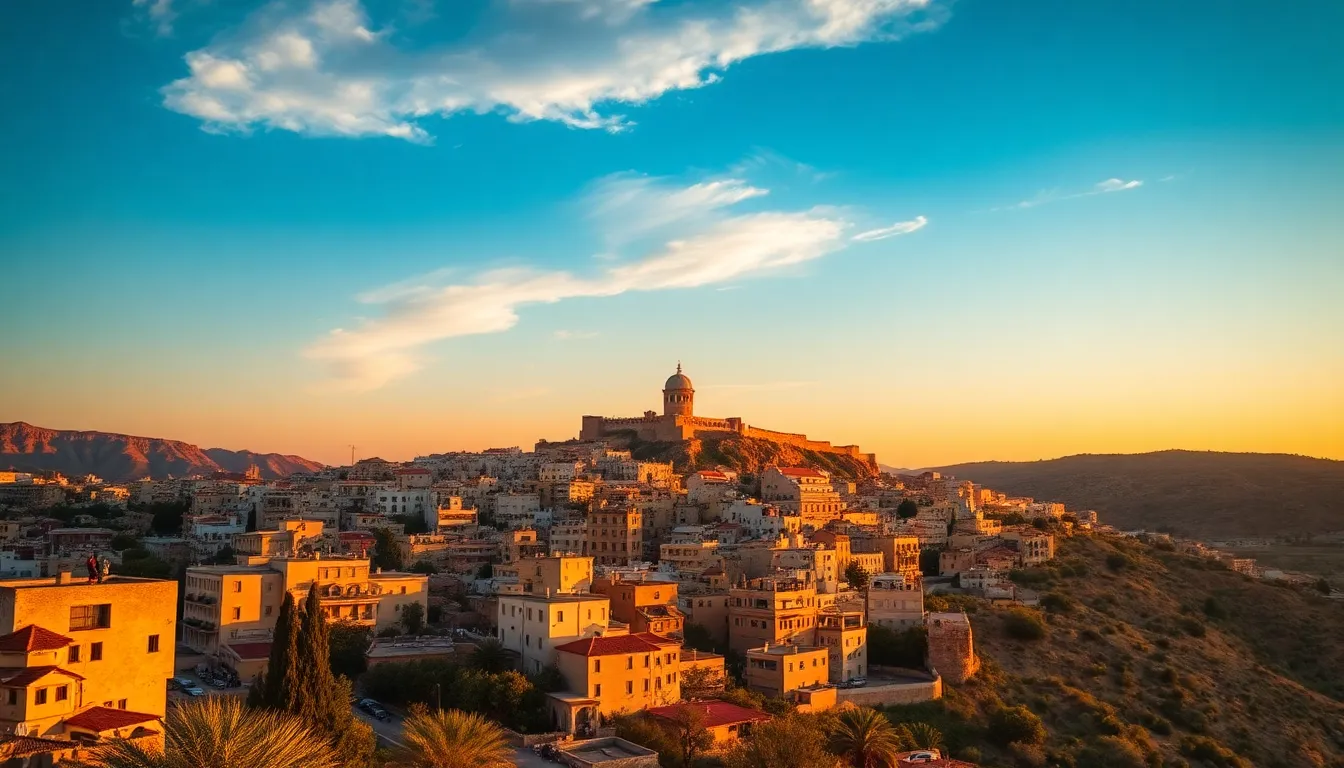
The old town is the reason to come. Melilla la Vieja — locally El Pueblo — is a fortified town on a rock above the harbour, built and rebuilt between the sixteenth and nineteenth centuries into four successive walled enclosures (recintos), and it is one of the most complete fortress complexes in the western Mediterranean.
The first enclosure
The oldest and the best: the sixteenth-century core on the tip of the promontory, entered through the Puerta de Santiago with its drawbridge — reportedly the only one of its kind in Spain — and containing the church of the Purísima Concepción, the Capilla de Santiago and a warren of lanes with sea on three sides. Allow a full morning.
The other three
Built outward in stages to the eighteenth century as artillery improved, with the Foso de Hornabeque, the Foso del Rosario and a set of bastions, tunnels and cisterns. Restoration since the 1980s has been serious and continues; some sections are open, some are not, and what is open changes.
The Cuevas del Conventico
A network of caves under the old town where the civilian population sheltered during sieges, with a passage down to the sea. They are visitable on a guided tour, they are genuinely atmospheric, and they are the single most memorable thing in Melilla la Vieja.
The museums
The Museo de Arqueología e Historia in the Torreón de la Concepción covers Rusaddir and the sieges; the Museo Militar is unavoidable in a garrison town; and the Museo del Modernismo down in the new city covers the other half of the story. All are small, cheap and worth the time.
Aljibes and the sea gate
The aljibes — vaulted cisterns cut into the rock — are how a besieged town on a dry promontory survived a hundred-day bombardment, and they are still there. Below them the Puerta de la Marina opens onto the water, which was the only supply line for three centuries.
Why it is not better known
Because it is in Melilla. A fortress town of this quality anywhere on the Spanish mainland would be on every itinerary; here it gets a fraction of the visitors of a minor Andalusian hill town, which is unfair to the fortress and, for a traveller, entirely to your advantage.
🎨 Enrique Nieto and the Second City of Modernismo
The surprise of Melilla is not the fortress, which you might expect, but the Modernista city below it. Melilla has the second-largest concentration of Modernista and Art Deco architecture in Spain, after Barcelona — around 900 catalogued buildings — and almost nobody outside Spain knows it exists.

How it happened
Between roughly 1900 and 1930 Melilla exploded from a walled garrison of a few thousand into a boom port of tens of thousands, on trade, mining concessions in the Rif and military spending. A whole new city had to be built at once, in the years when Modernismo was the fashionable style — so that is what got built.
Enrique Nieto
A Catalan architect who had worked in Gaudí's circle in Barcelona, arrived in Melilla in 1909, and stayed for the rest of his life, becoming municipal architect. He designed several hundred buildings here. If you have not heard of him it is because he spent his career in a city of 12 km² on the wrong side of the Mediterranean, which is precisely what makes the place worth a detour.
The Golden Triangle
The Triángulo de Oro — the blocks around Avenida Juan Carlos I Rey, Plaza de España and Calle Ejército Español — is where the density is highest. Walk it slowly and look up: the ground floors are ordinary shops, the upper storeys are floral ironwork, stained glass, sinuous stone and tile.
What to look for
The Casino Militar, the Palacio de la Asamblea (Nieto, 1933–48), La Reconquista, the Casa de los Cristales, the Or Zaruah synagogue, the Mezquita Central and the Hindu temple — Nieto designed buildings for all four of the city's religious communities, which tells you something about how the city worked.
The condition of it
Mixed and improving. A serious restoration programme has cleaned and repainted many facades in their original colours; others are weathered, altered or hidden behind signage. Melilla has real money problems and 900 protected buildings, and the arithmetic is difficult.
How to do it
The tourist office produces a free Modernista route map and there are guided walks. Two hours covers the Golden Triangle; half a day does it properly. Early morning or late afternoon light is much better for photographing the facades, and midday in July is not a serious proposition.
🚧 The Fence, and What It Costs
Melilla's land boundary with Morocco is about twelve kilometres long, and along almost all of it stands one of the most heavily engineered borders in the world: a double and in places triple barrier six metres high, with sensors, cameras, watchtowers and a service road, patrolled on the Spanish side by the Guardia Civil and on the Moroccan side by the Auxiliary Forces.
It exists because this fence and the one at Ceuta are the only land borders between the European Union and Africa. Everything that happens here is therefore not a local matter but a European one, which is why images of the Melilla fence appear in political arguments in countries that could not find it on a map.
How it grew
From a low wire fence in the 1990s to progressively higher and more instrumented barriers after each mass crossing attempt. The notorious concertina razor wire was removed in 2020 and replaced with a smooth anti-climb design after years of criticism over the injuries it caused. Each redesign has reduced crossings and increased the risk to those who still try.
The crossings
There are several gates but in practice one that matters: Beni Enzar in the north, the main pedestrian and vehicle crossing to Nador. Barrio Chino in the south, once the great porterage crossing, has been closed since 2020. That single closure changed the city's economy more than any political decision in decades.
What ended in 2020
Before the pandemic, 4,000 vehicles a day crossed at Beni Enzar; today it is about 1,700. And the porteadoras — the human porters, mostly Moroccan women, who carried enormous bales of goods on their backs through the Barrio Chino gate so that they would count as personal luggage rather than imports — are gone. That trade was degrading, dangerous and occasionally fatal, and it was also the livelihood of tens of thousands of people on both sides.
The customs question
Melilla had no functioning commercial customs at all from 1956 until 2023, because Morocco refused to recognise one. A commercial customs post finally opened in January 2023 as part of the Spanish-Moroccan rapprochement, and it has been a disappointment: by March 2026 the Spanish government reported just 46 goods movements for the year — four exports and forty-two imports. That is not a trade route; it is a formality.
The 2022 tragedy
On 24 June 2022 roughly two thousand people attempted a mass crossing at Barrio Chino. At least 23 people died by official Moroccan count and NGOs put the figure at 37 or more, with dozens still unaccounted for. Video showed bodies piled in the crush at the gate and injured people left untreated for hours. Spanish and Moroccan investigations were closed without prosecutions; the Council of Europe and UN bodies criticised both. It remains the deadliest single day in the history of this border.
Living beside it
For Melillans the fence is scenery and irritation rather than drama: a thing you drive past, a queue you sit in, a reason your relatives in Nador cannot visit easily. For those on the other side it is the difference between two economies. Both of those things are true at once, and any account that gives you only one of them is selling you something.
🌊 July 2026
On 30 and 31 July 2026 the Spanish enclaves experienced the largest single migration event in their history. Roughly 72,000 people crossed into Ceuta — on foot around the Tarajal breakwater and by swimming — after Moroccan border control was relaxed. At least 141 people died, most by drowning: 78 recovered on the Spanish side and 63 on the Moroccan.
What happened in Melilla
Far less, and that is the point. Groups gathered near Beni Enzar on 30 July and Spain closed the crossing entirely — vehicles and pedestrians — for about 36 hours, reopening on 1 August. There was no mass entry. Melilla's twelve kilometres of engineered fence held where Ceuta's shoreline did not, which is the whole argument about what these barriers are for, demonstrated in a weekend.
The response
Spain deployed the army alongside the Guardia Civil and National Police, ran maritime rescue operations, and installed a maritime barrier off Melilla on 13 August. Around 48,300 of those who reached Ceuta returned to Morocco voluntarily within days; several thousand remained into late August.
The political fallout
Melilla's president Juan José Imbroda attacked the Spanish government in August 2026 for coming "very late" with a unified command structure in Ceuta. The episode reopened every argument about the enclaves at once: their defensibility, their cost, and whether Spain's dependence on Moroccan cooperation for border control amounts to leverage Morocco can use at will.
The disinformation angle
The European Commission stated that foreign actors — Russian channels in particular — amplified the events online, spreading false claims and extremist framing. This is worth knowing before you read anything about the crisis on social media, including material that is still circulating.
The longer pattern
Mass crossing attempts at the enclaves are not new — 2005, 2014, 2018, 2021 at Ceuta, 2022 at Melilla — and they follow the temperature of Spanish–Moroccan relations at least as closely as they follow conditions in the Sahel. When Rabat is content, the fence is quiet. That correlation is uncomfortable for everybody and is denied by everybody.
What it means for a visitor
Almost nothing, in normal times. Crossings and closures affect the border, not the city; Melilla's streets were not the site of the crisis. But it does mean that you should never assume the land border will be open, and that any itinerary depending on crossing to Nador needs a fallback.
🏛️ How Melilla Is Governed
The institution
A ciudad autónoma under the Statute of Autonomy of 1995: a 25-seat Assembly, a Government Council, and a President who is simultaneously the mayor. Melilla elects one deputy to the Congress in Madrid and two senators. Spanish national law applies in full.
Who is in charge
Juan José Imbroda of the Partido Popular, invested by the Assembly on 7 July 2023 for the 2023–2027 term, returning to an office he had held for most of the previous two decades. The next ordinary election falls in 2027.
The autonomous-community demand
Melilla's long-running ask is to be upgraded from autonomous city to full autonomous community, with the extra powers and financing that implies. In March 2026 Imbroda made the formal request explicitly conditional on a change of government in Madrid — which tells you the demand is now as much party politics as constitutional principle.
The party landscape
The PP and Vox on one side; the PSOE much reduced; and Coalición por Melilla (CPM), historically the main vehicle of the Muslim-majority neighbourhoods. Politics here divides along community lines more openly than almost anywhere else in Spain, and everyone involved will tell you so.
The 2023 vote-buying scandal
The 2023 local election was overshadowed by a major postal-vote fraud investigation with arrests including CPM figures, and it did lasting damage — to that party, to turnout, and to trust in the process. It also fed a national argument about Melilla in which the city itself was mostly a prop.
The security architecture
A large Guardia Civil presence for the border, the Comandancia General de Melilla of the Spanish Army, the Regulares and the Legion with their long and complicated history here, and the National Police. Melilla has one of the highest ratios of uniformed personnel to civilians anywhere in the EU, and it is visible on the street.
💶 An Economy Without a Hinterland
Melilla's economy has one structural problem that everything else follows from: it is a port city with no hinterland it is allowed to trade with. Twelve square kilometres cannot generate an economy on their own, the land behind belongs to a country that does not recognise the border, and the mainland is 150 km of sea away.
What it runs on
Public spending. The city administration, the Spanish state, the military garrison, health, education and social transfers make up the great bulk of employment and income. Add retail, construction, the port and a very small tourism sector. There is almost no manufacturing and no agriculture.
The IPSI
Melilla is outside the EU VAT area and levies its own Impuesto sobre la Producción, los Servicios y la Importación at rates well below mainland IVA, plus reduced income and corporate tax. That makes some goods noticeably cheaper — fuel, tobacco, alcohol, electronics — and it was the basis of the whole cross-border trade the border closures ended.
What the 2020 closure did
The end of the Barrio Chino porterage trade removed the informal economy that a large share of both Melilla's and Nador's population depended on. It is generally reckoned to have been worth hundreds of millions of euros a year. Nothing has replaced it, the promised commercial customs has delivered 46 goods movements in the year to March 2026, and Melilla's shopkeepers will tell you about it at length.
Unemployment
Persistently among the highest in Spain, running well above the national average and far higher among the young and in the predominantly Muslim neighbourhoods. Informal work absorbs a good deal of what the official figures do not capture.
The port
A working commercial and passenger harbour with regular ferries to Málaga, Almería and Motril. It handles the city's supplies, which almost all arrive by sea from the peninsula — a fact that keeps prices for anything not covered by the IPSI advantage noticeably higher than in mainland Spain.
What could change it
A genuinely functioning commercial customs would change everything, and both governments say they want one. Whether Morocco intends to make it work — as opposed to keeping it nominally open — is the question every economic projection for Melilla turns on, and the 2026 figures do not encourage optimism.
🚶 Walking the City
Melilla is small enough to walk end to end in an hour and dense enough to spend three days in. Everything below is within twenty minutes of everything else on foot.

Plaza de España
The centre of everything: a circular plaza with a fountain, palms, the Palacio de la Asamblea on one side and the avenues radiating off it. It is also where the city's monumental memory of the African campaigns sits, which is not a comfortable subject and is not hidden.
The Golden Triangle
North and west of the plaza, the Modernista blocks: Avenida Juan Carlos I Rey, Calle Ejército Español, Calle López Moreno. Shops at street level, Art Nouveau above. This is the walk to do first and to do again in different light.
Up to the old town
East from the plaza, across the Foso de Hornabeque and up into Melilla la Vieja. From the ramparts you get the harbour, the mole, the coast towards Cape Three Forks, and Mount Gurugú behind everything.
Parque Hernández
The long central park, with ficus, palms, a bandstand and every generation of the city using it at once. In a place this dense it does a great deal of civic work, and it is the best place to simply sit and watch Melilla be itself.
The seafront and the mole
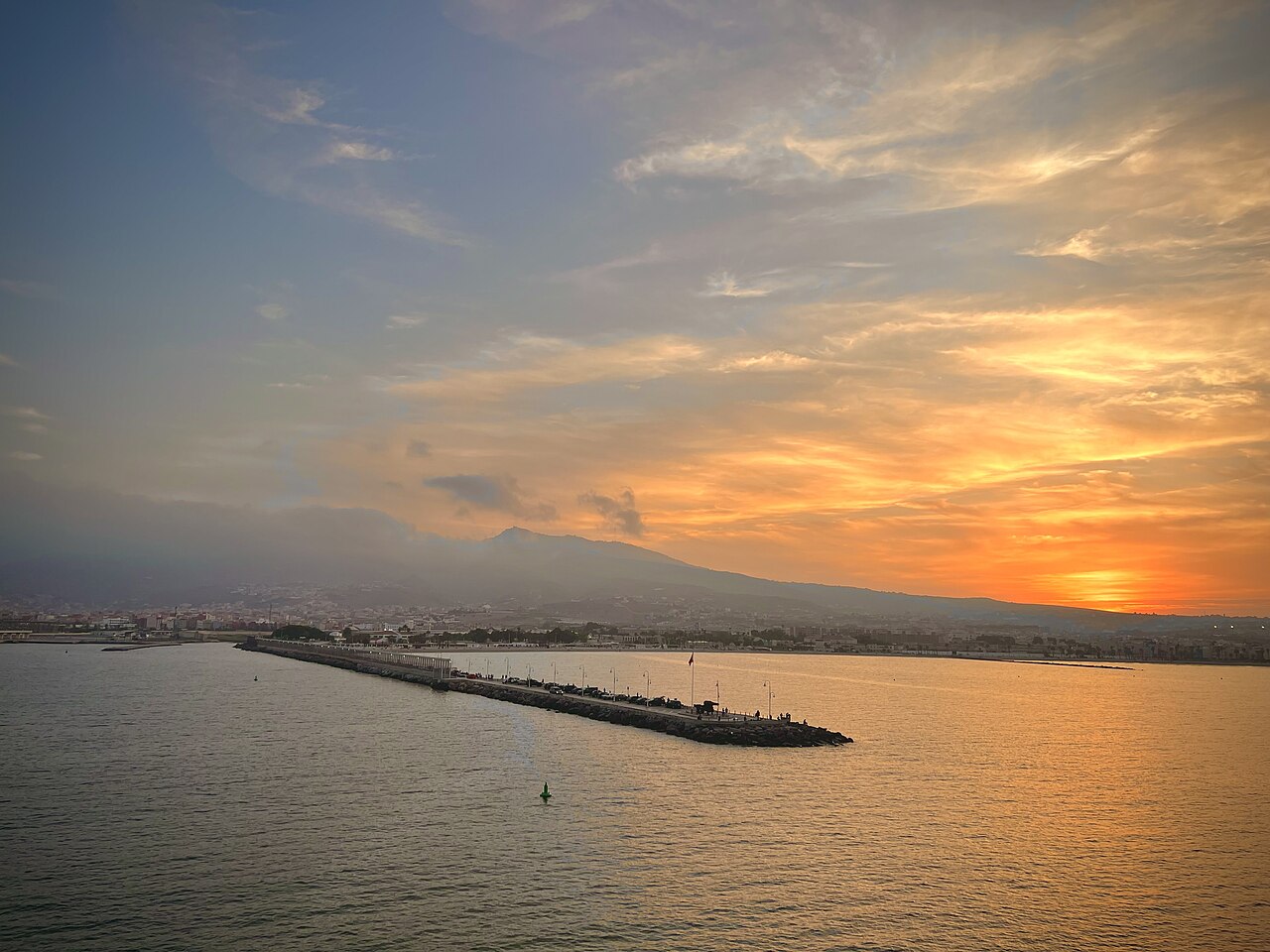
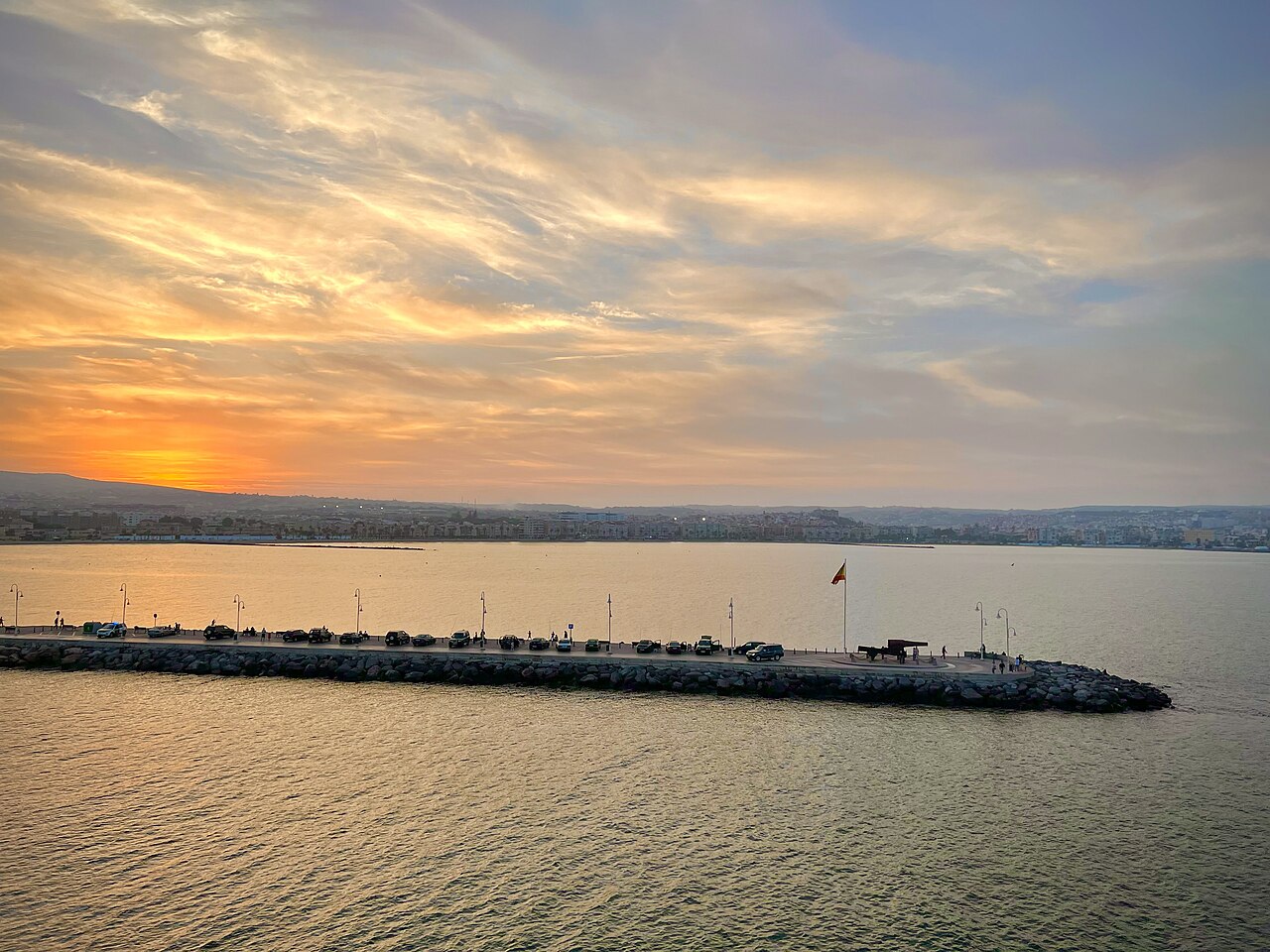
The paseo marítimo, the marina, the Sirena mermaid fountain, and the long harbour mole — a standard evening walk for half the city, and the best place in Melilla to be at sunset.
The neighbourhoods
Beyond the centre are the districts most visitors never see: Cañada de Hidum, La Libertad, Monte María Cristina. Predominantly Amazigh, young, crowded and poorer than the centre, and where the real demographic weight of the city sits. Walking through in daylight is unremarkable; treat them as neighbourhoods, not as sights.
🤝 The Four Cultures
The phrase is on the tourist signage and it is genuinely descriptive: four religious communities with their own places of worship, cemeteries, festivals and public holidays, in a city of twelve square kilometres. What follows is what that actually looks like, including the parts the slogan leaves out.

Christians
Spaniards of peninsular descent, historically the administrative, military and commercial class, and until recently the clear majority. Catholic, with the parish churches, the Semana Santa brotherhoods and the civic calendar that implies. Their share of the population has been falling for decades through emigration to the mainland and differential birth rates.
Muslims
Overwhelmingly Rif Amazigh, Tamazight-speaking, now roughly half of the population and a clear majority of the young. Spanish citizens — most since the citizenship regularisation that followed the protests of 1985–86, which is a recent enough date to matter politically. The Mezquita Central is the main mosque; Eid is an official Melilla holiday.
Jews
A community with medieval roots, greatly enlarged in the nineteenth century by Sephardi families from Morocco, at its height several thousand strong and central to Melilla's commercial boom. Now perhaps a few hundred, aged and shrinking through emigration to Israel and mainland Spain. The Or Zaruah synagogue, designed by Enrique Nieto in 1924, is one of the finest buildings in the city.
Hindus
The smallest community, a few dozen people, descended from Sindhi traders who arrived from the 1890s and ran much of the import business. The Templo Hindú is small and still in use. Their numbers have fallen sharply with the collapse of the cross-border trade.
How well it works
Better than the fence outside would lead you to expect, and less well than the brochure claims. There is real everyday coexistence, mixed schools and workplaces, four sets of public holidays — and there is also residential separation, a clear economic gradient between the centre and the Amazigh neighbourhoods, party politics organised along community lines, and periodic tension. Both halves are true.
What visitors notice
Church bells, the call to prayer, Spanish and Tamazight in the same conversation, halal and Iberian ham in adjacent shops, and a synagogue, a mosque, a Catholic church and a Hindu temple designed by the same architect. For anyone interested in how plural societies actually function, Melilla is worth a great deal more attention than it gets.
🗣️ Spanish and Tamazight
Spanish
The sole official language, universal in administration, education, media and public life, and spoken by essentially everyone. Melillan Spanish is Andalusian in character — aspirated s, dropped consonants — with a good deal of Arabic and Tamazight vocabulary in local use.
Tamazight
Specifically Tarifit, the Rif variety of Amazigh (Berber), the mother tongue of roughly half the population and of the great majority in the Amazigh neighbourhoods. It has no official status in Melilla, which is a long-standing political demand and a recurring argument. It is a language of the home, the street and increasingly of local media, not of the school.
The school problem
Children arriving at school with Tarifit at home and Spanish only from age three are at a measurable disadvantage, and Melilla's educational outcomes are among Spain's weakest. There is no bilingual programme of any scale. This is the single most consequential unresolved issue in the city and it is barely discussed outside it.
Arabic
Present religiously — Quranic instruction, Friday sermons — and in cross-border commerce, but it is not the community's mother tongue: Rif Amazigh is a different language family from Arabic altogether. Assuming Melilla's Muslims are Arabic speakers is the most common outside error about the city.
Haketia and other traces
The Haketia of the Sephardi community — Judeo-Spanish with Arabic and Hebrew elements — survives now only in phrases and family memory. It is one of several linguistic layers in Melilla that are effectively gone.
For a visitor
Spanish is all you need, everywhere. English is limited outside a few hotels. A word or two of Tamazight — azul for hello, tanemmirt for thank you — lands very well in the right shop and costs you nothing.
👥 Young, Crowded and Unequal
The numbers
86,616 residents on 1 July 2026, down 448 in a year — the only Spanish region losing population. The fall is entirely among registered foreign residents; Spanish nationals rose to 75,355. Density is around 7,000 people per km², which is Barcelona territory without Barcelona's transport or space.
Young
Melilla and Ceuta consistently have the highest birth rates in Spain and among the youngest populations. Schools are full, classes are large, and the city's demographic profile looks nothing like the mainland's ageing one.
Housing
The binding constraint. Twelve square kilometres, no room to expand, an old and partly protected building stock, and a young growing population. Overcrowding is common in the outer neighbourhoods and informal building is a persistent problem. Every social issue in Melilla runs through housing at some point.
Inequality
Sharp and geographic. The Modernista centre and the seafront on one side, and the northern and western neighbourhoods on the other, with poverty rates that put Melilla near the bottom of every Spanish social indicator table. The gradient correlates strongly with community, which is what makes it politically explosive.
Unaccompanied minors
Melilla, like Ceuta, receives significant numbers of unaccompanied minors from Morocco and further south, and its reception centre — La Purísima — has been criticised for years by the Ombudsman and by NGOs for overcrowding and conditions. It is a real problem with no local solution, and it is used in Spanish national politics by people who have never been here.
Everyday life
For most residents Melilla is an ordinary small Spanish city: school run, tapas, football, the paseo at seven, the beach in August. The border is background. That ordinariness is the thing most reporting about Melilla leaves out entirely, and it is worth holding on to.
🕌 Four Calendars in One City
The mosques
The Mezquita Central is the principal mosque; there are dozens of smaller ones across the Amazigh neighbourhoods. Friday visibly changes the rhythm of the city. Eid al-Fitr and Eid al-Adha are official public holidays in Melilla — a status they hold in almost nowhere else in Spain.
The churches
The Catholic parishes, with the Iglesia de la Purísima Concepción in the old town as the historic centre. Semana Santa is processed properly, with brotherhoods and bands, in a city where roughly half the onlookers are Muslim — which is exactly the kind of scene Melilla does well.
The synagogue
Or Zaruah, 1924, by Enrique Nieto: horseshoe arches, a Modernista interior and a congregation that has largely gone. It can normally be visited by arrangement or on a guided tour, and it is one of the two or three most beautiful interiors in Melilla.
The Hindu temple
Small, active, and easy to miss. The Templo Hindú serves a community now down to a few dozen families and is a survivor of the Sindhi trading network that once linked Melilla to Gibraltar, the Canaries and West Africa.
The cemeteries
Four of them, separate, and the most direct evidence that this is a real four-community city and not a marketing line: Catholic, Muslim, Jewish and a small Hindu provision. The Jewish cemetery in particular is a record of a community that was once several thousand strong.
Etiquette
Ordinary Spanish norms in the centre; a little more modesty in the outer neighbourhoods and around mosques. Ask before photographing people, particularly women, and particularly at the border — where photography is restricted anyway and where officers will stop you.
🌿 The Little There Is
Nobody comes to Melilla for nature, and it would be dishonest to pretend otherwise. But twelve square kilometres of coast do hold a few things worth knowing about.

Rostrogordo
A pine wood and recreational area in the north of the territory, near the lighthouse, with paths, a campsite and views along the coast. It is the largest piece of green ground inside the perimeter and it is where Melillans go for air.
The Aguadú cliffs
A short stretch of protected coastal cliff on the north-eastern edge, designated a Special Area of Conservation under EU habitat law, with nesting seabirds and endemic coastal flora. Small, genuinely protected and a surprise in a city this dense.
The Chafarinas Islands
Three small Spanish islands about 50 km east, a national wildlife refuge with one of the Mediterranean's most important colonies of Audouin's gull and a monk seal history. They are military and scientific territory; casual visits are not possible, and anyone offering you a trip is misinforming you.
Birds
Melilla's position on the strait-adjacent African coast makes it a decent migration watchpoint in spring and autumn, and the harbour and cliffs hold gulls, terns and waders. Serious birders go to the Moroccan side for the lagoon at Nador, which is far richer and requires a border crossing.
The beaches
City beaches: Los Cárabos, Hipódromo, Horcas Coloradas. Sand, promenade, lifeguards in season, and water quality that is generally good. They are perfectly pleasant and they are not why you have come this far.
The honest summary
Melilla is an urban destination with a coastline attached. If you want the landscapes of North Africa, the border is right there and the Rif is on the other side of it — but that is a different trip, with different paperwork.
🎭 What the City Does With Itself
The festivals
Semana Santa with full Andalusian brotherhood processions; the Día de Melilla on 17 September, marking 1497; Eid al-Fitr and Eid al-Adha as official public holidays; Hanukkah and Diwali marked publicly by their communities. Few cities of 86,000 people run four religious calendars in parallel.
Music
Spanish pop and flamenco alongside Rif Amazigh music — izran, the sung couplets of the Rif, and the modern Amazigh scene that comes over the border from Nador and Al Hoceima on car stereos and phones. The two audiences overlap less than you might hope and more than they used to.
The Modernismo as culture
The Museo del Modernismo, the guided routes and an annual programme of events around Enrique Nieto's legacy. Melilla has worked out that its architecture is its most exportable asset and has been marketing it seriously for about twenty years.
Football
UD Melilla, playing in the lower professional divisions, with the peculiarity that away fixtures mean a flight or a ferry. Copa del Rey draws against big peninsular clubs are the sporting events of the year. Melilla also produces a steady flow of players into the Spanish system.
Bullfighting and its decline
Melilla has a bullring, the Plaza de Toros, and a diminishing tradition. As across Spain, the audience is ageing and the argument is political; here it also maps onto community lines, which makes it quieter than elsewhere.
The written city
Melilla appears in Spanish literature mostly through the Rif wars — the memoirs, the Annual disaster, the generation of writers the campaigns produced. Contemporary Melillan writing, in Spanish and increasingly engaging with the Amazigh experience, exists but is very little translated.
🍽️ Tapas on One Side, the Rif on the Other
Melillan food is Andalusian at its base — this is a Spanish city and it eats like one — with a strong Moroccan and Rif layer, a Sephardi inheritance, and a small Indian trace from the Hindu community. It is the most interesting food in any Spanish city of this size, and almost nothing has been written about it.
The Spanish half
Full tapas culture: gambas, boquerones, ensaladilla, tortilla, croquetas, jamón, and fried fish done Andalusian-style. Melilla eats late, drinks vermouth at midday on Sunday, and takes the paseo before dinner exactly as Málaga does.
The Moroccan half
Pinchitos morunos — small marinated pork or lamb skewers, cumin-and-paprika, grilled over charcoal — are the point where the two cuisines meet and are arguably Melilla's signature street food. Also tajines, couscous on Fridays, harira, and grilled sardines the way they are done all along this coast.
Pastela
The great festive dish: a round pie of paper-thin warqa pastry filled with shredded chicken or pigeon, almonds, eggs cooked in the cooking liquor, cinnamon and orange-flower water, dusted with icing sugar and cinnamon. Sweet and savoury at once. Moroccan in origin, entirely at home in Melilla, and one of the great dishes of the Mediterranean.
The Sephardi trace
Dishes that came with the Jewish families from Tétouan and Fez — adafina, the slow Sabbath stew, sweet-and-savoury tagines with dried fruit, and pastries in honey. As the community has shrunk this cooking has retreated into homes, and it is the layer of Melillan food most at risk of simply disappearing.
Sweets and tea
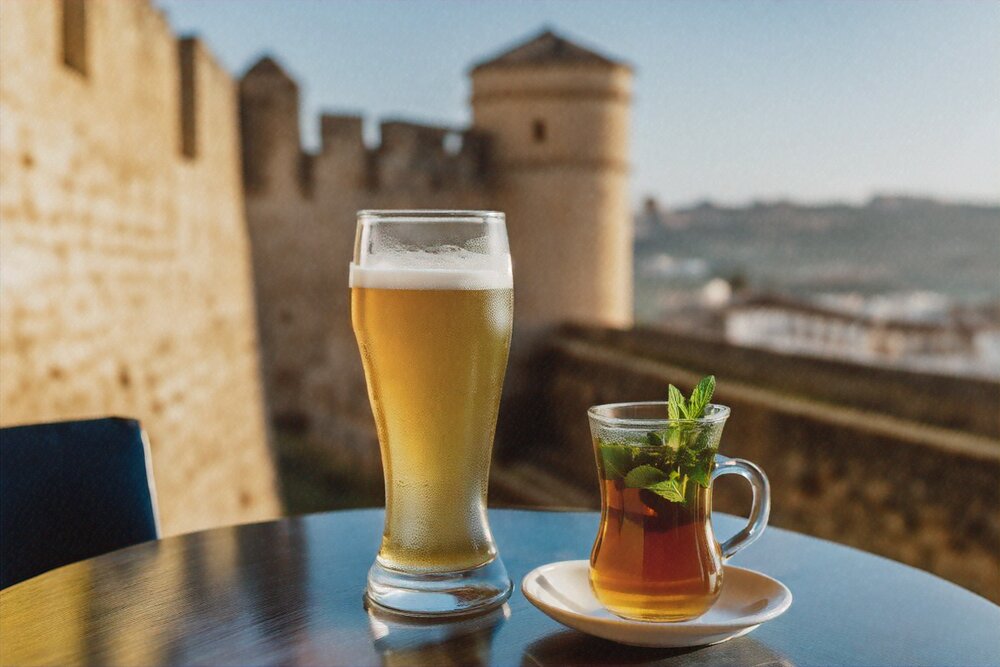
Mint tea, poured from a height, is drunk everywhere by everyone, alongside Spanish coffee. Chebakia, makrout, briouats, honey and sesame, next to Spanish churros and pestiños. This is where the two cultures share a table most easily.
Drinking
Alcohol is legal, cheap by Spanish standards thanks to the IPSI, and openly sold — this is Spain. It is also a city where roughly half the population does not drink, so the bar culture is real but less all-consuming than in Andalusia. Local beer is Spanish; the wine is imported from the peninsula.
👨🍳 Two Recipes From Both Sides of the Fence
One from each half of the city, both genuinely Melillan, both achievable in a European kitchen.
Pinchitos Morunos — Melillan Spiced Skewers
Serves 4 · 15 min prep · 4 h marinating · 10 min grilling · the city's street food
Ingredients: 700 g pork shoulder or lamb leg, cut into 2 cm cubes; 2 tsp ground cumin; 2 tsp sweet paprika; 1 tsp turmeric; ½ tsp ground coriander; ½ tsp cayenne or hot paprika; 3 cloves garlic, crushed; a handful of parsley and coriander, chopped; juice of half a lemon; 3 tbsp olive oil; 1 tsp salt; small wooden skewers, soaked.
Method: Mix every spice with the garlic, herbs, lemon juice, oil and salt into a loose paste. Turn the meat through it until every cube is coated, cover, and refrigerate at least four hours and preferably overnight — this is a marinade dish and short-cutting it is the one way to get it wrong. Thread four or five cubes onto each small skewer, packed close. Grill over charcoal if you possibly can, or under a very hot grill, about 4–5 minutes a side, until charred at the edges and just cooked through. Do not overcook them; they should still be juicy.
💡 Serve immediately with bread, a wedge of lemon and nothing else. In Melilla they come three or four to a plate as a tapa with a beer or a mint tea, and the correct number is always one more than you ordered.
Pastela — Melillan Chicken and Almond Pie
Serves 6 · 1 h prep · 1 h cooking · 40 min baking · the festive dish
Ingredients: 1 chicken (about 1.5 kg), jointed, or 1 kg thighs; 2 large onions, finely sliced; 1 tsp ground ginger; 1 tsp cinnamon plus more for dusting; ½ tsp turmeric; a good pinch of saffron; 100 g butter; a large bunch of coriander and parsley; 6 eggs; 200 g blanched almonds; 3 tbsp icing sugar plus more for dusting; 1 tbsp orange-flower water; 12 sheets of filo (warqa if you can find it); salt and pepper.
Method: Cook the chicken gently with the onions, butter, spices, herbs and a little water, covered, for about an hour, until it falls off the bone. Lift out the meat, shred it and discard skin and bone. Reduce the cooking liquor hard until thick, then beat in the eggs off a low heat and stir until they set into a soft, moist curd — not dry, this is the layer that makes the pie. Fry the almonds in a little butter until golden, cool, then crush coarsely with the icing sugar, a teaspoon of cinnamon and the orange-flower water. Butter a 26 cm round tin and line it with overlapping filo sheets, letting them hang over the edge. Layer: shredded chicken, then the egg curd, then the sweet almonds. Fold the overhang in, top with two more buttered sheets and tuck them down the sides. Bake at 190 °C for about 40 minutes until deep gold.
💡 Turn it out and dust generously with icing sugar and lines of cinnamon — the sweet dusting on a savoury pie is the whole point, and it is what the photograph in the gallery below gets wrong. Eat it warm, with your hands, from the middle of the table.
🍵 Beer and Mint Tea on the Same Table
Mint tea
Té moruno: green gunpowder tea, a great deal of fresh spearmint, a great deal of sugar, poured from a height into small glasses to raise a head. Drunk by everyone in Melilla regardless of community, at any hour, and refused only by the very brave.
Beer
Spanish, cold, and served as a caña with a free tapa in the older bars. The IPSI makes it cheaper here than on the peninsula, which is a fact every visitor from Málaga discovers within an hour of arriving.
Wine and spirits
All imported from mainland Spain — Rioja, Ribera, the Andalusian sherries — and, again, noticeably cheaper than at home because of the tax regime. There is no local production of anything; there is no land to grow it on.
Coffee
Spanish coffee culture in full: solo, cortado, café con leche, taken standing at the bar in the morning. The Modernista cafés around Plaza de España are the places to do it.
Juices and the rest
Fresh orange juice everywhere, horchata in summer, and the North African standbys — almond milk, avocado shakes, and the sweet coffee-with-spices you get in the Amazigh neighbourhoods.
Where to drink
The bars around Plaza de España and along Calle General O'Donnell for tapas and beer; the tea houses in the outer neighbourhoods for the other half of the city; and the seafront for the evening. Doing both in one night is the correct way to spend an evening in Melilla.
🏛️ What Is Protected
No World Heritage site
Melilla has none, and both the fortress and the Modernista city have been mooted as candidates. Nothing has been formally advanced. Given that Melilla holds Spain's second-largest body of Modernista architecture and one of the best-preserved fortress complexes in the western Mediterranean, this is a serious omission rather than a fair reflection of merit.
Melilla la Vieja
Declared a Conjunto Histórico-Artístico in 1953 and the object of a long, well-funded restoration since the 1980s, covering the walls, the cisterns, the caves and the museums. It is the single best-cared-for thing in the city.
The Modernista catalogue
Around 900 catalogued buildings, many individually protected, with grant schemes for facade restoration. Enforcement and money are both limited, and the results range from immaculate to visibly neglected on the same street.
The religious buildings
The Or Zaruah synagogue, the Mezquita Central, the Templo Hindú and the Catholic churches are protected and mostly in good condition. That a single architect, Enrique Nieto, worked on buildings for all four communities is a genuinely unusual piece of architectural history.
The Aguadú cliffs
A Special Area of Conservation under the EU Habitats Directive on the north-eastern coast — the city's only significant natural protection, and small.
What is at risk
The Modernista stock, from money and from unsympathetic alteration; the Jewish heritage, from the simple disappearance of the community that maintains it; and the intangible layers — Haketia, Sephardi cooking, the Sindhi trading world — most of which are already effectively gone. Melilla is better at conserving stone than at conserving memory, which is not unusual.
📅 When to Go
Melilla is a Mediterranean city with a mild, dry climate and no bad season — only a hot one and a wet-ish one. The calendar matters more than the weather here, because the city's four sets of holidays change what is open.
April to June — the best
Warm without being punishing, around 20–26 °C, dry, long light for photographing the Modernista facades and comfortable walking in the fortress. This is when to come.
September and October
Equally good and often quieter: sea still warm, temperatures back down from the summer peak, and the Día de Melilla on 17 September if you want the city in civic mood.
July and August
Hot — 30 °C and up — and humid, with the city's own holidaymakers and the ferry traffic from the peninsula at its peak. Accommodation is tight and prices rise. Also, from experience across the enclaves, the season when border incidents are most likely.
November to March
Mild, 12–18 °C, and this is when what little rain falls arrives. Perfectly viable for a city break — the museums and the fortress do not care about the weather — and the cheapest time to come.
Ramadan
Moves earlier by about eleven days a year and materially changes the rhythm of roughly half the city: different opening hours in the Amazigh neighbourhoods, and a completely different atmosphere after sunset. It is a genuinely interesting time to visit if you go in knowing. Check the dates.
The holidays to watch
Semana Santa (processions, some closures), Eid al-Fitr and Eid al-Adha (official Melilla holidays; much closed), and the Spanish national calendar. A city with four sets of holidays has a lot of days when something is shut.
✈️ Getting There and Getting Around
By air
Melilla Airport (MLN), inside the city, with a short runway and small aircraft — Air Nostrum / Iberia Regional to Madrid, Málaga, Almería, Granada, Seville and Barcelona. Flights are frequent, small, and notoriously prone to cancellation in fog and wind. Never book a same-day onward international connection out of Melilla.
By sea
Ferries from Málaga, Almería and Motril — roughly 6–8 hours, overnight sailings available with cabins, operated principally by Trasmediterránea/Baleària. Slower, much more reliable than the plane, and you can bring a car.
The land border
Beni Enzar is the only crossing. It is open to pedestrians and vehicles in normal times, and it can close without warning — it was shut for about 36 hours from 30 July 2026. Crossing on foot is straightforward for EU citizens with a passport; expect queues and formality on both sides, and do not photograph anything.
Getting around the city
Walk. Melilla is 12 km² and the centre, the fortress and the seafront are all within twenty minutes of each other on foot. There is a city bus network for the outer neighbourhoods, and taxis are cheap and plentiful.
Cars
You do not need one, and parking in the centre is difficult. If you bring one on the ferry, note that taking a Spanish hire car across into Morocco is normally prohibited by the rental contract — check before you assume.
Onward to Morocco
Nador is 12 km away and a taxi from the border is cheap; Nador El Aroui airport serves Europe and Casablanca. This is a genuinely useful onward route into the Rif — but it depends entirely on the border being open, and it needs its own paperwork.
🧭 Practical Matters
Documents
Melilla is Spain, so EU citizens need only an ID card or passport, and the same Schengen rules apply as on the mainland — with the caveat that Melilla and Ceuta have special provisions and Spain checks documents on the sea and air routes to the peninsula. Bring a passport rather than an ID card if there is any chance you will cross to Morocco.
Crossing to Morocco
A separate matter from Schengen. Czech and most EU citizens do not need a visa for Morocco for short stays, but you need a passport, you will get a Moroccan entry stamp, and you must be able to get back — which is not guaranteed if the crossing closes. Never cross with less time than you can afford to lose.
Money
The euro, Spanish banks, cards accepted everywhere in the centre, ATMs plentiful. Small shops and taxis prefer cash. Moroccan dirhams are useful only across the border and cannot legally be taken out of Morocco in quantity.
Health
Spanish public health service; the European Health Insurance Card works. The Hospital Comarcal de Melilla is the city hospital; complex cases go to the peninsula by air. No vaccinations are needed for Melilla itself. If you plan to cross into Morocco, check the usual travel-health advice for Morocco separately.
Safety
Melilla is an ordinary Spanish city with ordinary Spanish urban crime — pickpocketing, occasional car break-ins — and a very heavy police and Guardia Civil presence. It is not dangerous for visitors. Do not photograph the fence, the crossing, military installations or officers; this is enforced, and it is the single most likely way for a tourist to have a bad afternoon here.
Connectivity and advice
Spanish mobile networks, EU roaming, good coverage. Watch your phone switching to a Moroccan network near the border and charging you roaming — turn off automatic selection. Czech travellers should register with DROZD (MZV ČR) if they intend to cross into Morocco, and read the ministry's current advice for both countries.
🛡️ The Border and Common Sense
This section exists because Melilla's reputation abroad is built almost entirely on images of the fence, and that reputation is both misleading and worth taking seriously in specific, limited ways.
The city is not the border
Nothing that happens at the perimeter happens in the Modernista centre, the fortress or the seafront. In July 2026, while Ceuta was in crisis, Melilla's tourists carried on having lunch. Do not confuse a news photograph with the place.
But the border does close
Without warning, for hours or days, on either side's decision. Never build an itinerary that depends on a specific crossing at a specific time, and never leave luggage, a hotel or a flight on the far side of it.
Photography
The one hard rule. The fence, the Beni Enzar crossing, the port's secure areas, military installations, and Guardia Civil and police personnel are all off limits. Cameras have been confiscated and phones inspected. There is nothing there you need a picture of.
Demonstrations
Melilla has periodic protests — over housing, over policing, over the border, over national politics. They are usually small and peaceful. Standard advice applies: watch from a distance, do not film officers, leave if it changes character.
Being asked for papers
You may be. This is a border city with heavy security and identity checks are routine and legal. Carry your document, be polite, and it takes a minute. Objecting on principle is a way to make it take an hour.
What actually goes wrong
Cancelled flights, in fog. A closed border on the one day you planned to cross. A museum shut for a holiday you did not know about. Budget for all three and Melilla is an easy, pleasant and completely safe place to spend three days.
💶 What It Costs
Melilla is cheaper than mainland Spain for some things and dearer for others, and the dividing line is the tax regime. Anything taxed — fuel, tobacco, alcohol, electronics — is noticeably cheap. Anything shipped in from the peninsula, which is most food and most goods, carries a freight premium.
Sleeping
A modest hotel or hostal €45–70 a night; the better mid-range hotels in the centre €75–110; the Parador de Melilla, with its view over the city, more. The stock is small — perhaps a dozen serious options — so book ahead, particularly in August.
Eating
A caña with a free tapa €2–3. A plate of pinchitos €5–8. A menú del día €12–16. A proper dinner out €25–40. This is Andalusian pricing, which by northern European standards is a bargain.
Getting there
The flight from Madrid or Málaga is the expensive part and varies wildly — anywhere from €60 on a sale to €250 return at short notice. The ferry from Málaga or Almería runs roughly €40–90 each way for a seat, more for a cabin, and is often the better deal.
Getting about
You will walk. A taxi across town €5–8; a city bus about €1; a taxi from the border into Nador, a couple of euros' worth of dirhams.
Museums and sights
Cheap or free. The fortress museums and the Cuevas del Conventico charge a few euros; the Modernista route costs nothing but your legs. A full day of sightseeing in Melilla can be done for under €20.
A realistic daily budget
€70–90 a day staying in a hostal and eating tapas. €130–160 with a decent hotel and restaurants. Melilla is one of the better-value city breaks in Spain, and the reason is simply that almost nobody goes.
🚗 Getting Out of Twelve Square Kilometres
Three days is enough for Melilla itself. If you have more, everything else is across the border — which makes this section entirely contingent on that border being open.
Nador
12 km away, a Moroccan city of a few hundred thousand on the Mar Chica lagoon, with a big market, good grilled fish and none of Melilla's Spanishness. Half a day. It is the obvious first step across and the easiest.
The Mar Chica
A large coastal lagoon south of Nador, separated from the sea by a sand bar, with birdlife, a corniche and a very large stalled development project. Genuinely worth seeing and easy from Nador.
Cap des Trois Fourches
The dramatic headland north of Melilla — cliffs, a lighthouse, small coves and almost nobody. It is Moroccan territory and reached from the Moroccan side; the road is rough and a taxi or a hired driver from Nador is the way to do it.
The Rif
Al Hoceima and its national park are around three hours west along the coast, and Chefchaouen further still. This is a proper trip rather than a day out, and it is the best reason to treat Melilla as a starting point rather than a destination.
Ceuta
Melilla's sister enclave, 200 km west as the crow flies — but there is no practical direct route. In reality you fly or sail to the peninsula and come back down, or you drive the length of the Moroccan Rif coast. Nobody does this casually.
The paperwork, again
Every one of these requires crossing at Beni Enzar, a passport, a Moroccan entry stamp, and the border being open in both directions on the day. Do not take a hire car across. Do not plan a flight home for the evening you come back.
🇨🇿 Notes for Czech Visitors
Getting there
Prague to Madrid, Málaga or Barcelona — all direct and often cheap — then the short Air Nostrum hop to Melilla, or the ferry from Málaga or Almería. Realistically 8–12 hours door to door, and you can usually do the whole thing for well under 10,000 Kč return if you book the two legs separately.
Documents
Melilla is Spain and the EU, so a Czech ID card is enough to get there. But bring a passport — you will want it if you cross to Nador, and Melilla and Ceuta have their own Schengen provisions with document checks on the routes to the peninsula.
Money and health
Euro, so nothing to change. The Czech EHIC works in the Spanish public system exactly as on the mainland. There is one hospital; anything complicated is flown to the peninsula. Ordinary travel insurance is fine — this is not Mayotte.
Language
Spanish, and effectively only Spanish. English gets you through a hotel desk and not much else. Czech travellers with school Spanish will manage easily; those without will find Melilla harder work than Barcelona.
If you cross to Morocco
Czech citizens do not need a visa for Morocco for short stays, but you need a passport and you need the border open. Register with DROZD, the MZV ČR travel registry, and read the ministry's current advice for Morocco — not just for Spain, which is what the destination looks like on paper.
Why a Czech traveller would come
Because it is the cheapest and easiest way for a Central European to stand in Africa, in the European Union, in a Modernista city, inside a sixteenth-century fortress, in the same afternoon — and because almost no Czech has been. As an add-on to an Andalusian trip it costs two days and is worth four.
🤯 Things That Are Genuinely Strange About Melilla
Spain has been here longer than in half of Spain
Melilla has been continuously Spanish since 1497 — before Navarre joined Castile, before the Canaries were fully subdued, and two hundred years before Britain took Gibraltar. The enclave is not a colonial afterthought; it predates the modern Spanish state.
The border was drawn by cannon
The 1860 Treaty of Wad-Ras settled Melilla's boundary as, in effect, the ground within cannon-shot of the fortress. The modern twelve-kilometre fence still broadly follows a line established by the range of nineteenth-century artillery.
Second only to Barcelona
Melilla holds the second-largest concentration of Modernista architecture in Spain — around 900 buildings — almost all by one architect who had worked in Gaudí's circle and then spent forty years in a city of twelve square kilometres. Practically nobody outside Spain has heard of Enrique Nieto.
Eid is a public holiday
In a Spanish city, by law, Eid al-Adha is an official public holiday — one of the very few places in the European Union where an Islamic festival has that status. Melilla runs four religious calendars simultaneously and closes for all of them.
One architect, four faiths
Enrique Nieto designed the synagogue, worked on the Central Mosque, built for the Hindu community and produced Catholic buildings — all in the same small city, in the same three decades. It is hard to think of a parallel anywhere.
The Civil War started here
The military rising that became the Spanish Civil War broke out in Melilla on 17 July 1936, hours ahead of the mainland. One of the twentieth century's defining European conflicts began in a garrison town in Africa that most Europeans still cannot place.
🔮 What Happens Next
The customs, again
Everything economic turns on whether the commercial customs at Beni Enzar becomes real. It reopened in 2023 to considerable fanfare and recorded 46 goods movements in the year to March 2026. If that changes, Melilla has a future as a trading port; if it does not, the city stays an administrative enclave living on transfers.
Population decline
Melilla is now the only Spanish region losing population, and it is losing it from the foreign-resident register while Spanish nationals rise. That is a specific consequence of tightened border and residence policy, and it is a demographic squeeze on a city whose economy is already thin.
The autonomous-community question
The long campaign for full comunidad autónoma status was, in March 2026, tied by President Imbroda to a change of government in Madrid. It is unlikely to move before the next Spanish general election, and possibly not then.
The border, indefinitely
July 2026 demonstrated both that the fence works and that Melilla's security depends on Moroccan cooperation that can be withdrawn. Nothing about that arrangement is going to change. Expect more crises, more fence, more Spanish deployments, and no negotiation on sovereignty from either side.
Tourism as the plan B
The city's own strategy is heritage tourism — the fortress, the Modernismo, the four cultures — and it is a sensible plan with a hard ceiling: a dozen hotels, a small airport with cancelled flights, and a reputation abroad built on fence photographs. It can grow a great deal from a very low base and will never be an industry.
The realistic outlook
Melilla stays Spanish, stays small, stays subsidised, and stays interesting. It will not be resolved, negotiated away or transformed. The likeliest future is much like the present — which, for a city that has been besieged, bombarded and argued over for five centuries, is not the worst outcome available.
🧳 Should You Actually Go?
Go if
You like Modernista and Art Deco architecture and want to see Spain's second city of it with no crowds. You like fortresses and want a complete four-enclosure one with caves underneath. You are interested in how a genuinely plural society works day to day. Or you are already in Andalusia and want two days somewhere nobody you know has been.
Don't go if
You want beaches, nightlife or landscape — Andalusia and Morocco both do all three better and cheaper. You need English. Or you are going principally to look at the border, which is both prohibited to photograph and a poor reason to travel.
The two-day version
Day one: the Golden Triangle of Modernismo in the morning light, Plaza de España, lunch on tapas, the Museo del Modernismo, and the seafront at sunset. Day two: Melilla la Vieja — the first enclosure, the Cuevas del Conventico, the museums and the ramparts — then Parque Hernández, mint tea, and dinner.
Travelling decently here
Spend in local bars and hotels rather than the one chain. Learn that the city is not the fence, and do not treat the outer neighbourhoods as an attraction. Do not photograph the border, the crossing or officers. And take the four-cultures claim seriously enough to actually visit more than one of the four buildings.
What it is really like
Quiet. Melilla receives very few leisure visitors and is not organised around them, which means empty museums, unhurried bars, and a city getting on with its own life while you look at it. If that appeals, you will like it a great deal.
The verdict
One of the most interesting small cities in the European Union and one of the least visited, for reasons that have almost nothing to do with what it is actually like to be there. Two or three days, ideally attached to Málaga. Go before someone writes the guidebook.
📸 Gallery — Eight Photographs Recovered, One Recipe Rejected
This page is a break in the pattern. The old Melilla page hotlinked eight photographs from Wikimedia Commons, and unlike the four previous countries in this series, all eight files genuinely exist. What was wrong was the addresses: every one of the eight URLs carried an invented hash-prefix directory, so every image returned 404 and the old page showed eight blank frames. The correct paths were recovered from the Commons API and all eight now load. They are the photographs used throughout this page.
The eight recovered photographs
Melilla desde los tejados (the rooftop panorama, the best of the set), Plaza de España (3), Melilla – Plaza de España – Centro, Melilla. Sirena, Melilla, Spain and Melilla, Spain – sunset (the harbour mole), Melilla la vieja (the sea below the walls) and Encuentros (the Corten steel sculpture). All are on Wikimedia Commons, all now load, and all are used above with captions that describe what is actually in them.
A third defect class
This is new. The earlier countries in this series carried Commons URLs whose file titles did not exist at all — eight of eight checked, across Martinique, Réunion, New Caledonia and Mayotte. Melilla's eight have real titles and invented directory paths (6/62 for 7/78, 1/13 for d/d9, and so on). The symptom is identical — a blank frame — but the fix is completely different: these were recoverable. Any site-wide sweep has to check both, and has to check that URLs resolve rather than that titles exist.
Rejected: the pastela photograph
melilla-pastela.jpg shows a wedge of pastry with a smooth, set, pale-yellow custard filling — a lemon or crema tart. Pastela is not a custard tart. It is a round pie of paper-thin warqa pastry filled with shredded chicken or pigeon, crushed almonds and eggs cooked in the spiced cooking liquor, sweet and savoury at once. The icing-sugar-and-cinnamon dusting in the image is correct and is the dish's signature; everything under it is wrong. Not used, and the recipe above describes the real thing.
The two-image pattern holds
Melilla is the fifth consecutive country to yield exactly 01-hero.jpg plus <slug>-drink.jpg and a small number of recipe files — after Martinique, Mauritania, Mauritius and Mayotte. Five in a row is not a coincidence about these five places. Something in how the image set was built produced this shape, and it needs investigating directly rather than one country at a time.
What is still missing locally
There is no local image of the Modernista facades, of Melilla la Vieja's walls, of the Or Zaruah synagogue, of the Cuevas del Conventico, of Parque Hernández, or of any of the four communities. The recovered Commons photographs cover the city and the seafront well and cover the architecture and the religious buildings not at all — which for a city whose main asset is its architecture is the gap that matters.
CORRECTION, added 2026-09-07
The S3 connection came back later the same day and this list was wrong. The bucket holds 13 files for Melilla, not two: 01-fortress.jpg, 02-modernist.jpg, 03-harbor.jpg, 04-plaza.jpg, 05-coast.jpg, 06-oldtown.jpg, 07-church.jpg, 08-beach.jpg, 09-market.jpg, 10-sunset.jpg and wine-tea.jpg alongside the two named above. The HTTPS probing that produced the original list tested 02.jpg and 02-hero.jpg but never 02-modernist.jpg, and a guessing method only finds names you think to guess. The "two-image pattern" reported here and on four other pages was largely an artefact of that method. These eleven files have not yet been opened and inspected, so they are not used on this page; that is a job for a later pass. Recorded rather than quietly deleted.
How this list was made
By systematic HTTPS probing of the bucket, because the AWS connection has now been unavailable for ten consecutive countries, plus a full Commons API check of every hotlink on the old page and an HTTP check of every corrected URL. Treat the local list as a minimum — a proper bucket listing is owed for the whole run from Luxembourg onward.
Support This Project 🌍
This World Travel Factbook is a labor of love – free to use for all travelers. If you find it helpful, consider supporting its continued development.