

🇾🇹 Mayotte at a Glance
🌍 Overview — France, and Not Like France At All
Mayotte is a French department and an outermost region of the European Union, in the Mozambique Channel between Madagascar and the African mainland. It uses the euro, votes in French and European elections, and is administered from Paris. It is also, by every measure, the poorest place in the French Republic and the poorest region in the European Union, with around three quarters of the population living below the French poverty line.
It is 374 km² — a fifth the size of Prague — and the official population is about 320,000. Local officials and the census itself both suggest the real figure is considerably higher, and the gap between those two numbers is the single most contested statistic in the territory.
Where it is
In the northern Mozambique Channel, at the eastern end of the Comoro archipelago: Grande Comore, Mohéli and Anjouan make up the independent Union of the Comoros, and Mayotte is the fourth island. Anjouan is about 70 km away and visible from Mayotte's western coast, which is a fact that explains a great deal of what follows.
Two islands
Grande-Terre (363 km²), the main island, and Petite-Terre (11 km²) across a channel, connected by a frequent ferry known as the barge. The airport and the old colonial capital are on Petite-Terre; the population, the port and the modern capital Mamoudzou are on Grande-Terre.
The lagoon
The reason to come: a 1,500 km² lagoon enclosed by 195 km of barrier reef, with — unusually, and one of very few in the world — a double barrier reef on the south-west side. It is among the largest and most fully enclosed lagoons anywhere and it is Mayotte's genuine world-class asset.
Who lives there
Overwhelmingly Muslim — around 95%, Sunni of the Shafi'i school — and culturally Swahili-Comorian with a strong Malagasy element. The mother tongues are Shimaore, a Comorian Bantu language, and Kibushi, derived from Malagasy. French is the language of the state and of schooling and is a second language for most people.
Contested
The Union of the Comoros claims Mayotte and has done since 1975, and the UN General Assembly has passed more than twenty resolutions supporting that claim. France's position is that Mayotte voted repeatedly and decisively to remain French. Both of those statements are true and neither side has moved.
2026 in one line
Mayotte became a unified territorial collectivity on 1 January 2026; the refoundation programming law was adopted in August 2025; an exceptional census ran from November 2025 to January 2026 to establish how many people actually live here; and in August 2026 Prime Minister Sébastien Lecornu set out a reconstruction plan for an island where, twenty months after Cyclone Chido, rebuilding has been slow.
🏷️ Maore, and the Island of Death
The local name is Maore — hence Mahorais for the people and Shimaore for the language. Mayotte is the French rendering, and the older Arabic-derived form Mawtu or Jazīrat al-Mawt has sometimes been glossed as "island of death", probably from the reefs that wrecked ships approaching it. Mahorais generally prefer Maore, and it appears on political banners and in song.
Shimaore and Kibushi
Two unrelated mother tongues on one small island. Shimaore is a Comorian language of the Bantu family, closely related to Swahili and to the varieties spoken on Anjouan. Kibushi is a Malagasy language, brought by settlers from Madagascar, and is spoken mainly in villages on the west and north of Grande-Terre. Neither is an official language; both are what people actually speak at home.
French, and the school gap
French is the sole official language and the language of all education from primary school onward. For most Mahorais children it is a language they meet first at school, which is a large part of why educational outcomes here trail the mainland so badly. Recent policy has begun to introduce Shimaore and Kibushi in early years, which is contested and overdue.
The Comorian question of identity
Mayotte is culturally, linguistically and by kinship part of the Comoro archipelago, and politically part of France. Families are split across the sea border. Mahorais overwhelmingly and repeatedly voted to be French — and remain culturally Comorian. Anyone who describes this as a simple case, in either direction, is not describing it accurately.
Why Mayotte chose France
The usual account is the influence of the Mouvement Populaire Mahorais and the chatouilleuses — the "ticklers", a movement of Mahoraise women who campaigned, sometimes physically, against politicians favouring independence in the 1960s and 70s. Underlying it were long resentments about the archipelago's administration being run from Grande Comore after the capital moved from Dzaoudzi in 1958.
The flag question
Mayotte has no official flag of its own — it flies the French tricolour. An unofficial local emblem showing two seahorses and the crescent, based on the departmental coat of arms, is widely used. The motto on it, in Shimaore, is Ra Hachiri — "we are vigilant".
What Mahorais call themselves
Mahorais, and French, and Muslim, in an order that depends who is asking. The territory's official name in French is simply the Département de Mayotte; since 1 January 2026 it is administered as a single territorial collectivity combining the departmental and regional roles.
🗺️ The Oldest Island in the Archipelago
Mayotte is the eldest of the Comoros — volcanic, roughly eight million years old, and therefore thoroughly eroded. Where Grande Comore still has an active volcano nearly 2,400 m high, Mayotte has rounded green hills, deeply weathered red laterite soil, and a highest point of just 660 m at Mount Benara. The island has sunk and worn down far enough that the reef, which kept growing, ended up a long way offshore — which is exactly how the lagoon got so large.
The shape of it
Grande-Terre is about 39 km long and 22 km wide, with a spine of hills, deeply indented bays, and mangrove along much of the coast. Mount Choungui (594 m) in the south is the distinctive cone-shaped peak everyone climbs. Petite-Terre is a separate small island built from more recent volcanic craters, one of which holds the Dziani Dzaha lake.
Fani Maoré — the volcano that is real
In May 2018 Mayotte began experiencing thousands of earthquakes and started sinking and shifting eastward by centimetres. In 2019 a French research cruise found the cause: a brand-new submarine volcano 50 km east of the island, on the seabed at about 3,500 m, which had grown 820 m tall. Named Fani Maoré, it is the largest submarine eruption ever documented, and it is monitored continuously.
The soil and the erosion
Deep red laterite, and highly erodible once the forest is cleared. Deforestation for slash-and-burn cultivation on the hillsides has produced serious runoff, which silts the lagoon and damages the reef. This is one of the territory's most consequential environmental problems and it is directly connected to poverty and land pressure.
Climate
Tropical maritime, hot and humid all year. The kashkazi, the hot wet north-westerly monsoon, runs roughly November to April and brings the rain and the cyclones; the kusi, the cooler dry south-easterly, runs May to October. Temperatures sit between about 24 and 31 °C with very little seasonal range.
The water problem
Despite the rain, Mayotte has a chronic water crisis. Two reservoirs and a small desalination plant serve a population that has grown far faster than the infrastructure, and in the drought of 2023 the territory went onto rationing that at its worst gave many households water one day in three. It was a public-health emergency and contributed to a cholera outbreak in 2024. A new desalination plant is central to the current reconstruction plan.
Cyclones
Mayotte sits in the south-west Indian Ocean cyclone basin, and had been comparatively lucky for decades — until 14 December 2024. Chido has its own section below.
🐠 The Lagoon — Genuinely World Class
This is the thing Mayotte has that almost nowhere else does. A 1,500 km² lagoon, one of the largest enclosed lagoons in the world, ringed by 195 km of barrier reef with about a dozen passes through it — and on the south-western side, a double barrier reef, an outer and an inner reef separated by a deep channel, a formation found in only a handful of places on earth.
The Passe en S
The signature dive site: an S-shaped channel through the outer reef on the west side, with drop-offs, coral gardens, turtles, reef sharks, eagle rays and a real chance of dolphins. It is the single best-known piece of underwater Mayotte and is consistently rated among the finest sites in the Indian Ocean.
Turtles
Mayotte is one of the most important green turtle nesting sites in the western Indian Ocean, with hawksbills as well. Saziley and Papani beaches see nesting females most nights of the year, and there are organised night observation programmes run under strict rules. Turtle poaching for meat remains a real and prosecuted problem.
Whales and dolphins
Humpback whales calve inside and around the lagoon between roughly July and October, and Mayotte is one of the better places in the world to see mothers with calves in shallow, clear water. Resident spinner and bottlenose dolphins are present year-round, and there is a small resident population of dugongs — critically endangered here, and down to a handful of animals.
The Îlot de Sable Blanc
A pure white sandbank that appears in the middle of the lagoon at low tide and disappears at high, reached by boat, and the single most photographed thing in Mayotte. Its size and position shift; it is smaller than it was.
The Marine Nature Park
The whole lagoon and the surrounding waters — around 68,000 km² including the exclusive economic zone — were designated the Parc naturel marin de Mayotte in 2010, France's largest marine park. Enforcement across an area that size with the resources available is the obvious difficulty.
The pressures
Sediment runoff from deforested hillsides smothering coral; bleaching in the warming events of 1998 and 2016; overfishing of the inner lagoon; anchor damage; and plastic. The reef is in noticeably worse condition than twenty years ago, and the science on it is good because the park monitors it properly.
🕌 Sultans, Slavers and a Purchase
Settlement
Austronesian and Bantu-speaking settlers reached the Comoros from around the eighth century, and the archipelago became part of the Swahili trading world of the East African coast — a network of Muslim city states dealing in gold, ivory, cloth and enslaved people between Africa, Arabia and India. Mayotte's Kibushi-speaking villages preserve the Malagasy strand of that settlement.
The Shirazi sultanate
By the fifteenth century Mayotte had a sultanate whose ruling families claimed Shirazi Persian descent, as elsewhere on the Swahili coast. Islam has been the religion of the island for roughly a thousand years, which is important context for a place now often described in French politics as a recent frontier.
Raids and ruin
The late eighteenth and early nineteenth centuries were catastrophic. Malagasy raiders — the Betsimisaraka and Sakalava — attacked the Comoros repeatedly for slaves, and Mayotte was depopulated to perhaps a few thousand people. It is against this background that a Sakalava prince, Andriantsoly, having lost his own kingdom in Madagascar, ended up as sultan of Mayotte.
The sale, 1841
On 25 April 1841, Andriantsoly sold Mayotte to France for an annuity and the education of his sons in Réunion. France wanted a naval station in the Mozambique Channel. The purchase is the legal basis of the French presence, it is disputed by the Comoros as the act of a foreign usurper, and it is also the reason Mayotte's history diverged from the other three islands a full thirty years before they became a French protectorate.
The colonial period
France abolished slavery in Mayotte in 1846, imported indentured labour, and ran sugar plantations that failed, then turned to ylang-ylang, vanilla and copra. The capital sat at Dzaoudzi on Petite-Terre and administered all four Comoros — until 1958, when it moved to Moroni on Grande Comore. That move is the origin of Mahorais resentment and, ultimately, of the decision of 1974.
The chatouilleuses
From the 1960s a movement of Mahoraise women campaigned against the Comorian independence parties and for remaining French, and became known as the chatouilleuses — the ticklers — for their tactic of physically immobilising visiting politicians. They are national figures in Mayotte, with monuments, and they are the reason the island's political trajectory went the way it did.
🗳️ Four Votes, Thirty-Seven Years
Mayotte's status was decided by referendum, repeatedly, over more than three decades, and the results were never close. That record is France's entire answer to the Comorian claim, and it is a strong answer — with a complication about how the 1974 vote was counted that critics have never let go.
22 December 1974
The Comoros voted on independence. Across the archipelago the result was 94.6% in favour — but Mayotte voted 63.8% against. France then chose to count the results island by island rather than as a single territory. The Comoros declared independence unilaterally in July 1975; Mayotte stayed. Whether counting separately was legitimate is the crux of the entire dispute.
1976 and after
A confirmatory referendum in February 1976 produced 99.4% for remaining French, on a turnout of over 80%. The UN General Assembly rejected the vote and has adopted a long series of resolutions affirming Comorian sovereignty. Mayotte was left in an odd intermediate status — a collectivité territoriale — for the next three decades, wanted by France's own state less than by its own population.
29 March 2009
The decisive one. Mahorais voted 95.2% in favour of becoming a full French department, on a turnout of 61%. The campaign was explicit that this meant applying French law in full, including in areas of personal status law that would change local practice substantially.
31 March 2011
Mayotte became the 101st department of France and its fifth overseas department. In 2014 it became an outermost region of the European Union, which brought EU structural funds and EU law. Both changes were what the population had asked for.
What departmentalisation changed
Polygamy and unilateral repudiation were abolished for new marriages; the minimum age of marriage was raised; the customary cadi courts lost their civil jurisdiction. French social benefits were extended, though at rates that started far below the mainland and are still converging. The refoundation law of August 2025 is the latest instalment of that convergence.
The Comorian position
The Union of the Comoros continues to claim Mayotte, keeps a seat for it in its own constitution, and does not recognise the border. In practice it also cooperates with France on some matters and depends heavily on remittances from Comorians in France. The claim is real, the cooperation is real, and neither cancels the other.
🌀 14 December 2024
Cyclone Chido crossed Mayotte on the morning of 14 December 2024 as a category 4 system with sustained winds around 200 km/h and gusts well above that. It was the most powerful cyclone to strike the island in roughly ninety years. It went almost directly over the whole territory, and it hit the one kind of housing least able to survive it.
What it destroyed
The bangas and shantytown quarters — sheet-metal and breeze-block housing on the hillsides, home to something like 100,000 people, a large share of them undocumented migrants — were substantially destroyed. The French Red Cross reported most of the island's informal settlements flattened. Power, water, telecommunications and the hospital were all badly damaged, and the airport terminal roof was torn off.
The death toll, honestly
This is the hard part. The prefect said in the first days that the toll might reach several hundred, perhaps a thousand or more. The confirmed official figure settled at around forty. Those numbers cannot both be right, and the reason for the gap is that a large undocumented population has strong reasons to avoid officials, is not on any register, and buries its dead quickly under Islamic practice. The honest position is that the official figure is a floor and nobody knows the real number.
What followed
A state of emergency, a military airlift, water and food distribution, and a public argument about whether a French department had been left dangerously under-prepared. President Macron visited on 19 December and was heckled. Five weeks later, on 11 January 2025, Storm Dikeledi passed close by and brought flooding and landslides to a territory that had no roofs left.
The legal aftershock
Chido intensified the French political argument about Mayotte's undocumented population. A special law for Mayotte passed in early 2025 with emergency reconstruction powers, and separate legislation tightened the already-restricted rules on birthright citizenship in Mayotte — Mayotte has for years been the one part of France where droit du sol is applied more narrowly than elsewhere, and it was narrowed again.
Where reconstruction stands
Slower than promised. The refoundation programming law was adopted on 11 August 2025, setting out a multi-year convergence and rebuilding programme. By mid-2026 around 1,500 homes were reported under construction, and in August 2026 Prime Minister Sébastien Lecornu set out an accelerated plan including a second hospital, a new airport, a desalination plant and a second prison. A year and a half on, a great many people were still in temporary shelter.
Why it hit this hard
Because the housing was informal, the terrain is steep and deforested, the population is far larger than the infrastructure was built for, and the poorest people had nowhere to shelter that was not made of sheet metal. Chido was a natural event; the scale of the damage was a function of everything described elsewhere on this page.
🏛️ How It Is Governed, and 2026
Since 1 January 2026 Mayotte has been administered as a single territorial collectivity, merging what were the departmental and regional functions into one assembly — the same model adopted in Martinique and French Guiana. The change was made explicitly to speed up reconstruction and the convergence of Mayotte's rights and services with the rest of France.
The institutions
A prefect representing the state, with unusually wide powers here; an elected assembly with an executive president; 17 communes; two deputies in the National Assembly and two senators in Paris; and one seat in the European Parliament elections. French law applies, with a shrinking list of local adaptations.
The refoundation law
Adopted 11 August 2025: a programming law setting a timetable for bringing Mayotte's social benefits, minimum wage, health system and infrastructure toward mainland levels, alongside reconstruction. It matters because Mayotte has been a department since 2011 while receiving social provision at rates well below the mainland, which is the structural grievance behind most local politics.
The August 2026 plan
Prime Minister Sébastien Lecornu set out an accelerated package covering reconstruction, development aid, immigration enforcement and an increased security and military presence. Named projects include a second hospital, a new airport capable of taking long-haul aircraft directly, a desalination plant and a second prison. Whether these are delivered is the test everyone on the island is applying.
The census that mattered
From 27 November 2025 to 10 January 2026, around 800 enumerators carried out an exceptional census. The purpose was blunt: nobody knew how many people live in Mayotte. INSEE's figure was around 320,000–329,000; local elected officials routinely say 500,000. Every calculation about hospitals, schools, water and housing depends on which number is right.
Local politics
Dominated by the question of immigration and by the demand for equal treatment with the mainland — a combination that has made Mayotte fertile ground for the French far right, which has won large majorities here in recent national votes. That result surprises people who assume a 95% Muslim, overwhelmingly non-white electorate would vote otherwise, and it is entirely explained by the immigration issue.
Security
Gang violence involving young people, much of it linked to poverty and to the informal settlements, is a persistent problem and has produced periodic roadblocks, school closures and "dead island" strikes. Reinforced gendarmerie deployments are a recurring response. It is a genuine issue for residents; it very rarely touches visitors.
🛶 Seventy Kilometres of Sea
Anjouan, in the independent Comoros, is about 70 km from Mayotte and visible on a clear day. On one side of that water is one of the poorest countries in the world; on the other is the European Union, with French hospitals, French schools and French social security. That gradient, across a short stretch of open sea, produces everything in this section.
The kwassa-kwassa
Small open fibreglass fishing boats, typically carrying twenty to fifty people, crossing at night. The crossing takes several hours in an open boat across a channel with strong currents. Estimates of the number who have drowned attempting it since the 1990s run into the thousands to tens of thousands; nobody has a reliable figure, which is itself part of the story.
The visa Balladur
Until 1995, Comorians moved freely between the four islands, as they had for centuries. In that year France introduced a requirement for a specific visa to enter Mayotte, which is very hard for ordinary Comorians to obtain. Free movement within an archipelago became clandestine sea migration essentially overnight, and the death toll dates from that decision. It is defended as necessary border control and attacked as the direct cause of the drownings.
The numbers
INSEE has found that roughly half of Mayotte's residents are foreign nationals, the great majority Comorian. In the first half of 2026 alone, around 16,000 people were deported — from a territory whose official population is about 320,000. Many return within weeks. Mayotte carries out a large share of all removals from French territory.
Operation Wuambushu
In 2023 France launched a large-scale operation to demolish informal settlements, deport undocumented residents and break up gangs, followed by a second phase in 2024. It was fiercely contested — supported by much of the Mahorais electorate, criticised by human rights organisations for demolishing homes without rehousing, and complicated by the Comoros periodically refusing to accept deportation flights.
The children
The part that has no clean answer. Large numbers of minors are in Mayotte without parents, either born here or left behind after a parent's deportation. Schools operate in shifts because there are not enough classrooms. Estimates of unaccompanied minors run into the thousands. Whatever position one takes on the border, these are children in a French department without adequate provision.
Why Mahorais feel as they do
Because a population that is itself poor, and that voted to be French partly to escape the archipelago's poverty, has watched its schools, hospitals and water supply overwhelmed by numbers nobody planned for. The frustration is not abstract prejudice; it is a small society absorbing arrivals at a rate no European region has been asked to manage. That does not make every proposed remedy defensible, and it does explain the politics.
💶 The Poorest Region in the European Union
By GDP per head Mayotte is the poorest region in the European Union, at roughly a third of the French average. Around 77% of the population lives below the French poverty line, and a very large share of households have no mains water connection, no fixed employment and no formal housing. It is simultaneously far richer than the neighbouring Comoros, which is the whole problem.
What the economy is
Overwhelmingly public sector and transfers: the state, the collectivity, the schools, the hospital and social benefits. Add construction, retail, a small fishing fleet, and agriculture that is largely subsistence. There is very little productive private sector and almost no export.
Unemployment
Around a third of the labour force by the standard measure, and far higher among the young and among women — and that figure counts only those actively seeking work in the formal economy, which understates it. A large informal economy of street trading, transport and casual construction absorbs much of the rest.
The convergence gap
Mayotte has been a French department since 2011 but receives social benefits at rates below the mainland, phased in over years. The minimum wage is lower than in mainland France. Family allowances, housing benefit and unemployment support are all reduced or restricted. Closing that gap is what the refoundation law is for, and it is the central local political demand.
Ylang-ylang and vanilla
The colonial cash crops, and both now marginal. Mayotte was for decades a major world source of ylang-ylang essential oil, distilled from the flowers of a tree that grows well here and used in perfumery — Chanel No. 5 among others. Production has collapsed as labour costs rose, and what survives is a small artisanal sector plus a handful of distilleries that take visitors.
The cost of living
Everything is imported and prices are far above mainland France — food costs have been measured at 30–40% higher — in the poorest part of the country. Mayotte has had its own cost-of-living protest movements for the same reasons as Martinique and Guadeloupe, and with less to fall back on.
What the reconstruction money could change
The named projects — hospital, airport, desalination, housing — would address genuine structural bottlenecks rather than being prestige spending. The doubts are about delivery capacity on an island with a construction sector this small, and about whether the pace matches the promises. The gap between announcement and completion is the recurring theme of Mahorais politics.
🏙️ Mamoudzou
The capital and by far the largest town, on the eastern coast of Grande-Terre facing Petite-Terre across the channel. Officially around 70,000 people, in practice a great many more, and the destination of everybody on the island for work, administration, the hospital and the market. It is crowded, loud and hot, and it is not built for the number of people using it.
The market
The centre of the town and the best reason to be there: fish landed that morning, breadfruit, cassava, bananas of six kinds, mangoes, coconut, spices, and the brochetteries along the front grilling skewers in the evening. It is the one place a visitor sees Mayotte as its residents live it.
The barge
The ferry across the 3 km channel to Dzaoudzi on Petite-Terre, running constantly and free for foot passengers. It is the main artery of the territory, it carries the airport traffic, and riding it at rush hour packed shoulder to shoulder is the most Mahorais thing you can do in twenty minutes.
Where the hospital is
The Centre Hospitalier de Mayotte in Mamoudzou is the only full hospital in the territory and delivers more babies than any other maternity unit in France — a distinction driven by the number of Comorian women who cross specifically to give birth on French soil. It is chronically overstretched, and a second hospital is a headline item in the reconstruction plan.
The hillsides
Above and around the town are the informal quarters — Kaweni is the largest and has been called the biggest shantytown in France — built of sheet metal and breeze block on steep, deforested slopes. This is where Chido did its worst damage. It is also where a substantial share of the population lives, and it is visible from the main road.
Getting around
There is no rail and the bus network is limited; the practical options are shared taxis (taxis brousse), which run set routes cheaply and fill before departing, and a hire car. The single coastal road around Grande-Terre is the network, and traffic into Mamoudzou in the morning is genuinely severe.
Being honest about it
Mamoudzou is not a sightseeing town and nobody pretends otherwise. It is the working, overloaded heart of a territory under enormous pressure. Visitors generally pass through it to the market and the barge and stay elsewhere, which is reasonable — but a trip that avoids it entirely has not seen Mayotte.
🌋 Petite-Terre
The smaller island, 11 km², across the channel from Mamoudzou: the airport, the old colonial capital, and — because it was built from more recent volcanic craters — the most distinctive landscape in the territory.
Dzaoudzi and the Rocher
The administrative capital of the whole Comoro archipelago until 1958, on a rocky outcrop joined to the rest of Petite-Terre by a causeway lined with baobabs. There are colonial buildings, the residence of the prefect, and a view back across the channel. The Boulevard des Crabes causeway is the postcard.
Dziani Dzaha
A crater lake in an extinct volcanic cone, and one of the strangest bodies of water on earth: bright emerald green, hypersaline, and dominated by cyanobacteria and archaea in a chemistry that scientists study as a possible analogue for the Precambrian ocean. A short steep walk up the crater rim gets you the view, and the lake genuinely is that colour.
The airport
Dzaoudzi–Pamandzi International (DZA), on Petite-Terre, with a runway too short for direct long-haul in current conditions — which is why flights to Paris route via Réunion or Nairobi, and why a new airport is on the reconstruction list. The runway ends at the water at both ends and the approach is memorable.
Moya and Papani
The two best beaches on Petite-Terre, on the eastern side facing the open ocean. Moya is a double cove with a steep path down; Papani is a nesting beach where green turtles come ashore most nights. Both are watched by conservation volunteers in season and both have rules about lights and distance that are enforced.
Badamiers and the mangrove
The shallow lagoon between Petite-Terre and the causeway, with mangrove and waders, and one of the easiest places to see the territory's birdlife without a boat. It is also where much of Petite-Terre's rubbish ends up, which is part of the picture.
Why stay here
Petite-Terre has most of the small hotels, the airport, quieter roads and the best beaches, and is fifteen minutes from Mamoudzou by barge. For a short visit it is the sensible base.
🥥 Around Grande-Terre
Mount Choungui
The pointed 594 m peak at the southern end, and the classic Mayotte walk — steep, rooty, about an hour and a half up, with a rope section near the top and a view over the whole southern lagoon and the double reef. Go early; it is genuinely hot and there is no shade at the summit.
Saziley and the southern beaches
The Saziley peninsula in the far south is the best stretch of coast: protected, reached on foot or by boat, with nesting turtles, dry forest and beaches that see almost nobody. N'Gouja on the south-west is the famous one — turtles graze the seagrass in waist-deep water and you can snorkel with them from the beach, which is why it is also the busiest.
The north
Mtsamboro and the northern villages, with the offshore Îlot Mtsamboro and the fishing communities. This is the part of the island closest to Anjouan and the part with the strongest Kibushi-speaking presence. The road round the north is scenic and slow.
Ylang-ylang country
Around Combani and the central hills are the surviving ylang-ylang plantations and a handful of working distilleries that take visitors — the flowers are picked before dawn and steam-distilled the same morning, and the smell of the operation is extraordinary. It is the one piece of Mayotte's agricultural heritage that has become a small tourist product.
The mangroves
Mayotte has substantial mangrove forest along the western and southern shores — nursery habitat for the lagoon's fish, coastal protection, and a Ramsar-designated wetland at Vasière des Badamiers. Guided walks and kayak trips run through them and are one of the better low-impact things to do here.
Villages and the road
One coastal road, a lot of villages, mosques in every one, and life conducted substantially outdoors. Driving round Grande-Terre takes a full day with stops. Nothing is signposted for tourists because there is essentially no tourism industry, which is either the problem or the appeal depending on the traveller.
🦎 Lemurs, Baobabs and Flying Foxes
The maki
Mayotte's brown lemur, Eulemur fulvus, introduced from Madagascar long ago and now the emblem of the island. They are common, entirely unafraid of people, and found in patches of forest all over Grande-Terre — Coconi and the southern forests are reliable. Feeding them is illegal and does them harm; a great many visitors do it anyway.
The flying foxes
Pteropus seychellensis comorensis, the Comoro fruit bat, with a wingspan over a metre, roosting in noisy colonies in tall trees and streaming out at dusk. They are one of the best free spectacles on the island and easy to find once you know which trees to look at.
Baobabs
Mayotte has Adansonia digitata, the African baobab, along the coasts and on the causeway at Dzaoudzi, plus a small number of Madagascan species. The stands at Musical Plage and around the south-west are the ones people photograph.
What is endemic
Less than you might hope, because the island is small and long-settled — but there are endemic subspecies and a distinctive flora, and the Mayotte scops owl, the Mayotte drongo, the Mayotte white-eye and the Mayotte sunbird are all found nowhere else. Birdwatchers come specifically for the endemics and there are only a handful.
The forest problem
Mayotte has lost a very large share of its original forest, and continues to lose it — slash-and-burn cultivation on steep slopes by people with no land rights and no alternative. The consequence is erosion, silt in the lagoon and reef damage. It is a conservation problem that cannot be solved without addressing poverty and land tenure, and everybody working on it says so.
Where the protection is
The Marine Nature Park covering the lagoon and EEZ; a national forest reserve; several Ramsar wetlands; and the Conservatoire du littoral holding coastal land. Mayotte has no national park and no UNESCO World Heritage site, and the lagoon would be a serious candidate for the latter if a nomination were ever prepared.
👥 A Very Young, Very Muslim, Very Poor Society
The age structure
Mayotte is extraordinarily young: roughly half the population is under twenty, and the median age is around 18 against about 42 in mainland France. The fertility rate is close to 4.5 children per woman, by far the highest in France or the EU. Every school in the territory is over capacity and many run in shifts.
Islam
Around 95% Muslim, Sunni of the Shafi'i school, with strong Sufi brotherhoods and a Swahili-Comorian religious culture a thousand years old. There is a mosque in every village. Practice is generally moderate and locally rooted; France's laicity laws apply, with adaptations, and the historic cadi judges have lost their civil jurisdiction but retain social authority as mediators.
Marriage and the personal-status change
Departmentalisation abolished polygamy and unilateral repudiation for new marriages and raised the minimum marriage age. This was a genuine and rapid change to family law voted for by the population itself, and its social consequences — particularly for older women in existing polygamous households — are still working through.
The manzaraka and the grand mariage
Mahoraise weddings are enormous, multi-day, hugely expensive and the central social institution of the island. The manzaraka procession, in which the groom is escorted through the village under a canopy amid drumming and thrown perfume, is a public event anyone can watch. Families save for years.
Women's position
Mayotte has a matrilocal tradition — the house belongs to the wife and the husband moves in, and land often descends through women. Combined with the chatouilleuses history, this gives Mahoraise women a strong public role that surprises visitors expecting otherwise. It coexists with very high fertility, low female employment and high rates of early motherhood.
The school and language problem
Children arrive at school speaking Shimaore or Kibushi and are taught entirely in French. Classrooms are overcrowded, many buildings were damaged by Chido, and there are not enough teachers — the territory relies heavily on short-contract staff from the mainland. Educational outcomes are the worst in France by a wide margin, and this is the single biggest constraint on everything else.
💧 The Water Crisis
Mayotte gets over 1,500 mm of rain a year and has a chronic water shortage, which sounds contradictory until you look at the infrastructure. Two small reservoirs, a limited desalination capacity, a heavily leaking distribution network, and a population that has roughly doubled since the 1990s while the system did not.
What happened in 2023
A weak rainy season emptied the reservoirs. By September the territory was on rationing that in the worst-affected communes meant water for one day in three — taps dry for 48 hours at a stretch, in a tropical climate, in a French department. Schools closed, the hospital struggled, and bottled water had to be distributed by the state.
What it caused
A cholera outbreak in 2024 — the first in Mayotte in decades — concentrated in the informal settlements without mains connections, alongside recurring outbreaks of dengue and chikungunya. Water insecurity is the direct route by which poverty here becomes a health emergency.
Why it persists
Population growth far ahead of investment; a distribution network that loses a large fraction of what it carries; the fact that a substantial share of households in the informal quarters have no legal connection at all and buy water by the jerrycan; and a reconstruction backlog made much worse by Chido damaging the network.
What is being built
A third reservoir at Ourovéni, expansion of the existing desalination plant on Petite-Terre and a new one, network repairs, and emergency interconnections. The desalination plant is one of the named projects in the 2026 reconstruction package. Delivery has repeatedly slipped.
For a visitor
Hotels and the main towns generally have water, and bottled water is universally available and should be what you drink. But be aware that you may be showering in a territory where the household next door is collecting from a standpipe, and moderate your use accordingly. Cuts still happen.
The wider point
Mayotte's water crisis is the clearest single illustration of what it means to be legally French and materially not. The same state that guarantees the right to water could not deliver it here for months at a time, and that fact underlies the entire local politics of equal treatment.
🥁 Debaa, Mbiwi and the Grand Mariage
Debaa
A women's religious song and dance form, unique to Mayotte, performed seated in rows in matching brightly coloured salouva, with Sufi devotional texts in Arabic sung to hand percussion and a slow synchronised movement of arms and upper body. It is performed at weddings and religious festivals and it is the most distinctive art form on the island. There is nothing quite like it elsewhere in the Comoros.
Mbiwi
The counterpart: a faster, competitive women's dance in which pairs step forward to face each other and improvise, beating short bamboo sticks — the mbiwi — while the circle sings and claps. Loud, funny, and combative in a friendly way. Both debaa and mbiwi are women's forms; men have their own, including the chigoma drumming.
The grand mariage
The central institution. A Mahoraise wedding runs for days, involves the whole village, requires enormous outlay on gold, furniture and feasting, and confers adult social standing on the couple's families. The manzaraka — the groom's procession under a decorated canopy through the streets, with drumming, singing and clouds of perfume — is a public spectacle that visitors are generally welcome to watch from a respectful distance.
What people wear
The salouva, a wrapped length of brightly printed cloth, with a matching kishali shawl, is everyday women's dress and is worn with real style. The msindzano — a pale yellow face mask of ground sandalwood paste, worn as sun protection and cosmetic — is one of the most striking things a first-time visitor sees and is entirely ordinary here.
Language and music now
A local music scene mixing traditional forms with Comorian, Malagasy, East African and French influences, plus mgodro dance rhythms. Radio and social media operate substantially in Shimaore. There is a small but real literary and film output in French and Shimaore, and the cultural centre in Mamoudzou and the Musée de Mayotte (MuMA) in Dzaoudzi are the institutional homes of it.
Ramadan
In a 95% Muslim society Ramadan changes the rhythm of the whole territory: shortened working hours, restaurants closed by day, and an entirely different island after sunset. It is an interesting time to visit and a difficult one to get anything done in. Check the dates.
🍽️ Coconut, Cassava and the Sea
Mahoraise cooking is Comorian and Swahili at its base, with Malagasy and Indian elements and a French overlay in the towns. It is built on coconut milk, cassava, breadfruit, green banana, rice and fish, seasoned with a spice mix that reflects a thousand years of Indian Ocean trade — cardamom, clove, cinnamon, pepper, ginger.
Mataba
The signature dish, and it is important to be precise about what it is: cassava leaves, pounded very fine and stewed slowly in coconut milk into a thick, dark green mash, usually with salt fish, dried fish or meat, served with rice. It is a purée, not a parcel, and the pounding is what makes it. Almost every household eats it and every family claims theirs is better.
Mkatra foutra
The bread. A soft, slightly sweet round flatbread made with coconut milk and a little yeast, cooked flat on a griddle and usually finished with sesame seeds, eaten warm at breakfast with tea or alongside a curry. It is a single flat round bread — not a stack, not a pancake, and not sweetened with syrup.
From the sea
The lagoon supplies the table: grilled fish of every kind, tuna, capitaine, octopus, and the brochettes — skewers of fish or meat grilled on the roadside in the evening and eaten with a chilli sauce. The brochetterie is the closest thing Mayotte has to a national restaurant format.
The staples
Cassava and breadfruit, boiled or fried; green banana cooked as a vegetable; rice with everything; and ambrevades, pigeon peas, in coconut milk. Poulet au coco, chicken in coconut milk with spices, is the dish most visitors are given first.
Snacks and sweets
Bajias — split-pea fritters, an Indian Ocean cousin of the pakora, sold everywhere in paper cones. Samboussas. Mkatra mbouzi and other coconut cakes. And the fruit, which is the best thing on the island: mango, jackfruit, lychee, custard apple, a dozen bananas, and coconut in every form.
Drinking
In a 95% Muslim society alcohol is legal — this is France — and socially marginal. What people actually drink is fresh fruit juice, coconut water, ginger infusions and above all spiced tea and coffee with cardamom and clove, drunk strong and sweet. Alcohol is sold in supermarkets and served in the few tourist hotels; drinking it publicly elsewhere would be poor manners.
👨🍳 Two Recipes You Can Actually Make
Both are genuinely Mahorais. The cassava leaves for a proper mataba are hard to find in Europe, so a workable substitution is given — this is a compromise and it is flagged as one.
Mataba — Cassava Leaves in Coconut Milk
Serves 4 · 20 min prep · 45 min cooking · the national dish of Mayotte
Ingredients: 500 g cassava leaves — frozen pounded cassava leaf is sold in African and Brazilian shops as feuilles de manioc or maniçoba and is the right thing; failing that, 500 g young spinach plus 100 g kale, which gives the texture but not quite the flavour; 400 ml thick coconut milk; 1 large onion, finely chopped; 4 cloves garlic; 1 thumb ginger; 2 tomatoes, chopped; 200 g smoked or salted fish, flaked (or 300 g diced beef, or leave it out); 1 green chilli; 1 tsp ground cardamom; ½ tsp ground clove; oil; salt.
Method: If you are using fresh leaves rather than frozen pounded ones, they must be pounded or blitzed to a fine paste — this is not optional, it is the dish. Cassava leaves must also be cooked thoroughly, never eaten raw or lightly cooked. Soften the onion in oil, add garlic, ginger and the spices and cook two minutes. Add the tomatoes and cook them down. Add the leaf paste and about 200 ml water, and simmer, stirring, for 30 minutes — long, slow cooking is what turns raw leaf into mataba. Add the fish or meat and half the coconut milk and cook another 10 minutes. Add the rest of the coconut milk, the whole chilli and salt, and simmer 5 minutes more until it is thick enough to hold its shape on a spoon.
💡 It should be a dense dark-green mash, not a soup and not a leaf stew — if it is loose, keep cooking. Serve with plain white rice and grilled fish. It is better the next day.
Mkatra Foutra — Coconut Flatbread
Makes 6 · 20 min plus 1½ h rising · 15 min cooking · breakfast bread
Ingredients: 400 g plain flour; 7 g dried yeast; 250 ml thick coconut milk, warmed to blood temperature; 2 tbsp sugar; 1 tsp salt; 1 egg; 2 tbsp sesame seeds; a little oil for the pan.
Method: Warm the coconut milk, stir in the sugar and yeast and leave ten minutes until it foams. Mix into the flour with the salt and the beaten egg and knead to a soft, slightly sticky dough — about eight minutes by hand. Cover and leave to rise until doubled, roughly an hour and a half in a warm kitchen. Knock back, divide into six, and roll or press each piece into a flat round about 15 cm across and half a centimetre thick. Scatter sesame seeds over the top and press them in. Heat a heavy dry pan or griddle over a medium-low heat, brush it very lightly with oil, and cook each bread about 4 minutes a side until puffed and golden-brown in patches. They should stay soft.
💡 This is one flat bread per person, eaten warm with sweet spiced tea, or torn and used to eat a coconut curry. It is not a pancake, it is not stacked, and it does not get syrup or icing sugar — a point the gallery below has to make at some length.
🌼 Ylang-Ylang
For most of the twentieth century Mayotte was one of the world's principal sources of ylang-ylang essential oil, and the tree and its flower remain the island's emblem — on the tourist board's logo, on souvenirs, and in the smell that hangs around the distilleries at dawn.
The tree
Cananga odorata, originally from South-East Asia, brought to the Comoros in the nineteenth century. It is pruned into a low spreading shape so the flowers can be picked by hand, which is why plantation trees look nothing like the tall wild form. The flowers are greenish-yellow with long narrow drooping petals, like a spider — not the rounded blooms often used to illustrate it.
How the oil is made
Flowers are picked before dawn, when the scent is strongest, and must be distilled within hours. They go into a copper still over a wood fire and are steam-distilled in successive fractions — extra, first, second, third — each drawn off at a different stage and each with a different price and use. The extra fraction is the one perfumers want.
What it goes into
Fine perfumery, historically including Chanel No. 5, which is the fact every distillery guide will tell you within a minute of your arrival. Also soaps, cosmetics and aromatherapy. Mayotte's oil had a reputation for particular quality because of the soil and the way it was distilled.
Why it collapsed
Labour. Picking and distilling ylang-ylang is intensely manual, and once Mayotte's wages rose toward French levels the economics stopped working against Comorian and Madagascan producers. Production fell from hundreds of tonnes a year to a fraction of that. The Comoros and Madagascar are now the major sources.
What survives
A handful of small producers and distilleries, several of which take visitors — Combani and the central hills are where to look. A visit at dawn to watch the picking and the still working is one of the genuinely good things to do in Mayotte, and buying oil directly supports what is left of the industry.
The other crops
Vanilla, also once significant and now marginal for the same reasons; cloves, cinnamon and pepper grown in small quantities. The spice-and-perfume smallholdings around Combani are worth a morning and are as close as Mayotte gets to an agricultural tourism circuit.
🏛️ What Is Protected, and What Is Not
No World Heritage site
Mayotte has none, and this is worth stating plainly because the lagoon would be a serious candidate. A double barrier reef enclosing a 1,500 km² lagoon with turtle and humpback populations is the kind of thing UNESCO inscribes. No nomination has been prepared, which is a capacity problem rather than a merit one.
The Marine Nature Park
Parc naturel marin de Mayotte, created in 2010, covering the lagoon, the reefs and the exclusive economic zone — around 68,000 km² and France's largest marine protected area. It does genuinely good monitoring and enforcement work on a budget wholly inadequate to the area.
Ramsar wetlands
Several sites, including the Vasière des Badamiers mangrove and mudflat on Petite-Terre and the mangroves of the west coast, listed as wetlands of international importance for their bird populations and their role as fish nurseries.
The listed buildings
A short list, mostly on Petite-Terre: colonial administrative buildings at Dzaoudzi, the old sultan's residence, and the nineteenth-century Mosquée de Tsingoni on Grande-Terre, which dates in part to 1538 and is the oldest still-functioning mosque in France. That last one deserves to be better known than it is.
The Musée de Mayotte
MuMA at Dzaoudzi, in a restored colonial building, covering the archaeology, the sultanates, the ylang-ylang industry and Mahoraise material culture. Small, well done, and the only place to get the island's history in one visit.
What is at risk
The reef, from sediment and warming. The mangroves, from encroachment. The forest, from clearance. The archaeological record of the Swahili period, from construction. And the intangible heritage — debaa, mbiwi, the ritual calendar — from the sheer pressure of poverty and demographic change, though these look considerably healthier than the ecosystems.
🗣️ Shimaore, Kibushi and French
Mayotte is trilingual in a way no other French department is, and the relationship between the three languages tells you most of what you need to know about the territory's politics.
Shimaore
The majority mother tongue, a Bantu language closely related to Comorian Shingazidja and to Swahili, spoken by a large majority of the population at home and in the street. It has no official status — France recognises only French — but it is the language of daily life, of local radio, of most conversation you will overhear, and increasingly of local music and social media.
Kibushi
The other mother tongue, and a genuine surprise: Kibushi is a Malagasy language, brought by settlers from north-west Madagascar, and it is spoken in a belt of villages mostly in the south and west of Grande-Terre. Two unrelated language families on an island 25 km long. Speakers of the two generally use Shimaore or French to talk to each other.
French
The sole official language, the language of the administration, the courts and all schooling from the first day of primary. Fluency is very unevenly distributed: near-universal among the young and the educated, much patchier among older people and among recent arrivals from the Comoros. This gap is the single biggest obstacle in the school system.
Arabic
Taught and used religiously — Quranic school, the madrassa, is near-universal for children alongside the state school, and many people read Arabic script better than they speak the language. Shimaore was historically written in Arabic script; it is now usually written in a Latin orthography that is still not fully standardised.
What this means for a visitor
French is enough, everywhere, for everything. English is not widely spoken outside a few hotels and dive centres. Learning even a handful of words of Shimaore is noticed and appreciated out of all proportion to the effort.
A few words
Jeje? — how are you. Ndjema — fine. Marahaba — thank you. Kwaheri — goodbye. Karibu — welcome. The overlap with Swahili is obvious and if you have any Swahili at all you will follow more than you expect.
🤿 The Lagoon: Diving, Whales and Turtles
The lagoon is the one thing in Mayotte that is world-class without qualification, and almost everything worth doing here happens on or under the water.
The S pass
The Passe en S off the west coast is the dive every visitor is taken to and it deserves the reputation — a double-bend channel through the barrier reef with wall diving, strong coral cover, reef sharks, turtles and large pelagics coming in on the current. Boats leave from Mamoudzou and from the west-coast villages.
Humpback whales
July to October, reliably. Humpbacks come into the lagoon itself to calve, and mothers with calves are regularly seen from boats and sometimes from shore. There is a code of conduct with distance rules, and the operators that follow it are the ones to book. Swimming with them is regulated and best approached through a licensed operator, not on impulse.
Turtles
Green and hawksbill turtles nest on the beaches and feed on the seagrass in the lagoon, and Saziley and N'Gouja in the south are the well-known places to see them — at N'Gouja you can snorkel with feeding greens straight off the beach. Night nesting is watched under supervision; poaching remains a real problem and unaccompanied beach visits at night are discouraged for that reason.
Dolphins and dugongs
Several resident dolphin species. A tiny, critically endangered dugong population — a handful of animals — which you will almost certainly not see and should not go looking for. Manta rays and whale sharks pass through.
Snorkelling and the îlots
You do not need to dive. The îlot Mtsamboro, îlot Bandrélé and the sandbank îlot de sable blanc, which appears and disappears with the tide, are day-trip destinations by boat with good shallow coral. Bring your own mask; rental quality is variable.
Conditions and cautions
Warm water year round, 25–29 °C. Visibility best in the dry season. The lagoon has strong tidal currents in the passes and long shallow flats that strand boats — go with people who know it. Stonefish and cone shells exist; do not walk barefoot on the reef flat and do not pick things up.
📅 When to Go
Mayotte is tropical, hot and humid year round, with a wet north-westerly monsoon season and a drier, slightly cooler south-easterly one. The choice is mostly between rain and whales.
May to October — the dry season
The kashkazi has gone and the south-easterly trades bring the best conditions: less rain, lower humidity, temperatures around 24–28 °C, clearer water. This is when to come. July to October adds the humpbacks, which makes August and September the peak in every sense.
November to April — the wet season
Hot, humid and heavily wet, with temperatures to 32 °C and sustained downpours. Roads flood, mud slides close routes, mosquitoes multiply and visibility in the lagoon drops. It is also the cyclone season, and after Chido in December 2024 nobody in Mayotte treats that lightly.
The cyclone question
Cyclones reaching Mayotte were historically rare — the island sits north of the main track — but Chido (14 December 2024, category 4, gusts around 200 km/h) and Dikeledi a month later ended that complacency. If you travel between December and March, register with your embassy, know where your accommodation's shelter is, and follow Météo-France's alert levels.
Ramadan
Moves earlier by about eleven days a year. In a 95% Muslim territory it materially changes what is open and when. Not a reason to avoid Mayotte, but check the dates and adjust expectations about restaurants and administrative offices.
French school holidays
Flights and hotels fill for the metropolitan and Réunion school breaks, particularly the summer and the end-of-year holidays, because a large share of traffic is public servants going home. Book early for those windows.
The honest answer
September. Dry, whales still present, water clear, before the heat builds. August is equally good and busier.
✈️ Getting There and Getting Around
The airport
Dzaoudzi–Pamandzi (DZA), on Petite-Terre. Its runway is short — around 1,930 m — which is the central fact of Mayotte's transport economics: no widebody can operate it fully loaded, so there is no true long-haul service. A lengthened runway has been promised since the 1990s and was promised again in 2026.
Flights
From Paris via Réunion or Nairobi with Air Austral and Corsair, typically 13–16 hours in total with the connection. From Réunion (about 1h45) and Madagascar and Nairobi on regional carriers. There is no scheduled ferry from anywhere. Fares are high and vary enormously; the territorial continuity subsidy applies to residents, not to visitors.
The barge
The airport is on Petite-Terre and almost everything else is on Grande-Terre, and the link between them is the barge — a short vehicle-and-passenger ferry between Dzaoudzi and Mamoudzou, running frequently through the day, roughly every half hour in daylight and less often at night. It is cheap, it is the main artery of the territory, and it is the reason Mamoudzou's waterfront is what it is.
Car hire
The practical way to see Grande-Terre, and it should be booked well in advance because the fleet is small. Expect from around €45–60 a day. Driving is French — right-hand side, French rules, French signage — but the roads are narrow, steep, potholed, crowded and often blocked, and a single coastal route does most of the work.
Public transport
There is no real bus network. What exists is a system of shared taxis running fixed routes for a few euros, which works and is used by everyone, but requires some French and some patience. Rural evening service is thin to non-existent.
Entry
Mayotte is French territory but outside the Schengen area, with its own visa regime — this catches people out. EU citizens need an ID card or passport. Many nationalities that can enter Schengen visa-free still need a specific Mayotte visa, and a Schengen visa is not automatically valid here. Check before booking, not after.
🧭 Practical Matters
Money
The euro. French banks, French cards, ATMs in Mamoudzou and the larger towns and thin on the ground elsewhere. Cards are accepted in supermarkets and hotels; markets, taxis and small shops are cash. Draw money before leaving Mamoudzou.
Health
Take the malaria question seriously — Mayotte has had local transmission and outbreak years, and prophylaxis is generally advised; ask a travel clinic about current status. Dengue and chikungunya circulate; mosquito avoidance matters day and night. Do not drink untreated tap water: the water system is chronically stressed and there have been typhoid and cholera cases. Bottled or treated water throughout.
Medical care
The Centre Hospitalier de Mayotte in Mamoudzou is the only hospital and it is the busiest maternity unit in France while being severely overstretched. Serious cases are evacuated to Réunion. Carry your EHIC or insurance card, bring any regular medication with you, and take out insurance that explicitly covers medical evacuation.
Water and electricity
Water cuts are routine — many areas are on rationed supply with taps off for long stretches — and power cuts happen. Any accommodation worth booking has a tank; ask. A desalination plant is under construction and was re-announced in 2026. Keep bottled water in reserve.
Safety
This needs saying plainly. Mayotte has high rates of theft and violent crime, including armed robbery and carjacking, concentrated in and around Mamoudzou and worse at night. Roadblocks by local groups occur. The sensible rules: nothing visible in the car, no walking alone after dark, no phone in hand in the street, park in guarded lots, and take local advice daily. Most visits pass without incident; complacency is what causes problems.
Connectivity and etiquette
French mobile networks with EU roaming; coverage is good in the towns and patchy inland. Dress modestly outside the beach and hotels — covered shoulders and knees are the norm and are noticed. Ask before photographing people, always, and never photograph gendarmes, the port or the airport.
💶 What It Costs
Mayotte is expensive — French prices with an island freight premium on top, in a territory where most residents cannot afford them. Food prices run well above metropolitan France, and periodic price-control agreements on a basket of staples exist precisely because of it.
Sleeping
There is very little conventional tourist accommodation. A simple guesthouse or gîte runs €50–90 a night; the handful of proper hotels in Mamoudzou and on Petite-Terre €110–200; the small beach hotels in the south more. Book long ahead — the stock is genuinely tiny and business travel absorbs much of it.
Eating
A brochette with cassava from a roadside grill, €4–7, and it is the best-value food on the island. A plate in a modest local restaurant €10–16. A hotel or French-style restaurant meal €25–45. Supermarket prices are startling: imported goods can run half again on metropolitan prices.
Getting about
Shared taxi within Mamoudzou or on a fixed route, €1–3. The barge, a couple of euros for a foot passenger, more with a car. Car hire €45–60 a day plus fuel, which is dearer than in France.
On the water
A two-tank dive day €90–130. A whale-watching or lagoon boat trip €50–90 a head. A day to the îlots with lunch, similar. This is where the budget should go, because it is what the island is for.
A realistic daily budget
€70–90 a day staying in a gîte, eating locally and using shared taxis. €150–200 with a hotel, a hire car and restaurants. €250+ with diving or a boat every day. Flights from Europe are the dominant cost and can easily exceed everything spent on the ground.
Value judgement
Mayotte is not good value against Réunion, Zanzibar or Madagascar for a beach-and-boat holiday, and nobody should pretend otherwise. What it offers instead is a lagoon of the first rank, a living Swahili-Muslim culture inside the European Union, and almost no other tourists. Whether that is worth the price is a personal question.
🇨🇿 Notes for Czech Visitors
Getting there
There is no useful Czech connection. Prague to Paris, Paris to Réunion or Nairobi, then the hop to Dzaoudzi — realistically 18–24 hours door to door with two connections, and rarely under 900 EUR return outside a sale. Nobody goes to Mayotte from Prague by accident; it is a deliberate trip, usually combined with Réunion or Madagascar.
Documents
This is the trap. Mayotte is French but outside Schengen. Czech citizens still enter freely with an ID card or passport as EU citizens, so there is no visa problem — but the border is a real border, with a stamp and a queue, and anyone travelling with you on a non-EU passport may need a specific Mayotte visa even if they hold a valid Schengen one. Check that before buying tickets.
Money and health cover
Euro, so no exchange to think about. The Czech EHIC works in the French public system, but the hospital in Mamoudzou is one overstretched facility for the whole territory and serious cases go to Réunion — so travel insurance covering medical evacuation is not optional here in the way it might be in Provence.
Language
French, and effectively only French. English gets you through a dive centre and not much else. If your French is weak this is a harder destination than most, because there is no tourist infrastructure that has learned to work around it.
Reality check
Czech travellers used to Réunion or Zanzibar should know that Mayotte has almost no tourist industry: a handful of hotels, no resort strip, few restaurants, water rationing, and genuine crime problems around Mamoudzou. It is a fascinating place and a difficult holiday. Come for the lagoon and the culture, not for comfort.
The Czech connection
Essentially none — no embassy (Mayotte is covered from Paris), no direct trade, no community. The nearest thing to a link is scientific: Czech marine biologists and cetacean researchers do appear in Indian Ocean humpback work, and Mayotte's lagoon is part of that regional picture.
🤯 Things That Are Genuinely Strange About Mayotte
It voted to stay colonised
In 1974 the Comoros voted 95% for independence from France. Mayotte, counted separately, voted 63% to stay French — and in 1976 confirmed it at over 99%. It is one of very few places on earth that fought a long campaign for the right to remain part of a European state, and it spent 35 years afterwards asking to be more French, not less.
The UN says it isn't French
The General Assembly has repeatedly affirmed Comorian sovereignty over Mayotte, and the Comoros still claims it — the island appears on the Comorian flag as one of the four stars and in the constitution. France holds it by referendum; the international consensus is against. Almost nobody outside the region knows this dispute exists.
The youngest place in Europe
As a French department Mayotte is part of the EU's outermost regions, and its median age is around 18–20. It has, by a wide margin, the highest birth rate and the busiest maternity ward in France, in the poorest department in France.
Two unrelated languages on one small island
Shimaore is Bantu, cousin to Swahili. Kibushi is Malagasy, an Austronesian language whose relatives are in Borneo. They are spoken in neighbouring villages on an island you can drive across in an hour.
A volcano nobody noticed being born
In 2018 an unexplained seismic swarm shook the island for months. In 2019 an oceanographic survey found the cause 50 km offshore: a new submarine volcano, later named Fani Maoré, which had grown 820 m off the seabed — the largest submarine eruption ever documented. Mayotte has been slowly sinking and sliding east by centimetres a year ever since.
The oldest mosque in France
The Mosquée de Tsingoni has a mihrab dated 1538 and is still in use — a functioning Swahili sultanate-era mosque inside the French Republic and the European Union, older than most of what tourists queue for in Paris, and visited by almost nobody.
🔮 What Happens Next
Mayotte's next decade is being decided right now, and the honest summary is that everything depends on whether an enormous French reconstruction programme can outrun a demographic and hydrological crisis that has been getting worse for thirty years.
The new institution
On 1 January 2026 the department and the region merged into a single territorial collectivity — the reform Mayotte had been asking for. Whether a unified body actually delivers faster than two overlapping ones is the open question; the administrative capacity problem was never really about the number of assemblies.
Rebuilding after Chido
The refoundation programming law of 11 August 2025 set the framework and the money. Around 1,500 homes were under construction through 2026, and in August 2026 the prime minister, Sébastien Lecornu, announced a second hospital, a new airport, a second prison and a desalination plant. The pattern in Mayotte has always been that announcements outrun delivery; this time the scale of the destruction may force the difference.
Water
The binding constraint. Rationing, cuts lasting days, and outbreaks of waterborne disease are normal. A desalination plant and a third reservoir are the announced answers, and both are years out. Nothing else in Mayotte's development works until the water does.
The demographic question
The exceptional census of 27 November 2025 – 10 January 2026, run with some 800 enumerators, was meant to settle the argument between INSEE's roughly 320,000–330,000 and local officials' claim of 500,000. The answer matters directly, because state transfers are calculated per head. Whatever the number, roughly half the population is foreign, mostly Comorian, and 16,000 people were deported in the first half of 2026 alone.
Immigration policy
Successive laws have already removed birthright citizenship in its ordinary French form here and tightened residence rules. More is promised. None of it addresses the underlying arithmetic: a French department with a French social system sits 70 km from one of the poorest countries in the world, and the kwassa-kwassa crossings will not stop while that is true.
The realistic outlook
Mayotte will remain French — the referendums are unambiguous and nobody in Paris proposes otherwise. It will remain the poorest part of France. The best case is a decade of heavy investment that gets water, schools and housing to something approaching a national standard. The worst case is that reconstruction stalls, the population keeps growing, and the gap between what Mayotte is entitled to and what it receives keeps widening.
🧳 Should You Actually Go?
Mayotte receives a very small number of leisure visitors — a few tens of thousands a year, most of them visiting family or on public service — and it is the least touristed part of France by a wide margin. That is both the problem and the point.
Go if
You want a first-rank tropical lagoon with humpbacks, turtles and reef diving and are prepared to organise it yourself. You are interested in a living Swahili-Muslim island culture that happens to sit inside the European Union. You like places where you are the only visitor. Or you are already going to Réunion and can add a week.
Don't go if
You want a beach holiday with infrastructure — Réunion, Zanzibar, Seychelles and Madagascar all do that better and cheaper. You have no French. You are unwilling to think about water cuts, malaria prophylaxis and street crime. Or you would find the visible poverty and the shantytowns distressing to travel past every day, which is a legitimate reason to choose elsewhere.
The five-day version
Two days on the water — a dive on the Passe en S and a whale or îlot boat trip. A day driving Grande-Terre: Tsingoni mosque, a ylang-ylang distillery near Combani, the west-coast beaches. A day in the south for the turtles at N'Gouja or Saziley. And a half day on Petite-Terre for the Dziani Dzaha crater lake and the Musée de Mayotte.
Travelling decently here
Book local operators and guesthouses rather than the few chains; the money stays in a territory that badly needs it. Ask before photographing anyone. Dress modestly. Do not buy turtle shell, coral or anything made from them. Do not treat shantytowns as scenery.
Post-Chido reality
The territory is still visibly rebuilding. Some sites, roads and accommodation are affected, service is variable, and people's patience is finite after two years of it. Ask locally what is actually open rather than trusting a website, and be gracious about what is not.
The verdict
A genuinely rewarding destination for a specific kind of traveller and a poor one for everybody else. The lagoon is worth the journey; almost nothing else on the island is set up to receive you. Come with low expectations of infrastructure and high expectations of the water, and Mayotte will exceed both.
📸 Gallery — Two Images, Two Corrections, Two Rejections
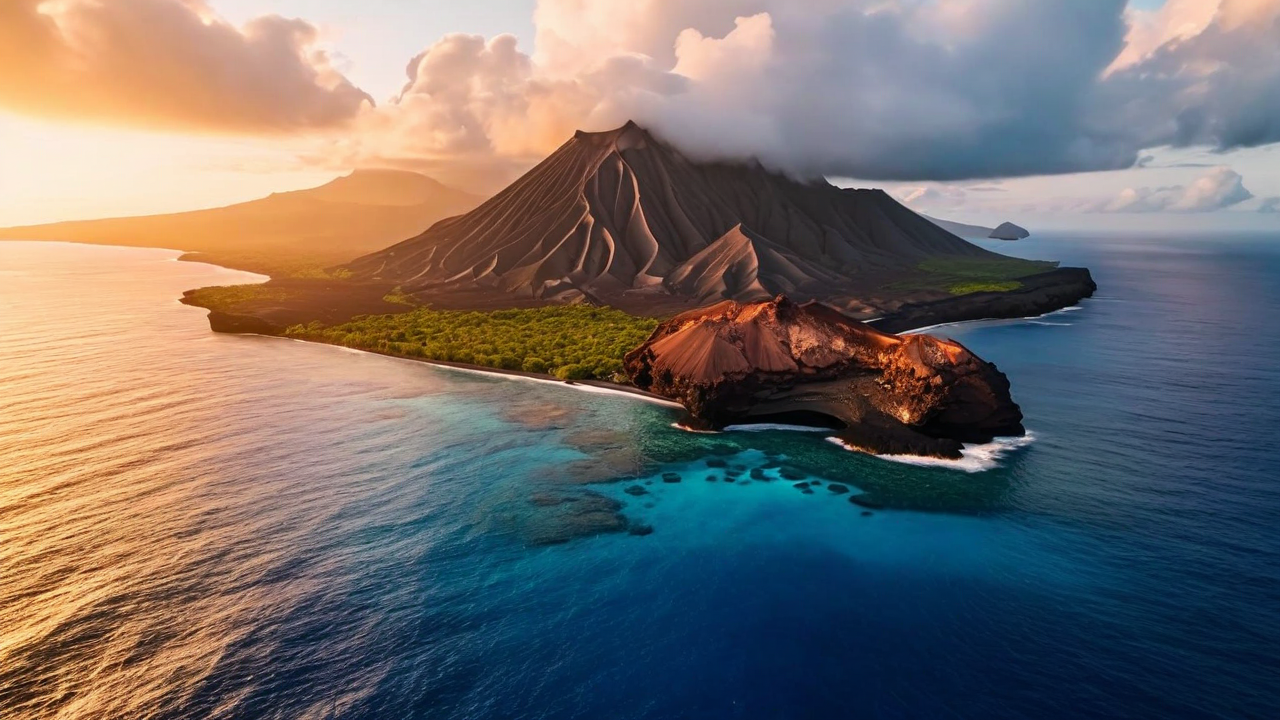
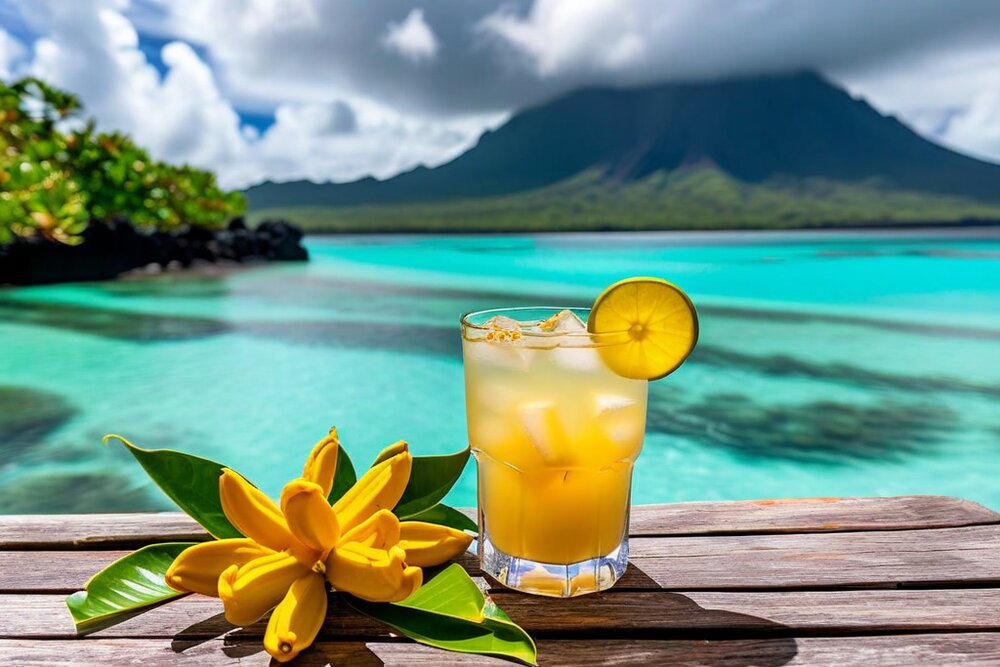
The bucket holds two images for the territory — 01-hero.jpg and mayotte-drink.jpg — plus two recipe files. Roughly a hundred candidate filenames were tested by HTTPS probing and nothing else exists. The old page's only photograph was a hotlink to Wikimedia Commons for a file called Mamoudzou_Mayotte.jpg, and that file was checked against the Commons API and is missing — the URL was fabricated. It has not been carried over. No counterfeit publisher logo was found on either local file, which is a better result than Martinique.
Rejected: mataba
mayotte-mataba.jpg shows neat leaf-wrapped parcels, in the manner of a Malay otak-otak or a Latin American tamale. Mataba is not a parcel. It is cassava leaf pounded to a fine paste and stewed in coconut milk into a thick dark-green mash, served in a bowl or on a plate with rice — the pounding and the long cooking are the whole dish. The image gets the form, the colour and the method wrong, and it would actively mislead anyone trying to recognise or cook it. Not used.
Rejected: mkatra foutra
mayotte-mkatra-foutra.jpg shows a stack of American-style pancakes with mango, honey and icing sugar. Mkatra foutra is a single soft round coconut-milk flatbread, about 15 cm across, finished with sesame seeds and eaten warm with tea or alongside a curry. One bread, not a stack; sesame, not syrup; savoury-adjacent, not a dessert. The recipe above describes the real thing and the picture would contradict it, so the picture is not used.
The fabricated Commons hotlink
The old page carried a single photograph loaded directly from upload.wikimedia.org, captioned as Mamoudzou. Queried against the Commons API, the file does not exist — the URL was invented. This is now the eighth fabricated Commons URL found across four pages in this stretch (Martinique ×4, Réunion, New Caledonia, Mayotte), out of eight checked. A site-wide sweep for upload.wikimedia.org is overdue.
What is missing
There is no image of Mamoudzou, of the barge, of Dziani Dzaha, of the Tsingoni mosque, of debaa or mbiwi, of a woman wearing msindzano, of a ylang-ylang still, of the turtles at N'Gouja, of a humpback, or of the reconstruction after Chido. Two generic tropical files cannot carry a territory whose entire interest is its people, its politics and its lagoon.
The pattern, now four countries deep
Martinique, Mauritania, Mauritius and now Mayotte have each produced exactly two country images plus a handful of recipe files, all generic tropical stock, several actively wrong. Four consecutive countries with an identical structure is not a coincidence about these four places — it points at a gap in how the image set was built, probably across the whole M range. This needs looking at directly rather than country by country.
How this list was made
By systematic HTTPS probing, because the AWS connection has now been unavailable for eight consecutive countries. Every numbered slot and every plausible bare name was tested, plus specific checks for the two defect classes found at Martinique. Treat this list as a minimum — a proper bucket listing is owed for the entire run from Luxembourg onward.
Support This Project 🌍
This World Travel Factbook is a labor of love – free to use for all travelers. If you find it helpful, consider supporting its continued development.