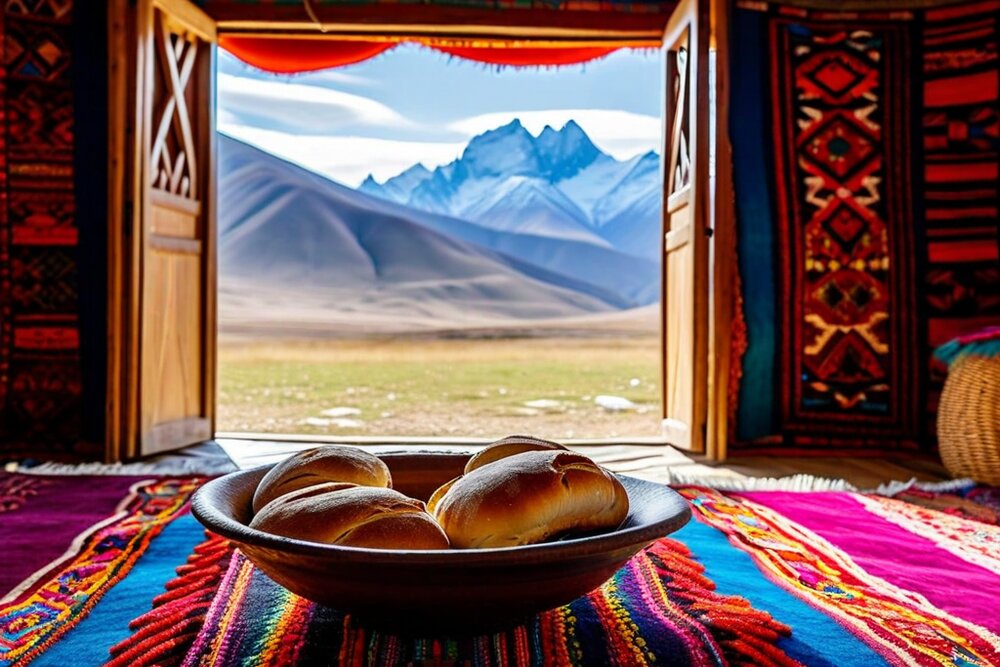



🇰🇬 Kyrgyzstan at a Glance
🌍 Overview
Kyrgyzstan is 199,951 km² — about two and a half Czech Republics — with roughly 7.3 million people, and the number that matters is this: over 90% of the country is mountain, more than 40% of it lies above 3,000 m, and the average elevation is around 2,750 m. There is no coastline, no desert to speak of and very little flat ground.
It is also, by a wide margin, the easiest and most rewarding country in Central Asia for an independent traveller. Most of the world enters without a visa, the mountains are world-class and largely unregulated, there is a functioning community-tourism network that puts money into villages, and a summer in the high pastures costs less than a week in the Alps.
The state
A presidential republic since the 2021 constitution, which reversed thirty years of parliamentary experiment and concentrated power in the presidency. Sadyr Japarov has been president since January 2021. Snap parliamentary elections on 30 November 2025 returned a Jogorku Kenesh overwhelmingly aligned with him on a turnout of under 37%, and a presidential election is set for 27 January 2027. See the politics section.
The people
Around 73% Kyrgyz, 15% Uzbek — concentrated in the south around Osh and Jalal-Abad — and 5% Russian, plus Dungans, Uyghurs, Tajiks, Turks and a shrinking German community. The Kyrgyz share has risen steadily since 1991 as Slavs emigrated. It is a young, rural and highly mobile population: something like a fifth of working-age Kyrgyz are abroad at any time, overwhelmingly in Russia.
The economy
Small and unusually dependent on two things. Remittances — around 15% of GDP, with 93% of the inflow coming from Russia — and gold, principally from the Kumtor mine, which the state seized from its Canadian operator in 2021. Growth has been strong on paper, around 8–9% in recent years, boosted substantially by re-export trade with China and by flows that regional analysts read as sanctions-related. GDP per head remains among the lowest in the former Soviet Union.
What visiting is like
Cheap, beautiful, informal and logistically improvisational. You can be on a horse at 3,000 m two hours after landing in Bishkek. What you should not expect: marked trails everywhere, mountain rescue, reliable schedules, English outside Bishkek and the tourism trade, or any tolerance from the weather. It rewards flexibility and punishes tight itineraries.
🏷️ The Forty, and the Sun on the Flag
Kyrgyz is traditionally explained as kyrk plus yz — "forty tribes" — the forty clans that the hero Manas is said to have united. Whether the etymology is sound is disputed by linguists; that it is what Kyrgyz people believe and build their symbols around is not.
The flag
A red field with a golden sun of forty rays — the forty tribes — and at its centre a tunduk, the wooden crown at the apex of a yurt, seen from below. It is one of the very few national flags depicting a piece of domestic architecture, and it is the most concentrated statement of national identity any Central Asian state has managed: the sun of the tribes over the roof of the home.
Kyrgyzstan or the Kyrgyz Republic
Both are official. Russian usage gave Kirgizia, which is now avoided as a Soviet-era term. The -stan is Persian for place. Kyrgyz people will occasionally point out that they are the only Central Asian titular nation whose name predates the region's modern borders by many centuries — the Yenisei Kyrgyz appear in Chinese sources in the second century BC.
Manas
The Epic of Manas is the national text and one of the longest oral poems in human history — the fullest recorded versions run to around half a million lines, roughly twenty times the Iliad and Odyssey combined. It tells of Manas uniting the forty tribes against the Khitan and Oirat. It was transmitted entirely orally by reciters called manaschi, who perform from memory in a trance-like declamatory style, and it is on the UNESCO intangible heritage list.
North and south
The country's most important internal division and the one that structures its politics. The north — Bishkek, Chuy, Issyk-Kul — is more Russified, more urban and looks toward Russia and Kazakhstan. The south — Osh, Jalal-Abad, Batken — is in the Fergana valley, more religious, more traditional, has the large Uzbek minority, and looks toward Uzbekistan. The mountains between them are crossed by one high road. Every revolution since 2005 has had a north–south dimension.
🏔️ The Mountains
Kyrgyzstan is the mountains, and everything else — the settlement pattern, the economy, the food, the politics of water, the tourism — follows from that. Two great ranges dominate: the Tian Shan across the north and east, and the Pamir Alay in the south-west, with the Fergana valley wedged in between.
The high ground
Jengish Chokusu (Pik Pobedy, Victory Peak) at 7,439 m on the Chinese border is the highest point and the northernmost seven-thousander on Earth — a serious and dangerous mountain with a poor summit-to-fatality record. Beside it stands Khan Tengri at 7,010 m, a near-perfect marble pyramid that glows red at sunset and is the more beautiful and more climbed of the two. Both sit above the vast Inylchek glacier.
The trekking ranges
The mountains most visitors actually go to are lower and far more accessible. The Terskey Ala-Too south of Issyk-Kul, reached from Karakol, is the country's trekking heartland — Ala-Kul lake, the Altyn Arashan hot springs, Jeti-Oguz. The Kyrgyz Ala-Too rises straight out of Bishkek's southern suburbs, with Ala Archa national park forty minutes from the city centre. And the Pamir Alay around Batken, with the granite big walls of Ak-Suu and Karavshin, which are a serious international climbing destination.
The jailoo
The word for a summer high pasture, and the central institution of Kyrgyz life. Families move their animals — sheep, horses, cattle — up to 3,000 m and above from roughly June to September, live in yurts, and make dairy products for the winter. It is not a performance for tourists: it is the actual economic basis of rural Kyrgyzstan, and staying in a working jailoo yurt is the single best thing a visitor can do here.
Glaciers, and their retreat
Kyrgyzstan holds thousands of glaciers, which are the water towers of Central Asia — the Syr Darya and Amu Darya systems that feed Uzbekistan and Kazakhstan begin in these mountains. They are retreating fast; estimates suggest a substantial fraction of the country's glacial mass has been lost since the mid-twentieth century, with severe implications for downstream irrigation and for Kyrgyzstan's own hydropower. Water is the country's most valuable strategic asset and its most contested.
Earthquakes
The whole country is seismically very active — the Tian Shan is being pushed up by the collision of India with Asia and continues to rise. Large destructive earthquakes are part of the historical record and are expected again; the risk to Bishkek's Soviet-era housing stock is a known and under-addressed problem.
Wildlife
Snow leopards, of which Kyrgyzstan holds a significant population and which almost nobody ever sees; Marco Polo sheep and ibex in the high east; wolves, brown bears and lynx; and the walnut-fruit forests of Arslanbob in the south-west, the largest naturally occurring walnut forest in the world and part of the ancestral home of the apple, plum and cherry.
💧 Issyk-Kul and the Lakes
Issyk-Kul is the second-largest alpine lake in the world after Titicaca — about 6,200 km², up to 668 m deep, sitting at 1,607 m between two mountain ranges — and it is the centre of Kyrgyz tourism, both foreign and, far more importantly, domestic.
The lake that does not freeze
Issyk-Kul means "hot lake", and the name is accurate: it is slightly saline and deep enough that it does not freeze in winter despite temperatures well below zero. It has no outflow. Under the water on the northern shore lie the remains of settlements drowned by changing levels — a genuine sunken-city archaeology, investigated since the Soviet period and still producing finds.
The north shore
Where the resorts are. Cholpon-Ata is the centre: Soviet-era sanatoria, newer hotels, beaches that fill with Kazakh and Kyrgyz families every July and August, and a genuinely important field of Bronze Age petroglyphs on the edge of town. Busy, cheap and not what a European visitor usually comes for — though it is the best possible place to watch Central Asians on holiday.
The south shore and Karakol
Quieter, drier, more spectacular, and where most independent travellers go. Karakol at the eastern end is the trekking base for the whole region, with a wooden Dungan mosque built without nails in Chinese temple style, a wooden Orthodox cathedral, and the country's best animal market on Sunday mornings. West of it: Jeti-Oguz, the Seven Bulls red sandstone formation; Skazka canyon; Barskoon; and the road up to the Kumtor mine.
Song-Kul
The other lake, and for many visitors the better one. Song-Kul sits at 3,016 m on a treeless plateau reached over high passes, has no permanent settlement, and in summer is ringed with yurt camps belonging to herding families. There is nothing to do there except ride, walk, watch the light and sleep under an extraordinary sky. It is the classic Kyrgyz experience and it is accessible to anyone who can tolerate two nights without a shower.
The other waters
Sary-Chelek, a deep forested lake in a biosphere reserve in the west, greener and more Alpine than anything else in the country. Kel-Suu, a remote turquoise lake near the Chinese border requiring a border permit and a hard drive, and increasingly the country's most photographed place. Ala-Kul, the high glacial lake above Karakol on the standard trek. And Merzbacher, a glacial lake that empties catastrophically every summer.
A note on the tourism
Issyk-Kul's shoreline has been developed fast and not always well, sewage and construction are a real issue for a lake with no outflow, and its level has been falling. Kyrgyzstan has periodically restricted building and periodically not enforced it. The lake is a national treasure being loved carelessly, which the country's own environmental community says openly.
📜 The Yenisei, the Silk Road and Manas
Origins
The Kyrgyz appear in Chinese records as a people on the Yenisei in southern Siberia from around the second century BC — one of the oldest continuously attested ethnonyms in Central Asia. In 840 AD the Yenisei Kyrgyz destroyed the Uyghur Khaganate and briefly dominated the Mongolian steppe. Migration south into the Tian Shan happened gradually over centuries, accelerating after the Mongol conquests, and the modern Kyrgyz are the product of that movement mixing with the peoples already there.
The Silk Road
The routes ran through here: over the Torugart and Irkeshtam passes from China, along the Issyk-Kul shore, through the Fergana valley. Tash Rabat, a stone caravanserai at 3,200 m in a side valley near the Chinese border, is the most atmospheric surviving structure — a squat domed building of uncertain date, probably fifteenth century, possibly on an earlier monastic site, standing entirely alone in a high valley.
Balasagun and the Burana Tower
The Karakhanids, the first Turkic dynasty to adopt Islam, ruled from Balasagun in the Chuy valley in the tenth to twelfth centuries. What remains is the Burana Tower, a truncated eleventh-century minaret now 25 m high after earthquakes took the top off, standing among balbal grave markers an hour from Bishkek. Nearby Uzgen in the south has a Karakhanid minaret and three mausolea with exceptional carved terracotta.
Nomadic life
Until the twentieth century the Kyrgyz were pastoral nomads organised by clan and by the north–south ong and sol wings, moving between winter quarters and summer pasture, with a rich material culture — the yurt, the shyrdak and ala-kiyiz felt carpets, horse equipment, silver — and an oral literature centred on Manas. Islam arrived slowly from the south and layered over older Tengri beliefs without ever entirely displacing them.
Kokand and Russia
From the eighteenth century the southern Kyrgyz fell under the Khanate of Kokand, which built forts including one at Pishpek — the origin of Bishkek. Russian expansion absorbed the northern tribes from the 1850s, some by treaty and some by force, and the Kokand khanate was destroyed in 1876. The Russians brought Slavic settlers into the Chuy valley and the best arable land, which is the origin of the demographic pattern that persisted until independence.
Urkun, 1916
The Urkun — the Exodus — is the central trauma of Kyrgyz history and is still barely known outside the country. A revolt against conscription into labour battalions for the Russian war effort was put down with extreme violence; tens of thousands of Kyrgyz fled over the Tian Shan passes into Chinese Xinjiang in the winter of 1916–17 and enormous numbers died of cold and starvation in the mountains. Estimates of the total loss run to a substantial fraction of the Kyrgyz population. It was suppressed as a topic in Soviet times and was commemorated officially only from the centenary in 2016.
☭ Soviet Kirghizia and Independence
Becoming a republic
The Soviet national delimitation of Central Asia in 1924 created a Kara-Kirghiz Autonomous Oblast, which became an autonomous republic in 1926 and a full Union republic in 1936. The borders drawn then are the ones the country has now, and they are the origin of the enclaves and disputed sections in the Fergana valley that produced armed conflict as recently as 2022.
Sedentarisation and the cost
Collectivisation from the late 1920s forced the nomads to settle, confiscated herds and destroyed the pastoral economy within a few years, with famine, flight to China and mass loss of livestock. The Kyrgyz intelligentsia was largely killed in the purges of 1937–38. Set against that, the Soviet period brought near-universal literacy, a university, industry, hospitals and the codification of the Kyrgyz literary language.
A deported republic
Like Kazakhstan, Kirghizia received deportees — Germans from the Volga, Chechens, Ingush, Karachai, Koreans and Meskhetian Turks — and hosted evacuated industry and populations during the war. The Dungans, Chinese-speaking Muslims who fled Qing repression in the 1870s, arrived earlier and remain a distinct and visible community with their own cuisine, which is one of the better things about eating in Karakol.
1990 and 1991
Ethnic violence between Kyrgyz and Uzbeks in Osh in June 1990 killed hundreds and was a warning nobody heeded. In the aftermath the physicist Askar Akayev, a compromise outsider, became president, and Kyrgyzstan declared independence on 31 August 1991. Akayev was initially the great liberal hope of Central Asia — Kyrgyzstan was called an island of democracy — and by the end of his fourteen years he was running a family business with a rigged parliament.
The Tulip Revolution, 2005
Fraudulent parliamentary elections in February and March 2005 produced protests that began in the south, spread to Bishkek, and on 24 March took the White House. Akayev fled to Russia. Kurmanbek Bakiyev replaced him, promised reform, and within five years had concentrated power, installed his family across the state and presided over the murder of journalists and opposition figures.
April 2010 and the Osh violence
Protests over utility price rises and corruption turned into an uprising on 7 April 2010; security forces fired on the crowd in Bishkek, killing around 87 people, and Bakiyev fled to Belarus. Two months later, in June, ethnic violence erupted in Osh and Jalal-Abad between Kyrgyz and Uzbeks, killing several hundred — most of them Uzbek — and displacing hundreds of thousands. It remains the worst event in independent Kyrgyzstan's history and its investigation and aftermath are still contested.
🏛️ Politics Now — 6 September 2026
📅 Checked 6 September 2026. Kyrgyzstan is under five months from a presidential election and the political landscape has been reshaped since 2020. This is a snapshot.
2020, the third revolution
Parliamentary elections on 4 October 2020 were annulled after protests seized the White House overnight. In the vacuum Sadyr Japarov — a politician serving a long sentence for hostage-taking in connection with the Kumtor mine protests — was freed from prison by a crowd and within days was prime minister, then acting president. He won the January 2021 presidential election with around 79%. It is the most remarkable political ascent in post-Soviet Central Asia.
The 2021 constitution
A referendum in April 2021 replaced the parliamentary system — Kyrgyzstan's distinguishing feature since 2010 — with a strongly presidential one, cut the Jogorku Kenesh from 120 seats to 90, allowed the president two five-year terms, and created a Kurultai as a consultative people's assembly. Critics called it a return to one-man rule; supporters called it an end to fifteen years of instability. Both descriptions have some evidence behind them.
Japarov and Tashiev
The country is effectively run by two men: President Sadyr Japarov and Kamchybek Tashiev, his long-time ally and head of the GKNB state security committee. Tashiev's institution has become the dominant force in Kyrgyz public life, driving anti-corruption prosecutions, business nationalisations and the pursuit of critics, and their partnership is the single most important fact in Kyrgyz politics.
The November 2025 election
The outgoing parliament voted to dissolve itself on 25 September 2025 and snap elections were held on 30 November, officially to avoid a clash with the presidential vote. Candidates aligned with the president took the overwhelming majority of the 90 seats. Turnout was under 37%, the lowest in the country's history, and external analysts described the result as consolidating the presidential system rather than contesting it.
January 2027
A presidential election is scheduled for 27 January 2027 and Japarov has said he will run for a second term. Given the parliamentary result, the absence of an organised opposition and the state of the media, the outcome is not the interesting question; what happens to the constitutional two-term limit after it is.
The closing space
The most consequential change since 2020, and the one Kyrgyzstan's reputation rested on. Kyrgyzstan was for thirty years the freest country in Central Asia — a real press, real NGOs, real protest. Since 2021: a foreign representatives law modelled on Russia's, the closure or blocking of independent outlets including Kloop and Temirov Live, prosecutions of journalists and bloggers, and the long Kempir-Abad case against opposition figures over a reservoir transfer to Uzbekistan. Rights organisations describe a rapid contraction; the government describes stability.
🌏 Neighbours, Russia and China
The Tajik border settlement
The most important diplomatic achievement in the country's history. The 984 km Kyrgyz–Tajik border was left undelimited by the Soviet collapse and produced repeated armed clashes, culminating in September 2022 when fighting killed more than a hundred people and displaced over 100,000. On 13 March 2025 Japarov and Rahmon signed a full delimitation treaty at Khujand; it was ratified by both parliaments, crossings reopened, and demarcation with nearly two thousand border pillars is now under way in Batken. Human rights organisations have pressed for the affected communities' property and movement rights to be central to implementation.
Uzbekistan
Transformed since 2016. Border delimitation with Uzbekistan was completed and ratified, including the transfer of the Kempir-Abad reservoir, which was politically explosive domestically and led to the prosecution of the opposition figures who objected. Trade, transport and water cooperation have all improved sharply, and a trilateral junction point with Tajikistan was agreed in 2025.
Russia
The dominant relationship. Kyrgyzstan is in the Eurasian Economic Union and the CSTO, hosts the Russian air base at Kant, and depends on Russia for the 93% of remittances that come from there and for much of its energy. Since 2022 Kyrgyzstan has also become a route for re-export into Russia, which has drawn Western sanctions attention to Kyrgyz banks. Bishkek's position is that it will not join sanctions and will not be a party to the war, and it has quietly absorbed a large number of Russians who left in 2022.
China
The other pole. China is the largest trading partner and the largest creditor — a substantial share of Kyrgyzstan's external debt is owed to the Export-Import Bank of China, which is a standing political sensitivity. The China–Kyrgyzstan–Uzbekistan railway, discussed for a quarter of a century, finally broke ground in December 2024 and is the largest infrastructure project in the country's history. Chinese-run mining has repeatedly produced local protest.
The United States and Europe
The Manas air base outside Bishkek was a critical transit point for the war in Afghanistan from 2001 until Kyrgyzstan closed it in 2014 under Russian pressure — a rare case of a small state playing two great powers and extracting rent from both. Relations with Washington have been cool since; the EU is a significant aid donor and granted Kyrgyzstan GSP+ trade preferences, which is one of the few levers outside actors still hold.
Water, the real currency
Kyrgyzstan's glaciers and reservoirs feed the irrigation of Uzbekistan and Kazakhstan, and the country's ability to release or hold water in the Toktogul reservoir is its strongest regional card. The old Soviet arrangement traded summer water for winter gas and coal and collapsed with the union. Kyrgyzstan wants to build the enormous Kambarata-1 dam, which downstream states have historically resisted and which is now, unusually, being pursued with their partial agreement and World Bank interest.
💰 The Economy
The headline numbers
Nominal GDP around USD 23.6 billion and growth reported at 8–9% in recent years, which is the fastest in Central Asia and needs reading carefully — a substantial part of it is re-export trade and financial flows connected to Russia rather than domestic production. GDP per head remains low. The currency is the som (KGS), which has been relatively stable and is fully convertible.
Remittances
The foundation. Around 15% of GDP, with inflows of roughly USD 3 billion a year and 93% of it from Russia. Something like a fifth of the working-age population is abroad. This makes Kyrgyz household income directly hostage to the Russian labour market, the rouble and Russian migration policy — a dependency the government cannot reduce quickly and does not much discuss.
Gold and Kumtor
The Kumtor mine at 4,000 m in the Tian Shan has supplied a very large share of export earnings and government revenue for thirty years. In 2021 the Japarov government seized operational control from the Canadian company Centerra and settled the dispute in 2022; the mine is now state-run through Kyrgyzaltyn. It is also, environmentally, a glacier being mined, with a long record of contested waste management and a cyanide spill into a river in 1998.
The re-export question
Since 2022 Kyrgyzstan's trade figures with China and with Russia have grown in ways that international analysts and Western sanctions authorities read as parallel-import routing into Russia. Several Kyrgyz banks and companies have been sanctioned by the US and EU as a result. It has been genuinely lucrative and it is a strategic exposure that could be closed by decisions taken elsewhere.
Energy and the winter
Kyrgyzstan generates most of its electricity from hydropower, principally the Toktogul cascade, and has a chronic winter deficit that requires imports and produces load-shedding. Domestic tariffs are heavily subsidised and politically untouchable. Building Kambarata-1 would change the picture entirely and costs several billion dollars the country does not have.
Crypto, and the other novelty
Kyrgyzstan has actively courted cryptocurrency mining and digital assets, drawn by cheap hydropower and light regulation, and has legislated a framework for it. This has attracted business, energy-consumption criticism during a power deficit, and a further layer of sanctions scrutiny. It sits alongside tourism as the government's answer to the question of what the country does other than send its people to Russia.
🏙️ Bishkek and Osh
Bishkek
A city of around 1.1 million at 800 m, laid out by Russian planners on a grid of tree-lined boulevards with irrigation channels running along the streets and the Kyrgyz Ala-Too wall standing 4,000 m high at the end of them. It is green, low, walkable, cheap and unglamorous, and its setting is spectacular in a way no photograph of the city itself ever conveys.
What to see there
Ala-Too Square with the Manas statue and the changing of the guard; the State History Museum, reopened after a long and contested renovation; the Osh Bazaar, which is the real one; Oak Park and its open-air sculpture; and the Soviet mosaics and modernist buildings scattered through the centre, which are a genuine and disappearing architectural interest. Two days is plenty.
Ala Archa
Forty minutes from the city and the reason to base yourself in Bishkek at all: a national park in a glaciated valley with day walks, an alpine hut, waterfalls and 4,000 m peaks immediately above. You can leave a Bishkek café after breakfast and be on a glacier moraine by lunchtime, which very few capital cities can offer.
Osh
The southern capital, over 3,000 years old by its own account, in the Fergana valley, hot, Uzbek-inflected and completely different in feel from Bishkek. Its centre is Sulaiman-Too, the sacred mountain rising straight out of the city — a UNESCO World Heritage site, a pilgrimage destination for many centuries, with shrines, petroglyph caves, a museum built into the rock and a small mosque said to have been built by Babur. The bazaar along the river is one of the great markets of Central Asia.
The south
Beyond Osh: Uzgen with its Karakhanid minaret and mausolea; Arslanbob, a Uzbek village under the world's largest walnut forest with a well-run community tourism network; Jalal-Abad; and Batken, remote, close to the Tajik border and the base for the Ak-Suu and Karavshin big-wall climbing. The south is less visited, more conservative and, many travellers think, more interesting.
Between them
The Bishkek–Osh road is the country's spine: about 670 km over two passes above 3,000 m, ten to twelve hours by shared taxi, frequently closed by snow in winter and genuinely spectacular. There are flights, which take an hour and cost very little. Doing it once by road is worth it; doing it in winter is not a plan.
⛺ The Jailoo and the Yurt
If you understand one thing about Kyrgyzstan, make it this. Jailoo is the word for the high summer pasture, and every year from roughly June to September a substantial number of Kyrgyz families still move their sheep, horses and cattle up to it — three or four hours by track above the last village, at 2,500 to 3,500 m, where the grass comes good only after the snow leaves. This is not a re-enactment for visitors. It is how a large part of the country’s livestock economy actually works, and it is the reason the summer landscape of Kyrgyzstan looks the way it does.
The Soviet period tried to end it and did not. Collectivisation moved the herds into state farms and the herders into villages, but the animals still had to go up in summer, so the practice survived inside the kolkhoz. When the state farms collapsed in the 1990s the animals were privatised into family hands and the old pattern reasserted itself almost immediately, because on ninety per cent mountain there is no other way to feed a flock.
The boz üy
The Kyrgyz yurt is called boz üy, “grey house”. A lattice wall (kerege) of willow, roof poles (uuk) bent by steaming, and the crown wheel (tündük) at the top — the same tündük that is on the national flag. Felt covers it, ropes and woven bands tension it, and two people who know what they are doing put one up in about an hour.
Inside
There is a floor of shyrdak and ala-kiyiz felt carpets, the stove and its pipe under the crown, bedding folded in a stack at the back, and a strict internal geography: the place of honour opposite the door, the men’s side, the women’s side and the kitchen end by the entrance. Guests are seated deliberately, not casually.
Shyrdak
The mosaic-felt carpet, cut and inlaid rather than woven, in high-contrast curling ram’s-horn patterns. It is the country’s finest craft and it is on the UNESCO list of intangible heritage in need of urgent safeguarding — the skill is genuinely at risk. A good handmade one takes weeks; the cheap machine-printed ones in Bishkek souvenir shops are not the same object at all.
Song-Kul
The most visited jailoo, a treeless lake at 3,016 m ringed by summer camps. Staying in a yurt there is the single most popular thing tourists do in Kyrgyzstan, and it is genuinely worth doing — but be clear that the camps set up for visitors are a tourism product built alongside the herding, not the herding itself. Nights are cold in every month, including July.
Community-Based Tourism
The CBT network, set up in the late 1990s with Swiss support, is the mechanism that turned herding families into hosts across the whole country. It arranges yurt stays, homestays, horses and guides at posted prices, with the money going to the family rather than an agency. It is, by a distance, the most successful rural tourism scheme in Central Asia and the reason independent travel here is easy.
What it is not
It is not nomadism in the full sense. Kyrgyz herding is transhumance — a fixed winter village, a fixed summer pasture, the same route every year. Families have houses, children go to school, and the jailoo is a season, not a life. Anyone selling you “the last nomads” is selling you something.
The practical consequence for a visitor is that Kyrgyzstan is one of the few countries where the traditional culture is not staged for you. You can walk into a valley in July and be invited into a yurt for tea and bread by people who are there for the sheep, not for you. The right response is to accept, to bring something, and not to photograph anyone without asking.
🍖 The Food
Kyrgyz food is herders’ food overlaid with Uzbek and Dungan food and then with a Russian canteen. That is the whole of it, and understanding those three layers explains almost every dish you will meet. The base layer is meat — mutton and horse — plus boiled dough, dairy, and bread; the Uzbek layer brings plov, samsa and the tandoor; the Dungan layer, from Chinese Muslims who fled here in the 1870s, brings lagman and hand-pulled noodles and is the reason there is real chilli and vinegar in the country at all.
Beshbarmak
“Five fingers” — the national dish and a ceremonial one. Mutton or horsemeat boiled long, the broth reserved, the meat pulled and laid over wide squares of boiled dough with onion, and the broth (shorpo) drunk from a bowl alongside. Eaten with the hands at a feast, from a shared platter, with the cuts distributed by seniority.
Lagman
The dish you will actually eat most. Hand-pulled wheat noodles with a stir-fried sauce of mutton, peppers, tomato, onion and often long beans. Ordered suyuk it comes as a soup; quyruldak or fried lagman comes dry and glossy. Dungan-run places do it best and it is the reliable, cheap, good meal everywhere in the country.
Oromo
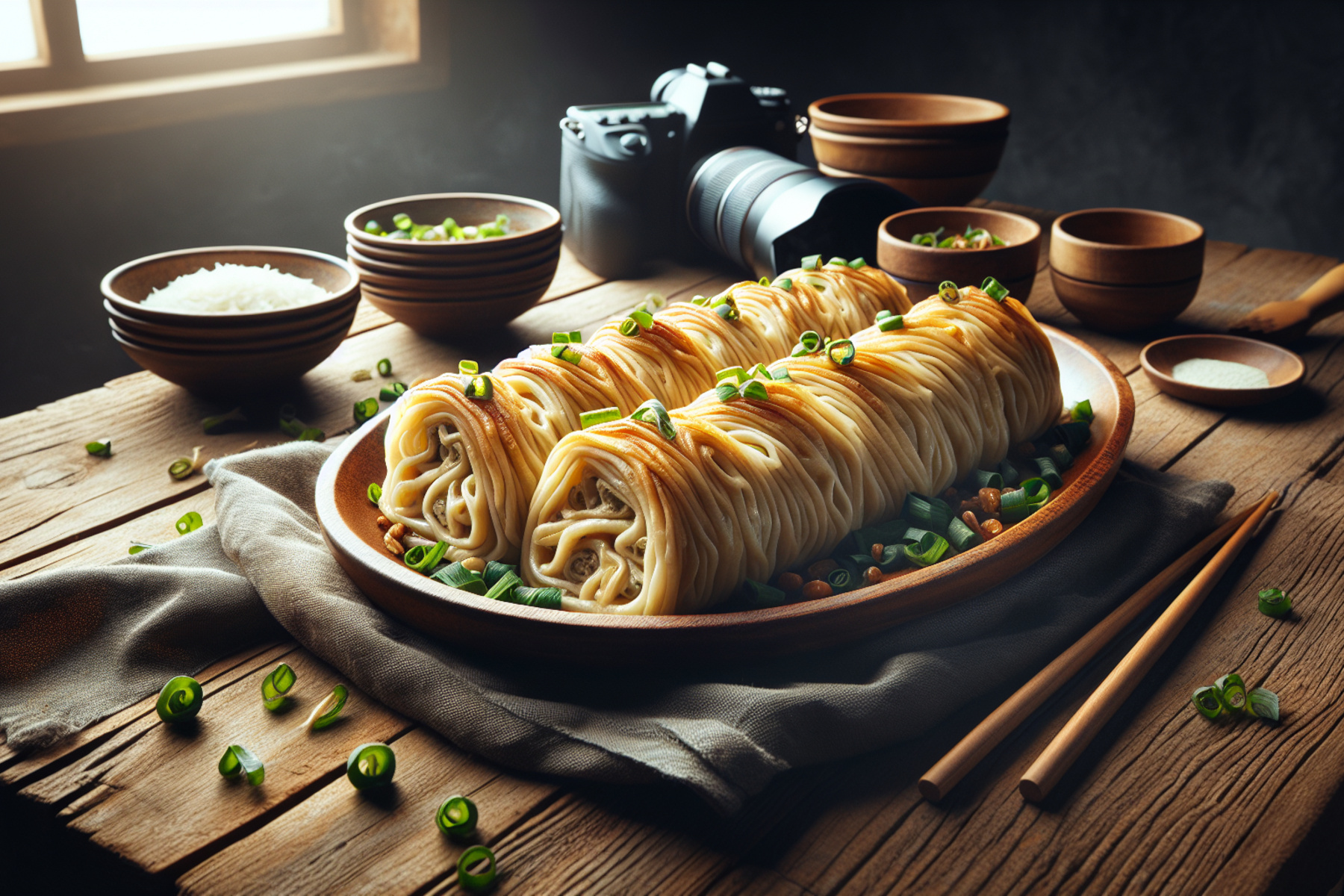
A large spiral of very thin dough rolled around a filling — minced meat and onion, or potato and pumpkin — coiled and steamed in a multi-tier steamer, then cut into wedges. It is the great home dish of Kyrgyzstan and one of the few that is genuinely local rather than borrowed. Manti, the individual steamed dumplings, are the same idea in single portions.
Plov and samsa
Plov (osh) — rice with mutton, carrot, onion and cumin cooked in a kazan — is Uzbek in origin and is the standard dish of Osh and the south, where it is taken very seriously. Samsa are the meat pastries baked stuck to the inner wall of a tandoor; buy them where the queue is.
Boorsok
Small squares or diamonds of dough deep-fried in oil, piled in a bowl and put on every table before anything else arrives. They are the bread of hospitality, they are what a family fries when guests are coming, and eating them straight out of the pan on a jailoo is one of the pleasures of the country.
The dairy
Where the country is genuinely distinctive. Kaymak (thick clotted cream) with bread and honey; ayran and chalap; and kurut, hard sun-dried balls of salted, strained yoghurt that keep indefinitely, are sold in every bazaar, and taste to almost every foreigner like salted chalk. Try one. Do not buy a bag.
What is genuinely hard here is being vegetarian. Meat is not an ingredient in Kyrgyz cooking, it is the point of it, and the broth is in everything including the things that look vegetable. Ashlyamfu (a cold Dungan dish of noodles and starch jelly in a sour, chilli-red sauce, the speciality of Karakol) and the potato-pumpkin oromo are honourable exceptions, as is the fruit, which in the Fergana fringes in late summer is superb.
👨🍳 Two Recipes
Two things you can genuinely make at home. The first is the national dish, scaled down from the sheep. The second is the everyday one.
Beshbarmak
Serves 6 · about 3 hours, mostly unattended
Ingredients: 1.5 kg lamb or mutton on the bone (shoulder or leg; horsemeat if you can get it), 2 large onions, 2 bay leaves, 10 black peppercorns, salt. For the dough: 500 g plain flour, 2 eggs, about 200 ml of the cooking broth or water, 1 tsp salt.
Method: Put the meat in a large pot with cold water to cover by 5 cm, bring slowly to the boil and skim thoroughly — the clarity of the broth is half the dish. Add one halved onion, the bay and peppercorns, salt lightly, and simmer very gently for 2 to 2½ hours until the meat comes off the bone. Meanwhile make a firm dough with the flour, eggs, salt and enough liquid to bring it together; knead 10 minutes, rest covered 30 minutes, then roll out as thin as you can manage and cut into squares of about 8 cm. Slice the second onion into thin rings, scald them in a ladleful of hot broth with a good grind of pepper and set aside. Lift the meat out, pull it into pieces and discard bone and gristle. Boil the dough squares in the strained broth, in batches, for 3 to 4 minutes each. Lay the dough on a wide platter, pile the meat over it, scatter the scalded onion on top and pour over a little broth. Serve the rest of the broth hot in bowls to drink alongside.
💡 The onion scalded in broth is not a garnish and it is not optional — it is what makes the dish taste of Kyrgyzstan rather than of boiled mutton.
Oromo
Serves 4 · about 1 hour 15 minutes
Ingredients: For the dough: 400 g plain flour, 220 ml warm water, 1 tsp salt. For the filling: 400 g minced lamb or beef (not too lean), 2 onions finely chopped, 300 g potato cut in 5 mm dice, 1 tsp cumin, 1 tsp black pepper, salt, 40 g butter or lamb fat.
Method: Make a smooth firm dough, knead well and rest it covered for 30 minutes. Mix the meat, onion, potato, spices and salt; do not pre-cook the filling. Divide the dough in two. Roll each piece out very thin into a long rectangle — thin enough to see the worktop through it. Spread half the filling over it in a thin even layer, dot with the fat, leave a clear margin at one long edge, and roll it up loosely into a long sausage. Coil the sausage into a flat spiral and set it on an oiled tier of a steamer. Repeat with the second piece. Steam over vigorous heat for 45 minutes. Cut into wedges and serve with a bowl of sour cream or ayran and, if you like heat, a chilli-and-vinegar dip.
💡 Roll the dough thinner than feels sensible. A thick oromo is a heavy, doughy disappointment and is the single most common way this goes wrong.
🥛 Kumis, Chai and the Rest
Kumis
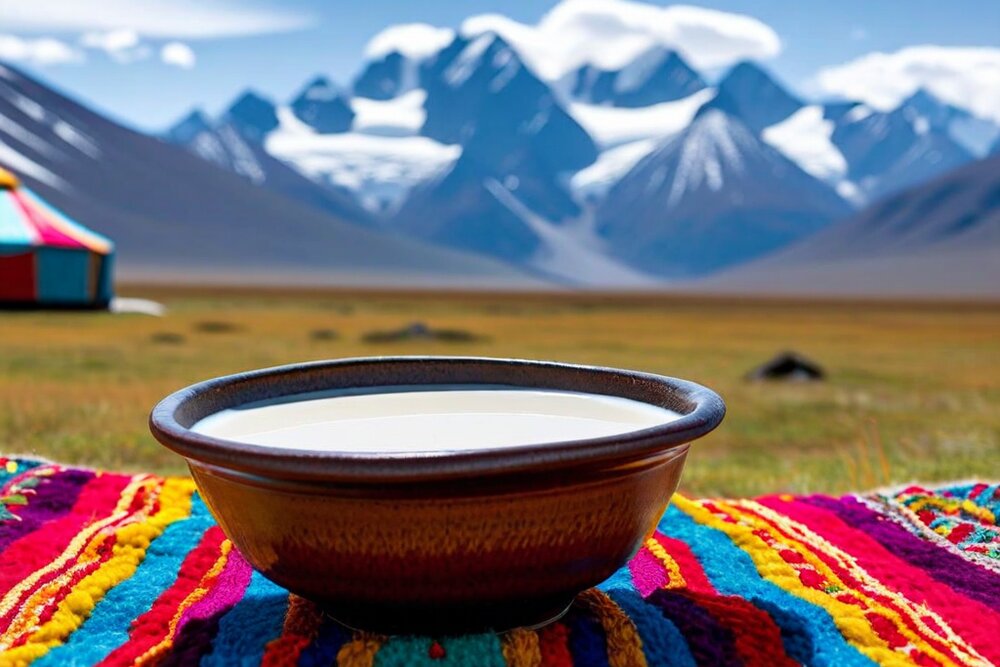
Fermented mare’s milk, slightly fizzy, sour, mildly alcoholic (around 1–2%) and the drink the culture is built on. It is seasonal — mares are milked from roughly May to September, several times a day — and the best of it is on the jailoo and at the roadside stalls on the Bishkek–Naryn and Suusamyr roads, sold from plastic barrels. There is a whole medical folklore around it and a sanatorium tradition of kumis cures. Your first mouthful will probably not be pleasant. Drink it anyway, slowly, and not a litre on the first day.
Maksym and chalap
Maksym-shoro is a fermented barley drink sold cold from branded street kiosks all over Bishkek in summer, cloudy and sour-savoury; chalap or ayran is thinned salted yoghurt, sometimes carbonated. Both are national soft drinks in the way lemonade is elsewhere, both are refreshing in real heat, and both taste startlingly savoury to anyone expecting sweetness.
Tea
Green tea (kök chai) in the south, black tea with milk and salt or with cream in the mountains. It arrives constantly, in bowls (kese) rather than cups, and it is poured only a little at a time — a full bowl is a hint that you should leave. Refusing tea is close to impossible and not worth attempting.
Alcohol
Kyrgyzstan is a Muslim-majority country with a thoroughly Soviet drinking culture and the two coexist without much friction. Vodka and Kyrgyz brandy are cheap and widely drunk, local beer is decent, and there is a small but real wine industry around the Chuy valley and Issyk-Kul that almost nobody outside the country has heard of. Toasting at a table is formal and sequential; if you do not drink, say so at the start and it will be respected.
Bozo
A thick, low-alcohol fermented millet or wheat drink, sold in winter, cloudy and porridge-like. It is an acquired taste that most visitors never acquire and is worth trying once for the same reason as kurut.
Water
Tap water in Bishkek is chlorinated and generally drunk by residents, but visitors should use bottled or filtered water, and in the mountains treat anything taken from a stream below a pasture — the herds are upstream of you more often than not. Bottled water is cheap and everywhere.
🎭 Manas, the Komuz and the Rules of the House
The Epic of Manas is the centre of Kyrgyz cultural identity and it is worth grasping how large it is: at around half a million lines in its fullest recorded versions it is roughly twenty times the length of the Odyssey, and it was carried orally for centuries by specialist reciters called manaschi, who perform from memory in a rapid, driving chant, without instruments, sometimes for hours. UNESCO lists the Manas trilogy and the art of the manaschi as intangible heritage. If you get the chance to hear one live, take it; it is nothing like reading it.
The komuz
The three-stringed fretless lute that is the national instrument, played with a fast flicking right hand and often thrown and spun mid-performance. Toktogul Satylganov, the most famous akyn (improvising bard-singer), is on the banknote. Aitysh — competitive improvised verse duels between akyns — is still performed and still popular.
Guest rules
Hospitality is close to obligatory and hosts will over-provide. Take your shoes off; wait to be shown where to sit; receive bread, tea or a bowl with the right hand (the left supporting the wrist is polite); do not turn the bread upside down or set it on the floor; and expect the bata, a short blessing with cupped palms drawn down the face, at the end of a meal. Follow whoever is oldest at the table and you will not go wrong.
What to bring
If you are hosted, bring something: tea, sweets, fruit, something for the children. Money is not appropriate in a private house but is entirely normal in a CBT homestay, where there is a posted price. Do not refuse food outright — take a little of everything, leave what you cannot manage.
Photographs
Ask. Rural Kyrgyzstan is welcoming and people will often say yes with enthusiasm, but the assumption that a herder’s family is scenery is the single most common way visitors give offence. Never photograph inside a mosque without permission, and be careful around cemeteries — the domed clay mazar graveyards are among the most photogenic things in the country and are also, obviously, graveyards.
Bride kidnapping
Ala kachuu — abducting a woman for marriage — is a real and continuing problem, not a folkloric survival. It is a criminal offence carrying up to ten years since 2013, and the sentence was raised again after several killings drew national protest, most prominently the murder of Aizada Kanatbekova in 2021. Estimates of prevalence vary widely; prosecutions remain rare relative to the estimates. Kyrgyz feminist organisations have driven what change there has been, and it is a subject people will discuss with you directly if you raise it respectfully.
Kalpak
The tall white felt hat with black embroidered bands, worn by men, with its own national day on 5 March. It is not a costume for tourists — you will see it on the street, in parliament and on the jailoo. There is an elaborate etiquette around it: it is not put on the ground, not given away carelessly, and not worn casually by outsiders.
🗣️ Kyrgyz and Russian
Kyrgyzstan is genuinely bilingual and the balance has been shifting for thirty years. Kyrgyz is a Turkic language of the Kipchak group, closely related to Kazakh, written in Cyrillic, and is the state language; Russian has constitutional status as an official language and remains the working language of much of Bishkek, business and higher education. In the northern cities you can function on Russian alone. In the south and in the villages, Kyrgyz dominates and Russian competence drops sharply with age.
Which one to learn
For a visitor, a handful of Russian words is more immediately useful in Bishkek, Karakol and along the main roads. A handful of Kyrgyz words is worth ten times as much everywhere else, because it is unexpected and delights people. Learn both greetings.
A survival list
Salamatsyzby — hello (formal). Rakmat — thank you. Ooba / jok — yes / no. Kancha turat? — how much? Jakshy — good. Kechiresiz — excuse me. Suu — water. Nan — bread. And jok, rakmat, “no thank you”, which is the most useful phrase you will own.
The language politics
There is a steady official push to widen Kyrgyz-language use — a 2023 state language law requires it of officials and in public communication, with penalties, and it has been criticised as pressure on Russian-speakers and defended as normal post-colonial language recovery. In practice Russian is not going anywhere soon: it is the language of the labour migration that a fifth of families depend on.
Uzbek
Around 15% of the population is ethnically Uzbek, concentrated in Osh, Jalal-Abad and the Fergana fringe, and Uzbek is widely spoken there. Its official status is a long-running and sensitive question, especially since 2010.
English
Limited but growing fast among the young, in Bishkek, in tourism and around CBT. Guides and hostel staff usually have it; taxi drivers, bazaar traders and herders usually do not. Download offline Russian and Kyrgyz for your translation app before you leave the city.
The alphabet
Cyrillic with three extra letters — ң, ө, ү. Learning to read Cyrillic takes an evening and transforms the trip: every marshrutka windscreen, bus station board, shop sign and menu becomes legible. Do it on the flight.
🏛️ UNESCO and the Silk Road
Sulaiman-Too
The Sacred Mountain above Osh, inscribed in 2009 and the country’s first World Heritage site. A five-peaked limestone crag standing straight out of the city, covered in petroglyphs and caves, with prayer and pilgrimage sites still in active use — people come to slide down a polished rock for fertility and to leave cloth at the shrines. There is a museum built into the cliff and a small mosque attributed to Babur at the top. It is the most important pilgrimage site in Central Asia outside the great Uzbek shrines.
Silk Roads: Chang'an–Tianshan
A transnational serial inscription (2014) shared with China and Kazakhstan. Kyrgyzstan’s three components are the Burana minaret and the site of Balasagun in the Chuy valley, the Krasnaya Rechka (Nevaket) settlement, and Ak-Beshim (Suyab), a Sogdian and Turkic city with Buddhist temples and a Nestorian church. What survives above ground is modest; what it represents is not.
Western Tian Shan
A natural World Heritage site (2016) shared with Kazakhstan and Uzbekistan, covering in Kyrgyzstan the Sary-Chelek biosphere reserve, Besh-Aral and Padysha-Ata. Sary-Chelek is a deep forest lake in the walnut country of Jalal-Abad and is, for many visitors, the most beautiful place in the country that is not above the treeline.
The walnut forest
Around Arslanbob lies the largest natural walnut forest on earth — roughly 11,000 hectares of it, harvested by the villages each autumn in a season that empties the schools. The local legend, cheerfully told, is that Alexander took walnuts home from here. It has a strong CBT presence and is one of the best places in the country to walk with a family rather than an agency.
Tash Rabat
A stone caravanserai at 3,200 m in a side valley off the Naryn–Torugart road, domed and half-buried in the hillside, probably 15th century and possibly on a much older Nestorian monastic site. It is the single most atmospheric building in Kyrgyzstan, there is nothing else within an hour of it, and there are yurts to stay in beside it.
Intangible heritage
Kyrgyzstan is unusually well represented: the Manas trilogy and the art of the manaschi, Ak-kalpak craftsmanship, the yurt itself (shared with Kazakhstan), aitysh improvised verse duelling, the Kok-boru horse game, and — on the urgent safeguarding list — the felt carpets ala-kiyiz and shyrdak.
📅 When to Go
Kyrgyzstan has a genuinely short season and this matters more here than in most countries, because the things people come for — the pastures, the passes, the lake, the trekking — are only open for part of the year. Get the timing wrong and you will find a cold country with the roads shut.
July–August: the season
The only period when everything works. The jailoo camps are up, the high passes are open, Issyk-Kul is warm enough to swim in (about 20 °C), and the trekking routes are clear of snow. It is also when the whole of Kazakhstan is on the north shore of Issyk-Kul, so Cholpon-Ata is crowded and prices rise. This is the right time for a first visit and you should not fight it.
June and September: the edges
June is green, flowering and beautiful, with the pastures filling and snow still on the passes into the middle of the month — high treks may not be on. September is arguably the best month of all: clear air, warm days, cold nights, the walnut and fruit harvest, empty roads, and the camps beginning to come down from mid-month. Late September is a gamble on the first snow.
May and October
Shoulder in the real sense. The valleys and cities are pleasant, the mountains are not accessible, and most yurt camps are shut. Good for Bishkek, Osh, Burana, the lower Issyk-Kul shore and museums; not for the thing the country is famous for.
November–March: winter
Cold and serious — Bishkek sits in a temperature inversion under bad smog for much of the winter, and Naryn regularly goes below −20 °C. The mountain passes close. The reason to come is skiing: Karakol is a real resort with genuinely good snow and low prices, and there is ski touring and heli-skiing in the Suusamyr valley. Otherwise the country is not open for business.
Altitude and clothing
Whatever the month, the rule is the same: pack for two seasons in one day. Song-Kul at 3,000 m can be 25 °C at midday and below freezing at 4 a.m. in July. A down layer, a windproof shell, a hat and a warm sleeping bag are not overpacking; they are the difference between enjoying the jailoo and enduring it.
Events worth timing
The World Nomad Games (Kyrgyz in origin, now rotating between host countries) if they fall here; Nooruz on 21 March, which is a proper national holiday with sumalak cooked in the squares; and the village kok-boru matches and horse games that happen through the summer and are not on any calendar you can read in advance — ask locally.
🚐 Getting There and Getting Around
Flying in
Manas (FRU) outside Bishkek is the main gateway; Osh (OSS) serves the south and is convenient if you are coming from the Fergana side. There are no direct flights from Europe. The realistic routings are via Istanbul (Turkish Airlines), Dubai (flydubai), Almaty, Tashkent or Moscow. Manas is small, the arrival is quick, and the taxi into the city takes about 40 minutes.
Marshrutka
The shared minibus is the circulatory system of the country. Fixed routes, fixed low fares, leaves when full, uncomfortable, and it goes everywhere. Long-distance ones run from the Western Bus Station in Bishkek to Osh, Naryn, Karakol and Talas. The Bishkek–Osh road takes 10 to 14 hours over two passes above 3,000 m and is one of the great road journeys of Central Asia, in both the good and the bad sense.
Shared taxi
The step up: same routes, four passengers, roughly two to three times the marshrutka fare and considerably faster. Negotiated at the bus stations. For the Bishkek–Osh run it is worth every som, though the driving will test you.
Hiring a driver
For the mountains, the practical answer. There is no public transport to Song-Kul, Tash Rabat, Kel-Suu or most trailheads. A car with driver runs roughly USD 60–100 a day plus fuel, arranged through CBT, your guesthouse or an agency, and is normally shared between a group. A 4×4 is genuinely required for the jailoo tracks, not an upsell.
Self-drive
Possible and increasingly common. Rental 4×4s are available in Bishkek, an international driving permit is expected, and the main roads are decent. The mountain tracks are not roads in the sense you are used to; fords, no barriers, no phone signal and no recovery service. Police stops are routine and, for foreigners, usually uneventful.
Borders
Land crossings work and are widely used: Kordai to Kazakhstan (busy, slow), Dostuk at Osh to Uzbekistan (straightforward, and the reason Osh–Fergana is an easy trip), Torugart and Irkeshtam to China (Torugart requires permits and a pre-arranged vehicle on both sides; Irkeshtam is simpler). Tajik crossings reopened after the 2025 treaty — check current status before relying on the Pamir Highway route.
📋 Practical Information
Visas
Kyrgyzstan is the easiest country in Central Asia to enter. Citizens of the EU including Czechia, the UK, the US, Japan, Australia and around sixty countries in total enter visa-free. Under Cabinet Resolution No. 855 the allowance is up to 30 days within any 60-day period — this is a rolling window, not a resettable 30 days, and people have been caught by it. Everyone else can apply for an e-visa at evisa.e-gov.kg. Your passport should have six months’ validity.
Registration
Foreigners staying beyond 60 days must register with the State Registration Service. Under the 30-in-60 visa-free rule this will not apply to an ordinary tourist trip. Hotels handle it where it does apply; homestays generally do not, so keep it in mind if you are extending.
Border zone permits
A real trap. Areas close to the Chinese and Tajik borders — including Kel-Suu, Enylchek and the Torugart approach — need a border permit arranged in advance, typically 7–14 days, through an agency. Turning up without one means turning round. Ask before you plan; the requirement changes.
Money
The som (KGS), cash-first. ATMs are reliable in Bishkek, Osh and Karakol and unreliable to absent elsewhere — draw what you need before going into the mountains, because no yurt camp takes cards. Exchange booths give good rates for clean USD or EUR notes. Cards work in Bishkek supermarkets, hotels and larger restaurants and almost nowhere else.
Connectivity
Local SIMs (Beeline, O!, MegaCom) are cheap, sold on presentation of a passport, and give good 4G in the valleys and towns. There is no signal on most of the jailoo, on the high passes or at Song-Kul, and that is normal — tell people at home not to expect messages. eSIM options exist and work in the cities.
Health and safety
No vaccinations required; standard travel cover plus something that explicitly covers altitude and mountain rescue is the important part, because helicopter evacuation is expensive and rescue capacity is thin. Altitude sickness is the real medical risk — Song-Kul, Kel-Suu and the trekking passes are all above 3,000 m. Tap water: bottled. Petty crime is low and violent crime against tourists rare; the usual caution about unofficial taxis and late nights in Bishkek applies, as does buying travel insurance you have actually read.
💵 What It Costs
Kyrgyzstan is one of the cheapest countries in the world that is genuinely comfortable to travel in independently. The costs that hurt are transport in the mountains and getting there in the first place; almost everything else is inexpensive.
A bed
Hostel dorm in Bishkek USD 8–12; guesthouse or homestay double USD 20–35 including breakfast; a yurt at Song-Kul or Tash Rabat typically USD 20–30 per person with dinner and breakfast included, which is the normal arrangement. Business hotels in Bishkek run USD 70–120 and are not necessary.
A meal
Lagman or plov in a local canteen USD 2–4; a full meal with drinks in a good Bishkek restaurant USD 10–15; samsa or a bag of boorsok from a bazaar under a dollar. Beer USD 1.50. The price gap between eating like a local and eating like a tourist is small enough not to think about.
Getting around
Marshrutka fares are trivial — Bishkek city rides well under a dollar, Bishkek to Karakol around USD 6, Bishkek to Osh around USD 12. Shared taxi to Osh USD 25–35. A hired 4×4 with driver USD 60–100 a day is the one genuinely significant cost and is normally split.
Horses and guides
A horse with a guide through CBT is roughly USD 25–40 a day; a multi-day supported trek with horses, guide and food lands around USD 60–90 a day per person in a small group. This is where the money goes on a classic Kyrgyzstan trip and it goes into the villages, which is the point.
A weekly budget
Backpacking with marshrutkas and homestays: USD 30–40 a day. Comfortable independent travel with a share of a driver and some organised trekking: USD 70–100 a day. A fully guided small-group tour: USD 150–250 a day. Kyrgyzstan rewards the middle option more than most countries.
Tipping
Not traditional and not expected. Rounding up in restaurants is normal in Bishkek, and 10% appears on some tourist-facing bills as a service charge. Guides, drivers and horsemen on a multi-day trip are tipped by convention now, and USD 5–10 a day is generous and welcome.
🇨🇿 For Czech Travellers
Getting there from Prague
No direct flight. The standard routings are Prague–Istanbul–Bishkek with Turkish Airlines, Prague–Dubai–Bishkek with flydubai on the second leg, or via Almaty or Tashkent. Total journey 10–14 hours with one stop. Return fares typically 16 000–25 000 Kč, with the low end in the shoulder months and the high end in July and August.
Visas
Czech citizens enter visa-free for up to 30 days within any 60-day period. Passport valid at least six months. No invitation, no registration for a normal tourist stay, no fee — it is genuinely one of the simplest entries anywhere for a Czech passport.
MZV ČR and DROZD
There is no Czech embassy in Bishkek. Consular coverage for Kyrgyzstan runs through the Czech Embassy in Nur-Sultan/Astana (Kazakhstan) — check the current arrangement on mzv.cz before you go, since coverage has moved in the past. Register your trip in DROZD (drozd.mzv.cz); for a country with thin rescue infrastructure and no local embassy this is not a formality.
Insurance
The European Health Insurance Card does not apply — Kyrgyzstan is outside the EU/EEA and there is no bilateral healthcare agreement. Buy commercial travel insurance and make sure the policy explicitly covers altitudes above 3,000 m, trekking, horse riding and mountain rescue including helicopter evacuation. Standard Czech policies frequently exclude exactly these, and Song-Kul is at 3,016 m.
Prices in Czech terms
A homestay double is around 500–800 Kč, a yurt night with two meals 450–700 Kč, a canteen lunch 50–90 Kč, the Bishkek–Osh shared taxi 600–800 Kč, a day of hired 4×4 with driver 1 400–2 300 Kč split between the group. Two weeks on the ground, travelling reasonably, comes to roughly 20 000–30 000 Kč excluding flights.
Czech traces
Kyrgyzstan sits inside the Czech mountaineering imagination — Czechoslovak expeditions worked the Tian Shan and the Pamirs through the Soviet period, and the 7,000ers around Lenin Peak and Khan Tengri are still a standard objective for Czech climbers, with Czech-run logistics on the Achik-Tash side of Lenin Peak. Czech development cooperation has run projects in the Kyrgyz countryside, and Czech hikers are a visible presence around Karakol and Ala Archa in July. Russian remains the shared language with older Kyrgyz — a Czech who learned it at school will find it more useful here than almost anywhere.
👥 The People
Who lives here
Roughly 73% Kyrgyz, 15% Uzbek and 5% Russian, with Dungan, Uyghur, Tajik, Kazakh, Turkish, Korean and German minorities. The Russian share has fallen from around a fifth at independence through steady emigration, and the Kyrgyz share is rising through both migration and a high birth rate. The Uzbek population is concentrated almost entirely in the south.
North and south
The most important internal division and the one that structures Kyrgyz politics. The north — Chuy, Issyk-Kul, Naryn, Talas — is more Russified, more urban around Bishkek, and looks to Kazakhstan and Russia. The south — Osh, Jalal-Abad, Batken — is more religious, more Uzbek, more agricultural and looks into the Fergana valley. Every president has been identified with one or the other and the balance is watched closely.
Osh, 2010
The wound. In June 2010, in the vacuum after the April revolution that removed Bakiyev, violence between Kyrgyz and Uzbek communities in Osh and Jalal-Abad killed several hundred people — most of the dead were Uzbek — burned whole neighbourhoods and displaced hundreds of thousands, many across the Uzbek border. Independent inquiries, notably the Kyrgyzstan Inquiry Commission, found the state response and the subsequent prosecutions heavily skewed against the Uzbek community, and the human rights defender Azimjon Askarov died in prison in 2020 after a conviction that the UN Human Rights Committee had found arbitrary. Osh is calm now; the subject is not closed and is not small talk.
Migration
Something like a fifth of the working-age population works abroad, overwhelmingly in Russia, in construction, transport, markets and delivery. Membership of the Eurasian Economic Union gives Kyrgyz citizens the legal right to work there without a patent, which is the main practical benefit the country gets from it. The social cost is a generation of children raised by grandparents, and the war and Russian policing of migrants have made the position much less secure since 2022.
Young and rural
Median age around 27, and roughly two-thirds of the population lives outside the cities. This is a young country with a shrinking domestic job market, and the gap between the two is what fills the buses to Moscow and also what fills the protests. Bishkek is the exception — its population has grown enormously through internal migration, largely into unplanned novostroiki settlements on the edges.
Women
Kyrgyz women are prominent in business, medicine, education and civil society, and the country had Central Asia’s only female president (Roza Otunbayeva, 2010–11, now UN envoy). Against that: bride kidnapping persists, domestic violence law is weakly enforced, and a parliamentary gender quota exists because without it representation collapses. Both halves of that are true simultaneously and Kyrgyz feminists say so more sharply than any foreign guidebook.
🕌 Islam, Tengri and the Mazars
Kyrgyzstan is around 90% Muslim, overwhelmingly Sunni of the Hanafi school, with a Russian Orthodox minority of roughly 7% and small Protestant, Catholic, Jewish and Buddhist communities. But the interesting thing about Kyrgyz Islam is how late and how lightly it arrived: the mountain Kyrgyz were Islamised much later than the settled populations of the Fergana valley, largely in the 17th to 19th centuries, and the older Tengrist layer never fully went away.
The two layers
You will see it everywhere. The mazar — a shrine at a spring, a tree hung with cloth, a domed grave complex on a hillside — is a place of pilgrimage that predates Islam and has been absorbed into it. So has the reverence for fire, the bata blessing, the use of juniper smoke to purify a room, and much of the wedding and funeral practice. Some urban clerics disapprove; the practice continues regardless.
Since independence
Religious observance has grown markedly since 1991, from a very low Soviet base. The number of mosques went from a few dozen to several thousand, and the enormous Saudi- and Turkish-funded Central Mosque in Bishkek, opened in 2018, is one of the largest in Central Asia. The state watches this closely, requires religious organisations to register, and bans a list of groups including Hizb ut-Tahrir.
North and south again
Religious practice is visibly stronger in Osh, Jalal-Abad and the Fergana fringe than in Bishkek or Karakol, where a great many people are Muslim in the way that many Czechs are Catholic — at weddings and funerals. Headscarves are common in the south and uncommon in central Bishkek, and the debate about them in schools is live.
Orthodoxy
The Russian Orthodox Church has a real presence, most beautifully in the Holy Trinity Cathedral in Karakol — an entirely wooden church of 1895, rebuilt after earthquakes, with no nails in the main structure. It is one of the loveliest buildings in the country and is in active use.
The Dungan mosque
Also in Karakol, and unmissable: a mosque built between 1907 and 1910 by Chinese Muslim craftsmen in the form of a Chinese Buddhist temple — upswept eaves, painted brackets, dragons and lotus in the woodwork, and not a nail in it either. Nothing else in Central Asia looks like it.
For visitors
Ordinary respect is enough. Cover shoulders and knees at mosques and mazars, remove shoes, women should cover their hair to enter a mosque, and ask before photographing worshippers. Ramadan is observed more visibly in the south; restaurants stay open in Bishkek throughout. Alcohol is sold openly nearly everywhere.
🐎 Kok-Boru, Wrestling and the Nomad Games
Sport in Kyrgyzstan is horses, and then it is wrestling. Football exists and is not very good; the country’s international successes are in freestyle and Greco-Roman wrestling and judo, where Kyrgyz athletes win Olympic and world medals, and in the horse games that no other country plays seriously.
Kok-boru
The national game and the reason to go to a village festival. Two mounted teams contest a headless goat carcass (now often a weighted dummy in official play) and try to drop it into the opposing tai kazan, a stone-walled well. It is fast, extremely physical, played on a marked field with rules and referees at the top level, and completely chaotic at the village level. UNESCO lists it as intangible heritage. It is also, obviously, a game with a dead animal in it, and squeamish visitors should know that before they buy a ticket.
The other horse games
At chabysh, long-distance horse racing on local breeds; kyz kuumai, in which a man chases a woman on horseback and she whips him if he fails; tyiyn enmei, picking a coin off the ground at a gallop; and oodarysh, mounted wrestling in which each rider tries to pull the other off. They are performed at festivals and are also genuinely practised.
World Nomad Games
Kyrgyzstan invented them. The first three editions were held at Cholpon-Ata on Issyk-Kul in 2014, 2016 and 2018, with an ethno-village in the Kyrchyn gorge, and they have since rotated to Turkey and Kazakhstan. They are a real sporting event and an unusually effective piece of national branding — if an edition falls while you are in the region, go.
Wrestling and combat sport
Where the medals come from. Kyrgyz wrestlers and judoka are consistently competitive internationally and the sport is followed properly at home. There is also a strong following for MMA, and a Kyrgyz champion is a national figure in a way a footballer is not.
Alpinism
The Soviet mountaineering system left deep roots. Lenin Peak (7,134 m) in the Trans-Alay is one of the most accessible 7,000ers in the world and draws climbers every July and August to the base camps at Achik-Tash; Khan Tengri (7,010 m) and Jengish Chokusu / Pobeda (7,439 m) in the Central Tian Shan are serious, remote and much harder. The country awards a “Snow Leopard” distinction for the five Soviet 7,000ers, two of which are here.
Ski
Karakol is a proper resort with a long season, good tree-line snow and prices that European skiers find hard to believe, and the Suusamyr valley is one of the best ski-touring and heli-skiing areas in Central Asia. This is the one solid reason to come in winter.
🧊 Glaciers, Water and Uranium
The glaciers
Kyrgyzstan holds several thousand glaciers, the reservoir that feeds the whole of the Syr Darya and Chuy irrigation system and therefore the agriculture of downstream Uzbekistan and Kazakhstan. They are shrinking measurably — studies report losses on the order of a fifth of glacier area since the mid-20th century, with accelerating retreat. This is the most consequential environmental fact about Central Asia and Kyrgyzstan is where it is happening.
Glacial lake floods
A direct and immediate hazard rather than a distant one. Retreating glaciers leave moraine-dammed lakes that burst; GLOF events have destroyed roads, bridges and settlements in Kyrgyzstan repeatedly, and monitoring the high lakes is a standing national programme. It is also a reason to take a local guide’s judgement seriously in a glacier valley.
Mining and Kumtor
Gold mining at 4,000 m on a glacier is exactly as environmentally contentious as it sounds. Kumtor has a documented history of waste rock dumped on ice, a cyanide truck that went into the Barskoon river in 1998, and long disputes over tailings. Nationalising the mine changed the owner, not the geology, and the government now has both the revenue and the liability.
Uranium legacy
A Soviet inheritance of tailings dumps at Mailuu-Suu and elsewhere in the south — radioactive waste stored in unstable, landslide-prone valleys above the Fergana valley’s water supply. It is one of the most serious unresolved environmental risks in Central Asia, remediation has been underway with EU and EBRD support, and Kyrgyzstan banned new uranium mining in 2019 after public protest and then partially reopened the question.
Bishkek air
In winter the city sits under a temperature inversion and burns coal — power plant, private houses in the novostroiki, and small boilers — producing air quality readings that periodically make Bishkek among the worst-ranked cities in the world. It is a genuine health issue for residents and a reason to think twice about a January visit if you have a respiratory condition.
Walnut, snow leopard, protected land
The positives are real. The Arslanbob walnut-fruit forests are globally unique, Kyrgyzstan holds a significant snow leopard population and hosted the summit that produced the twelve-country Bishkek Declaration on the species, and a network of reserves — Sary-Chelek, Besh-Aral, Ala Archa, Khan Tengri — covers a meaningful share of the country. Enforcement and funding are the perpetual weak point.
💡 Things Worth Knowing
A president freed by a mob
In October 2020 Sadyr Japarov was serving an 11-year sentence in a prison outside Bishkek. Within roughly a week, protesters had freed him, parliament had confirmed him as prime minister, and the sitting president had resigned. He was elected president in January 2021 with about 79% of the vote. There is no comparable sequence anywhere in the post-Soviet world.
The lake that never freezes
Issyk-Kul means “hot lake” and it does not freeze, despite sitting at 1,607 m, because it is deep (668 m), large, and slightly saline. It is the second-largest alpine lake on earth after Titicaca, it has no outflow, and there are submerged settlements along the shore that divers keep finding pottery in.
The tündük on the flag
The red flag’s yellow sun has forty rays for the forty Kyrgyz tribes united by Manas, and the crossed lines in the centre are the tündük, the crown of a yurt seen from below. It is the only national flag in the world whose central emblem is a piece of domestic architecture viewed from inside the house.
The walnut forest and Alexander
Arslanbob’s walnut forest is the largest natural one on the planet, and the durable local story is that Alexander the Great’s army carried nuts from here back to Europe — which is why, the telling goes, they are called Greek nuts in half the languages of the region. The botany is disputed; the forest is not.
Ninety-four per cent mountain
The usual figure is that over 90% of Kyrgyzstan lies above 1,500 m and about 40% above 3,000 m, with an average elevation around 2,750 m. Only a few countries on earth are comparably vertical, and it explains everything else about the place — the herding, the poor agriculture, the difficult roads, the hydropower, the isolation of the south from the north.
Radio Azattyk, Kloop, and what changed
For thirty years Kyrgyzstan was the one Central Asian country where journalists worked more or less freely, and travellers and analysts described it as an island. Since 2021 the independent outlets have been shut, blocked, or driven abroad, and reporters have been prosecuted. Whatever else you read about the country, note the date it was written — a lot of the standard descriptions of Kyrgyzstan are describing a country that existed until about five years ago.
🥾 Trekking and Horses
This is what the country is for. Kyrgyzstan has become, in about fifteen years, one of the best and cheapest trekking destinations on earth — not because the infrastructure is good but because it is almost absent, the mountains are enormous, the permits are few, and the herding families will put you up. There are no huts, no waymarking on most routes, no rescue service worth the name and no crowds.
Ala-Kul
The classic, and the one most people do. A three-day loop from Karakol over the Ala-Kul pass (3,860 m) past a turquoise glacial lake and down to the Altyn-Arashan hot springs. Well trodden by Kyrgyz standards, which means you will see other people. Snow on the pass into late June and again from late September; the descent from the pass is steep, loose and where the accidents happen.
Song-Kul on horseback
Two or three days riding up from Kochkor or Kyzart to the lake at 3,016 m, a night or two in a yurt, and down the other side. Arranged through CBT in Kochkor for a posted price. It is the trip that sells Kyrgyzstan, it is genuinely lovely, and it is also the busiest thing in the country in August.
Jyrgalan
A former coal village east of Karakol that reinvented itself as a trekking hub with community support, and did it well. Marked routes of two to five days, real local guesthouses, and far fewer people than Karakol. It is currently the best-organised walking base in Kyrgyzstan.
Kel-Suu
A long, narrow lake below vertical walls at 3,500 m in the At-Bashy district near the Chinese border, reachable only by 4×4 and only in high summer. It needs a border permit arranged in advance. It is the most spectacular single place in the country and the one most likely to be ruined for you by paperwork you did not organise.
Ala Archa
Forty minutes from Bishkek and therefore the easy option: a national park gorge with day walks to the Ak-Sai waterfall and glacier, an alpine camp, and serious climbing above it. Perfect for acclimatising, for a first or last day, or for anyone who wants the Tian Shan without the logistics.
How to do it safely
Take a guide or a horseman for anything off the Ala-Kul and Jyrgalan routes. Weather turns violently and river crossings rise through the day — cross in the morning. Carry a paper map and offline GPS; there is no signal. Tell CBT or your guesthouse your route and return date. Insurance that covers altitude and helicopter evacuation is the difference between a bad day and a catastrophe.
🗺️ Routes Through the Country
One week, no car
Bishkek two nights (museum, Osh bazaar, Ala Archa day trip) → marshrutka to Kochkor, arrange CBT → two nights at Song-Kul with horses → on to Karakol for the Dungan mosque, the wooden cathedral and a day walk to Altyn-Arashan → back along the north shore of Issyk-Kul with a stop at the Cholpon-Ata petroglyph field. Entirely doable on public transport and about USD 300–400 on the ground.
Two weeks, the full loop
Add the south. Bishkek → Burana → Song-Kul → Naryn → Tash Rabat → over the mountains to Osh and Sulaiman-Too → Arslanbob and the walnut forest → Sary-Chelek → back north via Toktogul. This is the trip that shows you the country rather than the postcard, and it needs a hired 4×4 for at least part of it.
Ten days, walking
Bishkek → Karakol → the Ala-Kul traverse to Altyn-Arashan (3 days) → rest → Jyrgalan for a further three- to four-day route → back to Bishkek with a day in Ala Archa. The best value trekking holiday available anywhere at this price.
With Uzbekistan
The natural combination and the reason many people come. Fly into Bishkek, work south through the country to Osh, cross at Dostuk into the Fergana valley and continue to Samarkand and Bukhara, flying out of Tashkent. Kyrgyzstan gives you the mountains and Uzbekistan gives you the architecture; neither country alone is the Silk Road.
Winter
Bishkek → Karakol for a week of skiing with a rest day at Altyn-Arashan’s hot springs in the snow → optionally Suusamyr for ski touring. Cheap, cold, uncrowded and genuinely good, and almost nothing else in the country will be open.
What to skip
The Cholpon-Ata beach strip in August unless you specifically want a Central Asian seaside resort, which is an interesting thing to see once. The Bishkek nightlife circuit. And any tour that promises “authentic nomad life” as a half-day excursion from a city — the jailoo is three hours up a track and cannot be visited in an afternoon.
🧳 Tourism, Honestly
Kyrgyzstan is the easiest country in Central Asia to visit and the one that gives the most back for the least money — and it is worth being straight about what that means in practice, because the marketing has run ahead of the reality in a few specific places.
What is genuinely excellent
The mountains, at a scale and emptiness that European hillwalkers are unprepared for. The CBT network, which works, is honest about prices and puts money into villages. The visa position. The cost. And the ordinary hospitality, which is not performed and which will surprise you repeatedly.
What is oversold
Song-Kul in August is a yurt camp car park. “Nomad” experiences sold from Bishkek. The idea that Kyrgyzstan is undiscovered — it has been on the backpacker circuit for fifteen years and the main routes are busy in July. And the notion that you can see it without spending real money on a vehicle: the great places have no bus.
Standards
Homestays are clean, warm and often excellent; plumbing is variable and the outdoor long-drop is normal outside towns. Yurt camps have no electricity beyond a solar light and no shower. Food in the mountains is repetitive — expect the same three dishes. None of this is a complaint if you know it in advance and all of it is a shock if you do not.
Driving standards
The one real safety issue. Kyrgyz road fatality rates are high, overtaking on blind mountain bends is normal practice, and seatbelts in the rear of a marshrutka often do not exist. Sit in the front where you can, do not take a shared taxi with a driver who has been on the road for fourteen hours, and be willing to say akyryn — slower.
Solo and women travellers
Kyrgyzstan is one of the more comfortable countries in the region for solo travellers of any gender, and solo women report generally positive experiences with the usual caveats about late nights and unofficial taxis in Bishkek. Local women will be direct with you about the parts of Kyrgyz gender norms that are not comfortable; listen rather than generalise.
Going in with the right expectation
This is a poor country with a young population, thin infrastructure, a closing political space and extraordinary landscape, where people will be kind to you for no reason. It is not a wilderness theme park and it is not a failed state. Both simplifications are common and both are wrong.
🔭 What Comes Next
January 2027
The presidential election is the near-term question and its result is not really in doubt. What matters is the constitutional two-term limit, whether it is left alone, and whether any organised opposition is permitted to contest at all. Kyrgyzstan’s distinguishing feature for thirty years was that its elections were unpredictable; that is what has changed.
The railway
The China–Kyrgyzstan–Uzbekistan line, broken ground in December 2024, would give Kyrgyzstan a transit role it has never had and a debt it will feel for decades. If it is finished roughly on schedule it is the single most transformative thing to happen to the country since independence; that is a large if, and the terms of the financing are not fully public.
Kambarata-1
The dam that would end the winter electricity deficit, give Kyrgyzstan real leverage over downstream water, and cost several billion dollars. Kazakhstan and Uzbekistan have moved from opposing it to participating in it and the World Bank has engaged. Whether it is built is the biggest open question in Central Asian water politics.
The Russia dependency
A fifth of the workforce and 15% of GDP rest on a labour market that Moscow controls and has been tightening. If Russian migration policy hardens further, or the rouble falls, Kyrgyz household income falls with it and there is no domestic substitute ready. This is the country’s largest structural vulnerability and it is not being reduced.
Water and ice
The glaciers are retreating and the whole downstream irrigation system of the Syr Darya depends on them. Kyrgyzstan is not the cause of this and will be among the first to carry its consequences, both directly, through floods and altered river timing, and diplomatically, as the country that holds the taps.
The thing that will not change
Ninety per cent mountain, a young population, families who take their animals up in June and bring them down in September, and a tradition of putting the guest in the best place in the house. Every political arrangement Kyrgyzstan has had since 1991 has been temporary. That has not been.
📸 About the Pictures on This Page
This page carries only two photographs — the hero image and one recipe illustration — and that is deliberate. Below is a plain account of what we had, what we used and what we threw away, because we would rather show you two honest pictures than a dozen convincing wrong ones.
How the image list was built
This page was first assembled while the site’s storage listing was unavailable, so the file list was reconstructed by probing the live server for likely filenames. The listing was obtained shortly afterwards and turned up one file the guessing had missed — kumis-mountains.jpg, which is now in the drinks section and is the best image on the page. What follows reflects the full listing.
What we used: the hero
The image at the top of this page is filed under the name kyrgyzstan-drink.jpg, which is misleading — there is no drink in it. It shows the view out through an open carved yurt door onto snow-covered mountains and pasture, with a bowl of bread on a felt carpet in the foreground. The setting, the door, the carpet pattern and the landscape are all genuinely Kyrgyz. The one thing to note is the bread: the rolls in the bowl look more like European bread rolls than like boorsok or the flat nan that would actually be in that bowl.
What we used: oromo
The recipe photograph in the food section is shown with its errors described in the caption beneath it — the coiled steamed spiral is right, the noodles, rice and chopsticks around it are not, and there is a camera visible in the frame. We use it because the central object is correct and it is the only picture of the dish we hold.
Rejected: the hero candidate
The file named 01-hero.jpg shows a large Timurid-style complex with four minarets standing on a river bend — blue-tiled domes, a formal iwan, the architecture of Samarkand or Bukhara. No such building exists in Kyrgyzstan, and no Kyrgyz landscape looks like that. Publishing it as a Kyrgyz hero image would be straightforwardly false, so we did not.
Rejected: beshbarmak
The file named kyrgyzstan-beshbarmak.jpg shows fried sticks of dough with what appears to be coconut and a dipping sauce. Beshbarmak is boiled mutton on wide sheets of boiled dough with onion and broth. The picture has no relationship to the dish it is named for.
Rejected: kumis, and its replacement
The file named kyrgyzstan-kumis.jpg shows a pale liquid presented as a dipping sauce beside dumplings. Kumis is fermented mare’s milk, drunk from a bowl, and is not a condiment for anything, so we dropped it. The storage listing then produced kumis-mountains.jpg — a bowl on a carpet outside a yurt below the snowline, which is exactly right — and that is the one in the drinks section.
The rule this site applies is simple: an image that is merely imperfect gets a caption that says so; an image that would actively teach the reader something false gets deleted. Three of the five Kyrgyzstan files failed that second test. We would rather this page looked sparse.
Support This Project 🌍
This World Travel Factbook is a labor of love – free to use for all travelers. If you find it helpful, consider supporting its continued development.