


🇱🇦 Laos at a Glance
🌏 Overview
Laos is Southeast Asia's quietest, most laid-back country — a landlocked nation of mist-covered mountains, ancient Buddhist temples, and the mighty Mekong River that forms most of its western border with Thailand. While its neighbors raced toward modernization, Laos maintained a gentler pace of life that feels like stepping back in time, earning it a devoted following among travelers seeking authenticity over spectacle.
The former French Indochina colony is home to UNESCO-listed Luang Prabang, perhaps the most perfectly preserved town in Southeast Asia, where saffron-robed monks collect alms at dawn against a backdrop of gilded temples and colonial architecture. From the mysterious Plain of Jars to the turquoise pools of Kuang Si Falls, from the 4,000 Islands of the Mekong to the karst caves of Vang Vieng, Laos offers experiences that linger long after the journey ends.
✅ Easy Access, Real Value
A 30-day visa on arrival is available to most nationalities at airports and major land borders ($30–42), with eVisa also available online. Laos remains one of the most affordable countries in Southeast Asia, and the Laos–China Railway has made overland arrival from northern neighbors far easier than a few years ago.
🏷️ Name & Identity
The kingdom of Lan Xang ("Million Elephants," referring to the elephants that once formed the kingdom's military and ceremonial backbone) was founded in 1353, becoming one of the largest and most powerful kingdoms in Southeast Asia. Its name lives on in the country's modern nickname and in the elephant motifs found throughout Lao art and architecture.
The country's official name today is the Lao People's Democratic Republic (Lao PDR), reflecting the single-party socialist government that has ruled since 1975. Despite the formal political framework, the everyday national character remains defined by the concept of boh pen nyang — "never mind, no worries" — a phrase that captures the gentle, patient, unrushed Lao temperament better than any government slogan could.
🗺️ Geography & Nature
Laos is a mountainous, heavily forested country with the Mekong River forming a natural artery through its length. About 80% of the terrain is mountains and plateaus, with the Annamite Range forming the eastern border with Vietnam. The northern highlands are home to diverse hill tribes and some of Southeast Asia's last primary forests. Laos is the only landlocked country in Southeast Asia, bordered by five nations: China, Vietnam, Cambodia, Thailand, and Myanmar.
The southern Bolaven Plateau is a cooler highland region of coffee plantations and waterfalls. Si Phan Don (4,000 Islands), near the Cambodian border, is where the Mekong widens into a labyrinth of islands, rapids, and channels, home to the rare Irrawaddy dolphin and Khone Phapheng Falls — Southeast Asia's largest waterfall by volume. National Protected Areas cover about 21% of the country, harboring Asian elephants, tigers, gibbons, and the saola, a strikingly rare antelope-like species discovered only in 1992.
🗺️ Map
📜 History
The kingdom of Lan Xang, founded in 1353, eventually split into three rival kingdoms, which were absorbed by Siam (Thailand) and later became a French protectorate in 1893 as part of French Indochina. French rule left a lasting architectural and culinary legacy, still visible today in Luang Prabang's baguette shops and Vientiane's colonial boulevards.
Laos's 20th century was defined by tragedy largely invisible to the outside world. During the Vietnam War era, Laos became the most heavily bombed country per capita in history: between 1964 and 1973, the United States dropped over two million tons of ordnance during the covert "Secret War," more than was dropped on all of Europe during the entirety of World War II. An estimated 30% of these munitions never detonated, and unexploded bombs remain a serious danger in rural areas today, more than five decades later. The communist Pathet Lao took power in 1975, establishing the current single-party socialist republic. Since the 1990s, the country has gradually opened to tourism and foreign investment, though political power remains concentrated in the Lao People's Revolutionary Party, with no legal opposition.
👥 People & Culture
Laos is one of the most ethnically diverse countries in Southeast Asia, with 49 officially recognized ethnic groups. The Lao Loum (lowland Lao) form the majority, while hill tribes including the Hmong, Khmu, and Akha maintain distinct languages, dress, and customs in the mountains. Theravada Buddhism pervades daily life: temples (wats) anchor every community, and most Lao men spend some period of their life as monks.
The daily alms-giving ceremony in Luang Prabang, where monks walk silently through dawn streets collecting rice from kneeling residents, is one of the most moving cultural traditions in Asia — and, worth noting for visitors, an act of genuine religious devotion rather than a staged tourist show, deserving of quiet, respectful observation rather than flash photography at close range. Traditional textile weaving, especially Lao silk, remains a genuinely living art form rather than a museum piece.
🗣️ Useful Lao Phrases
Sabaidee = Hello · Khop chai = Thank you · Boh pen nyang = No worries · Jao = Yes · Boh = No
🏛️ Luang Prabang
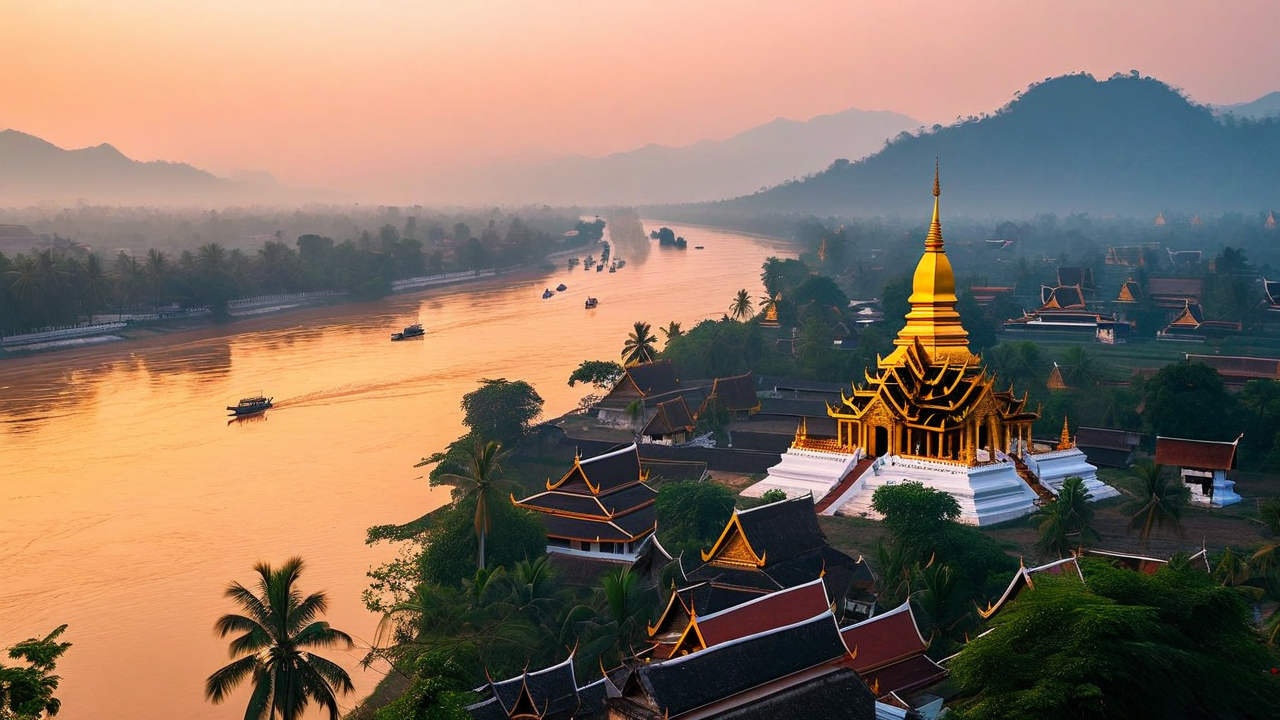
A UNESCO World Heritage city at the confluence of the Mekong and Nam Khan rivers, Luang Prabang is arguably Southeast Asia's most enchanting town. Golden temples, colonial French architecture, the dawn alms ceremony, the bustling night market, and the turquoise, multi-tiered pools of Kuang Si Falls just outside town combine into a destination that consistently exceeds expectations. Wat Xieng Thong, the city's most important temple, and the climb up Mount Phousi for sunset views over the rivers are the two essential stops beyond the alms ceremony itself.
🏞️ Vang Vieng & the South
Vang Vieng, once notorious for rowdy backpacker "tubing" culture, has spent the past decade genuinely reinventing itself as an adventure hub: kayaking, rock climbing, caving, and hot-air ballooning amid dramatic karst limestone scenery along the Nam Song River. The Plain of Jars, further north on the Xieng Khouang plateau, is a UNESCO-listed archaeological mystery — hundreds of massive stone jars, some over 2,000 years old, whose original purpose remains genuinely debated among archaeologists. The area also bears visible scars of heavy Secret War-era bombing, and visits to jar sites require staying strictly on cleared paths due to unexploded ordnance.
Si Phan Don (4,000 Islands), where the Mekong widens into a dreamy archipelago near the Cambodian border, offers hammock-swinging relaxation on Don Det and Don Khon, views of Khone Phapheng Falls, and a real chance of spotting the critically endangered Irrawaddy dolphin. The Bolaven Plateau, a highland region of coffee plantations and dramatic waterfalls (Tad Fane, Tad Yuang), rewards travelers willing to rent a motorbike for what's often called one of Southeast Asia's great road-trip loops.
🌡️ Climate & Best Time to Visit
November through February is cool and dry — the ideal window for most travel, with comfortable temperatures even in the lowlands. March and April turn very hot, often exceeding 35°C before the rains arrive. May through October is the monsoon: lush green scenery and dramatically fewer tourists, though some rural roads become impassable and river travel can be disrupted.
✈️ Getting There
Wattay International Airport (VTE) in Vientiane and Luang Prabang Airport (LPQ) receive regional flights from Bangkok, Hanoi, and other Asian hubs — there are currently no direct long-haul flights from the US or Europe, so most American visitors connect through Bangkok. Land borders are open to Thailand (via several Friendship Bridges across the Mekong), Vietnam, China, and Cambodia. The Laos–China Railway, completed in 2021 with cross-border service to Kunming beginning in 2023, has meaningfully eased overland arrival from southern China and is reshaping northern Laos's tourism and trade patterns.
📋 Practical Information
Visa: a 30-day visa on arrival is available to most nationalities at airports and major land borders ($30–42 depending on nationality); eVisa is also available online in advance. Money: the Lao Kip (LAK) is the official currency, though Thai Baht and US Dollars are widely accepted in tourist areas — note that the kip has experienced significant inflation and depreciation in recent years, so check current exchange rates rather than relying on older guidebook figures. Laos remains extremely affordable: budget travelers can manage $20–30/day, mid-range $40–70/day. ATMs are available in major towns but can be unreliable in remote areas — carry more cash than you think you'll need when heading off the main circuit.
🍜 Cuisine
Sticky rice eaten by hand, fiery herb-packed laap, and the fermented fish sauce that sets Lao food apart from its Thai neighbor. Read the full Food & Drink guide, with recipes →
💰 Cost of Living
Laos is one of the most affordable countries left in Southeast Asia. A simple noodle or rice dish at a local restaurant runs $1–3; a large Beer Lao costs about $1–2. Budget guesthouses run $8–15/night, mid-range hotels $30–60, and Luang Prabang's boutique French-colonial villas $60–200. Domestic transport is cheap but slow — buses between major towns can take considerably longer than the distance suggests, given mountain roads.
🏨 Accommodation
Luang Prabang has by far the best range: boutique hotels in restored French-Lao villas ($60–200), charming guesthouses ($15–40), and budget hostels ($5–10), including standout luxury properties like the Rosewood and Amantaka. Vientiane and Vang Vieng have expanding mid-range options. The 4,000 Islands offer rustic riverside bungalows from $5–15/night — simple, but with some of the best sunset views in the country included for free.
🎉 Festivals & Events
Pi Mai (Lao New Year, mid-April) — the country's biggest celebration, a multi-day nationwide water fight combined with genuine religious ceremony: Buddha images are ceremonially washed, sand stupas are built in temple courtyards, and elders are blessed with water as a sign of respect. Visitors should expect to get thoroughly soaked anywhere in the country during this period, cheerfully and without exception. Boun Awk Phansa (October) marks the end of Buddhist Lent with illuminated boat processions on the Mekong. Luang Prabang's night market runs every evening and is less a festival than a permanent institution — handicrafts, textiles, and street food stalls filling the main street after dark.
🏛️ UNESCO World Heritage
Luang Prabang's perfectly preserved old town and the mysterious Plain of Jars anchor Laos's UNESCO heritage. Explore the heritage sites →
💼 Business & Economy
A currency crisis, deep Chinese debt dependence, and a country trying to become "the battery of Southeast Asia." Read the full Business guide →
🔬 Fascinating Facts
💣 The Most Bombed Country, Per Capita
During the Secret War (1964–1973), more ordnance was dropped on Laos than on all of Europe combined during WWII. An estimated 30% failed to detonate and remains a danger today.
🍚 Sticky Rice Champions
Laos consumes more sticky rice per person than any country on Earth. Lao people are sometimes called luk khao niao — "children of sticky rice."
👶 A Genuinely Young Country
With a median age around 25, Laos has one of the youngest populations in Asia — though several neighbors, including Cambodia and Timor-Leste, are younger still.
🌊 Only Landlocked Country in ASEAN
Laos is the sole landlocked member of ASEAN, bordered by five countries: China, Vietnam, Cambodia, Thailand, and Myanmar.
⭐ Notable People
Kaysone Phomvihane (1920–1992) — founding leader of the Lao People's Revolutionary Party and the country's first prime minister after 1975, whose portrait remains ubiquitous in public buildings today. Bounthanh Xaysana — internationally exhibited contemporary Lao painter whose work bridges traditional Buddhist iconography and modern themes. Beyond individual names, it's worth noting that decades of war, isolation, and a small population have meant Laos has produced fewer internationally famous cultural figures than most of its neighbors — the country's real notability lies more in its collective traditions (temple architecture, textile weaving, Luang Prabang's living heritage) than in individual biography.
⚽ Sports
Football (soccer) is Laos's most popular spectator sport, though the national team remains one of the weaker sides in Southeast Asian competition. Sepak takraw — a foot-volleyball hybrid played with a rattan ball, popular across the region — draws genuine local enthusiasm, with informal matches visible in public squares most evenings. Muay Lao (Lao boxing), a close cousin of Muay Thai, retains a dedicated following, particularly around festival time.
📸 Photo Gallery
Share your Laos photos! Send to photos@kaufmann.wtf to be featured.
✍️ Author's Note
"I've watched a lot of sunrises in Southeast Asia, but nothing quite prepares you for Luang Prabang at 6am — the street lights still on, the town silent except for temple bells, and then a line of saffron-robed monks appearing out of the mist to collect rice from kneeling residents who've been waiting for them in the dark. Nobody is performing for anyone. It has been happening every single morning for centuries, tourists or no tourists."
"Laos rewards slowness in a way few countries do anymore. Miss the bus, and you'll catch the next one tomorrow. Boh pen nyang. Never mind. No worries. After a week here, I mostly meant it."
— Radim Kaufmann, 2026
Support This Project 🌍
This World Travel Factbook is a labor of love – free to use for all travelers. If you find it helpful, consider supporting its continued development.
