
🇬🇶 Equatorial Guinea at a Glance
🌏 Overview — Why Visit Equatorial Guinea
Equatorial Guinea is the only sovereign state in Africa where Spanish is the official language, one of the smallest countries on the continent, and — by almost any measure of visitor numbers — the least travelled country in Africa that is not actively at war. It receives a few thousand tourists a year, most of whom are oil-industry spouses on a weekend out.
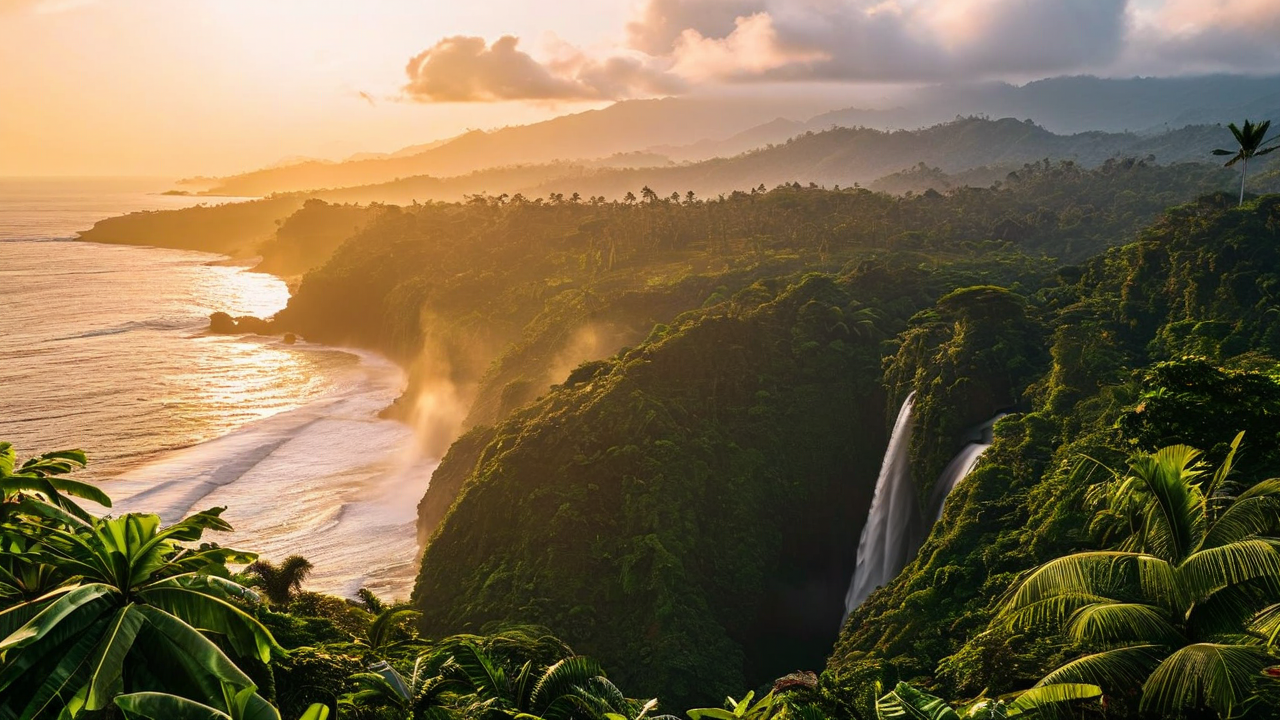
It is split in two. Bioko is a volcanic island 40 km off the coast of Cameroon, with a 3,011 m peak, a caldera full of primates and the wettest coastline in Africa. Río Muni is the mainland, wedged between Cameroon and Gabon, and is rainforest. Plus Annobón, a speck of volcanic rock 600 km out in the Atlantic, and a few smaller islands. Until January 2026 the capital was on the island; by presidential decree it is now Ciudad de la Paz, the purpose-built city in the mainland forest (see section 11), though Malabo keeps the airport, the embassies and most of the actual government for now. The largest city, Bata, is on the mainland.
Why anyone comes: wildlife, essentially. The Gran Caldera de Luba on Bioko holds seven primate species including the drill and the Bioko red colobus, at densities that exist because almost nobody goes there. Ureca's beaches take four species of nesting sea turtle. Monte Alén on the mainland has forest elephants, gorillas and chimpanzees. For a certain kind of traveller this is one of the most rewarding countries in the region.
Why almost nobody does: it is difficult and expensive. Hotels are priced for oil executives, the visa process has historically been demanding, independent movement is limited, roadblocks are frequent, and the photography rules are strict enough that people have been detained for pointing a camera at the wrong building. This page treats all of that as the main practical content rather than as a footnote, because that is what it is.
🏷️ Name & Identity
The name is purely descriptive and slightly inaccurate: the country lies just north of the equator on the mainland, though Annobón is south of it. "Guinea" is the old European name for the West African coast, and "Equatorial" distinguishes it from Guinea, Guinea-Bissau and Papua New Guinea — a set of countries whose only common feature is that name.
Spanish Guinea
The colonial name until independence on 12 October 1968. Spain's only significant sub-Saharan colony, held from 1778 when Portugal traded it for territory in South America.
Spanish in Africa
Around two-thirds of the population speak Spanish, making this the only African state where it is the working language of government. French and Portuguese were added as official languages later, for regional and Lusophone diplomatic reasons rather than because anyone speaks them much.
Two halves
Bioko and Río Muni were administered separately for most of the colonial period and were joined at independence. The island is Bubi; the mainland is Fang; the state is Fang-dominated. This is the country's central internal fault line.
Renamings
Malabo was Santa Isabel until 1973; Bioko was Fernando Po and then, briefly, Macías Nguema Biyogo; Bata was Bata throughout. Annobón was renamed Pagalu and then changed back.
The flag
Green, white and red with a blue triangle for the sea that links the island to the mainland, and a silk-cotton tree in the arms — under which the treaty with Spain was said to have been signed.
Motto
Unidad, Paz, Justicia — Unity, Peace, Justice. It is printed on the flag.
🗺️ Geography
A mainland rectangle and a scatter of islands, 28,051 km² in total — a little larger than Belgium, a third of Czechia. Everything is equatorial: hot, wet, and forested to a degree that made the interior almost impassable until oil money built roads.
Río Muni
The mainland, about 26,000 km², between Cameroon to the north and Gabon to the south and east. Coastal plain rising to interior hills, drained by the Río Benito and the Río Muni, and largely covered in rainforest.
Bioko
2,017 km² of volcano 40 km off Cameroon, geologically part of the Cameroon Line. Three shield volcanoes, the largest being Pico Basilé at 3,011 m — the country's highest point — and crater lakes in the south.
Annobón
17 km², 600 km south-west of Bioko and well south of São Tomé — closer to the coast of Gabon than to its own capital. Volcanic, with a crater lake, and reachable only by an occasional flight or ship.
Corisco & the Elobeys
Small islands in the Río Muni estuary off the mainland coast, with good beaches, an airport built for tourism that sees almost no traffic, and archaeological sites.
The wettest coast in Africa
Ureca, on Bioko's southern tip, records something in the order of 10,000 mm of rain a year — among the highest totals recorded anywhere on the continent.
Rainforest
Around 60% of the country is still forested, one of the higher proportions in Africa, largely because so little of it was ever accessible. Logging and roadbuilding are changing that.
📍 Map of Equatorial Guinea
Nothing here connects to anything else the way a normal country's map suggests. Malabo — the capital until January 2026 and still the working one — is on an island 250 km from the mainland it governs, and reaching the third-largest population centre means an ocean flight.
Malabo → Bata
Across water: a 40-minute flight, several times a day, and the country's busiest route. There is no ferry service you should rely on.
Malabo → Pico Basilé
About 35 km and an hour by road up a paved but steep and often cloud-covered military road. A permit is required.
Malabo → Luba → Ureca
Luba is an hour south. Ureca beyond it is another two to four hours on a track that is impassable in the wet season without a good 4×4 and often impassable anyway.
Bata → Monte Alén
About 130 km inland via Niefang, two to three hours on tarmac then track.
Bata → Ciudad de la Paz
Around 100 km east to the new capital at Djibloho, on a very good and very empty motorway.
Annobón
An occasional flight from Malabo, and a supply ship. Reaching it requires patience and, in practice, a permit and a reason.
📜 History — Portugal, Spain and Independence
The Bubi settled Bioko from the mainland, probably from the first millennium BCE. Portugal claimed the island in 1472 — Fernão do Pó gave it his name — and made almost nothing of it. In 1778, by the Treaty of El Pardo, Portugal traded Bioko, Annobón and rights on the mainland coast to Spain in exchange for territory in South America. Spain's first expedition lost most of its men to disease within months and withdrew.
For much of the 19th century Britain effectively ran the island, leasing it as a base for the West Africa Squadron suppressing the slave trade, and settling freed Africans and Sierra Leonean Krio at Clarence — later Santa Isabel, now Malabo. Their descendants, the Fernandinos, became a distinct English-speaking Protestant elite.
Spain took the colony properly in hand only from the late 19th century, and made it a cocoa economy — Bioko's volcanic soil produced some of the world's finest cacao, worked largely by contract labour brought from Nigeria. By the 1960s Spanish Guinea had one of the highest per-capita incomes and literacy rates in Africa.
Independence came on 12 October 1968, granted rapidly under UN pressure and with almost no preparation. Francisco Macías Nguema won the presidential election. Within a year the country had begun the collapse described in the next section.
🕯️ The Macías Years, 1968–1979
What happened in Equatorial Guinea between 1968 and 1979 is among the most extreme episodes of the twentieth century, and it is very little known outside the country. Francisco Macías Nguema declared himself President for Life in 1972 and ran the state as a personal instrument until his nephew overthrew and executed him in 1979.
The scale
Estimates suggest somewhere between a third and a half of the population was killed or fled. Perhaps 80,000 people died; perhaps 100,000 or more went into exile in Cameroon, Gabon and Spain. The country's population fell by an enormous fraction in a decade.
The educated class
Macías had the word intelectual banned. Almost the entire educated population was killed, imprisoned or driven abroad — a loss the country has never fully recovered from and which shapes it to this day.
Institutions
Schools were closed in 1975. The Catholic Church was banned in 1978 and his portrait placed on the altars of the churches that remained. The national treasury was reportedly kept in bags in his house in Mongomo.
Titles
"Unique Miracle", "Grand Master of Education, Science and Culture", "Sole Miracle of Equatorial Guinea". The regime's cult of personality was as total as any.
The end
In August 1979 his nephew, Lieutenant Colonel Teodoro Obiang Nguema Mbasogo — who had run the Black Beach prison — took power in a coup. Macías was tried and shot by Moroccan troops, because local soldiers reportedly believed his powers made him unkillable.
Why it matters now
Everything about the modern country runs from this: the missing generation, the absence of institutions, the dominance of one family from Mongomo, and a population with very direct reasons to be cautious about politics.
🏛️ The Obiang Era
Teodoro Obiang Nguema Mbasogo took power in August 1979 and has held it ever since — the world's longest-serving living head of state who is not a monarch. He has been re-elected repeatedly with official results in the range of 93 to 99 per cent, in contests that no international observer has described as competitive.
The record
In power since 1979. For scale: he took office the year the Soviet Union invaded Afghanistan, and was still in office when the last soldier who fought in that war retired.
Succession
His son Teodoro Nguema Obiang Mangue, universally known as Teodorín, is Vice-President and the presumed successor, and since 2024 has been running an anti-corruption campaign against rivals within the elite that most observers read as succession housekeeping. He was convicted in France in 2017 of laundering embezzled public funds, upheld on final appeal in 2021; in September 2025 the International Court of Justice rejected Equatorial Guinea's attempt to stop France selling the seized Avenue Foch mansion. Settlements were reached earlier in the United States and Switzerland.
The Wonga Coup
In March 2004 a group of mercenaries led by Simon Mann was arrested in Zimbabwe en route to overthrow the government. The plot was partly financed by investors including Mark Thatcher, who pleaded guilty in South Africa. Mann served time in Black Beach prison and was pardoned in 2009.
Politics today
The ruling PDGE holds effectively every seat in both chambers. Opposition parties exist on paper; the main one, Convergence for Social Democracy, has been repeatedly suppressed and its leaders detained.
The government since 2024
Manuel Osa Nsue Nsua has been Prime Minister since August 2024. On 16 June 2026 he submitted the resignation of the entire cabinet after the Vice-President announced it had met roughly a tenth of its targets; four days later Obiang reappointed him. The next presidential election is due in 2029, when Obiang will be 87.
The Engonga affair
In November 2024 hundreds of explicit videos of Baltasar Ebang Engonga — head of the national financial investigation agency and a nephew of the president — leaked online and made him briefly the most searched Equatoguinean on Earth. On 28 August 2025 a Malabo court sentenced him to eight years for embezzlement and fined him US$220,000. Locals read it as Teodorín clearing the field.
Russia arrives
Since October 2024 Russian instructors under the Africa Corps banner — reported at up to 200 — have trained presidential guard units in Malabo and Bata, the Russian embassy has reopened and a Russian House has opened in the capital. Obiang and Teodorín have met Putin and Lukashenko repeatedly since late 2023. It changes nothing for a visitor except the accents at the better hotels.
Rankings
Freedom House rates Equatorial Guinea Not Free with one of the lowest scores it issues. Reporters Without Borders placed it 94th of 180 in its 2026 index — up from 118th the year before, a rise RSF credits to online outlets escaping state control, not to any loosening of it. Transparency International ranks it among the most corrupt states measured.
How to hold this as a visitor
You are a guest in a country where politics is genuinely dangerous for the people who live in it. Do not raise it with strangers, do not press people for opinions, and understand that a shrug is an answer.
🛢️ Oil and the Resource Curse
In 1995 the Zafiro field came online off Bioko and Equatorial Guinea became, briefly, one of the fastest-growing economies on Earth. Within a decade it had a GDP per capita on paper higher than several EU member states, and one of the widest gaps between that figure and the way most of its population actually lived that has ever been recorded.
The boom
Production peaked around 2012 at roughly 400,000 barrels a day from a population then under a million. Oil and gas came to account for the overwhelming majority of exports and government revenue.
What it bought
Motorways with no traffic, a new capital in the jungle, an African Cup of Nations, five-star hotels in a city with intermittent water, and — genuinely — roads, an airport and a power supply that did not previously exist.
What it did not buy
Human development indicators far below what the income figures imply. Life expectancy, child mortality and access to clean water remain poor by regional standards, let alone by the standards of a country with that GDP per head.
The Riggs Bank affair
A 2004 US Senate investigation found that hundreds of millions in Equatoguinean oil revenue had passed through accounts at Riggs Bank in Washington controlled by the president and his associates. The bank was fined and ceased to exist.
The decline
Output has fallen steadily since 2012 as fields mature and it is now falling fast: oil production dropped an estimated 19% in 2025 and the economy shrank 5.4%, with the World Bank projecting further contraction through 2027. Hydrocarbons still supply over 80% of government revenue. The bets are on gas — a February 2026 deal with Cameroon to develop the cross-border Yoyo-Yolanda field and feed the under-used LNG plant at Punta Europa — plus fishing and, on paper, tourism.
Why you will notice
Prices. Malabo is one of the most expensive cities in Africa because it was built to charge oil companies, and those prices did not come down when the oil did.
🏙️ Malabo
A city of around 300,000 on the northern edge of Bioko, in the crater of an extinct volcano opening onto the sea. Founded by the British as Clarence in 1827 and Spanish Santa Isabel until 1973, it is the most attractive colonial-era townscape in Central Africa — and it is small enough to walk in a morning.
The old town
A grid of Spanish colonial buildings above the port: shuttered two-storey houses with deep balconies, painted in ochre and white, in various states of restoration and decay. Calle de Enrique Nvó and the streets around the plaza are the best of it.
Catedral de Santa Isabel
Twin-spired neo-Gothic, completed in 1916 by a Spanish architect, and the city's landmark. It faces Plaza de la Independencia and is open.
Paseo Marítimo
The seafront promenade, rebuilt with oil money, and where Malabo walks in the evening. The view back to the town from the port road is the classic one.
Malabo II & Sipopo
The new districts — ministries, conference centres, a golf course and a presidential compound at Sipopo built for a 2011 African Union summit. Spectacularly empty.
Markets
Mercado Central and the Semu market for produce, fish, and the bushmeat trade that is one of Bioko's serious conservation problems.
Practical
Everything of interest is in a small area. Hotels are expensive; the mid-range options are around the centre and the top end at Sipopo. Walking the old town by day is fine — but see the photography section before you take your camera out.
🌆 Bata & the Mainland
Bata is the largest city in the country — bigger than the capital — on the mainland coast, and it feels like a different nation: hotter, flatter, more African, more crowded, and less Spanish. It is where most Equatoguineans live and work.
Paseo Marítimo
A three-kilometre seafront promenade, well built and genuinely pleasant, with the Torre de la Libertad at one end — a viewing tower that is the city's landmark.
Mercado Central
Large, busy and the best place to see ordinary Equatoguinean life. Fish, cassava, plantain and everything else.
The cathedral
Bata's cathedral and the surrounding Spanish colonial core survive in patches among the new construction.
7 March 2021
Four explosions at the Nkoantoma military barracks on the edge of the city — badly stored explosives and a nearby stubble fire, officially — killed at least 107 people, injured more than 700 and damaged much of Bata. It is the worst peacetime disaster in the country's history and the memorial to its victims is where Pope Leo XIV prayed on his visit in April 2026.
Beaches
Long grey-sand beaches run north and south of the city. Swimming is possible; the surf and the currents deserve respect and there is no supervision.
Getting inland
Niefang, Evinayong and Mongomo are reached on good roads. Mongomo, on the Gabonese border, is the Nguema family's home town and has a basilica modelled on St Peter's — the second-largest church in Africa, in a town of a few thousand people.
Practical
Bata is the base for Monte Alén and for anything on the mainland. Flights from Malabo run several times a day and take 40 minutes.
🏗️ Ciudad de la Paz — the Capital in the Jungle
In the middle of the mainland rainforest, at Djibloho, the government has been building a new capital. Announced as Oyala and renamed Ciudad de la Paz, it is intended to house government, a university, a five-star hotel district and eventually 200,000 people, in forest that was empty a decade ago.
Why
The official reason is national development and a capital that is not on an island. The widely repeated unofficial reason is security — a capital deep inland is much harder to seize in a coup than a port city, and the 2004 plot is remembered.
What is there
Six-lane boulevards, a presidential palace, ministries, the Afro-Arab Investment Bank building, a university, a golf course and a great deal of very good empty road through the trees.
Population
Far below plan. Ministries have relocated in stages and civil servants commute or are posted; the city does not yet function as one.
Visiting
It is on the road between Bata and Mongomo and can be driven through. It is also full of government buildings, which makes it exactly the sort of place where cameras cause problems.
The comparison
It belongs to a small family of purpose-built jungle and desert capitals — Brasília, Naypyidaw, Astana, Egypt's new administrative capital — and shares their emptiness and their logic.
Worth it?
As a sight, no. As an insight into what the oil money was for, entirely.
Capital on paper — January 2026
By decree signed on 2 January 2026 and announced the next day, Obiang proclaimed Ciudad de la Paz the national capital, ending Malabo's run since 1968. The official reasons given were Malabo's and Bata's overcrowding and the need for a capital on the mainland. In practice the ministries, embassies, the international airport and the president's working days are still overwhelmingly in Malabo; expect the change to show on maps long before it shows on the ground.
⚖️ Human Rights & What It Means for You
A guide that describes the beaches and omits this would be dishonest. Equatorial Guinea is consistently ranked among the most repressive states in the world, and any visitor should arrive understanding the environment they are moving through — not because they are at risk, but because the people around them are.
The documented picture
Arbitrary detention, torture in custody, suppression of opposition parties, and near-total control of media are documented consistently by the UN, Amnesty International and Human Rights Watch. Black Beach prison in Malabo has a long-standing reputation.
Press
There is effectively no independent domestic press: state RTVGE and the Vice-President's Asonga channel are the broadcasters, and what independent reporting exists is done online, much of it from Spain. Foreign journalists have been detained and deported, and in the 2023 Marburg outbreak reporters needed a ministry permit to talk to medical staff. If you are a journalist, travelling on a tourist visa to report is a serious risk, not a technicality.
Corruption
Documented in detail by foreign courts rather than domestic ones — the French, US and Swiss cases against the Vice-President are the fullest public accounting that exists.
The US deportation deal
Under an agreement signed in October 2025, for which Washington paid US$7.5 million, Equatorial Guinea accepts people deported from the United States who are not its citizens. Those sent — a few dozen, several of whom had been granted protection by US courts — have been held under guard in a Malabo hotel and pressed to return to the countries they fled; in June 2026 human-rights groups took the case to the African Commission. Since June 2025, meanwhile, Equatoguinean nationals have been barred from entering the United States under the Trump travel ban.
What it means practically
Very little for an ordinary tourist, who is far more likely to be inconvenienced than endangered. Roadblocks, document checks, and occasional demands for small payments are the normal texture of movement.
What not to do
Do not photograph anything official. Do not discuss the president. Do not carry political material. Do not attempt to interview anyone about politics. Do not assume a conversation is private.
The ethical question
Some travellers decline to visit countries like this on principle. That is a defensible position and so is the opposite one — that the money spent reaches guides, drivers and guesthouse owners rather than the state. This page does not tell you which to hold; it tells you what you would be choosing between.
🌋 Bioko — Pico Basilé & the Caldera
Bioko is a 2,017 km² volcano rising straight out of the Gulf of Guinea, geologically part of the Cameroon Line and biologically a continental fragment isolated by rising seas at the end of the last ice age. That isolation is why it has the endemics it does, and why conservation biologists care about it far more than travel writers do.
Pico Basilé · 3,011 m
The island's summit and the highest point in the country, up a paved military road from Malabo. A permit is required and there is an installation near the top, so this is not a walk-up. Cloud forest, then giant lobelias and grassland; the view, on the rare clear day, reaches Cameroon.
Gran Caldera de Luba
A vast collapsed caldera in the island's remote south, effectively roadless, with seven primate species inside it. Reaching it means a multi-day guided trek in and out. It is the single most significant piece of wildlife habitat in the country.
The primates
Drill, Bioko red colobus, black colobus, Preuss's monkey, red-eared monkey, crowned monkey and putty-nosed monkey. Several are endemic subspecies and several are critically endangered — the Bioko red colobus above all.
Bushmeat
The primary threat, and it is visible: primates are openly sold in Malabo's markets. Bans exist and enforcement is inconsistent. Conservation groups have worked on the island for decades against this.
Moka
A highland village at around 1,400 m in the south of the island, cool and green, with crater lakes at Biao and Loreto nearby. The usual base for anything in the south, with basic accommodation.
Luba
The island's second town, on the west coast, an hour from Malabo — a small port with a Spanish core and the road towards Ureca beyond it.
🐢 Ureca & the Turtle Beaches
Bioko's southern tip is one of the most important sea turtle nesting sites in the Gulf of Guinea, and one of the wettest places in Africa — Ureca records rainfall in the order of ten metres a year, which is roughly fifteen times what falls on Prague.
Four species
Leatherback, green, olive ridley and hawksbill all nest on the black-sand beaches between Ureca and Moaba. Leatherbacks are the headline — the largest turtle on Earth, hauling out to lay in the dark.
Season
Nesting runs roughly October to February, peaking around December and January — which is also the wettest part of the year on that coast.
Monitoring
A long-running research and protection programme has operated on these beaches, with beach patrols and tagging. Visits, where possible, go through it rather than around it.
Getting there
Hard. A rough track south from Luba that is frequently impassable, or a long walk, or a boat. Plan on a guided expedition with several days, not a day trip.
What else is there
Waterfalls dropping directly onto the beach, forest running to the tideline, and effectively no infrastructure. It is as close to untouched tropical coast as remains in the region.
Reality check
This is the single best thing in Equatorial Guinea and it takes real effort, real money and a fixer who knows the permits. Do not turn up in Malabo hoping to arrange it in a day.
🌳 Monte Alén National Park
The mainland's principal protected area: around 2,000 km² of rainforest between Bata and the interior, part of a transboundary complex continuing into Gabon. It has the megafauna the islands do not.
What lives there
Forest elephants, western lowland gorillas, chimpanzees, mandrills, forest buffalo, leopard, and a bird list well over 250 species. Sightings are hard — this is dense forest, not savanna.
How to visit
Through a guide arranged in Bata or Malabo. There is a park headquarters at Monte Alén village, basic accommodation, and trails including a canopy walkway that has been in variable states of repair.
Lago Atok
A forest lake within the park where elephants and buffalo come to drink, reached on a walk of several hours. Overnight in a hide is the standard way to see anything.
Realistic expectations
You will hear far more than you see, and the birds and insects are the reliable part. People who come expecting East African game viewing are disappointed; people who come for Congo Basin rainforest are not.
Threats
Logging, roadbuilding and bushmeat hunting. Management capacity is limited and international conservation funding has come and gone.
Other reserves
Río Campo in the far north on the Cameroon border, and Altos de Nsork in the south-east near Gabon. Both are less accessible again.
🏝️ Annobón & Corisco
Two of the least-visited inhabited places in Africa, both belonging to a country that is itself barely visited.
Annobón
Seventeen square kilometres of volcano 600 km out in the Atlantic, south of São Tomé and closer to Gabon than to its own capital. Around 5,000 people, a crater lake at A Pot, whales offshore, and a Portuguese-based creole, Fá d'Ambô, that is unlike anything else spoken in the country.
Getting to Annobón
An occasional flight from Malabo and a supply ship. Both are irregular. Permission in practice means a permit and a reason, and travellers have waited weeks in Malabo for a seat.
Its isolation
Annobón has been the subject of repeated reports of neglect and, in 2024, of a heavy security response to local protests over quarrying and living conditions. It is not a straightforward place to visit and it is not a resort.
Corisco
A small island in the Río Muni estuary with genuinely beautiful white-sand beaches, an ancient burial site, and an international airport built for a tourism industry that never arrived. Reachable by boat from Bata or Cogo, or by air.
Elobey Grande & Chico
Two tiny islands nearby. Elobey Chico was the colonial administrative centre for the mainland and is now an abandoned town being taken back by the forest — one of the most atmospheric places in the country.
Practical
All of this needs a fixer, permits and flexibility. None of it can be booked online.
🦍 Wildlife & Conservation
For a small country, Equatorial Guinea holds a disproportionate share of Gulf of Guinea biodiversity — a consequence of having both an isolated oceanic-style island and a slice of intact Congo Basin forest.
Endemism on Bioko
The island's separation from the mainland at the end of the last ice age left endemic subspecies of several primates and birds, plus the Bioko frog and a distinctive amphibian fauna.
The drill
One of Africa's most endangered primates, found only in Cross River Nigeria, southwest Cameroon and Bioko. Bioko's population is one of the most important remaining.
Bioko red colobus
Critically endangered and essentially confined to the Gran Caldera. Its numbers are the clearest measure of whether protection there is working.
Sea turtles
Four species nesting on the southern beaches, monitored for decades. Among the more important nesting aggregations in the Gulf of Guinea.
Birds
Over 400 species recorded nationally, including Gulf of Guinea specialities. For birders this is the strongest single reason to come.
The pressure
Bushmeat hunting driven by urban demand in Malabo, logging on the mainland, and very limited enforcement capacity. Conservation here has depended heavily on foreign university and NGO programmes, whose funding fluctuates.
Biosphere reserve · 2025
In September 2025 UNESCO designated Bioko a Biosphere Reserve — the country's first UNESCO listing of any kind, covering the island's forests, the Caldera and the turtle coast. It is not a World Heritage site and brings no new enforcement, but it is the first time the island's biology has had an international label to point to.
🏛️ UNESCO Heritage
None inscribed — Equatorial Guinea ratified the World Heritage Convention only in 2010 and is one of a handful of African states with no site on the list. Until 2026 it was the only country in Africa without even a Tentative List; that changed this year, after a UNESCO mission in August 2025 walked the candidate sites with the ministry.
Tentative List · six entries, all 2026
Caldera de Luba Scientific Reserve · Annobón Nature Reserve · Monte Alén National Park · Pico Basilé National Park · the neo-Gothic church of Batete on Bioko · Corisco (Mandji) island. A Tentative List is a statement of intent, not a nomination; the first actual dossier is years away.
Biosphere reserve
Bioko island, designated by UNESCO's Man and the Biosphere programme in September 2025 — a different list from World Heritage, and the country's only UNESCO designation to date.
Intangible heritage
No element inscribed; Equatorial Guinea is one of nine states party to the 2003 Convention with none. A UNESCO-funded pilot inventory of traditional dances — balele, the Fang forms, the mvet — runs from late 2025 to the end of 2026 and is the likely source of a first nomination.
What to see of it
Batete church, an hour from Malabo on the Luba road, is the one Tentative List entry you can visit without a permit or an expedition: a 1887 timber-and-iron neo-Gothic church built by Claretian missionaries, and one of the more surprising buildings in Central Africa.
🎭 People & Culture
Something around 1.7 million people, though census figures are contested and estimates vary widely. The population is young, urbanising fast, and includes a substantial number of West and Central African migrant workers drawn by the oil economy.
Fang
Roughly 85% of the population and the dominant group on the mainland, part of a people spread across Cameroon, Gabon and Equatorial Guinea. The ruling elite is Fang, and specifically from the Mongomo area.
Bubi
The indigenous people of Bioko, now a minority on their own island after a century of migration. A 1998 uprising was suppressed and Bubi political organisation has been heavily restricted since.
Ndowe, Bujeba, Annobonese
Coastal peoples of the mainland, and the Portuguese-creole-speaking community of Annobón. Each has its own language and identity.
Fernandinos
Descendants of freed slaves, Sierra Leonean Krio settlers and Afro-Cuban deportees settled at Clarence in the 19th century — historically English-speaking, Protestant and commercially prominent, now a small community.
Religion
Overwhelmingly Catholic, a legacy of Spain, alongside widespread traditional practice. Mbwiti and other traditional systems persist, and the two coexist without much difficulty.
Social manner
Reserved with strangers, formal, and warmer once introduced. Greetings matter and are unhurried. Personal questions about your work and family are normal; questions about politics from you are not.
💬 Language
Spanish is the language of government, education and the media, and around two-thirds of the population speaks it — the only place in Africa where that is true. French and Portuguese are also official, for regional-bloc and Lusophone-diplomacy reasons respectively, and neither is much spoken.
Equatoguinean Spanish
Closer to peninsular Spanish than to Latin American varieties — vosotros is used, and the accent has a Spanish rather than an American cast. A European Spanish speaker will feel more at home here than in Bogotá.
Fang
The most widely spoken indigenous language and the lingua franca of the mainland, part of the Bantu family and spoken across three countries.
Bubi
The language of Bioko's indigenous people, endangered, with revitalisation efforts that are complicated by politics.
Fá d'Ambô
The Portuguese-based creole of Annobón, descended from the language of 16th-century settlers and enslaved people. Roughly 5,000 speakers and one of the world's smaller creoles.
Pichinglis
An English-based creole spoken in Malabo, related to Nigerian and Cameroonian Pidgin, and the working street language of the port and the markets.
English
Very little outside the oil sector and the better hotels. Spanish is close to essential for anything independent — this is one of the few African countries where French will not help you.
🍲 Food
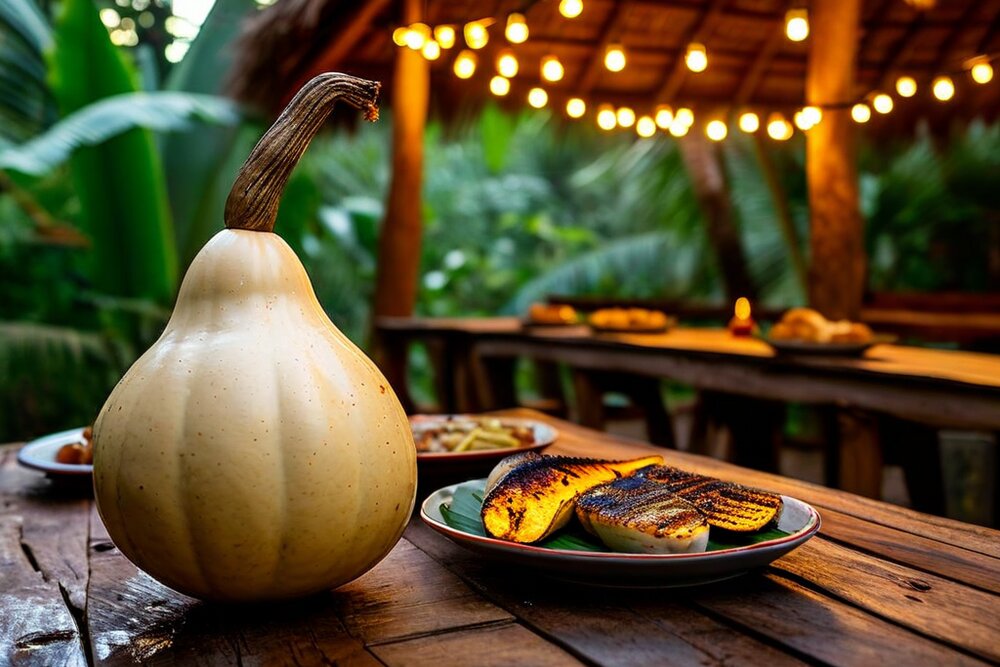
Central African cooking with a Spanish layer on top: cassava, plantain, yam and malanga as the base, fish and chicken as the protein, palm oil and peanut as the sauces, and a colonial inheritance of Spanish bread, tinned goods and the occasional improbable paella.
Pepesup
A fiery pepper soup of fish or meat, the country's most characteristic dish, eaten at any hour and firmly believed to cure a hangover.
Sopa de pescado
Fish soup in the Spanish manner, with Central African seasoning — the clearest place the two culinary inheritances meet.
Peanut sauce
Chicken or fish stewed in ground peanut with tomato and chilli, served over rice or with plantain. The regional staple, done well here.
Succotash and akwadu
Beans with plantain and corn; and akwadu, baked banana with coconut and butter, which is the standard dessert.
Bushmeat
Widely eaten and widely sold, including protected primate species. This is a serious conservation problem rather than a culinary curiosity, and declining it is the correct response.
Where to eat
Hotel restaurants in Malabo are expensive and mediocre; the Spanish and Lebanese-run places in the centre are better. Street and market food is where the actual cooking is, and the fish grilled by the port in the evening is the best thing in the city.
🥃 Drinking
Malamba
The national spirit: sugarcane distilled locally, clear, strong and variable. Sometimes infused with bark or herbs. Offered socially, and refusing outright is a little awkward — accept a small one.
Topé
Palm wine, tapped from the raffia or oil palm and drunk the same day, cloudy and lightly fermented. Sweeter in the morning and increasingly alcoholic as the day goes on.
Beer
The mainstream drink. San Miguel is brewed under licence and is what most people order; Cameroonian and Spanish imports are widely available.
Spanish wine
Imported and everywhere in the hotels, which is a colonial hangover rather than a local tradition. There is no wine industry here and never has been — the country is too wet and too equatorial for vines.
Coffee and cocoa
Bioko's volcanic soil once produced world-class cacao and good coffee. Both collapsed after independence and are being replanted in small quantities. If you find local chocolate, buy it.
Practical
Alcohol is legal, unrestricted and expensive in hotels. Buy in a shop if you want it at a sane price.
🎉 Festivals & the Calendar
Independence Day · 12 October
The national day, marked with parades and official ceremony, and the biggest date in the calendar.
Freedom Day · 3 August
Commemorating the 1979 coup that ended the Macías regime. Officially the "Day of the Armed Forces" and heavily observed.
President's Day · 5 June
Obiang's birthday, and a public holiday.
Corpus Christi
A moveable feast and one of the most genuinely popular religious occasions, with processions in Malabo and Bata.
Abira
A Bubi purification ceremony on Bioko, in which a community is symbolically cleansed of evil. One of the surviving indigenous ritual traditions.
Balele and traditional dance
Balele on Bioko and Fang dance forms on the mainland appear at national celebrations and at village level. The mainland's mvet — a sung epic accompanied by a stringed harp-zither, performed by a trained bard — is the region's great oral art form.
The papal visit · April 2026
Pope Leo XIV spent 21–23 April 2026 in the country at the end of his first African journey — the first pope here since John Paul II in 1982. He met Obiang in Malabo, said Mass in the basilica at Mongomo, visited Bata's prison and the memorial to the 2021 explosions, and closed with a stadium Mass in Malabo. In a country this Catholic and this closed it was the biggest public event in a generation, and the speeches were watched very closely for what they did and did not say about the regime.
🏅 Sport
Football
The national obsession, as everywhere in the region. Equatorial Guinea co-hosted the Africa Cup of Nations in 2012 with Gabon and hosted it alone in 2015, stepping in at short notice when Morocco withdrew over Ebola concerns. The stadiums in Malabo and Bata date from this. At AFCON 2025 in Morocco (December 2025–January 2026) the Nzalang went out in the group stage for the first time in their history — beaten 2–1 by Burkina Faso, 1–0 by Sudan on a Saúl Coco own goal, and by Algeria.
Nzalang Nacional
The national team reached the AFCON semi-finals in 2015 and has produced genuine upsets since. Emilio Nsue, top scorer at the 2023 AFCON, is the country's best-known player — and in 2024 FIFA ruled he had never been eligible to play for it at all, having represented Spain at youth level: two World Cup qualifying wins were forfeited 3–0, the federation fined and Nsue banned for six months. Equatorial Guinea finished fifth of six in its 2026 World Cup group behind Tunisia, Namibia, Liberia and Malawi.
Eric the Eel
At the Sydney Olympics in 2000, Eric Moussambani swam the 100 m freestyle in 1:52.72 — the slowest time in Olympic history, having learned to swim eight months earlier in a hotel pool and never having seen a 50 m pool. He finished, the crowd stood, and he became the most famous Equatoguinean alive. He later became the national swimming coach.
Paula the Crawler
The same Games produced Paula Barila Bolopa, whose 50 m freestyle was similarly the slowest ever swum at an Olympics. Both were entered under a wildcard programme intended to widen participation.
Basketball and athletics
Both played, both under-resourced. The country's sporting infrastructure was built for the AFCON and has been uneven since.
Watching football
League matches in Malabo and Bata are cheap, loud and welcoming. It is one of the easier ways to spend an evening among Equatoguineans rather than among oil expatriates.
🌦️ Climate & When to Go
Equatorial, hot and wet. Temperatures sit between 25 and 32 °C essentially every day of the year and humidity is high enough that the number matters less than it should. What varies is the rain — and Bioko and the mainland do not have the same pattern, which catches people out.
Bioko — dry-ish season
Roughly December to February, and again a shorter break around July and August. This is when the tracks in the south are passable and when the island is worth attempting.
Bioko — wet season
The rest of the year, heavily. The southern coast at Ureca is among the wettest places in Africa and receives rain in quantities that close roads for months.
Río Muni
Two dry seasons, roughly December to February and June to August, with the heaviest rain in April–May and September–November. The mainland is drier overall than Bioko's south.
Turtle season
October to February on the Bioko beaches — which overlaps awkwardly with the wettest months on that coast. There is no clean answer; December and January are the usual compromise.
Best overall
December to February. Driest on both island and mainland, and the turtle season is on.
Harmattan
The Saharan dust wind reaches the Gulf of Guinea in December and January, producing hazy days and cooler nights. It ruins photographs and improves the temperature.
✈️ Getting There & Getting Around
Two international airports: Malabo (SSG) on Bioko and Bata (BSG) on the mainland. Both are small, both are modern, and photographing either of them is a good way to have a difficult afternoon.
Airlines
Iberia, the historic Madrid link, dropped the route in 2020, and the Spanish carriers that picked it up (Plus Ultra, and Ceiba itself) have flown it only on and off since — as of 2026 assume there is no dependable Madrid nonstop and check what is actually operating when you book. Air France via Paris, Turkish via Istanbul, Ethiopian via Addis Ababa, Royal Air Maroc via Casablanca and regional carriers from Douala, Libreville and Lagos are the reliable ways in.
Ceiba Intercontinental
The national carrier, running the Malabo–Bata shuttle and some regional and Annobón routes. Bookings are best made through an agent locally.
Malabo–Bata
Forty minutes, several times a day, and unavoidable — there is no reliable passenger ferry between the island and the mainland.
Roads
Better than you expect. Oil money built good tarmac between the main centres on the mainland and around northern Bioko. What is not paved is often not passable.
Roadblocks
Frequent, routine, and a normal part of intercity travel. Carry your passport and permits, be patient and polite, and expect delays rather than trouble.
Getting around independently
Difficult. Car hire exists but is expensive and usually comes with a driver, which is the sensible arrangement anyway. Shared taxis and minibuses run between towns. Almost every visitor uses a fixer or a driver, and this is the right call.
🇪🇺 Getting There from Europe & Czechia
The natural route from Europe used to be through Madrid, a straight consequence of the colonial history — but Iberia gave up Madrid–Malabo in 2020 and nothing has replaced it reliably, so for most travellers the practical routes now run through Paris, Istanbul, Addis Ababa or Casablanca.
Via Madrid
The colonial connection is no longer a scheduled certainty: Iberia stopped flying Madrid–Malabo in 2020 and the replacements have come and gone. If a nonstop is running when you book — about six hours — it is the cleanest option from Prague on a single ticket; if not, Madrid is just another connection.
Via Istanbul or Addis
Turkish Airlines and Ethiopian both serve Malabo and connect well from Prague. Often cheaper than Iberia and usually longer.
Via Paris or Casablanca
Air France and Royal Air Maroc also fly in, with connections from most of Europe.
From Prague
Reckon on 12–18 hours with one or two connections — Paris, Istanbul or Addis are the usual ones. Return fares typically CZK 20,000–40,000, and they do not drop much; this is not a leisure route and the fares reflect it.
Combining
Equatorial Guinea pairs logically with São Tomé and Príncipe, Cameroon or Gabon. All three are easier countries, and São Tomé in particular is what a lot of people are actually looking for when they think about the Gulf of Guinea.
Book the ground first
Arrange the fixer, the hotel and any permits before the flight. This is not a country where you land and work it out.
🛂 Visas & Entry
Historically one of the hardest tourist visas in Africa to obtain. The rules have been changing, and this is one section where you should verify rather than trust a page — check with the Equatoguinean embassy accredited to your country within a month of travelling, and do not rely on what a forum said last year.
The traditional process
An application through an embassy with a letter of invitation from a sponsor in the country, proof of accommodation, a yellow fever certificate, bank statements, an itinerary and often an interview. Processing measured in weeks.
The letter of invitation
The pivotal document, and the reason most independent travellers use a local agency — the agency provides it. Budget for this as a real cost.
Recent changes
An online e-visa portal has existed since 2023 and is now the normal route for tourists, with fees in the tens of dollars, approvals quoted in days and arrival expected through Malabo; a letter of invitation, proof of funds and the yellow fever certificate are still asked for. The government has also announced exemptions for a number of nationalities as part of a tourism push. Whether any of that applies to you, and whether it is being implemented consistently at the airport, are questions for the embassy — apply through the official portal, not an agent's copy of it.
Yellow fever
A vaccination certificate is required and is checked on arrival. Without it you will have a problem at the airport, and it is not the kind of problem that is easily solved there.
On arrival
Expect thorough questioning about your purpose, your accommodation and your onward ticket. Have printouts of everything. Journalists and researchers travelling as tourists are taking a genuine risk, not a procedural shortcut.
Registration
Some visitors have been required to register with the police locally. Your hotel or fixer will know; ask on arrival rather than discovering it at a roadblock.
📵 The Photography Rules
This deserves its own section because it is the single most common way visitors get into trouble in Equatorial Guinea, and because the rules are stricter and more strictly enforced than in almost any other country a tourist is likely to visit.
What is prohibited
Government buildings of any kind, the presidential palace and its perimeter, military and police installations and personnel, airports, ports, bridges, and anything that could be construed as infrastructure. In practice this covers a large share of what is architecturally interesting in Malabo.
What happens
Detention, deletion of your images, questioning, and in some documented cases the confiscation of the camera or phone and a period in custody. It is not a fine-and-move-on situation.
Permits
A photography permit has at various times been required and obtainable through the Ministry of Information. Whether one is currently needed and how to get it is a question for your fixer — and having one does not override the prohibited list.
People
Always ask, and accept a refusal without argument. Photographing people without permission causes offence here and can also attract official attention.
The safe approach
Landscape and wildlife outside towns: fine. Street photography in Malabo: ask your guide each time. Anything with a uniform, a flag or a fence in it: no.
Drones
Do not bring one. There is no version of this that ends well.
📋 Practical Information
Money
Central African CFA franc (XAF), pegged to the euro at a fixed 655.957 to 1 — so euros convert cleanly and predictably. Shared with Cameroon, Gabon, Chad, CAR and Congo-Brazzaville.
Cash
Bring euros. This is a cash economy, ATMs are unreliable and often out of service, and card acceptance outside the top hotels is minimal. Change at a bank, not on the street.
Health
Yellow fever certificate required. Malaria risk is high and year-round — take prophylaxis and use repellent seriously. Typhoid and hepatitis A are usually recommended. The country had its first Marburg virus outbreak in 2023, on the mainland, with around a dozen confirmed deaths — contained, but a reminder of how thin the health system is. Medical facilities are limited; evacuation insurance is essential, not optional.
Water
Do not drink the tap water anywhere. Bottled is available in towns; carry more than you think you need in the heat.
Electricity
220 V, 50 Hz, European type C and F sockets — Czech plugs fit directly. Supply is better than it was and still not continuous; a power bank is worth carrying.
Connectivity
Orange and Muni cover the towns. Data is expensive and slow by European standards, and coverage away from the main centres is patchy to absent.
Time zone
UTC+1, no daylight saving. The same as Prague in winter, one hour behind in summer.
Language
Spanish, seriously. French will not help and English barely will. If you have no Spanish, a guide is not a luxury.
Documents
Carry your passport, visa and any permits at all times. Copies are not always accepted at roadblocks.
Emergency
There is no single reliable emergency number in practice. Your embassy, your fixer and your hotel are the chain to use — Czech citizens are covered by the nearest accredited embassy rather than a resident one; check with the ministry before travelling.
MZV and DROZD
Read the current Czech Ministry of Foreign Affairs advice at mzv.gov.cz and register in DROZD. In a country with no Czech resident embassy and limited medical capacity, this is more than a formality.
Tipping
Not strongly established. Rounding up and tipping guides and drivers is appreciated.
⚠️ Safety
Equatorial Guinea is, for a tourist, considerably safer than its reputation and considerably more complicated than most places. Violent crime against foreigners is not the issue. Bureaucracy, officialdom and health are.
⚠️ Travel Advisory
US State Department: Level 2 — Exercise Increased Caution (issued 7 October 2025), citing crime and health. No blanket warning against travel from the US, UK or Czech ministries as of September 2026; all of them stress the photography rules, the yellow fever requirement and the absence of trauma care. The Czech Republic has no embassy here — check mzv.gov.cz for the accredited mission and register in DROZD.
Crime
Petty theft and opportunistic robbery in Malabo and Bata, particularly after dark and around the markets. Low by the standards of large African cities. Use taxis at night and keep valuables out of sight.
Officials
Roadblocks, document checks and occasional requests for informal payments are the routine texture of travel. Stay polite, produce documents, do not argue, and do not offer money unprompted. A driver who knows the road handles most of this.
The real risks
Malaria first, road accidents second, and the near-total absence of trauma care third. In that order, and all three are more likely to affect you than crime.
Medical
Facilities are limited even in Malabo. Anything serious means evacuation to Europe or South Africa. Comprehensive insurance with evacuation cover is genuinely essential here.
Road travel
Roads between the main centres are good; driving standards and night-time visibility are not. Do not travel intercity after dark.
Political sensitivity
The single behavioural rule: no photographs of anything official, no political conversation, no political material in your luggage. The photography section is the practical version of this.
💰 Costs
Expensive — one of the most expensive countries in Africa relative to what you get, because the hospitality economy was built to charge oil companies rather than travellers, and those prices survived the decline in oil.
Accommodation
Malabo hotel rooms run from around US$100 for a basic guesthouse to US$250–400 for the international chains. There is very little budget accommodation and almost no hostel scene.
Food
Hotel restaurant mains US$25–40; a good local meal US$8–15; market and street food a few dollars. The gap between the two economies is stark.
Transport
The Malabo–Bata flight around US$100–150 return. Car with driver US$100–200 a day. Taxis in Malabo are cheap and shared by default.
Fixers and guides
US$80–200 a day depending on what they are arranging, plus permits. For Ureca or the Caldera, a multi-day expedition arranged locally will run to several hundred dollars per person and is not optional.
Realistic daily budget
US$180–300 per person per day for a mid-range independent trip with a driver — before flights and before any expedition costs. There is no meaningful budget version of this country.
Where the money goes
Disproportionately to hotels and to the state. Choosing local guides, local restaurants and locally owned guesthouses is the main lever a visitor has.
🏨 Where to Stay
Malabo — centre
A handful of mid-range hotels around the old town and the port, walking distance from the cathedral and the seafront. The practical choice for a short stay.
Malabo — Sipopo
The luxury enclave east of the city built for the 2011 African Union summit: five-star hotels, a golf course, a beach, and complete isolation from the country you came to see.
Bata
Several business hotels along and behind the Paseo Marítimo, priced for oil and construction workers rather than tourists.
Moka
Basic highland accommodation on Bioko — a guesthouse and a research-station-style lodge. Cool, quiet, and the base for the south of the island.
Luba and Ureca
Very basic or nothing. Anything in the far south means camping or a community arrangement made by your fixer in advance.
Monte Alén
Park accommodation at the headquarters, simple and dependent on current management. Confirm it exists before you set out.
🤯 Fascinating Facts
Africa's only Spanish-speaking state
Equatorial Guinea is the sole sovereign African country with Spanish as an official language — and it is spoken by around two-thirds of the population.
A capital on an island
Malabo sits on Bioko, 250 km from the mainland it governs and only 40 km from Cameroon. Reaching the country's largest city requires a flight over international water.
The longest-serving leader alive
Teodoro Obiang has been in power since August 1979 — longer than any other living non-royal head of state anywhere in the world.
Traded for South America
Spain acquired Bioko and Annobón from Portugal in 1778 in exchange for territory in what is now Brazil and Uruguay. Spain's first expedition then lost most of its men to disease and left.
Ten metres of rain
Ureca on southern Bioko records rainfall in the order of 10,000 mm a year, among the highest totals on the African continent.
A capital built in the jungle
Ciudad de la Paz is being constructed in rainforest at Djibloho, with boulevards and ministries and very few people — reportedly, in part, because an inland capital is harder to overthrow.
The Wonga Coup
A 2004 mercenary plot to overthrow the government, financed in part by Mark Thatcher, that ended with its leader in Black Beach prison and a great deal of embarrassment in London.
Eric the Eel
At Sydney 2000, Eric Moussambani swam the slowest 100 m freestyle in Olympic history, having learned eight months earlier and never seen a 50 m pool. The crowd gave him a standing ovation and he later coached the national team.
Seven primates in one crater
The Gran Caldera de Luba holds seven primate species in a single roadless basin, including the critically endangered Bioko red colobus.
👤 Notable Equatoguineans
Teodoro Obiang Nguema Mbasogo (b. 1942)
President since 1979 and the world's longest-serving living non-royal head of state. Took power from his uncle in a coup and has held it through eight elections.
Francisco Macías Nguema (1924–1979)
The first president, whose eleven years killed or exiled an enormous share of the population and destroyed the country's institutions. Executed after the 1979 coup.
Leoncio Evita (1929–1996)
Author of Cuando los combes luchaban (1953), generally recognised as the first novel published in Spanish by a Black African writer.
Donato Ndongo-Bidyogo (b. 1950)
The country's most significant living writer and historian, long exiled in Spain. Las tinieblas de tu memoria negra is the essential Equatoguinean novel.
María Nsue Angüe (1945–2017)
The first Equatoguinean woman to publish a novel, Ekomo (1985), a landmark of Hispanic African literature.
Eric Moussambani (b. 1978)
"Eric the Eel", the Sydney 2000 swimmer whose 1:52.72 became one of the Olympics' great human stories. Later national swimming coach.
Emilio Nsue (b. 1989)
The country's best-known footballer, born in Spain, top scorer at the 2023 Africa Cup of Nations and the leading scorer in the Nzalang Nacional's modern history — despite FIFA ruling in 2024 that he had never been eligible to play for the country, which cost it two World Cup qualifying wins.
Concha Buika (b. 1972)
Grammy-winning singer, born in Palma de Mallorca to Equatoguinean parents in exile, and the most internationally successful artist of the diaspora.
Simon Mann (1952–2025)
Not Equatoguinean, but inseparable from the country's modern story — the British mercenary who led the 2004 coup attempt and served five years in Black Beach prison.
📰 Media & Press Freedom
Equatorial Guinea sits at 94th of 180 in the 2026 RSF World Press Freedom Index (score 52.79), a jump of 24 places in a year that says more about the index than about the country: nobody was killed or jailed, so the security score is decent, while the political and economic scores remain among the worst in Africa. Pre-censorship is the norm, press offences are criminal, there is no media regulator, and journalists who step out of line are suspended, threatened or lose their phones to the security services.
What exists
State broadcaster RTVGE, and Asonga, the one "private" channel, owned by the Vice-President — both mouthpieces. The big news for most people is satellite television and WhatsApp. The independent outlets that matter are online and mostly abroad: Diario Rombe from Spain, AhoraEG and a handful of exile sites.
How control works
Not by violence, mostly, but by permission: accreditation to enter, a ministry authorisation to cover a hospital, a suspension for criticising a Covid committee, a defamation suit for the rest. The 2023 Marburg outbreak was covered from Geneva, not from Bata.
For visitors
Nothing here touches a traveller except the photography rules, which are the practical face of the same system. Sites are not blocked and SIM cards are unrestricted, but assume nothing on a local network is private.
✍️ Author's Note
Equatorial Guinea is a country I would recommend to perhaps one traveller in a hundred, and to that one without hesitation. If your idea of a trip involves permits, a fixer, roadblocks, ten metres of rain and a multi-day walk into a crater to look for a colobus, this is one of the last places on Earth that will give you exactly that. If it does not, São Tomé is two hundred kilometres away, costs a third as much and is a genuinely lovely country.
The reason it is worth the effort is the Gran Caldera and the beaches at Ureca. There is very little intact tropical habitat left in the Gulf of Guinea and this is some of the best of it, protected largely by being extremely difficult to reach. Getting there requires money, patience and someone local who knows which permits are currently real.
And go with your eyes open about where you are. This is not a country that welcomes questions, and the people you meet have very good reasons for the answers they give and do not give. Take the photography rules seriously — they are the thing that turns a good trip into an incident. Do not perform curiosity about politics at people who cannot afford to satisfy it. Be a straightforwardly good guest, spend your money with guides and guesthouses rather than with hotels, and look at the forest.
—Radim Kaufmann, 2026
Support This Project 🌍
This World Travel Factbook is a labor of love – free to use for all travelers. If you find it helpful, consider supporting its continued development.
