🚛 BelAZ — Building the World's Biggest Trucks
Belarus doesn't build passenger cars for the world market, but it builds something far stranger and, in its own way, far more impressive: some of the largest land vehicles ever manufactured. BelAZ (Belarusian Automobile Plant), founded in 1948 in the town of Zhodzina, 50km northeast of Minsk, is one of the world's leading manufacturers of ultra-class mining haul trucks — the colossal dump trucks that move earth and ore at open-pit mines from Siberia to Chile.
The company's flagship, the BelAZ 75710, is the largest and heaviest dump truck ever put into production: a 450-tonne payload capacity, a gross vehicle weight of 810 tonnes, and a body large enough to swallow roughly 300 average passenger cars in a single load. Twin 16-cylinder diesel engines produce a combined 4,600 horsepower, driving the truck via a Siemens electric transmission system through eight enormous tyres, each nearly 4 metres tall. It measures 20.6 metres long — longer than two city buses parked end to end — yet can still turn in a 31-metre radius. As of 2026 it remains the reigning title-holder, still ahead of the nearest Caterpillar and Komatsu ultra-class competitors on raw payload.
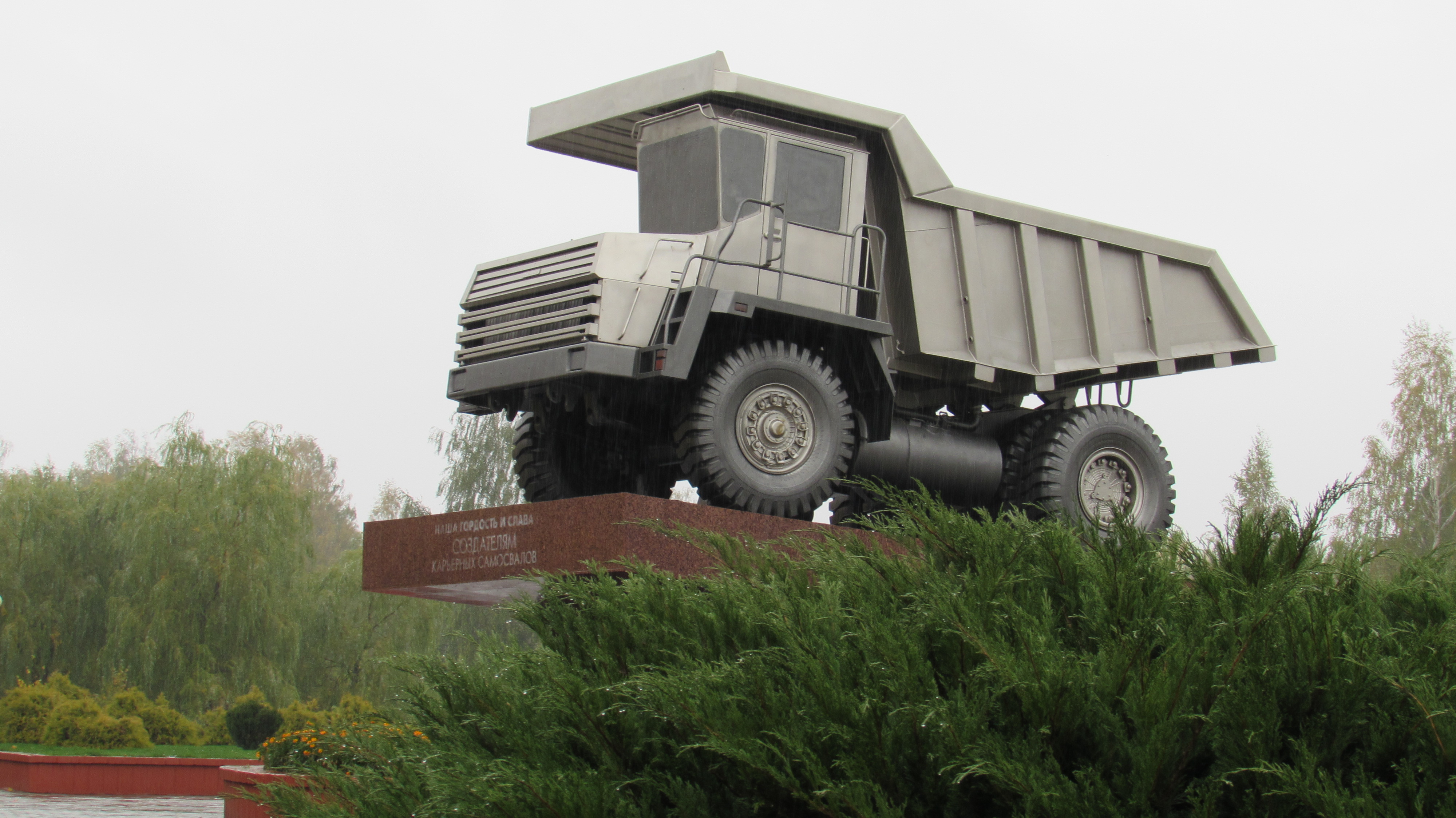
BelAZ trucks are a source of genuine national pride in Belarus — the company's monument truck stands on a plinth in Zhodzina like a war memorial, and "BelAZ" is a household name in a way few industrial brands are. The company remains 100% state-owned, employs roughly 10,000 people, and exports to more than 80 countries; a single 75710 costs in the range of $6–8 million and burns over 1,000 litres of diesel per hour of operation. For an American reader, the closest comparison is Caterpillar's own ultra-class trucks — except this particular giant-truck arms race has, since 2013, been led from a small city in Belarus rather than Illinois.
🚌 MAZ — Trucks, Buses & a Soviet Legacy
The Minsk Automobile Plant (MAZ), founded in 1944, is BelAZ's older sibling and the source of its original engineering DNA — BelAZ itself began as a MAZ subsidiary producing dump trucks before splitting into an independent giant in its own right. Today MAZ builds highway trucks, city buses, trolleybuses, and specialty military and municipal vehicles, and remains one of the most recognisable industrial brands across the former Soviet space. MAZ buses and trolleybuses are a common sight not just in Minsk but across Russia, Central Asia, and parts of Eastern Europe.
Both BelAZ and MAZ trace back to a Soviet-era decision to make Belarus a manufacturing hub for heavy machinery — a legacy that persists almost unchanged in the country's economic structure today. Belarus never developed a mass-market passenger car industry the way Czechoslovakia (Škoda) or East Germany (Trabant, Wartburg) did; instead, it specialised in trucks, tractors (Minsk Tractor Works, MTZ, is another major exporter), and heavy equipment — a niche where it remains globally competitive even now.
