

🇦🇨 Ascension Island at a Glance
🌏 Overview
Ascension Island is one of Earth's most remote and inaccessible destinations — a volcanic speck in the South Atlantic Ocean, 1,600 km from Africa and 2,250 km from Brazil. This 88 km² British Overseas Territory exists in magnificent isolation, reachable only with advance government permission and, even then, only via a handful of flights a month.
The island's unique appeal lies in its otherworldly volcanic landscapes, pioneering ecological history, and extraordinary wildlife. Green Mountain, transformed from barren lava into a cloud forest through Victorian-era terraforming, represents one of humanity's earliest successful environmental interventions. Green sea turtles nest on pristine beaches, frigatebirds soar above the world's largest colony of their kind, and species found nowhere else on Earth cling to existence on this remote outpost.
🏷️ Name & Identity
The island's history begins with two Portuguese voyages two years apart. Navigator João da Nova first sighted it in 1501, naming it Ilha da Conceição (Conception Island). It was largely forgotten until 1503, when Afonso de Albuquerque came upon it again — this time on Ascension Day — and gave it the name that stuck. For three centuries it remained unclaimed and essentially unvisited, too dry and barren to interest anyone beyond passing ships hunting turtles and seabirds for food.
Britain garrisoned the island in 1815 — partly to deny Napoleon any escape route from St Helena, 1,300 km to the southeast — and the Royal Navy formally classified it as HMS Ascension, a "stone frigate." Today it is a constituent part of the British Overseas Territory of Saint Helena, Ascension and Tristan da Cunha. Its inhabitants are typically called "Ascension Islanders," though most are temporary contract workers rather than permanent residents — Ascension uniquely has no permanent population and no right of abode. Nobody is born owning the right to stay.
⚠️ Important Travel Advisory
Access Restrictions: Ascension Island requires advance permission from the Ascension Island Government. This is not a casual tourist destination.
- All visitors must have confirmed accommodation before arrival
- Return travel must be pre-booked and confirmed
- No tourist visas — only special entry permits, granted case by case
- Medical evacuation is extremely limited; travel insurance with repatriation cover is essential
🔴 Who Can Visit: family of residents, researchers, journalists with authorization, and occasionally independent travelers with a compelling reason and the patience for the permit process.

Mars on Earth
Over 40 volcanic cones dot Ascension's otherworldly landscape — black lava flows meet red cinder fields
🗺️ Geography & Regions
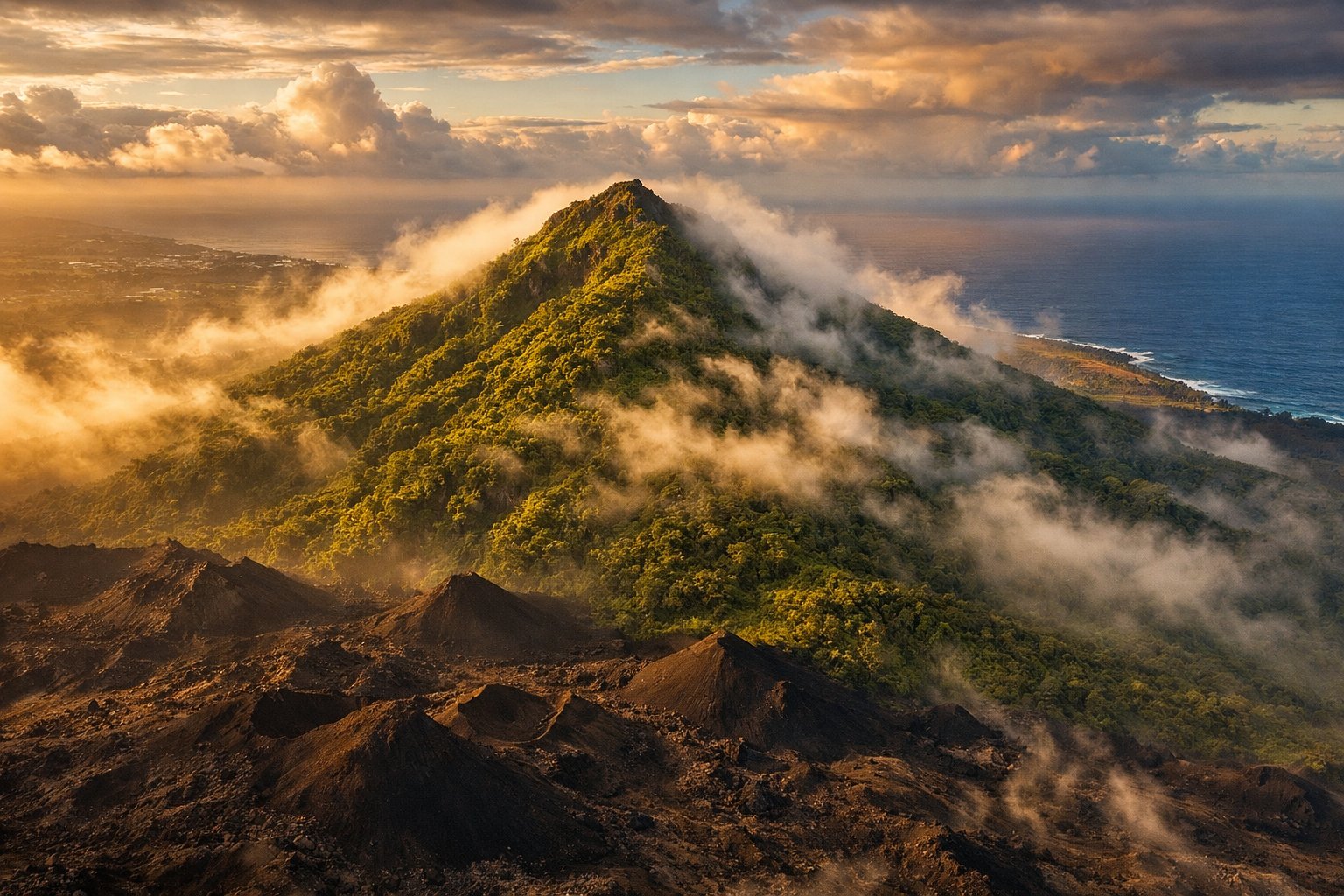
Ascension emerged from the Mid-Atlantic Ridge less than one million years ago — making it geologically young. Over 40 volcanic cones dot the landscape, creating terrain that genuinely resembles Mars, so much so that NASA and other agencies have used it to test planetary rover equipment. The highest point is Green Mountain at 859 meters — once completely barren, now transformed into a unique cloud forest ecosystem through Victorian-era terraforming that began in the 1840s.
Much of the island remains raw volcanic terrain: black and red cinder fields, lava flows, and scattered volcanic bombs. The contrast between the lush green summit and the desert-like lowlands creates one of Earth's most dramatic ecological transitions within such a small area — you can genuinely walk from Martian desert to misty rainforest in an afternoon.
🗺️ Map of Ascension Island

Georgetown — World's Smallest Capital
White colonial buildings with red roofs nestle along the volcanic coastline
📜 History
After its 1501 sighting and 1503 renaming, Ascension sat essentially unclaimed for three centuries — too dry and waterless for permanent settlement, useful only as an emergency stop for turtle meat and seabirds. The island's strategic importance finally emerged in 1815, when the British Royal Navy garrisoned it to guard against any rescue attempt of Napoleon Bonaparte during his exile on nearby Saint Helena. In 1899, Ascension became a crucial telegraph relay station on the cable connecting Britain to South Africa, giving the barren rock a real, ongoing purpose for the first time.
The United States built Wideawake Airfield during World War II, and it became critical again during the 1982 Falklands War, serving as the staging base for the longest bombing raids in history at the time — a 12,700 km round trip. Today the island hosts RAF, US Space Force, and European Space Agency tracking facilities, continuing its long career as one of the most strategically valuable dots on the map that almost nobody has heard of.
👥 People & Culture
Ascension has no indigenous culture and no permanent population in the usual sense — everyone who lives here does so on a contract, whether military, scientific, or civilian, and everyone eventually leaves. The roughly 800 residents form two main communities: British and American military and space-agency personnel on fixed postings, and "Saints" — workers from nearby St Helena, 1,300 km to the southeast, who have staffed Britain's remote South Atlantic outposts for generations and form the backbone of the island's civilian workforce.
This transience shapes a genuinely unusual social culture: intense, close-knit community bonds that form fast precisely because everyone knows their posting has an end date. The Two Boats Club and the Saints Club are the island's only real social venues, hosting quiz nights, darts, and the kind of unpretentious camaraderie that comes from 800 people sharing a volcano in the middle of an ocean. English is the only language in everyday use, spoken with a distinct St Helenian lilt among the Saints community. There is no organized religion beyond a small Anglican congregation, no local newspaper beyond a modest community bulletin, and remarkably little crime — there is, after all, nowhere to run to.
🏛️ Government & Politics
Ascension is not a country and has never been one. Since the 2009 constitution it is one of three parts of the British Overseas Territory of Saint Helena, Ascension and Tristan da Cunha, each with its own local administration but a single Governor. The Governor — Nigel Phillips CBE — is resident in Jamestown on St Helena, 1,300 km to the southeast, and sent the King’s message to the island for Ascension Day 2026 in the usual way: by proxy, across an ocean.
Day-to-day authority rests with the Administrator, currently Rowan Laxton, who lives on the island at Residency in Georgetown and exercises the Governor’s functions locally. Alongside him sits the Ascension Island Council, an elected body with no political parties, no whips, and no manifestos — candidates stand as individuals and are voted for by name.
🗳️ Island Council — General Election, 3 July 2025
Eight candidates stood, which under Ascension’s rules triggered a seven-seat council rather than five. Turnout: 207 of 546 registered voters — 37.91%.
| Councillor | Votes | Share |
|---|---|---|
| Eugene Leroy Bennett | 145 | 15.71% |
| Thomas Tyson George Hickling | 140 | 15.17% |
| Laura Marie Shearer | 130 | 14.08% |
| Thomas Barnes | 119 | 12.89% |
| Michael Duncan Ross Ellick | 116 | 12.57% |
| Alan Herbert Nicholls | 111 | 12.03% |
| Ethan Duncan Bally | 89 | 9.64% |
Councillors serve alongside the Administrator on the Ascension Island Government. There are no political parties on Ascension — every candidate stands independently.
Two constitutional facts define everything else about the island. First, there is no right of abode: nobody, including people born on Ascension, has an automatic right to live here. Residence depends on holding a job or being the dependant of someone who does, and it ends when the contract does. Second, there is no land ownership — all land is Crown land, leased to the Ascension Island Government, the MoD, the US Air Force, and a handful of commercial operators. You cannot buy a house on Ascension because there are no houses to buy.
The island runs on the Saint Helena pound (SHP), pegged one-to-one with sterling; UK notes and coins circulate interchangeably, and card acceptance is patchy enough that cash still matters. The economy is essentially three employers — the Ascension Island Government, the RAF/MoD at Wideawake, and the US Air Force detachment — supplemented by the European Space Agency tracking station, a satellite and cable-landing presence, and the fishing licence and stamp revenues that fund a surprising share of the budget.
🏛️ Key Attractions
Green Mountain National Park: a cloud forest ecosystem created through 1840s terraforming — bamboo groves, ginger plants, and mist-shrouded paths where you can walk from volcanic desert to tropical forest in hours. Long Beach: the primary nesting beach for green sea turtles (January–May); witnessing 200+ kg turtles haul themselves ashore to lay eggs is one of Earth's great wildlife spectacles.
Boatswain Bird Island: a small offshore islet hosting the world's largest colony of Ascension frigatebirds — an endemic species found nowhere else on Earth. Letterbox Walks: a unique local tradition of hikes across volcanic terrain to hidden message boxes where visitors leave notes for whoever finds them next. Devil's Riding School: a dramatic volcanic crater with steep cinder walls that creates an otherworldly amphitheater, one of the island's most photographed natural features.

Ancient Navigator Returns
Green sea turtles swim 2,000+ kilometers from Brazil to nest on Ascension's beaches

Endemic Frigatebirds
The Ascension frigatebird is found nowhere else on Earth — males display bright red throat pouches to attract mates

Devil's Riding School
A dramatic volcanic crater with steep cinder walls — one of the island's most spectacular natural features
🍽️ Cuisine
This remote South Atlantic island's cuisine is simple but flavorful, shaped by what a fortnightly supply ship can deliver and what can actually be caught or grown locally — featuring fresh fish and the island's famous land crabs, brought together with the practical, unfussy cooking traditions of the St Helenian community that runs most of the island's kitchens.
Steamed Land Crabs
Island Delicacy
Fresh land crabs, native to Ascension's volcanic slopes, steamed simply with garlic and local herbs.
Ingredients: 4 land crabs, cleaned · 4 cloves garlic, minced · 30ml butter · 1 lemon · fresh thyme · salt, pepper · bay leaves
Preparation: purge the crabs in saltwater for 24 hours. Place in a steamer with bay leaves and steam 15–20 minutes until red. Melt butter with garlic and thyme, and serve the crabs with the garlic butter and a squeeze of lemon.
💡 The crabs must be purged before cooking to clean out their systems — don't skip this step.
Pilau
Spiced Rice
One-pot spiced rice with fish or chicken — island comfort food, and a practical way to stretch whatever protein the last supply run brought in.
Ingredients: 240ml rice · 200g fish or chicken · 1 onion, sliced · 1 tomato, diced · 480ml stock · turmeric, cumin · peas, carrots
Preparation: brown the protein and set aside. Sauté onion until golden, add rice and toast 2 minutes, then add spices, vegetables, and stock. Return the protein, cover, and simmer 20 minutes until the rice is done.
💡 Don't lift the lid while it simmers — let the steam do the work.
Grilled Tuna Steaks
Fresh Catch
Simply grilled fresh tuna with lemon and herbs — the surrounding waters are extraordinarily rich in big pelagic fish, and this is the island's default way of cooking them.
Ingredients: 2 tuna steaks · 30ml olive oil · 2 cloves garlic · 1 lemon · fresh rosemary · salt, pepper
Preparation: marinate the tuna in oil, garlic, and herbs for 30 minutes. Heat a grill or pan very hot, season the steaks, and grill 2–3 minutes per side for medium-rare. Rest 2 minutes and serve with lemon.
💡 Fresh tuna should stay pink in the center — don't overcook it.
🍸 Cocktails & Mixed Drinks
On one of the world's most remote islands, drinking culture is defined by resourcefulness. The Saints Club and Two Boats Club are the social hubs, and what's poured depends entirely on what the last supply ship carried.
Green Mountain Cooler
Mid-Atlantic Refresher
Named for Ascension's remarkable Green Mountain — a cloud forest created through Victorian-era terraforming.
🥃 Tall glass · 🔨 Build
Ingredients: 45ml white rum · 30ml Midori · 90ml pineapple juice · 15ml lime juice · soda water
Preparation: build over ice in a tall glass. Top with soda water. Garnish with a lime wheel and mint.
💡 Green Mountain was transformed from barren lava into a cloud forest by Darwin and Hooker's 1840s terraforming experiment.
Saints Club Shandy
The Island Staple
The everyday drink of Ascension's small community — beer and lemonade at the Saints Club.
🥃 Pint glass · 🔨 Build
Ingredients: 250ml lager beer · 250ml cloudy lemonade · lemon wedge
Preparation: pour the beer into a pint glass. Top with lemonade. Garnish with a lemon wedge.
💡 Beer arrives on the fortnightly supply ship — when it runs out, it runs out.
Wideawake Punch
Volcanic Island Rum Punch
Named after Wideawake Airfield and the sooty tern colony it's named for. Dark rum and ginger beer — the serviceman's classic.
🥃 Rocks glass · 🔨 Build
Ingredients: 60ml dark rum · 15ml lime juice · 10ml honey syrup · ginger beer · Angostura bitters · crystallized ginger
Preparation: build rum, lime, honey, and bitters over ice. Top with ginger beer. Garnish with a lime wheel and crystallized ginger.
💡 The airfield was crucial during the Falklands War and remains a strategic mid-Atlantic staging point.
Kaufmann Drinks Score (KDS)
| Drink | Style | KDS |
|---|---|---|
| Green Mountain Cooler | Mid-Atlantic Refresher | 79 |
| Saints Club Shandy | The Island Staple | 68 |
| Wideawake Punch | Volcanic Island Rum Punch | 82 |
✦ Author's Note — Radim Kaufmann
The Saints Club bar had exactly one room, twelve barstools, and a view of nothing but volcanic rock and ocean. The bartender — an RAF contractor from Birmingham — poured me a shandy and shrugged. "Not much choice here, mate. Beer comes on the supply ship every two weeks. When it runs out, we improvise." He gestured at the Green Mountain rising behind the base. "At least the view is free."
🍷 Wine, Spirits & Drinking Culture
Ascension Island has no vineyards, no breweries, no distilleries — and only about 800 residents, almost all of whom are military personnel, contractors, or BBC relay station staff. This is one of the most isolated inhabited places on Earth: a volcanic rock in the middle of the South Atlantic, a thousand miles from the nearest continent. Everything alcoholic is imported by sea or the occasional flight.
The Two Boats Club and the Saints Club (named after the St Helenian workers who form the island's primary civilian population) are Ascension's only social drinking venues. Both are modest, military-style clubs serving imported British beers, basic spirits, and the occasional bottle of wine. The Two Boats Club, at the island's only real settlement outside Georgetown, hosts quiz nights, darts, and the kind of intimate community socializing that only happens when 800 people share a volcano.
🏆 Kaufmann Wine Score — why there isn’t one
Most countries in this factbook get a Kaufmann Wine Score. Ascension does not, and the reason is not an oversight: there is nothing here to rate. The island has no vineyard, no winery, no distillery and no brewery — not a single litre of alcohol is produced on Ascension. Every bottle behind the bar at the Two Boats Club or the Saints Club crossed an ocean to get there, usually on the RMS-era supply chain that still governs island life. Rating imported Carlsberg and duty-free Bell’s against Bordeaux would tell you nothing about Ascension. What the island offers instead is the context of a drink: a cold beer on a volcano 1,600 km from the nearest continent, drunk with people who all know exactly when their contract ends.
St Helenian rum culture is the closest thing to a local drinking tradition. The Saints — workers from nearby St Helena, 800 miles to the southeast — bring their own traditions: rum punch, strong tea, and the resilient good humor of a community that has been staffing Britain's remote outposts for generations.
✍️ Author's Note Radim Kaufmann
Ascension Island is the kind of place where the concept of "drinking culture" reduces to its purest form: a few people, a remote location, and a bottle. The Two Boats Club on a Friday night — darts, warm beer, 800 miles of ocean in every direction — is drinking stripped of all pretension. There's something almost noble about it. No wine list, no cocktail menu. Just human beings sharing a drink on a volcano in the middle of nowhere. Sometimes that's all you need.
✈️ How to Get There
Wideawake Airfield is a military airfield jointly operated by the USAF and RAF, and under a UK–US agreement, only state aircraft (military and diplomatic flights) are normally authorized to land. There are two practical routes for the rest of us, and both require an entry permit from the Ascension Island Government arranged well in advance — nothing about getting here can be booked on impulse.
Via St Helena (the commercial route): as an exception to the general rule, Wideawake is open to a scheduled commercial charter linking Ascension with St Helena, operated by AirLink roughly once a month as an extension of its weekly Johannesburg–St Helena service, with a seasonal Cape Town connection in the southern summer. In practice this means Johannesburg → St Helena → Ascension, and the whole chain is only as strong as St Helena Airport. That fragility was demonstrated in February 2026, when St Helena’s Resilience Forum declared a Major Incident on 6 February after the airport was downgraded from Category 6 over fire-tender readiness; commercial flights were suspended outright, the airport operated at Category 4 for light aircraft and medevac only, and AirLink stopped taking bookings. Services resumed in the second half of February 2026, and AirLink has since scheduled a weekly seasonal Cape Town rotation for December 2026 to March 2027 — but the episode is the standing argument for never building a tight itinerary around this route.
Via the RAF Airbridge: the South Atlantic Airbridge — an A330 Voyager running twice weekly between the UK, Ascension and the Falkland Islands, about nine hours and 6,800 km on the northern leg — carries a small civilian allocation (around fifteen indulgence seats per flight since the service resumed in May 2023), subject to Ministry of Defence approval and military priority. Family of residents and those with a genuine connection to the island stand the best chance. Note that RAF Brize Norton’s runway is closed for modernisation from mid-July to late November 2026, with Airbridge passengers routed via East Midlands Airport instead. There are no cruise calls with landing rights, no ferries, and no way to simply turn up: this remains one of the most logistically demanding places on Earth to visit legally.

Wideawake Airfield
The only gateway to Ascension — this strategic military base supported every crewed US space mission and remains a critical mid-Atlantic staging point
🏨 Accommodation
Obsidian Hotel: the only proper hotel on the island, located in Georgetown, at roughly £100–150/night. Guesthouses: limited availability, must be booked through the Ascension Island Government, around £60–80/night. Confirmed accommodation is required before entry permission will even be considered — you cannot arrive and figure it out on the ground.
Currency: Saint Helena Pound (SHP), pegged 1:1 to GBP; British pounds are accepted everywhere. Bring cash — card acceptance is unreliable across the island.
🌡️ Climate
Ascension has a hot, dry tropical maritime climate. Temperatures hover between 22–31°C year-round, with low humidity by tropical standards thanks to steady southeast trade winds. Rainfall is sparse and erratic at sea level — about 130mm a year at Georgetown — but Green Mountain, rising to 859m, captures cloud moisture and supports its surprising cloud forest. There is no real "season," but September–April is hottest, May–August slightly cooler.
🛂 Visa & Entry
Ascension is not a tourist destination in the ordinary sense. All visitors must obtain an entry permit in advance from the Ascension Island Government and provide proof of onward travel, accommodation, and medical/repatriation insurance — this process should be started months, not weeks, ahead of any planned trip.
There is no visa in the usual sense and no visa fee — what you need is an Entry Permit issued by the Ascension Island Government, and it is granted on the strength of a reason to be here rather than a desire to be here. Tourism is accepted, but the application asks for confirmed accommodation (the island’s bed stock is measured in dozens, not hundreds), confirmed onward travel off the island, and evidence of medical and repatriation insurance. Permits are typically issued for a defined stay tied to those bookings; overstaying is not a paperwork issue on an island you cannot leave without official cooperation.
Practical points that catch people out: the permit process assumes you already hold a seat on a flight, and flights are the constraint — so most itineraries are built backwards from the AirLink schedule or an approved Airbridge seat. Passports should have comfortable validity beyond the trip. Firearms, drones and any commercial filming equipment require separate permission, and drone use near the airfield or the US and communications facilities is refused as a matter of course. Yachts must obtain clearance in advance; unannounced arrivals are turned away.
⚠️ Travel Advisory & Health
🟢 Level 1 — Exercise Normal Precautions
Ascension has effectively no violent crime, no political instability, and no terrorism risk — there is, as residents put it, nowhere to run to. The real hazards here are logistical and medical rather than criminal: you cannot leave when you want to, and you cannot be treated for anything serious on the island. Every credible risk on Ascension traces back to one fact — the nearest hospital with a surgical department is a long flight away over open ocean.
🩺 Medical reality
Georgetown Hospital is a small facility with a resident doctor who also serves as the island’s Chief Medical Officer, supported by a nursing team. There is no surgeon, no intensive care, no obstetrics and no specialist diagnostics. Anything beyond routine care means medical evacuation — which depends on aircraft availability and can take days. Comprehensive medical and repatriation insurance is a condition of the entry permit, not a suggestion, and the Ascension Island Government checks it. Pregnant women are generally not permitted to remain on-island past a set stage of pregnancy, and people with chronic conditions requiring monitoring are routinely refused residence.
🧪 The MV Hondius hantavirus incident — April–May 2026
In the spring of 2026 Ascension found itself, briefly and improbably, at the centre of a global health story. The Dutch-flagged expedition cruise ship MV Hondius had sailed from Ushuaia on 1 April 2026 for the Antarctic Peninsula and the South Atlantic. On 27 April a passenger with severe acute respiratory illness was medically evacuated to Ascension — the only landfall within reach. On 1 May the island’s single doctor recognised that this was not an isolated case but a cluster; PCR confirmed hantavirus on 2 May, and sequencing identified Andes virus (ANDV) on 6 May. By 8 May, eight cases and three deaths were linked to the voyage, six of them laboratory-confirmed.
The outbreak prompted a WHO Disease Outbreak News notice, a CDC health advisory and an ECDC rapid assessment, and drew specialists from South Africa, the UK and the Netherlands into a response coordinated from a volcanic island of a few hundred people. The virus is not endemic to Ascension — Andes virus is a South American pathogen and the exposure occurred before the ship arrived. The episode is remembered here less as a health scare than as a demonstration of what the island actually is: the only door in the middle of an ocean, and one clinician sharp enough to notice a pattern.
🌊 Everyday hazards
The sea is the thing that actually hurts people here. Ascension’s beaches have powerful shore break and rip currents, no lifeguards, and — seasonally — “rollers”, long-period Atlantic swells that arrive without warning and have swept people off rocks and jetties. Swim only where locals swim, and treat the Georgetown pier landing with respect. Add relentless equatorial sun with almost no shade on the lava plains, dehydration on the Green Mountain and Letterbox walks, sharp ‘aʻā-like clinker underfoot that destroys soft shoes, and unlit roads at night. There are no venomous land animals, no malaria and no rabies.
Conservation rules carry real force: it is an offence to disturb nesting green turtles or to use white light on the nesting beaches between roughly January and May, and access to Boatswain Bird Island and parts of the Green Mountain National Park requires permission from the Conservation Department. Photography is restricted around the airfield, the US facilities and the communications installations — when in doubt, do not raise the camera.
💰 Cost of Living
Almost everything is imported by ship, so prices run high for what you get. Expect £4–£6 for a pint, £15–£25 for a basic meal, and £60–£150/night for the island's limited accommodation options. Bring cash — both sterling and the local Saint Helena pound, which trades at par — since card acceptance is patchy at best.
🎉 Festivals & Events
Community life centers on a small calendar of events: the annual Green Mountain Fun Day, the Ascension Island Marathon (one of the smallest and most remote marathons in the world), the Two Boats Sports Day, and — the real headline event — green turtle nesting season (December–May), when hundreds of females return to lay eggs on Long Beach, drawing what passes for crowds on an island of 800 people.
🏛️ Heritage & Protected Waters
Ascension has no UNESCO World Heritage Sites — not one, and none pending. It is not a State Party in its own right (that status belongs to the United Kingdom), and no Ascension site sits on the UK’s tentative list. For an island of this scientific significance that is a genuine gap rather than a verdict on its worth, and it puts the island in the same category as most small South Atlantic territories: extraordinary, and formally unrecognised.
What Ascension does have is one of the largest protected ocean areas in the world. The Ascension Island Marine Protected Area, designated in August 2019, covers the territory’s entire 445,000 km² Exclusive Economic Zone — an area roughly the size of Sweden, closed to all commercial fishing and to deep-sea mining, with recreational fishing permitted only in the territorial waters immediately around the island. It protects marlin, tuna and sailfish stocks, the seamounts of the Mid-Atlantic Ridge, and the migratory corridors used by the green turtles and seabirds that nest ashore. The MPA has been run under a management plan covering 2021–2026, now at the point of renewal, with monitoring supported by the Blue Marine Foundation and the island’s own Conservation Department.
On land, protection is concentrated in the Green Mountain National Park — the island’s only national park, and quite possibly the world’s only deliberately planted cloud forest — together with the seabird colonies of Boatswain Bird Island, an offshore stack that served as the last refuge of the endemic Ascension frigatebird through the long feral-cat years. Georgetown’s built heritage is modest but real: St Mary’s Church (1861), the Georgian-era fortifications at Fort Hayes and Fort Bedford, the old Eastern Telegraph Company cable-station buildings, and the pierhead where every person and every crate has arrived since 1815.

Letterbox Walk at Sunset
The Elliott's Pass trail leads to traditional letterboxes where visitors leave messages
🎒 Packing Tips
Lightweight, sun-protective clothing; sturdy hiking shoes for the volcanic terrain (sharp cinder will shred flimsy sandals); reef-safe sunscreen; a windbreaker for the noticeably cooler, mistier conditions on Green Mountain; binoculars for seabirds and turtles; and a head torch — light pollution here is essentially nonexistent, and the night sky is extraordinary. Bring more of everything than you think you need, including any specific toiletries or medications, since there are no real shops for restocking.
🌐 Useful Resources
Official: ascension.gov.ac — the Ascension Island Government site carries the authoritative word on entry permits, flight schedules, Island Council business and public-health notices, all of which can change at short notice. Marine: ascensionmpa.ac documents the 445,000 km² Marine Protected Area and its management plan. Conservation: the Ascension Island Conservation Department runs the turtle and seabird programmes and occasionally takes volunteer researchers. Statistics: the St Helena Government Statistics Office publishes the quarterly population estimates for Ascension — the only reliable numbers on a population that turns over constantly. Community: The Islander, the island bulletin, remains the closest thing to a local paper.
📖 Recommended Reading
Charles Darwin's own journal entries from his brief 1836 visit aboard HMS Beagle remain a vivid firsthand account of the island before Green Mountain existed as we know it today. For the terraforming story specifically, look for accounts of Joseph Hooker's correspondence with Kew Gardens, which detail the remarkable planning behind one of history's earliest deliberate ecosystem engineering projects. General South Atlantic histories covering St Helena, Ascension, and Tristan da Cunha together offer useful context for how these three isolated territories fit into Britain's wider imperial and strategic story.
🎬 Videos About Ascension Island
Recommended YouTube searches:
- "Green Mountain Ascension Island" — the cloud forest and its Victorian origin story
- "Ascension Island turtle nesting Long Beach" — the green turtle spectacle in full swing
- "Wideawake Airfield history" — from World War II to the Falklands to today
- "Ascension frigatebird Boatswain Bird Island" — the endemic colony up close
🔬 Fascinating Facts
🌳 First Terraforming: Green Mountain's transformation, beginning in the 1840s, is widely considered the world's first successful deliberate "terraforming" experiment — predating the word by nearly a century.
🐢 Ancient Navigation: green sea turtles swim 2,000+ km from Brazil to nest here — exactly how they locate this tiny speck of an island remains a genuine scientific mystery.
📡 Space Infrastructure: Ascension supported tracking for every crewed US space mission from Mercury through the Space Shuttle era, and continues to host ESA and US Space Force facilities today.
✈️ Longest Bombing Raid: the 1982 Vulcan raids from Ascension to the Falklands covered a 12,700 km round trip — the longest bombing missions in history at the time.
🦅 Endemic Species: the Ascension frigatebird is found nowhere else on Earth, breeding only on tiny Boatswain Bird Island just offshore.

Green Mountain Cloud Forest
Victorian-era terraforming transformed barren volcanic rock into this misty tropical world
👤 Notable People
Charles Darwin visited briefly aboard HMS Beagle in 1836 and helped popularize the idea of "greening" Green Mountain. Botanist Joseph Hooker, with support from his father who directed the Royal Botanic Gardens at Kew, later carried the plan out — deliberately planting hundreds of foreign plant species from botanical gardens across Europe, South Africa, and Argentina to build a working cloud forest from scratch, one of the earliest large-scale ecological engineering projects in history and still, remarkably, thriving nearly two centuries later.
⚽ Sports
Football is the dominant sport, organized through a small inter-departmental league among the military, contractor, and civilian communities. The Ascension Island Marathon, fishing tournaments, and open-water swimming events round out a modest but genuinely enthusiastic sporting calendar for a population of 800 — and yes, there is a functioning cricket pitch, improbably laid out on volcanic ash in Cricket Valley.
📰 Media & Press Freedom
The island has one local community publication, The Islander, and the BBC World Service operates a major Atlantic Relay Station here, though its output serves global broadcasting rather than local news. As a UK Overseas Territory, press freedom standards mirror those of the United Kingdom, though the tiny, tight-knit population means most "news" travels by word of mouth long before it reaches print.
📸 Photo Gallery
✍️ Author's Note
Ascension is not a place you visit so much as a place you're granted access to, and that changes how you experience it. Every conversation on the island seems to circle back to logistics — the next supply ship, the next flight, the fortnight until the beer runs out — because logistics genuinely are the defining fact of life here. Nothing exists on Ascension by accident; everything, from the eucalyptus on Green Mountain to the person pouring your drink at the Saints Club, arrived deliberately, on a schedule, from somewhere else.
And yet the place has real, ongoing life in it. Green sea turtle nesting numbers keep climbing under decades of steady protection. The frigatebird colony, once devastated by introduced cats, has stabilized since the island's successful eradication program. The Marine Protected Area declared around the island in 2019 quietly ranks among the largest fully protected ocean reserves on Earth. None of this makes headlines, because almost nobody visits to see it — which is precisely what makes it worth the trouble.
Standing on Green Mountain, cloud forest dripping around you, looking down at black lava fields stretching to an empty ocean horizon in every direction, it's hard not to think about how deliberately all of this was built — the mountain's ecosystem, the airfield, the whole improbable fact of 800 people living on a volcano in the middle of nowhere. Ascension rewards travelers who understand that getting there is not an obstacle to the experience. It is the experience.
— Radim Kaufmann, 2026
Support This Project 🌍
This World Travel Factbook is a labor of love – free to use for all travelers. If you find it helpful, consider supporting its continued development.