🚫 Why There's No Economy to Invest In
There is no honest way to write a conventional "starting a business in Antarctica" section, so this page does something different. Antarctica has no government, no currency, no permanent residents, no property ownership, and — under the 1991 Madrid Protocol to the Antarctic Treaty — a blanket ban on commercial mineral resource extraction that remains in force until at least 2048, and can only be lifted by unanimous consent of all Treaty parties. There is, in the normal sense, no economy to invest in.
What DOES exist is a genuine, regulated commercial sector: Antarctic tourism. Around 100,000+ visitors reach the continent most seasons, almost all via expedition cruise operators (Lindblad/National Geographic, Quark Expeditions, Hurtigruten, and dozens of others) self-regulated through the International Association of Antarctica Tour Operators (IAATO), founded in 1991 specifically because no government has jurisdiction to regulate tourism directly. IAATO membership — voluntary but near-universal among serious operators — sets landing-site capacity limits, wildlife-distance rules, and environmental protocols that function, in effect, as Antarctica's tourism law.
🚢 Tourism, Logistics & Science Contracting
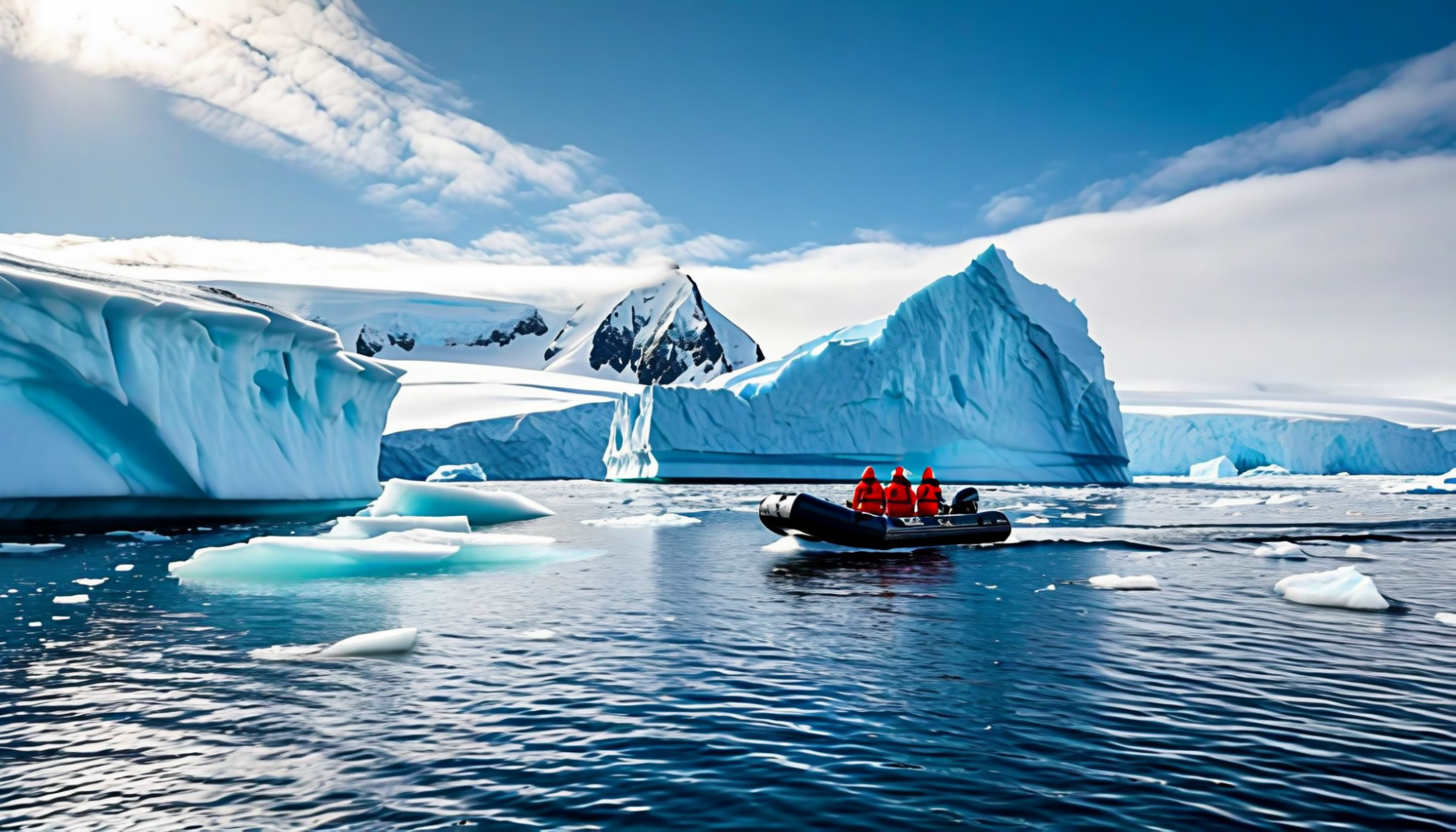
Zodiac Expedition
The tourism-and-logistics economy that actually operates on the continent.
Beyond tourism, a small logistics-and-science economy operates: companies like Antarctic Logistics & Expeditions (ALE) run private aviation and camp services for climbers, researchers, and high-end tourists heading to the interior (including the South Pole itself), operating essentially as a commercial contractor to both national science programs and private clients. National research stations — McMurdo (US), Vostok (Russia), Concordia (France/Italy), and roughly 70 others — are government-funded science infrastructure, not commercial enterprises, typically run by national polar institutes (the US Antarctic Program via the National Science Foundation, for example) rather than any Antarctic "company."
For American readers specifically: the US Antarctic Program is the single largest national presence on the continent, and its McMurdo, Amundsen-Scott South Pole, and Palmer stations are staffed substantially through NSF contractor Leidos — meaning the most realistic way for an American to "work in Antarctica" isn't starting a business there at all, but applying for one of several thousand seasonal support, trades, or science-support roles the contractor hires for each austral summer.
