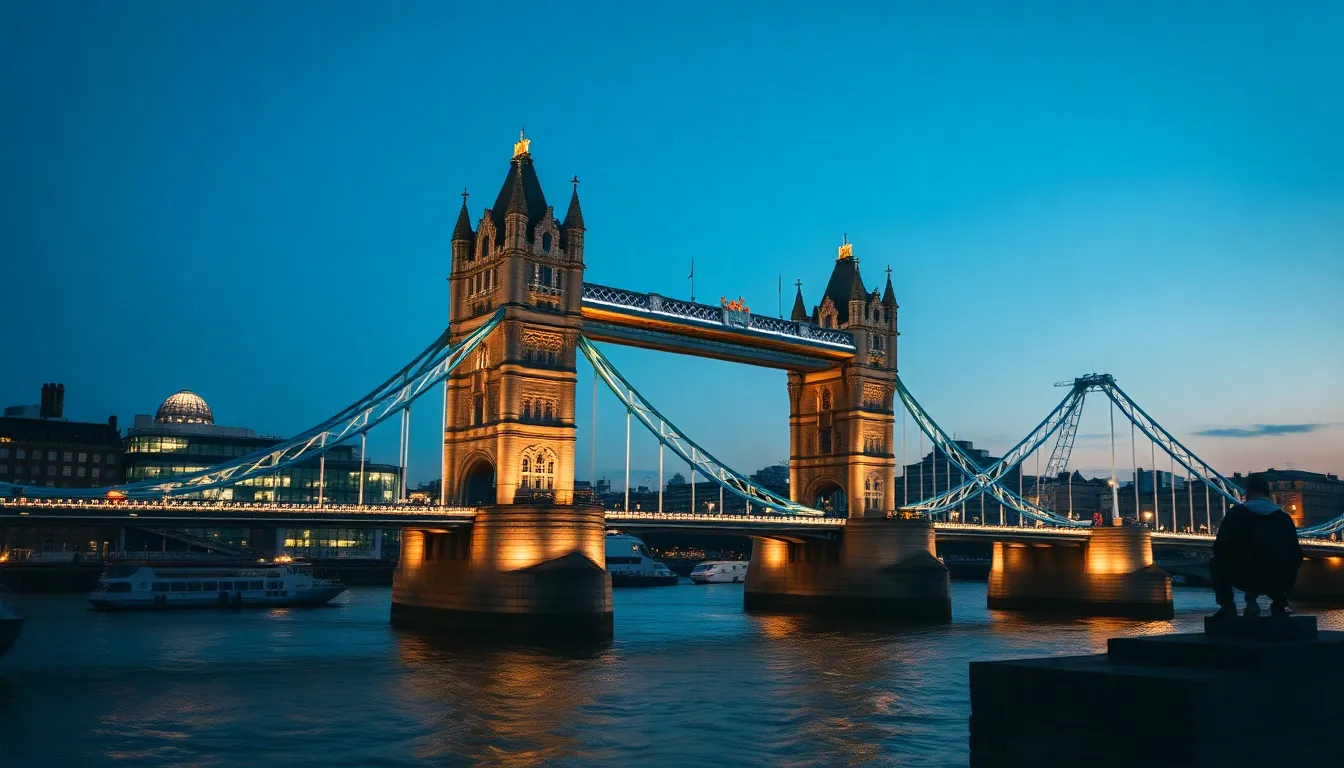
England, Scotland, Wales and Northern Ireland form a country of royal ceremony, industrial invention, living regional identities and landscapes shaped by the Atlantic.
Kaufmann World Travel Factbook · Updated September 2026
The United Kingdom represents, for many Americans, the first foreign country—familiar enough in language to feel accessible, different enough to feel genuinely abroad. Four nations comprise it: England, Scotland, Wales, and Northern Ireland, each with distinct character and identity.
London alone could absorb weeks: world-class museums mostly free, West End theater, royal pageantry. But the UK rewards those venturing beyond—to Edinburgh's dramatic castle, the Lake District's Wordsworth landscapes, the Scottish Highlands' vast emptiness.
02
Record-Breaking 2024
The UK achieved highest-ever tourism levels:
- 41.2 million overseas visits (+9% vs 2023) - First year above the 2019 record of 40.9 million - £31.5 billion spending (+1% YoY) - London: 20.95 million international visitors - 3rd most visited city globally (after Bangkok and Hong Kong)
03
Top Source Markets 2024
Country
Visitors
USA
5.6 million
France
3.6 million
Germany
3.3 million
Ireland
~2.5 million
Australia
Record growth
USA visitors worth £6.7 billion—nearly £1 in every £5 spent.
04
2025 Forecast
43.6 million visits, £33.4 billion spending; VisitBritain forecasts 45.5 million visits and £35.7 billion for 2026.
Head of state and government. The United Kingdom is a constitutional monarchy. The head of state is King Charles III (acceded 8 September 2022). The head of government is the Prime Minister, Andy Burnham, who took office on 20 July 2026 after succeeding Sir Keir Starmer as leader of the Labour Party.
05
📖 Quick Facts
**Capital**
London
Population
69.5 million (ONS, mid-2025)
Area
243,610 km²
Currency
GBP (Pound Sterling)
Language
English
Time Zone
GMT (UTC+0) / BST
Driving Side
Left
Calling Code
+44
Visitors 2024
41.2 million (record)
Tourism spending
£31.5 billion
06
🗺️ Geography & the Four Nations
The United Kingdom occupies 243,610 km² across the British Isles and comprises four nations: England, Scotland, Wales and Northern Ireland. Great Britain — England, Scotland and Wales — is Europe’s largest island; Northern Ireland shares the island of Ireland with the Republic of Ireland, and that border is the UK’s only land frontier.
Nowhere in the UK is more than about 125 km from tidal water, which is why the maritime temperate climate reaches every corner of it. The highest point is Ben Nevis in the Scottish Highlands at 1,345 m; the longest river is the Severn at 354 km, slightly ahead of the Thames at 346 km. The landscape runs from the chalk downland of the south coast — the same Cretaceous belt that surfaces again in Champagne — through the Pennines and the Lake District fells to the deeply glaciated sea lochs of the north-west.
07
🗺️ Map
08
📖 London: World Capital
Demands extended exploration—British Museum's treasures, West End theater, royal pageantry, neighborhoods from medieval City to hipster Shoreditch.
09
Must-See
British Museum: Rosetta Stone to Parthenon Marbles—entirely free. 6.48 million visitors 2024 (UK's most visited attraction).
Natural History Museum: 6.30 million visitors—dinosaurs, blue whale, free entry.
Tate Modern: 4.60 million visitors—contemporary art in converted power station.
Westminster Abbey: Royal tombs, coronation tradition, 1,000 years of history.
Tower of London: Crown Jewels, Beefeaters, medieval fortress.
10
London 2024 Stats
20.95 million international visitors (+3.3% vs 2023).
£17.29 billion spending (+10.1% vs 2019).
#3 most visited city globally (after Bangkok and Hong Kong).
83.9 million Heathrow passengers (world's 2nd busiest for international traffic).
11
🏴 Scotland
12
Edinburgh
Rivals London for dramatic setting. Castle dominates volcanic rock. Old Town tumbles down Royal Mile. Georgian New Town provides classical elegance.
Edinburgh Festival (August): World's largest arts festival—thousands of performances.
13
The Highlands & Islands
Wilderness on European scale—mountains, lochs, empty glens.
Isle of Skye: Accessible Highland beauty with dramatic landscapes.
Orkney: Neolithic settlements older than pyramids.
14
🏴 Historic England
15
Beyond London
Oxford & Cambridge: Ancient university towns, colleges, traditions spanning eight centuries.
Cotswolds: Honey-stone villages in rolling countryside.
Bath: Roman baths, Georgian architecture.
York: Viking and medieval history, intact city walls.
Lake District: Mountains and lakes inspiring Romantic poets.
Stonehenge: Neolithic mystery on Salisbury Plain.
16
🛂 Entry Requirements
Most visitors who do not need a visa — including citizens of the United States, Canada, Australia, Japan and the EU — must hold an Electronic Travel Authorisation (ETA) before travelling to the UK.
Requirement
Detail
Scheme introduced
8 January 2025 for the first non-visa nationalities
Enforced from
25 February 2026 — carriers must verify permission to travel before boarding
Cost
£20 per person (raised from £16 on 8 April 2026; originally £10)
Apply at
gov.uk or the official UK ETA app
Processing
Usually within 3 working days
Validity
2 years, or until the passport expires — whichever is sooner
Duration of stay
Up to 6 months per visit
Northern Ireland. An ETA is required for arrival into Northern Ireland by air or sea. There are no routine immigration checks on the land border with the Republic of Ireland, but the legal requirement to hold permission still applies.
Airside transit. Passengers transiting airside at Heathrow or Manchester without passing through UK immigration are currently exempt from the ETA under a Home Office concession in force since 16 January 2025. The concession is explicitly temporary and under review. Landside transit, and any transfer between UK airports, crosses the border and does require an ETA.
British dual nationals. From 25 February 2026 they must travel on a valid British passport, a valid Irish passport (Irish dual nationals only), or a Certificate of Entitlement to the Right of Abode in a foreign passport. A dual national cannot use an ETA.
17
📖 Getting There & Around
18
Airports
London Heathrow (LHR): 83.9M passengers 2024, world's 2nd busiest international.
Trains: National Rail connects major destinations—book in advance for best fares.
London transport: Tube, buses, Overground—use contactless or Oyster card.
Eurostar: London to Paris/Brussels via Channel Tunnel.
Car rental: Drive on left; works for rural exploration.
20
📖 Costs
Currency: Pound Sterling (GBP), around £0.74 per US$1 (£1 ≈ US$1.35, September 2026). Cards accepted nearly everywhere.
Item
Cost
Budget hostel
£20-40/night
Mid-range hotel
£100-200/night
London luxury hotel
£300-800+/night
Pub meal
£12-18
Restaurant meal
£20-40
Fine dining
£80-200+
Pint of beer
£5-8
West End theater
£30-150+
British Museum
Free
Average visitor spend 2024: £877 per visit.
21
🍽️ Cuisine
Full English breakfast: Eggs, bacon, sausage, beans, toast, tomatoes, black pudding.
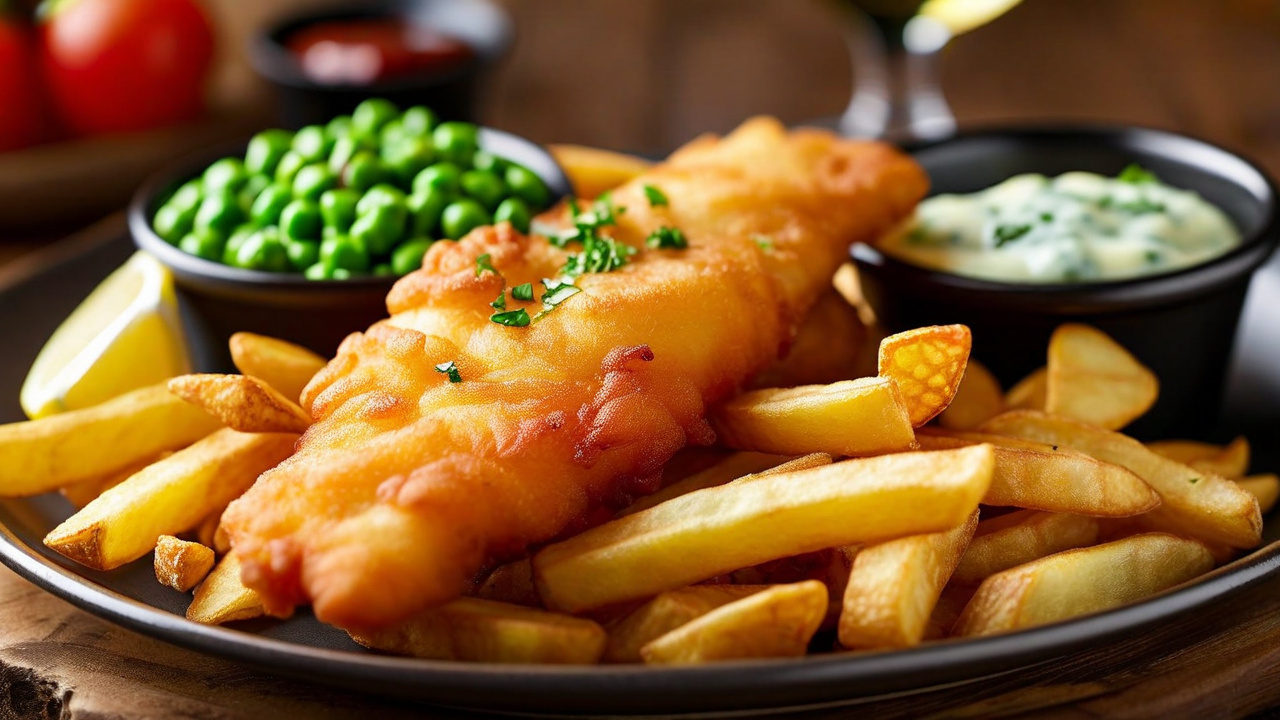
Fish and chips: National comfort food.
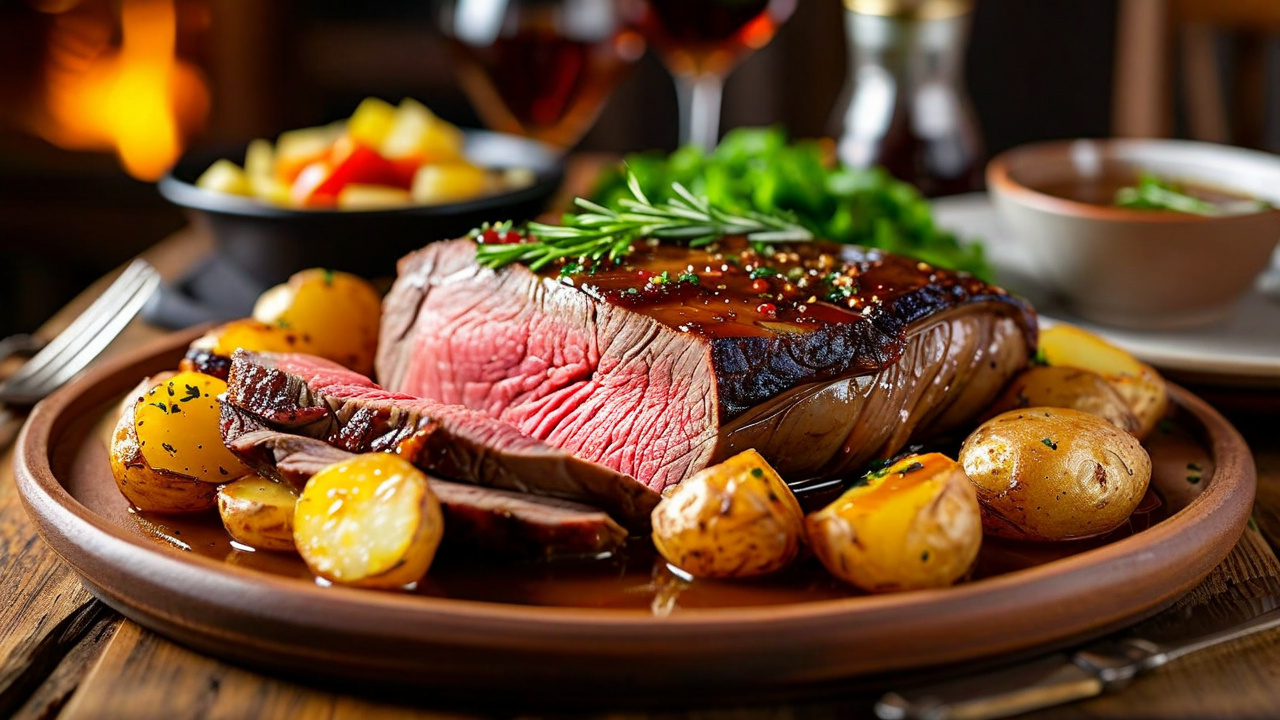
Sunday roast: Beef/lamb/chicken with Yorkshire pudding, roast potatoes.
Afternoon tea: Sandwiches, scones with clotted cream and jam—ceremonial indulgence.
Pub culture: Not just drinking—conversation, games, increasingly good food. Real ales, single malt whiskies.
Indian food: Often better than in India—generations of immigrant communities.
Modern British: Local ingredients, global influences, Michelin-starred establishments.
Sunday Roast
Traditional Dinner
Roast beef with Yorkshire pudding and all the trimmings.
Ingredients: 1.5kg beef roasting joint. For Yorkshire puddings: 4 eggs, 200g flour, 300ml milk. 1kg potatoes for roasting, pan juices for gravy, 300g carrots, 200g peas, horseradish sauce.
Preparation: Roast beef to desired doneness. After that, rest meat while making Yorkshires. Make batter, pour into hot fat. Then bake until puffed and golden. Make gravy from pan juices. Finally, serve with roast potatoes and vegetables.
💡 Yorkshire pudding batter should rest—and pan must be smoking hot.
Fish and Chips
National Dish
Beer-battered fish with thick chips—British institution.
Ingredients: 2 cod or haddock fillets, For batter: flour, beer, baking powder, Large potatoes for chips, Mushy peas, Oil for frying, Malt vinegar.
Preparation: Cut thick chips, parboil, dry. After that, make beer batter, rest. First fry chips at 160°C (320°F), drain. Then dip fish in batter, fry until golden. Second fry chips at 190°C (374°F) until crispy. To finish, serve with mushy peas and vinegar.
💡 Double-frying chips is essential—first to cook, second to crisp.
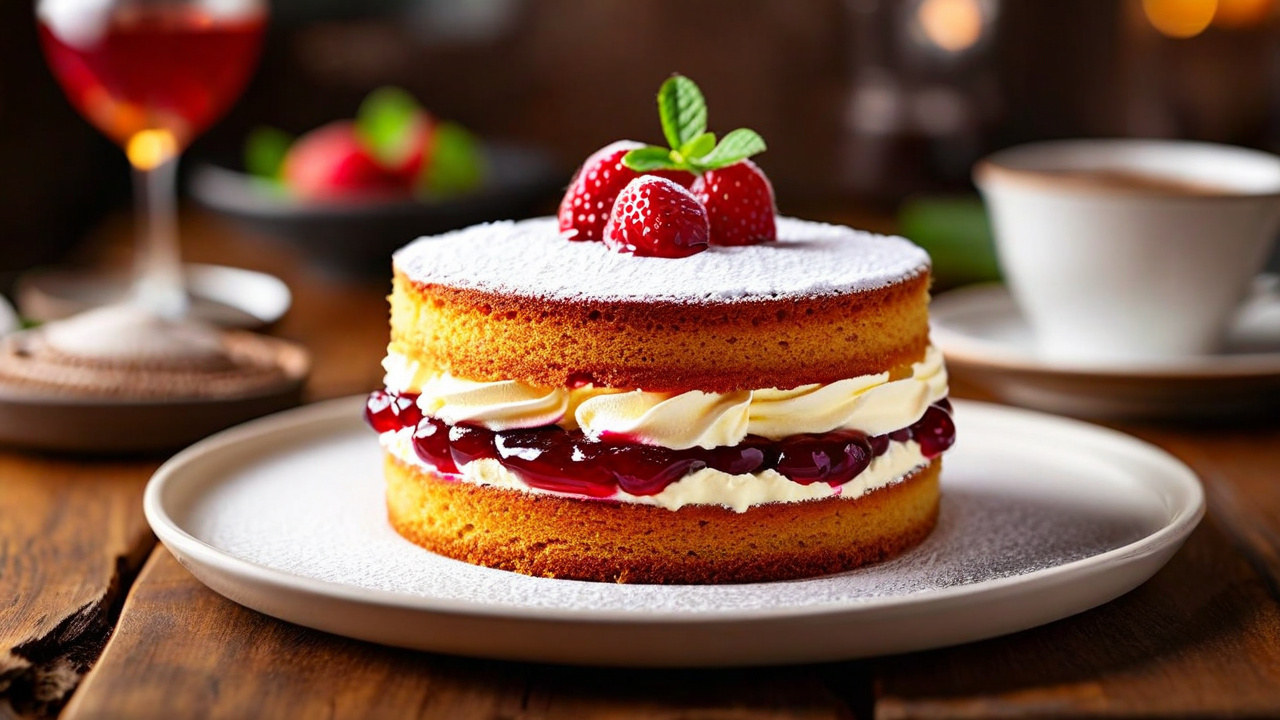
Victoria Sponge
Classic Cake
Light sponge with jam and cream—quintessentially British.
Preparation: Cream butter and sugar. After that, add eggs one at a time. Fold in flour gently. Then bake in two tins at 180°C (356°F). Cool, spread jam on one layer. Finally, add cream, sandwich together, dust with sugar.
💡 All ingredients should be room temperature for light sponge.
22
📖 Best Time to Visit
Season
Conditions
May-Sep
Best weather, longest days, outdoor events
Jun-Aug
Peak season, highest prices, Wimbledon/Edinburgh Festival
Apr, Oct
Fewer crowds, reasonable weather
Dec
Christmas markets, festive, cold/damp
Always pack layers and rain gear—British weather changes quickly.
23
📊 Tourism Statistics
Metric
Data
Overseas visits 2024
41.2 million (record; +9% on 2023)
vs 2019
Above the previous record of 40.9 million
Spending 2024
£31.5 billion (+1%)
2025 estimate
43.6 million visits, £33.4 billion
2026 forecast
45.5 million visits, £35.7 billion
London visitors 2024
20.95 million international
London ranking
3rd most visited city worldwide, after Bangkok and Hong Kong
Top source market
United States (5.6M visits)
Most visited attraction
British Museum, 6.48 million (2024)
Heathrow
83.9 million passengers 2024; 2nd busiest worldwide for international traffic
Source: VisitBritain inbound tourism statistics and forecasts; ALVA visitor numbers. Figures reviewed September 2026.
24
✨ Essential Tips
1. ETA required (£20), enforced at boarding since 25 February 2026—apply online before travel 2. Book trains in advance for best fares 3. Contactless payment works on London transport 4. Museums mostly free—donations appreciated 5. Drive on the left if renting car 6. Pack rain gear regardless of season 7. Book Edinburgh Festival accommodation months ahead 8. Tipping optional but 10-15% appreciated for service
25
🍷 Wine, Spirits & Drinking Culture
The United Kingdom — and specifically England — is experiencing one of the most dramatic viticultural transformations in modern wine history. What was dismissed as a curiosity three decades ago has become a serious, internationally acclaimed wine industry, driven by climate change, exceptional chalk terroir, and a new generation of ambitious winemakers. English sparkling wine, in particular, has achieved what was once unthinkable: blind-tasting victories over Champagne, critical praise from the world's leading wine writers, and a rapidly growing reputation as one of the finest expressions of the traditional method outside the Champagne region itself.
26
🍇 Terroir & Climate
England's viticultural miracle rests on a geological fact: the chalk downlands of Sussex, Kent, Hampshire, and Surrey are a direct geological continuation of the Champagne region's craie — the same Cretaceous chalk belt that runs beneath the English Channel. This identical terroir, combined with a cool maritime climate that is converging with Champagne's temperatures of 30 years ago due to global warming, gives English sparkling wines their remarkable finesse, acidity, and aging potential. The South Downs of Sussex and Hampshire are now recognized as arguably the finest terroir for traditional-method sparkling wine outside Champagne, with south-facing slopes, excellent drainage, and a long, cool ripening season that preserves acidity and develops complex flavors.
27
📊 Industry Growth
The numbers tell a story of explosive growth. England and Wales now have 4,841 hectares under vine (up from fewer than 800 in 2000 and 3,758 in 2020), with approximately 1,158 vineyards and 280 wineries. The 2025 harvest produced 124,377 hectolitres — more than 16.5 million bottles, a 55% jump on the previous year, with sparkling wine accounting for roughly 70% of output. The dominant grape varieties mirror Champagne: Chardonnay (the most planted), Pinot Noir, and Pinot Meunier, supplemented by the German-bred Bacchus for aromatic still whites (often compared to Sauvignon Blanc) and Seyval Blanc, a cold-hardy hybrid that was the backbone of English wine before the Champagne varieties took over.
28
🏆 Key Producers
Nyetimber is the pioneer and standard-bearer — founded in 1988 by Stuart and Sandy Moss on a historic Sussex estate mentioned in the Domesday Book, it produced England's first world-class sparkling wine and remains the benchmark, with its Classic Cuvée and Blanc de Blancs regularly scoring alongside top Champagnes. Ridgeview, also in Sussex, has won the Decanter World Wine Award and supplies Buckingham Palace. Gusbourne in Kent produces some of England's most precise and age-worthy sparkling wines. Wiston Estate on the South Downs creates elegant Blanc de Blancs from pure chalk soils. Chapel Down in Kent is the largest producer and most commercially visible brand. Exton Park in Hampshire, Hambledon (England's oldest commercial vineyard, planted 1952), and Hattingley Valley round out a roster of producers that would be impressive in any wine region in the world.
29
🏴 Wales & Beyond
Wales has a small but growing wine scene, with approximately 30 vineyards — notably Ancre Hill in Monmouthshire, which produces biodynamic sparkling wine of genuine quality. Scotland has a handful of experimental plantings, though commercial viticultural viability remains marginal. Northern Ireland has no wine production. The UK wine story is overwhelmingly an English one, concentrated in the southern counties, though climate change is gradually pushing the viability frontier northward.
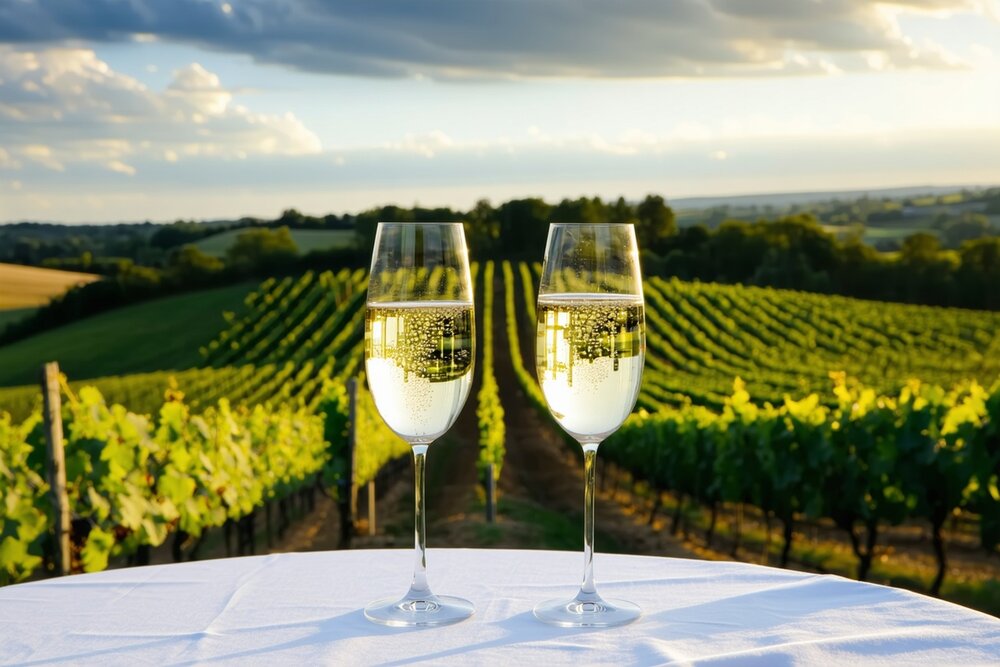
English Sparkling Wine — The Sussex Revolution · On the same Cretaceous chalk that underlies Champagne, England's South Downs are producing some of the world's finest traditional-method sparkling wines.
🏆 Kaufmann Wine Score (KWS)
100-point scoring: 🔴 Aroma (/25) · 🟡 Taste (/30) · 🟢 Finish (/20) · 🔵 Value (/25) — Total /100
Wine
🔴
🟡
🟢
🔵
KWS
Nyetimber Classic Cuvée
23
27
18
20
88
Nyetimber Blanc de Blancs
24
28
19
19
90
Gusbourne Blanc de Blancs
23
27
18
21
89
Ridgeview Bloomsbury
22
26
17
22
87
Chapel Down Bacchus Reserve (still)
20
24
15
23
82
30
🏛️ UNESCO World Heritage Sites
The United Kingdom has 35 properties inscribed on the UNESCO World Heritage List — 29 cultural, 5 natural and 1 mixed. The UK ratified the Convention on 29 May 1984. A 36th, Liverpool – Maritime Mercantile City, was delisted in 2021, one of only three deletions in the history of the List. Five further sites sit on the UK Tentative List, including the historic core of York and Birkenhead Park.
31
Cultural (29)
🏛️ Blaenavon Industrial Landscape
Inscribed 2000
🏛️ Blenheim Palace
Inscribed 1987
🏛️ Canterbury Cathedral, St Augustine's Abbey and St Martin's Church
Inscribed 1988
🏛️ Castles and Town Walls of King Edward in Gwynedd
Inscribed 1986
🏛️ City of Bath
Inscribed 1987
🏛️ Cornwall and West Devon Mining Landscape
Inscribed 2006
🏛️ Derwent Valley Mills
Inscribed 2001
🏛️ Durham Castle and Cathedral
Inscribed 1986
🏛️ Frontiers of the Roman Empire (Hadrian's Wall)
Inscribed 1987
🏛️ Gorham's Cave Complex, Gibraltar
Inscribed 2016
🏛️ Heart of Neolithic Orkney
Inscribed 1999
🏛️ Historic Town of St George, Bermuda
Inscribed 2000
🏛️ Ironbridge Gorge
Inscribed 1986
🏛️ Jodrell Bank Observatory
Inscribed 2019
🏛️ Maritime Greenwich
Inscribed 1997
🏛️ Moravian Church Settlements
Inscribed 2015
🏛️ New Lanark
Inscribed 2001
🏛️ Old and New Towns of Edinburgh
Inscribed 1995
🏛️ Palace of Westminster and Westminster Abbey
Inscribed 1987
🏛️ Pontcysyllte Aqueduct and Canal
Inscribed 2009
🏛️ Royal Botanic Gardens, Kew
Inscribed 2003
🏛️ Saltaire
Inscribed 2001
🏛️ Stonehenge, Avebury and Associated Sites
Inscribed 1986
🏛️ Studley Royal Park including Fountains Abbey
Inscribed 1986
🏛️ The English Lake District
Inscribed 2017
🏛️ The Forth Bridge
Inscribed 2015
🏛️ The Great Spa Towns of Europe (Bath)
Inscribed 2021
🏛️ The Slate Landscape of Northwest Wales
Inscribed 2021
🏛️ Tower of London
Inscribed 1988
32
Natural (5)
🏛️ Dorset and East Devon Coast (Jurassic Coast)
Inscribed 2001
🏛️ Giant's Causeway and Causeway Coast
Inscribed 1986
🏛️ Gough and Inaccessible Islands
Inscribed 1995
🏛️ Henderson Island
Inscribed 1988
🏛️ The Flow Country
Inscribed 2024
33
Mixed (1)
🏛️ St Kilda
Inscribed 1986
Source: UNESCO World Heritage Centre, States Parties — United Kingdom. Verified September 2026.
34
⚠️ Safety & Travel Advisory
⚠️ Level 2 — Exercise Increased Caution
The U.S. Department of State advises travellers to exercise increased caution in the United Kingdom due to terrorism. Separately, the UK national threat level was raised to SEVERE — meaning an attack is highly likely — in April 2026 following the Golders Green attack in London. SEVERE is the second-highest of five levels.
In practice this means visible armed policing at transport hubs and major events, bag searches at museums and stadiums, and occasional short-notice station or street closures. None of it should deter a visit — the UK remains one of the most heavily visited countries in the world — but travellers should stay aware of local reporting, follow instructions from police and stewards without delay, and register with their own embassy if staying for an extended period.
Everyday risks are more mundane: pickpocketing and phone-snatching on mopeds in central London, and traffic — look right first when crossing. Emergency number is 999 (112 also works). Healthcare is free at the point of need for emergencies, but visitors should carry travel insurance; non-emergency treatment is charged to overseas visitors.
35
📋 Quick Reference
Category
Information
Best Time
May-September
ETA
Required · £20 · enforced from 25 Feb 2026
Currency
Pound Sterling (GBP)
Language
English
Power
230V, Type G
Emergency
999
Airports
London Heathrow (LHR) main hub
36
🏴 Wales
Wales brings its own language, national identity, castles and mountain landscapes to the union. Cardiff is the capital, while Eryri (Snowdonia), Pembrokeshire and the industrial valleys reveal very different chapters of Welsh life.
37
☘️ Northern Ireland
Northern Ireland shares the island of Ireland with the Republic of Ireland and gives the United Kingdom its only land frontier. Belfast, the Causeway Coast and the living memory of the Troubles require both curiosity and historical care.
38
👑 Royal Heritage
Royal places are part of the British landscape rather than a single London attraction: Westminster Abbey, the Tower of London, Windsor, Edinburgh and many regional castles connect ceremony with a long and contested history.
39
🎭 Museums, Art & Theatre
Many of the country’s major national museums are free to enter. London’s British Museum, Natural History Museum and Tate Modern sit alongside regional collections, historic houses and a theatre culture extending far beyond the West End.
40
🌊 Coasts & Islands
No point in the United Kingdom lies far from tidal water. Atlantic weather, fishing ports, chalk cliffs, sea lochs and island communities shape travel from Cornwall and Wales to the Hebrides, Orkney and Northern Ireland’s coast.
I went up to the Sussex Downs in a September that could not decide what it was doing, which is the most British condition a month can have. The vineyard rows ran along a chalk slope that looked, from a distance, exactly like a field of anything else. Then you scuff the topsoil with a boot and there it is — white, crumbling, the same Cretaceous seam that ducks under the Channel and comes up again in Champagne. Nobody planted here for a thousand years because it was too cold. Now it isn’t, and that is not a happy fact, but the wine is very good.
That contradiction is the country in miniature. Britain keeps producing excellence out of circumstances it did not ask for and cannot fully control. The museums are free because a Victorian argument about public good was won and never quite overturned. The trains are expensive and the pubs no longer close at eleven — that rule died with the 2003 Licensing Act, though half the guidebooks still repeat it. The Tube is 163 years old and smells like it. All of it works, mostly, in a way that feels less designed than survived.
What I would tell anyone going: leave London earlier than you think you should. The city is genuinely one of the world’s great ones and it will eat your entire trip if you let it. But the thing you will remember is a wet afternoon in a Yorkshire pub with a fire going, or the Flow Country in Sutherland — 2024’s newest World Heritage Site, and the least photogenic sublime landscape in Europe: bog, sky, and nothing, going on for a very long time.
Radim Kaufmann
—Radim Kaufmann, 2026
Support This Project 🌍
This World Travel Factbook is a labor of love — free to use for all travelers. If you find it helpful, consider supporting its continued development.
Share your own photograph of the United Kingdom. Attach it to your email and include the location and your preferred credit. Send only photographs you own.