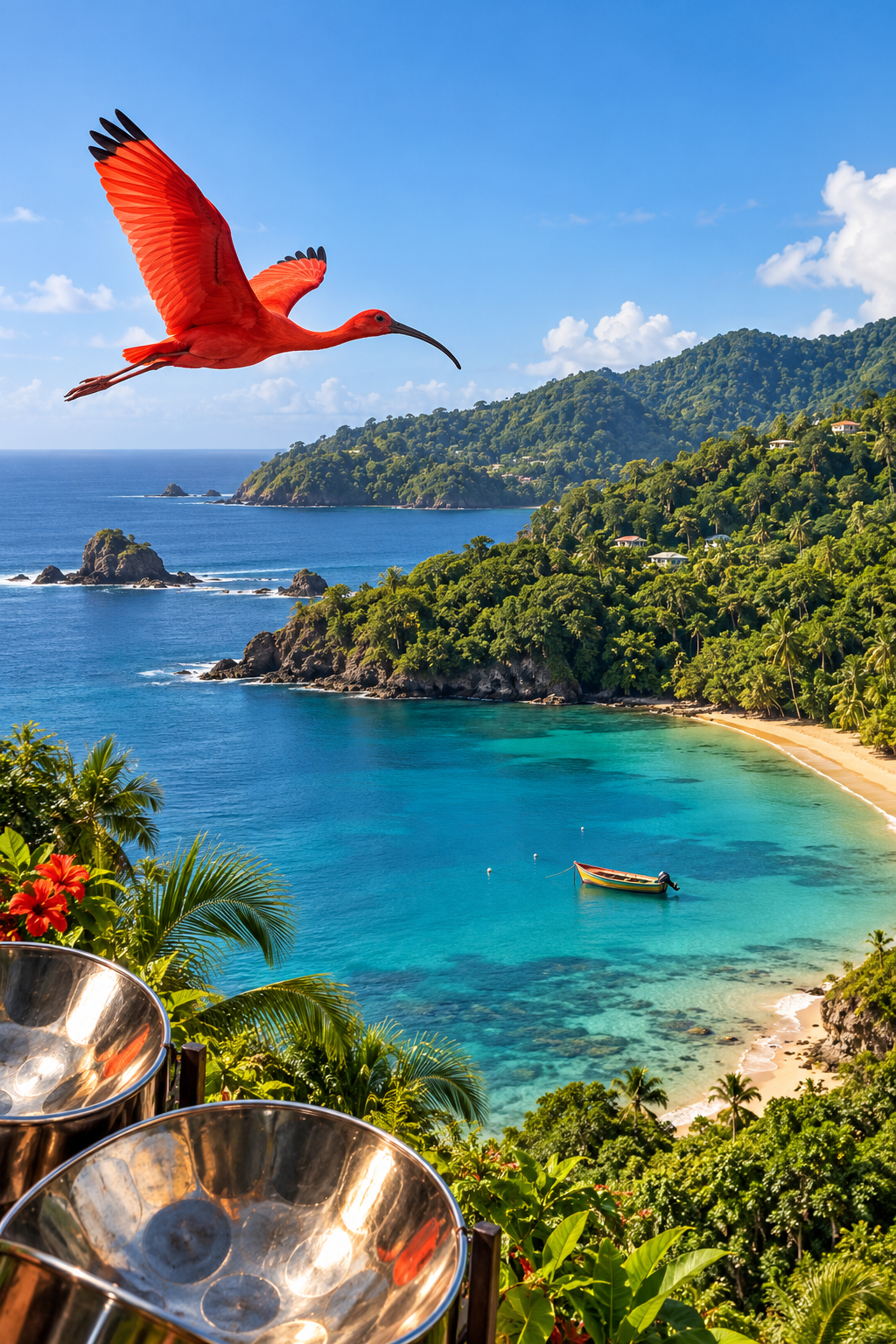
A southern-Caribbean twin-island republic: steelpan and Carnival in Trinidad, forest and reef in Tobago, and a culture too layered to reduce to a beach break.
Trinidad and Tobago · T&TCaribbean · South America’s continental shelf
Port of SpainCapital
≈1.37mPopulation · 2026 estimate
TTD · TT$Currency
EnglishOfficial language
01
🌏 Overview
Trinidad and Tobago is a sovereign twin-island republic at the southern edge of the Caribbean, closer to Venezuela than to the Antilles most visitors picture first. Trinidad is the larger, busier island: a working capital, energy industry, night-time food stalls and Carnival bands share the same small geography. Tobago is greener, quieter and more maritime, with villages, reefs and the Main Ridge Forest Reserve.
This is not a resort-only destination. Its most memorable experiences are cultural: a dawn doubles breakfast, a pan rehearsal, a Hindu festival, a cricket conversation, or an evening lime with people who make welcome feel unforced. Beach time belongs in the itinerary, especially on Tobago, but it should not erase the republic’s political, industrial and diasporic story.
02
🏷️ Name, Flag & Identity
National flag of Trinidad and Tobago · geometrically redrawn from the official design.
Trinidad is conventionally linked to the Trinity; Tobago’s name is often connected to tobacco. The modern republic became independent in 1962 and a republic in 1976. Its motto, “Together We Aspire, Together We Achieve,” appears beneath the national coat of arms. The black, white and red flag is commonly read as earth and dedication, water and equality, and fire and courage.
English is the official language, but everyday speech has its own quick, expressive Trinidadian and Tobagonian rhythms. “Lime” means to hang out; “ole talk” is playful conversation. Treat that English as living local culture rather than a simplified version of another country’s English.
03
🗺️ Geography & the two islands
Trinidad’s Northern Range is geologically related to Venezuela’s coastal mountains; mangroves and wetlands stretch toward the west coast, while the south-west contains Pitch Lake. Tobago lies north-east across the channel, with steep forested ridges, protected bays and a more visibly tourism-oriented economy. The country’s total land area is about 5,131 km².
Caroni Swamp is the best-known place to see the scarlet ibis, the national bird. On Tobago, Buccoo Reef, the Nylon Pool, Speyside and the rainforested interior deserve time—but reefs are fragile, so use operators that avoid anchoring on coral and do not touch wildlife.
04
📜 History
Indigenous peoples lived on both islands long before European arrival. Spanish rule over Trinidad gave way to British control in 1797; Tobago passed repeatedly between European powers before becoming British. Enslavement, emancipation and the arrival of indentured labourers from India after 1845 shaped a society with African, Indian, European, Chinese, Syrian-Lebanese and many other lineages.
Oil and gas changed Trinidad’s economy in the twentieth century. Independence was led by Eric Williams in 1962. That history helps explain both the republic’s industrial base and the cultural density of its food, music, faiths and public festivals.
05
🎶 Carnival, steelpan & everyday culture
Carnival is the country’s most internationally visible art form, but it is not a two-day costume show. Calypso, soca, mas-making and Panorama rehearsals build for months; J’Ouvert begins before dawn on Carnival Monday. Check official dates and buy tickets only from recognized organisers—popular events sell out.
Steelpan was developed in Trinidad in the twentieth century and became a full orchestral instrument. A respectful visit to a panyard, with permission and without blocking rehearsal, is one of the clearest ways to hear the country rather than simply consume it.
06
🏙️ Port of Spain
Port of Spain is a compact capital where the Queen’s Park Savannah, the Magnificent Seven, markets, restaurants and panyards sit close together. It rewards a plan rather than aimless late-night wandering. Use licensed or hotel-arranged transport after dark, keep valuables unobtrusive and ask local hosts which neighbourhoods to avoid.
07
🏝️ Tobago
Tobago is not merely Trinidad with better beaches. Its scale, pace and local politics are distinct, and its best days alternate between water and forest: early snorkeling, a village lunch, then a hike or an unhurried sunset. Pigeon Point and Store Bay are easy introductions; Speyside, Charlotteville and the Main Ridge reward a longer stay.
08
🍛 Food & drink
Start with doubles—bara filled with curried channa and sauces—and state your pepper tolerance plainly. Bake and shark is a classic beach order, while roti, pelau, callaloo, corn soup and Tobago crab and dumpling show the country’s many culinary roots. Angostura bitters were created in the nineteenth century in what is now Venezuela and became globally associated with the company long based in Trinidad.
09
🧭 Practical travel
Piarco International Airport serves Trinidad and A.N.R. Robinson International Airport serves Tobago. Inter-island flights and ferries are central infrastructure, but schedules can change; confirm directly with the carrier. The Trinidad and Tobago dollar is the currency. Cards work widely in formal businesses, while cash remains useful for small vendors and transport.
The dry season is broadly January to May and the wetter period June to December, but weather is local and variable. Trinidad and Tobago lies south of the main hurricane belt, not outside all tropical-weather risk. Entry rules, health requirements and safety guidance change: consult the immigration authority and your own government’s current travel advice before booking.
10
🌿 Nature & responsible visits
The republic has no UNESCO World Heritage inscription as of October 2026. That does not make its cultural and natural places less significant. Follow site rules around turtle nesting beaches, wetlands and reefs; never purchase wildlife products; and use a local guide where a trail, tide or community protocol calls for one.
11
📍 Map
12
🔎 Sources & further reading
For trip-critical information, begin with official sources rather than social posts: Trinidad and Tobago’s immigration and tourism authorities, the Tobago House of Assembly, the Meteorological Service and the management bodies for protected areas. Cultural context benefits from local reporting and conversations, not only event marketing.
Trinidad and Tobago makes most sense when its two islands are allowed to remain different. Carnival and the sea are real draws, but so are the small rituals around food, music and conversation—the things that make a destination a society rather than a backdrop.
— Radim Kaufmann, 2026
Share Your Photo
Have a Trinidad and Tobago photograph you own? Attach it to an email with the location and the name for credit.