
🇲🇰 North Macedonia at a Glance
🌍 Overview — Small, Landlocked, and Argued Over
North Macedonia is 25 713 km² of mountains, one great lake and one long river valley, wedged between Kosovo, Serbia, Bulgaria, Greece and Albania. About 1.84 million people live here. It has been a candidate for European Union membership since 2005 — longer than any other country currently waiting — and it is not noticeably closer to joining than it was then.
The reason is not the usual one. North Macedonia has spent its entire independent existence being told by its neighbours what it may call itself, what its language is, and whose history it is allowed to claim. It gave up its own name in 2018 to settle with Greece. Bulgaria then raised a different objection, and the country has been stuck there ever since.
Where it is
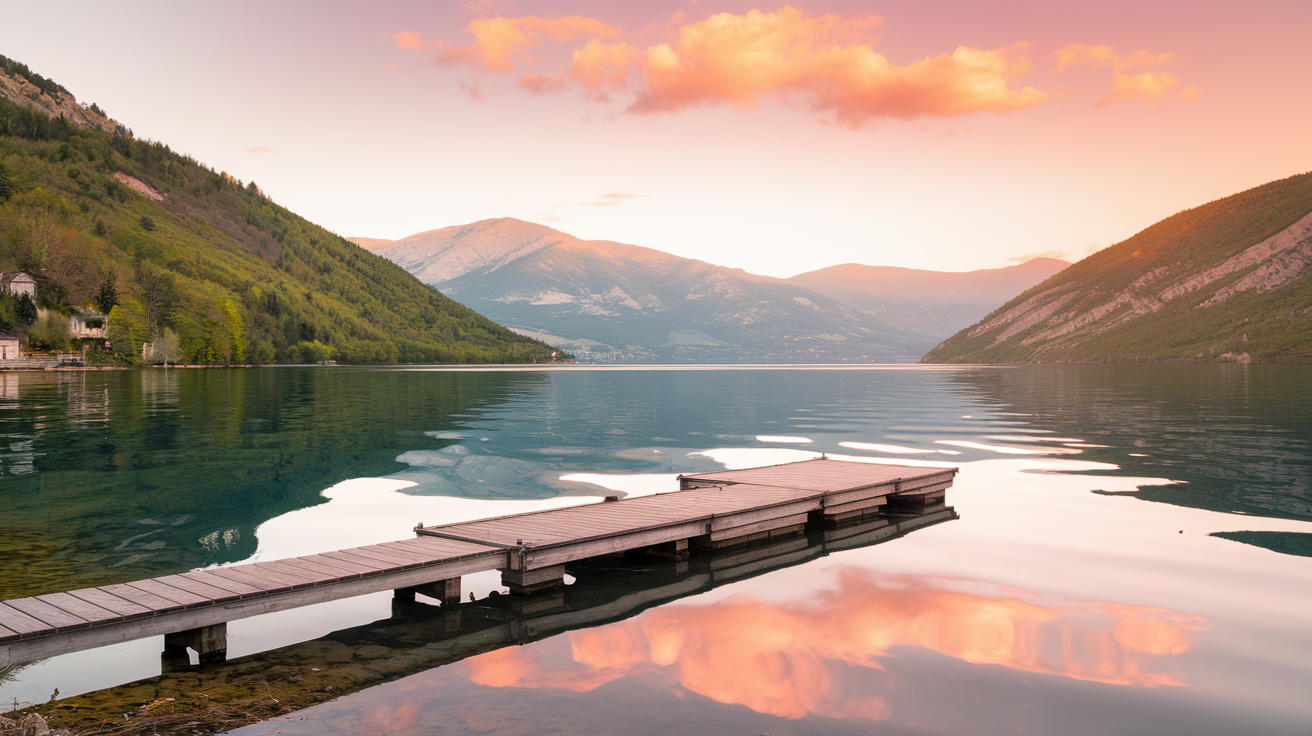
The centre of the Balkan peninsula, landlocked, with the Vardar running diagonally from the north-west to the Greek border and on to the Aegean at Thessaloniki. That corridor has been the main land route from central Europe to the Aegean since antiquity, and it is why this small country has been fought over so persistently.
Who lives here
The 2021 census — the first in twenty years — counted 1 836 713 residents, of whom 58.4 % declared themselves Macedonian and 24.3 % Albanian, with Turks, Roma, Serbs, Bosniaks and Vlachs making up most of the rest. See the population section, where the numbers are more interesting than they look.
⚠️ The name
Officially the Republic of North Macedonia since February 2019, under the Prespa Agreement signed with Greece in June 2018. Before that it spent twenty-seven years in the UN as the former Yugoslav Republic of Macedonia — a placeholder, used because Greece objected to the word Macedonia standing alone. See the dispute and the agreement.
What it joined
NATO, on 27 March 2020 — the direct payoff of the Prespa Agreement, and it happened fast. The EU half of the bargain has not been delivered, which is the central grievance in Macedonian politics and the reason public support for the deal has fallen.
What to actually come for
Lake Ohrid, which is genuinely one of the great lakes of the world. The Byzantine churches and frescoes, which are world-class and almost unvisited. Three national parks with real mountains. The Old Bazaar in Skopje. And food and wine at prices that have not caught up with the rest of Europe.
⚠️ And one thing to know
This is a country where the history is contested by three neighbours at once, and where a visitor's casual remark about Alexander the Great, the Macedonian language or the Bulgarian question can land very badly. The politics is not background here; it is the foreground, and this page treats it that way.
🏷️ What the Country Is Called, and by Whom
Macedonia
From the ancient kingdom of Makedonía, whose core was in what is now Greek Macedonia and whose reach at its height covered much of the southern Balkans. The name has been applied to shifting territories for 2 500 years, which is exactly why four modern states can each make a case for it.
The geographic region
"Macedonia" as a region is larger than the country and is divided between Greece (about half), North Macedonia (about 38 %), Bulgaria (about 10 %) and slivers of Albania and Serbia. Every version of the argument comes back to that map.
⚠️ Severna Makedonija
The current official name in Macedonian, and the compromise of 2018: the adjective is geographic, not ethnic. The Prespa Agreement was explicit that the country's citizens are Macedonians and their language is Macedonian, while Greece's own northern province keeps the name too. That distinction was the whole of the deal, and it satisfied nobody completely.
What people say
Inside the country, in ordinary speech: Makedonija. The "North" is used on documents, at borders and in international contexts, and its absence in conversation is not a political statement so much as how people talk. The car code changed from MK to NMK; the internet domain is still .mk.
The flag
A golden sun with eight rays on red, adopted in 1995. It replaced the Vergina Sun — the sixteen-ray star from the tomb of Philip II — which Greece regarded as unambiguously Greek and whose use on the first flag was one of the sharpest points of the dispute. Under Prespa the old symbol was withdrawn from public use.
⚠️ The old page's flag
Worth saying plainly, since this page replaces one: the previous version of this page displayed 🇦🇼, the flag of Aruba. On a page about a country whose entire modern history is an argument over symbols, that is not a trivial slip. The flag here is 🇲🇰.
🗺️ Mountains, One River, No Sea
Four-fifths of North Macedonia is upland. The country is a basin-and-range landscape of steep limestone and granite massifs separated by flat-floored valleys, drained almost entirely by one river, and with a sharp climatic split between a continental north and an almost Mediterranean south.
The Vardar
The spine. It rises in the north-west, runs through Skopje and the central valleys and crosses into Greece, where it becomes the Axios and reaches the sea near Thessaloniki. The valley carries the main road, the main railway, the vineyards and most of the population. Nearly the whole country drains into it.
The mountains
Mount Korab (2 764 m) on the Albanian border is the high point, shared with Albania. Šar Planina in the north-west is the largest massif, with alpine pasture and the country's serious skiing. Pelister in the south-west, Galičica between the two lakes and Jakupica in the centre complete the frame.
Three national parks
Mavrovo, the largest, with the much-photographed half-submerged church of St Nicholas in the reservoir; Pelister, protecting stands of the endemic Molika pine (Pinus peuce) and the two glacial tarns known as the Eyes of Pelister; and Galičica, on the ridge between Ohrid and Prespa with a view down onto both at once.
Matka
A limestone gorge on the Treska twenty minutes from Skopje, with a reservoir, kayaks, cliff-hung medieval churches and the Vrelo cave, which is among the deepest underwater caves in Europe and whose full depth is still not established. The easiest good half-day in the country.
⚠️ Earthquakes
The country sits on an active fault system. The Skopje earthquake of 26 July 1963 killed over a thousand people and destroyed around 80 % of the city — the single most important event in the capital's modern history, and the reason Skopje looks the way it does. See the Skopje section.
Climate
Continental in the north and the mountains — cold winters, hot summers, real snow. The Vardar valley south of Demir Kapija and the Gevgelija–Dojran corner are effectively Mediterranean, hot and dry enough for figs and pomegranates. That southern strip is the wine country.
🌊 Lake Ohrid — Older Than Almost Anything
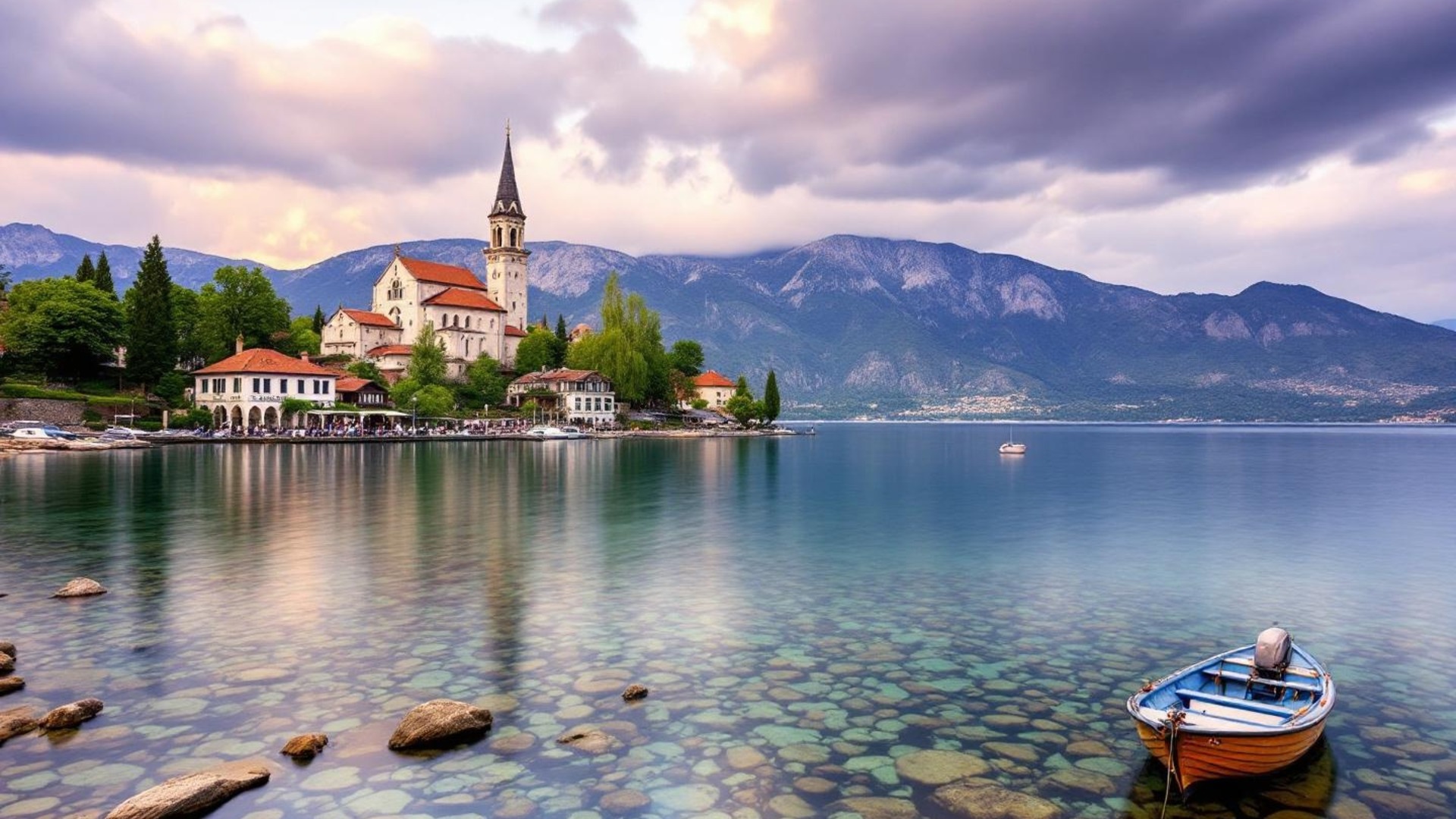
Lake Ohrid is the reason to come. It is 358 km², 288 m deep, shared two-thirds with Albania, and — this is the part that matters — it is one of the oldest lakes on earth, which has let it evolve a fauna found nowhere else.
⭐ How old
Deep drilling under the SCOPSCO programme in 2013 went 569 m into the lake bed and dated the basin at roughly 1.3 to 1.5 million years. Older figures of "two to three million" circulate widely — including on the page this one replaces — and the drilling settled the question. Even at 1.3 million years it is comfortably the oldest lake in Europe.
What lives in it
Over 200 endemic species, a density of endemism comparable to Baikal. The Ohrid trout (Salmo letnica), the belvica, endemic snails, sponges and flatworms, and a relict fauna that has been evolving undisturbed since before the Pleistocene. It is fed largely by karst springs from Prespa, 150 m higher, through the limestone of Galičica — which is why the water is so clear and so cold.
UNESCO, twice
The Macedonian side of the lake and the town were inscribed in 1979–80 as a rare mixed natural and cultural property; the Albanian portion was added in 2019. Ohrid town is the reason for the cultural half: a compact Ottoman-era lakeside town of steep lanes and overhanging upper storeys, built over a Roman and Byzantine city.
⚠️ And it is in trouble
UNESCO has repeatedly considered placing the site on the List of World Heritage in Danger, and its 2024 reporting was blunt about uncontrolled lakeside construction, over-tourism and the failure of both countries to put agreed measures in place. Sewage, illegal building and pressure on the springs are the specific problems. A visitor in August sees the crowding; the ecological damage is less visible and worse.
The churches
Sveti Jovan Kaneo, the small stone church on a headland, is the postcard — and a Byzantine cross-in-square building, nothing like a Gothic spire. Sveta Sofija has eleventh-century frescoes of the first order. Sveti Naum, at the southern end near the Albanian border, sits above the springs that feed the lake. Ohrid was said to have 365 churches, one for each day; the number is folklore, the density is not.
Prespa
The smaller, higher lake behind Galičica, shared with Greece and Albania, with pelicans, an island monastery and a fraction of Ohrid's visitors. Its level has fallen alarmingly over recent decades, which matters for Ohrid too, since Prespa feeds it underground.
🍷 Tikveš and the Wine Nobody Outside the Balkans Drinks
North Macedonia makes a serious amount of wine — historically the largest producer in Yugoslavia after Serbia — and almost none of it has any international profile. Most is still sold in bulk. What is bottled is startlingly good value and worth going out of your way for.
The three regions
Povardarie (the Vardar valley), which is the heart of it and holds around four-fifths of the vineyard; Pčinja-Osogovo in the north-east; and Pelagonija-Polog in the west and south-west. Tikveš, around Kavadarci and Negotino in the middle Vardar, is the classic district and gives its name to the country's largest winery.
⭐ Vranec
The signature grape — vranec, "the black stallion", deeply coloured, tannic, high in alcohol, and capable of real depth when it is not overcropped. Shared with Montenegro, where it is spelled vranac. If you drink one Macedonian wine, drink this.
The other grapes
Kratošija (a relative of Zinfandel/Primitivo), Stanušina, an obscure native pink-skinned variety making light reds and rosés, and Temjanika — the local Muscat — for aromatic whites. Plus the usual international plantings, which are mostly less interesting than the natives.
⚠️ The map problem
The image bank supplies a decorative "wine regions" map for this country. Its region names are correct — Povardarie, Pčinja-Osogovo, Pelagonija-Polog — and its geography is invented: the country outline is wrong, Tikveš is printed twice, "Greece" is printed on the Bulgarian border, and Ohrid and Prespa are drawn outside the country. It is not used on this page, and the reasoning is set out in the author's note.
Visiting
Tikveš, Stobi, Popova Kula, Chateau Kamnik and a growing number of small producers receive visitors, most within an hour or two of Skopje along the Vardar. Popova Kula at Demir Kapija has rooms and is the easiest introduction. Booking ahead matters; walking in often does not work.
Rakija
The other drink, and the more important one socially. Home-distilled fruit brandy — grape, plum, quince — offered at the start of a meal and declined at your peril. Strengths are unregulated and enthusiastic. See the drinks section.
👥 The 2021 Census and What It Actually Showed
North Macedonia went twenty-one years without a census. The 2011 attempt was abandoned mid-count amid a dispute over methodology and ethnic arithmetic. When the count finally happened in 2021, the result reframed several things the country had assumed about itself.
⭐ The population fell
1 836 713 residents — against roughly 2.02 million in 2002. That is a drop of about ten per cent in two decades, driven overwhelmingly by emigration to Germany, Switzerland, Italy and beyond, plus a birth rate below replacement. The figure of "2.1 million" still quoted in most guidebooks, including the page this replaces, is the total including the diaspora who self-enumerated — a different thing, counted for the first time.
The ethnic numbers
Of residents: 58.4 % Macedonian, 24.3 % Albanian, 3.9 % Turkish, 2.5 % Roma, 1.3 % Serb, plus Bosniaks, Vlachs and others. Counting the diaspora as well shifts it to about 54.2 % and 29.5 % — because Albanian-speaking emigrants registered in far greater proportion. Which of those two sets of numbers gets quoted is itself a political act in this country.
⚠️ Why the percentages matter so much
Because of the Ohrid Framework Agreement. Under it, a community above 20 % of the population — nationally or in a municipality — acquires language rights, proportional public employment and a veto through the "Badinter" double-majority in parliament. A census is therefore never only a census here.
Emigration
The defining social fact. Estimates of Macedonian citizens living abroad run from 500 000 to well over 700 000. Whole villages in the south-west are inhabited in summer and empty in winter. Medical staff and engineers leave in numbers the country cannot replace, and "who is left" is the quiet subject of a great deal of domestic politics.
Ageing and the cities
The median age has risen sharply and the rural population is old. Growth is concentrated in Skopje, which holds around a third of the country, and in Tetovo and Gostivar in the Albanian-majority north-west. Bitola, the historic second city, has been shrinking for decades.
Religion
Roughly two-thirds Orthodox Christian and a third Muslim, mapping closely onto the Macedonian/Albanian-Turkish division. Mosques and churches stand within sight of each other in most towns and the everyday coexistence is real — which is not the same as saying the politics is settled.
⚔️ Ancient Macedon, and Who Gets to Claim It
The kingdom of Macedon under Philip II and Alexander the Great is the most valuable piece of contested heritage in the Balkans, and the fight over it has shaped this country's foreign policy for thirty years. The facts are less dramatic than either side's version.
Where the kingdom was
Its heartland — Aigai (Vergina) and Pella, the royal capitals and the royal tombs — is in modern Greek Macedonia. At its height the kingdom expanded far north into what is now North Macedonia and beyond, but the core was southern. That geographical fact is the foundation of the Greek position and it is not in dispute among historians.
⚠️ Who the ancient Macedonians were
Scholarly consensus holds them to have been a Greek-speaking people on the northern edge of the Hellenic world, regarded by southern Greeks as rough provincials but Greek. The idea of a distinct non-Greek Macedonian nation with continuity to today's Slavic-speaking Macedonians is not supported by the evidence.
What is in North Macedonia
Paeonia — a separate kingdom, north of Macedon, absorbed by Philip II — and later Roman Macedonia Salutaris. The genuinely important classical sites here are Roman rather than Macedonian: Stobi on the Vardar and Heraclea Lyncestis at Bitola, both with superb mosaics.
The Slavic arrival
Slavs settled the region from the sixth and seventh centuries, well over a thousand years after Alexander. Modern Macedonians are a Slavic people speaking a South Slavic language. This is the point at which the ancient claim breaks, and most Macedonian historians have never made it — it was a political project, not a scholarly one.
⚠️ Antiquisation
From around 2006 the VMRO-DPMNE government of Nikola Gruevski pursued a deliberate policy of identification with antiquity: the airport and the main motorway renamed after Alexander, enormous classical statuary in Skopje, textbooks revised. It inflamed Greece, embarrassed many Macedonians, and was largely reversed after 2017 as part of the settlement. Its most visible residue is Skopje 2014.
Where that leaves a visitor
With a real and impressive classical and Roman heritage that does not need the Alexander story at all, and with a live argument that it is wise to listen to rather than join. The Prespa Agreement dealt with this explicitly: it states that the country's heritage is not related to the ancient Hellenic civilisation of Greek Macedonia.
🏛️ Rome, Byzantium and the Via Egnatia
Roman Macedonia
Rome took the kingdom in 168 BC and made it a province. The Via Egnatia, the great road from the Adriatic to Constantinople, ran along the southern edge of the region through Heraclea Lyncestis — founded by Philip II, rebuilt as a Roman city, and today a first-rate site outside Bitola with early Christian basilicas and floor mosaics of exceptional quality.
Stobi
On the Vardar near Gradsko: the largest classical site in the country, a Roman and then early Byzantine city with a theatre, a synagogue, basilicas and extensive mosaics. It was an episcopal seat and a major stop on the north–south route. Easy to reach from the motorway and consistently under-visited.
Christianity early
The region was Christianised early and thoroughly — Paul's journey into Macedonia is the first recorded Christian mission in Europe, and the density of late-antique basilicas here reflects that. Much of what is visible at Stobi and Heraclea is fourth- to sixth-century Christian, not pagan Roman.
Byzantium and the Slavs
After the Slavic settlement the region moved between Byzantine and Bulgarian control for centuries. Samuel's Empire, with its capital at Ohrid around the year 1000, is claimed as national history by both Skopje and Sofia — another argument with two sincere sides. Samuel's Fortress above Ohrid is the landmark.
1014
Basil II destroyed Samuel's army at Kleidion and, by the chronicle tradition, blinded the prisoners and sent them home — earning the epithet Bulgaroktonos, Bulgar-slayer. Samuel is said to have died of shock on seeing them. The story may be embroidered; its hold on Balkan memory is not.
The Archbishopric of Ohrid
Established after 1018 and autocephalous, it governed church life across a wide area for seven centuries until the Ottomans abolished it in 1767. Its restoration is the historical basis of the modern Macedonian Orthodox Church, whose autocephaly was finally recognised by the other Orthodox churches only in 2022 — after decades of isolation.
✍️ Cyril, Methodius and the Ohrid Literary School
This is the country's strongest claim on European history and the one it makes least noisily. The alphabet that Russian, Ukrainian, Serbian, Bulgarian and Macedonian are written in traces back through Ohrid.
The brothers
Cyril (Constantine) and Methodius, born in Thessaloniki in the ninth century, created the Glagolitic alphabet and translated the scriptures into Slavonic in order to evangelise Great Moravia, where they were sent in 863 at the request of Prince Rastislav. Thessaloniki's hinterland was Slavic-speaking, which is why two Greek brothers knew the language.
⭐ The Czech connection
This is not a footnote for Czech readers — it is the shared origin. The mission of 863 to Great Moravia is the foundation of Slavic literacy in the Czech lands, and Cyril and Methodius are co-patrons of Europe and national saints in both countries. 5 July is a public holiday in the Czech Republic and in North Macedonia alike. See the section for Czech readers.
Clement and Naum
After Methodius died and the mission was expelled from Moravia, his disciples came south. Clement of Ohrid and Naum established at Ohrid what is generally called the first Slavic university — a school that is said to have trained some three and a half thousand pupils and that standardised the Cyrillic alphabet, simpler than Glagolitic and named for their teacher.
What survives
Sveti Kliment and Panteleimon at Plaošnik in Ohrid, rebuilt over the excavated foundations of Clement's monastery and holding his relics. Sveti Naum at the south end of the lake, over the springs. Both are working churches and both are central to how Macedonians understand their place in Europe.
⚠️ And Bulgaria says
That Clement and Naum were Bulgarian, that the literary school was Bulgarian, and that the medieval language they wrote was Old Bulgarian. Sofia's position is sincerely held and has scholarly support; so does Skopje's reading. It is the same dispute as everything else here, in its oldest form, and it is currently blocking the country's EU accession.
Why it matters to a visitor
Because it reframes the place. A small Balkan country that most Europeans could not find on a map is where the alphabet that half of Europe writes in was finished. Standing at Plaošnik with that in mind is worth more than any amount of classical statuary in Skopje.
🕌 Five Ottoman Centuries, 1392–1912
The Ottomans held this region for more than five hundred years — longer than they held anywhere in Europe except the immediate hinterland of Constantinople. Almost everything a visitor experiences as characteristically Macedonian comes from that period: the food, the bazaars, the bathhouses, the bridges, the demographic map.
What they built
The Old Bazaar in Skopje, the largest in the Balkans outside Istanbul, with its caravanserais, hammams and the Stone Bridge over the Vardar. The Mustafa Pasha Mosque in Skopje. The painted mosque of Tetovo, one of the most unusual buildings in the Balkans. The old quarters of Bitola, Kratovo, Kruševo and Ohrid.
Bitola
Known as Manastir under the Ottomans, it was a major provincial capital and the city with the most foreign consulates in the empire outside Istanbul — which is why it has a boulevard of nineteenth-century European mansions, Širok Sokak, and a distinctly consular, faintly Habsburg air. Atatürk studied at the military academy here.
The demographic legacy
Five centuries of Ottoman administration, Islamisation and population movement produced the mixed map the country still has — the Albanian-majority north-west, the Turkish communities, the Roma, and the Orthodox Slavic majority. Every subsequent conflict here has been an argument about that map.
⚠️ Not a golden age and not only a dark one
Ottoman rule brought stability and commerce along with the millet system, which organised society by religion rather than nation, the devşirme levy of Christian boys in the earlier centuries, and a tax burden that fell hardest on the Christian peasantry. Both the nationalist version and the nostalgic version are simplifications.
The nineteenth century
As Ottoman power weakened, Serbia, Bulgaria and Greece each built a case for the region and each funded schools, churches and armed bands to promote it. The "Macedonian Question" — who the Slavic-speaking population of Macedonia actually was — became the most intractable problem in European diplomacy, and in one form or another it still is.
The end
The Balkan Wars of 1912–13 expelled the Ottomans and then partitioned the region among the victors. Serbia took what is now North Macedonia, Greece took the south, Bulgaria a slice in the east. The Slavic-speaking population was divided among three states, none of which recognised it as a separate nation.
🔥 Ilinden, 2 August 1903
The Ilinden Uprising is the founding event of Macedonian national memory, it lasted ten days, and it was crushed. Its date is the national holiday, its republic is on the banknotes, and its meaning is disputed by Bulgaria to this day.
What happened
On St Elijah's Day (Ilinden), 2 August 1903, the revolutionary organisation IMRO rose against Ottoman rule across the region. In Kruševo, a small mountain town in the south-west, the insurgents held the town for ten days and proclaimed the Kruševo Republic.
⭐ The Kruševo Manifesto
The republic's proclamation is the document that gives Ilinden its moral weight: it appealed to all inhabitants regardless of religion or nationality, explicitly including the region's Muslims, and stated that the rising was against the Ottoman state and not against Turks as a people. For 1903 in the Balkans, that was extraordinary.
The suppression
Ottoman forces retook Kruševo and shelled it; villages across the region were burned and thousands killed, with a large refugee flight into Bulgaria. The rising was over within weeks. It did, however, force the great powers to impose a reform programme on Macedonia, which is the sense in which it achieved anything.
⚠️ Whose uprising was it?
IMRO's membership was Slavic-speaking, its leaders wrote in a language Bulgaria regards as Bulgarian, and Bulgaria considers Ilinden part of Bulgarian history and its leaders Bulgarians. North Macedonia considers it the first assertion of Macedonian statehood. Both countries hold official commemorations of the same event on the same day with incompatible meanings, and this is precisely the historical dispute now sitting in the way of EU accession.
Goce Delčev
IMRO's best-known figure, killed in a skirmish in May 1903 before the rising. He is a national hero in both countries, his remains are in Skopje, and a joint historical commission spent years failing to agree on how to describe him. He is the single most contested biography in the Balkans.
Where to see it
Kruševo — the highest town in the country at about 1 350 m, with nineteenth-century houses, the Ilinden memorial (the "Makedonium", a spectacular piece of Yugoslav-era brutalist sculpture) and the grave of Nikola Karev. One of the most atmospheric places in the country and an easy detour from Bitola.
⭐ Yugoslavia, 1944–1991
Macedonian nationhood as it exists today was codified inside Yugoslavia. That is a simple statement of fact and it is also, in the wrong company, an incendiary one — because it is what Bulgarian nationalists mean when they say the nation was invented by Tito.
2 August 1944
The ASNOM assembly met — on the anniversary of Ilinden, deliberately — at the monastery of Prohor Pčinjski and proclaimed a Macedonian state within the new federal Yugoslavia. The date became the national holiday, and the choice of Ilinden's anniversary was the whole argument in a gesture.
What the republic gained
For the first time: a codified standard language (1945, based on the west-central dialects and written in a Cyrillic alphabet adapted for it), schools and universities in that language, an autocephalous church declared in 1967, a national historiography, and a republic with borders. A nation acquired its institutions in a single generation.
⚠️ The Bulgarian charge
That all of this was a Yugoslav construction designed to detach a Bulgarian population from Bulgaria, and that the language is a codified Bulgarian dialect. Macedonians answer that national identity is a matter of self-identification, that it had been asserted before 1944, and that a neighbour does not get a vote. There is no neutral ground here and this page does not pretend to occupy it — but a visitor should know the argument exists and how sharply it is felt.
How it was in practice
Yugoslavia's poorest republic, subsidised from the federal fund, industrialised late and incompletely. Substantial emigration to western Europe from the 1960s. Politically quieter than Kosovo or Croatia — Macedonia gave the federation fewer crises than any other republic, which is part of why its exit was peaceful.
1963
The Skopje earthquake destroyed the capital and produced an extraordinary international response, with aid and architects arriving from both Cold War blocs. The reconstruction, including Kenzo Tange's master plan and the great brutalist public buildings, is Yugoslavia's most striking architectural episode. See Skopje.
⭐ 8 September 1991
A referendum voted for independence and the country left Yugoslavia without a shot being fired — the only republic to do so. The Yugoslav army withdrew peacefully in 1992. Given what happened in Croatia and Bosnia, that is the single most underrated achievement in the country's history.
🇲🇰 Independence, 1991 — the Quiet Exit
On 8 September 1991 a referendum backed independence and the Republic of Macedonia left Yugoslavia peacefully. It then spent the next decade discovering that leaving was the easy part.
The peaceful separation
The Yugoslav People's Army withdrew by March 1992 without fighting — taking its equipment with it and leaving the new state with almost no army. President Kiro Gligorov, a Yugoslav-era economist of considerable skill, is generally credited with managing the exit. He survived a car bomb in 1995 that killed his driver and cost him an eye.
⚠️ The Greek blockade
Greece objected to the name and to the flag, and in February 1994 imposed a trade embargo, closing the port of Thessaloniki to a landlocked country that depended on it. It lasted until the 1995 Interim Accord, under which the country changed its flag and constitutional wording and Greece lifted the blockade — leaving the name unresolved for another twenty-three years.
UNPREDEP
From 1992 the UN deployed a preventive peacekeeping force on the northern border — the first genuinely preventive deployment in UN history, and a success, in that the Yugoslav wars did not spread here. China vetoed its extension in 1999 after the country recognised Taiwan; within weeks the Kosovo war sent a quarter of a million refugees across the border.
The 1990s economy
Catastrophic. The loss of the Yugoslav market, the Greek embargo, sanctions on rump Yugoslavia to the north — the country was squeezed from three directions at once. Unemployment ran above 30 % for years and emigration accelerated.
The name in the UN
Admitted in April 1993 under the provisional reference "the former Yugoslav Republic of Macedonia" — lowercase "former", a diplomatic contortion designed to avoid conceding anything. Over a hundred countries recognised it bilaterally as the Republic of Macedonia anyway, including the United States from 2004. See the dispute.
What it inherited
Yugoslavia's poorest republic, no coastline, no army, a hostile neighbour to the south, a war zone to the north, and a large minority that did not feel the new state was theirs. That last problem came to a head in 2001.
🗿 The Name Dispute, 1991–2018
For twenty-seven years a European country was prevented from using its own name in international organisations. It is, seen from outside, one of the strangest disputes in modern diplomacy, and seen from inside it was about identity, territory and history all at once.
Greece's case
That Macedonia is a Greek region and a Greek historical heritage; that a neighbouring state calling itself Macedonia implied a claim on Greek territory, which the new state's first constitution and its use of the Vergina Sun appeared to support; and that the ancient Macedonians were Greek, making the appropriation of their symbols a form of historical theft.
Skopje's case
That a people has the right to call itself what it calls itself; that the name had been in continuous domestic use since 1944 and the identity longer than that; that the country had renounced territorial claims in 1995; and that no state should have a veto over its neighbour's name.
⚠️ What it actually cost
NATO membership, blocked by Greece at the Bucharest summit in 2008 despite the country having met the criteria; EU accession talks, blocked every year despite candidate status from 2005; and two decades of investment that went elsewhere. The country was held in a waiting room for a generation.
The 2011 ICJ ruling
The International Court of Justice found that Greece had breached the 1995 Interim Accord by blocking the NATO bid. The judgment changed nothing in practice — Greece continued to object and the court had no way to compel it — which is a useful lesson in how much international law can do about a determined veto.
Antiquisation, again
The Gruevski government's response from 2006 was to escalate the symbolism: Alexander the Great on the airport, the highway and an enormous equestrian statue in Skopje. It hardened Athens, it complicated the eventual settlement and it cost a great deal of money the country did not have. See Skopje 2014.
What broke the deadlock
A change of government in Skopje in 2017 under Zoran Zaev, a government in Athens under Alexis Tsipras willing to spend political capital, and an EU and US push to close the Western Balkans' open files. The result was Prespa.
✍️ The Prespa Agreement, 17 June 2018
Signed on the shore of Lake Prespa, at the point where the two countries meet, the agreement ended the dispute by changing the country's name. It is the rarest thing in Balkan politics — a negotiated settlement of an identity conflict — and it is deeply unpopular in both countries that signed it.
⭐ What it says
The country becomes the Republic of North Macedonia, erga omnes — for all purposes, domestic and international. In exchange, Greece accepts that the citizens are Macedonians, that the language is Macedonian and a South Slavic language, and drops its objections to NATO and EU membership. Both sides accept that their heritages are distinct and that the country's is not related to ancient Hellenic civilisation.
The referendum problem
The 30 September 2018 referendum produced over 90 % in favour — on a turnout of about 37 %, below the 50 % threshold, after the opposition campaigned for a boycott rather than a no vote. The result was therefore simultaneously overwhelming and invalid. Parliament ratified the change anyway in January 2019, by a two-thirds majority assembled with considerable difficulty.
What it delivered
NATO membership on 27 March 2020, and the removal of the Greek veto. Relations with Greece — the country's largest foreign investor and its route to the sea — improved substantially and have stayed improved. On its own terms the agreement worked.
⚠️ What it did not deliver
The European Union. The Greek veto was replaced within two years by a Bulgarian one. To a great many Macedonians the arithmetic is simple and bitter: they gave up the country's name, the thing they were told was the only obstacle, and got NATO and a new obstacle. Polling support for the agreement has fallen accordingly, and the current government's position on it is cool.
In Greece
Equally unpopular. The Tsipras government survived a confidence vote over it by a handful of votes, there were very large protests in Thessaloniki and Athens, and it contributed to the government's defeat in 2019. Both signatories paid a domestic price and neither got a clean win.
How to talk about it
Carefully. "North" in conversation with a Macedonian is not neutral; nor is dropping it in conversation with a Greek. The safest course for a visitor is the one used on this page: the full official name where precision matters, and otherwise let people use their own.
🤝 2001 and the Ohrid Framework Agreement
In 2001 North Macedonia came closer to a Yugoslav-style war than at any other moment, and then did something the rest of the former Yugoslavia had not managed: it stopped, and negotiated a settlement that has held for twenty-five years.
The conflict
From January 2001 the National Liberation Army, an ethnic Albanian insurgent force with links to the Kosovo Liberation Army, fought government forces in the north and west — around Tetovo, Kumanovo and Aračinovo. It lasted about seven months and killed somewhere over two hundred people, with significant displacement. By Balkan standards of the previous decade, it was small; the fear was of what it would become.
⭐ The settlement
The Ohrid Framework Agreement of 13 August 2001, brokered with heavy EU and US involvement. The NLA disarmed under NATO supervision; the state made constitutional concessions. It is the reason there was no war here, and it is the country's most significant political achievement.
What it changed
Languages spoken by more than 20 % of the population became official alongside Macedonian — in practice, Albanian, nationally and in municipalities where the threshold is met. Proportional representation of communities in the police, the civil service and public bodies. Decentralisation to municipalities. And the "Badinter" double majority, requiring a majority of minority-community MPs for laws touching culture, language, education and identity.
⚠️ The criticisms
From Macedonian nationalists: that it rewarded an armed insurgency and entrenched a permanent ethnic veto. From Albanian parties: that implementation has been slow and incomplete, especially in employment and higher education. From political scientists: that it institutionalised ethnicity in a way that makes non-ethnic politics almost impossible — every government since has been a coalition of a Macedonian party with an Albanian one.
The 2019 language law
Extended official use of Albanian across state institutions nationally. It was passed with difficulty, referred to the constitutional court, and remains a live grievance for the nationalist right — a reminder that the 2001 settlement is still being argued over, twenty-five years on.
How it feels on the ground
Ordinary coexistence in most places, genuine separation in some: parallel school systems, parallel social lives, and towns where the two communities share a market and little else. It is peaceful, it is not integrated, and Macedonians of both communities will tell you so.
🇪🇺 The Bulgarian Veto and the 2026 Deadlock
North Macedonia has been an EU candidate since 2005. The European Commission has recommended opening negotiations every year since 2009. As of September 2026 no negotiating chapter has been opened, and the obstacle is no longer Greece.
⚠️ What Bulgaria wants
Sofia lifted its initial veto in 2022 in exchange for a French-brokered framework requiring North Macedonia to amend its constitution to name Bulgarians among the constituent peoples, alongside commitments on history teaching, the treatment of the Bulgarian-identifying minority, and language. The amendment is the sticking point, and it requires a two-thirds parliamentary majority that does not exist.
Where it stands
Prime Minister Hristijan Mickoski, in office since 2024, has stated that no constitutional amendment will be made while he holds the post unless Skopje's own conditions are met first: explicit European Council guarantees that Macedonian identity and language will not be reopened, recognition of Macedonian as an official EU language, and a rule that bilateral disputes cannot block accession. The EU's answer has been that the amendments are the necessary next step and that there is no Plan B.
⭐ Why it is a matter of principle here
Because the country already did this once. It changed its constitution and its name in 2018 to satisfy Greece, on the understanding that this was the obstacle. Being asked to amend the constitution again, for a second neighbour, on a question of national identity, reads in Skopje not as a technical condition but as a demonstration that the process has no floor.
Why Sofia sees it differently
Bulgaria's position is that it was the first country to recognise North Macedonia's independence in 1992, that it lifted its veto in 2022, and that what it is asking for is minority protection of a kind the EU requires as standard. The dispute over Goce Delčev and Ilinden sits underneath all of it.
⚠️ The cost of waiting
Twenty-one years as a candidate. Persistent emigration, particularly of the young and qualified. Falling public support for membership — still a majority, but no longer the near-unanimity of fifteen years ago — and a growing constituency that says the process is a humiliation regardless of the destination. Meanwhile Chinese, Turkish and Russian influence has space to work.
The realistic assessment
There is no timetable. The opposition has called for a referendum on the amendments; the government has not moved; the EU has not blinked. Anyone reading a source that gives a target accession date for North Macedonia should treat it as speculation.
🏛️ Who Runs the Country
The system
A parliamentary republic. The Sobranie has 120 seats elected by proportional representation, plus provision for diaspora seats. The president is directly elected for five years with largely ceremonial powers. Government is always a coalition — invariably a large Macedonian party plus at least one Albanian party, a structural consequence of the Ohrid Framework.
The two blocs
VMRO-DPMNE, conservative and nationalist, which governed 2006–2017 under Nikola Gruevski and returned in 2024 under Hristijan Mickoski. SDSM, social democratic, which governed 2017–2024 under Zoran Zaev and signed Prespa. On the Albanian side the DUI, descended from the 2001 insurgency, was in every government from 2008 until 2024, when the newer VLEN coalition displaced it.
2024
VMRO-DPMNE won the parliamentary election decisively and Gordana Siljanovska-Davkova became the country's first woman president. She caused an immediate diplomatic incident by using the name "Macedonia" rather than "North Macedonia" at her inauguration — a signal about the new government's attitude to Prespa, delivered on day one.
⚠️ The wiretapping scandal
The event that defines modern Macedonian politics. From 2015 the opposition released recordings from a mass surveillance operation said to cover some 20 000 people — journalists, judges, ministers, foreign diplomats. They indicated systematic electoral manipulation and interference in the courts. The crisis ended Gruevski's government; he was later convicted of corruption and fled to Hungary in 2018, where he was granted asylum and remains.
April 2017
A mob stormed the parliament after the election of an ethnic Albanian speaker, injuring MPs including the future prime minister Zoran Zaev. It is the closest the country's institutions have come to breaking since 2001, and a number of participants were subsequently convicted.
Corruption
The persistent, unglamorous problem underneath all of it. North Macedonia sits in the lower half of Transparency International's index, public procurement and the judiciary are the recurring weak points, and successive EU reports have identified rule of law rather than any bilateral dispute as the deepest obstacle to membership.
🏙️ Skopje — Three Cities on Top of Each Other
Skopje holds around 600 000 people, roughly a third of the country, and it is genuinely one of the strangest capitals in Europe. Not because of any single thing, but because three incompatible cities occupy the same ground and none of them has given way.
⭐ The Ottoman city
North of the river: the Old Bazaar (Stara Čaršija), the largest in the Balkans outside Istanbul, still a working market of silversmiths, tinsmiths, tailors and grill houses. The Kale fortress above it, the Mustafa Pasha Mosque (1492), the Daut Pasha hammam now an art gallery, and the Kuršumli An caravanserai. This is the best part of the city and it is the oldest.
The 1963 city
South of the river: what was built after the earthquake destroyed roughly 80 % of Skopje on 26 July 1963. Aid came from both Cold War blocs and the reconstruction was planned by the Japanese architect Kenzo Tange. The results — the old railway station, left broken with its clock stopped at 05:17, the Telecommunications Centre, the University complex — are among the most remarkable brutalist buildings in Europe and are only now being appreciated.
The 2014 city
Everything in between: a programme of neoclassical façades, triumphal arches, colonnades and enormous statues built from 2010. It has its own section, because it needs one.
The Stone Bridge
The hinge between them, Ottoman in its present form and Roman in its foundations, linking the bazaar to the main square. Standing on it you can see all three cities at once, which is the single most useful five minutes a visitor can spend here.
Mother Teresa
Born Anjezë Gonxhe Bojaxhiu in Skopje in 1910 to an Albanian family. The church where she was baptised was destroyed in the earthquake; a memorial house stands on the site. She is one of the very few figures here whom Macedonians, Albanians and the Catholic Church all claim without much rancour.
⚠️ The air
Skopje sits in a basin and in winter it traps pollution badly — the city has repeatedly registered among the worst air quality readings in Europe, driven by domestic heating with wood and coal, traffic and industry. If you are sensitive, do not come in December or January, and check the readings before you do.
🗿 Skopje 2014 — the Most Expensive Argument in the Balkans
Between roughly 2010 and 2017 the Macedonian government rebuilt the centre of its capital in a style that did not previously exist there, at a cost usually estimated at €600–700 million in a country whose entire annual budget was a few billion. It is the most divisive thing in the country and it is unavoidable — you will walk through it from the moment you arrive.
What was built
Neoclassical façades bolted onto existing modernist buildings. A triumphal arch. Colonnades, fountains and museums in an invented baroque. And statues — well over a hundred of them, including a 22-metre equestrian figure on the main square called, officially and carefully, "Warrior on a Horse", which everybody understands to be Alexander the Great. A second, "Warrior", across the river, is Philip II by the same convention.
⚠️ Why
Antiquisation. The project was the physical expression of the Gruevski government's claim on classical antiquity, built at the height of the name dispute and aimed as much at Athens as at Macedonians. It also, as the subsequent investigations found, moved enormous sums through public procurement.
The criticisms
That it is kitsch — façades in polystyrene and fibreglass, some already visibly degrading. That it buried the 1963 reconstruction, encasing internationally significant brutalist architecture in fake baroque. That it wrote the country's Albanian quarter of the population out of the capital's iconography entirely. And that the money was needed elsewhere.
The defence
That the post-earthquake centre was bleak and unloved, that the project gave the city a walkable monumental core that people do in fact use, and that visitors photograph it constantly. Skopje's tourist numbers did rise. Not all of the defence is in bad faith.
⭐ What happened after
The Zaev government stopped the programme, renamed the airport and the motorway under the Prespa Agreement — they are now Skopje International and the Friendship Highway — and set up a commission on what to do with the rest. Almost nothing has been removed. It is far cheaper to leave a fibreglass colonnade standing than to take it down, and so it stands.
How to look at it
As a document. It is the most legible thing in the country: a small, poor, contested state trying to argue itself into existence in stone, and getting the stone wrong. Walk it once in daylight and once at night, when the lighting flatters it, and then go to the bazaar, which needs no argument at all.
🏛️ Ohrid Town
The town on the lake is the country's one internationally recognised destination and it earns it. A compact Ottoman-era hillside of steep lanes and overhanging upper storeys, built on a Roman and Byzantine city, with an amphitheatre in the middle of it and churches at every turn.
⭐ Sveti Jovan Kaneo
The small stone church on a headland above the water, thirteenth-century, Byzantine cross-in-square with a shallow dome — the image on every poster of the country. It is tiny, it is beautiful, and it looks nothing like the Gothic-spired building the image bank supplies for this page. Go at the end of the day.
Sveta Sofija
The former cathedral, eleventh-century, with frescoes of the first rank — some of the most important surviving Byzantine wall painting anywhere. Used as a mosque under the Ottomans, which whitewashed and thereby preserved much of it. The acoustics are good enough that the summer festival uses it as a concert hall.
Plaošnik
The site of Clement's monastery and school, rebuilt over excavated foundations, holding his relics and standing on early Christian mosaics. Combined with what happened here, it is the most historically significant square hundred metres in the country.
The rest of the town
Samuel's Fortress on the ridge with the full lake view; the antique theatre, Hellenistic and still used; the Robev house and the nineteenth-century merchant architecture; and the Bay of Bones down the lake, a reconstructed Bronze Age pile-dwelling settlement built over a real underwater excavation.
Sveti Naum
Thirty kilometres south, almost at the Albanian border: a tenth-century foundation above the springs that feed the lake, rebuilt, with peacocks in the courtyard and boats out to the springs themselves. Crowded in August and worth it anyway.
⚠️ Seasons
July and August the town is full, the lake is warm and the prices double; the Ohrid Summer Festival runs through it and is genuinely good. May, June and September are better in every other respect. Winter is quiet, cold and beautiful, and most of the lakefront closes.
🏛️ Bitola, Kruševo and the South
Bitola
The second city and the most European-feeling place in the country. As Ottoman Manastir it held more foreign consulates than anywhere in the empire outside Istanbul, and the legacy is Širok Sokak — a long pedestrian boulevard of nineteenth-century consular mansions, cafés and a clock tower. Atatürk attended the military academy here, which is now a museum and a point of Turkish pilgrimage.
Heraclea Lyncestis
On the southern edge of Bitola: founded by Philip II, rebuilt by Rome on the Via Egnatia, and holding early Christian basilicas with floor mosaics of exceptional quality — birds, trees and animals in a representation of paradise. Among the best Roman mosaics in the Balkans and almost nobody is ever there.
⭐ Kruševo
The country's highest town at about 1 350 m, and the most atmospheric. Site of the 1903 republic, with steep cobbled streets, nineteenth-century houses, the Makedonium — a spectacular piece of Yugoslav memorial architecture that looks like a landed spacecraft — and a paragliding scene. It is also historically a Vlach and Aromanian town, which shows in the architecture.
Prilep and the tobacco country
Marko's Towers on the crags above the town, the medieval fortress of the folk-epic king; the monastery of Treskavec up a rough track with one of the great views in the country; and, below, the plain that grows most of the country's tobacco, still a significant crop and a significant employer.
Pelister
The national park above Bitola, protecting relict stands of the endemic Molika pine and the two glacial tarns called the Eyes of Pelister. Good walking, a small ski area, and the Vlach villages of Malovište and Brajčino on its flanks.
Stobi and the Vardar
On the way south from Skopje: the largest classical site in the country, and immediately around it the Tikveš wine district. Bitola, Prilep, Kruševo, Stobi and the vineyards make a natural loop of three or four days, and it is the part of the country visitors most often skip.
🕌 Tetovo, Gostivar and the North-West
The north-west is the Albanian-majority part of the country, and it is culturally and visually distinct from everywhere else — different language on the signs, different architecture, a different relationship with the state. Most foreign visitors never go, which is a mistake.
⭐ The Painted Mosque
Šarena Džamija in Tetovo, built in 1438 and redecorated in 1833, is one of the most unusual buildings in the Balkans: the entire exterior and interior are covered in painted floral and architectural panels in a style found nowhere else, including a depiction of Mecca. There is nothing else like it and it is a twenty-minute walk from the bus station.
The Arabati Baba Tekke
Also in Tetovo: a Bektashi Sufi complex from the eighteenth century, a walled compound of wooden lodges and gardens, and one of the most important surviving Bektashi sites outside Albania. Its ownership has been disputed between the Bektashi community and the Islamic Religious Community for years, which is its own window into the country.
Šar Planina
The great massif along the Kosovo border, with the country's most serious mountain walking and the Popova Šapka ski area above Tetovo. Sheep transhumance still operates here, the Šarplaninac livestock guardian dog comes from these mountains, and the high ridges are genuinely remote.
Gostivar and Mavrovo
South of Tetovo, and then the road climbs into Mavrovo National Park — the largest, with the reservoir, the half-submerged church of St Nicholas that appears on a great many photographs, the Bigorski monastery with its extraordinary carved iconostasis, and the stone village of Galičnik.
The Galičnik Wedding
Every July the near-abandoned mountain village of Galičnik stages a traditional wedding over two days, with the full sequence of ceremonies, costume and dance. It began as a real event — the village's migrant workers came home once a year to marry — and is now the country's best-known folk festival.
⚠️ A note on travel here
Nothing about the north-west is unsafe. It is, however, a part of the country where Albanian is the working language, where the state's presence is lighter, and where a visitor asking pointed questions about 2001 or about Kosovo will be answered at length. Go, be interested, and let people tell it their way.
💹 An Economy of Wages, Remittances and Waiting
The shape of it
GDP per capita of roughly 8 000 US dollars nominal, around a third of the EU average in purchasing-power terms — poor by European standards, middle-income globally. Growth has been positive but modest for a decade, and not fast enough to close the gap or to keep people from leaving.
What it makes
Automotive components — wiring harnesses, catalytic converters, seat parts — for German and other European manufacturers, concentrated in free economic zones near Skopje and Štip and now the largest export category. Plus steel and ferro-alloys, textiles and clothing on contract, tobacco, wine, and fruit and vegetables including the peppers that become ajvar.
⚠️ Remittances
Money sent home by the diaspora is worth a very large share of household income — estimates run to a sixth or more of GDP depending on how informal flows are counted. It is a stabiliser and a symptom: the economy runs partly on the earnings of the people who left it.
Unemployment
Down substantially from the catastrophic levels of the 2000s, when it ran above 30 %, to the low-to-mid teens. Youth unemployment remains far higher, informal employment is widespread, and the official figures are flattered by emigration removing people from the labour force entirely.
Energy
A weak point. Heavy historical dependence on domestic lignite and on imported electricity and gas, with real exposure during the 2022 price shock. Solar and wind investment has picked up and the country has committed to phasing out coal, but the grid and the financing are both constraints.
What it is good at
Being cheap and close to the EU market, with a workforce that speaks languages and a corporate tax rate of 10 %. What it is bad at: rule of law, procurement, and keeping its graduates. Every EU progress report for fifteen years has said a version of the same thing.
🗣️ Macedonian, Albanian and the Politics of a Dialect Continuum
Macedonian is a South Slavic language written in a Cyrillic alphabet adapted for it in 1945. It is closest to Bulgarian, close to Serbian, and mutually intelligible with both to a substantial degree — which is exactly why its status is argued about.
What makes it distinctive
Among Slavic languages it is unusual: it has no noun cases, uses a postposed definite article (kniga → knigata, the book), forms the future with a particle (ќe), and has a three-way deictic article system. These are Balkan Sprachbund features shared with Bulgarian, Albanian, Greek and Romanian — the result of centuries of contact rather than common descent.
⚠️ The Bulgarian position
That Macedonian is a regional written norm of Bulgarian, codified in 1945 for political reasons. The Bulgarian Academy of Sciences maintains this formally. Macedonian and international linguists overwhelmingly treat it as a separate standard language — the criteria for language versus dialect being social and political as much as structural, as the Scandinavian and Serbo-Croatian cases both show.
What Prespa settled
The agreement with Greece explicitly recognises the language as Macedonian and as belonging to the South Slavic family — which mattered, because it separated the language question from the ancient-Macedon question once and for all. Bulgaria was not a party to that.
Albanian
Official alongside Macedonian nationally under the 2019 law, and locally wherever speakers pass 20 %. It is not Slavic and not related to Macedonian at all — Albanian is its own branch of Indo-European. In Tetovo, Gostivar, Debar, Struga and much of Skopje's north-west you will hear it more than Macedonian.
Getting by
English is widely spoken by anyone under forty and in all tourism. Serbian and Croatian work with older people; so does German, thanks to the diaspora. Cyrillic on road signs is usually doubled in Latin, but not always — learning the alphabet takes an hour and makes the country twice as navigable.
A few words
Здраво zdravo — hello. Благодарам blagodaram — thank you. Молам molam — please / you're welcome. Да / Не da / ne. Колку чини? kolku čini? — how much? На здравје! na zdravje! — cheers. The last one is often printed abroad as "na zdavje", missing the r, including on the page this one replaces.
🎶 Oro, Brass and the Long Coffee
⭐ Oro
The circle dance, danced at every wedding, festival and public celebration, with linked hands or belts and a leader who improvises while the line follows. Teškoto — "the heavy one" — from the Mijak villages of the west is the famous one: slow, weighted, danced by men in ceremonial dress, and understood as a dance about leaving home to work abroad. Given the country's emigration, it has not stopped being relevant.
The music
Two strands. Balkan brass, loud and fast, at weddings and at the Roma celebrations. And the older village tradition of zurla and tapan — a piercing double-reed shawm over a big drum — which at close range is one of the most physically overwhelming sounds in European folk music. Plus the čalgija ensembles of the towns, urban and Ottoman-inflected.
Odd time signatures
Macedonian folk music runs on asymmetric metres that most European traditions do not use — 7/8, 9/8, 11/16, 12/16 and stranger. It is one of the genuinely distinctive things about the region's music and it is the reason Balkan folk turns up so often in jazz and contemporary composition.
Coffee
The social institution. Long, slow, and not primarily about coffee: an invitation to kafe is an invitation to sit for two hours. Turkish-style in the old towns, espresso everywhere else. Refusing to sit down is the one reliable way to be thought rude.
⭐ Ajvar season
Every autumn, in September and October, households buy red peppers by the sack and spend a weekend roasting, peeling and cooking them down into ajvar, which is then jarred for the winter. Whole streets smell of roasting peppers. It is the closest thing the country has to a national ritual and it is done at home, not commercially. See the food section.
Crafts and festivals
Woodcarving of remarkable quality — the iconostasis at Bigorski and the work of the Mijak carvers is world-class. Icon painting with a continuous tradition from Byzantium. Filigree silver in the Skopje bazaar. And a festival calendar that runs from the Galičnik Wedding in July through the Ohrid Summer to Vevčani Carnival in January, which is pagan, satirical and older than anyone can date.
✝️ Churches, Mosques and the Frescoes Nobody Sees
For a country of this size the density of significant religious buildings is absurd, and the Byzantine fresco cycles in particular are of an importance that the visitor numbers do not begin to reflect.
⭐ The frescoes
Sveti Pantelejmon at Nerezi, above Skopje, painted in 1164, contains a Lamentation that art historians routinely describe as a turning point in European painting — the moment Byzantine art found human grief. It is in a small church on a hillside, it is usually empty, and it is one of the most important rooms in Europe.
More of them
Sveta Sofija and Sveti Jovan Kaneo at Ohrid. Sveti Gjorgji at Kurbinovo above Lake Prespa, from 1191. Sveti Naum. Marko's Monastery near Skopje. Treskavec above Prilep. Most have no entry queue and several have no entry fee.
The Macedonian Orthodox Church
Declared autocephaly unilaterally in 1967, was not recognised by any other Orthodox church, and spent fifty-five years in canonical isolation — its clergy unable to concelebrate, its sacraments unrecognised. In 2022 the Ecumenical Patriarchate and then the Serbian Church recognised it as the Archbishopric of Ohrid. That was a very big deal domestically and passed almost unnoticed abroad.
Islam here
Roughly a third of the population, predominantly ethnic Albanians and Turks, and overwhelmingly moderate and Ottoman-Hanafi in character, with a significant Bektashi Sufi presence in the west. The Painted Mosque at Tetovo and the Mustafa Pasha in Skopje are the buildings to see.
Living side by side
The muezzin and the church bells are audible from the same spot in most towns, religious holidays on both calendars are widely observed, and mixed neighbourhoods are normal. This is real and worth saying. It is also true that the communities largely educate their children separately and that politics is organised on ethnic lines.
⚠️ Visiting
Cover shoulders and knees in churches and mosques; remove shoes in mosques; women should carry a scarf. Photography inside frescoed churches is often prohibited and the prohibition is about flash damage, not superstition. Monasteries frequently offer accommodation, and Bigorski in particular is worth arranging.
⚠️ Kočani, 16 March 2025
A fire in a nightclub in the small eastern town of Kočani killed 59 people and injured around 150, most of them young. It is the worst disaster in the country's independent history and it changed the national conversation about corruption in a way that a decade of political scandal had not.
What happened
Pyrotechnics used during a concert in a crowded venue ignited the ceiling. The building was a converted warehouse, the ceiling material was flammable, there was effectively one usable exit, and the venue held far more people than it was licensed for. Almost all of the dead were teenagers and young adults.
⚠️ The licence
Investigations established that the club had been operating on an improperly issued licence, and that fire safety requirements had not been met or inspected. Fifteen people were arrested on corruption charges in connection with the permit and the inspections, including officials.
Why it landed so hard
Because everyone recognised the mechanism. A small country where a permit can be bought, an inspection can be skipped and nobody is accountable until people die — this was not an accident that happened to happen, it was the predictable output of a system the whole country complains about. The grief was followed very quickly by fury.
What followed
National mourning, mass demonstrations, resignations, prosecutions, and an emergency review of venue licensing across the country. Whether it produces lasting change in inspection and procurement is the open question, and the honest answer in 2026 is that it is too early to say.
The medical response
The country's burns capacity was overwhelmed within hours and the most serious cases were airlifted abroad — to Greece, Bulgaria, Serbia, Turkey, Slovenia, Croatia and Austria, among others. The regional response was immediate and generous, and in a part of the world defined by its disputes, that is worth recording.
⚠️ Why it is on a travel page
Because a guide that lists nightclubs and omits this is not being tactful, it is being useless. The lesson for a visitor is narrow and practical: in this country, as in much of the region, check where the exits are in any crowded indoor venue, and treat capacity limits and fire regulations as aspirational rather than enforced.
🚗 Getting Around
Distances
Small. Skopje to Ohrid is about 170 km and three hours; Skopje to Bitola about 180 km; nothing in the country is more than four hours from anywhere else. You can see a great deal in a week without moving hotel more than twice.
Driving
The best option. Roads are decent on the main corridors — the A1 motorway runs the length of the Vardar from the Serbian to the Greek border — and rough on minor mountain roads. Hire cars are cheap. Drive on the right, headlights on at all times, zero-tolerance alcohol limit for new drivers and 0.5 otherwise, and speed cameras are real. Winter tyres are compulsory in the cold months.
Buses
The default for anyone not driving. Frequent, cheap, generally punctual and covering everywhere. Skopje's main bus station sits under the railway station; buy at the counter. Ohrid, Bitola and Tetovo are all well served; village routes are sparse and stop early.
⚠️ Trains
Limited and slow. The north–south line from Tabanovce through Skopje to Gevgelija works; the line west towards Kičevo is being extended towards Albania but the through connection is not there. There is no rail link to Greece for passengers and no rail to Ohrid. Do not plan around trains.
Flying
Skopje International (SKP), well served by low-cost carriers from across Europe, and Ohrid St Paul the Apostle (OHD), seasonal and much smaller. Thessaloniki, three hours by road, is often a cheaper and better-connected way in, and the drive down the Vardar is a good one.
Borders
Land crossings with all five neighbours. The Greek crossing at Bogorodica/Evzoni and the Kosovo crossing at Blace are the busiest and can queue badly in the summer, particularly in August when the diaspora drives home. Check whether your hire car's insurance covers Kosovo — many Macedonian contracts do not, and you buy cover at the border.
🌡️ Climate and When to Go
⭐ May–June and September
The answer. Warm but not brutal, the lakes are swimmable by June, the mountains are open, the crowds at Ohrid have not arrived or have gone, and prices are lower. September adds the grape harvest and the start of ajvar season.
July–August
Hot — Skopje and the Vardar valley regularly pass 35 °C and can reach 40 — and Ohrid is full, with the Summer Festival running and accommodation at its most expensive. Good for the lake, poor for the cities, and book well ahead.
Autumn
October is lovely: warm days, cold nights, the forests turning on Pelister and Mavrovo, wine cellars busy. By November it is grey and wet and the mountain roads start to be a consideration.
⚠️ Winter
Cold — Skopje sits around freezing in January, the mountains far below — and it is when the capital's air quality is at its worst, regularly among the poorest readings in Europe. Skiing at Mavrovo and Popova Šapka is cheap and modest. Ohrid is beautiful, empty and largely shut.
Spring
March and April are unreliable — snow lingers above 1 200 m and the weather swings — but the lowlands are green, the wildflowers on Galičica are excellent and the country is empty. Easter, on the Orthodox calendar, is the big spring event.
The microclimates
Remember the split. The Gevgelija–Dojran corner in the south-east and the lower Vardar are effectively Mediterranean and stay warm well into October, while Mavrovo and Šar Planina hold snow into May. In a country this small you can pack for two climates and use both in a day.
🍽️ Eating in North Macedonia
Macedonian cooking is Ottoman technique on Mediterranean produce, eaten in quantity and shared. Grilled meat, roasted peppers, white brined cheese, beans, tomatoes that taste of something, bread, and more of all of it than anyone ordered. It is one of the best-value food cultures in Europe and one of the least known.
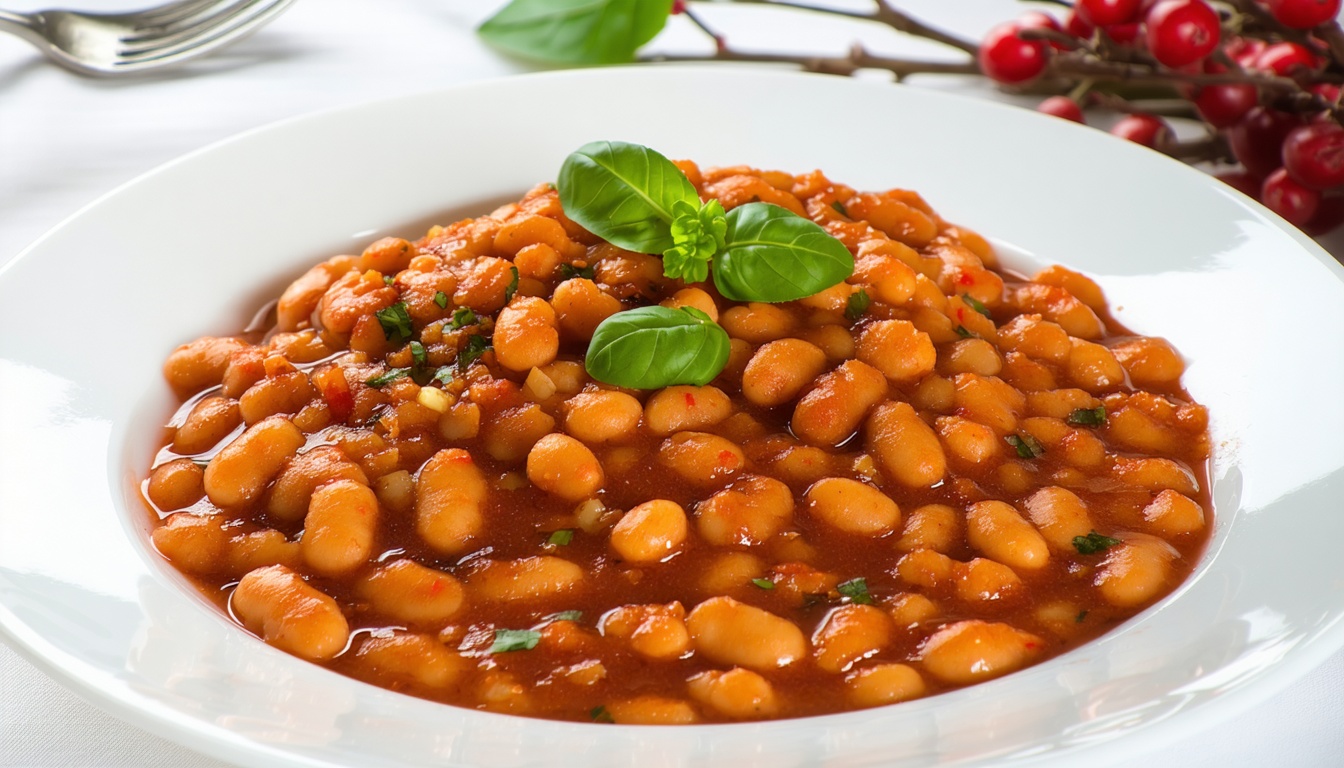
⭐ Tavče gravče
The national dish, and genuinely a national dish rather than a tourist-menu one. Dried white beans — ideally the large flat tetovec beans from around Tetovo — baked slowly in an earthenware pan with onion, paprika and dried red pepper until the top browns. Often with a sausage or a piece of ribs pushed in. Cheap, meatless in its base form, and served everywhere.
⭐ Ajvar
The roasted red pepper relish that defines the country's autumn. Long sweet red peppers — kurtovska kapija — roasted over fire, peeled, minced, and cooked down slowly with oil, sometimes with aubergine, until dense and dark. Made at home in huge batches and eaten all winter on bread, with cheese, with everything. Shop-bought is a shadow of homemade and everyone will tell you so.
Skara
The grill, and the centre of any restaurant meal. Kebapi — small fingers of minced meat, ordered by the ten — with raw onion and bread. Pleskavica, the big spiced patty. Kolbasi, ražnjići, lamb, and šopska salata alongside: tomato, cucumber, onion and a snowdrift of grated white cheese.
The starters
Pindžur, ajvar's tomato-heavier cousin. Malidzano, with aubergine and walnut. Turšija, mixed winter pickles. Sirenje, the white brined cheese, and kashkaval, the yellow one. Selsko meso, "village meat", pork and mushrooms baked in a clay pot. And Ohrid trout by the lake, which is expensive, protected, and worth asking about the provenance of.
Bread and pastry
Burek for breakfast — filo with cheese, meat or spinach, eaten with drinking yoghurt. Zelnik, the flatter country pastry with leeks or greens. Pogača, the round loaf. And tulumba and baklava after, which are Ottoman and unapologetic about it.
⚠️ Practicalities
Portions are large and sharing is normal — order fewer dishes than you think. A full restaurant meal with wine runs €10–20 a head outside Skopje's smart places. Vegetarians do well on the starters, beans and pastries; vegans have a harder time, because the cheese is everywhere.
📖 Three Recipes
The two that define the country, plus the salad that comes with everything. All three are cheap and none needs special equipment beyond, ideally, an earthenware dish.
Tavče gravče — baked beans in a clay pan
Serves 4 · soak overnight · 30 min prep · 1 hour baking · the national dish
Ingredients: 500 g dried large white beans (tetovec, or butter/lima beans) · 2 onions, sliced · 3 tbsp sunflower oil · 2 tbsp sweet red paprika · 1 tsp hot paprika or 2 dried red chillies · 1 tbsp plain flour · 2 tsp dried mint · salt, pepper · optional: 200 g smoked sausage or pork ribs · fresh parsley
Method: Soak the beans overnight. Drain, cover with fresh cold water, bring to the boil and boil hard for 10 minutes, then drain again — this step matters and skipping it makes them indigestible. Cover with fresh water and simmer 45–60 minutes until tender but not collapsing; keep the cooking liquid. Meanwhile fry the onion gently in the oil until soft and golden, stir in the flour and cook a minute, then take off the heat and stir in both paprikas — off the heat, or the paprika burns bitter. Combine the beans, the onion mixture, the dried mint, salt and pepper and enough of the bean liquid to come just level with the beans. Tip into an earthenware dish, push in the sausage or ribs if using, lay a couple of dried chillies on top and bake at 200 °C for about an hour, until the liquid has reduced and the surface has browned and crusted. Rest ten minutes and serve in the dish, scattered with parsley.
💡 Bake it in the pan and serve it in the pan. The crust on top is the dish — if you spoon it onto a plate you have made bean soup.
Ajvar — roasted red pepper relish
Makes about 4 jars · 1 hour roasting · 2–3 hours cooking · the autumn ritual
Ingredients: 5 kg long sweet red peppers (kurtovska kapija, or Romano) · 1 large aubergine (optional, and traditional in the milder version) · 200 ml sunflower oil · 3 tbsp red wine vinegar · 2 tbsp salt · 4 cloves garlic (optional) · 1–2 hot chillies if you want it fierce
Method: Roast the peppers whole — over charcoal if you possibly can, otherwise under a hot grill or in a 220 °C oven — turning until the skins are blackened and blistered all over. Pile them into a covered pot or a plastic bag and leave 20 minutes to steam, which loosens the skins. Peel, stem and seed them, working over a bowl but discarding the liquid: ajvar must not be wet. Roast and peel the aubergine the same way if using. Mince everything coarsely (a mincer gives the traditional texture; a food processor pulsed briefly will do, but do not purée). Put the pulp in a wide heavy pan with the oil, salt and vinegar and cook over low heat, stirring very regularly with a wooden spoon, for two to three hours, until it darkens to brick red, thickens enough to hold the mark of the spoon, and the oil begins to separate at the edges. Add garlic and chilli in the last twenty minutes. Fill hot into sterilised jars and seal.
💡 The three hours of stirring are not optional and cannot be hurried — undercooked ajvar is a watery pepper sauce. This is why it is made once a year, by several people, with the radio on.
Šopska salata — the salad that comes with everything
Serves 4 · 10 minutes · no cooking
Ingredients: 4 ripe tomatoes · 1 cucumber · 1 green pepper · 1 small onion · 150 g white brined cheese (sirenje, or feta) · 2 tbsp sunflower or olive oil · 1 tbsp red wine vinegar · salt · parsley
Method: Cut the tomatoes into rough chunks, the cucumber into half-moons, the pepper into strips and the onion into thin slices. Combine in a wide shallow bowl, dress with the oil, vinegar and a little salt and toss. Then grate the cheese over the top in a thick even layer so that it covers the vegetables completely — that snow-covered look is the point and the salad is served that way across the region. Scatter with parsley and do not toss again.
💡 Everything depends on the tomatoes. Made with supermarket tomatoes in February this is a pointless salad; made with real ones in August it is one of the best things you will eat all year.
🥂 Rakija, Vranec and the Long Toast
⭐ Rakija
The fruit brandy that opens every meal and closes every negotiation. Grape (lozova) is the standard; plum, quince and pear are common; the good stuff is homemade and the strength is whatever the still produced. It is served in small glasses, at room temperature, before food, and it is sipped, not shot — downing it in one marks you out as a foreigner more reliably than your accent.
The toast
На здравје! — na zdravje! — with eye contact, which is taken seriously. Note the r: the form "na zdavje" turns up in a good deal of published material, including the page this one replaces, and is simply a typo.
Wine
Covered at length in its own section: vranec for reds, temjanika and smederevka for whites, Tikveš as the heartland. House wine in a taverna is poured from a jug, costs almost nothing and is usually perfectly good.
Beer
Skopsko is the national lager and is everywhere; Zlaten Dab from Prilep is the other big name. A small craft scene has appeared in Skopje in the last decade, mostly good and mostly expensive by local standards.
Coffee, and boza
Coffee is the social currency — see the culture section. Boza, the thick, faintly sour fermented millet drink sold in the bazaars, is an Ottoman survival and an acquired taste worth acquiring once. Salep in winter, thick and hot, is the other one.
⚠️ A warning about hospitality
Rakija is offered generously, refills are automatic, and refusing is difficult without giving offence. The reliable technique is to accept the first, sip it slowly and leave the glass part-full — an empty glass is an invitation. Drink-driving enforcement is real and the limit is low.
💸 What It Costs
North Macedonia is among the cheapest countries in Europe, and noticeably cheaper than Croatia, Slovenia or Greece. The currency is the denar (MKD), pegged to the euro at roughly 61.5 MKD = €1, which has been stable for years.
Accommodation
A decent double in a city guesthouse or three-star hotel runs €30–55; apartments in Ohrid outside August €25–45; hostels €10–15. Ohrid in July and August is the one place where prices double and booking ahead is essential.
Eating
A burek and yoghurt breakfast €1.50–2.50. A plate of kebapi with salad and bread €4–7. A full restaurant dinner with a carafe of wine €10–20 a head, less outside Skopje and Ohrid. Coffee €1–1.80. A bottle of decent Tikveš vranec in a shop €4–8.
Transport
Intercity bus Skopje–Ohrid about €10, Skopje–Bitola about €7. City buses under €0.60. Taxis are cheap and metered in Skopje — a cross-city ride is usually under €4. Hire car from €25–35 a day; fuel is roughly European average and the largest single expense of driving.
Sights
Museums and monasteries €1–3, most of them. The Ohrid churches charge small individual fees that add up; a combined ticket exists. Matka boat trips and the Vrelo cave around €10–15. National park access is free.
⚠️ Money
Cards are widely accepted in Skopje and Ohrid and less so in villages, small tavernas and markets — carry cash. ATMs are everywhere; some charge high fixed fees, so withdraw larger amounts less often. Denars cannot easily be changed outside the country, so spend them before you leave. Exchange offices give better rates than banks and are legitimate.
A week
Comfortably €350–550 per person for a week including accommodation, food, transport and entries, excluding international flights — and that is a generous version, not a backpacking one.
📋 Practical Information
Visas
EU, EEA, Swiss, UK, US, Canadian, Australian and many other citizens enter visa-free for 90 days in any 180 with a passport valid for the stay. North Macedonia is not in the Schengen area and not in the EU, so time here does not count against a Schengen allowance — which makes it a useful place to spend a few weeks.
Safety
Genuinely low crime, including violent crime, and solo travellers including women generally report feeling comfortable. The usual caveats: pickpocketing in Skopje's bazaar and bus station, taxi overcharging if you do not insist on the meter, and stray dogs in numbers in some towns, which are mostly placid but worth not startling.
⚠️ Health
No compulsory vaccinations. Tap water is safe in cities and Ohrid; ask in villages. Public healthcare is free at the point of emergency but under-resourced; private clinics in Skopje are good and cheap by western standards. Take travel insurance — there is no EHIC arrangement with the EU, so European Health Insurance Cards do not work here, which catches a lot of EU visitors out.
Connectivity
Not in EU roaming. A European SIM will charge international rates, sometimes severe ones — check before you land. Local prepaid SIMs from A1 or Telekom are cheap and take five minutes. Wi-fi is widespread and generally good, and mobile coverage reaches most of the country except deep in the mountains.
Time, power, tipping
CET (UTC+1), CEST in summer. 230 V, European type C/F plugs — no adapter needed from most of Europe. Tipping is rounding up, or up to 10 % for a good restaurant meal; it is appreciated rather than expected.
⚠️ Things that catch people out
Cyrillic on some road signs with no Latin doubling — learn the alphabet. August traffic at the borders, when hundreds of thousands of diaspora drive home. Hire cars that are not insured for Kosovo. And nightlife venues where fire safety cannot be assumed — check the exits.
🇨🇿 For Czech Readers
North Macedonia is one of the easiest and cheapest places in Europe for a Czech traveller to reach and one of the least visited by them — and the two countries share an origin story that most people in both have forgotten.
⭐ Cyril and Methodius
This is the connection that matters. The brothers from Thessaloniki who came to Great Moravia in 863 and gave the Czech lands their first written language are the same men whose disciples, Clement and Naum, founded the literary school at Ohrid that finished the Cyrillic alphabet. 5 July is a public holiday in both countries for the same reason. Standing at Plaošnik in Ohrid, a Czech visitor is standing at the other end of their own alphabet's story. See that section.
Getting there from Prague
Wizz Air flies Prague–Skopje directly, typically two or three times a week, in about 2 hours; fares booked ahead run 1 500–4 000 Kč return and can be far less on a sale. Otherwise connect via Vienna, Istanbul or Belgrade. Thessaloniki is a three-hour drive from Skopje and often has cheaper flights.
Visas and documents
Czech citizens travel visa-free and may enter on a national ID card as well as a passport. Stays up to 90 days in 180. A Czech driving licence is sufficient; a green card for the vehicle is needed if driving your own car.
⚠️ Insurance and the EHIC trap
The European Health Insurance Card does not work here — North Macedonia is outside the EU and outside the EHIC system, and Czech travellers regularly arrive assuming otherwise. Take commercial travel insurance covering treatment and repatriation. Private clinics in Skopje are good and, by Czech standards, inexpensive if you are paying cash.
Prices in crowns
Guesthouse double 750–1 350 Kč a night. Kebapi with salad 100–170 Kč. Restaurant dinner with wine 250–500 Kč. Coffee 25–45 Kč. Bus Skopje–Ohrid 250 Kč. Hire car 600–850 Kč a day. A week on the ground, excluding flights, comfortably 8 500–13 500 Kč.
MZV ČR a DROZD
The Czech Ministry of Foreign Affairs issues no travel warning for North Macedonia and treats it as a safe destination with ordinary precautions. There is a Czech embassy in Skopje. Registration in DROZD (drozd.mzv.cz) is quick and worth doing, particularly if you plan to walk in Šar Planina or Mavrovo, where mobile coverage is patchy and mountain rescue is thin.
✍️ Author's Note — the Aruba Flag, the Gothic Spire and a Map of Nowhere
Every page in this atlas is rebuilt by reading the old one and checking it. This one had more to correct than most, and the errors are instructive rather than embarrassing — they are the errors a generated page makes.
⚠️ The flag was Aruba's
The previous version of this page displayed 🇦🇼 — the flag of Aruba — for North Macedonia. On a page about a country that spent twenty-seven years in a diplomatic war over a flag and a name, that is the least forgivable possible error, and it was sitting on the live site. It is 🇲🇰.
⚠️ The population was the wrong number
The old page gave ~2.1 million. The 2021 census — the first in twenty-one years — counted 1 836 713 residents. The 2.1 million figure is the total including self-enumerated diaspora, a different measurement introduced in that census. The ethnic breakdown was also out of date: 58.4 % / 24.3 % of residents, not 64 % / 25 %.
⚠️ And the lake was too old
The old page dated Lake Ohrid at "2–3 million years". The SCOPSCO deep drilling project of 2013 went 569 m into the lake bed and settled it at roughly 1.3–1.5 million. Still the oldest lake in Europe by a distance; just not that old. Also corrected: the toast is na zdravje, with an r.
⭐ The Gothic spire
The old header image is genuinely beautiful and genuinely wrong: the water is exactly Ohrid — clear over pale limestone, a wooden skiff, the mountain wall behind — and the church has a tall Gothic spire that belongs to Slovenia or northern Italy. Ohrid's churches are Byzantine, domed, low and stone. It is kept on this page, moved into the section on the lake, with the error named. Same failure mode as the Sahelian kasbah filed under Niger: right region, wrong architectural world.
⚠️ And a sea in a landlocked country
The other hero image the bank supplies, 01-hero.jpg, shows a baroque twin-towered church on an islet in a fjord-like bay with moored boats, cruise ships and a palm tree. That is the Bay of Kotor in Montenegro. North Macedonia has no coast, and Ohrid sits at 700 metres. It is not used here. Also not used: an ajvar photograph showing a chunky glossy relish with hot chillies, when ajvar is a smooth matte paste of roasted sweet peppers — notable because ajvar is internationally famous, which makes it a genuine counter-example to a hypothesis this project has been building.
⭐ The wine map, and what it settles
The bank also supplies a decorative wine regions map. Its three region names — Povardarie, Pčinja-Osogovo, Pelagonija-Polog — are correct and correctly spelled, so they came from a real source. Its geography is invented: the country outline is not North Macedonia's, Tikveš is printed twice, "Greece" is printed on the Bulgarian border, and Ohrid and Prespa are drawn outside the country. That is the pattern to look for in the other wine maps in this collection: the names come from a source, the geometry comes from nowhere.
Support This Project 🌍
This World Travel Factbook is a labor of love – free to use for all travelers. If you find it helpful, consider supporting its continued development.
