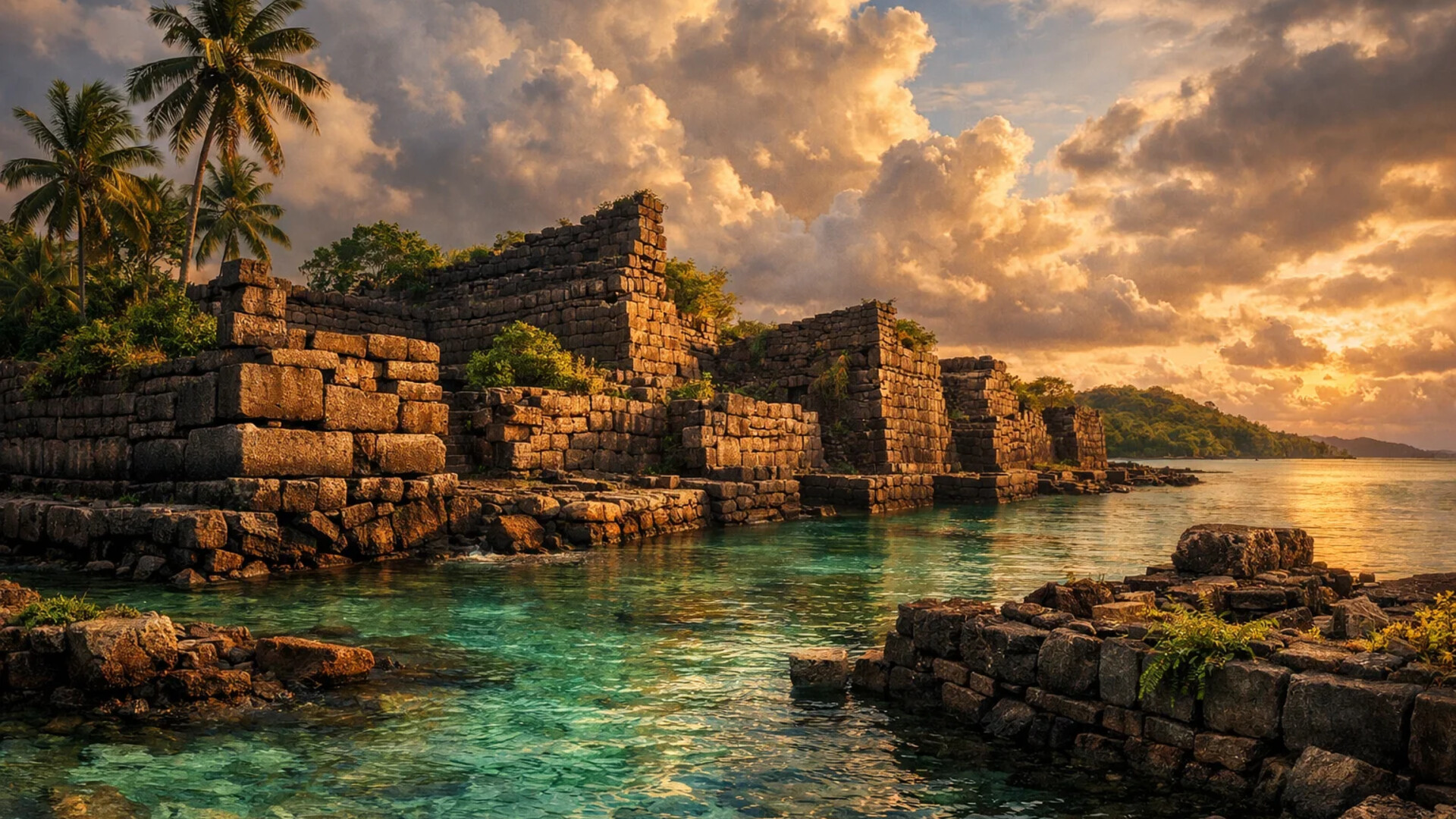



🇫🇲 Micronesia at a Glance
🌍 Overview — A Country That Is Mostly Sea
The Federated States of Micronesia is a country of 607 islands with a total land area of 702 km² — smaller than the Prague metropolitan area — scattered across 2.98 million km² of ocean, an exclusive economic zone larger than the European Union. The ratio of sea to land is roughly 4,200 to 1.
It has about 114,000 people and it is losing them: the population has been falling for years, not because of the sea but because every citizen has the right to live and work in the United States and a great many of them do.
Four states, four countries
Yap, Chuuk, Pohnpei and Kosrae, spread over 2,700 km from west to east — roughly Lisbon to Moscow. They have different languages, different cultures, different histories and no shared vernacular. A Yapese and a Kosraean converse in English.
Where it is
In the western North Pacific, north of the equator, mostly within the Caroline Islands. Guam lies to the north-west, Palau to the west, the Marshall Islands to the east, Papua New Guinea far to the south. The nearest continental landmass is 2,500 km away.
What it looks like
Both kinds of Pacific island at once: high volcanic islands — Pohnpei, Kosrae and the big islands of Chuuk, green, mountainous and drenched with rain — and low coral atolls, dozens of them, a couple of metres above the sea.
The relationship with America
Independent since 1986 under a Compact of Free Association: the FSM runs its own affairs, the United States provides funding and is responsible for defence, and FSM citizens may live and work in the US without a visa. That last clause shapes the country more than any other single fact.
Why anyone comes
Three reasons, each world-class and none of them famous: Nan Madol, a megalithic city built on artificial islets; Chuuk Lagoon, where a Japanese fleet still sits on the seabed; and Yap, where manta rays gather and stone discs the size of a car remain legal currency.
How many visitors
Very few — in most years fewer than 20,000 arrivals in total, a large share of them on business or visiting family, and a substantial part of the remainder divers going straight to Chuuk. This is one of the least-visited countries on earth.
🏷️ Micronesia, and the Confusion It Causes
Two different things
Micronesia is a region of the Pacific — from Greek mikros nesos, "small islands" — containing Kiribati, the Marshall Islands, Nauru, Palau, Guam, the Northern Marianas and the FSM. The Federated States of Micronesia is one country inside it. Confusing the two is the standard error and it makes a lot of published information about "Micronesia" useless.
The Caroline Islands
The older geographical name for the archipelago, given by Spanish navigators for Charles II of Spain. Palau and the FSM together make up the Carolines; the FSM is the eastern four fifths of them.
What the states call themselves
Wa'ab (Yap), Chuuk — formerly written Truk, and still called that by divers and in the wreck literature — Pohnpei, formerly Ponape, and Kosrae, formerly Kusaie. The old spellings persist in books, charts and dive guides, which is worth knowing when you search.
The flag
Four white stars on United Nations blue, one for each state, in the pattern of a compass rose. The blue is the Pacific. It is one of the few national flags whose design is essentially about the sea rather than about the land.
The motto
Peace, Unity, Liberty — and the unity part is a genuine achievement rather than decoration, because these four states had almost nothing in common before the twentieth century and one of them has repeatedly considered leaving.
A country of citizens abroad
Something in the order of a third of all FSM citizens now live in the United States, principally Guam, Hawaii and the American mainland. The FSM is one of a small number of countries where the diaspora is close to the size of the resident population, and where remittances and return migration shape everyday life.
🗺️ 607 Islands, and the Water Between Them
The scale problem
Everything about the FSM is governed by distance. From Yap to Kosrae is about 2,700 km; the only way between them is a flight that stops at every state on the way, or a government supply ship that takes weeks. Internal travel is the single hardest thing about the country.
The high islands
Pohnpei (334 km²), the largest, with Dolohmwar (Nahnalaud) rising to about 780 m; Kosrae (110 km²), a single steep green island with no lagoon reef gap; and the volcanic islands inside Chuuk Lagoon. All are rainforested, mountainous and largely roadless in the interior.
Chuuk Lagoon
One of the largest lagoons in the world — about 2,130 km² of enclosed water — ringed by a 225 km barrier reef with a scatter of steep volcanic islands inside it. It is a drowned volcano, and it was the reason the Japanese Combined Fleet used it as a forward base.
The atolls
Dozens of them, from Ulithi and Woleai in the west to Mokil and Pingelap in the east, plus the Polynesian outliers Nukuoro and Kapingamarangi in the far south, whose people speak Polynesian languages and are culturally distinct from everyone else in the country.
The rain
Pohnpei is one of the wettest places on earth. The coast receives around 4,800 mm a year and the interior highlands are credibly estimated at 7,500 to 10,000 mm — measurements are difficult because nobody lives up there. Kosrae is similar. This is not a place with a dry season worth the name.
The sea as territory
The 2.98 million km² exclusive economic zone is the country's principal economic asset. Fishing licences sold to foreign tuna fleets — Japanese, Korean, Taiwanese, Chinese, American — are a major share of national revenue, and the FSM is a founding member of the Parties to the Nauru Agreement, the cartel that made those licences worth something.
🌦️ Warm, Wet, and in the Typhoon Alley
The basics
Tropical maritime, and essentially unchanging: 26–31 °C every day of the year, humidity generally above 80%, and sea temperature around 29 °C. There is no cool season and no cold. Visitors from temperate climates consistently underestimate how tiring the humidity is.
Rain
Everywhere and all year, heaviest roughly April to November. On Pohnpei and Kosrae expect rain most days — often a violent hour and then sun. The western atolls and Yap are drier and can have genuine drought years, which on an atoll is an emergency.
Typhoons
The FSM sits in the birthplace of Pacific typhoons: many storms form over or near the Carolines and intensify as they track west toward the Philippines. Yap and Chuuk are the most exposed; Pohnpei and Kosrae, closer to the equator, are hit less often but not never. Typhoon Maysak devastated Chuuk and Yap in 2015; Typhoon Wutip hit Chuuk in 2019.
El Niño
Matters here more than almost anywhere. El Niño years shift rainfall west, which brings severe drought to the eastern islands and atolls — Pohnpei's 1998 and 2016 droughts required emergency water shipments — and increases typhoon activity in the west.
The best window
December to March: less rain, calmer seas, better visibility for diving and the lowest typhoon risk. It is also when Yap's manta season and the main cultural festivals fall. This is the season to plan for.
What it means practically
Bring quick-drying clothes and expect to be wet. Waterproof anything electronic. Accept that boat trips and inter-island flights get cancelled by weather, and never build an itinerary that cannot absorb losing a day.
📜 Four Thousand Years, Four Colonial Flags
The FSM has been settled for millennia and colonised, in the space of a single century, by Spain, Germany, Japan and the United States — a sequence no other part of the Pacific matches, and one that is still visible in the buildings, the loan words and the wrecks.
Settlement
Austronesian voyagers reached the Carolines by roughly 2000 BCE, navigating without instruments using stars, swells, birds and cloud formations — a body of knowledge that survives today on Satawal and a few other outer islands and is one of the great intellectual achievements of any human society.
Nan Madol and Lelu
Between about 1200 and 1600 CE, the Saudeleur dynasty on Pohnpei built Nan Madol — around 100 artificial islets of stacked basalt and coral rubble in a lagoon, the only ancient city in the Pacific built on a reef. Kosrae built Lelu, a similar walled complex, at the same time. Both were abandoned before Europeans arrived.
Spain, 1885–1899
Spain had claimed the Carolines since the sixteenth century and did almost nothing with them until Germany forced the issue in 1885; Pope Leo XIII arbitrated in Spain's favour. Fourteen years later, after losing the Spanish-American War, Spain sold the entire archipelago to Germany for 25 million pesetas.
Germany, 1899–1914
Copra plantations, road-building, and a rebellion on Pohnpei in 1910–11 — the Sokehs Rebellion — which the Germans put down by executing seventeen men and deporting the survivors to Palau. The site of the executions on Pohnpei is a memorial.
Japan, 1914–1945
The most transformative period. Japan took the islands at the start of the First World War, held them under a League of Nations mandate, and settled them heavily — by the 1930s Japanese settlers outnumbered islanders in parts of the group. Then militarisation: Chuuk became the Japanese Combined Fleet's main forward base, and on 17–18 February 1944 the US Navy destroyed it in Operation Hailstone.
America, 1947–1986
Administered as part of the UN Trust Territory of the Pacific Islands, with an approach that has been criticised for building dependence rather than capacity. The FSM constitution took effect in 1979, the Compact of Free Association in 1986, UN membership in 1991.
🇺🇸 The Compact of Free Association
The single most important thing about the FSM is not geographical but legal. Under the Compact of Free Association, the country is fully sovereign, has its own foreign policy and sits in the UN — and is at the same time bound to the United States in a way no other independent state is.
What the FSM gets
Direct financial assistance, access to US federal programmes, the US dollar as currency, US postal service, and — decisively — the right of every FSM citizen to enter, live and work in the United States indefinitely without a visa. No other country's citizens have that.
What the United States gets
Full responsibility for defence, and a denial right: the FSM cannot allow any other country's military access to its territory or waters. In an ocean where China's reach is growing, that clause covers 2.98 million km² of the western Pacific and is the reason Washington renewed the agreement.
The 2023-24 renewal
The economic provisions were renegotiated and the Compact of Free Association Amendments Act was signed on 9 March 2024, providing funding for the three freely associated states over a further twenty years. For the FSM it means around 3.3 billion dollars through 2043, with the emphasis on education, health and infrastructure.
The trust fund
The Compact Trust Fund is designed to replace direct assistance when the grants end, so that the FSM eventually funds itself from the returns. In January 2026 President Simina and the trust fund committee marked its passing the two billion dollar mark — a genuine milestone, and still short of what full self-funding requires.
The problem with it
The migration right that makes the Compact valuable to individuals is also what hollows out the country: the most educated and employable leave first. And a US audit body reported in 2026 that spending of Compact money has been slowed by construction labour shortages caused by that same emigration. The Compact's benefit and the Compact's cost are the same clause.
The China question
Beijing has courted the FSM steadily — infrastructure, scholarships, port interest — and the FSM has at times pushed back publicly. The country recognises the People's Republic rather than Taiwan, unlike its neighbours Palau and the Marshall Islands. Great-power competition in this ocean is not abstract here; it is the main lever the FSM has in negotiating with Washington.
🏛️ How a Country of 114,000 Governs Itself
The structure
A federal republic with an unusually weak centre and four very strong states. The national capital is Palikir on Pohnpei — a purpose-built government campus rather than a city, and one of the least-known capitals in the world. Each state has its own constitution, governor and legislature, and considerable autonomy.
The Congress
A single chamber of 14 senators: one at-large senator from each of the four states serving four years, and ten serving two-year terms allocated by population. There are no political parties — candidates run as individuals and coalitions form around personalities, islands and issues.
The president
Elected by Congress from among the four at-large senators, not by the public. Wesley W. Simina, of Chuuk, has been president since 12 May 2023, with Aren B. Palik of Kosrae as vice-president. Congressional elections were held on 4 March 2025; the next general election falls on 2 March 2027.
The unwritten rule
The presidency rotates informally between the states, and the president and vice-president are by convention from different states — a balancing convention rather than a legal requirement, and the main thing holding a federation this diverse together.
The Chuuk question
Chuuk holds roughly half the FSM's population and is by a distance the poorest state. A secession movement has repeatedly proposed independence and repeatedly deferred the referendum, most recently pushing it beyond the Compact renegotiation. It is dormant rather than dead, and any serious move would break the country.
Foreign policy
Independent and, for a country this size, active: an early and loud voice on climate change in the UN and at COP meetings, a member of the Pacific Islands Forum, and a signatory of the Nauru Agreement on tuna. The FSM recognises the People's Republic of China, unlike Palau and the Marshall Islands.
💵 Fish Licences, Federal Grants and Remittances
The FSM has one of the least diversified economies in the world. There is almost no manufacturing, agriculture is largely subsistence, and the money comes from three places: the United States, foreign fishing fleets, and relatives abroad.
Compact assistance
The largest single item. The 2024 agreement runs to about 3.3 billion dollars for the FSM through 2043, aimed at education, health and infrastructure, with the Compact Trust Fund — past 2 billion dollars as of January 2026 — intended to take over when the grants stop.
Fishing licences
The FSM's 2.98 million km² of ocean holds some of the world's richest tuna grounds, and licences sold to foreign purse-seine fleets are the main domestic revenue. The Parties to the Nauru Agreement vessel-day scheme, which the FSM helped create, raised the price of those days several-fold and is one of the more successful pieces of collective bargaining by small states anywhere.
Remittances
Money sent home by the third of the population living in the United States. It does not appear in headline GDP figures the way aid does, and in many households it is the largest single income.
Employment
The public sector dominates — national government, four state governments, schools, hospitals. Private employment is small: retail, construction, a little tourism, some fish processing. Unemployment is high and youth unemployment higher, which feeds directly into the emigration.
The dollar
The FSM uses the US dollar and has no central bank or monetary policy of its own. That imports American price stability and removes any possibility of devaluation, which for an economy this dependent on imports is broadly a good trade.
What is missing
Almost everything is imported — fuel, rice, tinned food, building materials — which makes the cost of living high and the trade deficit enormous. Attempts at export industries (garments in Yap, fish processing in Pohnpei) have mostly failed on distance and labour cost. Distance is the fundamental economic fact of the FSM and there is no policy answer to it.
🚪 The Country That Is Leaving
The FSM's defining problem is not the sea. It is that its citizens can legally move to the United States tomorrow, and about a third of them have.
The numbers
Resident population is around 114,000 in 2026 and has been falling for years — the FSM is one of very few countries with sustained negative population growth that is entirely voluntary. Estimates of FSM citizens living in the US run to tens of thousands, concentrated in Guam, Hawaii, Oregon and Missouri.
Who leaves
The young, the educated and the employable, which is the worst possible selection for the country they leave. Nurses, teachers, tradesmen and graduates go where the wages are ten times higher. A 2026 US audit found Compact-funded construction projects delayed by a shortage of local labour caused by that same emigration.
Why they go
Wages, jobs, hospitals and universities — none of which the FSM can provide at scale. Under the Compact there is no visa, no quota and no queue. This is not a failure of patriotism; it is a rational response to a legal right that exists precisely because the relationship with the US is so close.
What it does to the islands
Schools with falling rolls, villages of the old and the very young, skills gaps in every profession, and outer islands where the population has dropped below the level at which a community functions. It also creates dense transnational families in which the household spans two countries.
The counter-argument
Remittances, US education, and returnees who bring back skills and capital. Several FSM politicians and officials have spent long periods in the United States. The diaspora is a resource as well as a loss — but it is a resource the country does not control.
The uncomfortable conclusion
The clause that makes the Compact valuable to individual Micronesians is the clause that most threatens the viability of the state. No FSM government has proposed changing it, because no FSM government could survive proposing it.
🌊 The Sea, Honestly
The FSM is one of the world's most-cited climate-vulnerable states and has been a loud voice at every climate conference for thirty years. The picture on the ground is more specific — and in some ways more urgent — than the standard "sinking islands" story.
The atolls
The genuine existential exposure. Dozens of FSM atolls sit two to three metres above sea level, and the immediate threat is not permanent submergence but saltwater intrusion into the freshwater lens and into taro pits. Once the groundwater turns brackish, an atoll becomes uninhabitable long before it goes under.
The high islands
Pohnpei, Kosrae and the Chuuk volcanic islands are not going anywhere — but almost everyone lives on the narrow coastal strip, and that is where the erosion, the storm surge and the road washouts are. Kosrae has already had to consider relocating coastal settlements inland and uphill.
Storms
Warmer seas mean stronger typhoons in a country that already sits where they form. Maysak in 2015 destroyed a large share of the housing and crops on Chuuk and Yap. Recovery on small islands with no construction industry takes years, not months.
The reefs
Bleaching events have hit FSM reefs repeatedly and ocean acidification threatens the coral that both builds the atolls and feeds the people. A reef that stops growing is an atoll that stops keeping up with the sea.
What the FSM does about it
Punches far above its weight diplomatically — it was an early and forceful advocate for the 1.5 °C target and for loss-and-damage finance, and it has pushed hard on cutting HFCs, where a small state's proposal genuinely changed global policy. Domestically: seawalls, mangrove replanting, relocation planning and water security.
The honest ranking
For most FSM communities the sea is the second problem. Emigration is the first, and it is happening now rather than by 2100. Any account of the FSM that leads with drowning islands and omits the departure lounge at Pohnpei airport has the emphasis wrong.
🌧️ Pohnpei
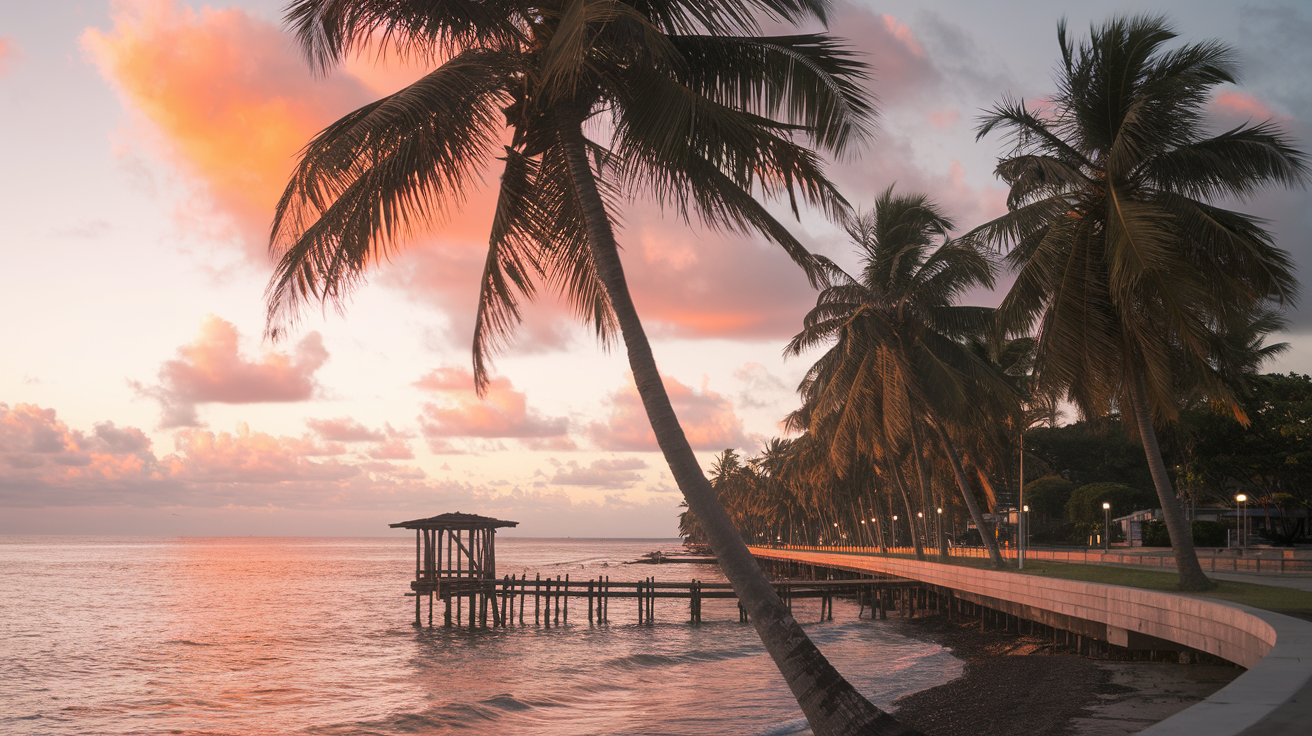
02-sukhumi-promenade.jpg, after a place on the Black Sea coast of Abkhazia. The picture is Pacific; only the filename is not. The gallery at the foot of this page explains why.The largest island, the seat of the national government, and one of the wettest places on the planet: a green volcanic dome wrapped in mangrove and ringed by a barrier reef, with a mountainous interior almost nobody enters.
Kolonia and Palikir
Kolonia is the town — a few thousand people, one main street, Spanish, German and Japanese ruins scattered among the shops. Palikir, the national capital, is a purpose-built government campus 6 km away with local-style architecture and almost nothing else. Do not expect a capital city.
Sokehs Rock
The basalt monolith over the harbour, the island's emblem, and a hard steep climb with a big view. Sokehs was also the site of the 1910–11 rebellion against the Germans and of the executions that ended it — there is a memorial, and it matters locally far more than the view does.
Waterfalls and forest
Kepirohi and Liduduhniap falls are the accessible ones. The interior is cloud forest of extraordinary endemism — Pohnpei has endemic birds, endemic plants and its own flying fox — and it is genuinely difficult country: no trails to speak of, permanent mud, and rain.
The reef and the atolls
A barrier reef with good diving and, offshore, Ant Atoll and Pakin — uninhabited or nearly so, spectacular, and reached by a boat trip that needs to be arranged with someone who knows the passes.
Sakau and society
Pohnpei has an intact chiefly system — the Nahnmwarki and Nahnken titles, the feast houses, the ranked presentation of yams and pigs — that runs in parallel with the elected government and matters more in daily life. Sakau, the local kava, is central to all of it.
Base for
Nan Madol, which is on Pohnpei's south-eastern shore and is the reason most non-divers come to the FSM at all.
🗿 Nan Madol
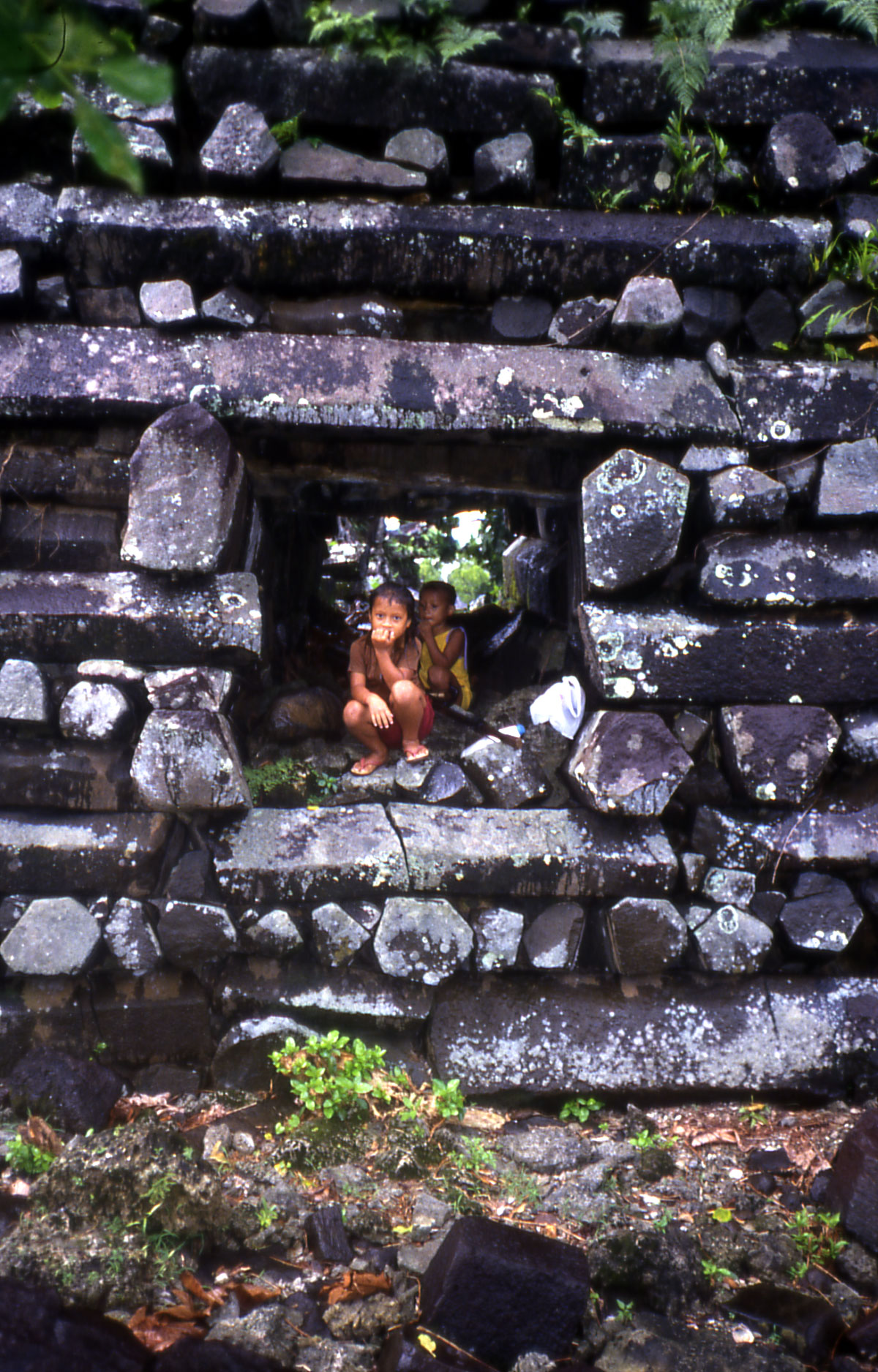
About a hundred artificial islets built on a reef flat off Pohnpei's south-east coast, separated by tidal canals and walled with columnar basalt — naturally hexagonal prisms of volcanic rock, quarried elsewhere on the island, floated or rafted into place and stacked crosswise like the logs of a cabin. It is the only ancient city of its kind anywhere, and it was inscribed by UNESCO in 2016 and placed on the List of World Heritage in Danger the same day.

What it was
The ceremonial and political centre of the Saudeleur dynasty, which unified Pohnpei and ruled it from roughly 1200 to 1600 CE. The name means "spaces between" — the canals. The elite lived here; the population that fed them lived on the main island, which is part of why the system eventually collapsed.
The scale
Around 750,000 tonnes of basalt and coral rubble moved by a society with no metal, no wheel, no draught animals and a population in the tens of thousands. The mortuary sector Nandauwas has walls up to 7.6 m high enclosing a central tomb.
How to see it
By boat at high tide, or on foot at low tide across the reef flat — muddy, slippery, and you will need reef shoes either way. Access is through the local landowners and a customary fee is paid; go with a guide arranged in Kolonia. It is not a managed site with a ticket office.
Why it is "in danger"
Mangrove roots prising the walls apart, siltation of the canals, storm damage, and the near-total absence of resources for conservation. UNESCO listed it as endangered at the moment of inscription, which is unusual and honest.
The atmosphere
It is haunted in the ordinary sense of the word: overgrown, quiet, half-submerged, and locally regarded with real unease — many Pohnpeians will not go there after dark and some will not go at all. Respect that rather than treating it as colour.
The nonsense
Nan Madol attracts a great deal of lost-continent and ancient-astronaut writing, none of which is supported by anything. It was built by Pohnpeians, the dating is reasonably secure, and the engineering question — how the columns were moved — is a real archaeological problem, not a mystery requiring outside help.
🤿 Chuuk Lagoon
The largest state by population and the poorest, and the site of what is by common consent the best wreck diving in the world. On 17–18 February 1944, US carrier aircraft attacked the Japanese Combined Fleet's forward anchorage in Operation Hailstone and sank some forty ships and over 250 aircraft in two days. They are still there.
What is down there
Freighters, tankers, submarine tenders, a destroyer, and aircraft — most in 10 to 40 m of warm clear water, upright, and heavily encrusted with coral after eighty years. The famous ones are the Fujikawa Maru (with Zero fighter fuselages in the hold), the Nippo Maru (a tank on the deck), the San Francisco Maru — deep, with trucks and mines — and the Shinkoku Maru, now a soft-coral garden.
Why it is unique
Nowhere else combines this density of large wrecks, this depth range, this water temperature and this preservation. The lagoon is sheltered, the visibility is usually good, and a single week can cover twenty ships. Divers plan careers around coming here.
The war grave problem
These ships went down with their crews and human remains are present on several. Chuuk state law and diver etiquette both prohibit removing anything and entering certain spaces. Photographs of remains are widely considered unacceptable. Treat it as a cemetery that happens to be underwater, because that is what it is.
Practicalities
Most diving is from liveaboards — the Odyssey and others — or from the small land-based operations at Weno. Penetration and deep wrecks require appropriate training and gas; a good number of the best dives are beyond recreational limits. Book far ahead; capacity is small.
Weno and the state
Weno, the main island, is the FSM's largest town and its most difficult: infrastructure is poor, water and power intermittent, and Chuuk has by far the country's worst reputation for petty crime and for alcohol-related trouble. Most divers see the airport, the boat and the water — which is a fair choice, and it does mean the state gets little from them.
Above water
The lagoon islands are beautiful and almost entirely untouristed. There are Japanese fortifications, guns and tunnels on several. Going ashore needs local arrangement, and is worth it if you can make it.
💰 Yap
The westernmost state, the most culturally conservative, and the one where the traditional order has held most firmly against the twentieth century. Yap is where the stone money is, where the manta rays are, and where a visitor is most likely to do something inadvertently rude.
The stone money
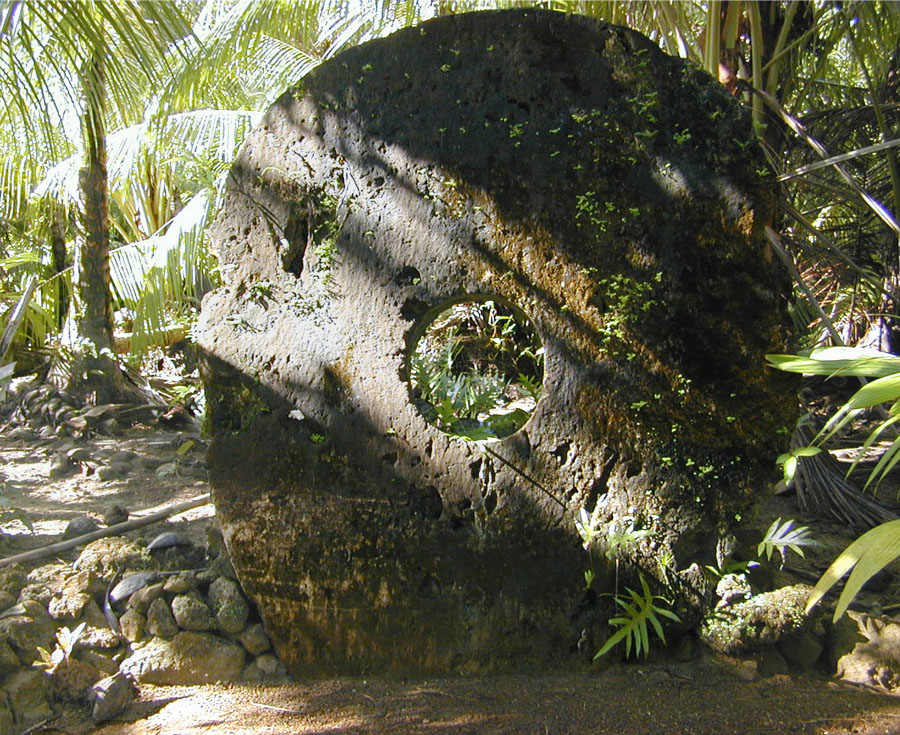
Rai discs range from a few centimetres to over three metres and four tonnes. They are still owned, still exchanged for land, marriages and settlements, and they do not move — ownership transfers by public agreement while the stone stays where it is. Economists cite Yap regularly when explaining that money is a ledger, not a thing.
Where to see it
Village stone money banks — rows of discs standing along a path or against the platform of a community house — at Balabat, Okau and elsewhere. They are private property on private land. Ask before entering, ask before photographing, and expect to pay a small customary fee.
The manta rays
Yap has resident reef manta rays that gather at cleaning stations in the Mi'il and Goofnuw channels, most reliably December to April. Yap was one of the first places in the world to build a dive industry around mantas, and it is still one of the most reliable.
Custom and etiquette
Yap is genuinely traditional and the rules are real. Do not walk on paths or land without permission; do not touch or photograph stone money without asking; dress modestly — for women in villages that means covering the thighs, and note that the local convention about the upper body is the reverse of the European one. Carry a small gift or fee for village visits.
Yap Day
Around 1 March, the main cultural festival: village dance groups, standing dances and sitting dances, bamboo dances, and a great deal of preparation. It is a Yapese occasion that outsiders may attend rather than a show, and it is the single best time to be on the island.
The canoes
Yap and the outer islands kept traditional outrigger sailing canoes and non-instrument navigation alive when almost everywhere else lost them. Canoe houses still build, and voyages between the outer islands are still made under sail.
🌴 Kosrae
The smallest and easternmost state, a single steep green island of about 110 km² with some 6,000 people, no lagoon and no traffic. It is the quietest place in the country and by a distance the easiest.
The island
One volcanic mass rising to about 630 m at Mount Finkol, fringed by mangrove and reef, with a single road that does not quite go all the way round. The outline is said to resemble a sleeping woman, which is how it is invariably introduced.
Lelu Ruins
The other megalithic site: a walled complex of basalt and coral on the islet of Lelu, contemporary with the later phase of Nan Madol and the seat of Kosrae's own paramount chiefs. Smaller and less famous, and you will almost certainly have it to yourself.
Diving and reef
Some of the healthiest hard coral in Micronesia, largely because Kosrae has little runoff, little development and an active marine protected area at Utwe. The wall diving is excellent and the reef is in visibly better condition than at more visited sites.
The forest and the mangroves
Dense rainforest, the Utwe-Walung Marine Park mangrove channels, and hiking to Mount Finkol and Menke — the last through the ruins of a pre-Christian ceremonial site. Kayaking the mangrove channels is the signature low-effort thing to do.
Sundays
Kosrae is intensely Congregationalist and Sunday is observed absolutely: no shops, no diving, no boats, no swimming, no work. Church singing is extraordinary and visitors are welcome. Plan around it rather than being caught by it.
Why go
Because it is what people imagine when they imagine the Pacific, without the resorts: no crowds, no crime to speak of, warm reef, deep forest, and a small number of family-run places to stay. Of the four states it is the one that most rewards simply slowing down.
⛵ The Outer Islands
Beyond the four main groups lie dozens of atolls and single islands, some with a few hundred people, some with a dozen, reached by field-trip ship a few times a year. This is the least-visited part of one of the least-visited countries on earth.

The navigators
Satawal, in Yap's outer islands, is the home of Mau Piailug — the navigator who in 1976 guided the Hōkūle'a from Hawaii to Tahiti without instruments and effectively restarted the Polynesian voyaging revival. Non-instrument navigation is still taught in the Carolines, and it is a living tradition rather than a reconstruction.
Ulithi
One of the largest atolls in the world by lagoon area, and in 1944–45 the largest naval anchorage on earth — the US Pacific Fleet's forward base, with over 600 ships at times. Today a few hundred people live there and almost nothing marks it.
The Polynesian outliers
Nukuoro and Kapingamarangi, far to the south of Pohnpei, whose people speak Polynesian languages and are culturally distinct from the rest of the FSM. Nukuoro's wooden figures are in major museums and are among the most striking sculpture of the Pacific.
Getting there
The field-trip ships run by each state, on schedules that are approximate and change; a berth takes days to weeks and needs to be arranged in advance and in person. There are small airstrips on a handful of atolls with irregular service. This is genuine expedition travel.
Permission
Outer island visits are not casual. Most require permission from the state and from the island's chiefs, arranged ahead. Turning up is not how it works, and doing it wrong causes real offence.
Why it matters
These islands hold the most intact traditional knowledge in the country — navigation, canoe building, weaving, the ranked social order — and they are also the most exposed to sea-level rise and the most depopulated. What is there now may not be there in thirty years.
🪢 Four Cultures, Eight Languages

The languages
English is the official language and the only one shared nationally. The main indigenous languages are Chuukese (by far the largest), Pohnpeian, Yapese and Kosraean, plus Ulithian, Woleaian, Nukuoro and Kapingamarangi. Yapese in particular is unusual even within Austronesian and is not mutually intelligible with anything else here.
Rank and title
Traditional hierarchy remains powerful, especially on Pohnpei and Yap. Pohnpei's Nahnmwarki and Nahnken lines and their ranked title system operate alongside the elected government; on Yap, village and land rank determine a great deal. Titles are earned through feast-giving and service, and they matter.
Land and the sea
Land is held by clan and lineage, not by individuals, and it is almost never sold — which is why so many things in the FSM, from hotel development to archaeological access, run through customary landowners rather than through the state. Reefs and lagoon areas are owned too.
Feasts
The central social institution: yams grown to competitive size on Pohnpei, pigs, kava, breadfruit, and elaborate ranked presentation and redistribution. A first-yam feast or a funeral feast can absorb a family's resources for a year, and refusing to participate is not really an option.
Christianity
Near-universal and taken seriously — Catholic in Chuuk and parts of Pohnpei and Yap, Congregationalist in Kosrae and the rest of Pohnpei, from nineteenth-century American and Spanish missions. Kosrae observes Sunday absolutely. Church choirs are extraordinary and a highlight of any visit.
Weaving, carving and dance
Yapese and outer-island lavalava weaving on backstrap looms; Nukuoro sculpture; Chuukese love sticks and masks; and dance forms that differ by state — Yap's standing and sitting dances and bamboo dances, performed in rows with sung narrative, are the best known.
🍽️ Reef, Root and Coconut
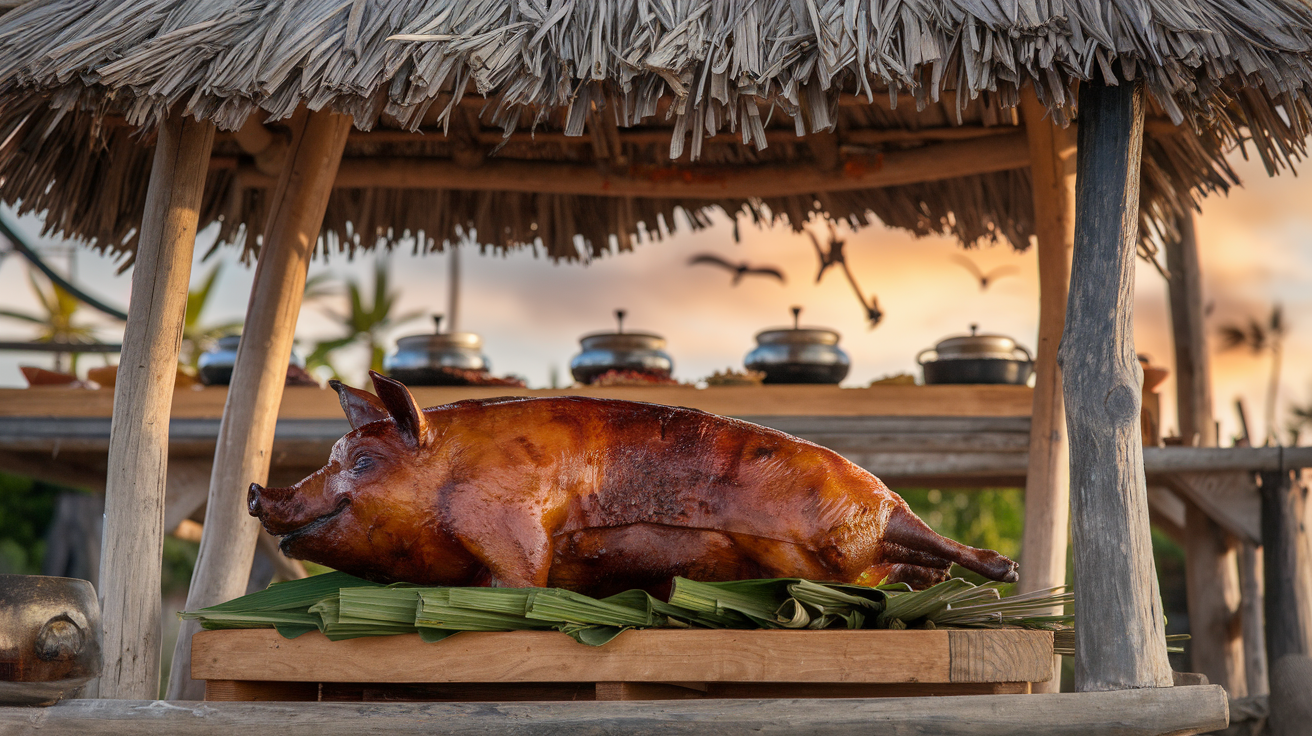
13-cuisine-feast.jpg — the same filename Abkhazia's feast image carries, for reasons the gallery explains.Micronesian food is one of the least documented cuisines in the world, partly because there is very little restaurant culture to document it. What people actually eat is reef fish, taro, breadfruit, yam, banana and coconut, cooked simply, plus an enormous quantity of imported rice and tinned protein.
The staples
Taro in several varieties, including the giant swamp taro grown in pits on the atolls; breadfruit, roasted, boiled or fermented; yam, which on Pohnpei is grown to prestige sizes requiring several men to carry; banana, cooked as a starch; and coconut in every form.
From the sea
Reef fish grilled whole or in coconut milk, tuna — often raw, sashimi-style, a lasting Japanese inheritance — octopus, lobster, clams, and mangrove crab. Ciguatera is present in some reef species in some places and locals know which; follow their lead rather than ordering the biggest reef fish on the menu.
The Japanese layer
Thirty years of Japanese administration left more marks on the food than any other outside influence: sashimi, soy sauce, bento-style rice boxes, ramen, and Japanese words for kitchen equipment. It sits alongside the American layer — Spam, tinned corned beef, instant noodles — which is less benign nutritionally.
The health problem
The shift from taro, fish and breadfruit to white rice, tinned meat and sugary drinks has given the FSM one of the world's highest rates of type 2 diabetes and obesity. This is a well-documented Pacific-wide public health emergency and there are active local campaigns to bring back local staples.
Where to eat
There is very little in the way of restaurants: a handful in Kolonia and Weno, hotel dining rooms, small Filipino and Chinese places, and market stalls. The best food is in homes, and if you are invited to a feast, go.
A note on the recipes below
Both are genuinely Micronesian and both are achievable in Europe with substitutions that are flagged as substitutions. The country's own cooking uses an earth oven and a hot fire, and no European kitchen reproduces that — what follows is the workable approximation, not a pretence.
👨🍳 Two Recipes You Can Actually Make
Reef Fish in Coconut Milk — the Everyday Dish
Serves 4 · 15 min prep · 25 min cooking · eaten across all four states
Ingredients: 4 whole small firm white fish (snapper, sea bream, mullet), scaled and gutted, or 700 g firm white fillets; 400 ml thick coconut milk; 1 onion, sliced; 3 cloves garlic; 1 thumb ginger, julienned; 2 spring onions; 1 mild green chilli; juice of 1 lime; a handful of taro or spinach leaves (optional); salt; oil. To serve: boiled taro, breadfruit, yam, sweet potato or plain rice.
Method: Score the fish two or three times on each side and salt it lightly. Soften the onion, garlic and ginger in a little oil in a wide pan over a low heat for five minutes — do not brown them; this is not a browned cuisine. Pour in half the coconut milk and bring to a bare simmer. Lay the fish in the pan in a single layer, add the chilli whole, cover and cook 6–8 minutes a side for whole small fish, less for fillets, spooning the milk over as it goes. Add the leaves if using and the rest of the coconut milk, and cook two minutes more — do not let it boil hard, or the coconut milk splits and the sauce turns grainy. Off the heat, add lime juice and the spring onion.
💡 Serve with something starchy and plain — boiled taro or breadfruit if you can get them from an African or Caribbean shop, sweet potato if you cannot, rice as the everyday fallback. The sauce is thin and mild, not a curry; resist the urge to spice it up.
Roasted Breadfruit — the Staple, Properly
Serves 4 · 5 min prep · 45-60 min cooking · the pre-rice carbohydrate of the Pacific
Ingredients: 1 whole mature breadfruit, or 1 kg frozen breadfruit chunks — both sold in African, Caribbean and South Asian shops; a little oil; salt; and, for the sweet version, 200 ml coconut cream and 2 tbsp grated palm sugar or brown sugar.
Method: For a whole fruit: prick it several times with a knife — this matters, an unpricked breadfruit can burst — and roast it directly on a rack at 200 °C for 45 to 60 minutes, turning once, until the skin is blackened and blistered and a skewer goes through easily. In the islands this is done on an open fire and the char is part of the point. Let it cool enough to handle, cut it in quarters, cut out the core, and peel off the blackened skin. The flesh should be pale, dense and faintly sweet, somewhere between potato and fresh bread. For frozen chunks: boil 20 minutes until tender, drain very well, then roast at 220 °C in a little oil for 20 minutes to get colour.
💡 Eat it hot with the fish above and its coconut sauce, or make the sweet version: mash the flesh with warm coconut cream and palm sugar into a thick paste. Underripe breadfruit is starchy and dull and overripe is sweet and sticky — you want it just yielding to a thumb.
🥥 Sakau, and What There Is to Drink
Sakau — kava, Piper methysticum — is the central social and ceremonial drink of Pohnpei and Kosrae, and it is not a tourist experience so much as the medium through which a great deal of Pohnpeian society actually operates.
How it is made
The root is pounded on a flat basalt stone with smaller stones — a rhythmic hammering audible across a valley in the evening — then the mash is squeezed through the inner bark of hibiscus into a coconut shell. The result is grey-brown, slippery, faintly muddy, and numbs the mouth almost immediately.
What it does
Not alcohol and not a hallucinogen: a mild sedative and muscle relaxant that leaves the mind clear and the body heavy. Conversation slows, voices drop, and people sit. Two or three shells is a normal evening; a great deal more is possible and unwise.
The protocol
In a ceremonial setting the order of serving follows rank, precisely, and getting it wrong is a real insult. In a commercial sakau bar — there are many on Pohnpei — it is informal, cheap and welcoming. Take the shell with both hands, drink it in one, and do not sip.
Cautions
Kava interacts badly with alcohol and with several medications, and heavy long-term use is associated with liver problems and a scaly skin condition. It also makes driving genuinely unsafe. Try it, enjoy it, and do not have a fourth.
Tuba and alcohol
Tuba, fermented coconut palm sap, is drunk in some islands. Beer and spirits are imported and expensive. Alcohol is a serious social problem in parts of the FSM, and Chuuk state has periodically prohibited it altogether — check the current position before packing a bottle, and never take alcohol to an outer island.
Everything else
Coconut water straight from the nut, which is everywhere and free; imported soft drinks, which are everywhere and part of the health problem; instant coffee; and on Kosrae a Sunday of tea and church.
🏛️ One World Heritage Site, and It Is in Danger
Nan Madol
The FSM's only UNESCO World Heritage site, inscribed in 2016 as "Nan Madol: Ceremonial Centre of Eastern Micronesia" — and placed on the List of World Heritage in Danger in the same session, for mangrove overgrowth, siltation and the absence of a conservation regime.
Lelu
Kosrae's megalithic complex, contemporary with Nan Madol and built by the same broad tradition. It is on the national register and on UNESCO's tentative list, and it is far less protected and far less visited.
The war heritage
The wrecks of Chuuk Lagoon are a heritage site of world importance and are protected under Chuuk state law as a historic monument and war grave. Salvage and souvenir-taking are prohibited. Japanese fortifications, guns and tunnels survive on many islands and are largely unmanaged.
Intangible heritage
The navigation traditions of the Carolines — star compass, swell piloting, etak — are among the most significant surviving bodies of indigenous scientific knowledge anywhere, and they are held by a small and ageing number of people. Canoe building, lavalava weaving and the ranked feast systems are in a similar position.
What threatens it
Money, mostly. There is no national heritage budget of consequence, no conservation profession, and no realistic prospect of one in a country of 114,000 with these fiscal constraints. Add tropical climate, typhoons and mangroves, which take stone apart quickly.
What visitors can do
Pay the customary fees without haggling — they are the only funding the sites have. Take a local guide. Do not climb on walls, do not move stones, do not take anything from a wreck. And on Yap, ask before entering land, every time.
🐠 Diving, Which Is Why Most People Come
The FSM is, for divers, a first-rank destination and, for everyone else, an obscure one. The four states offer four genuinely different kinds of diving and between them cover most of what warm water can do.
Chuuk — the wrecks
The best wreck diving on earth: some forty ships and hundreds of aircraft from Operation Hailstone in February 1944, in warm clear water at recreational and technical depths, coral-covered and largely intact. A week on a liveaboard is the standard way to do it. It is also a war grave, and behaves accordingly.
Yap — the mantas
Resident reef manta rays at cleaning stations in the Mi'il and Goofnuw channels, most reliable December to April, with grey reef sharks on the outer walls and mandarinfish in the shallows at dusk. Yap pioneered manta diving and the encounter is close and repeatable.
Kosrae — the coral
The healthiest hard coral in the country: steep walls, high cover, and very little damage, because there is almost no runoff and almost no development. Shore diving is possible and the marine park at Utwe is properly enforced. This is the reef to see if you want to know what one is supposed to look like.
Pohnpei — the passes and Ant Atoll
Reef passes with current and sharks, decent walls, and boat trips out to Ant and Pakin atolls, which are as close to untouched as reefs get. Fewer operators than the other three, and conditions vary a lot with the rain.
What to know before booking
Operations are small and can be fully booked or, occasionally, temporarily closed. Confirm directly before flying. Bring your own mask and computer; rental gear is limited. Nitrox is available at the main operations and not everywhere. And there is no recompression chamber in the FSM — the nearest is in Guam.
Insurance
Non-negotiable. You need diving cover that includes evacuation to Guam, which is expensive and slow to arrange. DAN or an equivalent, checked to make sure the FSM is covered by name, and read what it says about liveaboards and about wreck penetration.
🌿 Rainforest, Reef and Very Few Mammals
Birds
The FSM's great biological interest. Long isolation produced a remarkable set of endemic birds — the Pohnpei lorikeet, Pohnpei fantail, Pohnpei flycatcher, Kosrae white-eye, Chuuk monarch, Yap monarch and more. Several are threatened, and the extinct Kosrae crake and Kosrae starling are a warning about what rats and cats do to island birds.
Bats and what else
The only native land mammals are flying foxes — several species, still hunted in places — and small bats. There are no native land mammals otherwise, no snakes of consequence, and nothing dangerous on land. Everything else was introduced, mostly to the detriment of the birds.
The forests
Pohnpei and Kosrae carry dense tropical rainforest with high endemism, including Pohnpei's cloud forest and its dwarf montane vegetation. Pohnpei's uplands are among the least-explored forests in the Pacific, protected as much by rain and terrain as by law.
The mangroves
Extensive and important: coastal protection, fish nursery, and the material for a great deal of daily life. Kosrae's Utwe-Walung channels are the accessible ones and are best seen by kayak.
The reefs and the ocean
Around 350 species of coral and well over a thousand of reef fish, plus the pelagic life of a very large EEZ — mantas, sharks, whales in migration, and the tuna stocks that fund the state. Sea turtles nest on many islands and are protected in law and still occasionally taken in practice.
The threats
Invasive species, particularly rats and the little fire ant; overfishing of reef species close to towns; sedimentation from clearing and roadbuilding; bleaching; and plastic, which arrives on every current from everywhere. Community-managed marine areas are the FSM's main conservation tool and where they are enforced they work well.
📅 When to Go
The best window
December to March. Drier, calmer seas, better underwater visibility, lowest typhoon risk, and it coincides with Yap's manta season and with Yap Day around 1 March. If you have a choice, this is it.
April to June
Still reasonable, warming up and getting wetter, with the typhoon season beginning to build in the west. Fewer visitors and slightly easier to get dive slots.
July to November
The wet and typhoon-prone months. Diving still happens and Chuuk's lagoon is sheltered, but boat days get cancelled, inter-island flights slip and the rain on Pohnpei is relentless. Prices do not really fall, because there is no volume market to discount to.
Dates worth planning around
Yap Day (around 1 March), FSM Constitution Day (10 May), Independence Day (3 November), and state charter days. Also Christmas and New Year, when diaspora families return and flights fill months ahead.
Sundays
Everywhere quiet; on Kosrae completely closed — no boats, no diving, no shops. Build it into the plan, and consider going to church, where visitors are genuinely welcome and the singing is worth the trip on its own.
How long
A week gets you one state properly. Two weeks gets you two. Trying to see all four in under three weeks means spending most of the time in airports, because the flight schedule dictates everything.
✈️ Getting There, Which Is the Hard Part
Access is the single biggest obstacle to visiting the FSM, and it has got worse rather than better. There is essentially one airline, on one route, and if it is disrupted there is no alternative.
The Island Hopper
United Airlines operates the legendary Island Hopper: Guam – Chuuk – Pohnpei – Kosrae – Kwajalein – Majuro – Honolulu and back, a few times a week, with short hops and steep approaches onto small runways. It is one of the world's great scheduled flights and it is also, for most travellers, the only way in.
Yap and Palau
Yap is served separately, usually from Guam and connecting toward Palau, on a schedule of a few flights a week. Getting from Yap to the other three states means going back through Guam, which is why almost nobody combines Yap with Chuuk or Pohnpei on one trip.
Getting to Guam
From Asia — Tokyo, Seoul, Manila, Taipei — or from Honolulu. For a European this means two long flights and at least one overnight before you even start. From Prague, realistically 30 to 40 hours door to door.
Between the states
The Island Hopper again, or nothing. There are no ferries between states and no charter market to speak of. Missing a hop can cost you two or three days, because the next one may not be until the day after tomorrow.
The field-trip ships
Each state runs supply vessels to its outer islands, on approximate schedules, with basic passenger accommodation. Days to weeks, arranged in person, and the only way to most of the atolls.
The practical rule
Never book a tight connection out of the FSM. Leave at least a full day of slack in Guam or Honolulu at the end of the trip, and take insurance that covers missed connections. Weather and mechanical delays on a single-airline route with no alternative are not unlikely — they are normal.
🧭 Practical Matters
Entry
Czech and most EU citizens are granted visa-free entry for 30 days on arrival for tourism; passport valid six months, onward ticket required and checked. Extensions are possible through immigration. Each state can also impose its own requirements, and Yap in particular expects visitors to have accommodation arranged.
Money
The US dollar. Cards are accepted at the main hotels and dive operations in Pohnpei, Chuuk and Yap and almost nowhere else. ATMs exist in the main towns and run out of cash. Bring more US dollars in small notes than you think you need — this is the single most common practical mistake visitors make.
Health
No vaccinations required; hepatitis A, typhoid and tetanus commonly advised. Dengue, Zika and chikungunya all circulate — use repellent. Hospitals are limited: serious cases are evacuated to Guam or Hawaii, which costs tens of thousands of dollars. Insurance with a high evacuation limit is essential, and there is no recompression chamber in the country.
Water and food
Do not drink untreated tap or rainwater-tank water. Bottled water is available in the towns and scarce elsewhere; a filter bottle is worth carrying. Food is safe in hotels and at feasts; be sensible about reef fish and ciguatera and take local advice on which species.
Connectivity
Improved a great deal with submarine cables, and still limited: usable mobile data and wifi in the main towns, patchy to nothing on outer islands. Buy a local SIM in Kolonia or Weno. Assume you will be offline for parts of the trip and tell people at home that.
Etiquette
The thing that matters most. Land, reef and paths are privately owned — ask before walking, swimming, photographing or picnicking. Dress modestly away from resorts: in Yap villages, thighs are covered and the convention about the upper body is the reverse of Europe's. Take off shoes indoors. Accept food and kava when offered. Small customary payments are normal and are not a scam.
💶 What It Costs
The FSM is expensive relative to what you get, and there is no budget tier to drop into. Almost everything is imported and flown or shipped a very long way, there is no competition, and the visitor numbers are too low to create any.
Sleeping
A simple guesthouse 60–90 USD; the main hotels in Kolonia, Weno or Colonia (Yap) 100–170 USD; the better dive resorts on Yap and Kosrae more. Standards are modest everywhere — clean and functional rather than smart. Book directly by email and expect to be asked to confirm again.
Eating
A local plate — fish, rice, taro — 6–12 USD. A hotel dinner 15–30 USD. Imported anything is dear. A sakau shell in a bar is a dollar or two, which makes it the best value in the country.
Diving
A two-tank day 150–200 USD; a week's Chuuk liveaboard 3,000–5,000 USD depending on boat and season. Nitrox and gear rental extra. This is the single largest line in most visitors' budgets and it is the reason they came.
Getting about
Taxis in Kolonia and Weno are shared and cheap, a couple of dollars a ride. Car hire 50–75 USD a day where it exists. Boat charters to Nan Madol, Ant Atoll or the outer reefs 100–250 USD for the boat, worth splitting.
The flights
The dominant cost. Prague to Pohnpei via a European or Asian hub and Guam runs, realistically, 2,000–3,000 USD return, and can be more. Inter-state Island Hopper segments are 150–350 USD each. Book months ahead; there is no last-minute market.
A realistic daily budget
120–160 USD a day without diving, staying in guesthouses and eating locally. 250–350 USD a day with diving. In Czech terms: a two-week trip taking in two states with a week of diving lands somewhere around 120,000–160,000 Kč per person including flights.
🇨🇿 Notes for Czech Visitors
Getting there
There is no easy way. Prague to Tokyo, Seoul or Manila, then to Guam, then the United Island Hopper. Realistically 30–40 hours door to door with two or three connections, and 2,000–3,000 USD return. This is one of the hardest countries in the world to reach from Central Europe.
Documents
Czech citizens get 30 days visa-free on arrival for tourism. Passport valid six months beyond entry, onward ticket required and actually checked. If you transit the United States or Guam — and you almost certainly will — you need a valid ESTA, and that catches people out because Guam is US territory.
Money and insurance
US dollars, cash, in small notes. The EHIC is meaningless here. Take insurance with a very high medical evacuation limit — the nearest adequate hospital is in Guam or Hawaii and an air ambulance runs to tens of thousands of dollars. If you dive, buy DAN or equivalent and confirm the FSM is covered by name.
MZV ČR and DROZD
There is no Czech embassy in the FSM; the country is covered from the Czech mission accredited in the region, and consular help would be slow. Register in DROZD before departure — for a destination this remote with this little infrastructure it is genuinely worth doing, not a formality.
Language
English is the official language and is widely spoken in the towns, in government and in the dive industry — considerably more useful here than in most of the Pacific. No Czech is spoken and no Czech signage exists anywhere.
Realistic expectations
This is not a beach holiday and there is no resort tier. It is expensive, slow, wet, and logistically fragile. What it offers a Czech traveller is a megalithic city almost nobody has seen, the best wreck dive on earth, and a working traditional culture — for a cost and effort roughly comparable to a serious expedition.
🤯 Things That Are Genuinely Strange About Micronesia
Money that nobody moves
Yap's rai stones are still valid currency, still used for significant transactions, and stay exactly where they are when ownership changes. One famously large stone was lost overboard on the voyage from Palau generations ago; it is still owned, still traded, and still at the bottom of the sea, because everyone agrees it exists.
A city built on a reef
Nan Madol is the only ancient city in the world built on a reef flat, on around a hundred artificial islets, out of naturally hexagonal basalt columns weighing up to fifty tonnes — by a society with no metal tools, no wheel and no draught animals.
A country that is 99.98% water
Land 702 km², exclusive economic zone 2.98 million km². If you rendered the FSM's territory to scale on a page, the land would be invisible.
The fleet that is still there
The Japanese Combined Fleet's forward base was destroyed at Chuuk in two days in February 1944 and nobody ever raised the ships. Forty vessels and hundreds of aircraft remain on the lagoon floor, coral-covered, with cargo, vehicles and personal effects in place.
Navigating without instruments, still
Carolinian navigators on Satawal and neighbouring islands still cross open ocean using a star compass, swell patterns, bird behaviour and a mental system called etak. It was from this tradition that Mau Piailug came, and it was he who navigated the Hōkūle'a from Hawaii to Tahiti in 1976 and reignited voyaging across the Pacific.
Everyone can move to America
Every FSM citizen has the right to live and work in the United States indefinitely, with no visa and no quota. Roughly a third have. No other sovereign country's citizens have that relationship with the US — and it is the reason the FSM's population is shrinking.
🔮 What Happens Next
The money is settled — for twenty years
The 2024 Compact amendments secured funding to 2043 and the trust fund passed 2 billion dollars in January 2026. That removes the fiscal cliff that dominated FSM politics for a decade. It does not solve anything after 2043, and building the fund to genuine self-sufficiency remains the central long-term project.
The people are not
Emigration continues and is the binding constraint on everything else — including on spending the Compact money, since a 2026 audit found projects delayed by a shortage of construction labour caused by the emigration itself. A country cannot build its way to prosperity with a workforce that is leaving.
Chuuk
Half the population, the least of the money, and a secession question that has been deferred rather than resolved. Any serious move toward a Chuuk referendum would be the largest political event in the FSM's history and would call the federation itself into question.
The strategic squeeze
The FSM sits in the middle of the western Pacific at a moment when the United States, China, Japan and Australia all want influence there. That gives a country of 114,000 people real leverage, and it also makes it a place where great-power competition could land hard. The FSM has so far played the position carefully.
The sea
Atolls will become uninhabitable through saltwater intrusion before they are submerged, and that process is under way. Managed relocation — within states, or to the high islands, or to the United States — is a live policy question that nobody wants to be the first to name plainly.
The realistic outlook
The FSM will remain sovereign, remain closely bound to the United States, and probably remain smaller each year. The best case is a country that funds itself from its trust fund and its fisheries, keeps its outer islands populated, and holds on to what makes it distinct. It is not an impossible case, and it is not the default one.
🧳 Should You Actually Go?
Go if
You dive seriously and want Chuuk, or you want mantas at Yap, or reef in genuinely good condition at Kosrae. You are interested in Nan Madol, which is one of the great archaeological sites of the world and receives a few hundred visitors a year. Or you want to see a living Pacific culture that has not been arranged for anybody.
Don't go if
You want a beach holiday — there is no resort infrastructure and Fiji, Palau or French Polynesia do that far better. You have a tight schedule. You cannot absorb cancelled flights, closed Sundays and days of rain. Or you are counting the cost per day, because the FSM offers poor value on any conventional measure.
The realistic trip
Ten days to two weeks in one or two states. Pohnpei for Nan Madol and sakau; add Kosrae for reef and quiet, or Chuuk for a diving week. Yap needs its own trip through Guam. Trying to do all four in a fortnight means living on the Island Hopper.
Travelling decently here
Ask permission — for land, paths, reefs, photographs, everything. Pay customary fees without negotiating. Take a local guide at Nan Madol and Lelu. Take nothing from a wreck. Cover up in villages. Accept the kava. And do not photograph human remains in Chuuk, which needs saying because people do.
What you get
Almost no other visitors. At Nan Madol you will very likely be alone. On a Chuuk wreck there will be your boat and nobody else's. That is increasingly rare anywhere on earth and it is the FSM's real offer.
The verdict
A serious destination for a narrow set of reasons, and a bad one for any other. If Nan Madol, the wrecks or the mantas are the point of the trip, the FSM delivers something no other country can. If they are not, almost anywhere in the Pacific will give you more for less.
📸 Gallery — The Bucket Finally Answered, and It Changed the Story
This gallery has been rewritten after the fact, because halfway through building this page the S3 connection came back for the first time in twelve countries — and the real directory listing overturned what a month of HTTPS probing had concluded.
The bucket holds 13 files for Micronesia, not one. And twelve of them are stored under Abkhazian place names: 02-sukhumi-promenade.jpg, 03-lake-ritsa-dock.jpg, 04-stalin-dacha.jpg, 05-gagra-colonnade.jpg, 06-new-athos-monastery.jpg, 16-tkvarcheli-ghost-town.jpg and more. Sukhumi, Lake Ritsa, Gagra, New Athos and Tkvarcheli are all in Abkhazia, on the Black Sea, 12,000 km away.
What actually happened
Somebody built the Abkhazia image set first, then reused its entire filename scheme for other countries while generating new, country-appropriate pictures. The renaming was done only where a country name appeared in the filename — Abkhazia's 14-abkhazian-wines-vineyard.jpg became 14-micronesian-wines-vineyard.jpg here and 14-lithuanian-wines-vineyard.jpg in Lithuania — and everything else kept the Abkhazian place name. Lithuania, Luxembourg and Micronesia are all affected.
Why this was not found sooner
Because the S3 connection had been unavailable for twelve consecutive countries and the image lists on those pages were built by guessing filenames and testing them over HTTPS. That method can only find names you think to guess, and nobody guesses that Micronesia's seafront photograph is filed under Sukhumi. The "two images per country" pattern reported on the previous five pages was substantially an artefact of that method, and those galleries need a correction pass. It is recorded here rather than quietly fixed.
What the real listing shows
Melilla has 13 files, not two. Mali has 23. Malta has 17. Mexico has six. Marshall Islands has seven. Only Martinique, Mauritania, Mauritius and Mayotte genuinely have small sets — and even those have three files each rather than two, the third being an image the probing never guessed (rhum-agricole.jpg, mint-tea-sahara.jpg, rum-lagoon.jpg, ylang-ylang.jpg).
The dead references are still real
Separately and independently: the old Micronesia page referenced three recipe images — micronesia-reef-fish.jpg, micronesia-sakau.jpg, micronesia-taro-breadfruit.jpg — and all three return 404. They are not in the bucket under any name. The old page therefore showed three broken frames while thirteen usable files sat unreferenced beside them. That finding stands.
The five photographs added
Wikimedia Commons, all opened and inspected before captioning: two of Nan Madol (a wall detail and children in a passage, for scale), a rai stone, a Yapese community house with its stone money bank, and a Yapese outrigger canoe under sail. They cover what the bucket cannot: the actual construction of Nan Madol, and Yap.
Not used, and why
03-lake-ritsa-dock.jpg is a beautiful generated lagoon, but its mountains are jagged dry spires — Marquesan, not Micronesian; the FSM's high islands are rounded and rainforested to the summit. Two Chuuk Lagoon wreck photographs were identified on Commons but the files would not download after an hour of attempts, and nothing goes on a page here that has not been opened and looked at — that rule is exactly what caught everything else in this list.
Support This Project 🌍
This World Travel Factbook is a labor of love – free to use for all travelers. If you find it helpful, consider supporting its continued development.