

🇯🇴 Jordan at a Glance
🌍 Overview
📅 How this page is written. Jordan is stable, but it sits inside a region that currently is not, and the practical position for a visitor has changed several times in the last two years. Everything about the current situation is dated and was checked on 6 September 2026. Treat that material as perishable and check your own foreign ministry before booking.
Jordan is 89,342 km² — a little larger than Czechia — with about 11.5 million people, of whom well over half live in and around Amman. It has a 26 km coastline, almost no oil, and one of the most severe water shortages of any country on Earth. What it does have is Petra, Wadi Rum, the best-preserved Roman provincial city in the world, the lowest point on the planet, and a record of surviving eighty years of regional catastrophe without becoming one.
The state
A constitutional monarchy in which the monarch holds real power. King Abdullah II has reigned since 1999; he appoints the prime minister and the cabinet, can dissolve parliament, and the elected lower house has genuine but limited authority. The ruling Hashemite family traces descent from the Prophet Muhammad and ruled Mecca for centuries before the Saudis took the Hijaz — a lineage that is the monarchy's central claim to legitimacy.
The people
About 11.5 million. The single most important social fact is that a large share — estimates commonly run to half or more of the population — is of Palestinian origin, most holding Jordanian citizenship. On top of that Jordan hosts around 1.3 million Syrians (about 700,000 registered as refugees), plus Iraqis, Yemenis, Sudanese and around 2 million Palestinians registered with UNRWA. Per head of population it is one of the largest refugee-hosting countries in the world.
The economy
Upper-middle income, chronically strained. No oil, so the state runs on phosphates and potash — Jordan is a leading world exporter of both — plus pharmaceuticals, garments, remittances, tourism and a great deal of foreign aid, particularly American and Gulf. Public debt is high, youth unemployment has run above 40% at times, and the budget deficit is a permanent feature. The word Jordanian economists use most often is rentier, and they use it critically.
What visiting is like
Genuinely one of the most rewarding countries in the Middle East and one of the easiest. Jordanians are hospitable to a degree that visitors find almost uncomfortable, the archaeology is world-class, the desert is extraordinary and the infrastructure works. The problem is not Jordan; it is that people cancel trips to Jordan whenever something happens in a country next to it. See the next section.
⚠️ Where Things Stand — 6 September 2026
📅 Checked 6 September 2026, and dated on purpose. This is the fastest-ageing section here. If you are reading it much later, treat it as history and go to MZV ČR, your own foreign ministry and the airlines. Jordan itself has remained stable throughout; what changes is the region around it and what that does to flights, prices and nerves.
The short version
Jordan is not a war zone and has not been one. It is a stable country with a functioning state, and violence against tourists is essentially unknown. What it has suffered is economic collateral damage from wars next door — in Gaza since October 2023, in Iran and across the region since 28 February 2026 — expressed as cancelled bookings, closed airspace, higher fuel costs and empty hotels.
What that has done to Petra
The numbers are stark. Petra took about 1.2 million visitors in 2023; in 2024 it took under 460,000, a fall of around 60%, after the Gaza war began. 2025 recovered partially — roughly 291,000 in the first seven months. 2026 opened strongly, with over 112,000 foreign visitors in January and February alone, and then the regional war from late February stopped it dead: essentially total cancellation of March bookings, and Petra hotel occupancy of around 6% in April, during what should have been the Eid peak.
Airspace and flights
Jordanian airspace has been closed temporarily on several occasions since 2024 when missiles and drones have crossed it, with flights turned back or diverted at short notice. Royal Jordanian and the European carriers have suspended and resumed Amman routes repeatedly. Assume schedule risk: book flexible fares, keep a spare day either end, and take insurance that actually covers disruption from regional conflict rather than excluding it.
The borders
The Syrian border has reopened and relations with the post-Assad government in Damascus have warmed sharply — bilateral trade approached $1 billion in 2025 and nine agreements were signed in 2026. It is nonetheless a border where Jordan conducted airstrikes on 3 May 2026 against Captagon and weapons-smuggling infrastructure in Suwayda governorate. The Israeli and West Bank crossings open and close according to events. The Iraqi and Saudi borders function normally.
What it means for a visitor now
Most Western foreign ministries advise against travel to the immediate border strips with Syria and Iraq and to areas within a few kilometres of the Israeli frontier, while treating the rest of the country — Amman, Petra, Wadi Rum, Aqaba, the Dead Sea, Jerash — as travel-with-normal-precautions. That has been the shape of the advice for two years. It is not a substitute for the advisory your own ministry publishes today.
The honest recommendation
If the advisories permit, this is an extraordinarily good time to go: the sites are empty, the guides and hotels want your business badly, and prices have fallen. That is also exactly why the recommendation has to come with the dating above — a page that told you Jordan was empty and cheap in a month when the airport was closed would be worse than useless.
🏷️ The Name and the Kingdom
The full name is the Hashemite Kingdom of Jordan — al-Mamlaka al-Urduniyya al-Hashimiyya — and both halves of it carry a claim. Jordan is the river, from a Semitic root y-r-d meaning to descend, which the river does: it falls from the Sea of Galilee at 210 m below sea level to the Dead Sea at 430 m below, the steepest drop of any major river in the world and the reason the country's western edge is a trench.
Hashemite
The dynasty descends from Hashim ibn Abd Manaf, the Prophet Muhammad's great-grandfather, and the family were Sharifs of Mecca — hereditary guardians of the holy city — for some seven centuries until 1925, when Ibn Saud drove them out and founded Saudi Arabia. That expulsion is why the Hashemites ended up ruling Iraq (until 1958) and Jordan (still). The lineage is the monarchy's foundational argument, and it is also why the King of Jordan is the custodian of the Muslim and Christian holy sites in Jerusalem under an arrangement reaffirmed with the Palestinian Authority in 2013.
Transjordan
The state was created by Britain in 1921 as the Emirate of Transjordan — literally "across the Jordan", seen from Jerusalem — carved out of the British Mandate for Palestine and given to the Hashemite prince Abdullah. The famous story that Churchill drew the border's eastern zigzag, "Winston's hiccup", after a boozy lunch is almost certainly apocryphal, but the zigzag is real and is on every map. Independence came on 25 May 1946 and the name shortened to Jordan in 1949.
The flag
Black, white and green horizontal bands with a red triangle at the hoist and a seven-pointed white star — the colours of the Great Arab Revolt of 1916, representing the Abbasid, Umayyad and Fatimid caliphates and the Hashemite dynasty. The seven points stand for the seven verses of the opening surah of the Quran. Almost every modern Arab flag derives from this design.
Who Jordanians are
The identity question is live and delicate. Broadly there are East Bankers — families of the territory east of the Jordan before 1948, including the Bedouin tribes that supply much of the army and civil service — and Jordanians of Palestinian origin, whose families arrived in 1948 and 1967. The distinction shapes politics, employment and electoral districting, is rarely discussed openly with foreigners, and is not something a visitor should raise casually.
🗺️ Geography
Jordan is essentially three north–south strips: the Jordan Rift Valley in the west, a highland plateau above it where nearly everyone lives, and the eastern desert — the badia — which is about four-fifths of the country and holds almost nobody.
The Rift
Part of the Great Rift Valley running from Turkey to Mozambique. The Jordan River comes down it to the Dead Sea, whose surface is the lowest exposed land on Earth at roughly 430 m below sea level and falling about a metre a year. South of the Dead Sea the rift continues as the dry Wadi Araba to the Gulf of Aqaba. The whole trench is a seismic fault and Jordan gets earthquakes.
The highlands
A limestone plateau at 700–1,200 m running the length of the country, catching what rain there is. This is where Amman, Irbid, Madaba, Kerak and the ancient King's Highway all sit, and where the olives, wheat and vines grow. The escarpment down to the rift is dramatic — Wadi Mujib drops from the plateau to the Dead Sea in a gorge that Jordanians call their Grand Canyon.
The badia
The eastern and southern desert, about 80% of the land area. In the north-east it is harra, a black basalt boulder field left by ancient volcanoes; in the south it is the sandstone and granite of Wadi Rum, with rock towers rising 700 m from a red sand floor. The highest point in the country, Jabal Umm ad Dami (1,854 m), is down there, and on a clear day you can see Saudi Arabia from the top.
The coast
26 kilometres of it, at Aqaba on the Red Sea — one of the shortest coastlines of any country with a coast. It is enough for a container port, an oil terminal, a naval base, a free-trade zone and a diving industry, all crammed together, with Eilat visible across the water in Israel and Saudi Arabia and Egypt in sight on a clear day.
Climate
Mediterranean in the highlands — wet, cool winters with occasional snow in Amman, hot dry summers — and desert everywhere else. Rainfall ranges from about 600 mm a year in the north-west to under 50 mm in the east. Summer highs in the Jordan Valley and Aqaba routinely pass 40 °C; Amman at 1,000 m is noticeably cooler. The khamsin sand wind blows in spring.
Nature
Thin but carefully managed. The Royal Society for the Conservation of Nature runs a network of reserves — Dana, spanning four biogeographic zones from 1,500 m down to 50 m below sea level; Mujib, the lowest-altitude nature reserve in the world; Ajloun's oak forest; Azraq's wetland, which was pumped nearly dry to supply Amman and is being partially restored. The Arabian oryx was reintroduced at Shaumari after going extinct in the wild.
💧 The Water Problem
Jordan is among the two or three most water-scarce countries in the world, and it is the single constraint that shapes everything else — the economy, the refugee debate, the relationship with Israel and Syria, and what a hotel shower is like. Availability is on the order of 60–100 m³ per person per year against an international scarcity threshold of 500.
Why it is so bad
Very little rain, a shared river system Jordan sits at the bottom of, and a population that has repeatedly doubled through refugee inflows rather than births. The Jordan River now carries a small fraction of its historic flow after upstream abstraction by Israel and Syria, and the Yarmouk, its main tributary, was heavily dammed on the Syrian side. Groundwater is being pumped far faster than it recharges; the Azraq oasis was pumped almost dry to supply Amman and the story is a national parable.
What that feels like
Most Jordanian households receive piped water once a week and store it in the black rooftop tanks you will see on every building in the country. Hotels shield visitors from this almost entirely, which is exactly why it is worth knowing: your long shower is drawn from a system in which your hosts are rationed. Take short showers, reuse towels and do not leave taps running — this is not empty eco-messaging here.
The Syrian thaw
One genuinely positive change. After the fall of the Assad government in December 2024, the long-frozen water dispute reopened, and in January 2026 Jordan and the new Syrian administration signed a preliminary agreement to redistribute Yarmouk waters, aiming to raise Jordan's share to about 180 million m³ a year, with joint committees reactivated and illegal well-drilling addressed. Whether it is implemented is the question, but the direction has reversed.
The big engineering answer
The Aqaba–Amman Water Desalination and Conveyance Project: desalinate Red Sea water at Aqaba and pump it 450 km north and 1,000 m uphill to Amman, targeting around 300 million m³ a year. It is the largest infrastructure project in Jordan's history, it is enormously expensive, it has slipped repeatedly, and it is essentially the country's plan A. An earlier scheme, the Red Sea–Dead Sea Conveyance with Israel and the Palestinian Authority, was shelved in 2021.
The Dead Sea is dying
A direct consequence. Deprived of most of the Jordan's inflow and mined for minerals on both shores, the Dead Sea has lost about a third of its surface area since 1960 and its level falls roughly a metre a year. Thousands of sinkholes have opened along the retreating shoreline, swallowing roads and beach resorts on both sides. Hotels now run shuttles down to a shore that used to be at the door.
What you can usefully do
Very little, honestly, beyond using less and not pretending otherwise. But choosing eco-lodges and RSCN reserves puts money into the organisations doing the restoration work, and Jordanian guides will talk about water at length if you ask — it is the subject on which the gap between a tourist's experience of the country and a resident's is widest.
📜 From Neolithic Statues to the Nabataeans
The oldest statues in the world
At 'Ain Ghazal, now a suburb of Amman, archaeologists found plaster human figures from about 7200 BC — among the earliest large-scale human statues ever made, with bitumen-ringed eyes and a strangely modern stare. Some are in the Jordan Museum in Amman and others in the Louvre and the British Museum. The site was a farming town of several thousand people when Jericho was still small.
Biblical kingdoms
The plateau east of the Jordan held the kingdoms of Ammon (around modern Amman), Moab (the Kerak plateau) and Edom (the mountains around Petra). The Mesha Stele, found at Dhiban in 1868 and now in the Louvre, is a Moabite king's account of his wars with Israel around 840 BC and is one of the earliest extra-biblical references to the kingdom of Israel and possibly to the House of David.
The Nabataeans
An Arab people who from around the fourth century BC controlled the incense and spice routes from southern Arabia to the Mediterranean and grew rich taxing them. They built Petra as their capital, mastered desert hydrology to a degree that still impresses engineers, wrote in an Aramaic script that became the direct ancestor of the Arabic alphabet, and ran an independent kingdom until Rome annexed it in AD 106.
Greeks and Romans
Alexander's successors left Hellenistic cities across the region, and Rome organised ten of them as the Decapolis — of which Jerash, Umm Qais, Pella and Amman (as Philadelphia) are in Jordan. The Roman province of Arabia Petraea was created in 106 and the Via Nova Traiana ran from Bosra to Aqaba. Jerash is the best-preserved Roman provincial city anywhere, precisely because it was abandoned rather than built over.
Byzantine Jordan
Christianity arrived early and thoroughly; by the fifth and sixth centuries the plateau was full of churches with mosaic floors, and it is the mosaics that survive. Madaba's church of St George holds the Madaba Map of about AD 560 — the oldest surviving cartographic depiction of the Holy Land, and still used by archaeologists to locate lost sites. Umm ar-Rasas, a UNESCO site, has an even larger mosaic floor with a series of cities depicted around its border.
The Baptism Site
Bethany Beyond the Jordan — Al-Maghtas — on the east bank, identified as the place where John baptised Jesus, was inscribed by UNESCO in 2015. Excavated only after the 1994 peace treaty made the militarised riverbank accessible, it holds Byzantine churches, baptismal pools and a pilgrimage complex, and three popes have visited. The Jordan itself here is a disappointingly narrow, murky stream — a direct consequence of the water abstraction described above.
🕌 Islam, Crusaders and the Ottoman Centuries
The conquest
Muslim armies defeated the Byzantines at the Battle of Yarmouk in 636, fought in the river valley on Jordan's northern border — one of the genuinely decisive battles in world history, since it opened Syria and Palestine to the caliphate. Under the Umayyads, ruling from Damascus, the area east of the Jordan was central rather than peripheral, and they built the string of so-called desert castles across the badia.
The desert castles
Qusayr Amra (UNESCO, about 730) is the famous one: a small bath-house whose interior is covered in figurative frescoes — hunting scenes, craftsmen, six kings of the earth, and naked bathers — plus one of the earliest known depictions of the night sky on a dome. It sits awkwardly with later Islamic conventions about images and is precisely why it matters. Qasr Kharana, Qasr Azraq and Qasr al-Hallabat complete a good day's driving loop east of Amman.
Crusaders
The Crusader lordship of Oultrejordain guarded the route from Damascus to Egypt and left two enormous castles on the King's Highway: Kerak, held by the spectacularly reckless Raynald of Châtillon, whose raids on Muslim caravans and on the Red Sea gave Saladin his justification for the campaign that ended at Hattin in 1187; and Shobak, further south and much emptier. Ajloun, in the north, is the Muslim answer — built by Saladin's nephew to watch the Crusaders and the iron mines.
The Ottoman long silence
From 1516 to 1918 the area was Ottoman and largely neglected: a thinly governed frontier of tribes, a few towns, and the Hajj route from Damascus to Mecca, which was the region's economic lifeline. The Hejaz Railway, built 1900–08 with donations from across the Muslim world to carry pilgrims, ran the length of it. Petra was lost to European knowledge entirely until Johann Ludwig Burckhardt, a Swiss traveller in Arab disguise, talked his way in on 22 August 1812.
The Great Arab Revolt
In 1916 Sharif Hussein of Mecca, encouraged by British promises, revolted against the Ottomans. His sons Faisal and Abdullah led the campaign north with British liaison officers, of whom T. E. Lawrence became the famous one. The revolt's method was blowing up the Hejaz Railway repeatedly; its high point was the capture of Aqaba in July 1917 by an overland attack from the desert. Rusting locomotives and blown bridges are still visible along the line.
The promises, and what happened to them
The British had made incompatible commitments — to Hussein, to France in the Sykes–Picot agreement, and to the Zionist movement in the Balfour Declaration. Faisal was made king of Syria and expelled by France within months, then given Iraq; Abdullah, marching north to avenge him, was intercepted diplomatically and offered Transjordan instead. Jordan exists, in a real sense, because of a consolation prize.
🇯🇴 The Kingdom Since 1946
1946 and 1948
Independence on 25 May 1946. Two years later Jordan's Arab Legion, the best-trained Arab army of the 1948 war and led by a British officer, fought Israel in Jerusalem and ended holding the West Bank and East Jerusalem, which Jordan annexed in 1950 — a move recognised by almost nobody. Around 700,000 Palestinian refugees arrived. King Abdullah I was assassinated at the al-Aqsa Mosque in 1951, with his 15-year-old grandson Hussein beside him.
Hussein, 1953–1999
Forty-six years on the throne, most of them precarious. He dismissed the British commander of his army in 1956, survived numerous coup and assassination attempts, lost the West Bank and East Jerusalem in the Six-Day War of 1967 along with another 300,000 refugees, and in September 1970 — "Black September" — fought a short, brutal civil war against the PLO, which had built a state within his state. The PLO was expelled to Lebanon. It is the most painful episode in modern Jordanian history and it is rarely discussed.
Disengagement and peace
In 1988 Hussein renounced Jordan's claim to the West Bank in favour of the PLO. In 1994 he signed the Wadi Araba peace treaty with Israel, the second Arab state to do so after Egypt, settling the border and water sharing and opening the Jordan Valley crossings. The treaty is unpopular with much of the Jordanian public and has been under continuous strain since 2023, but it has held.
Abdullah II since 1999
Hussein changed the succession in his final days, naming his eldest son Abdullah over his brother. Abdullah II has pursued economic liberalisation, IMF programmes, a large privatisation drive and cautious political reform, while keeping the security services strong. Jordan absorbed a million Iraqis after 2003 and 1.3 million Syrians after 2011, has been a partner in the campaign against Islamic State, and has kept out of every regional war it could.
The Arab Spring, and why it did not topple him
There were sustained protests in 2011–12 and again in 2018 over an IMF-backed tax law, which brought down a prime minister. But the demands were overwhelmingly for reform of the government, not abolition of the monarchy — a distinction Jordanian protesters have kept deliberately. The King's ability to sack a cabinet and start again is, in practice, the safety valve that has repeatedly worked.
2021 and the family
In April 2021 the King's half-brother, former crown prince Hamzah bin Hussein, was placed under house arrest amid what the government called a plot to destabilise the country; he later renounced his royal title. It was the most visible crack in the Hashemite family in decades and the state's handling of it — heavy on security, thin on public evidence — drew criticism at home and abroad.
🏕️ Refugees — the Central Fact
No other country's demography has been rewritten so many times by other countries' wars. Understanding Jordan means understanding that a very large share of its population arrived as refugees, in four great waves, and that the state's finances, politics and water supply have been reshaped each time.
Palestinians
The largest and oldest group: around 700,000 in 1948, another 300,000 after 1967, and more from Kuwait in 1991. Jordan is the only Arab state to have granted citizenship on a large scale to Palestinian refugees. UNRWA registers around 2.3 million Palestine refugees in Jordan, roughly a fifth of whom live in ten camps that are now permanent urban districts — Baqa'a and Wihdat are effectively towns. Their status is the deepest political question in the country.
Iraqis
Perhaps a million after the 2003 invasion and the civil war that followed, many of them middle-class professionals who settled in west Amman rather than in camps and reshaped the capital's economy and property market. Numbers have fallen substantially since, but the imprint on Amman is permanent.
Syrians
Around 1.3 million since 2011, of whom roughly 700,000 are registered as refugees. About 80% live outside camps, in northern towns and in Amman, competing for housing, jobs and water. Zaatari, opened in 2012, was at its peak the fourth-largest population centre in Jordan; Azraq is the newer, more planned one. International funding to support them has fallen year on year while the costs have not.
What it costs
Jordan's argument to donors is straightforward: it is a poor country with no water absorbing the consequences of wars it did not start, and the compact under which it hosts refugees in exchange for aid, trade access and loans is a national economic strategy rather than charity. The counter-argument at home is that services, wages and rents have all suffered and that Jordanians pay for it. Both are true, and the tension is a permanent feature of Jordanian politics.
The Gaza question
Since October 2023 the loudest fear in Jordanian public life has been of another mass displacement across the river — a scenario successive Jordanian governments have said, in unusually blunt terms, they would regard as a red line and an existential threat to the kingdom. Whatever a visitor's own view, this is the frame through which Jordanians read news from Gaza and the West Bank, and it is worth knowing before conversation turns to it, as it will.
Visiting a camp
Do not. Refugee camps are not attractions, tours of them are exploitative, and the residents have been photographed enough. If you want to engage, several social enterprises and NGOs in Amman and the north employ refugees and sell what they make; buying from them is worth more than a visit.
🏛️ Politics and Society Today
How it works
The King appoints the prime minister and can dismiss the cabinet and dissolve parliament. Jafar Hassan has been prime minister since September 2024. The Senate is appointed by the King and the House of Representatives is elected; a package of reforms from 2021–22 introduced a national party list alongside district seats and a quota for women, with the aim — declared openly — of building real political parties over a decade or so.
The 2024 election and the Islamists
The September 2024 election was the first under the new law. The Islamic Action Front, the Muslim Brotherhood's political wing, emerged as the largest single bloc with 31 of 138 seats, boosted by public anger over Gaza. Then, in April 2025, the Interior Ministry formally banned the Muslim Brotherhood itself, making membership and promotion of its ideology illegal, after a security case involving weapons and a rocket plot. The IAF was not banned but its offices were raided. The relationship between the state and its largest organised opposition is, as of 2026, unresolved.
Press and civil society
Jordan is more open than most of its neighbours and less open than its reputation suggests. A cybercrime law passed in 2023 broadened offences around online speech and drew heavy criticism from journalists and rights organisations; prosecutions for social-media posts about officials, the security services or the King are a real risk. The rule for a visitor is simple and worth taking seriously: do not post anything insulting about the King or the armed forces, which is a criminal offence.
The security picture
The General Intelligence Directorate (the Mukhabarat) is capable, pervasive and widely credited both with keeping Jordan safe and with limiting political life. Jordan has suffered terrorist attacks — the 2005 Amman hotel bombings killed 60, and there was an attack at Kerak in 2016 — but has had no mass-casualty attack on tourists in years, and security at sites and hotels is visible and competent.
Society
Conservative, hospitable, and more varied than the stereotype: cosmopolitan west Amman with its cafés and galleries is a different world from a village in the Balqa or a Bedouin camp in the badia, and Jordanians will tell you so. Tribal affiliation still matters enormously, including in politics and in dispute resolution, where customary tribal law operates alongside the courts. Women's participation in education is high and in the formal labour force is low — around 15%, one of the lowest rates in the world, and a subject of continuous domestic debate.
Religion
About 95% Sunni Muslim. The Christian minority, roughly 2–4% and mostly Greek Orthodox, is old — these are communities that have been Christian since before Islam — and holds reserved parliamentary seats. Relations are generally good and Christian towns like Fuheis and Madaba are visibly different in atmosphere. There are also Circassians and Chechens, Muslim refugees from the Russian conquest of the Caucasus in the 1870s, who founded modern Amman and traditionally guard the royal palace.
💵 The Economy
What Jordan sells
Phosphates and potash above all — the Dead Sea is one of the world's great mineral deposits and Jordan is a top-five exporter of both. Then pharmaceuticals, a genuinely competitive generics industry supplying much of the region; garments, made in special zones largely by South Asian workers under a duty-free arrangement with the United States; fertilisers; and services.
What it does not have
Oil and gas, in a neighbourhood defined by them. Jordan imports over 90% of its energy, which makes the budget hostage to world prices and to whichever pipeline is currently working. It has invested heavily in solar and wind — renewables now supply a substantial and growing share of electricity — and has an oil shale deposit that is enormous and, so far, economically stubborn.
Aid and remittances
Both are structural. American aid runs into billions of dollars over multi-year memoranda; Gulf states and the EU add more, much of it tied to hosting refugees and to security cooperation. Remittances from the large Jordanian expatriate workforce in the Gulf are one of the largest sources of foreign currency. Economists call this a rentier structure and criticise it; Jordanian officials point out that it is what a small state with no resources and five unstable neighbours actually has.
Tourism
Normally around 10–14% of GDP when the region is calm, which is the problem: it is the sector that collapses first whenever anything happens next door, as the numbers in the current-situation section show. Jordan has responded by pushing domestic and Gulf tourism and by diversifying into hiking, wellness and film — Wadi Rum has stood in for Mars, Tatooine and Arrakis often enough that the desert has its own film-commission office.
The dinar
The Jordanian dinar has been pegged to the US dollar at about 0.709 JOD to $1 since 1995, which makes it one of the world's higher-value currencies and, for a visitor, a persistent small shock: 1 JOD is roughly €1.20–1.30, and things that look cheap in numbers are not. The peg has held through every regional crisis and is a point of national pride.
🏙️ Amman
About 4 million people in the metropolitan area — well over a third of the country — spread over nineteen hills. Amman was a village of a few thousand when it was made capital of Transjordan in 1921; the Circassians had refounded it in 1878 on the ruins of Roman Philadelphia. Nearly everything you see is younger than a century, and much of it is younger than the last refugee wave.
The Citadel and the theatre
Jabal al-Qal'a, the Citadel hill, stacks the whole history: an Ammonite wall, a Roman Temple of Hercules with a giant marble hand from its lost statue, a Byzantine church, and the extraordinary Umayyad Palace with a reconstructed dome. The Jordan Archaeological Museum up there is small and holds the 'Ain Ghazal statues and some of the Dead Sea Scrolls material. Below, the Roman Theatre seats 6,000 and is cut into the hillside in the middle of downtown.
Downtown (al-Balad)
The old commercial centre: the King Hussein Mosque, the gold and spice souks, juice stands, Hashem the falafel institution and Habibah for kunafa. It is loud, crowded and by a distance the most interesting part of the city. The Duke's Diwan, a 1924 building on Rainbow Street's slope, is free and full of the city's own history.
West Amman
Jabal Amman, Weibdeh, Abdoun — leafy, wealthy, full of cafés, galleries, bookshops and restaurants, and about as far from the cliché of the Middle East as it is possible to get. Rainbow Street for the evening promenade and the Friday Souk Jara market in summer; Jabal al-Weibdeh for the art scene, Darat al-Funun being the best of it. The contrast with the crowded eastern districts is stark and Jordanians discuss it openly.
The Jordan Museum
In Ras al-Ain, and the single best museum in the country: the 'Ain Ghazal statues, the Copper Scroll from Qumran, Nabataean material, and a clear chronological account of the region. Two hours, and do it before Petra rather than after.
Getting around and eating
Traffic is heavy and the hills are steep — taxis and Uber/Careem are cheap and are what everyone uses; the Bus Rapid Transit system opened in 2021 and works well on its corridors. Eat downtown for falafel, hummus and fatteh, in Weibdeh for modern Jordanian cooking, and find a mansaf lunch on a Friday, which is when families eat it.
Day trips from Amman
Jerash 50 minutes north. Ajloun castle and forest beyond it. The desert castles loop east. Madaba, Mount Nebo and the Dead Sea in one run west and south — a classic and very doable day. Umm Qais in the far north-west, looking over the Sea of Galilee and the Golan, which is the most geopolitically legible view in the country.
🏛️ Petra
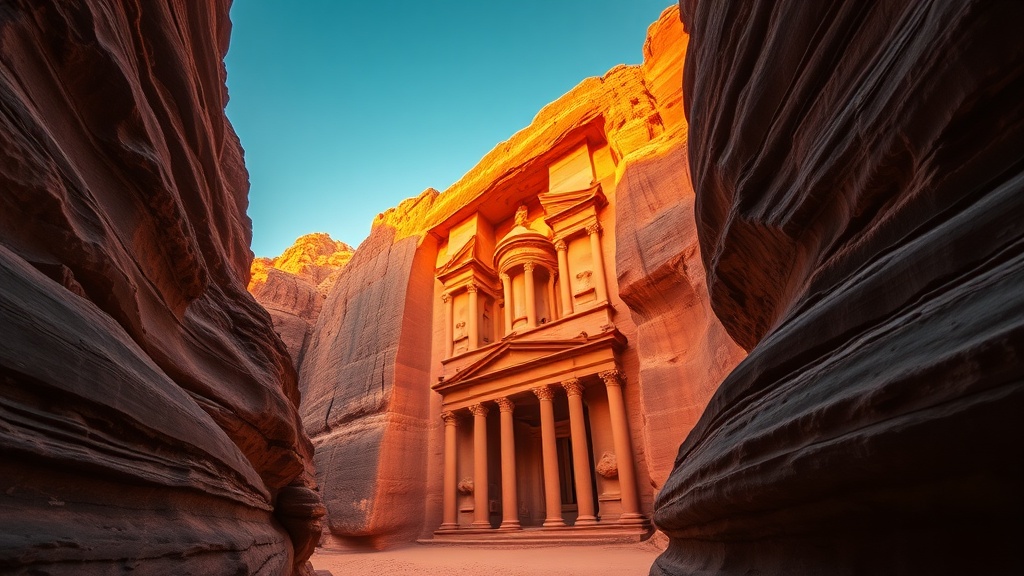
A Nabataean city of tombs, temples and houses carved into and built against sandstone cliffs, hidden in a bowl of mountains and reached through a 1.2 km slot canyon. It was a UNESCO World Heritage site from 1985, was voted one of the New Seven Wonders of the World in 2007, and it is the reason most people come to Jordan. It also takes far longer than a day.
The Siq and the Treasury
You walk in through the Siq, a natural fissure 1.2 km long and in places only 3 m wide with walls 180 m high, past the channels and clay pipes the Nabataeans cut to bring water into the city. It opens without warning onto Al-Khazneh, the Treasury — a 40 m façade carved top-down into the cliff around the first century BC or AD, almost certainly the tomb of a king, and named for a legend that the urn on top held pirate gold. The urn is chipped from centuries of people shooting at it to break it open.
The Monastery
Ad-Deir is larger than the Treasury — about 47 m wide — and less crowded, because it is up roughly 800 rock-cut steps from the city centre, an hour of climbing. Go early or late; the light is best in the afternoon and the tea stall opposite is one of the great places to sit in the Middle East. Do not let anyone talk you out of it and do not do it at midday in July.
What else is in there
Petra is a 264 km² archaeological park and the famous façades are a fraction of it. The Street of Facades, the Roman theatre cut into rock and seating 8,500, the Royal Tombs on the east cliff, the colonnaded street, the Great Temple, the High Place of Sacrifice up a stepped path with the best view of the whole basin, and — a discovery announced in 2016 — a large ceremonial platform found by satellite imagery that nobody had noticed on the ground.
How long, and the ticket
Two days minimum, three if you can. Tickets are priced to encourage staying: a one-day ticket costs substantially more per day than a two- or three-day one, and if you are not staying at least one night in Jordan the price roughly quadruples, a rule aimed squarely at cruise day-trippers from Aqaba. The Jordan Pass, bought online before you arrive, bundles the tourist visa fee with entry to Petra and forty-odd other sites and saves a serious amount of money — buy it before you fly.
Little Petra and the back way
Siq al-Barid — Little Petra — is 15 minutes north, free or nearly so, much smaller, and holds one of the very few surviving Nabataean painted ceilings. From there a marked back route walks in to the Monastery from above, which reverses the whole experience and avoids the Siq crowds. It needs a guide or a good map and about three hours.
Petra at night, and the ethics
Petra by Night lights the Siq and the Treasury with about 1,500 candles three evenings a week; opinions differ sharply on whether it is magical or a queue in the dark. More important: the Bdoul Bedouin lived in Petra's caves until they were rehoused in the village of Umm Sayhoun in 1985 to allow the UNESCO listing, and they run most of the horses, donkeys and stalls inside. Do not ride the donkeys up to the Monastery — animal welfare here has been documented as poor and improving only slowly. Walk, and buy your tea at the top instead.
🏜️ Wadi Rum
A UNESCO site since 2011, listed for both its landscape and its rock art: 720 km² of red sand with granite and sandstone massifs rising up to 700 m out of it, cut by canyons and dotted with 25,000 petroglyphs and inscriptions going back 12,000 years. T. E. Lawrence called it "vast, echoing and god-like", and the phrase has been in the brochures ever since.
What you do there
4×4 tours of half a day to two days, run by the local Zalabia and Zawaideh Bedouin who hold the tourism concession. Camel treks, hot-air balloons at dawn, rock climbing on some of the best desert rock anywhere, and hiking — Jebel Umm ad Dami, the country's highest point, is a half-day walk from a road head. Most people do a jeep afternoon and one night in a camp, which is enough to see it and not enough to feel it.
The named places
Lawrence's Spring and the so-called Seven Pillars of Wisdom rock face by the entrance (named after the book, not the other way round). Khazali Canyon with Nabataean, Thamudic and Islamic inscriptions on its walls. Burrah Canyon. Um Fruth and Burdah rock bridges — Burdah is a proper scramble and needs a guide. The Nabataean temple near Rum village, which most tours skip.
Sleeping there
Camps range from mattresses under the stars to "bubble" domes with air conditioning and private bathrooms, at every price. The traditional option is a Bedouin goat-hair tent with dinner cooked in a zarb, a pit oven buried in the sand for three hours. Whatever you book, the point is the night: Wadi Rum is far enough from anywhere that the sky is genuinely dark, and the silence is total.
Practical
Vehicles enter through the visitor centre near Rum village and you must go with a licensed local operator — this is by design, and the revenue is what keeps the reserve's communities in it. Summer is brutally hot and winter nights fall below freezing; bring warm clothes even in spring, because visitors consistently underestimate the desert at night. Phone signal is patchy, cash is useful, and there is no fuel inside.
Mars, Tatooine and Arrakis
Wadi Rum has doubled for Mars in The Martian, for Jedha and Tatooine in the Star Wars films, for Arrakis in Dune, and for itself in Lawrence of Arabia, shot here in 1962. Film crews are a meaningful part of the local economy and guides will point out locations whether or not you asked.
🏛️ Jerash and the North
Jerash
Ancient Gerasa, and the best-preserved Roman provincial city in the world — better than anything in Italy outside Pompeii, because it was abandoned after an earthquake in 749 and buried in sand rather than built over. You enter through Hadrian's Arch (129), past the hippodrome, into the extraordinary oval forum ringed by columns, then up the cardo maximus with its chariot ruts still in the paving, to the Temple of Artemis whose columns visibly sway in the wind — guides demonstrate with a spoon in a joint. Two theatres, a nymphaeum, fifteen churches. Allow three hours.
Ajloun
Qal'at ar-Rabad, built in 1184 by Saladin's nephew Izz ad-Din Usama to watch the Crusaders at Kerak and Belvoir and to control the iron mines. It is a properly military castle with a working feel, and the view from the top takes in the Jordan Valley and, on a clear day, the hills of the West Bank. The Ajloun Forest Reserve nearby is oak and pistachio woodland with cabins and a good short trail — the greenest place in Jordan.
Umm Qais
Ancient Gadara, on a headland in the far north-west, and worth the drive for the view alone: from the acropolis you look down on the Sea of Galilee, across to the Golan Heights, and along the Yarmouk valley into Syria — four jurisdictions in one panorama. The ruins are black basalt rather than limestone, there is an Ottoman village built on top of the Roman town, and it is where the Gospels place the miracle of the Gadarene swine.
Pella and Irbid
Pella (Tabaqat Fahl) in the Jordan Valley is one of the longest continuously occupied sites in the region — Neolithic through Bronze Age, Greek, Roman, Byzantine and Umayyad — and is beautiful, unrestored and nearly empty. Irbid is Jordan's second city, a young university town with a famous café street and almost no tourists, and its Museum of Jordanian Heritage at Yarmouk University is excellent.
The Jerash Festival
Held most summers in the Roman theatres — music, dance and poetry from across the Arab world, staged in a 2,000-year-old auditorium. It has been cancelled or scaled back in years of regional crisis, so check before planning around it.
🌊 The Dead Sea, Madaba and the Baptism Site
Floating
The surface sits about 430 m below sea level — the lowest exposed land on Earth — and the water is around ten times as salty as the ocean, which is why you float like a cork and why nothing lives in it. Twenty minutes is plenty. Do not shave beforehand, do not put your head under, and do not get it in your eyes — it is genuinely agonising and every resort has a freshwater shower for exactly that reason. The black mud is a real mineral product and smearing it on is compulsory.
Where to do it
The resort strip at Sweimeh has the international hotels with private beaches and pools. Amman Beach is the public option, cheap and busy on Fridays. Both are on the northern shore about an hour from Amman. Bring flip-flops — the salt crystals on the bottom are sharp — and expect to walk further to the water each year, because the sea is retreating about a metre a year and the shoreline moves.
Mujib and the hot springs
The Mujib Biosphere Reserve is the lowest-altitude nature reserve in the world, and its Siq Trail walks and swims up a river gorge between 100 m walls — wet, exhilarating, open roughly April to October and closed when there is flash-flood risk. Ma'in Hot Springs, further south, are thermal waterfalls falling down a cliff into pools, with a resort at the bottom.
Madaba
The City of Mosaics, half an hour from the Dead Sea road and one of Jordan's Christian towns. The church of St George holds the Madaba Map, a floor mosaic of about AD 560 depicting the Holy Land from Lebanon to the Nile with Jerusalem at its centre — the oldest surviving map of the region, and detailed enough that archaeologists have used it to find lost buildings. The Archaeological Park and the Church of the Apostles hold more, and the town is a pleasant, low-key place to stay instead of Amman.
Mount Nebo
Ten minutes from Madaba, and where Moses is said to have been shown the Promised Land and then died without entering it. The view west takes in the Dead Sea, the Jordan Valley and, on a clear day, Jericho and the towers of Jerusalem. A Byzantine church on the summit, restored and reopened in 2016, protects a superb sixth-century mosaic floor. Pope John Paul II came in 2000 and planted an olive tree; Benedict XVI and Francis followed.
Bethany Beyond the Jordan
Al-Maghtas, the Baptism Site, on the east bank of the river — identified with the place where John baptised Jesus, excavated only after the 1994 peace treaty demined the riverbank, and a UNESCO site since 2015. You go in by shuttle with a guide. At the water itself you are a few metres from Israeli and Palestinian pilgrims on the far bank with soldiers on both sides, which is an experience of the region that no amount of reading conveys.
🏰 The King's Highway, the Castles and Aqaba
The King's Highway
One of the oldest continuously used roads in the world, running the length of the plateau from Amman to Aqaba and mentioned in the Book of Numbers. Driving it instead of the fast Desert Highway is the single best decision on a Jordan itinerary: it takes twice as long and passes Madaba, Mount Nebo, Wadi Mujib, Kerak, Dana and Shobak on the way to Petra. Hire a car or a driver — public transport on it is thin.
Kerak
A vast Crusader castle of 1142 on a spur above the plateau, with dark vaulted galleries you need a torch for and a drop from the walls that was used to throw prisoners off. Its lord, Raynald of Châtillon, broke truces, raided the Hajj caravans and launched ships on the Red Sea to threaten Mecca; Saladin took the castle after Hattin and reportedly beheaded him personally. The town has a decent museum and not much else.
Shobak and Dana
Shobak (Montreal, 1115) is the older Crusader castle, smaller, emptier and more atmospheric, with a secret stairway of 375 steps down to a spring. Dana Biosphere Reserve is the best of the RSCN reserves: a village of stone houses on the lip of a canyon that drops from 1,500 m to 50 m below sea level, with four biogeographic zones, several hundred plant species and hiking that is the finest in Jordan. Stay at the Dana Guesthouse or the Feynan Ecolodge at the bottom, which is candle-lit and off-grid.
The Jordan Trail
A waymarked long-distance path running 675 km from Umm Qais in the north to Aqaba on the Red Sea, opened in 2017, in 40 days or in sections. The Dana-to-Petra stretch — arriving at Petra on foot over the mountains, through the back door — is regularly called one of the finest walks in the world, takes five days, and is the reason a growing number of visitors now come to Jordan without going near a tour bus.
Aqaba
Jordan's only port and only seaside, at the top of the Gulf of Aqaba, with a special economic zone that makes it a duty-free bubble. The diving is very good — coral reefs in excellent condition by Red Sea standards, several deliberately sunk wrecks including a C-130 Hercules and a tank, and warm water year-round. It is also warm in winter when Amman is cold, which makes it Jordan's own holiday town. From the beach you can see four countries: Jordan, Israel, Egypt and Saudi Arabia.
Umm ar-Rasas and the odd ones
Umm ar-Rasas, a UNESCO site off the King's Highway, is a walled Roman camp turned Byzantine town with a spectacular mosaic floor in the church of St Stephen depicting fifteen cities of the region — and two stylite towers, on which hermits lived on top of a pillar. Almost nobody goes. Also worth the detour: Qasr al-Mushatta by the airport, and Umm el-Jimal in the north-east, a black basalt town of the Roman and Byzantine periods that looks like nothing else in the country.
🏛️ UNESCO World Heritage
Jordan has six World Heritage properties, five cultural and one mixed. For a country of 89,000 km² that is a dense concentration, and the list is unusually easy to complete — all six are within a day's drive of each other on a sensible itinerary.
Petra (1985)
The Nabataean capital, inscribed as "one of the most famous archaeological sites in the world, where ancient Eastern traditions blend with Hellenistic architecture". The protected area covers 264 km², far more than the part visitors walk.
Quseir Amra (1985)
An Umayyad bath-house and hunting lodge of about 730 in the eastern desert, inscribed for the frescoes covering its interior — hunting, bathing, craftsmen, six kings of the earth, and a hemispherical map of the night sky that is among the earliest known. A conservation programme has stabilised and cleaned them over the last decade.
Umm ar-Rasas (2004)
Kastron Mefa'a: a Roman military camp that became a Byzantine and early Islamic town, with mosaic floors including the church of St Stephen's depiction of fifteen cities, and two square towers used by stylite hermits. Largely unexcavated and largely unvisited.
Wadi Rum (2011)
A mixed site — natural and cultural — for the desert landscape and for 25,000 rock carvings, 20,000 inscriptions and 154 archaeological sites documenting 12,000 years of human presence, including Thamudic and Nabataean writing that helps trace the evolution of alphabets.
Bethany Beyond the Jordan (2015)
Al-Maghtas, the Baptism Site: Byzantine churches, chapels, a monastery, hermit caves and baptismal pools on the east bank of the Jordan, associated with the baptism of Jesus and a place of Christian pilgrimage since at least the fourth century.
As-Salt (2021)
The newest, and the one nobody expects: an Ottoman-era hill town near Amman inscribed as "the Place of Tolerance and Urban Hospitality", for its yellow limestone merchant houses and for a social tradition in which Muslim and Christian communities lived intermixed with shared institutions. It is half an hour from the capital, it is free to walk around, and it is very good.
🍚 Food
Jordanian cooking is Levantine with a Bedouin core: bread, yoghurt, lamb, rice, olive oil and a great deal of parsley, with a strong sense that food is for sharing and that a guest must be overfed. The single dish that matters is mansaf, and it is not just a dish — it is a ceremony.
Mansaf
The national dish, and the centre of every wedding, funeral, reconciliation and Friday lunch. Lamb slow-cooked in jameed — dried fermented sheep's-milk yoghurt, reconstituted into a tangy white sauce — served on a huge communal platter over rice and a layer of shrak flatbread, strewn with toasted almonds and pine nuts. Traditionally eaten standing, with the right hand only, rolling the rice into a ball with the fingers, from a shared tray. Being offered the head or the tongue is an honour. UNESCO added mansaf to the intangible heritage list in 2022.
Maqluba and the rice dishes
Maqluba means "upside-down": layers of fried aubergine or cauliflower, meat and rice cooked in one pot and then inverted onto a platter so it holds a cake-like dome, served with yoghurt. The flip is the whole point and it is done at the table to applause or to disaster. Also musakhan — sumac-and-onion chicken on flatbread, Palestinian and beloved — and zarb, meat and vegetables cooked for hours in a sand-buried oven, which is the Bedouin party dish in Wadi Rum.
Mezze
The start of everything: hummus, mutabbal (smoky aubergine), ful (fava beans, breakfast food), tabbouleh — which in the Levant is mostly parsley with a little bulgur, not the reverse — fattoush, labneh, olives, pickles, kibbeh, vine leaves, and falafel from a stand. Bread is the utensil and there will be far too much of it.
Street food and breakfast
Hashem in downtown Amman — falafel, hummus, ful and mint tea, unchanged for decades, cash only, king and commoner alike. Shawarma everywhere in the evening. Ka'ak, sesame bread rings sold from carts with a paper twist of za'atar. And knafeh — shredded pastry over melted cheese, soaked in syrup, dyed orange and served hot — which is Nablus's gift to the region and which Jordanians consume at a rate that alarms visitors.
Practicalities
Eating is late and long; dinner from 20:00. Meals are shared and ordering individually confuses people. If you are invited to a home, accept, arrive with something sweet, refuse the first offer of more food once and then accept, and expect to be given the best of everything. Vegetarians do well on mezze; vegans need to watch for ghee and yoghurt. Ramadan changes everything — restaurants close by day and the country eats at sunset.
A note on names
Jordanian, Palestinian, Syrian and Lebanese cooking overlap heavily and who invented what is a genuinely touchy subject across the whole Levant. Mansaf is unambiguously Jordanian; musakhan is Palestinian; hummus and falafel are claimed by everybody and the argument is not one a visitor should try to settle.
👨🍳 Two Recipes
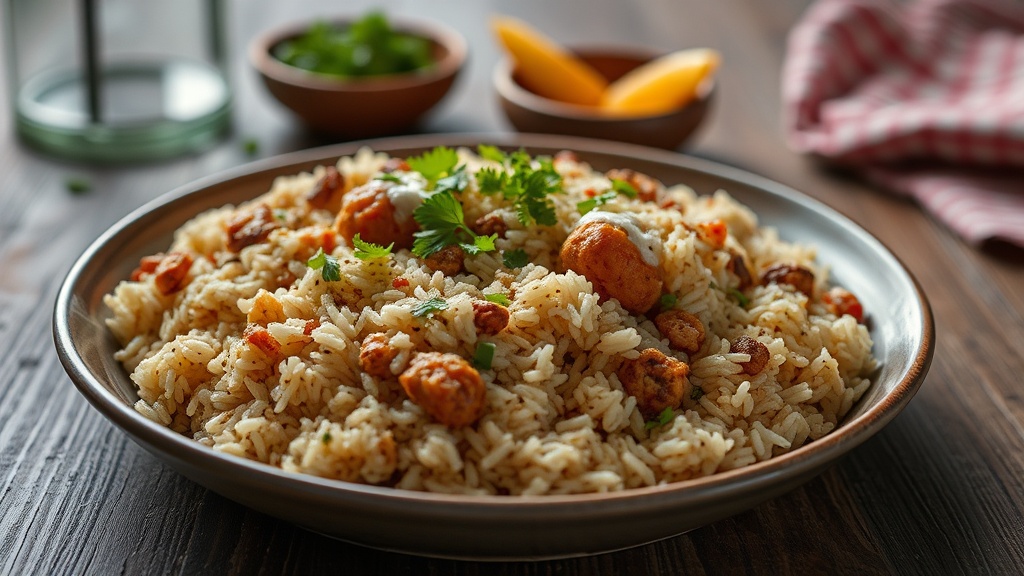
Maqluba
Jordan and Palestine · 6 people · about 2 hours · a wide pot with a lid and a serving platter that covers it
Ingredients: 1 kg lamb on the bone (or a whole chicken, jointed) · 2 large aubergines, sliced 1 cm thick · 1 cauliflower, in florets · 500 g long-grain or basmati rice, rinsed and soaked 30 minutes · 1 onion · 2 bay leaves · 4 cardamom pods · 1 cinnamon stick · 2 tsp baharat (Levantine seven-spice) · 1 tsp turmeric · ½ tsp allspice · salt and black pepper · oil for frying · to serve: toasted almonds and pine nuts, chopped parsley, and a bowl of plain yoghurt or cucumber-yoghurt salad.
Method: Salt the aubergine slices and leave 30 minutes, then pat dry and fry until deep brown; fry the cauliflower too. Drain both on paper. Meanwhile simmer the meat with the onion, bay, cardamom and cinnamon in water to cover for about an hour until tender; keep the stock, which is what the rice cooks in. Now build the pot: oil the base, lay the meat in a single layer, then the aubergine and cauliflower over it, then the drained rice mixed with the baharat, turmeric and allspice. Pour over hot stock to about 1.5 cm above the rice, bring to the boil, then cover and cook on the lowest heat for 35–40 minutes without stirring. Rest it, covered and off the heat, for 10–15 minutes. Put the platter over the pot, take a breath, and invert in one movement.
💡 Two things decide whether it stands up: the rest before flipping, and the amount of liquid — too much and it collapses into a mound. Loosen the edges with a knife first, and lift the pot off slowly rather than pulling it. If it does collapse, everybody has seen it happen and it tastes exactly the same.
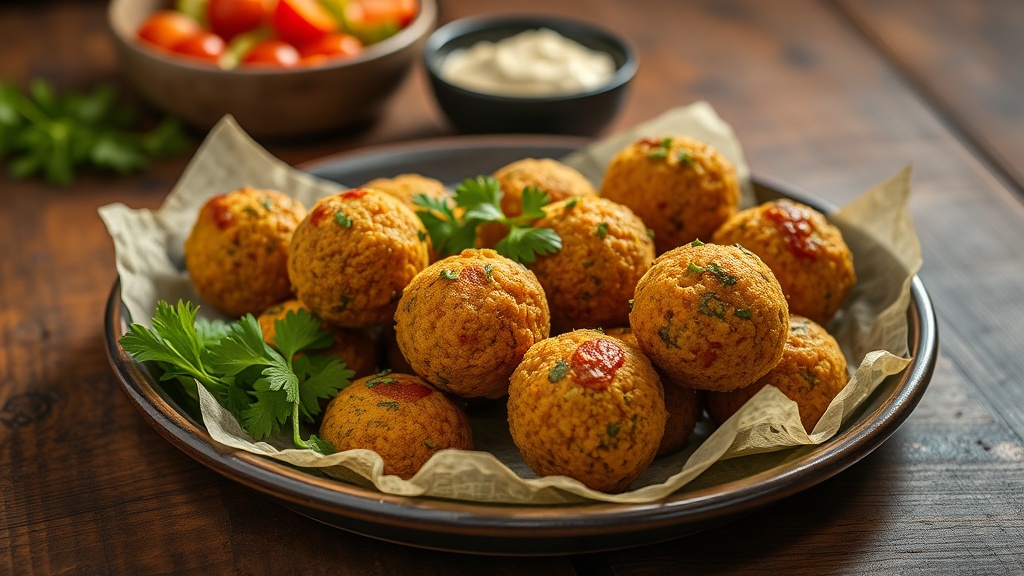
Falafel
The Levant · makes about 25 · soak overnight, then 30 minutes · a food processor and a deep pan
Ingredients: 250 g dried chickpeas, soaked in plenty of cold water for at least 12 hours — never cooked, never tinned · 1 small onion · 4 garlic cloves · a large bunch of flat-leaf parsley · a smaller bunch of coriander · 1½ tsp ground cumin · 1 tsp ground coriander · ½ tsp cayenne · 1 tsp salt · ½ tsp bicarbonate of soda · 1 tbsp sesame seeds (optional) · oil for deep frying. To serve: tahini sauce (tahini, lemon, garlic, water), pita, tomato, cucumber, pickled turnip.
Method: Drain the soaked chickpeas thoroughly and dry them — wet mixture is the main cause of falafel disintegrating. Put them in a processor with the onion, garlic, herbs and spices and pulse to a coarse, damp, sandy texture, not a purée; it should just hold when squeezed. Chill it 30 minutes to an hour. Stir in the bicarbonate only immediately before frying. Shape into balls or flattened discs, roll in sesame if using, and fry at 170–175 °C, a few at a time, for about 3–4 minutes until deep brown. Drain and eat within minutes.
💡 The three ways this goes wrong: cooked or tinned chickpeas (it will fall apart), over-processing to a paste (it will be dense), and adding the bicarbonate early (it will go flat). Fry one first as a test. Falafel is a thing to be eaten hot and immediately — it is worse ten minutes later and unrecoverable the next day.
☕ Tea, Coffee and What Is and Is Not Drunk
Tea
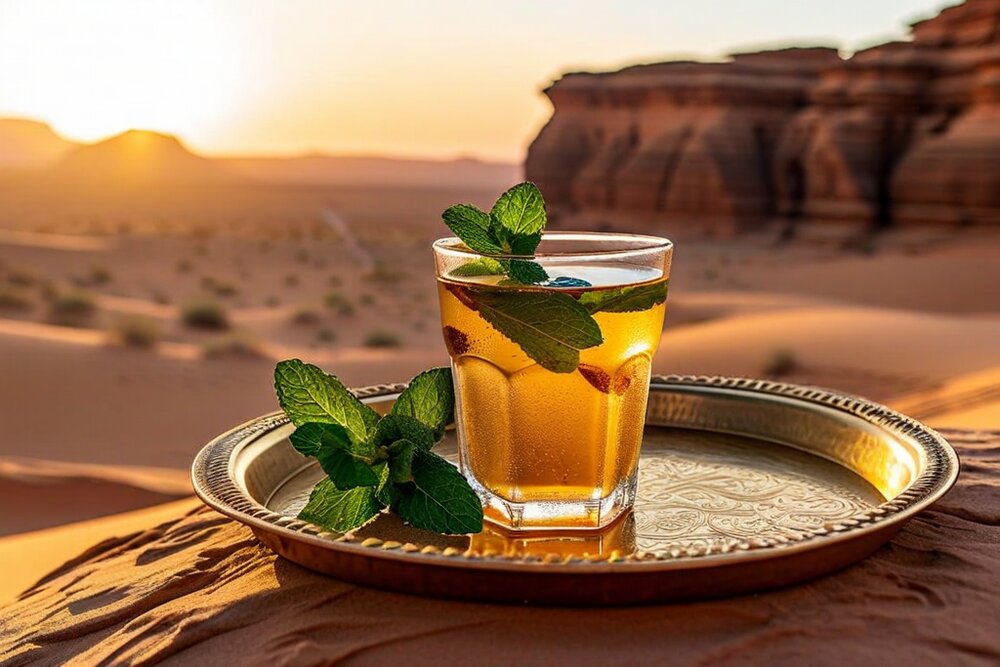
The national fuel, drunk all day, in small glasses, very sweet, with mint in summer and sage (maramiya) in winter. You will be offered it constantly — in shops, at petrol stations, by carpet sellers, by strangers — and it is almost always genuine hospitality rather than a sales tactic. Accepting is the polite move and costs you nothing but time.
Alcohol, honestly
Jordan is a Muslim country in which alcohol is legal, taxed and available, which surprises people in both directions. Hotels, licensed restaurants and dedicated liquor shops sell it; most ordinary restaurants do not. Amstel and Petra beers are brewed locally, and arak — aniseed spirit, drunk with water and ice, turning cloudy — is the traditional drink. Do not drink in the street, do not offer alcohol to someone who has not indicated they drink, and expect it to be unavailable in Ramadan and on some religious holidays.
Wine
Jordan has a small but real wine industry with a claim to some of the oldest winemaking ground on Earth. The main producers are the Zumot family's Saint George estate and the Jordan River winery, with vineyards in the north-east around Mafraq and Sama as-Sarhan and in the highlands near Madaba and Mount Nebo. Output is tiny and mostly consumed domestically. It is worth trying once, and it is not why you came.
What else
Fresh juice everywhere — pomegranate, orange, lemon-mint, sugarcane — and it is excellent and cheap. Sahlab in winter, a thick hot milk drink with cinnamon and nuts. Tamarind and liquorice drinks sold by men with enormous brass urns on their backs in downtown Amman, which is worth photographing and worth drinking. And bottled water constantly: do not drink the tap water in Jordan, and remember whose scarce supply the bottles are drawn from.
💡 Coffee, Hospitality and Etiquette
The coffee ritual, which is a test
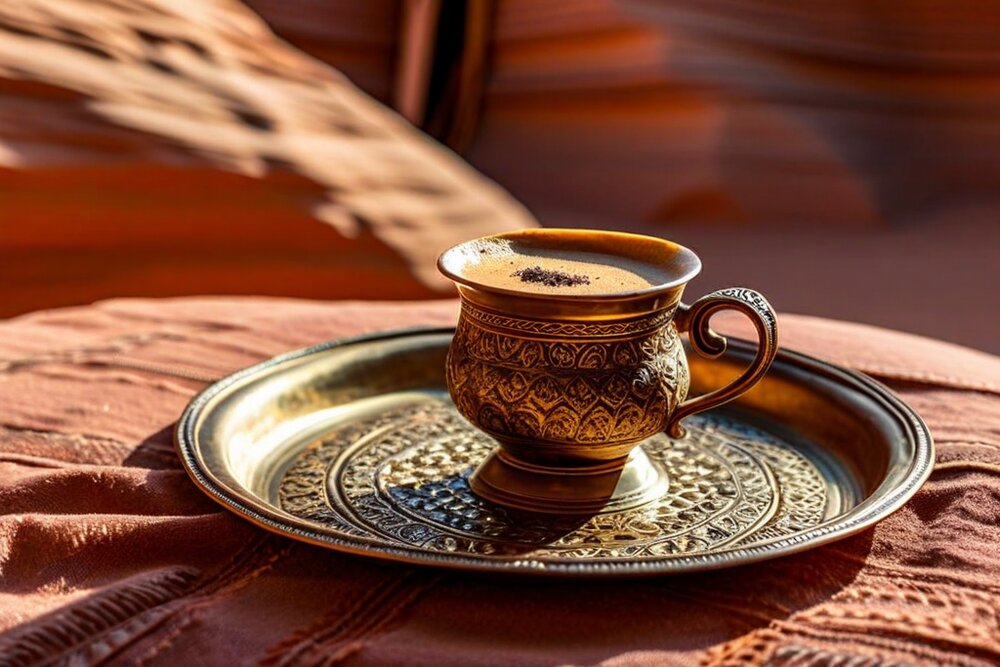
You will be given a small cup, filled about a third. Drink it. It will be refilled. When you have had enough — three cups is the polite number — you shake the cup gently from side to side as you hand it back. That is the signal to stop. Handing it back still without shaking means "more, please", and a guest who does not know the gesture can be refilled indefinitely, which is a joke Bedouin hosts enjoy. Take it with the right hand.
Hospitality is not optional
Jordanian and especially Bedouin hospitality is a serious cultural obligation, not a courtesy. You will be invited for tea, for a meal, into homes, by people who cannot afford it. The correct response is to accept when you reasonably can, to accept graciously, to compliment the food, and not to offer money, which insults the whole transaction. Bringing sweets or fruit to a home is right; sending photographs afterwards is better.
Dress
Jordan is more relaxed than the Gulf and more conservative than Turkey, and it varies enormously by place. In west Amman and Aqaba resorts, ordinary Western clothes are fine. Elsewhere: shoulders and knees covered for everyone, nothing tight or transparent, and a scarf for women to cover the head at mosques. Swimwear at the Dead Sea and Aqaba resorts is normal; at a public beach it is not, and Jordanian women often swim clothed.
The right hand, and other basics
Eat, give and receive with the right hand. Do not show the soles of your feet. Do not photograph people, especially women, without asking; do not photograph military installations, borders, airports or the police at all. Remove shoes entering a home or a mosque. Public displays of affection between couples are frowned on; men holding hands with men is ordinary friendship and means nothing else.
Bargaining and tipping
Haggle in souks and for taxis without meters; do not haggle in shops with marked prices. Tipping is expected — 10% in restaurants where service is not included, a dinar or two for hotel staff and drivers, and a fair rate for a guide, who is likely to have had a very lean two years. Small notes are useful; nobody ever has change.
Conversation
Jordanians are direct, funny and extremely willing to discuss politics, and they will ask you what you think about Palestine within about ten minutes. Listen more than you talk, do not lecture, and be aware of the criminal-law line: insulting the King, the royal family or the armed forces is an offence, including in a social-media post. That is not a hypothetical restriction and people are prosecuted for it.
📅 When to Visit
March–May
The best window, and it is not close. Highland temperatures in the high teens to mid-twenties, the desert warm by day and cold at night, and — after a wet winter — wildflowers across the plateau and even in Petra. Wadi Rum and the Dead Sea are comfortable rather than punishing. Book ahead for Easter, when the Christian sites and Madaba fill up.
June–August
Hot to dangerous. Amman at 1,000 m is bearable at 32–35 °C; the Jordan Valley, the Dead Sea and Aqaba routinely exceed 40 °C and Petra is a stone bowl with almost no shade. If you must come, start at dawn, be indoors from 11:00 to 16:00, carry far more water than feels necessary, and treat the Monastery climb and the Petra High Place as morning-only. Prices are lower and the sites are empty for a reason.
September–November
The second-best window and arguably the equal of spring. Heat breaks through September, October is close to ideal everywhere including the desert, and the light is superb. Sea temperature at Aqaba is at its warmest. November brings the first rain to the north and shortens the days.
December–February
Cold and wet in the highlands — Amman gets snow most winters and the city stops when it does, Petra can be freezing and occasionally closes paths for ice, and the desert nights drop below zero. But Aqaba is warm, the Dead Sea is pleasant, everything is cheap and the major sites are close to deserted. Pack properly and it is a genuinely good season for the south.
Ramadan
The Islamic lunar calendar moves it about eleven days earlier each year. Eating, drinking and smoking in public during daylight is illegal for everyone including non-Muslims, most restaurants close by day, hours change and traffic before sunset is chaotic. Against that: the atmosphere after iftar is wonderful and hotel prices fall. Check the dates for your year before booking, and be prepared to eat in your hotel.
Other timing notes
Friday is the day off and the day for mansaf; sites are open but government offices and many shops are not. Eid al-Fitr and Eid al-Adha fill domestic hotels, especially at the Dead Sea and Aqaba. Flash floods in the wadis are a real hazard between roughly October and April — never enter a slot canyon, including the Siq at Petra, when rain is forecast; people have died doing exactly that.
🚗 Getting Around
Driving
The best option for a real itinerary, and easier than it looks. Roads are good, signs are bilingual, and hire cars are inexpensive. Jordanian driving is assertive rather than dangerous, with the caveat that lane discipline is notional and speed bumps appear without warning. Fuel is cheap by European standards. The King's Highway is the drive worth doing; the Desert Highway is fast, dull and full of lorries.
JETT and the buses
JETT runs comfortable long-distance coaches on the main tourist routes — Amman to Petra, Aqaba, the Dead Sea and the King Hussein Bridge — and must be booked ahead. Beyond that, service taxis and minibuses connect everything cheaply, leave when full rather than on a timetable, and require some Arabic or some patience. There is no useful passenger rail network.
Taxis and apps
Yellow taxis in Amman have meters and should use them; insist politely. Uber and Careem both work in Amman and remove the argument entirely. For longer trips, hiring a car with a driver for the day is common, costs less than you would expect and is often the best answer — a good driver is half a guide.
Tours and guides
Licensed guides at Petra and Jerash are genuinely worth the money — the sites are large and unlabelled and an hour with a guide changes what you see. In Wadi Rum you are required to go with a local operator. Given the state of the tourism economy in 2026, a guide's day rate is one of the most direct ways to put money into the local economy.
Distances
Small country, real distances. Amman–Petra about 3 hours by the Desert Highway or 5–6 by the King's Highway; Petra–Wadi Rum 1.5 hours; Wadi Rum–Aqaba 1 hour; Amman–Dead Sea 1 hour; Amman–Jerash 50 minutes; Amman–Aqaba 4 hours. A seven-day loop — Amman, Jerash, Dead Sea, Madaba, King's Highway, Petra (two days), Wadi Rum, Aqaba — is the standard trip and it works.
Crossing borders
To Israel and the West Bank: the King Hussein/Allenby Bridge near the Dead Sea for the West Bank (no Jordanian visa on arrival here — arrange in advance or use the Jordan Pass rules carefully), the Sheikh Hussein bridge in the north, and Wadi Araba near Aqaba. Opening hours are short and change; all are subject to closure at no notice. To Saudi Arabia and Iraq the crossings function but require the right visas. The Syrian border has reopened, though travel into Syria is a separate decision requiring its own current advice.
📋 Practical Information
The Jordan Pass — read this first
Buy it online before you arrive. The Jordan Pass waives the tourist visa fee (40 JOD) and bundles entry to Petra and around forty other sites for a single price of roughly 70–80 JOD depending on how many days at Petra you choose. It pays for itself immediately if you visit Petra at all. The condition is that you must stay in Jordan at least three nights — three consecutive nights, four days — or the visa waiver does not apply. This is the single most useful practical fact about visiting Jordan.
Visas
Czech and most European citizens get a visa on arrival at Amman's Queen Alia airport and at Aqaba, valid one month and extendable; the fee is waived by the Jordan Pass. Arriving overland at the King Hussein/Allenby Bridge from the West Bank is the exception — no visa is issued there, so you need one in advance or a valid re-entry. Aqaba's ASEZ free zone issues its own free visa on arrival. Rules change; check international.visitjordan.com and your own ministry.
Health
No vaccinations required for entry from Europe; hepatitis A and typhoid are commonly advised. The EHIC does not apply and there is no Czech–Jordanian healthcare agreement, so commercial travel insurance is essential and should cover medical repatriation and, if you are hiking or diving, those activities specifically. Private hospitals in Amman are excellent and Jordan is a regional medical-tourism destination. Do not drink the tap water. Emergency number: 911.
Money
The Jordanian dinar, pegged at about 0.709 to the US dollar, so 1 JOD ≈ €1.20–1.30 — an expensive-feeling currency. It divides into 1,000 fils and prices are often written to three decimals, which confuses everyone at first. Cards work in hotels, restaurants and larger shops; cash for taxis, souks, small restaurants, Bedouin camps and tips. ATMs are widespread in towns and absent in the desert.
Connectivity and language
Buy a local SIM at the airport — Zain, Orange and Umniah all sell cheap tourist data packages and coverage is good except deep in the badia. Wi-Fi is normal in hotels and cafés. English is widely spoken in tourism, hotels and among the educated, and a few words of Arabic — shukran, marhaba, afwan, yalla — go a very long way.
Solo travel and women
Jordan is one of the easier Middle Eastern countries for independent and solo travel, including for women, and many women travel here alone without difficulty. Realistic caveats: staring and unwanted attention are common, particularly in Petra and downtown Amman; dressing modestly reduces it substantially; and a firm, unembarrassed "no" is understood. LGBT travellers should know that same-sex activity is not criminalised in Jordan, but social attitudes are conservative and discretion is the norm.
🛡️ Safety, Realistically
Jordan's safety record for visitors is very good and its reputation is worse than its record, for the straightforward reason that it is next to places that are dangerous. The distinction between being in a bad neighbourhood and being dangerous is the whole subject of this section.
Crime
Low, and violent crime against foreigners is rare. Petty theft exists in crowded markets and at Petra but at levels well below most European capitals. The most common complaints from visitors are overcharging by taxis without meters and persistent sales pressure in Petra — irritating, not dangerous. Jordan is a country where people routinely return lost wallets.
Terrorism
Jordan has been attacked and has a strong counter-terrorism apparatus. The 2005 Amman hotel bombings killed 60 people and there was an attack on tourists at Kerak in December 2016. Since then there have been foiled plots rather than successful mass-casualty attacks, and the visible security at hotels, sites and roads reflects the effort. The risk is real, small, and comparable in practice to that in several European capitals.
The border zones
Where the actual advisories bite. Foreign ministries generally advise against travel within a few kilometres of the Syrian and Iraqi borders and in the strip along the Israeli frontier away from the official crossings and the Dead Sea resorts. None of these areas contains anything a tourist would go to. Jordan itself struck targets across the Syrian border on 3 May 2026 against Captagon smuggling networks, which is a reminder of what that frontier is.
Natural hazards
More likely to hurt you than any of the above. Flash floods in the wadis between October and April kill people, including a school group in 2018 — never enter a canyon with rain in the forecast, and obey closures. Heat in Petra and the desert in summer is genuinely dangerous. Petra's paths are uneven with unfenced drops. Wadi Rum at night gets cold enough to matter. And the Dead Sea will do you serious harm if you get it in your eyes or swallow it.
Demonstrations
Protests over Gaza and over economic conditions occur, particularly after Friday prayers and near the Israeli embassy in Amman. They are usually orderly and heavily policed. Stay away from them: not because they are dangerous to bystanders, but because a foreigner in a political demonstration is a problem for everybody including the demonstrators.
What to actually do
Register with DROZD, keep insurance that covers regional-conflict disruption, keep a copy of your passport, keep some cash, keep flexible flights, and read your own ministry's advice the week you fly rather than the month you book. Then go, because the country is safe, the people are extraordinarily welcoming, and the visitor numbers in the current-situation section show what has happened to people who depend on visitors.
💰 What It Costs
Jordan is more expensive than travellers expect from a Middle Eastern country — the dinar is strong, almost everything is imported, and Petra in particular is priced at world-heritage rates. Against that, 2026 prices have fallen sharply because the visitors have not come.
The big fixed costs
Jordan Pass 70–80 JOD, which is also your visa. Petra alone would be 50 JOD for one day, 55 for two, 60 for three — and 90 JOD if you are not staying a night in Jordan. Wadi Rum entry 5 JOD plus 25–60 JOD for a half- or full-day jeep tour and 25–70 JOD for a camp with dinner. Petra by Night 17 JOD. Most other sites are covered by the Pass.
Sleeping
Hostel dorm 8–15 JOD. Simple hotel double 25–45 JOD. Mid-range hotel 50–90 JOD. Dead Sea and Petra resort hotels 100–200 JOD. A Wadi Rum camp 25–70 JOD per person with dinner and breakfast. Prices in Petra and at the Dead Sea are markedly higher than the rest of the country, and in 2026 they have been discounted heavily.
Eating
Falafel or shawarma sandwich 0.75–2 JOD. A full mezze lunch for two 10–15 JOD. Mid-range restaurant dinner 12–20 JOD a head. Hotel restaurants and the Petra tourist strip 25–40. A local beer 4–7 JOD in a bar, much less from a liquor shop — alcohol is heavily taxed and is the one thing that will surprise your budget.
Moving
Car hire from about 25–40 JOD a day, fuel around 0.9 JOD a litre. A car with driver for a day 60–100 JOD. JETT coach Amman–Petra about 12 JOD. Amman taxi across town 2–4 JOD; airport to town about 20–25 JOD. Amman–Aqaba flight from about 40 JOD one way.
A realistic daily budget
Backpacking with hostels, service taxis and street food: 30–45 JOD a day plus the Pass. Comfortable mid-range with a hire car, hotels and restaurants: 80–130 JOD. At roughly 32–35 Kč to 1 JOD — check the rate — the mid-range figure is about 2,600–4,500 Kč a day. Petra and Wadi Rum are the two days that break any budget, and they are also the two days you came for.
🇨🇿 Getting There, and Notes for Czech Travellers
Flights from Prague
There is no scheduled direct flight from Prague to Amman, though charters have run seasonally to Aqaba for Dead Sea and Red Sea packages. The usual one-stop routings are Royal Jordanian or a European carrier via Vienna, Frankfurt, Munich, Istanbul, Warsaw or Athens, or the Gulf carriers via Doha, Dubai or Abu Dhabi. Flying time is roughly 6–9 hours in total. Since 2024 schedules have been disrupted repeatedly by regional airspace closures — buy a flexible fare.
Two airports
Queen Alia International (AMM), 35 km south of Amman, is the main gateway and where the visa-on-arrival and Jordan Pass process happens. King Hussein International (AQJ) at Aqaba is the second, has its own free-zone visa arrangement, and is the sensible arrival point if your trip is Wadi Rum, Petra and the Red Sea. Flying into one and out of the other saves a long backtrack and costs little more.
Money in Czech terms
The dinar at roughly 32–35 Kč per 1 JOD — verify before you go. That makes the Jordan Pass about 2,400–2,800 Kč, a falafel sandwich 25–65 Kč, a mid-range dinner 400–700 Kč a head, a Wadi Rum camp with dinner 800–2,400 Kč per person, and a comfortable day about 2,600–4,500 Kč. Bring euros or dollars to change, or use ATMs; Czech crowns are not exchangeable in Jordan.
MZV ČR, DROZD and the embassy
The Czech Embassy is in Amman (Zahran Street, 4th Circle area), and it is one of the more useful Czech missions in the region. Register your trip in DROZD — for Jordan in 2026 this is a genuine recommendation rather than a formality, given airspace closures and the chance of needing to be contacted. Check mzv.gov.cz the week you fly. The EHIC does not apply; travel insurance covering repatriation and conflict-related disruption is essential.
Czech traces
Thinner than in Europe but real. Czechoslovak and later Czech companies built and supplied infrastructure across the Middle East from the 1950s, and Czech-made Tatra and Zetor vehicles were once common sights in Jordan. Alois Musil — the Moravian orientalist, priest and explorer, cousin of Robert Musil — travelled the Jordanian and Syrian badia between 1896 and 1915, was the first European to describe and document Qusayr Amra in 1898, and mapped tribal territories in work that Arabists still cite. The desert castle on this page's UNESCO list is on it substantially because a Czech found it.
What surprises Czechs most
How green the north is, and how completely unlike the mental image of "the Middle East" the plateau in spring looks. How expensive the dinar makes everything feel. How direct people are about politics, and how quickly a conversation gets to Palestine. And the hospitality — being fed, repeatedly, by people who then refuse payment, which Czech visitors find genuinely difficult to navigate and which is simply how the place works.
🗣️ Arabic, and the Jordanian Version of It
The official language is Modern Standard Arabic, which is what is written, broadcast and taught and which nobody speaks at home. Everyday speech is Jordanian Arabic, part of the Levantine group and mutually intelligible with Palestinian, Syrian and Lebanese — the dialect group that, thanks to Levantine television and music, most of the Arab world can follow.
Three Jordanian accents
Broadly: an urban variety in Amman, Irbid and Zarqa, heavily influenced by Palestinian speech; a rural variety in the villages of the plateau; and a Bedouin variety in the badia and the south, which is closer to the Arabic of the Arabian peninsula. The most audible marker is the letter qaf: urban speakers often drop it to a glottal stop, rural speakers may say k, and Bedouin speakers say a hard g — so the word for heart is albi, kalbi or galbi depending on who is saying it.
What that tells you
Enough that Jordanians place each other by it instantly, which is why the accent question overlaps with the East Banker and Palestinian-origin distinction described in the identity section. A visitor will not hear the difference and should not try to comment on it.
Twelve useful words
Marhaba — hello. As-salamu alaykum and the reply wa alaykum as-salam. Shukran — thank you; afwan — you're welcome. Min fadlak / min fadlik — please, to a man / to a woman. Aiwa and la — yes and no. Qaddesh? — how much? Yalla — come on, let's go, the most used word in the country. Inshallah — God willing, which also means "probably not" and "stop asking". Khalas — enough, done, finished. Habibi — my dear, used constantly between men and meaning nothing romantic. Sahtein — the thing you say to someone eating.
Getting by
English is widely spoken in tourism, in hotels and among younger and educated Jordanians, and signage on main roads and at sites is bilingual. Learning to read the Arabic numerals — which are not the ones Europe calls Arabic — is a twenty-minute investment that pays off at every price tag. Attempting a few words in Arabic produces a warmth of response out of all proportion to the effort.
🔬 Curiosities
Winston's hiccup
The zigzag in Jordan's eastern border with Saudi Arabia is genuinely called Winston's Hiccup or Churchill's Sneeze, from a story that Churchill drew it after a liquid lunch in Cairo in 1921. Historians are fairly sure the story is invented and that the line follows tribal grazing arrangements. The nickname has outlived every attempt to correct it.
The alphabet you are reading came through here
The Nabataean script, an Aramaic cursive developed at Petra and in the Hauran, evolved directly into the Arabic alphabet. Inscriptions on the rocks of Wadi Rum and Petra let palaeographers watch letters change shape over centuries — one of the few places on Earth where the development of a major writing system is legible on a cliff face.
Aqaba's twenty-six kilometres
Jordan's entire coastline is 26 km, and 12 of those kilometres were bought from Saudi Arabia in 1965 in a land swap that traded roughly 6,000 km² of inland desert for a longer beach and, as it turned out, an enormous phosphate deposit. It is generally regarded as one of the better deals in modern Middle Eastern diplomacy.
The world's oldest statues, in a suburb
The 'Ain Ghazal plaster figures of about 7200 BC were found in 1974 during road construction on the edge of Amman, and part of the site now lies under a housing development and a motorway interchange. Some of the oldest large human images ever made were dug out of a builder's trench.
Petra was lost for 600 years
Not to the Bedouin who lived there, but to Europe. From the Crusades until 22 August 1812 no outsider had recorded it, when Johann Ludwig Burckhardt — a Swiss traveller who had spent years learning Arabic and passing as a Muslim scholar — persuaded a guide to take him to "sacrifice a goat at the tomb of Aaron" and got a look at the Treasury on the way. He never returned; he died in Cairo aged 32.
The Dead Sea makes cosmetics and fertiliser
The same brine that visitors float in is industrially evaporated on both shores for potash, bromine and magnesium — Jordan's Arab Potash Company is one of the world's largest producers, and mineral extraction is one of the reasons the sea is shrinking. The mud you smear on at a resort and the fertiliser on a European field come from the same pans.
⚖️ Overtourism, Undertourism and What Jordan Actually Needs
Most countries in this atlas have a section about too many visitors. Jordan's problem in 2026 is the reverse, and pretending otherwise would be dishonest.
The collapse in numbers
Petra took about 1.2 million visitors in 2023 and fewer than 460,000 in 2024. 2025 recovered partially. 2026 began with over 112,000 foreign visitors in January and February and then lost essentially all of March to cancellations when the regional war began, with Petra hotel occupancy at around 6% in April. Jordan recorded roughly 1.3 million visits to tourist sites in the first half of 2026, of which Petra was 235,000.
Who that hurts
Not the state, primarily — the guides, the horse and camel men at Petra, the Bdoul families who run the stalls, the Wadi Rum camp owners, the drivers, the small hotels in Wadi Musa. These are households with no alternative employment in towns built entirely around one site. Two years of this has emptied savings and pushed people out of the industry.
What that means for you
If the advisories permit, this is close to the best moment in a generation to see Jordan: Petra without crowds is a different place, Wadi Rum camps have space, guides have time, and prices are down. It is also, unusually, a trip where the money genuinely matters to the people receiving it. Hire the guide. Take the two-day Petra ticket. Stay the extra night.
Where the real pressure was, and will be again
When the visitors return, Petra's problems come back: erosion of the rock-cut façades by foot traffic and salt, damage to tomb interiors, unregulated animal use, and 6,000 people a day funnelled through one 3 m-wide canyon. The 2021 discovery that groundwater and flash-flood management inside the park had degraded since Nabataean times was not a compliment to modern administration. Booking the two- or three-day ticket, walking rather than riding, and using the back routes all reduce it.
Practical, not performative
Refuse the donkey and horse rides at Petra — welfare there has been documented as poor and the pressure from tourists is what sustains the practice. Use RSCN reserves and their lodges, which fund the conservation directly. Buy from cooperatives — the Iraq al-Amir women's cooperative, Bani Hamida weaving, the Jordan River Foundation — rather than from import shops. And use less water than you would at home, for the reasons in the water section.
And go
Jordan has spent eighty years being stable in a place where that is difficult and expensive, and its tourism industry is currently paying the price for other people's wars. Nothing in this page is an argument for ignoring the advisories. Everything in it is an argument that when the advisories allow, you should come.
📸 The Pictures on This Page — and What Is Missing
A note in the interest of honesty. This site keeps its own image archive, and the folder for Jordan holds four files. Three are used on this page: the Treasury at the top, the mint tea in the drinks section and the coffee cup in the etiquette section. The fourth is not, and neither is one of the three recipe photographs. The reasons are below.
Rejected: the wine-regions map
jordan-wine-regions-map.jpg is a decorative "wine regions of Jordan" map, and as a map it is wrong in ways that matter. Its scale bar reads 0–20 km for a country 400 km long — out by more than an order of magnitude — and carries the nonsense word "Sulp". Amman is not on it at all. The borders do not match Jordan's, the Saudi frontier is wrong and the famous eastern zigzag is absent. A picture that presents itself as a map is making geographic claims, and these are false, so it is not used. The real wine geography is described in words in the drinks section.
Rejected: the "mansaf"
jordan-mansaf.jpg shows a bowl of pale chopped something with lime slices, herbs and chilli flakes. Mansaf is a large communal platter of shrak flatbread and rice topped with bone-in lamb, drenched in hot white jameed sauce and strewn with toasted almonds and pine nuts. There is no lamb, no rice, no bread, no jameed and no platter in the photograph, and there is a lime, which appears nowhere in the dish. Mansaf is the national dish and a UNESCO-listed cultural practice; illustrating it with this would be worse than illustrating it with nothing.
What ought to be in the archive
In rough order of how badly they are missed: Wadi Rum, Jerash's oval forum, the Monastery at Petra, the Dead Sea, Amman's citadel and hills, Kerak or Shobak, the Madaba Map, Dana, Aqaba's reef, and a real mansaf. Ten photographs would carry this page properly. At present it has three.
Why say so
Because the alternative is filling the gaps with stock images of somewhere else, which a large share of travel pages do, and a surprising number of those images are of the wrong country entirely. The rule here is that a picture is either opened, checked and captioned honestly, or it is not used. Where the pictures that survive still diverge from reality — the coffee cup has a handle and Bedouin cups do not; the tea is too pale — the caption says so.
Support This Project 🌍
This World Travel Factbook is a labor of love – free to use for all travelers. If you find it helpful, consider supporting its continued development.