

🌍 India at a Glance
🌏 Overview
India is a world unto itself — the seventh-largest country by area, the most populous nation on Earth with ~1.48 billion people, and home to one of the oldest continuous civilizations in human history. From the snow-capped Himalayas in the north to the tropical beaches of Kerala in the south, from the Thar Desert in the west to the tea gardens of Assam in the east, India contains more geographic, cultural, linguistic, and culinary diversity than most continents.
This is the land that gave the world yoga, chess, the decimal system, and the concept of zero. A country with Hindi and English as the Union's official languages alongside 22 constitutionally scheduled regional languages and hundreds more mother tongues, where ancient temples stand beside gleaming tech campuses, and where a vegetarian street snack on a Bombay corner can be the most memorable meal of your life. India doesn't just reward travel — it transforms the traveller.
With 45 UNESCO World Heritage Sites (the sixth-most globally), the Taj Mahal, the spiritual ghats of Varanasi, the pink city of Jaipur, the backwaters of Kerala, the ancient caves of Ajanta and Ellora, and the world's most vibrant festival calendar, India offers an intensity of experience that no other destination can match.
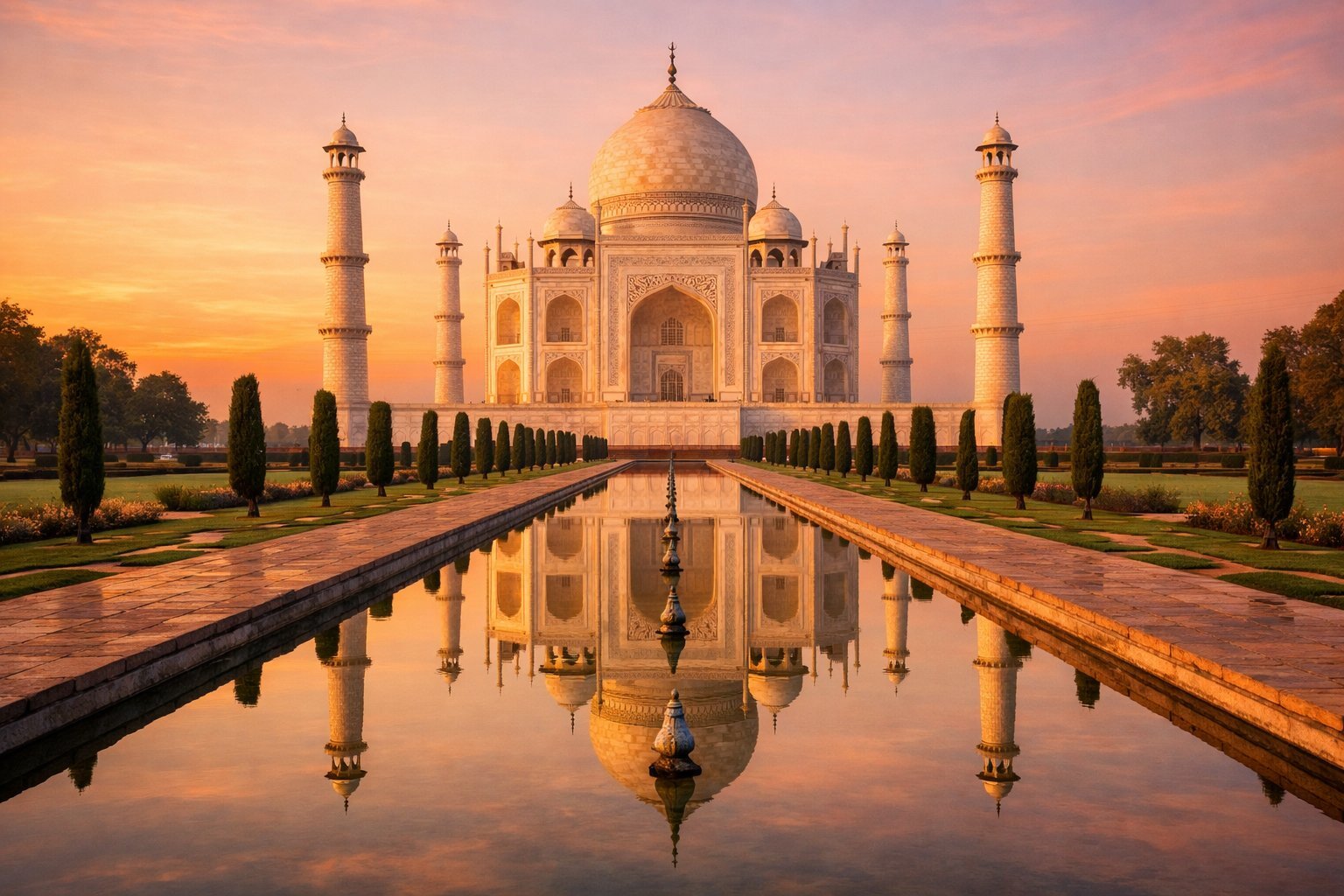
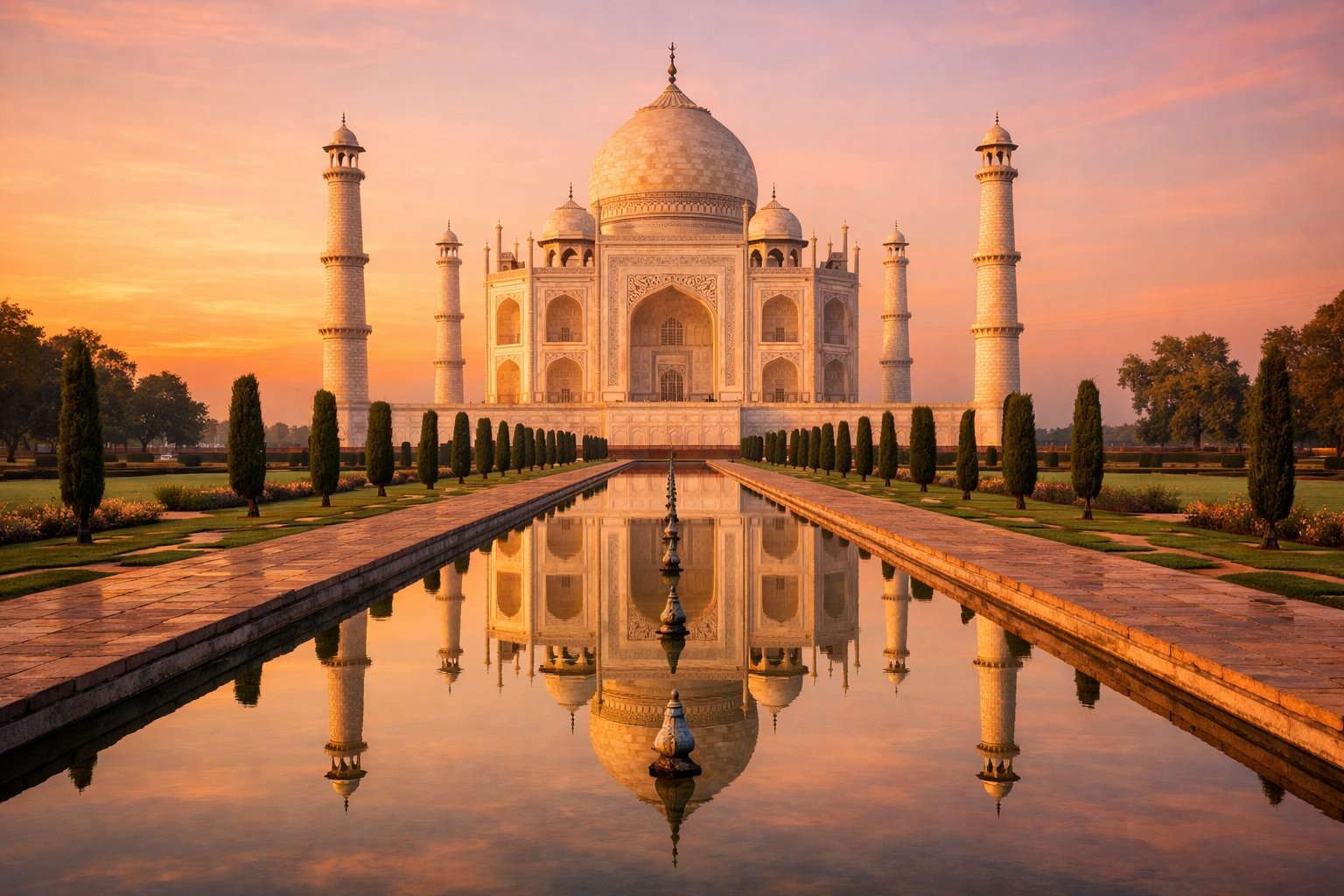
Taj Mahal
The crown jewel of India — Shah Jahan's eternal monument to love, glowing at sunrise in Agra
🏷️ Name & Identity
The name "India" derives from the River Indus (Sindhu in Sanskrit), via the Persian "Hind" and Greek "Indos". Indians also call their country Bharat (from the legendary emperor Bharata) and Hindustan (land of the Hindus/Indus). The Constitution recognises both "India" and "Bharat" as official names.
The Indian flag — the Tiranga (tricolour) — features saffron for courage and sacrifice, white for truth and peace, and green for faith and fertility, with the navy-blue Ashoka Chakra (a 24-spoke wheel representing the eternal wheel of law) at its centre. The national emblem is the Lion Capital of Ashoka from Sarnath, with four Asiatic lions. The national anthem is "Jana Gana Mana" composed by Rabindranath Tagore.
🗺️ Geography
India spans 3,287,263 km² — roughly one-third the size of the United States. The Himalayan mountain chain forms the northern border, containing the world's highest peaks including Kangchenjunga (8,586m), the highest peak under Indian administration. South of the Himalayas lies the vast Indo-Gangetic Plain, one of the most fertile and densely populated regions on Earth, watered by the sacred rivers Ganges, Yamuna, and Brahmaputra.
The Deccan Plateau dominates the southern peninsula, flanked by the Western and Eastern Ghats mountain ranges. India's coastline was remeasured in 2025 using high-resolution GIS at 11,098.81 km — nearly 3,600 km longer than the older 7,516.6 km figure, the difference coming from far more detailed charting of bays, estuaries, and islands — along the Arabian Sea, Indian Ocean, and Bay of Bengal. The Thar Desert extends across Rajasthan in the west, while the northeast — the "Seven Sisters" states — contains some of Asia's densest tropical rainforests. Climate ranges from alpine in Ladakh to tropical monsoon in Kerala, with the world-famous monsoon season (June–September) defining the agricultural calendar.
🗺️ Map of India
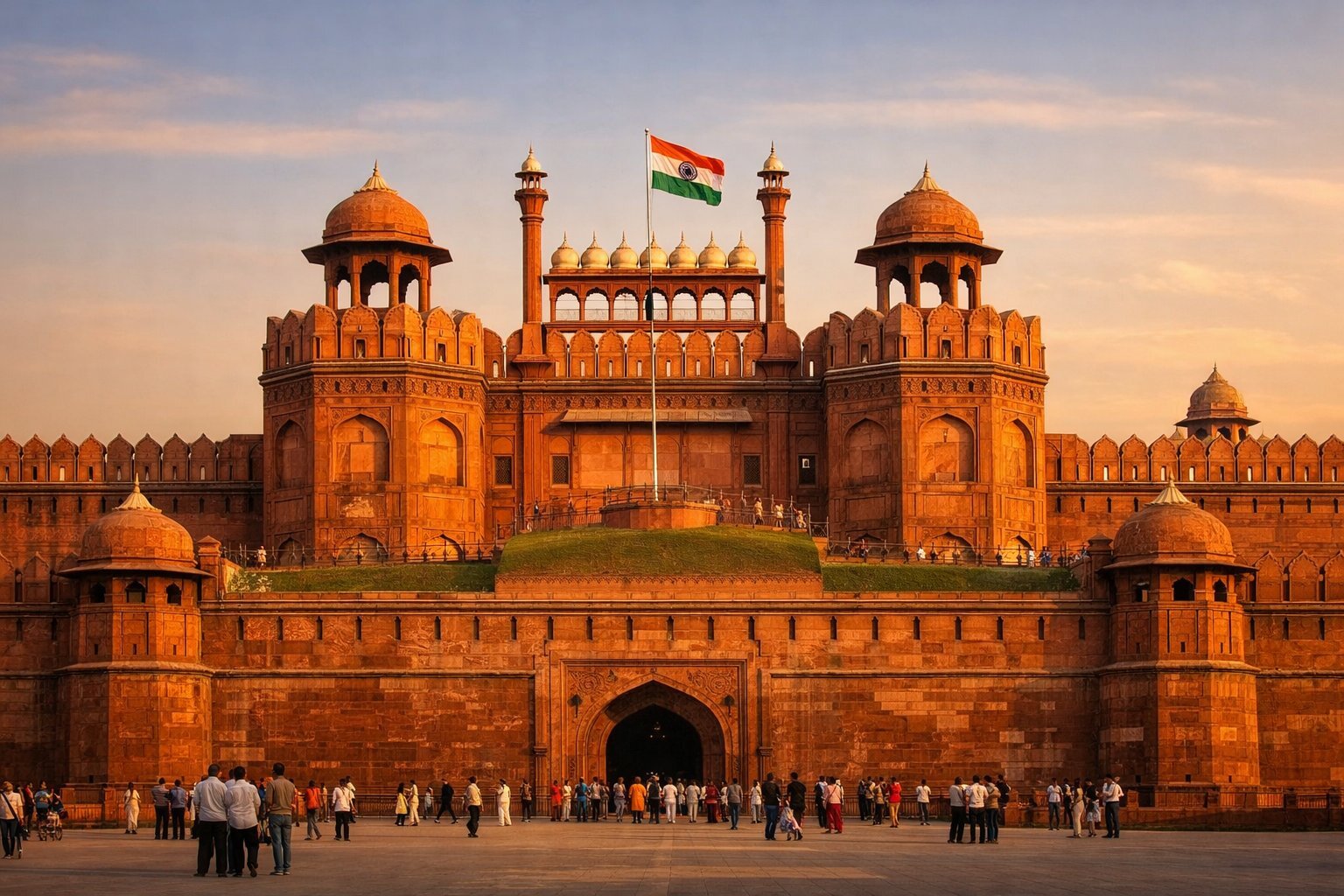
Red Fort, Delhi
The massive 17th-century Mughal fortress where India's Prime Minister raises the flag each Independence Day
📜 History
India's history spans over 5,000 years. The Indus Valley Civilization (3300–1300 BCE) — centred at Mohenjo-daro and Harappa — was one of the world's earliest urban societies, with advanced drainage, standardised weights, and planned cities. The Vedic Period brought Sanskrit, the Rigveda, and the foundations of Hinduism.
The Maurya Empire (322–185 BCE) under Chandragupta and Emperor Ashoka unified most of the subcontinent. Ashoka's conversion to Buddhism after the bloody Kalinga War led to one of history's great moral transformations — his edicts of non-violence and tolerance are carved on pillars across India. The Gupta Empire (320–550 CE) — India's "Golden Age" — produced breakthroughs in mathematics (the concept of zero, the decimal system), astronomy, literature, and art.
The Mughal Empire (1526–1857) created India's most iconic monuments: the Taj Mahal, Red Fort, and Fatehpur Sikri. Emperor Akbar's policy of religious tolerance united a diverse empire. British colonial rule began with the East India Company and intensified after 1857. The independence movement, led by Mahatma Gandhi through non-violent civil disobedience, culminated in independence on 15 August 1947 — accompanied by the traumatic Partition that created Pakistan. India adopted its constitution in 1950, becoming the world's largest democracy.
👥 People & Culture
India's ~1.48 billion people encompass staggering diversity: Hindi and English as the Union's official languages, 22 more languages listed in the Constitution's Eighth Schedule — Hindi and English serve the Union government, but India has no constitutionally declared national language — 121 languages and 270 mother tongues with at least 10,000 speakers recorded in the 2011 Census, and every major world religion. Hinduism (79.8% per the 2011 Census), Islam (14.2%), Christianity, Sikhism, Buddhism, and Jainism coexist, alongside tribal and folk traditions. India's Constitution abolished untouchability (Article 17), not caste itself — caste identities continue to influence marriage, politics, social networks and, through affirmative-action "reservation" policies, access to education and public jobs. Family is the bedrock — multi-generational households remain common, and arranged marriages are still the norm in many communities.
India as a whole has one of the world's largest film industries — Bollywood is only its Hindi-language branch; Tamil, Telugu, Malayalam, Bengali, and Kannada cinema each command enormous audiences of their own. Classical dance forms include Bharatanatyam, Kathak, Odissi, and Kathakali. Indian classical music (Hindustani in the north, Carnatic in the south) is built on intricate raga and tala systems. Textile traditions — from Varanasi silk to Rajasthani block printing to Kashmiri pashmina — are UNESCO-level heritage in themselves.
Useful phrases (Hindi): Namaste (hello/goodbye), Dhanyavaad (thank you), Haan/Nahin (yes/no), Kitna? (how much?), Bahut accha (very good), Paani (water), Madat (help).
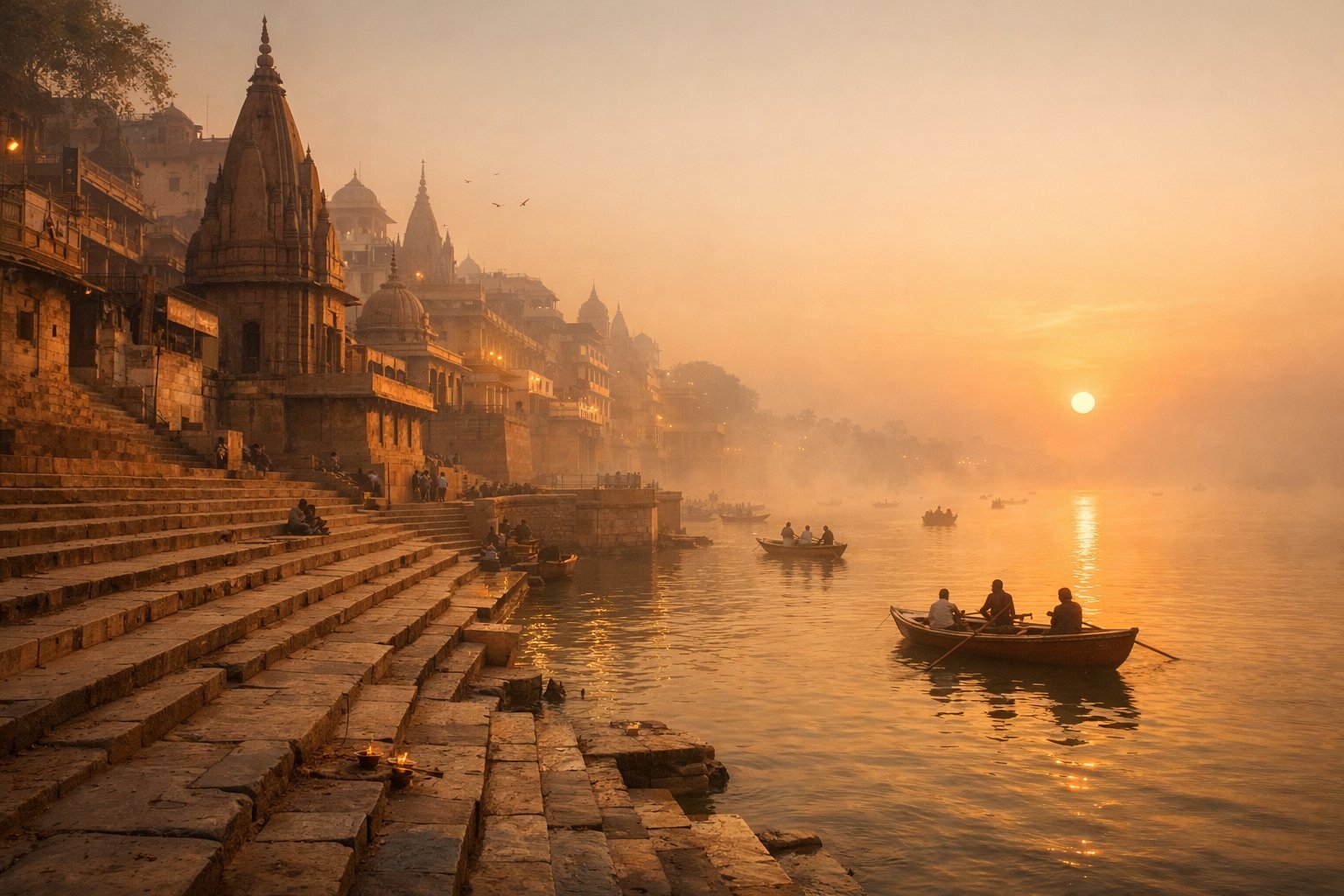
Varanasi
Dawn on the ghats of the world's oldest continuously inhabited city — where life and death merge on the Ganges
🏛️ Delhi — The Capital
Delhi is not one city but many — a remarkable sequence of medieval and early-modern capitals has risen and fallen on this site, with older settlement traditions popularly linked to the legendary Indraprastha. Old Delhi (Shahjahanabad) is a sensory labyrinth: the Jama Masjid (one of India's largest mosques), the Red Fort (UNESCO), the spice market of Khari Baoli, and the legendary street food of Chandni Chowk — paranthe (stuffed flatbreads) at Paranthe Wali Gali have been served since the 1870s.
New Delhi, designed by Edwin Lutyens, is the seat of government — the grand Rajpath (now Kartavya Path) leads from India Gate to Rashtrapati Bhavan (President's House). The Qutub Minar (UNESCO, 1193) — a 72.5m red-sandstone tower, among the tallest of its kind — stands beside the remarkably corrosion-resistant Iron Pillar, a 4th-century metallurgical achievement. Humayun's Tomb (UNESCO, 1570) is the architectural precursor to the Taj Mahal. Akshardham Temple, Lotus Temple (Bahá'í), and the Gurudwara Bangla Sahib offer spiritual serenity amid the chaos.
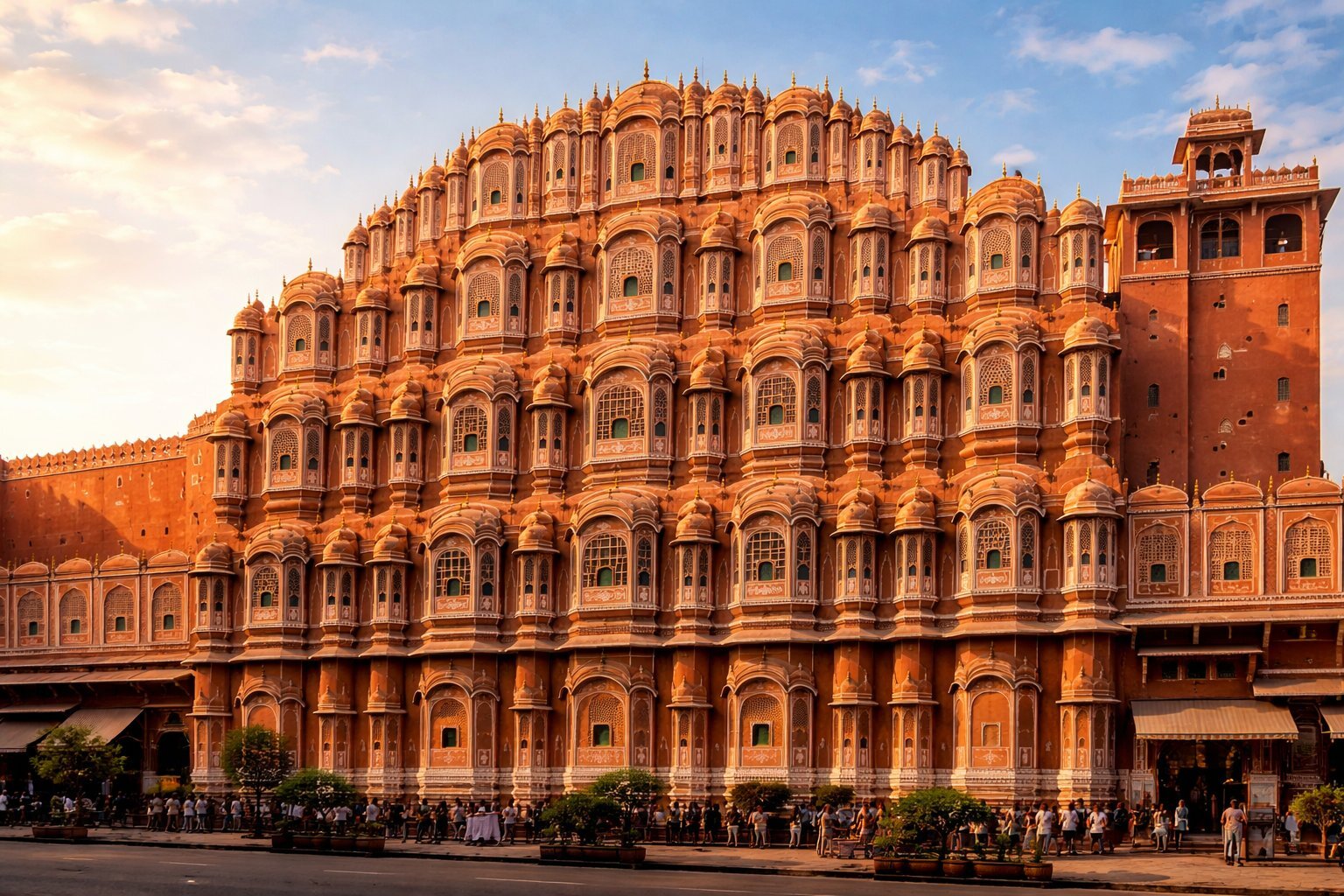
Hawa Mahal, Jaipur
The Palace of Winds — 953 honeycomb windows allowed royal women to observe street life unseen
👑 Rajasthan — Land of Kings
Rajasthan is India distilled to its most romantic essence — desert fortresses, pink cities, camel caravans, and turbaned warriors. Jaipur (the Pink City, UNESCO) features the Hawa Mahal, Amber Fort with its mirror-mosaic halls, and the Jantar Mantar astronomical observatory (UNESCO). Udaipur — the "Venice of the East" — floats around Lake Pichola, its white City Palace reflected in still waters. Jodhpur, the Blue City, is crowned by the formidable Mehrangarh Fort.
Jaisalmer rises from the Thar Desert like a golden mirage — its living fort (one of the world's few inhabited fortresses) and its desert camel safaris under star-filled skies are unforgettable. The six Hill Forts of Rajasthan collectively form a UNESCO site. Rajasthani cuisine — dal baati churma, laal maas, ghevar — is as bold as the landscape.
🙏 Varanasi — City of Light
Varanasi (Benares, Kashi) is one of the world's oldest continuously inhabited cities — Mark Twain wrote it was "older than history, older than tradition, older even than legend." For Hindus, to die and be cremated here on the banks of the Ganges is to achieve moksha — liberation from the cycle of rebirth. The Ganga Aarti ceremony at Dashashwamedh Ghat at dusk — priests swinging flaming brass lamps in synchronised ritual — is one of India's most powerful spectacles.
The city has 84 ghats along the river. Manikarnika Ghat burns funeral pyres 24 hours a day, 365 days a year — local tradition holds that the sacred fire here has never been extinguished. Dawn boat rides along the ghats reveal the extraordinary panorama of temples, palaces, and daily life. Varanasi is also a centre of classical music, silk weaving (Banarasi saris), and learning — Banaras Hindu University is one of Asia's largest.
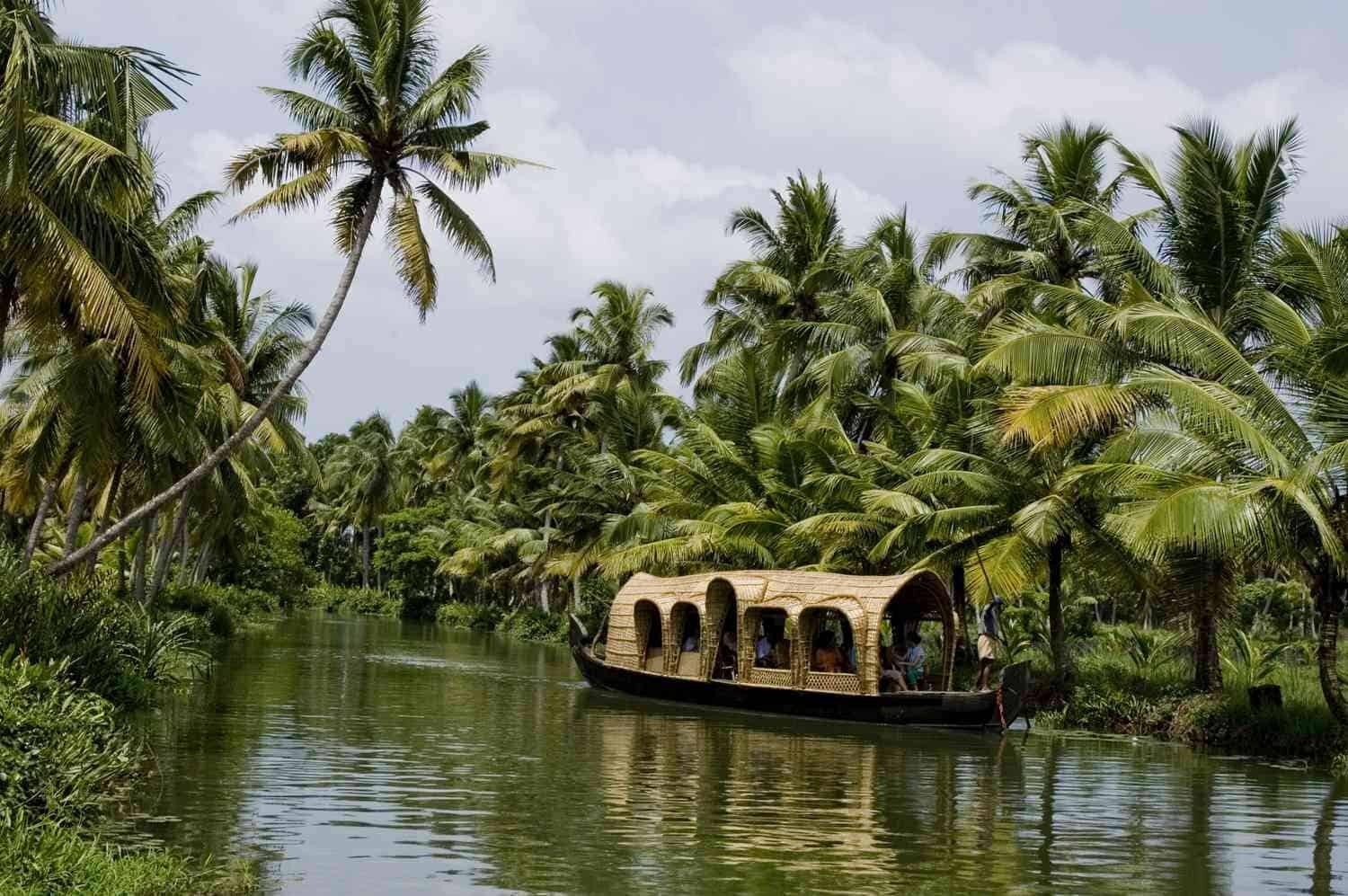
Kerala Backwaters
A traditional houseboat glides through the emerald palm-fringed waterways of "God's Own Country"
🌴 Kerala — God's Own Country
Kerala, stretching along India's tropical Malabar Coast, is a world apart — lush, literate (94% literacy in the 2011 Census, India's highest), and languid. The backwaters are a 900km network of lagoons, canals, and rivers fringed by coconut palms; kettuvallam (traditional houseboats converted into floating hotels) drift through this emerald labyrinth. Alleppey (Alappuzha) is the gateway.
Kochi (Cochin) blends Portuguese churches, Chinese fishing nets, Jewish synagogues, and Dutch palaces — a testament to Kerala's ancient spice trade connections. Munnar offers endless tea plantations carpeting misty hills. Periyar wildlife sanctuary harbours tigers and elephants in evergreen forest. Kerala cuisine is coconut-based perfection: appam with stew, fish moilee, and the legendary sadya — a vegetarian feast served on a banana leaf with 26+ dishes. Ayurvedic massage and treatment centres draw wellness seekers worldwide.
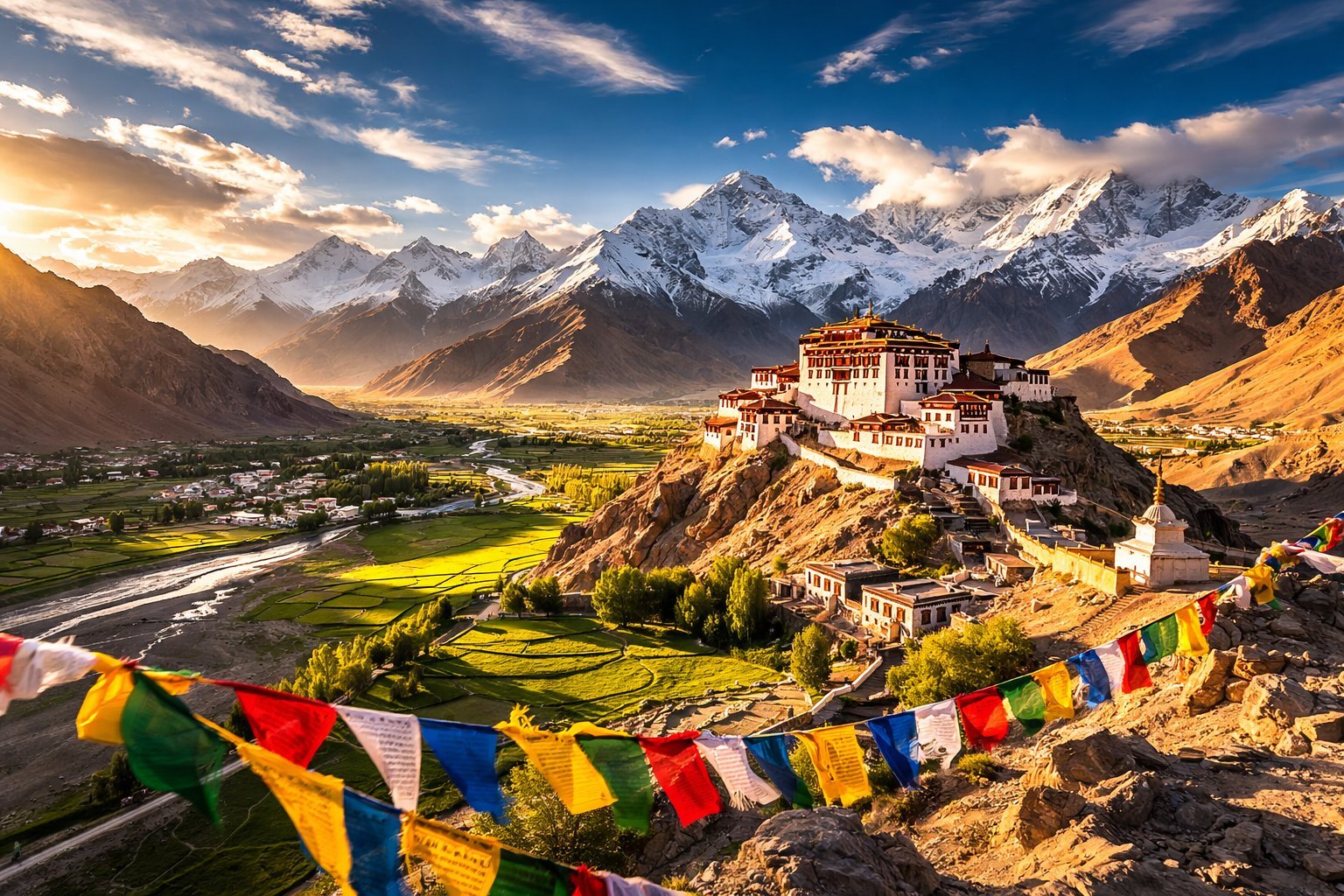
The Himalayas
Prayer flags flutter before snow-capped peaks and a cliffside monastery in Ladakh — the roof of the world
🏔️ The Himalayas
India's Himalayan region is one of the planet's most spectacular landscapes. Ladakh — "Little Tibet" — offers high-altitude desert landscapes, ancient Buddhist monasteries (Thiksey, Hemis, Lamayuru), and the surreal Pangong Lake at 4,350m. Himachal Pradesh contains Shimla (the old British summer capital), the hippie-turned-spiritual town of Manali, and the Tibetan exile community of Dharamsala/McLeod Ganj, seat of the Dalai Lama.
Uttarakhand holds the sacred sources of the Ganges and Yamuna — Rishikesh (yoga capital of the world, where the Beatles studied with Maharishi Mahesh Yogi) and Haridwar host nightly Ganga Aarti. The Valley of Flowers National Park (UNESCO) erupts into colour each monsoon. Sikkim, nestled between Nepal, Tibet, and Bhutan, offers views of Kangchenjunga and pristine Buddhist culture. Darjeeling, with its toy train (UNESCO), produces one of the world's most celebrated and geographically distinctive teas.
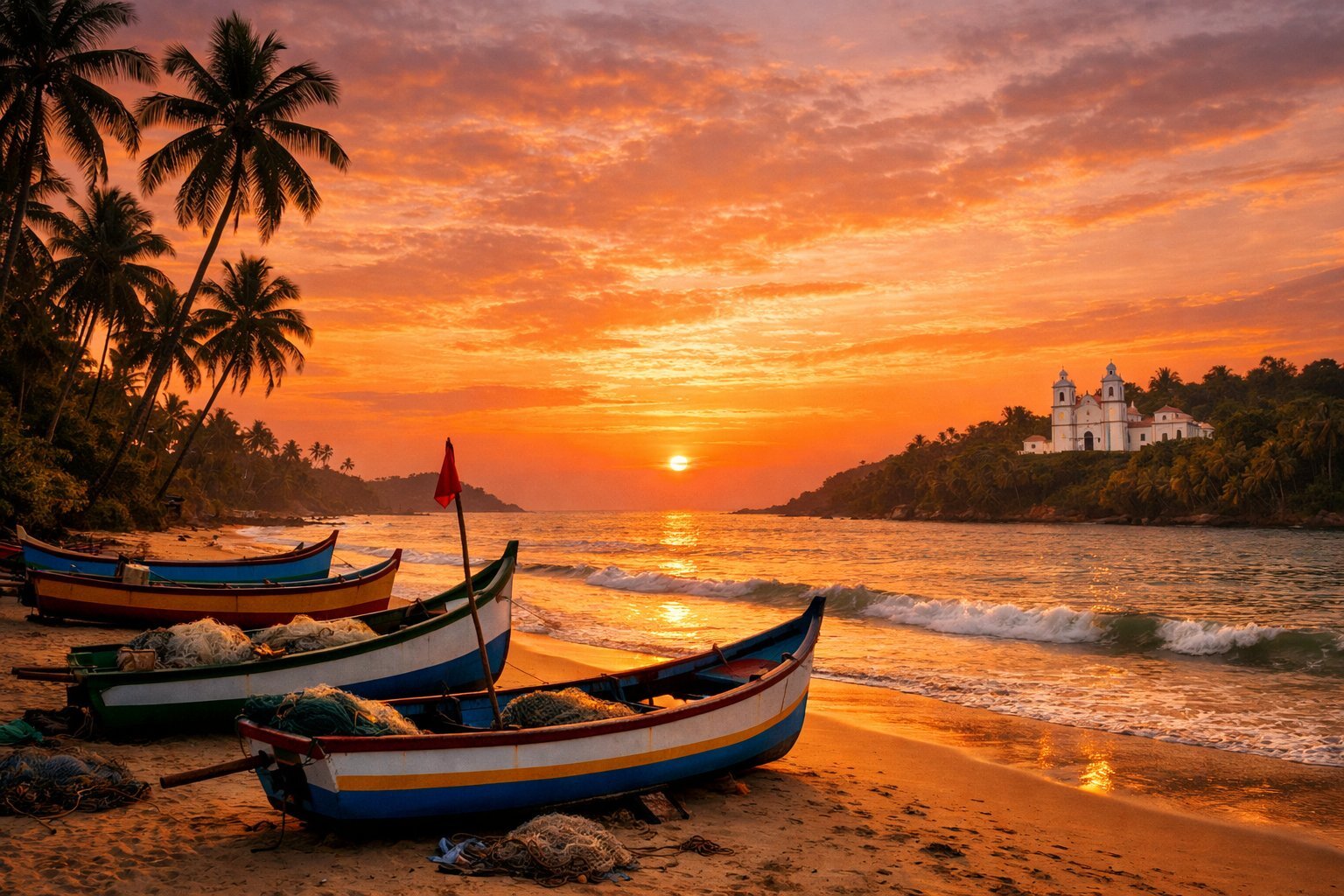
Goa
Colourful fishing boats and palm-fringed beaches beneath a blazing sunset — India's tropical paradise
🏖️ Goa — Sun, Sand & Heritage
India's smallest state packs an outsized punch. Portuguese for 450 years (1510–1961), Goa blends Latin Catholicism with Indian culture in a unique fusion visible in its Baroque churches, whitewashed colonial houses, and cuisine that features vindaloo (from Portuguese "vinha d'alhos"), sorpotel, and feni (cashew or coconut spirit). The Churches and Convents of Goa (UNESCO) include the Basilica of Bom Jesus, housing the remains of St Francis Xavier.
North Goa (Anjuna, Vagator, Baga) is the party zone — trance music, flea markets, beach shacks. South Goa (Palolem, Agonda, Colva) offers tranquil palm-lined beaches and boutique retreats. Beyond the coast, the Western Ghats rise into Bhagwan Mahavir Wildlife Sanctuary with its waterfalls and spice plantations. Goa's relaxed pace, affordable seafood, and golden light make it India's most accessible introduction.
🍽️ Cuisine
Indian cuisine is not one cuisine but dozens — each state, region, and community has its own distinct tradition. The north favours wheat (naan, roti, paratha), rich Mughlai gravies (butter chicken, rogan josh, korma), and tandoor-cooked meats. The south revolves around rice, coconut, and lentils — dosa, idli, sambar, and rasam. Bengal specialises in fish and sweets (rasgulla, sandesh). Gujarat is almost entirely vegetarian. Rajasthan cooks with minimal water in desert conditions. Hyderabad's biryani is legendary.
Indian street food is a universe: Mumbai's vada pav (the "Bombay burger"), Delhi's chaat, Kolkata's kathi rolls and phuchka, Lucknow's kebabs, and Amritsar's kulcha chole. Chai — spiced milky tea — is the national drink, served at every roadside stall. The thali (a round platter with multiple small dishes) is the quintessential Indian meal, offering a complete balance of flavours in a single sitting.
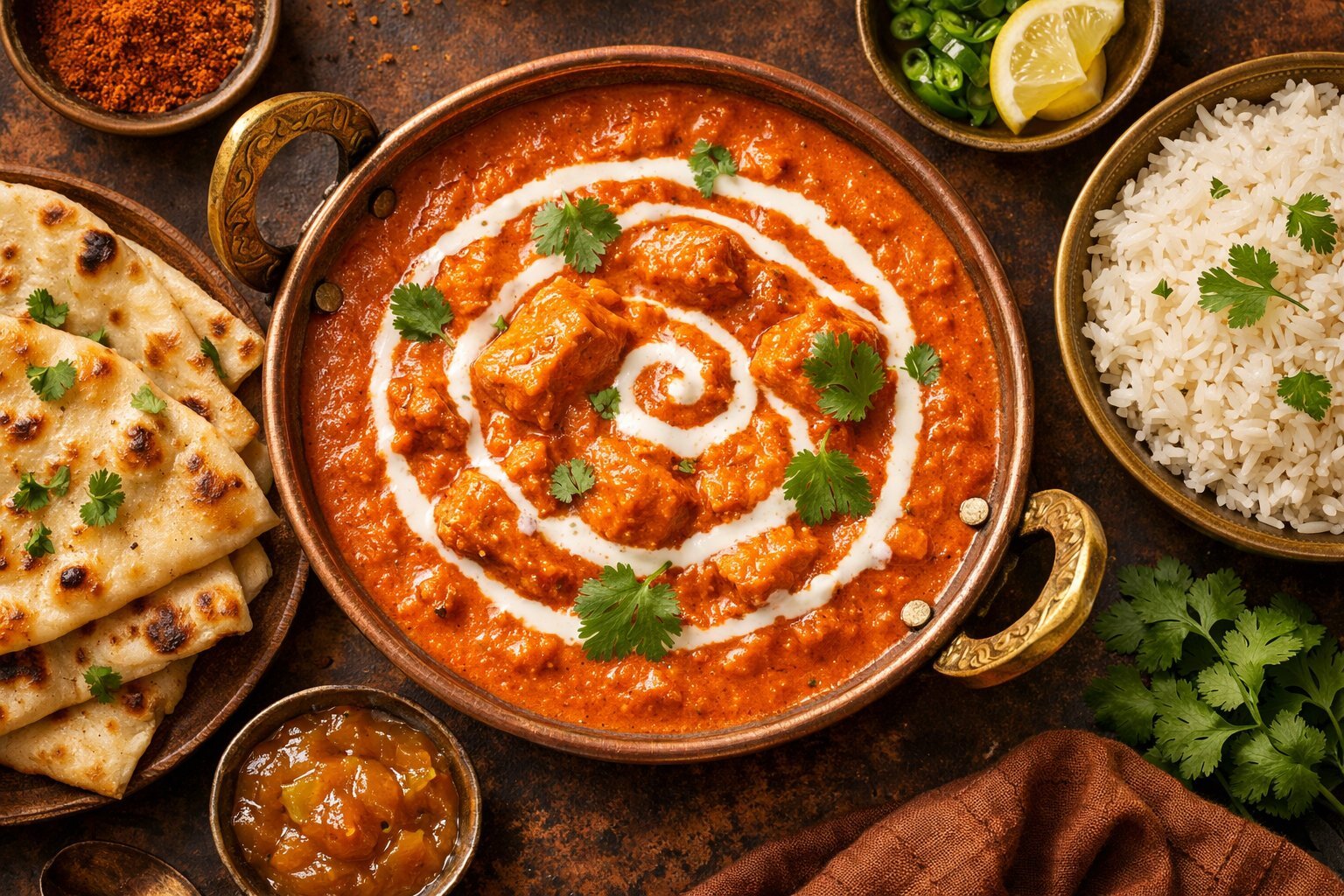
🍛 Butter Chicken (Murgh Makhani)
Ingredients: 500g chicken thighs, 2 tbsp yogurt, 1 tbsp garam masala, 1 tsp turmeric, 1 tsp chilli powder, 400g tinned tomatoes, 100ml cream, 50g butter, 1 onion, 4 cloves garlic, ginger, salt, kasuri methi (dried fenugreek leaves), coriander.
Preparation: Marinate chicken in yogurt, garam masala, turmeric, and chilli for 2+ hours. Grill or pan-fry until charred. Separately, sauté onion, garlic, and ginger in butter, add tomatoes and simmer 20 minutes. Blend smooth, return to pan, add cream and kasuri methi. Add chicken, simmer 15 minutes. Finish with a swirl of cream. Serve with naan or basmati rice.
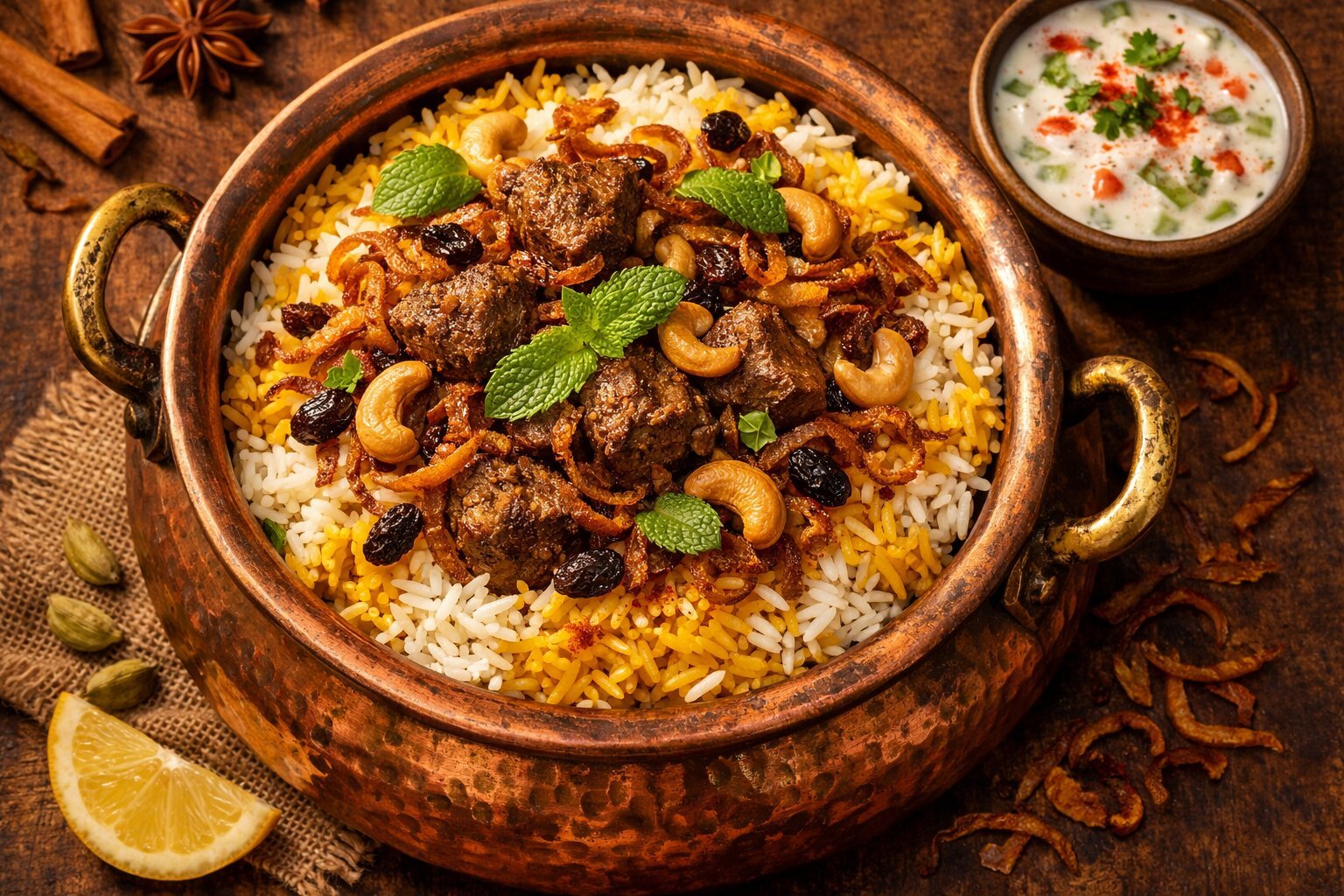
🍚 Hyderabadi Dum Biryani
Ingredients: 500g basmati rice, 500g lamb or chicken, 3 onions (thinly sliced and fried), yogurt, ginger-garlic paste, green chillies, saffron in warm milk, mint, coriander, whole spices (cardamom, cinnamon, cloves, bay leaf), ghee, salt.
Preparation: Marinate meat in yogurt, ginger-garlic paste, chillies, and half the fried onions for 2 hours. Par-boil rice with whole spices until 70% done, drain. Layer marinated meat in a heavy pot, top with rice, remaining fried onions, saffron milk, mint, coriander, and ghee. Seal lid with dough (dum), cook on very low heat 40 minutes. Serve with raita.
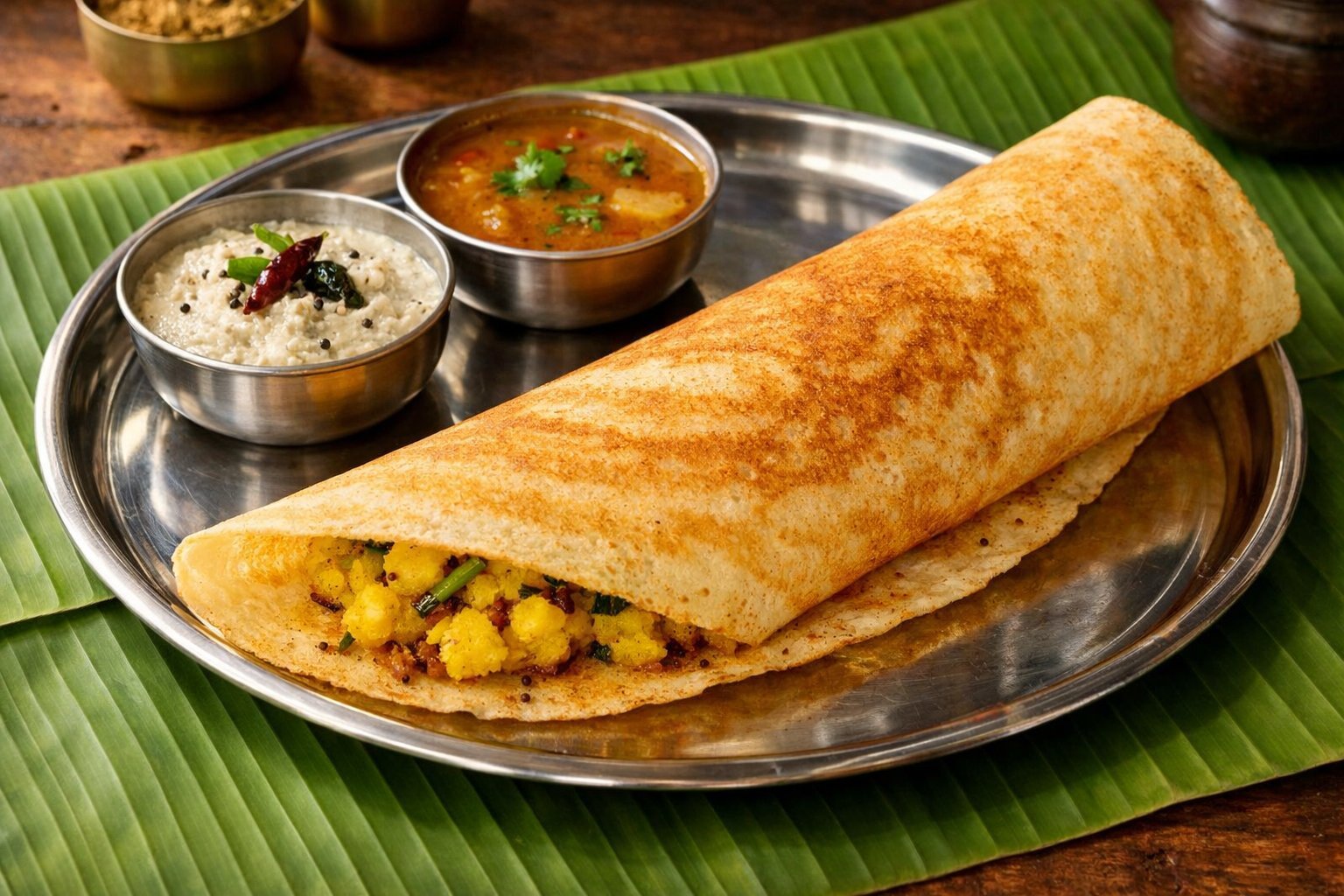
🥞 Masala Dosa
Ingredients: Dosa batter (3 cups rice, 1 cup urad dal, soaked and fermented overnight), potato filling (4 potatoes, mustard seeds, curry leaves, turmeric, onions, green chillies), coconut chutney, sambar.
Preparation: Boil and roughly mash potatoes. Temper mustard seeds, curry leaves, and green chillies in oil, add onions, turmeric, and mashed potatoes. For dosa, heat a flat griddle, pour a ladle of fermented batter and spread in a thin circle. Drizzle oil, cook until crispy and golden. Place potato filling inside, fold. Serve with coconut chutney and sambar.
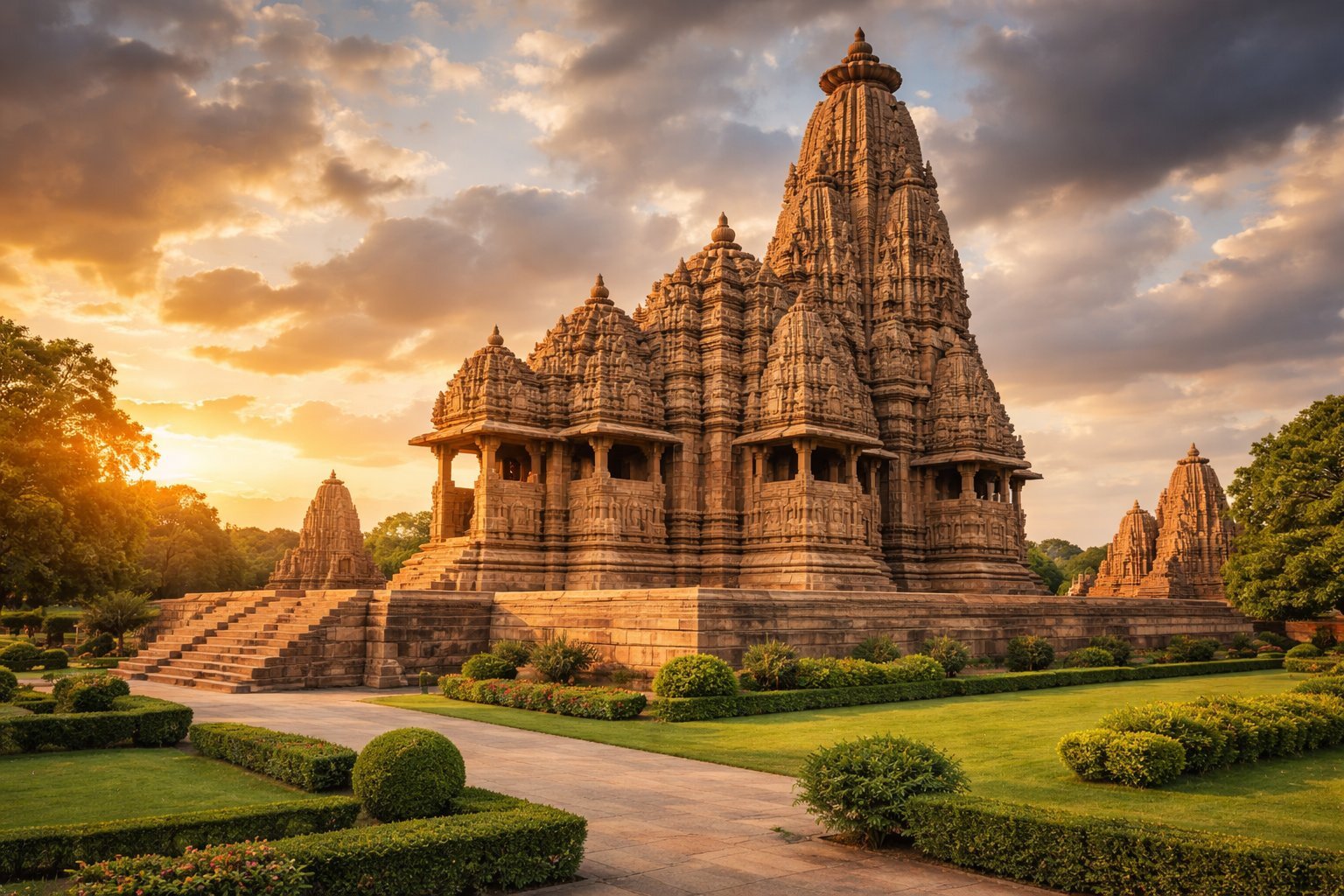
Khajuraho
Medieval Hindu temples adorned with exquisite stone carvings — a UNESCO World Heritage masterpiece
🍵 Drinks & Chai Culture
Chai is India's lifeblood — spiced tea simmered with milk, served in tiny cups (kulhad clay cups in the north) at every street corner, railway station, and office. Each region has its own variation: Kolkata's extra-sweet, Mumbai's cutting chai (half a glass, strong), Kashmir's kahwa (green tea with saffron and almonds). India is the world's second-largest tea producer — Darjeeling, Assam, and Nilgiri produce distinctly different leaves.
Lassi (yogurt drink — sweet, salted, or mango) is the quintessential Punjabi refreshment; Blue Lassi in Varanasi is legendary. Fresh coconut water flows in the south. Feni (Goa's cashew spirit), toddy (Kerala's palm wine), and Old Monk rum are iconic Indian spirits. The craft beer scene has exploded in Bengaluru, Mumbai, and Delhi. India also produces surprisingly good wines from Nashik vineyards — Sula is the pioneer.
🍷 Wine, Spirits & Cocktails
Feni (Goa's cashew spirit), toddy (Kerala's palm wine), and Old Monk rum are India's iconic traditional pours, while Nashik's altitude-grown vineyards — led by pioneer Sula — have built a genuine modern wine industry from almost nothing since the 1990s. Read the full wine, spirits & cocktails guide, including the Kaufmann Wine Score and three original recipes →
🌦️ Climate & Best Time
India's climate varies enormously. The cool season (October–March) is the primary travel season for most of India — comfortable temperatures, clear skies, and festival season. The hot season (April–June) brings intense heat across the plains (40–48°C in Rajasthan/Delhi). The monsoon (June–September) transforms the landscape — dramatic rains, lush green, fewer tourists, lower prices, but flooding and travel disruption possible.
Best times by region: Rajasthan/Delhi/Agra: Oct–Mar. Kerala: Sep–Mar. Goa: Nov–Feb. Himalayas: Apr–Jun and Sep–Oct (trekking). Ladakh: Jun–Sep only (passes closed in winter). Northeast: Oct–Apr. Varanasi: Oct–Mar. The shoulder months (September, March) often offer the best balance of weather, crowds, and prices.
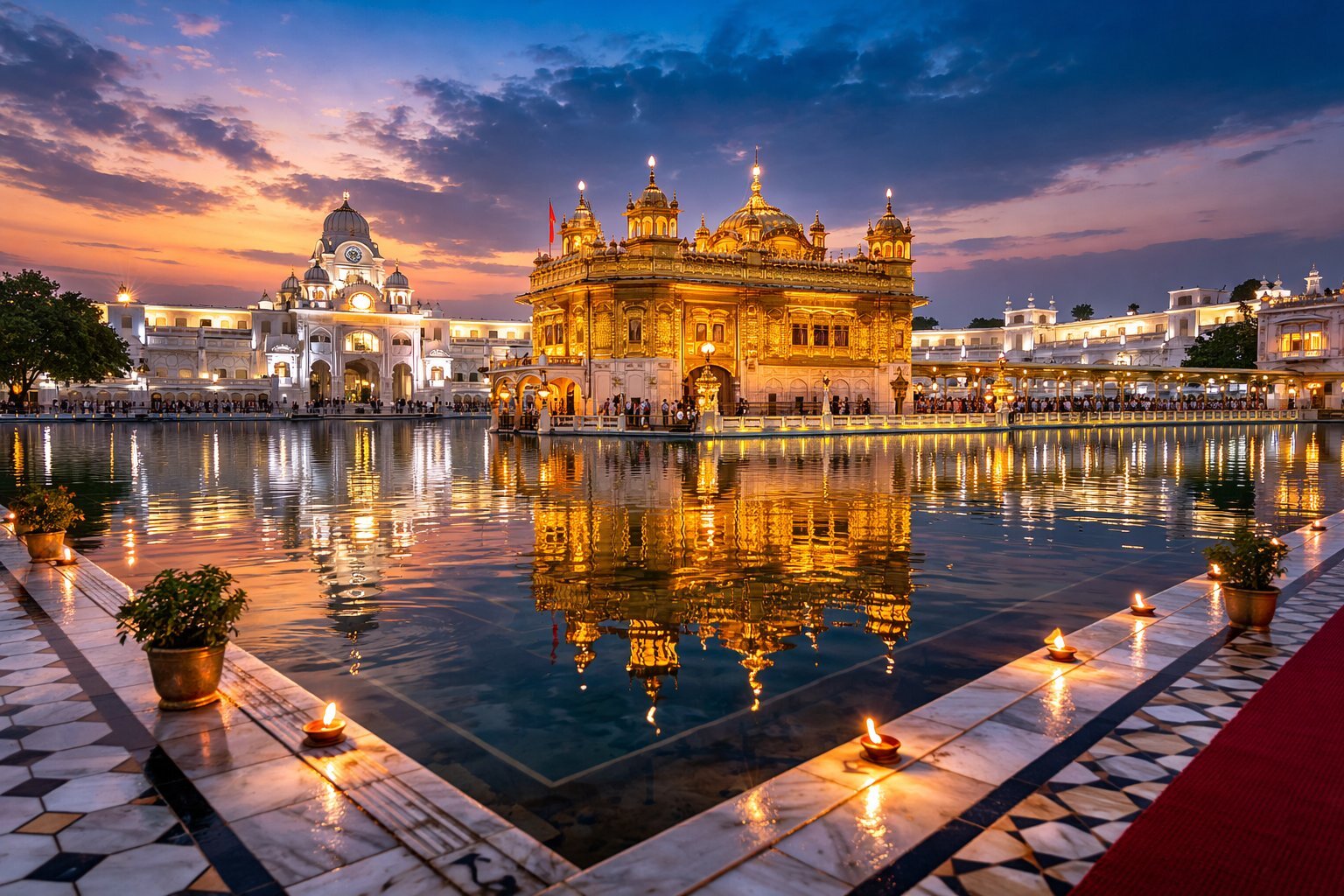
Golden Temple, Amritsar
The Harmandir Sahib — Sikhism's holiest shrine, illuminated at dusk and reflected in the sacred pool
✈️ Getting There
Indira Gandhi International Airport (DEL) in Delhi and Chhatrapati Shivaji Maharaj International (BOM) in Mumbai are the main gateways, with direct flights from every continent. Bengaluru (BLR), Chennai (MAA), Hyderabad (HYD), and Kochi (COK) also handle international traffic. Air India, IndiGo, and SpiceJet serve domestic routes — India has over 130 airports, and domestic flights are affordable (often under $50).
Indian Railways is one of the world's greatest travel experiences — 68,000+ km of track connecting virtually every city and town. Book via IRCTC; classes range from general (adventure) to first-class AC (comfort). The Palace on Wheels and Maharajas' Express offer luxury train journeys through Rajasthan. Road travel: Volvos connect major cities, local buses reach everywhere, and ride-sharing apps (Ola, Uber) work in cities.
📋 Practical Information
Most nationalities need an e-Visa — apply online at indianvisaonline.gov.in (30-day, 1-year, or 5-year options; the e-Visa is not the same as, and does not replace, the separate e-Arrival Card that foreign nationals and OCI holders must also complete free of charge within 72 hours before landing). For US citizens, the 30-day e-Tourist Visa runs $10 (April–June) or $25 (July–March), the 1-year option is $40, and the 5-year option is $160, plus a 3% bank charge — fees are set per nationality under a reciprocal-pricing scheme, so confirm the current rate for your own passport before applying (per the Indian Visa Online fee schedule updated 9 July 2026). The process is straightforward; approval typically takes 3–5 days. India uses 230V/50Hz, plug types C, D, and M. The Indian Rupee (INR/₹) is the currency — ATMs are ubiquitous in cities, UPI digital payments (Google Pay, PhonePe) are now used even by street vendors — ordinary UPI needs an Indian bank account, but foreign visitors can increasingly pay via UPI One World, a scheme built specifically for international travellers. Tap water is not safe; drink bottled or filtered water always.
Health: Travellers arriving directly from Europe don't normally need a vaccination certificate, but India requires proof of yellow fever vaccination from anyone arriving from, or having recently transited, designated yellow-fever-endemic countries. Hepatitis A/B, Typhoid, and routine shots are recommended regardless. Avoid ice in drinks outside trusted restaurants. Carry oral rehydration salts. Malaria prophylaxis advisable for some regions. Safety: Most established tourist circuits see heavy visitor traffic and are generally manageable, but risk varies by region, gender, transport mode, and current conditions — watch for scams at tourist sites, use prepaid taxis/apps, and women travelling alone should take extra precautions (stick to well-lit areas, use verified transport, dress modestly in conservative regions). Most Western governments currently advise against travel to Jammu & Kashmir (Srinagar, Pahalgam, Gulmarg, Sonamarg included) — Ladakh is normally excluded from this advisory — and to areas within roughly 10km of the Pakistan border in parts of Gujarat, Punjab and Rajasthan; the Attari–Wagah border crossing near Amritsar has been closed since May 2025 with no announced reopening date. Check your own government's current advisory before finalising an itinerary in these areas. Emergency: 112 (unified).
Special permits: Foreign travellers need advance permits for parts of the northeast and border regions, notably Arunachal Pradesh and Sikkim, plus some border, mountain and protected/tribal areas elsewhere. Rules and eligible entry points change; verify current Ministry of Home Affairs requirements before travel rather than assuming last year's rules still apply.
💰 Costs
India remains one of the world's best-value destinations. Budget: $15–30/day (dorm beds ₹300–800, street food meals ₹30–100, local transport). Mid-range: $40–100/day (decent hotels ₹2,000–5,000, restaurant meals ₹300–800, AC transport). Luxury: $150–500+/day (heritage hotels, palace stays, private guides). A meal at a local dhaba (roadside eatery) costs ₹80–150; a thali at a nice restaurant ₹300–600. A beer is ₹150–300. Domestic flights ₹2,000–5,000. Train tickets (sleeper class) from ₹200.
🏨 Accommodation
India offers everything from $3 dormitory beds to $3,000-a-night palace suites. Budget: Backpacker hostels (Zostel, Moustache, GoStops) from ₹300–800/dorm. Guesthouses and dharamshalas (pilgrim lodges) from ₹500–1,500. Mid-range: OYO and branded hotels ₹1,500–5,000. Heritage: Rajasthan's converted havelis, forts, and palaces — Neemrana, Suryagarh, Samode — from ₹5,000–25,000. Luxury: Taj Hotels (the Taj Mahal Palace in Mumbai is an icon), Oberoi, ITC, and Leela from ₹15,000+. Kerala houseboats ₹5,000–15,000/night. Goa beach huts start at ₹500 in season.
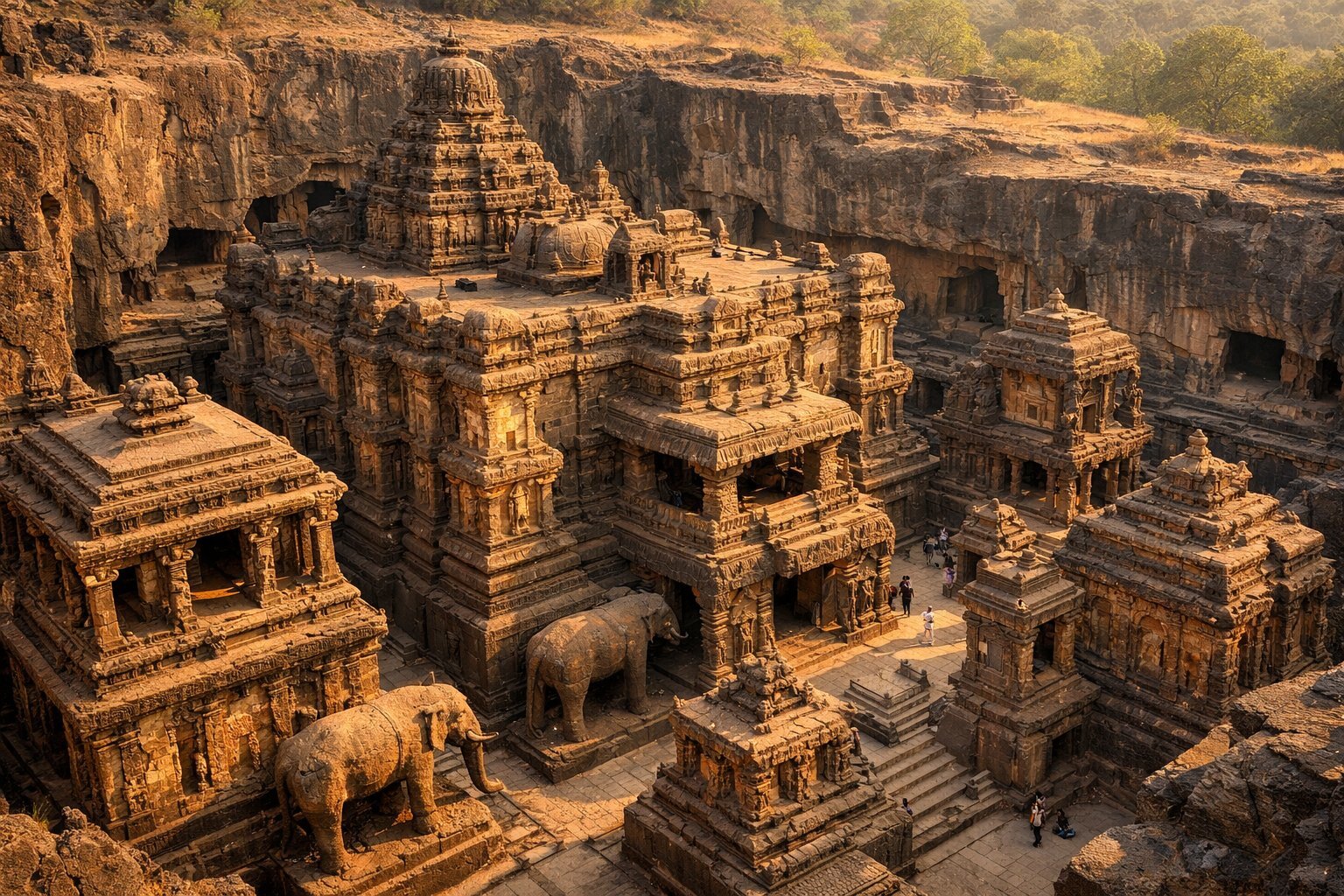
Kailasa Temple, Ellora
The world's largest monolithic rock excavation — an entire Hindu temple carved from a single cliff
🎭 Festivals & Events
Diwali (Oct/Nov) — the Festival of Lights — transforms the entire country with oil lamps, fireworks, and sweets; it's India's biggest celebration. Holi (Mar) — the Festival of Colours — sees millions drench each other in coloured powder and water, celebrating the arrival of spring. Dussehra/Navratri (Oct) features giant effigy burnings (Ravana) in the north and nine nights of garba dancing in Gujarat.
Kumbh Mela — the world's largest religious gathering — draws its biggest crowds to Prayagraj, where the 2025 Maha Kumbh recorded over 660 million cumulative pilgrim visits across 45 days. Kumbh gatherings follow astrological cycles at four sacred sites (Prayagraj, Haridwar, Nashik, Ujjain), with major bathing festivals at each roughly every 12 years and smaller ones between. Pushkar Camel Fair (Nov, Rajasthan) combines 50,000 camels with a carnival atmosphere. Onam (Kerala, Aug/Sep) features boat races and feast thalis. Ganesh Chaturthi (Mumbai, Sep) sees massive idol processions. Republic Day (Jan 26, Delhi) showcases a military and cultural parade. Eid, Christmas (Goa), Pongal (Tamil Nadu), Baisakhi (Punjab) — India celebrates something every week.
🏛️ UNESCO World Heritage
India has 45 UNESCO World Heritage Sites (37 cultural, 7 natural, 1 mixed) — the sixth-highest count globally, after the Ancient Buddhist Site of Sarnath joined the list in July 2026. The Taj Mahal (1983) needs no introduction — Shah Jahan's white marble mausoleum for his wife Mumtaz Mahal, built 1632–1653 by 20,000 artisans, with pietra dura inlay of 28 types of precious stones. The Ajanta Caves (1983) contain 30 rock-cut Buddhist caves with paintings dating from the 2nd century BCE — the finest surviving examples of ancient Indian art.
The Ellora Caves (1983) feature 34 caves spanning Buddhist, Hindu, and Jain traditions, including the extraordinary Kailasa Temple (Cave 16) — carved top-down from a single basalt cliff, removing an estimated 200,000 tonnes of rock. The Khajuraho Group of Monuments (1986) showcases medieval Hindu and Jain temples with famously sensuous sculptural traditions. The Group of Monuments at Hampi (1986) preserves the ruins of the Vijayanagara Empire across a surreal boulder-strewn landscape.
Other highlights include: Qutub Minar and Red Fort Complex (Delhi), Fatehpur Sikri, Humayun's Tomb, Sun Temple at Konark, Mahabodhi Temple at Bodh Gaya, Mountain Railways of India, Western Ghats biodiversity hotspot, Kaziranga National Park (one-horned rhino), Sundarbans (mangrove tigers), and Jaipur City (2019).
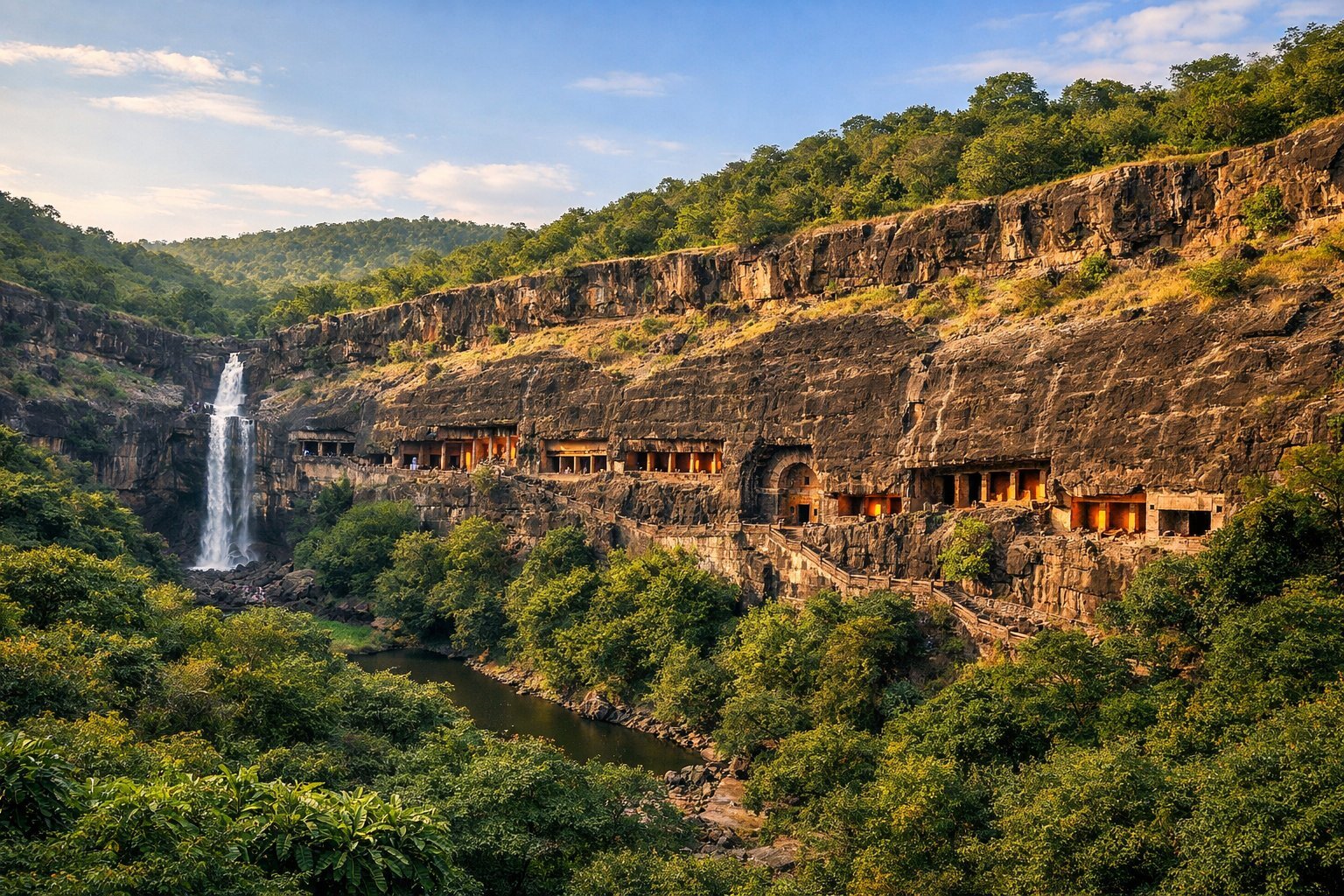
Ajanta Caves
Ancient Buddhist cave temples with 2,000-year-old paintings, carved into a horseshoe-shaped cliff
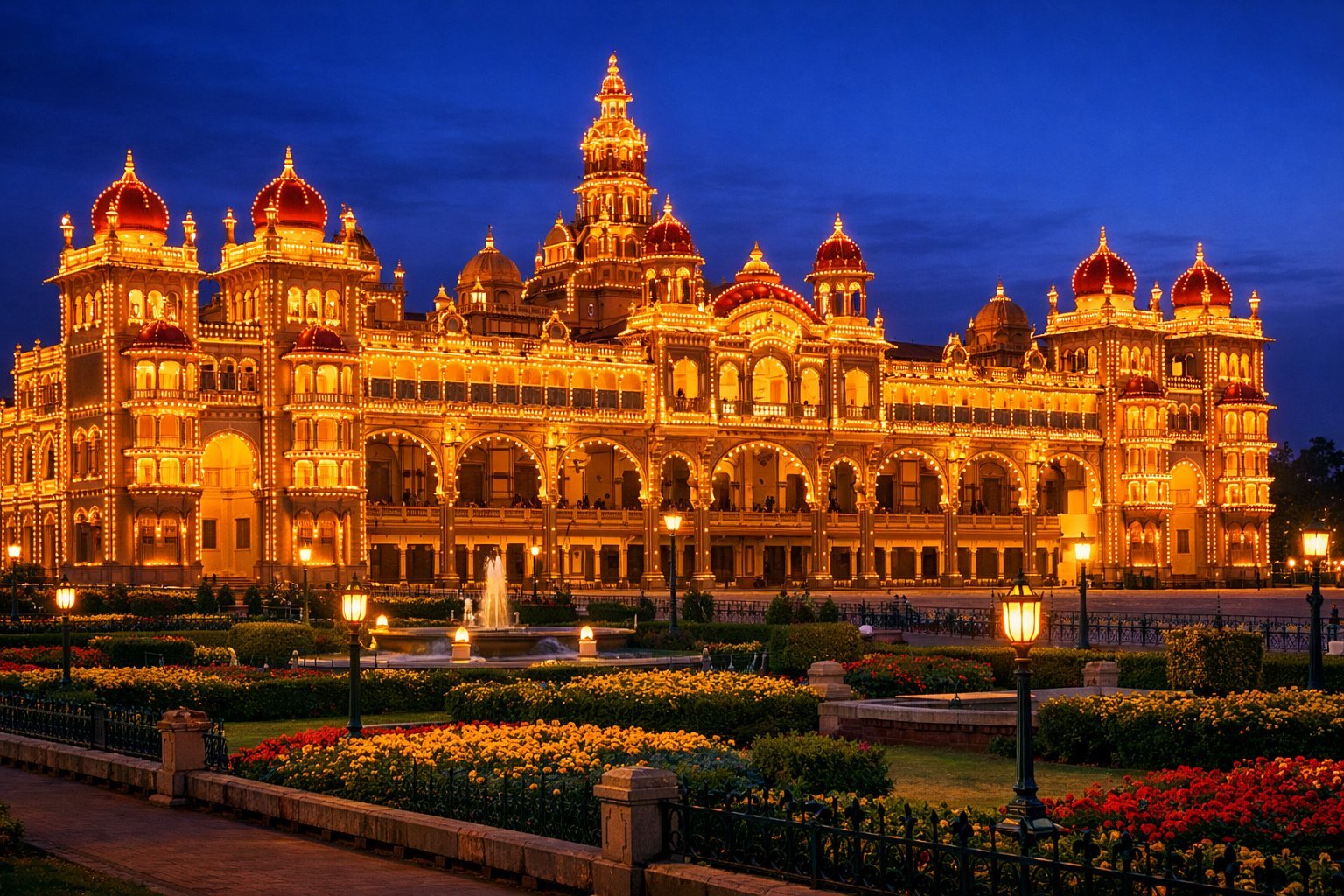
Mysore Palace
One of India's most visited palaces — tens of thousands of bulbs illuminate the Indo-Saracenic masterpiece every Sunday and festival
🎒 Packing Tips
Light, modest clothing in breathable cotton. Cover shoulders and knees for temple visits. A scarf/shawl is essential (sun protection, temple covering, train blanket). Comfortable walking shoes and slip-on sandals for temples. Bring: insect repellent, sunscreen, hand sanitiser, tissues/toilet paper, oral rehydration salts, a padlock for train luggage. Earplugs and an eye mask transform Indian train travel. A water bottle with built-in filter saves money and plastic. For the Himalayas: warm layers, waterproof jacket.
🌐 Resources
incredibleindia.org (official tourism). indianvisaonline.gov.in (e-Visa). irctc.co.in (train bookings). makemytrip.com and goibibo.com (flights/hotels). rome2rio.com (route planning). Ola/Uber (ride-sharing). Google Maps works well in India for navigation. Emergency: 112 (unified), 100 (police), 102 (ambulance), 101 (fire).
📚 Recommended Reading
"Shantaram" Gregory David Roberts — epic novel of an Australian fugitive in Bombay's underworld. "A Fine Balance" Rohinton Mistry — four lives interweave during the Emergency. "The God of Small Things" Arundhati Roy — Booker Prize winner set in Kerala. "Maximum City" Suketu Mehta — immersive non-fiction portrait of Mumbai. "Holy Cow! An Indian Adventure" Sarah Macdonald — an Australian's journey through Indian spirituality. "India: A History" John Keay — the definitive single-volume history.
🎬 Videos
YouTube: Karl Rock (living in Delhi, cultural deep dives), Drew Binsky (India travel vlogs), Padman (street food tours by Mark Wiens), Dhruv Rathee (Indian issues explained). Documentaries: BBC's "The Story of India" (Michael Wood), "Sacred Rivers" (Simon Reeve). Films: "Lagaan", "Rang De Basanti", "The Lunchbox", "Dil Chahta Hai" — Bollywood primers that capture India's spirit.
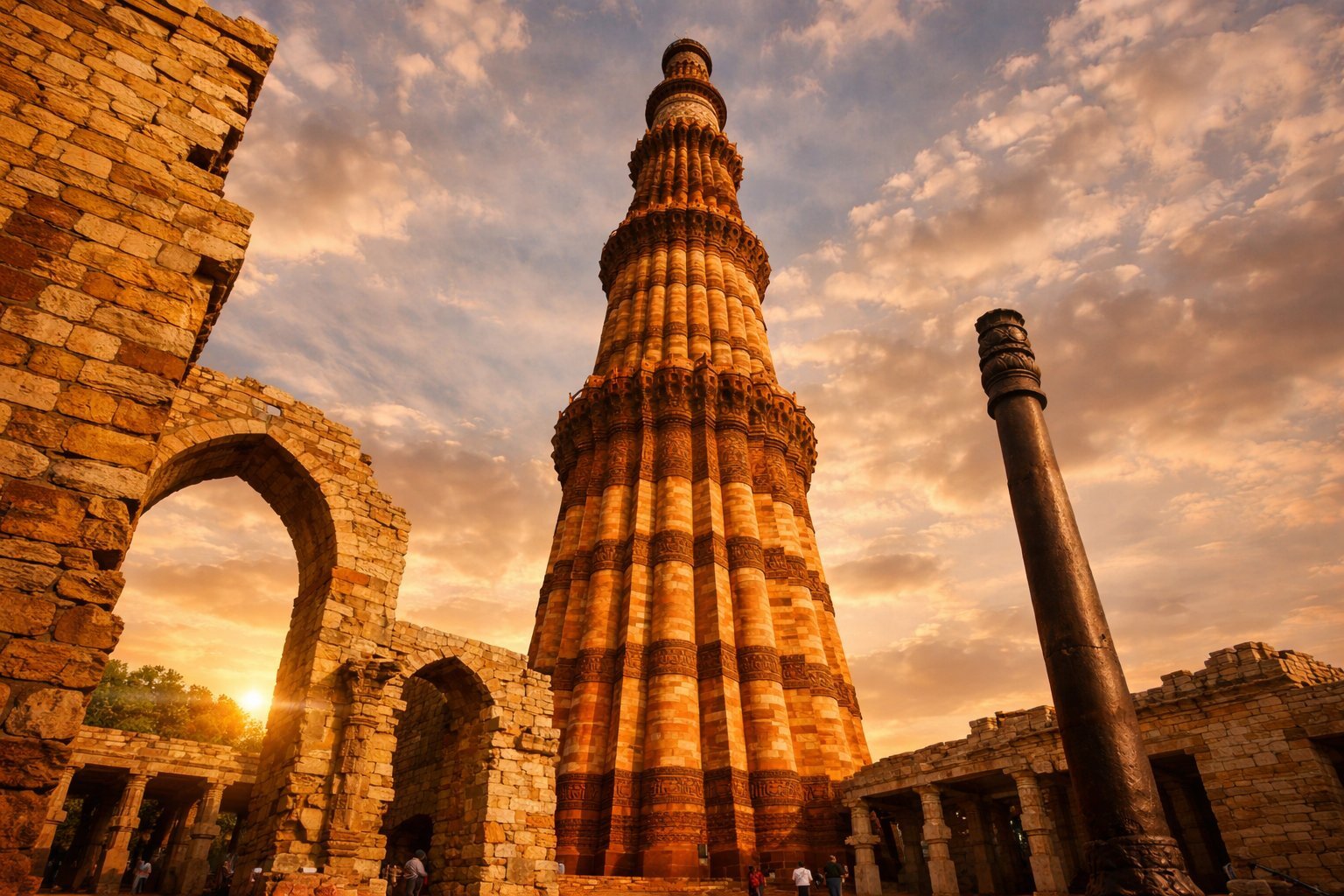
Qutub Minar
This 72.5-metre red-sandstone tower has stood in Delhi since 1193, beside the corrosion-resistant Iron Pillar
🔬 Fascinating Facts
Most populous: India surpassed China in 2023 to become the world's most populous country at ~1.48 billion.
Invented zero: Indian mathematicians were central to developing zero as a number — Brahmagupta set out systematic arithmetic rules for it in 628 CE, one of the most consequential breakthroughs in the history of mathematics.
World's largest democracy: With 960+ million eligible voters, Indian elections are the largest democratic exercise on Earth.
Vegetarian nation: India has one of the world's largest vegetarian populations, though estimates vary widely — roughly 20–40% — depending on survey methodology, region, and how the question is asked.
Kumbh Mela: The 2025 Maha Kumbh at Prayagraj recorded over 660 million pilgrim visits across 45 days by official count — cumulative footfall rather than a verified count of unique individuals, but still the largest human gathering ever documented. The illuminated festival site was photographed from the International Space Station.
Chess: The game was invented in India as "chaturanga" in the 6th century CE.
Shampoo: The word comes from the Hindi "chāmpo" (चाँपो), meaning to press or massage — brought to England in the 18th century via Mughal-era shampooing traditions.
Space power: India's Chandrayaan-3 successfully landed near the Moon's south pole in 2023, and Mangalyaan reached Mars orbit in 2014 on a notably modest budget, a fact widely (if a little glibly) compared in media coverage to contemporary Hollywood film budgets.
⭐ Notable People
Mahatma Gandhi (1869–1948): Father of the nation, whose philosophy of non-violent civil disobedience inspired movements worldwide and led India to independence.
Rabindranath Tagore (1861–1941): Asia's first Nobel laureate in Literature (1913), polymath who wrote the national anthems of both India and Bangladesh.
Dr. B.R. Ambedkar (1891–1956): Architect of India's Constitution and champion of Dalit rights — one of the 20th century's most important social reformers.
Ravi Shankar (1920–2012): Sitar maestro who introduced Indian classical music to the West, collaborating with George Harrison and influencing the Beatles.
Sachin Tendulkar (b. 1973): Cricket's greatest batsman — 100 international centuries, revered as a near-deity by a billion fans.
Satyajit Ray (1921–1992): Filmmaker whose "Apu Trilogy" transformed world cinema — Akira Kurosawa said not to have seen Ray's films was like not seeing the sun or the moon.
⚽ Sports
Cricket is not a sport in India — it's a religion. The Indian Premier League (IPL) is the world's richest cricket league. India has won the Cricket World Cup twice (1983, 2011) and the T20 World Cup three times (2007, 2024, 2026), becoming in 2026 the first team ever to successfully defend the T20 title, beating New Zealand by 96 runs in front of a home crowd in Ahmedabad. Watching a match at Eden Gardens (Kolkata, 68,000 capacity) or Wankhede (Mumbai) is an unforgettable experience.
Field hockey holds a cherished place in Indian sporting history — eight Olympic gold medals (1928–1980) — though India has no sport with official "national game" status; that is a persistent popular myth the government has explicitly denied designating. Kabaddi, an ancient contact sport, has been professionalised through the Pro Kabaddi League. Football has a fanatical following in Kerala, Goa, and Kolkata. Badminton (PV Sindhu, Olympic silver/bronze) and wrestling are rising forces. Chess has produced multiple prodigies, including Grandmaster D. Gukesh who became the youngest world champion at 18.
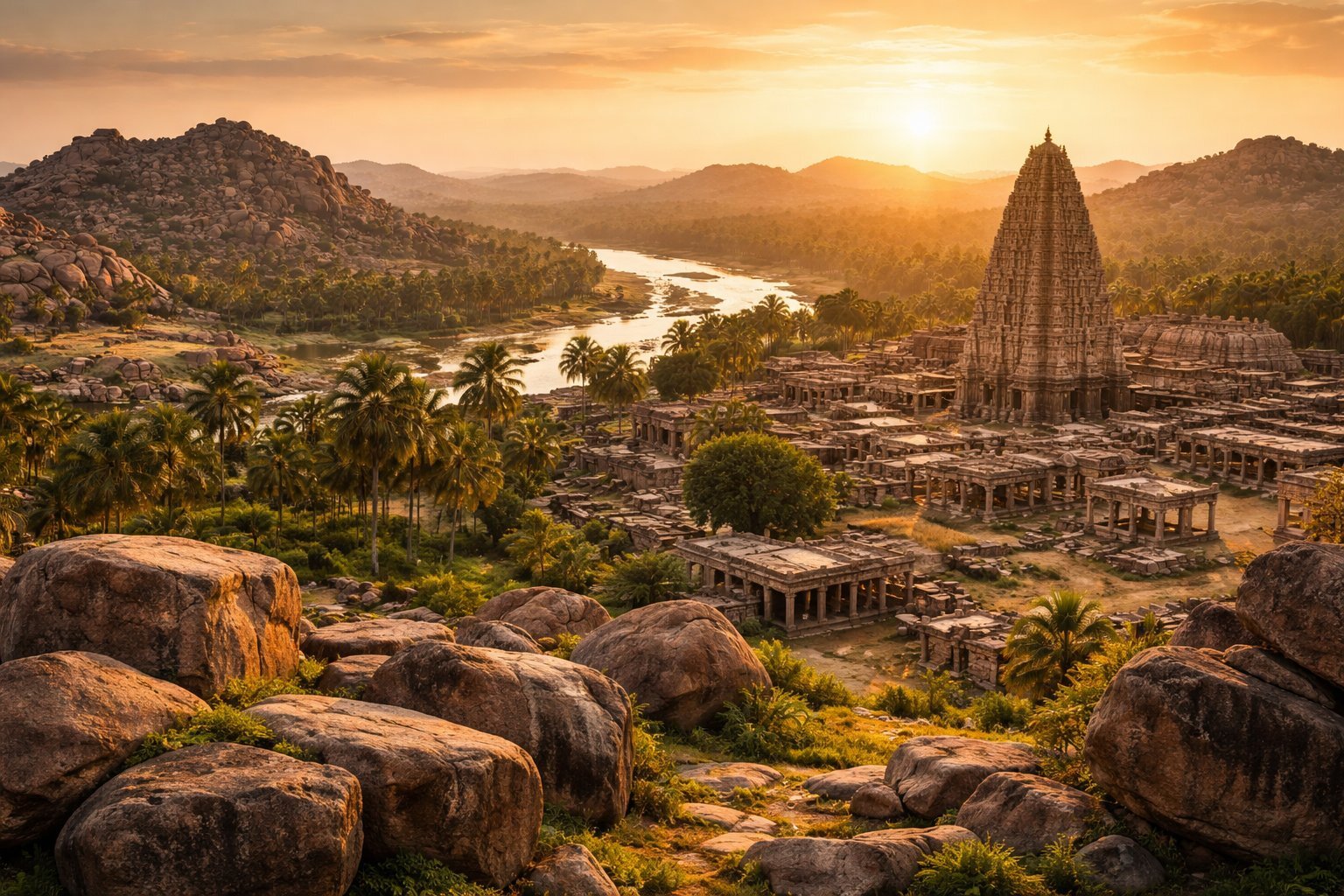
Hampi
The ruins of the great Vijayanagara Empire scattered among giant boulders — a UNESCO wonderland
📰 Media
India has one of the world's most vibrant media landscapes: over 100,000 registered newspapers and magazines in dozens of languages. The Times of India is one of the world's largest English-language newspapers by print circulation. The Hindu, Indian Express, and Hindustan Times provide quality reporting. NDTV, Republic TV, and India Today are major news channels. Prasar Bharati (DD/All India Radio) is the public broadcaster. Reporters Without Borders ranked India 157th of 180 countries in its 2026 World Press Freedom Index, and press-freedom pressures are widely reported — but India's media landscape remains enormous, multilingual, and fiercely competitive.
📸 Photo Gallery
✍️ Author's Note
India broke me open. Not gently — India doesn't do gentle. The first time I watched the sun rise over the Ganges in Varanasi, with cremation fires burning on one side and children flying kites on the other, I understood that this country holds the entire human experience in a single frame. It's overwhelming, contradictory, infuriating, and transcendent — sometimes within the same hour.
Don't try to "do" India. Let it do you. Eat from street stalls (your stomach will forgive you). Take the train (even if it's twelve hours late). Talk to strangers (they will talk to you regardless). The Taj Mahal really is that beautiful. Kerala really is that peaceful. Rajasthan really is that colourful. And the food — the food is reason enough to come, reason enough to return, and reason enough to never quite leave.
"Atithi Devo Bhava" — The Guest is God
—Radim Kaufmann, 2026
