
⚡ Key Facts
🌍 Overview
Ghana is a West African republic on the Gulf of Guinea, bordered by Côte d'Ivoire to the west, Burkina Faso to the north, Togo to the east, and the Atlantic Ocean to the south. Home to roughly 34 million people across 238,533 km², it is one of Africa's most politically stable democracies and a cultural powerhouse whose kente cloth, highlife and hiplife music, and jollof rice are recognised across the continent and diaspora.
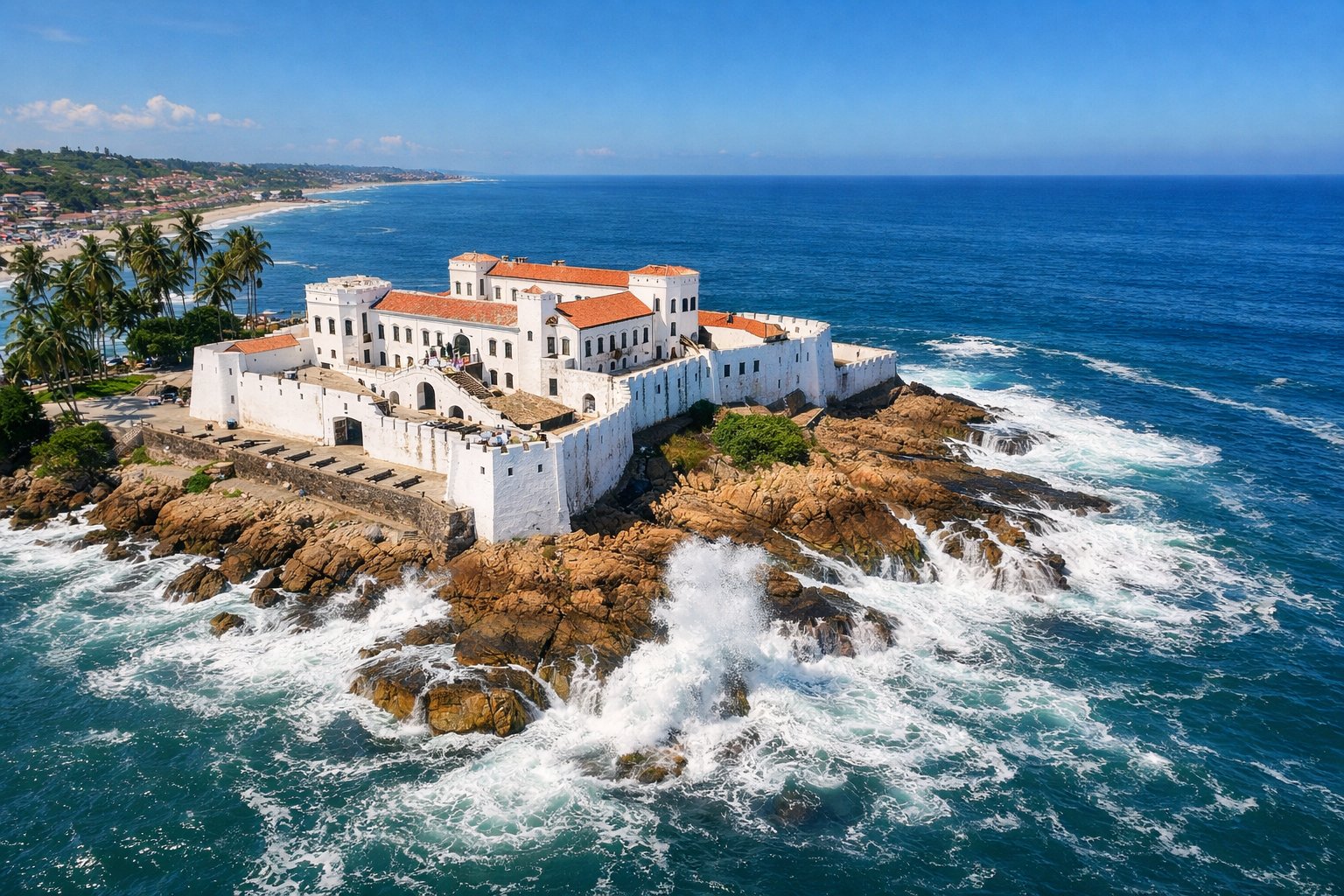
Known historically as the Gold Coast, Ghana was the first sub-Saharan African nation to gain independence from European colonial rule, declaring sovereignty on 6 March 1957 under Kwame Nkrumah. The country's coastline is dotted with some forty European-built forts and castles — Elmina, Cape Coast, Christiansborg — grim UNESCO-listed witnesses to the transatlantic slave trade that shaped the Atlantic world.
Today Ghana draws travellers seeking Ashanti royal culture in Kumasi, elephants and antelope at Mole National Park, the waterfalls and stilt villages of the Volta Region, and the powerful memorial experience of the coastal slave-trade castles. The 2019 "Year of Return" invited descendants of enslaved Africans to reconnect with the continent and cemented Ghana's reputation as the spiritual capital of Pan-African homecoming.
🏷️ Name & Identity
The modern name "Ghana" was chosen at independence in 1957 by Kwame Nkrumah, borrowed from the medieval Ghana Empire (c. 300–1200 CE), which actually flourished hundreds of kilometres to the northwest in present-day Mali and Mauritania. The choice was symbolic — a deliberate rejection of the colonial label "Gold Coast" and a claim to a deeper African past.
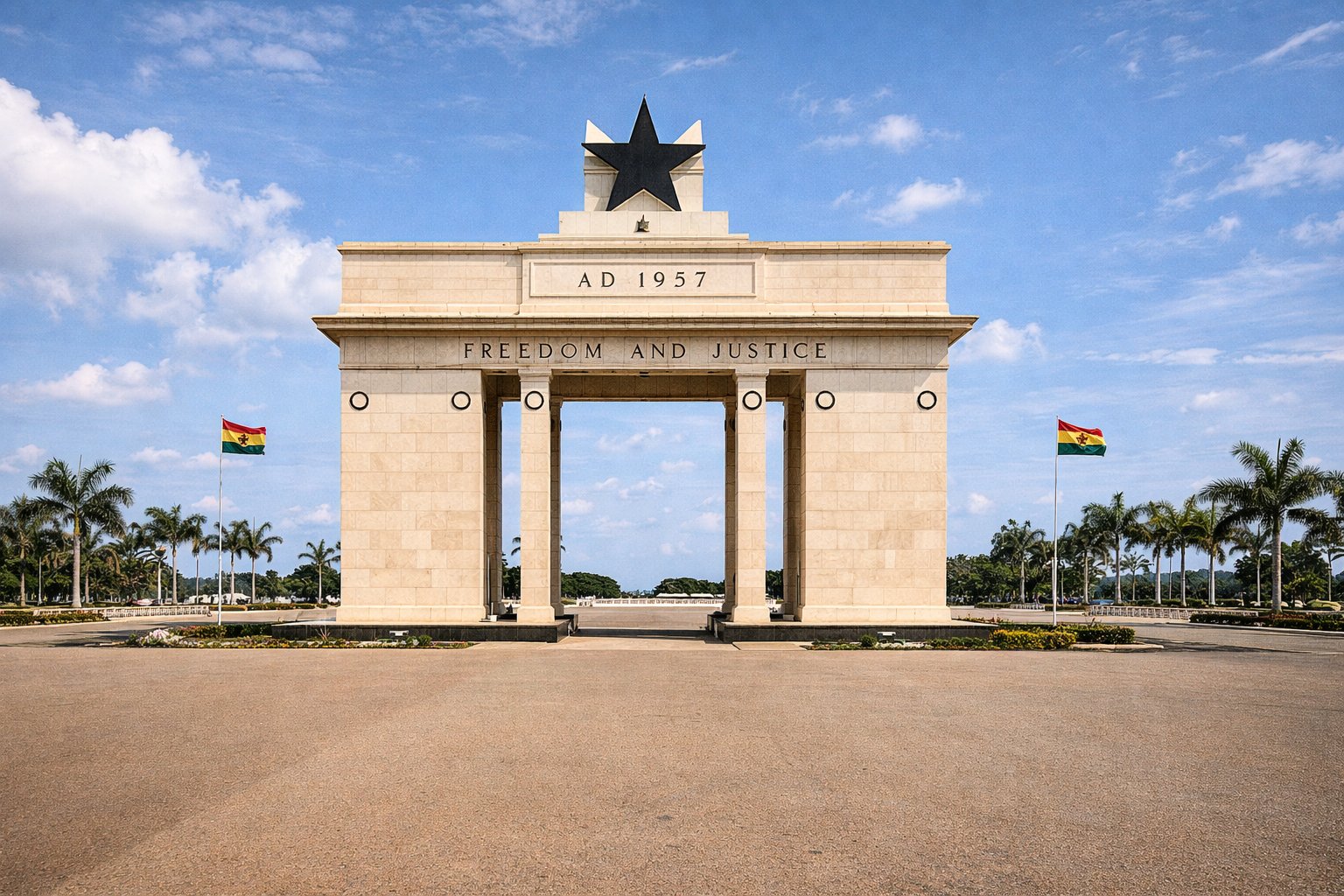
Officially the Republic of Ghana, the country's motto is "Freedom and Justice," and its flag — red, gold, green horizontal stripes with a central black star — inspired flags across decolonising Africa. The black star, borrowed from Marcus Garvey's Black Star Line, is Ghana's most potent emblem and gives the national football team its nickname, the Black Stars.
🗺️ Geography & Regions
Ghana spans from the sandy Gulf of Guinea beaches in the south to the dry Sahelian savanna of the far north. Between them lie tropical rainforest in the Ashanti region, the man-made Lake Volta (one of the largest reservoirs in the world by surface area, 8,502 km²), the Akwapim–Togo mountain range along the eastern border, and the cocoa-belt plateaus of Ashanti and Brong-Ahafo. The highest point is Mount Afadja (Afadjato, 885 m) in the Volta Region.
Administratively the country is divided into 16 regions, created in 2019 from the historical ten. Greater Accra is the political heart, Ashanti (with Kumasi) the cultural one, Western and Central regions hold the castles and rainforests, Northern and Upper regions the savanna and game parks, and Volta Region the waterfalls and hills.
🗺️ Map
📜 History
Long before Europeans arrived, the territory that is now Ghana hosted a succession of powerful African kingdoms — the Bono state (from c. 1450), the Dagbon kingdom of the north, the Ga and Fante coastal polities, and most famously the Ashanti Empire (c. 1670–1902), founded by Osei Tutu and his priest Okomfo Anokye, whose legendary Golden Stool is said to contain the soul of the Ashanti nation.
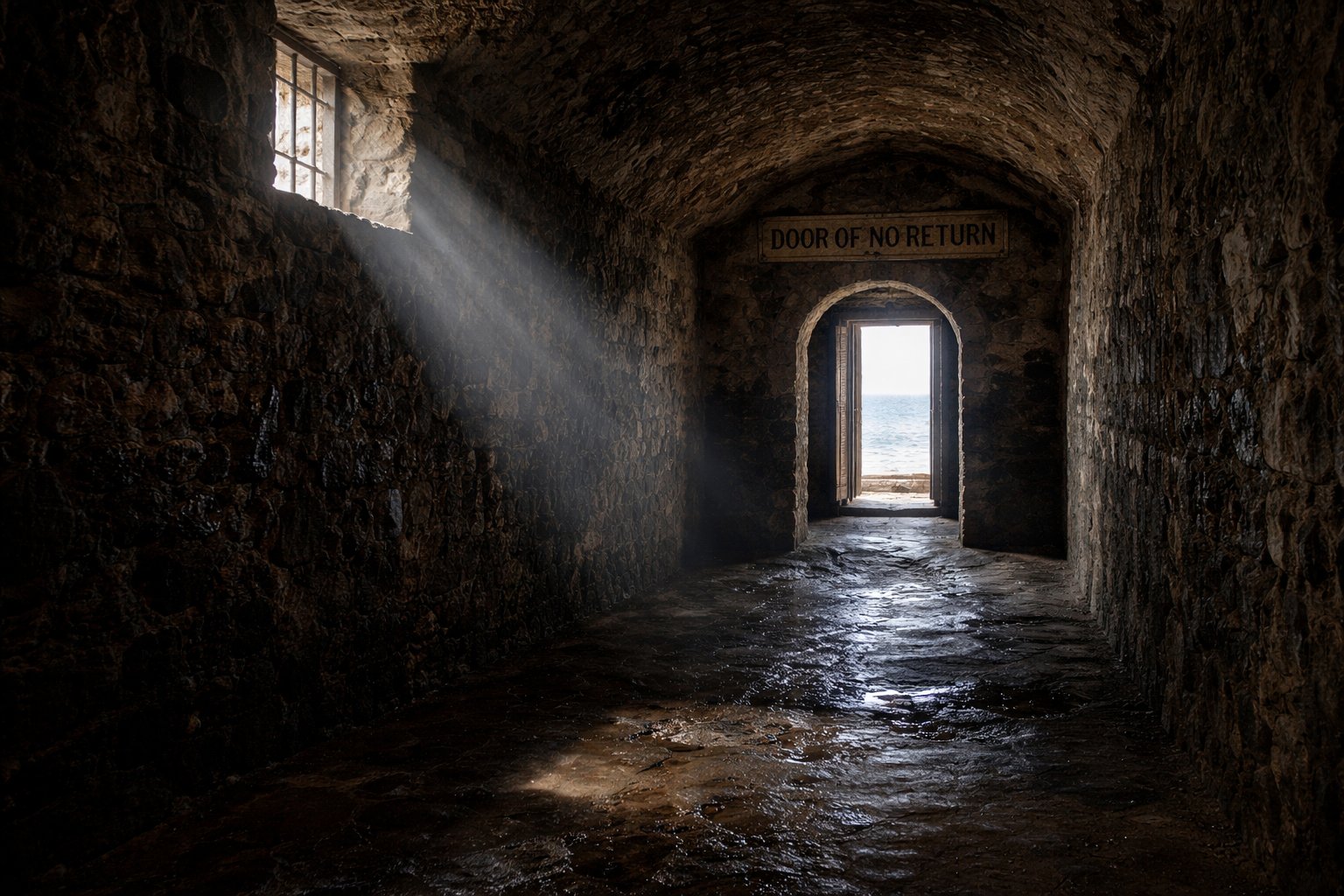
Portuguese traders reached the coast in 1471 and built Elmina Castle in 1482 — the oldest European building south of the Sahara. Dutch, Swedish, Danish, Brandenburger and British forts followed. From the 16th to 19th centuries the coast became a central hub of the transatlantic slave trade; an estimated six million Africans passed through these castles' "doors of no return."
After four Anglo-Ashanti Wars the British eventually annexed the Gold Coast. On 6 March 1957, Kwame Nkrumah declared the first black African colony independent, and Ghana became a beacon for Pan-Africanism. A turbulent era of coups followed (1966, 1972, 1979, 1981) until Jerry Rawlings shepherded the country to multiparty democracy in 1992. Peaceful transfers of power since — NDC and NPP alternating — have made Ghana one of Africa's democratic success stories.
👥 People & Culture
Ghana is home to more than 100 ethnic groups. The Akan (Ashanti, Fante, Akuapem and others) make up roughly 47%, followed by Mole-Dagbani in the north (~17%), Ewe in the southeast (~14%), Ga-Dangme around Accra (~7%), and Guan, Gurma, Mande and others. English is the official language; Twi, Fante, Ga, Ewe, Dagbani and Hausa dominate daily life.
About 71% of Ghanaians are Christian and 20% Muslim, with a significant minority practising traditional African religions — and in practice all three coexist, often in the same family. Ghana is famous for its warmth and hospitality: you will be greeted with "Akwaaba!" (welcome) everywhere. Funerals are major social events; highlife, gospel and Afrobeat soundtrack every bus, taxi and market.
🏛️ Accra — The Capital
Accra is a sprawling coastal metropolis of more than five million people, mixing colonial-era Jamestown with the skyscrapers of Airport City, the craft markets of Osu and the art galleries of Labadi. Don't miss the Kwame Nkrumah Memorial Park & Mausoleum, the restored Jamestown Lighthouse, the bustling Makola Market, the haunting Black Star Gate at Independence Square, and the Nubuke Foundation for contemporary Ghanaian art.
⛓️ Cape Coast & Elmina Castles
Cape Coast Castle and Elmina Castle, both UNESCO World Heritage sites, are the most visited — and most painful — places in Ghana. Elmina (1482) is the oldest European building south of the Sahara; Cape Coast became the British administrative headquarters. Guided tours lead visitors through the cramped male and female dungeons, past the Door of No Return, and up to the chapels and governor's apartments above. Former US President Barack Obama visited Cape Coast Castle with his family in 2009; almost every returnee from the African diaspora makes the pilgrimage.
👑 Kumasi — Heart of Ashanti
Kumasi is Ghana's second city and the cultural capital of the Ashanti Kingdom. The Manhyia Palace remains the residence of the Asantehene (king), whose Golden Stool is still the most sacred object in Ghanaian culture. Visit the Kejetia Market — one of the largest open-air markets in West Africa with more than 10,000 stalls — the Ashanti craft villages of Bonwire (kente weaving), Ahwiaa (wood carving), and Ntonso (adinkra cloth). The Military Museum occupies the old Kumasi Fort, where Yaa Asantewaa's famous 1900 siege took place.
🐘 Mole National Park
Ghana's largest wildlife refuge (4,577 km²) lies in the Northern Region, a savanna park home to African bush elephants, kob, hartebeest, warthogs, baboons, crocodiles and more than 300 bird species. Mole is famous for its walking safaris — armed ranger walks at dawn get you remarkably close to elephants drinking at the waterholes below the Mole Motel escarpment. Nearby, the 13th-century mud-and-stick mosque of Larabanga is one of the oldest in West Africa.
💦 Volta Region
East of Lake Volta, the Akwapim–Togo mountains shelter Ghana's highest peak (Afadjato), the country's tallest waterfall (Wli Falls, 80 m upper cascade, home to thousands of fruit bats), the monkey sanctuary of Tafi Atome, and the traditional kente weavers of Kpetoe. A boat cruise on Lake Volta from Akosombo — past the huge hydroelectric dam — remains one of Ghana's most relaxing experiences.
🍜 Cuisine
Jollof rice, waakye breakfast bowls, and grilled tilapia by the roadside — Ghanaian food is loud, communal, and unapologetically spicy. Read the full Food & Drink guide →
🍷 Wine, Spirits & Drinking Culture
Ghana grows no grapes, but palm wine tappers and akpeteshie distillers have perfected a different kind of drinking culture. Read the full Wine & Spirits guide →
🍹 Cocktails & Mixed Drinks
Akpeteshie, Ghana's fiery national spirit, anchors a small but growing cocktail scene in Accra's bars. See the full Food & Drink guide →
🌡️ Climate & Best Time to Visit
Ghana has a tropical climate with two main zones. The south has two rainy seasons (April–June and September–October) and warm temperatures year-round (24–32°C). The north has a single rainy season (May–October) followed by the dry, dusty Harmattan (December–February), when the Sahara wind carries fine dust as far south as Accra. Best travel window: November–March — dry, cooler and festival-rich, though the Harmattan haze can obscure distant views.
✈️ How to Get There
Kotoka International Airport (ACC) in Accra is the main gateway, served by KLM, British Airways, Lufthansa, Turkish, Emirates, Qatar, Delta, Ethiopian, Kenya Airways, RwandAir and regional carriers. Flights from London take around 6.5 hours, from New York about 11. Overland, Ghana connects to Togo (Aflao), Burkina Faso (Paga) and Côte d'Ivoire (Elubo) via functioning but sometimes slow border posts.
📋 Practical Information
Visa: required for most nationalities; e-visa available since 2024. Citizens of ECOWAS states are visa-free. Yellow fever vaccination is mandatory on arrival (bring the certificate). Malaria prophylaxis is strongly recommended. Currency: Ghanaian Cedi (GHS) — ATMs widespread in cities. Power: 230 V, UK-style three-pin plugs (Type G). SIM cards: MTN, Telecel (ex-Vodafone) and AirtelTigo; registration requires passport. Safety: Ghana is one of West Africa's safest countries; ordinary precautions apply in Accra markets and night-time taxi use.
💰 Cost of Living
Ghana is moderate by West African standards. A budget traveller can get by on US$35–50/day (guesthouses, street food, shared trotros). Mid-range US$80–150/day (hotels, restaurants, private driver). A cold Star beer: ~GHS 20 (US$1.50). A plate of jollof with chicken: GHS 40–80. Accra–Kumasi STC bus: GHS 150–200. Mole Motel room: GHS 900+/night.
🏨 Accommodation
Accra offers everything from the Kempinski Gold Coast City and Labadi Beach Hotel down to backpacker guesthouses in Osu. In Cape Coast, Oasis Beach Resort remains a travellers' favourite. Kumasi has the Golden Tulip and several mid-range hotels. Mole Motel is the classic base for wildlife watching, with Zaina Lodge offering safari-luxury at the same gate. Volta Region has rustic eco-lodges at Wli and Tafi Atome.
🎭 Festivals & Events
Homowo (August, Ga people of Accra) — a harvest festival whose name means "hooting at hunger." Akwasidae (every 42 days, Kumasi) — the Asantehene receives subjects in royal regalia at Manhyia Palace. Aboakyir (Winneba, May) — the deer-hunting festival. PANAFEST (biennial, July/August) — Pan-African arts festival at Cape Coast. Chale Wote Street Art Festival (August, Jamestown, Accra) — contemporary art takeover. Year of Return events run each December, drawing huge crowds of diasporans for "Afrochella"/Afro Nation.
🏛️ UNESCO & World Heritage
Two UNESCO World Heritage Sites: the 28-fort Forts and Castles chain along the coast, and the surviving Asante Traditional Buildings near Kumasi. Explore both sites in depth →
🎒 Packing Tips
Lightweight long sleeves and trousers for mosquito protection, strong sunscreen, DEET repellent, a good hat, a water-filter bottle, ORS sachets, malaria prophylaxis, yellow-fever certificate (mandatory), modest clothing for mosques and chief's palaces, binoculars for Mole, a power bank (load-shedding is no longer as bad as "dumsor" years but still happens), and cash US dollars in clean new bills for emergencies.
🌐 Useful Resources
Ghana Tourism Authority (visitghana.com), Ghana Immigration Service e-visa portal, Ghana Meteorological Agency, Ghana Wildlife Division (Mole bookings), STC bus (stc.com.gh), and community-tourism NGO Ghana Community Based Tourism.
📚 Recommended Reading
Homegoing by Yaa Gyasi — two sisters, one sold into slavery, seven generations across Ghana and America. The Beautyful Ones Are Not Yet Born by Ayi Kwei Armah — classic post-independence Ghanaian novel. Changes: A Love Story by Ama Ata Aidoo. Ghana: A Political History by F. K. Buah. Ghana Must Go by Taiye Selasi. For context on the castles: Lose Your Mother by Saidiya Hartman.
🎬 Videos About Ghana
Search YouTube for: "Ghana Year of Return 2019 highlights," "Anthony Bourdain Parts Unknown Ghana," "Wode Maya Ghana travel vlogs," "Kejetia Market Kumasi walking tour," "Mole National Park walking safari," and "Chale Wote Street Art Festival."
🔬 Fascinating Facts
Ghana is the world's second-largest cocoa producer after Côte d'Ivoire, supplying roughly 20% of global beans. The Akosombo Dam created Lake Volta, one of the largest artificial lakes on Earth by surface area. Ghana is home to the world's most photographed "fantasy coffins" — personalised caskets shaped like fish, planes, Coca-Cola bottles or lions, crafted by the Ga carpenters of Teshie-Nungua. The adinkra symbols — more than 120 visual proverbs such as Sankofa ("return and get it") — are now UNESCO-recognised intangible heritage. Ghana's national football team has qualified for four FIFA World Cups (2006, 2010, 2014, 2022) and reached the quarter-finals in 2010.
⭐ Notable People
Kwame Nkrumah (1909–1972) — founding father of Ghana and Pan-Africanism. Kofi Annan (1938–2018) — seventh UN Secretary-General and Nobel Peace Prize laureate. Yaa Asantewaa (c.1840–1921) — queen mother of Ejisu who led the 1900 Ashanti war against the British. Jerry Rawlings (1947–2020) — populist president who returned Ghana to democracy. Abedi Pele and Michael Essien — football legends. Azumah Nelson — arguably Africa's greatest boxer. Stormzy and Idris Elba — British-Ghanaian cultural icons. Yaa Gyasi — contemporary Ghanaian-American novelist. El Anatsui — internationally celebrated sculptor of metal tapestries.
⚽ Sports
Football is a national obsession. The Black Stars (men) have won four Africa Cup of Nations titles (1963, 1965, 1978, 1982) and famously beat the USA twice in the World Cup group stage (2006, 2010). Ghanaian stars have played at Real Madrid, Chelsea, Bayern Munich, Inter and Juventus. Boxing is the other great Ghanaian sport: Azumah Nelson, Ike Quartey and Joshua Clottey held world titles. Ghana also has a growing presence in athletics, basketball and rugby.
📰 Media & Press Freedom
Ghana has one of the freest press environments in Africa, though its ranking in the RSF Press Freedom Index slipped in recent years following attacks on journalists. Leading outlets: Daily Graphic, Ghanaian Times, Joy FM / MyJoyOnline, Citi FM, GhanaWeb, and the state broadcaster GBC. Vibrant talk-radio and a fiercely independent investigative tradition (the late Anas Aremeyaw Anas of Tiger Eye PI is the most famous example) keep politicians on their toes.
📸 Photo Gallery


✍️ Author's Note
My first morning in Cape Coast, I stood in the women's dungeon with a small group of strangers as our guide, a young man named Kofi, asked us to be quiet for a minute. The walls still smelled faintly of something ancient and organic; a shaft of light came through the single high window. Afterwards, outside, the Atlantic was impossibly blue and children were kicking a football against the castle's white walls as if it were just another wall in just another town. Ghana holds that contradiction with extraordinary grace — the gravity of what happened here, and the insistent brightness of life going on. I have travelled much of West Africa and returned to Ghana more than any other country on the coast. It is the welcome — Akwaaba — and the way a stranger will walk you two blocks out of their way just to make sure you find the right tro-tro. It is the smoky perfume of jollof drifting out of a roadside shack at dusk. It is the thunder of drums at an Ashanti funeral that somehow manages to feel like a celebration. If there is one country in Africa I would tell a first-time visitor to begin with, it is Ghana.
—Radim Kaufmann, 2026
