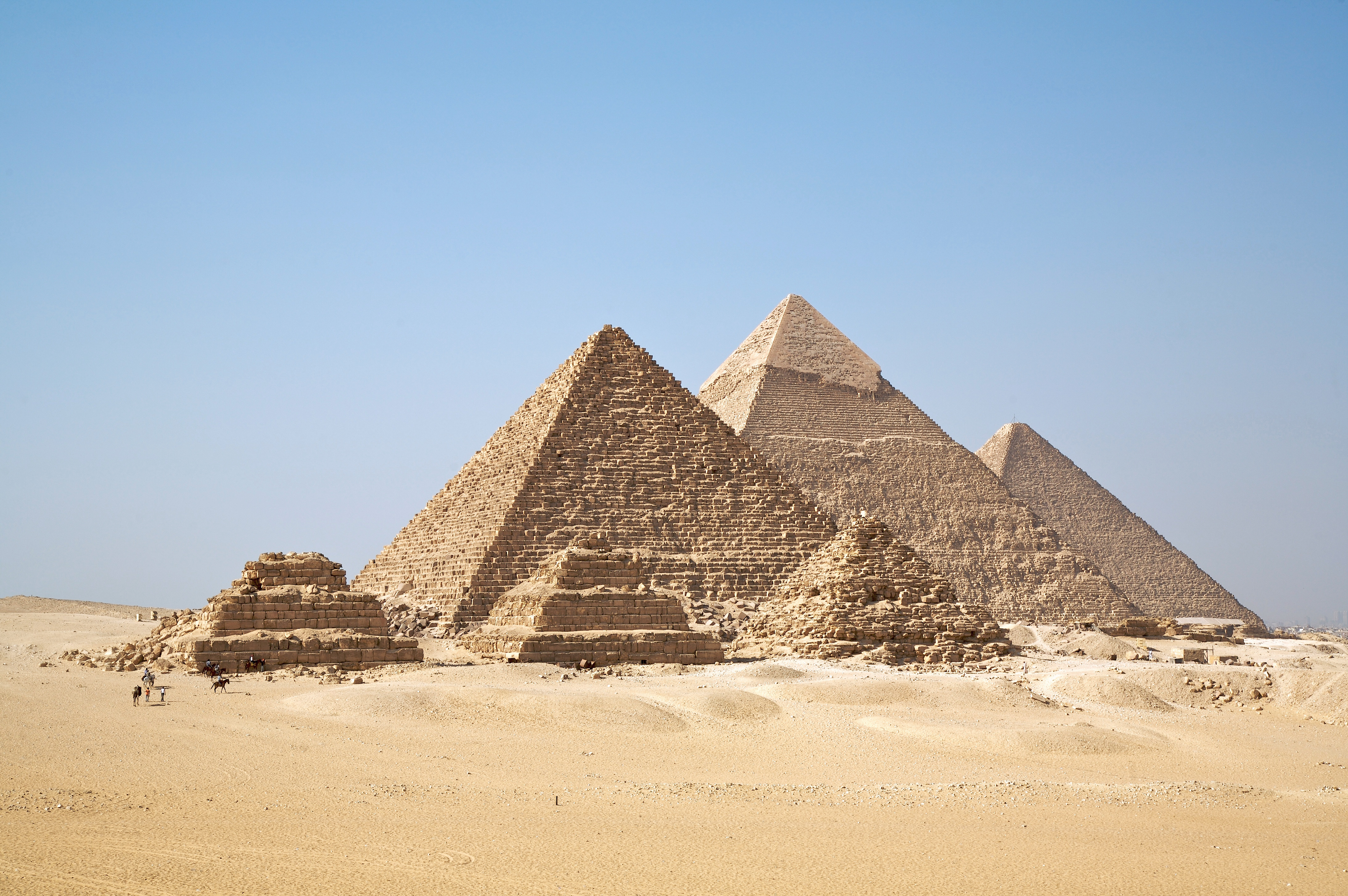
A million square kilometres of desert with a green thread down the middle, five thousand years of continuous record, and 110 million people living on four per cent of the land.
Giza · Ricardo Liberato · CC BY-SA 2.0 · Image credits
Egypt is a million square kilometres of desert with a green thread running down the middle. Almost 110 million people live on roughly 4% of the land, in the Nile valley and its delta, and they have been doing so continuously since before writing existed anywhere else. No other country offers a documented human record of this depth in one place.
The headline sights genuinely deliver. The Great Pyramid is more astonishing in person than in any photograph, mostly because of its scale and because a modern city now stops at its fence. Karnak is, with Angkor Wat, one of the two largest religious complexes ever built. The tomb of Nefertari at Thebes is, by a considerable margin, the most beautiful painted interior in the ancient world. Abu Simbel was cut into blocks and moved up a cliff in the 1960s to save it from a lake, which is itself one of the great engineering stories.
Two things need saying plainly. First, Egypt is hard work for the independent traveller — the commercial pressure at every site is relentless, and the guide, the driver, the camel man and the ticket seller all want something. It is not dangerous and it is not personal; it is exhausting, and knowing that in advance changes the trip completely. Second, the Egyptian pound has lost most of its value since 2022, which has made the country very cheap for foreign visitors and very hard for Egyptians. Site entry fees have risen steeply to compensate.
Ten days does Cairo, Luxor and Aswan properly. Two weeks adds the Red Sea or the Western Desert. A Nile cruise is the least stressful way to see the temples between Luxor and Aswan, and for many people it is worth choosing on that basis alone.
Giza: the Great Pyramid of Khufu was the tallest structure built by humans for about 3,800 years, and is the only one of the Seven Wonders still standing.kallerna · CC BY-SA 3.0Back to top ↑
02
Name & Identity
Egyptians call their country Miṣr — a Semitic name of great antiquity, used in Arabic, Hebrew and Akkadian, and also the everyday word for Cairo. "Egypt" comes to us through Greek Aigyptos, itself probably from Hut-ka-Ptah, "the house of the soul of Ptah", the temple name of Memphis. The ancient Egyptians called their own land Kemet — "the black land", after the fertile Nile silt — as against Deshret, the red land of the desert.
Formal name
Arab Republic of Egypt. A republic since the officers' coup of 1952 ended the monarchy; the current constitution dates from 2014.
Continuity
Egyptians descend, largely, from the people who built the monuments. This is not a case of one civilisation replacing another on the same ground — the language, religion and script changed; the population substantially did not.
Copts
Around 10% of Egyptians are Christian, overwhelmingly Coptic Orthodox — the largest Christian community in the Middle East. Copt and Egypt are the same word, both from the Greek.
Coptic
The last stage of the ancient Egyptian language, written in Greek letters. It died as a spoken tongue around the 17th century and survives in liturgy — the only living descendant of the language of the hieroglyphs.
Two Egypts
"Upper Egypt" is the south and "Lower Egypt" the north, because the Nile flows north. This confuses every visitor once and then never again.
The flag
Red, white and black with the golden Eagle of Saladin. The pan-Arab colours; the eagle has been the national emblem since 1958.
Ninety-five per cent of Egypt is desert. The habitable country is a ribbon of irrigated land a few kilometres wide either side of the Nile for 1,500 km, opening into the Delta north of Cairo, plus the Mediterranean and Red Sea coasts and a handful of oases. Herodotus called Egypt "the gift of the Nile" and no one has improved on the description.
The Nile
About 6,650 km from its most distant source, and the longest river in Africa. The Blue Nile from Ethiopia carried the silt that made Egypt possible; since the Aswan High Dam closed in 1970 the annual flood no longer happens and the silt stays behind Lake Nasser.
The Delta
The fan of farmland north of Cairo where the Nile splits into the Rosetta and Damietta branches. The most densely populated agricultural land on Earth, and slowly sinking as sea level rises.
The Western Desert
Two-thirds of the country: the eastern Sahara, with the Great Sand Sea, the White and Black Deserts, and the oases of Siwa, Bahariya, Farafra, Dakhla and Kharga.
The Eastern Desert
Between the Nile and the Red Sea: mountainous, mineral-rich, quarried by the pharaohs for granite and porphyry, and now the hinterland of the resort coast.
Sinai
The triangular peninsula between Africa and Asia, with Mount Catherine (2,629 m), the country's highest point, and the Gulfs of Suez and Aqaba either side.
The Suez Canal
Opened 1869, 193 km long, and carrying something in the order of 10–12% of world trade in normal years. Egypt's most valuable piece of geography after the Nile — and hostage to the Red Sea: Houthi attacks from November 2023 roughly halved traffic, and revenue fell to about US$4.1 billion in 2025 from over US$10 billion before. It has been recovering in 2026 as the effective closure of Hormuz rerouted ships; July 2026 (US$505 million) was the best month since December 2023.
Cairo sits at the head of the Delta. Luxor is 650 km south, Aswan 220 km beyond that, and Abu Simbel a further 280 km almost at the Sudanese border. The Red Sea resorts lie east across the desert; Siwa is 750 km west, near Libya.
650 km. One hour by air, about 10 hours by overnight sleeper train, 9–10 hours by road. Fly or take the sleeper; do not drive.
Luxor → Aswan
220 km. Three to four hours by road or train, or three to four nights by Nile cruise, which is the point.
Aswan → Abu Simbel
280 km through empty desert. Three hours each way by road in a convoy, or 45 minutes by air.
Cairo → Hurghada
450 km, about 5–6 hours by road or an hour by air. Sharm el-Sheikh is a similar distance across Sinai.
Cairo → Siwa
750 km via Marsa Matruh, 8–10 hours by bus. A long day, and worth it.
Getting around
Domestic flights (EgyptAir and low-cost carriers) are cheap and save whole days. Trains along the Nile are good; the Cairo–Luxor–Aswan sleeper is a genuinely pleasant way to travel.
Egyptian history is conventionally divided into thirty-odd dynasties across three millennia, grouped into Old, Middle and New Kingdoms with Intermediate Periods of disunity between them. The essential thing to hold onto as a visitor is that these periods are enormously far apart. The Great Pyramid was already 1,200 years old when Tutankhamun was buried, and Cleopatra lived closer in time to the Moon landing than to the building of the pyramids.
Unification · c. 3100 BCE
Upper and Lower Egypt joined under Narmer, and the state that results is arguably the world's first nation-state. Writing appears at essentially the same moment.
Old Kingdom · c. 2686–2181 BCE
The pyramid age. Djoser's Step Pyramid at Saqqara (c. 2670), then Sneferu's experiments at Meidum and Dahshur, then Khufu, Khafre and Menkaure at Giza.
Middle Kingdom · c. 2055–1650 BCE
Reunification after collapse, the classical period of Egyptian literature, and expansion into Nubia.
New Kingdom · c. 1550–1069 BCE
The empire: Hatshepsut, Thutmose III, Akhenaten's religious revolution, Tutankhamun, and Ramesses II, who reigned 66 years and built a third of what survives. Thebes — modern Luxor — is its capital.
Late Period & Ptolemies
Persian and then Greek rule from 332 BCE. The Ptolemies built Philae, Edfu, Dendera and Kom Ombo, which is why the best-preserved "Egyptian" temples are the most recent ones.
Rome · 30 BCE
Cleopatra VII's death ends Ptolemaic Egypt and it becomes a Roman province — the empire's granary. The last hieroglyphic inscription dates from 394 CE at Philae.
The Arab conquest of 641 CE made Egypt Muslim and Arabic-speaking, and Cairo — founded by the Fatimids in 969 — became one of the great cities of the medieval world. Saladin, the Mamluks and then the Ottomans from 1517 each left their layer on it; the Mamluk mosques of Islamic Cairo are the finest medieval Islamic architecture anywhere.
Napoleon's invasion of 1798 failed militarily and succeeded intellectually: the 160 scholars he brought produced the Description de l'Égypte and his soldiers found the Rosetta Stone, which Champollion used to decipher hieroglyphs in 1822. Egyptology begins here, and so does the wholesale removal of Egyptian antiquities to European museums.
Muhammad Ali, an Albanian officer who seized power in 1805, built a modern state, an army and an industrial base. His successors built the Suez Canal (1869) and bankrupted the country doing it, which brought British occupation in 1882. Formal independence came in 1922, real independence with the officers' coup of 1952 and Nasser's nationalisation of the canal in 1956.
Since then: the 1967 defeat, the 1973 crossing, Sadat's peace with Israel at Camp David in 1978 and his assassination in 1981, thirty years of Mubarak, the 2011 revolution that filled Tahrir Square and removed him, the elected Muslim Brotherhood government of 2012, its removal by the army in 2013, and the presidency of Abdel Fattah el-Sisi since 2014. The state has built a new administrative capital in the desert east of Cairo and moved its ministries there.
Since then — el-Sisi won a third term in December 2023 (89.6%, running to 2030) with Moustafa Madbouly as prime minister since 2018; the pound was floated in March 2024 alongside an expanded US$8 billion IMF programme and the US$35 billion Ras El-Hekma deal with the UAE; the Gaza war from October 2023 turned Rafah into a humanitarian bottleneck and Houthi attacks on Red Sea shipping cut Suez Canal revenue to about US$4.1 billion in 2025; Cairo hosted the UN World Urban Forum in November 2024 and finally opened the Grand Egyptian Museum on 1 November 2025; the activist Alaa Abd el-Fattah was pardoned on 22 September 2025 after a decade in and out of prison; parliamentary elections followed in late 2025. The 2026 Iran war (from 28 February 2026) has spared Egypt militarily — it hosts no foreign bases — but not economically: Israeli gas supplies were suspended, fuel prices rose 30% and bread prices were capped in March 2026, Rafah was shut again for three weeks, and the United States briefly urged its citizens to leave 14 regional states including Egypt before clarifying that Egypt stayed at Level 2. In September 2026 el-Sisi received Mahmoud Abbas in Cairo, restating Egypt's refusal of any displacement of Palestinians.
Three pyramids, six queens' pyramids, a sphinx and a boat museum on a limestone plateau at the edge of Cairo. The Great Pyramid of Khufu was built around 2560 BCE from some 2.3 million blocks, stood 146.6 m when its casing was intact — 138.5 m now — and was the tallest structure humans built for roughly 3,800 years, until Lincoln Cathedral's spire. It is the only one of the Seven Wonders of the Ancient World still standing.
Going inside
A separate and expensive ticket. The Grand Gallery is genuinely impressive; the burial chamber is a bare granite room. It is hot, airless and involves a long stooped climb. Claustrophobic visitors should skip it without regret; the Red Pyramid at Dahshur gives a similar experience for far less.
Khafre and Menkaure
Khafre's looks taller because it stands on higher ground and keeps its casing cap. Menkaure's is much smaller and has a gash in its north face from a 12th-century attempt to demolish it.
The Sphinx
Carved from a single limestone outcrop, 73 m long, almost certainly of Khafre and almost certainly from his reign. Its nose was gone long before Napoleon's artillery, which is a persistent and false story.
Who built it
Not slaves. The workers' village and cemetery excavated at Giza show a paid, fed, organised and medically cared-for workforce, buried with honour in the shadow of the thing they built.
The camel men
Insistent, everywhere, and the source of most complaints about Giza. Agree a price and a duration in writing before mounting anything, or simply decline firmly and keep walking. "La, shukran" repeated calmly works.
Practical
Go at opening or in the last two hours. Two entrances — the main one at the Sphinx and the plateau gate — and a shuttle around the site. Take water, a hat and small notes. Allow three hours.
Thirty kilometres south of Giza is the necropolis of Memphis, the Old Kingdom capital, and it is older, emptier and for many visitors more rewarding than Giza itself. Half a day here is the best-value archaeology in Egypt.
Step Pyramid of Djoser
Saqqara, c. 2670 BCE — the first large stone building in the world, designed by Imhotep, the first architect whose name we know. Recently restored, and you can now go inside.
Saqqara tombs
The mastabas of Ti, Mereruka and Kagemni have painted and carved wall scenes of daily life — fishing, brewing, cattle, surgery — far more vivid than anything royal. The Serapeum, with its enormous granite sarcophagi for the sacred Apis bulls, is extraordinary.
The Bent Pyramid
Dahshur, built by Sneferu, whose angle changes halfway up because the builders realised it was going to collapse. You can see the learning happening.
The Red Pyramid
Sneferu's second attempt and the first true smooth-sided pyramid. You can go inside, usually alone, for a fraction of the Giza price.
Memphis
The city itself is almost entirely gone — mud brick, and the Nile moved. What is left is an open-air museum with a colossal fallen Ramesses II and an alabaster sphinx.
Practical
Combine Saqqara and Dahshur in one half-day with a driver. Far fewer people than Giza, and the touts are correspondingly calmer.
A metropolitan area of somewhere around 22 million people, and the largest city in the Arab world and in Africa. It is loud, dense, polluted, endlessly hospitable and completely unlike the desert imagery that surrounds Egypt in the popular imagination. Give it three days rather than one.
Grand Egyptian Museum
At Giza, and the largest archaeological museum in the world. After two decades of building and a trial-opening phase it was inaugurated on 1 November 2025 (public from 4 November) and now shows the complete Tutankhamun collection together for the first time — over 5,000 objects, most of which had never been displayed. Tickets are online-only since December 2025 with timed entry; foreign adults pay roughly EGP 1,500–1,700 (about US$30). Allow four hours.
Egyptian Museum, Tahrir
The old red museum on Tahrir Square still holds a vast collection — Old Kingdom statuary, the Amarna material, Yuya and Thuya. Cluttered, under-labelled and atmospheric in a way the new museum deliberately is not.
NMEC
The National Museum of Egyptian Civilization at Fustat, where the royal mummies were moved in 2021 in a televised parade through the city. The mummy hall is quiet, dark and the most affecting room in Egypt.
Khan el-Khalili
The medieval bazaar, going since 1382. Tourist-facing on the main lanes and a working market two streets in. El-Fishawy café has been open, they say, since 1773.
Coptic Cairo
The Hanging Church, Abu Serga (built over a crypt where the Holy Family is said to have sheltered), the Ben Ezra Synagogue and the Coptic Museum, all within a few hundred metres inside the Roman fortress of Babylon.
Getting around
The metro is cheap, fast, air-conditioned and has women-only carriages. Uber and Careem work well and remove all taxi negotiation. Traffic is as bad as its reputation.
A UNESCO World Heritage site in its own right, and the densest concentration of medieval Islamic architecture on Earth — hundreds of mosques, madrasas, mausolea, fountains and caravanserais from the Fatimid, Ayyubid, Mamluk and Ottoman periods, most of them still in use.
Al-Azhar
Founded 970 CE, and both a mosque and the world's second-oldest continuously operating university. The centre of Sunni religious authority.
Ibn Tulun
876–879 CE, the oldest mosque in Cairo surviving in its original form, with a spiral minaret modelled on Samarra. Vast, plain, empty and the most peaceful place in the city.
Sultan Hassan & Al-Rifa'i
Two colossal mosques facing each other below the Citadel. Sultan Hassan (1356–63) is the masterpiece of Mamluk architecture; Al-Rifa'i opposite is 20th-century and holds the tomb of the last Shah of Iran.
The Citadel
Saladin's fortress from 1176, with the Ottoman Muhammad Ali Mosque on top and the best view over the city — smog permitting.
Al-Muizz Street
A kilometre of Fatimid and Mamluk facades, pedestrianised and lit at night. Walk it from Bab al-Futuh to Bab Zuweila and climb the gate towers.
City of the Dead
The vast Mamluk necropolis where families live among the tombs. Extraordinary and inhabited; go with a local guide, and go respectfully or not at all.
Ancient Thebes, capital of the New Kingdom, and the greatest concentration of standing monuments anywhere in the world. The convention here is that the living occupied the east bank, where the sun rises, and the dead the west, where it sets — and two and a half thousand years later the town still follows it.
Karnak
One of the largest religious complexes ever built — about 100 hectares, second in area only to Angkor Wat — added to by some thirty pharaohs over 1,500 years. The Great Hypostyle Hall — 134 columns, the tallest 21 m — is one of the handful of spaces on Earth that genuinely cannot be photographed.
Luxor Temple
In the middle of the modern town, and best at night when it is lit. A mosque sits on top of one corner, built when the temple was buried to its shoulders and never removed — a perfect section through Egyptian history.
The Avenue of Sphinxes
The 2.7 km processional way linking Karnak and Luxor Temple, excavated over decades and reopened with great ceremony in 2021. You can now walk the whole thing.
Luxor Museum
Small, superbly lit and beautifully labelled — the opposite of the old Cairo museum, and the best hour of curation in the country.
Dendera & Abydos
Day trips north. Dendera's Hathor temple has a recently cleaned ceiling of astonishing colour; Abydos is the cult centre of Osiris with the finest raised relief in Egypt.
Practical
Karnak at opening, Luxor Temple after dark, the museum in the heat of the afternoon. Two full days minimum for both banks; three is better.
The Theban Necropolis: sixty-odd royal tombs cut into the rock of a desert valley, the queens' valley beside it, the nobles' tombs on the hillside, and a line of mortuary temples along the edge of the cultivation. Hire a bicycle or a driver for the day and start at dawn.
Valley of the Kings
The standard ticket admits you to three tombs of a rotating open selection. Ramesses VI, Seti I and Tutankhamun each need a separate ticket. Seti I is the finest tomb in Egypt and the extra fee is steep and worth it.
Tutankhamun's tomb
KV62 is small and plain — he died young and was buried in a hurry. The mummy is still there, which nothing else in the valley can say, and the treasure is now at the Grand Egyptian Museum.
Nefertari, QV66
In the Valley of the Queens: the most beautiful painted interior surviving from the ancient world, restored over a decade in the 1990s. Access is limited, timed and expensive. If you see one thing on the west bank, see this.
Hatshepsut's temple
Deir el-Bahari, three colonnaded terraces set against a cliff — the most modern-looking building in ancient Egypt. Her successor tried to erase her name from it, and mostly failed.
Medinet Habu & Ramesseum
Ramesses III's mortuary temple keeps more original colour than anywhere else at Thebes; the Ramesseum is the ruin whose fallen colossus prompted Shelley's Ozymandias.
Deir el-Medina
The village of the workmen who cut the royal tombs, with their own small decorated tombs above it. Their court records, letters and strike documents are the best evidence we have for ordinary ancient life.
Aswan is the pleasantest city in Egypt: smaller, slower, hotter and visibly Nubian, on a stretch of Nile scattered with granite islands and white-sailed feluccas. It was the ancient frontier — the source of the granite for the obelisks, and the gateway to Nubia.
Philae
The temple of Isis, dismantled and rebuilt on Agilkia island in the 1970s when the High Dam flooded its original site. Reached by boat, and the last place in Egypt where the old religion was practised — the final hieroglyphic inscription, from 394 CE, is here.
The Unfinished Obelisk
Still attached to the bedrock in the granite quarry, cracked and abandoned. Had it been raised it would have been 42 m and the largest ever cut. It shows the entire method.
The High Dam
Completed 1970, created Lake Nasser, ended the annual flood, generates a large share of Egypt's electricity, and permanently changed the country's agriculture, ecology and coastline. The single most consequential structure of modern Egypt.
Nubian villages
On Elephantine Island and the west bank at Gharb Soheil — painted houses, a distinct language and culture, and a community displaced twice by dams. Visit through a Nubian-run guesthouse, not a bus tour.
Feluccas and Kitchener's Island
An hour under sail at sunset around the islands is the best-value thing in Aswan. The botanical garden on Kitchener's Island is a good destination for it.
Old Cataract Hotel
Where Agatha Christie wrote part of Death on the Nile. Afternoon tea on the terrace costs a lot and buys the finest view in the country.
Abu Simbel is 280 km south, near the Sudanese border: two rock-cut temples of Ramesses II, the great one fronted by four 20 m colossi of the king himself. Between 1964 and 1968 the entire complex was cut into 1,036 blocks and reassembled 65 m higher and 200 m back, inside an artificial hill, to save it from Lake Nasser — a UNESCO campaign that effectively created the World Heritage system. Twice a year, on 22 February and 22 October, the rising sun reaches down the axis to light the sanctuary. Go by air, or by road convoy leaving Aswan around 04:00.
Between Luxor and Aswan the temples sit on the riverbank at intervals of a few hours, which is exactly why the cruise exists. Three or four nights, three or four temples, and — crucially for Egypt — a floating hotel between them where nobody is trying to sell you anything.
The route
Luxor to Aswan (three nights, going upstream) or Aswan to Luxor (four nights, downstream and slightly cheaper). Stops at Esna's lock, Edfu and Kom Ombo, plus the Luxor and Aswan sites.
Edfu
The temple of Horus, built by the Ptolemies between 237 and 57 BCE and buried in sand until the 1860s. The best-preserved major temple in Egypt — you can read the whole plan of an Egyptian temple from it because nothing is missing.
Kom Ombo
A rare double temple, dedicated to Sobek the crocodile god and Horus the Elder, split precisely down the middle. The crocodile museum beside it holds several hundred mummified crocodiles.
Dahabiya
The alternative: a small sailing boat with six to twelve cabins, no engine noise, moorings at villages the big ships cannot use. Two to three times the price and a completely different trip.
Choosing a boat
There are hundreds and the range is enormous. The five-star ships are genuinely comfortable; the cheap ones are not. Read recent reviews rather than star ratings, and check whether the guide is included and how good they are.
Lake Nasser
A separate and much rarer cruise, from Aswan to Abu Simbel past the rescued temples of Kalabsha, Wadi es-Sebua and Amada. Four nights, few boats, and almost no other tourists.
Founded by Alexander in 331 BCE, capital of the Ptolemies, home of the Library and the Lighthouse, and for centuries the intellectual centre of the Mediterranean world. Almost none of that survives above ground — the ancient city is under the modern one and under the harbour. What is left is a faded, salt-stained, sea-facing Egyptian city that feels nothing like Cairo.
Bibliotheca Alexandrina
The modern library, opened 2002, a disc tilted towards the sea with the world's languages carved on its granite skin. A gesture rather than a reconstruction, and a very good one.
Qaitbay Citadel
A 15th-century fort built on the foundations — and partly from the stones — of the Pharos lighthouse, which collapsed in earthquakes between the 10th and 14th centuries.
Kom el-Shoqafa
Second-century catacombs cut three levels into the rock, where Egyptian, Greek and Roman funerary art collide in the same reliefs. The strangest and best site in the city.
The Corniche
Twenty kilometres of seafront, best walked in the evening. Fish restaurants, decayed Italianate apartment blocks, and a genuinely Mediterranean atmosphere.
El Alamein
Two hours west: the 1942 battlefield and the Commonwealth, German and Italian cemeteries. Sobering and very little visited.
Practical
Two and a half hours from Cairo by train. Best in spring or autumn — Alexandria has real winter rain and a summer that fills it with Egyptian holidaymakers.
West of the Nile is the eastern Sahara, and in it a string of oases that feel like separate countries. Siwa, 50 km from Libya and 750 km from Cairo, is the most distinct: a Berber-speaking oasis of date palms and salt lakes where Alexander the Great came in 331 BCE to consult the oracle of Amun and was, reportedly, declared a god.
Shali
The mud-brick fortress town at Siwa's centre, abandoned after three days of rain dissolved it in 1926 and now a melted, walkable ruin above the modern village.
The Oracle temple
At Aghurmi, where Alexander asked his question. What he was told, he never said.
Salt lakes
Hypersaline pools of extraordinary blue where you float like a cork. Cleaner and stranger than the Dead Sea, and free.
Great Sand Sea
Dunes to the horizon, reached on a 4×4 sunset trip with sandboarding and a hot spring. Simple, touristy and completely worth it.
White Desert
Near Farafra: chalk formations eroded into mushrooms and towers, camped in overnight. The best night sky in Egypt. Reached from Bahariya oasis, itself five hours from Cairo.
Practical
Siwa is 8–10 hours by bus from Cairo via Marsa Matruh, or overnight. Take cash — ATMs are unreliable. Siwa is culturally conservative; dress modestly and ask before photographing people.
The Red Sea has some of the best and most accessible diving in the world: warm water year-round, visibility routinely 20–30 m, hard coral in good condition, and an unusually high proportion of endemic species because the sea is nearly enclosed. It is also the reason most European visitors come to Egypt at all, and most of them never see a pyramid.
Hurghada
The largest resort area, on the mainland coast opposite Sinai. Enormous, package-oriented and the cheapest way into the region. Reefs offshore rather than on the beach.
Marsa Alam
Further south, quieter, better reefs, and the place for dugongs, turtles and — at Samadai and Satayah — spinner dolphins. Marsa Mubarak and Abu Dabbab are shore dives.
El Gouna & Soma Bay
Purpose-built and comfortable, aimed at kitesurfers and families respectively. El Gouna is a lagoon town with its own airport shuttle.
SS Thistlegorm
A British freighter sunk in 1941 and found by Cousteau, still holding motorcycles, trucks and rifles in its holds. Frequently called the best wreck dive in the world, and reachable on a day trip from Sharm or a liveaboard.
Liveaboards
The way to dive the Brothers, Daedalus and Elphinstone in the south, or the Ras Mohammed–Thistlegorm–Abu Nuhas circuit in the north. A week aboard costs less than the equivalent in most of the world.
Conservation
Reef damage from anchoring, sunscreen and sheer numbers is real, and bleaching events have hit parts of the coast. Choose operators that use mooring buoys and brief properly; do not touch or stand on anything.
The peninsula between Africa and Asia: desert mountains, Bedouin, some of the best coral in the Red Sea, and the mountain where Moses is said to have received the commandments. Sinai has its own entry rules, its own security situation and a completely different feel from the Nile valley.
Sharm el-Sheikh
The big resort town at the southern tip, with Ras Mohammed National Park — Shark and Yolanda Reefs, the wall at Anemone City — twenty minutes away. Direct charter flights from much of Europe.
Dahab
An hour north and a different world: a low-rise Bedouin town of dive shops, camps and beachfront cafés. Cheap, relaxed, and the best base for independent divers in Egypt.
The Blue Hole
Dahab's famous sinkhole. Superb as a shallow dive along the wall; the "Arch" at 55 m has killed a large number of divers over the years and is beyond recreational limits. Treat the memorial plaques on the cliff as the briefing they are.
St Catherine's Monastery
Built by Justinian in the 6th century at the foot of Mount Sinai and never destroyed — the oldest continuously inhabited Christian monastery in the world, with a library second only to the Vatican's and the bush itself in the courtyard. A May 2025 Ismailia appeals-court ruling that the monastery's lands belong to the Egyptian state (the monks keeping the right of use) caused a diplomatic row with Greece; Cairo says the monastery's religious status is untouched, and the visitor experience has not changed.
Mount Sinai
A three-hour climb, traditionally begun around 02:00 to reach the 2,285 m summit for sunrise. Cold at the top even in summer; camel to the steps and walk the last 750 of them.
Security
North Sinai has been the site of a long-running insurgency and most foreign ministries advise against all travel there. South Sinai — Sharm, Dahab, St Catherine, Nuweiba — is a separate and heavily secured area. The Gaza border at Rafah has been closed or tightly restricted since May 2024 and is not a tourist crossing. Check current advice; the distinction matters.
Egyptians are, by wide agreement including their own, the funniest people in the Arab world. Humour is the national coping mechanism and a political instrument; the jokes that came out of 2011 and out of every subsequent crisis are a genre. Hospitality is genuine and can be overwhelming — an invitation to tea is usually just an invitation to tea.
Religion
Around 90% Sunni Muslim and around 10% Christian, overwhelmingly Coptic Orthodox. Both calendars are public and both sets of holidays are widely observed.
Ramadan
Shifts the whole rhythm of the country: sites open shorter hours, restaurants may close in daylight, and the streets come alive after sunset. Travelling then is fascinating and logistically harder. Do not eat, drink or smoke visibly in public during fasting hours.
Family
The central unit, and the reason so much of life happens in large groups. Egyptians will ask directly about your family, marital status and children within minutes; it is interest, not intrusion.
Baksheesh
A tip, a gratuity and sometimes a small bribe, and it lubricates everything: the guard who opens a locked chamber, the man who shows you where the toilet is, the driver. Carry a thick wad of small notes and treat it as a running cost rather than an outrage.
Dress
Egypt is conservative outside the beach resorts. Shoulders and knees covered for both sexes at religious sites and generally in cities and villages; a scarf for women entering mosques. The resorts operate by entirely different rules.
Harassment
Street harassment of women is a well-documented and widely acknowledged problem in Egypt, including of foreign visitors. Conservative dress reduces it; it does not eliminate it. Firm, loud refusal works better than politeness, and Egyptian bystanders will often intervene.
Arabic, and specifically Egyptian Arabic (Masri), which is the most widely understood spoken dialect in the Arab world — a century of Egyptian cinema, music and television did what no institution could. Learn Arabic anywhere and Egyptians will understand you; learn Egyptian Arabic and everyone from Morocco to Iraq will understand you.
Salaam alaykum
The universal greeting. Reply wa alaykum es-salaam.
Shukran / afwan
Thank you / you're welcome. Shukran gazilan — thank you very much.
La, shukran
"No, thank you." The most useful phrase in the country and worth saying calmly and often.
Bikam?
How much? Follow it with ghali awi — very expensive — and you have a negotiation.
Inshallah / khalas
"God willing" and "finished / enough". Khalas ends a haggle; inshallah means anything from yes to no.
Egyptian g
Egyptians pronounce the Arabic letter jim as a hard g. This is why it is Gamal, Giza and gamoosa where other Arabs say Jamal, Jiza and jamoosa.
English is widely spoken in tourism and in educated Cairo; French and German turn up on the Red Sea. Russian is common in Hurghada and Sharm. Outside those contexts, a phrasebook earns its weight immediately.
Egyptian food is peasant food scaled to a nation: beans, bread, rice, lentils, vegetables and not much meat, seasoned with cumin, coriander and garlic and eaten with enormous quantities of flat bread. It is cheap, filling and much better than its international reputation, which barely exists.
Koshari
The national dish — on UNESCO's Intangible Heritage list since December 2025 · 60 minutes · serves 4
Ingredients: Rice, brown lentils, small macaroni, chickpeas, plenty of onions, tomatoes, garlic, white vinegar, cumin, chilli, oil.
Method: Cook rice, lentils and pasta separately. Fry sliced onions slowly until dark and crisp. Make a tomato sauce with garlic, cumin and chilli, and a separate garlic-vinegar daqqa. Layer rice, lentils and pasta in a bowl, add chickpeas, pour over the tomato sauce and the vinegar, and finish with a heap of the fried onions.
💡 Carbohydrate on carbohydrate on carbohydrate, and the best two-dollar meal in the world. The onions are not a garnish; they are the point.
Ful Medames
Breakfast, every day, for five thousand years · overnight soak plus 2 hours · serves 4
Method: Soak the beans overnight, then simmer very slowly for two hours until soft. Mash roughly with garlic, cumin, lemon juice and oil, keeping some beans whole. Serve hot with the toppings on the side and plenty of bread.
💡 Ful jars have been found in tombs of the Twelfth Dynasty. Egyptians eat it for breakfast and argue about the toppings.
Ta'amiya
Egyptian falafel, made from fava beans rather than chickpeas, greener inside and, most Egyptians will tell you, the original.
Molokhia
A green soup of jute mallow leaves with garlic and coriander, served over rice with rabbit or chicken. Slippery, divisive and utterly Egyptian.
Hawawshi & feteer
Spiced minced meat baked inside bread; and feteer meshaltet, a many-layered flaky pastry served sweet or savoury.
Mahshi & om ali
Vine leaves, courgettes and peppers stuffed with herbed rice; and om ali, a hot pastry-and-milk pudding with nuts and raisins that is the national dessert.
Drinks
Karkade (hibiscus, hot or iced), sugarcane juice from a street press, mint tea, and thick Turkish-style coffee ordered by sweetness — saada, mazbout, ziyada.
Alcohol
Legal but low-profile. Stella (since 1897) and Sakara are the local lagers; Egyptian wine is better than its reputation — see the Wine & Spirits section below. Do not expect to find any of it outside hotels, resorts, Drinkies shops and licensed restaurants, and never during Ramadan daylight.
Egypt has made wine for five thousand years — the tomb scenes at Saqqara show the whole process, and jars from Tutankhamun's tomb were labelled with vintage, vineyard and winemaker — and then very nearly stopped. The modern industry was refounded by the Greek-Egyptian Nestor Gianaclis in 1882 at Abu Hummus in the Delta, nationalised under Nasser, and revived after 2000. Today two producers matter: Gianaclis (part of Al Ahram Beverages, owned by Heineken), which makes Omar Khayyam, Cape Bay and Grand Marquis, and the independent Kouroum of the Nile (Jardin du Nil, Beausoleil, Ayam), whose vineyards on the desert edge in the Delta and north of Cairo produce the country's best bottles. Expect ripe, sun-heavy reds and simple, cold-served whites; the heat is the enemy, so the good wine is picked at night and the vintages are young. Prices in licensed shops run EGP 300–700; hotel mark-ups triple that.
Zibib & boukha
Zibib is the Egyptian anise spirit, the local cousin of arak and ouzo, turned cloudy with water. Cheap, strong and mostly drunk at home.
Stella & Sakara
Stella (1897) is the national lager and one of the oldest brands in the country; Sakara Gold is stronger and Sakara King stronger still. Both are Al Ahram/Heineken.
Where to buy
Drinkies (the Al Ahram retail chain) delivers in Cairo and Alexandria; otherwise hotels, resort bars and a few licensed restaurants. Duty-free on arrival is the cheapest imported option.
Etiquette
Drinking is legal and tolerated but not public. Never drink on the street or near a mosque, and expect dry days on major religious holidays.
🏆 Kaufmann Wine Score — Egypt
Rated on four criteria: Aroma (/25), Taste (/30), Finish (/20), Value (/25) — Total /100
Wine
🔴 Aroma
🟡 Taste
🟢 Finish
🔵 Value
Total
Jardin du Nil Red (Kouroum of the Nile)
20
23
15
19
77
Beausoleil Chardonnay (Kouroum of the Nile)
19
22
14
20
75
Grand Marquis Cabernet Sauvignon (Gianaclis)
19
22
14
18
73
Cape Bay Chenin Blanc (Gianaclis)
17
20
12
21
70
Ayam Rosé (Kouroum of the Nile)
17
19
12
20
68
Omar Khayyam Red (Gianaclis)
16
19
12
19
66
95–100 Legendary · 90–94 Outstanding · 85–89 Very Good · 80–84 Good · 75–79 Average · <75 Below Average
A month of daytime fasting on the lunar calendar, so it moves back about eleven days a year. Nights are festive, lanterns hang across the streets, and the pre-dawn drummer still walks some neighbourhoods.
Eid al-Fitr & Eid al-Adha
The two great feasts. Everything closes, everything moves, and domestic transport is booked solid. Plan around them.
Coptic Christmas · 7 January
A public holiday for the whole country, not only for Christians. Coptic Easter follows the Orthodox calculation and is the bigger of the two.
Sham el-Nessim
The Monday after Coptic Easter, and the oldest festival still celebrated in Egypt — a pharaonic spring feast, observed by Muslims and Christians alike, involving salted fish, spring onions and an entire nation picnicking outdoors.
Abu Simbel sun festival
22 February and 22 October, when the sunrise reaches the sanctuary. Crowded, early and genuinely worth it.
Moulids
Saints' festivals, both Muslim and Coptic, with Sufi processions, music and enormous crowds. The moulid of Sayyid al-Badawi at Tanta draws well over a million people.
Hot desert climate: essentially no rain except a little on the Mediterranean coast in winter, and a very large difference between the mild north and the ferocious south. Luxor and Aswan in July routinely exceed 42 °C, which is not a matter of discomfort but of safety.
Oct–Apr — the season
The right time. Cairo 20–25 °C by day, Luxor and Aswan warm and pleasant, Red Sea water still 24–26 °C. Also the busiest and most expensive.
Dec–Jan
Peak season and genuinely cold at night in the desert and on the Nile — bring a fleece, which surprises nearly everyone. Cairo can be grey and chilly.
Mar–Apr & Oct–Nov
The best compromise: warm, tolerable in the south, and slightly cheaper. Watch for the khamsin, the hot spring sandstorm wind, in March and April.
May–Sep
Very hot. Luxor and Aswan are punishing and the sites are visited at dawn or not at all. Prices drop steeply and the Red Sea remains fine — this is peak season for the resorts precisely because the sea is warm.
Red Sea water
21–23 °C in February and up to 29 °C in August. A 3–5 mm wetsuit in winter; a shorty or nothing in summer.
Practical heat
Two to four litres of water a day in the south, a hat, electrolytes, and sightseeing scheduled for 06:00–11:00 and after 15:00. Heat exhaustion is the most common medical problem visitors have here.
Nobel laureate 1988, and the Cairo Trilogy — Palace Walk, Palace of Desire, Sugar Street — is the great novel of modern Egyptian life. Read Palace Walk before you go.
The Yacoubian Building
Alaa Al Aswany's 2002 novel of a single Cairo apartment block, and the sharpest portrait of Egyptian society before 2011. Filmed in 2006.
Death on the Nile
Agatha Christie wrote it partly at the Old Cataract in Aswan. Both film versions are travelogues as much as mysteries, and the 1978 one was shot on location.
Cairo Station (1958)
Youssef Chahine's film, and the beginning of serious Egyptian cinema. Egypt was the Hollywood of the Arab world for fifty years.
Umm Kulthum
The single most important voice in Arab music. Her monthly Thursday broadcasts emptied the streets from Morocco to Iraq for four decades. Her funeral in 1975 drew four million people.
The Rosetta Stone
For the decipherment story, John Ray's short book or Andrew Robinson's biography of Champollion. Both make the code-breaking as gripping as it was.
Egypt is one of the best-connected countries in Africa. Cairo (CAI) is the hub; Hurghada (HRG) and Sharm el-Sheikh (SSH) take enormous volumes of European charter traffic; Luxor (LXR), Aswan (ASW) and Marsa Alam (RMF) all handle international flights.
Airlines
EgyptAir from most European capitals, plus the major European carriers to Cairo, Turkish and Gulf carriers via their hubs, and dozens of charter and low-cost operators to the Red Sea.
Domestic flights
Cheap and time-saving. Cairo–Luxor or Cairo–Aswan is an hour and often costs less than the taxi to the airport. EgyptAir dominates; book ahead in high season.
The sleeper train
Cairo to Luxor and Aswan overnight in a two-berth cabin with dinner and breakfast. Comfortable rather than luxurious, sold in foreign currency, and a much better experience than the day trains for tourists.
Day trains
Good and very cheap between Cairo, Alexandria and up the Nile. First class is air-conditioned and reserved.
Buses
Go Bus and Blue Bus run comfortable coaches to the Red Sea, Sinai and the oases. The main option where there is no train.
In cities
Uber and Careem in Cairo and Alexandria — use them, and skip taxi negotiation entirely. The Cairo metro is excellent and costs almost nothing. Outside cities, hire a car with a driver rather than driving yourself.
Egypt is among the easiest long-haul-feeling destinations to reach from Central Europe, because the Red Sea charter market flies it hard all winter. From Prague there are usually direct seasonal flights to both Red Sea airports and a scheduled route to Cairo.
Direct to the Red Sea
Prague to Hurghada and Sharm el-Sheikh operate as seasonal charters and low-cost services, roughly 4.5 hours, sold both as packages and seat-only. This is the cheapest way into Egypt from Czechia by a wide margin.
Prague to Cairo
EgyptAir has operated a direct Prague–Cairo service in recent seasons; otherwise connect via Istanbul (Turkish), Vienna, Frankfurt, Munich or Warsaw. Four to seven hours total.
Combining
Fly into Hurghada, spend a few days on the coast, then take a bus or a domestic flight to Luxor — it is only 4–5 hours by road — and continue to Aswan. This gets both halves of Egypt on one cheap ticket.
Costs from Prague
Return charter fares to the Red Sea run roughly CZK 6,000–14,000 depending on season; Prague–Cairo return typically CZK 8,000–16,000. All-inclusive Red Sea packages are frequently cheaper than a week in Czechia.
Timing
October to April for the Nile valley; the Red Sea works all year, with July and August very hot on land but excellent in the water.
Package vs independent
A Red Sea package is genuinely good value and hard to beat. Everything else — Cairo, Luxor, Aswan — is better and cheaper arranged independently or with a local guide than through a European tour operator.
Most European, British, North American and Australian citizens need a tourist visa. It costs US$30 (raised from US$25 on 1 March 2026; a multiple-entry e-visa is US$65) and can be bought on arrival at any international airport, or in advance as an e-visa. Single entry, 30 days.
Buying on arrival
At the bank counters before immigration — buy the sticker, then queue for the stamp. Cash in USD, EUR or GBP; have the exact amount and clean notes. This trips up a predictable number of people every day.
E-visa
Available on the official government portal and worth doing in advance if you would rather not deal with the counters. Use only the official site; there are many paid intermediaries.
Sinai-only stamp
Arriving at Sharm el-Sheikh, Taba or Nuweiba and staying within South Sinai, you can get a free 15-day entry permit instead of a visa. It does not cover St Catherine's or travel out of Sinai — for those you need the full visa.
Passport
Six months' validity beyond arrival is the usual requirement. Israeli stamps are not a problem for entry to Egypt.
On departure
There is no exit fee. Allow three hours at Cairo airport in high season; security screening happens on entering the terminal as well as at the gate.
US State Department: Level 2 — Exercise Increased Caution for Egypt as a whole (terrorism, crime, health), with Level 4 — Do Not Travel zones: the Northern and Middle Sinai (terrorism), the Western Desert unless with a licensed tour company, and all border areas (military zones). The March 2026 "depart now" alert issued at the start of the Iran war was clarified within a day: Egypt's overall level did not change and the embassy is open and operating normally.
UK FCDO / Czech MZV: advise against all travel to North Sinai and to within 20 km of the Libyan border, and against all but essential travel to the rest of the Western Desert away from the main oasis roads; the Nile valley, Cairo, Alexandria, the Red Sea coast and South Sinai are not subject to advisories. The Rafah crossing to Gaza has been closed or restricted for most of the time since May 2024. Register with your embassy before travelling.
Egypt is, statistically, a safe country for tourists, and the tourist corridor is heavily and visibly protected. The problems visitors actually encounter are commercial rather than criminal — persistent, wearing, and best handled with a plan rather than with irritation.
The real risks
Road traffic, by an enormous margin, followed by heat and stomach illness. Egypt's roads kill several thousand people a year, most of them on night-time intercity routes. Do not drive yourself, do not take night intercity roads, and wear a seatbelt where one exists.
Terrorism
The serious threat is in North Sinai, where most foreign ministries advise against all travel. Attacks in the tourist areas have been rare for years and security at sites, hotels and roads is intensive. Check your ministry's current advice; the picture is regional, not national.
The 2026 Iran war
Egypt has stayed out of the war that began on 28 February 2026 and has not been attacked — it hosts no foreign bases. The knock-on effects for visitors were flight delays and reroutings around closed airspace in March 2026, fuel-price rises and a short-lived US alert on 2 March urging citizens to leave 14 regional countries, which the US Embassy in Cairo clarified within a day did not change Egypt's Level 2 advisory. Airports and resorts stayed open throughout.
"It's closed"
A man outside a site tells you it is shut today, or closed for prayer, or the entrance has moved — and offers an alternative. It is never true. Walk to the actual ticket office and check for yourself.
The free gift
A scarf placed on your shoulders, a bracelet pressed into your hand, a photograph taken with your own camera by a helpful stranger. All of these will be charged for. Do not accept anything you have not asked for.
Camels and horses
Agree the price, the currency, the duration and whether it includes the ride back — in writing, on the phone screen — before you get on. Being taken up a dune and asked for more to come down is a standard routine.
Papyrus, perfume, alabaster
Any "factory" or "government shop" your driver takes you to is paying him commission. Say no in advance and repeat it. Real papyrus is expensive; painted banana leaf is what is usually sold.
Baksheesh strategy
Carry a large number of 5, 10 and 20-pound notes in a separate pocket. Give small amounts freely and cheerfully for genuine service, and nothing at all for unrequested "help". Trying to eliminate baksheesh is a losing battle; budgeting for it is not.
A guide fixes most of it
A licensed Egyptologist guide for the days at Giza, Saqqara and Luxor costs perhaps US$40–80 a day, deflects almost all of the above, and roughly triples what you understand of what you are looking at. It is the best money spent in Egypt.
MZV and registration
Read your foreign ministry's current advice before booking — for Czech travellers, mzv.gov.cz — and register your trip in your ministry's traveller system before you fly.
Egyptian pound (EGP). The currency was floated in March 2024 and lost roughly a third of its value overnight; it slid further and in September 2026 trades around 52–53 to the US dollar. Check the rate the week you travel — this figure moves.
Cash
Egypt runs on cash. ATMs are common in cities and resorts and often out of order or out of notes. Bring euros or dollars to change as a backup, and never accept damaged foreign notes as change.
Cards
Accepted in hotels, larger restaurants and museums. Not in markets, taxis, small cafés or for baksheesh.
Site tickets
Almost all major sites now sell tickets online or by card at the gate, and prices have risen steeply since the devaluation to keep pace in dollar terms. Budget more than an old guidebook suggests.
Water
Do not drink the tap water. Bottled is universal and cheap; check the seal. Ice in reputable places is fine, and Egyptian stomach upsets are common enough to be worth carrying rehydration salts for.
Health
No vaccinations required from Europe; hepatitis A and typhoid are usually recommended. Pharmacies are excellent, well stocked and will dispense far more than a European pharmacist would.
Electricity
220 V, 50 Hz, European two-pin type C sockets. Czech and German plugs fit directly.
Connectivity
Vodafone, Orange, e& (the former Etisalat Misr) and WE all sell tourist SIMs at the airport cheaply; coverage is good along the Nile and the coasts. eSIMs work.
Time zone
UTC+2, with daylight saving reintroduced in 2023 — so UTC+3 in summer. Same as Prague much of the year, one hour ahead in parts of it.
Drones
Effectively banned. Bringing one in without a permit means confiscation at the airport and potentially worse. Do not.
Photography
Fine at most sites, often with a fee for tombs and museums. Never photograph bridges, military installations, police or airports. Ask before photographing people, always.
Emergency
122 police, 123 ambulance, 126 tourist police. Tourist police are present at all major sites and generally helpful.
Egypt is extremely cheap for foreign visitors and has become more so since the 2024 devaluation — for everything except site entry, which the government has raised sharply to compensate. Expect a trip where meals cost almost nothing and museums cost European prices.
Budget · US$25–40/day
Hostel or simple hotel, street and local food, trains and buses, a couple of sites a day. Genuinely comfortable.
Mid-range · US$70–130/day
Good hotel, restaurant meals, domestic flights, a private guide and driver for the big days.
Nile cruise
US$80–200 per person per night on a standard five-star ship, usually all-inclusive; a dahabiya is US$250–500.
Site prices
The main sites — the Giza plateau, the Valley of the Kings, Abu Simbel, the Grand Egyptian Museum — each run roughly US$12–30 for foreign adults, with separate extra tickets for the Great Pyramid interior, Seti I and Nefertari. Budget US$30–50 a day on tickets in Luxor.
Typical prices
Koshari US$1–2 · restaurant meal US$5–12 · metro ride under US$0.20 · Uber across Cairo US$3–6 · licensed guide US$40–80/day · Cairo–Luxor flight US$50–90 · sleeper train US$100–140 for two.
The exchange
Change money at banks or official exchange offices, never on the street. Keep receipts if you want to change pounds back on departure.
The island district: leafy, quiet by Cairo standards, full of embassies, bookshops and restaurants, and the choice of most repeat visitors.
Cairo — Giza
Hotels facing the pyramids, from budget rooftops with a view of the Great Pyramid to the historic Mena House. Convenient for the plateau and the new museum, far from everything else.
Cairo — Downtown
Belle-époque buildings and faded grand hotels around Tahrir. Cheap, atmospheric, central and noisy.
Luxor
East bank for convenience and restaurants; west bank for quiet, village life, and being on the right side of the river when the tombs open. The west bank is the better choice for anyone staying more than two nights.
Aswan
Nubian guesthouses on Elephantine Island or at Gharb Soheil are the distinctive option and support the community directly.
Red Sea
All-inclusive resorts dominate and are excellent value bought as a package. Dahab is the exception — small camps and guesthouses, booked directly.
Seven inscriptions, six of them cultural, and between them they cover most of what anyone comes to Egypt to see.
Memphis and its Necropolis · 1979
The pyramid fields from Giza to Dahshur, including Saqqara — a single inscription covering the entire Old Kingdom capital and its cemeteries.
Ancient Thebes with its Necropolis · 1979
Karnak, Luxor Temple, the Valleys of the Kings and Queens, and the mortuary temples of the west bank.
Nubian Monuments · 1979
From Abu Simbel to Philae — the temples rescued and relocated during the 1960s international campaign that created the modern World Heritage idea.
Historic Cairo · 1979
The medieval Islamic city, described in the inscription as one of the world's oldest Islamic cities with its mosques, madrasas, hammams and fountains largely intact.
Abu Mena · 1979
An early Christian pilgrimage city west of Alexandria. On the List of World Heritage in Danger since 2001 because of a rising water table from surrounding irrigation.
Saint Catherine Area · 2002
The monastery and the mountains around it, sacred to Christianity, Islam and Judaism alike.
Wadi Al-Hitan · 2005
"Whale Valley" in the Fayum: fossil skeletons of early whales with legs, in the desert, documenting the return of mammals to the sea. Egypt's only natural World Heritage site and its most surprising.
Tentative List — 34 sites, most of them submitted in 1994 and 2003 and never advanced: Siwa, Abydos, the Ptolemaic temples of Upper Egypt, the Fayum, Rosetta, the Wadi Natrun monasteries, Ras Mohammed, Dahab, and — the newest, added in 2021 — the old Egyptian Museum on Tahrir Square itself. Nothing from Egypt was inscribed at the 2025 or 2026 Committee sessions.
Intangible Cultural Heritage — 11 elements. Nine on the Representative List: the Al-Sirah Al-Hilaliyyah epic (2008), tahteeb stick-fighting (2016), Arabic calligraphy (2021, shared), the festivals of the Holy Family's journey (2022), the date palm (2022, shared), metal engraving (2023, shared), henna (2024, shared), the semsemiah lyre of the Canal cities (2024, with Saudi Arabia) and koshari (December 2025). Two on the Urgent Safeguarding List: Aragoz hand puppetry (2018) and handmade weaving in Upper Egypt (2020).
The Great Pyramid was completed around 2560 BCE; Cleopatra died in 30 BCE; the Moon landing was 1969. She lived nearer in time to the first Moon landing than to the building of the pyramid outside her window.
Tallest for 3,800 years
The Great Pyramid held the record for the tallest human structure until Lincoln Cathedral's spire in about 1311 CE — a span of roughly 3,800 years, which no other record has come close to.
The builders were paid
The workers' village at Giza has yielded bakeries, breweries, a hospital and a cemetery of honoured burials. The pyramid workforce was skilled, fed, rotated and buried with respect — not enslaved.
The last hieroglyphs
The final dated hieroglyphic inscription was carved at Philae in 394 CE. The script was then unreadable for 1,428 years, until Champollion in 1822.
Four per cent
Almost the entire Egyptian population lives on about 4% of the national territory. Seen from space at night, Egypt is a bright thread with a fan at the top and darkness either side.
A temple that was moved
Abu Simbel was cut into 1,036 numbered blocks between 1964 and 1968 and rebuilt 65 m higher inside an artificial mountain. Twenty-two other monuments were relocated in the same campaign.
Mummy portraits
The Fayum portraits — startlingly lifelike painted panels on Roman-era mummies — are the best surviving body of ancient portrait painting from anywhere in the classical world.
A parade for the dead
In April 2021, 22 royal mummies were moved across Cairo from the old museum to the NMEC in a televised procession with gun salutes and an orchestral score, watched by millions.
Whales with legs
Wadi Al-Hitan in the Western Desert preserves skeletons of 40-million-year-old whales that still had hind limbs — the fossil record of a mammal walking back into the sea, lying in sand.
Architect of the Step Pyramid, chancellor to Djoser, and the first named architect and physician in history. Deified 2,000 years after his death.
Hatshepsut (r. c. 1479–1458 BCE)
One of very few women to rule Egypt as pharaoh, and one of the most successful. Twenty peaceful, prosperous years, a great mortuary temple, and a successor who tried to erase her from the record.
Ramesses II (r. 1279–1213 BCE)
Sixty-six years on the throne, more surviving monuments than any other pharaoh, over a hundred children, and the mummy that travelled to Paris for conservation in 1976 — received with military honours at Le Bourget. The much-repeated story that he was issued a passport listing his occupation as "King (deceased)" has never been backed by a document; the images circulating online are modern fakes.
Cleopatra VII (69–30 BCE)
The last ruler of Ptolemaic Egypt: Macedonian Greek by descent, reportedly the first of her line to learn Egyptian, and a considerably more capable politician than the romantic version allows.
Umm Kulthum (c. 1904–1975)
The greatest singer in Arab music and a national institution. Her funeral drew an estimated four million people onto the streets of Cairo.
Naguib Mahfouz (1911–2006)
The first Arabic-language writer to win the Nobel Prize in Literature, in 1988, and the chronicler of twentieth-century Cairo. Survived an assassination attempt in 1994.
Omar Sharif (1932–2015)
Egyptian actor turned global star through Lawrence of Arabia and Doctor Zhivago, and a world-class bridge player besides.
Ahmed Zewail (1946–2016)
Nobel Prize in Chemistry 1999 for femtochemistry — imaging chemical reactions at the timescale of a millionth of a billionth of a second.
Mohamed Salah (b. 1992)
From a village in the Delta to one of the best footballers in the world, and comfortably the most recognised living Egyptian anywhere. Nine years and every trophy at Liverpool (2017–May 2026), then, at 34, the captain who took Egypt past the group stage of a World Cup for the first time in July 2026.
Football is the national obsession and Al Ahly of Cairo — record holders of the CAF Champions League — its establishment; the derby with Zamalek divides every household. The national team has won the Africa Cup of Nations a record seven times but not since 2010, and had never won a World Cup match until June 2026. Away from football, Egypt is the world's dominant squash nation, an African handball power, and a reliable Olympic medallist in weightlifting, wrestling, fencing and modern pentathlon.
World Cup 2026 — the breakthrough
Undefeated through qualifying (eight wins in ten), Egypt drew 1–1 with Belgium, beat New Zealand 3–1 on 21 June (Salah and Mostafa Ziko scoring) for a first-ever World Cup win, drew a group with Iran, then beat Australia on penalties in Arlington on 3 July — the first knockout win in Egyptian history, Salah converting with a Panenka. Against Argentina on 7 July they led 2–0 with eleven minutes left and lost 3–2 to a stoppage-time header.
AFCON 2025
Fourth place in Morocco: a semi-final exit, then defeat by Nigeria on penalties in the third-place match on 17 January 2026. The seventh title remains the one Salah has never won. Coach Hossam Hassan, the country's record goalscorer, was hired in 2024 partly because the currency crisis ruled out a foreign manager.
Paris 2024
Three medals: Ahmed Elgendy won modern pentathlon gold with a world-record 1,555 points — Africa's first in the sport; weightlifter Sara Samir took silver at 81 kg, eight years after her Rio bronze; and Mohamed Elsayed won bronze in the men's épée.
Squash
Egyptians have held both world No. 1 rankings for most of the past decade — Ali Farag, Nouran Gohar, Hania El Hammamy, Mostafa Asal — and the sport's biggest events, played in glass courts in front of the pyramids, are as Egyptian as they get.
Hosting
Cairo hosted the UN World Urban Forum in November 2024; Ismailia the African Weightlifting Championships in May 2026; and Cairo stages the BWF World Junior Badminton Championships (5–17 October 2026) and the croquet Golf Croquet World Championship (21–29 November 2026).
Ismaily relegated
The "Brazilians" of the Canal city went down from the Premier League on 12 May 2026 — their first relegation since 1958 and only the second in the club's history.
Egypt was the media capital of the Arab world for most of the twentieth century — its films, songs and radio made Egyptian Arabic the dialect everyone understands — and it remains one of the most restricted places to be a journalist. Reporters Without Borders ranks Egypt 169th of 180 in the 2026 World Press Freedom Index (up one place), noting the release of high-profile journalists but a press still under "serious constraints". Almost all television and the big dailies — Al-Ahram, Al-Akhbar, Al-Masry Al-Youm — are state-owned or owned by state-linked companies; the independent Mada Masr has been blocked inside Egypt since 2017 and reads via VPN.
What changed
Alaa Abd el-Fattah, the blogger who became the face of the 2011 generation, was pardoned on 22 September 2025 after his mother's ten-month hunger strike; photojournalist "Mohamed Oxygen" was also freed. In July 2026 some sixty people were detained for joining an opposition Discord server — the ceiling on speech has not moved.
For visitors
Foreign news sites are open; some Egyptian ones are not. Do not photograph police, soldiers, bridges or the Suez Canal, and treat political conversation with strangers as the strangers' risk, not yours.
Legacy
Umm Kulthum's first-Thursday radio concerts, Youssef Chahine's cinema, and the studio system that made Cairo the Hollywood of the Arab world are all in the Egypt on Screen & Page section above.
The official source for site opening hours, ticket prices and closures — all of which change, and none of which guidebooks keep up with.
Official e-visa portal
Use only the government portal for the e-visa. There are many paid lookalikes charging several times the fee for the same thing.
Grand Egyptian Museum
Fully open since 1 November 2025. Tickets are sold online only, with timed entry slots — book before you travel; there are no walk-in sales.
Egyptian National Railways
Timetables and sleeper-train booking. The sleeper is sold separately from the day trains and in foreign currency.
Books
Toby Wilkinson, The Rise and Fall of Ancient Egypt, for the whole span; Barry Kemp, Ancient Egypt: Anatomy of a Civilisation, for how it actually worked; Naguib Mahfouz for the modern country.
Guides
Hire a licensed Egyptologist through your hotel or a reputable local agency rather than at the gate. Ask for their licence number; it is a real qualification with a real examination behind it.
Egypt is the only country where I would tell someone to hire a guide even if they never hire guides. Not because the sites are hard to find — they are the most findable places on Earth — but because a licensed Egyptologist turns a wall of unreadable carving into a story, and because their presence removes about ninety per cent of the friction that makes people say they found Egypt exhausting.
The friction is real and it is worth naming honestly rather than pretending it away. You will be approached constantly, told things that are not true, and asked for money for services you did not want. None of it is threatening. All of it is tiring. The travellers who enjoy Egypt most are the ones who decided in advance that this is simply how the place works, budgeted a pocket of small notes for it, learned to say la, shukran without irritation, and then went and looked at the pyramids.
And do look at them properly. Go twice — once at opening when the light is flat and there is nobody there, and once in the last hour when the stone turns orange. Then go to Saqqara, which almost nobody does, and stand in front of the oldest large building humans ever made, and consider that the people who built the Great Pyramid already thought of it as ancient.