🍸 Cocktails & Mixed Drinks
Armenia's drinking culture centers on legendary Ararat brandy and ancient winemaking, covered in full below. Yerevan's cocktail scene is booming too, with bartenders incorporating pomegranate, apricot, and other Armenian flavors into a distinctly local bar culture.
Armenian Brandy Sour
Ararat in a Glass
Armenia's signature cocktail — Ararat brandy, fresh lemon, and silky egg white foam.
🥃 Coupe glass · 🔨 Shake & strain
Ingredients: 50ml Ararat 5-star brandy · 25ml fresh lemon juice · 20ml simple syrup · 1 egg white · 2 dashes Angostura bitters · lemon twist
Preparation: dry shake all ingredients without ice for 15 seconds. Add ice and shake hard. Double strain into a chilled coupe. Garnish with a lemon twist.
💡 Churchill received Ararat brandy from Stalin at Yalta and reportedly ordered 400 bottles a year afterward.
Tahn
Salted Yogurt Drink
Armenia's essential refreshment — salted yogurt thinned with water, served ice-cold alongside every meal.
🥃 Tall glass · 🔨 Mix & chill
Ingredients: 200ml matsun (Armenian yogurt) · 200ml cold water · pinch of salt · fresh mint · ice
Preparation: whisk matsun with cold water until smooth and frothy. Season with salt, pour over ice, and garnish with fresh mint.
💡 The universal Armenian table drink — the perfect pairing with khorovats.
Ararat Old Fashioned
Armenian Brandy Twist on the Classic
Armenia's legendary Ararat brandy meets the timeless Old Fashioned, with pomegranate molasses adding a distinctly Armenian twist.
🥃 Rocks glass · 🔨 Stir
Ingredients: 50ml Ararat 5-star brandy · 10ml pomegranate molasses · 2 dashes Angostura bitters · large ice cube · orange peel · pomegranate seeds
Preparation: stir brandy, pomegranate molasses, and bitters with ice for 30 seconds. Strain over a large ice cube. Express orange peel and drop it in. Scatter pomegranate seeds on top.
💡 Pomegranate is Armenia's national fruit — dried apricots and walnuts are the traditional brandy accompaniment.
Kaufmann Drinks Score (KDS)
| Drink | Style | KDS |
|---|---|---|
| Armenian Brandy Sour | Ararat in a Glass | 87 |
| Tahn | Salted Yogurt Drink | 72 |
| Ararat Old Fashioned | Armenian Brandy Twist | 90 |
✦ Author's Note — Radim Kaufmann
At a stone table in Tatev, overlooking the world's longest cable car and a thousand years of monastery history, a grandmother poured Ararat brandy into tiny glasses and placed a bowl of dried apricots beside them. "Churchill loved our brandy," she said with quiet pride. "We have been making it since before his England existed."
🍷 Wine, Spirits & Drinking Culture
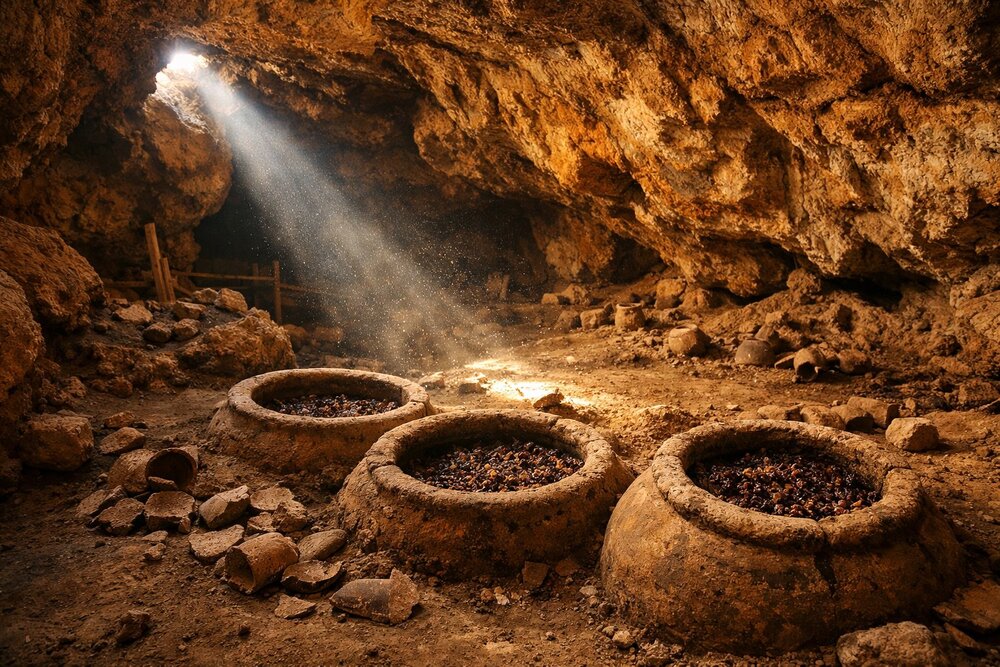
Armenia may be where wine began. In 2011, archaeologists excavating the Areni-1 cave in Vayots Dzor province uncovered a complete winery — fermentation vats, a wine press, storage jars, grape seeds, and residues — dating to approximately 4100 BC. This 6,100-year-old installation is the oldest known winemaking facility in the world. Wine is not something Armenia adopted — it's something Armenia may have invented.
Today, Armenia's wine renaissance is one of the most exciting stories in the wine world. After decades of Soviet-era bulk production and post-independence economic collapse, a new generation of winemakers is rediscovering indigenous grape varieties and ancient winemaking traditions, producing a small but fiercely original wine industry unlike anything else on Earth.
🍇 The Indigenous Grapes
🍷 Areni Noir — The Ancient One · KWS 87
Armenia's flagship red · Vayots Dzor, Ararat Valley · 6,100 years of history
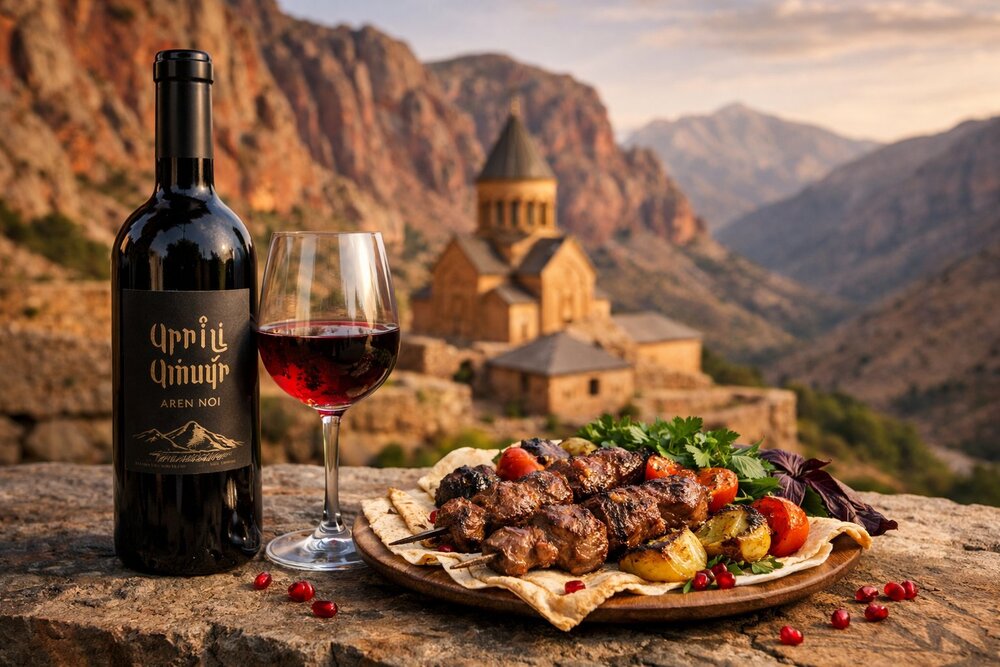
Areni Noir is Armenia's answer to Pinot Noir — a thin-skinned, aromatic red grape producing medium-bodied wines of extraordinary complexity: pomegranate, sour cherry, dried rose, and a distinctive mineral edge from the volcanic soils of Vayots Dzor. Light on its feet, high in acidity, with a savory, almost meaty finish — completely unlike anything from Bordeaux or Napa.
🥂 Voskehat — The Golden · KWS 83
Armenia's signature white · "Golden berry" · Aragatsotn, Armavir
Armenia's most important white grape — the name means "golden berry." Produces full-bodied, textured whites with stone fruit, honey, and wild herb aromatics. Vinified in traditional clay amphorae (karas), Voskehat develops an amber hue and oxidative complexity rivaling Georgian amber wines.
🍷 Karmrahyut — The Blood Red · KWS 81
Deep-colored blending grape · Ararat Valley
Literally "red juice" — Armenia's darkest grape, producing inky, tannic reds with blackberry, black pepper, and smoke. Often blended with Areni for structure and color depth; single-varietal bottlings are bold and demanding, best with grilled lamb on a cold mountain night.
🥃 Armenian Brandy — Churchill's Choice
Armenian brandy (konyak) is the country's most famous spirit and arguably its greatest contribution to distilled alcohol. The Ararat Brandy Factory in Yerevan, founded in 1887, produces brandy from indigenous grapes aged in Caucasian oak — the 20-year Nairi and the legendary Dvin are world-class spirits. Winston Churchill famously preferred Armenian brandy to French Cognac, and Stalin reportedly sent him 400 bottles a year; the Yalta Conference toasts were made with Armenian konyak.
Oghi (Armenian fruit brandy) is the traditional home spirit — distilled from mulberries, apricots, grapes, or plums in copper stills. Nearly every Armenian family has a relative who makes oghi; the mulberry version (tuti oghi) is the most prized, with a delicate floral sweetness that belies its 50–60% alcohol content. Refusing a toast of oghi is close to unthinkable.
🥂 Toasting Culture — The Tamada Tradition
Armenia shares the Caucasian tamada (toastmaster) tradition with Georgia. At any khorovats party, the tamada leads a sequence of formal toasts — to the host, to parents, to Armenia, to the absent, to love, to the dead. Each toast is a mini-speech, often poetic, always heartfelt. Glasses must be emptied completely. The evening builds in emotional intensity until the final toasts bring the table to tears or laughter, or both. This is drinking as communal ritual, refined over roughly 6,000 years of practice.
🏆 Kaufmann Wine Score — Armenia
Rated on four criteria: Aroma (/25), Taste (/30), Finish (/20), Value (/25) — Total /100
| Wine / Grape | 🔴 Aroma | 🟡 Taste | 🟢 Finish | 🔵 Value | Total |
|---|---|---|---|---|---|
| 🍷 Areni Noir | 22 | 25 | 16 | 24 | 87 |
| 🥂 Voskehat | 21 | 23 | 15 | 24 | 83 |
| 🍷 Karmrahyut | 19 | 23 | 14 | 25 | 81 |
| 🥂 Kangun (Karas, Armavir plain) | 20 | 24 | 15 | 23 | 82 |
✍️ Author's Note Radim Kaufmann
Standing in Areni-1 cave, looking at the 6,100-year-old wine press — the clay vat still stained with ancient grape residue — is one of the most moving experiences I've had in any wine region. This is where it started. Not in France, not in Italy, not in Georgia. Here, in a cave in a dry Armenian gorge, someone first figured out how to turn grapes into wine.
Modern Armenian wine is a revelation. Areni Noir from Vayots Dzor — pomegranate, sour cherry, dried herbs, volcanic minerality — tastes like nothing else. Zorah, ArmAs, Karas, and Van Ardi are producing wines of genuine international quality from grapes most wine drinkers have never heard of. And the prices are absurdly low: a bottle that would cost $50 from an equivalent Burgundy producer costs $12 in Armenia. Go now, before the world catches on.
