🍸 Cocktails & Mixed Drinks
Argentina's drinking culture is as passionate as its tango — from the sacred ritual of mate to the Fernet con Coca that fuels every boliche, and a spirit that predates the Aperol Spritz by more than a century.
Fernet con Coca
Argentina's Unofficial National Drink
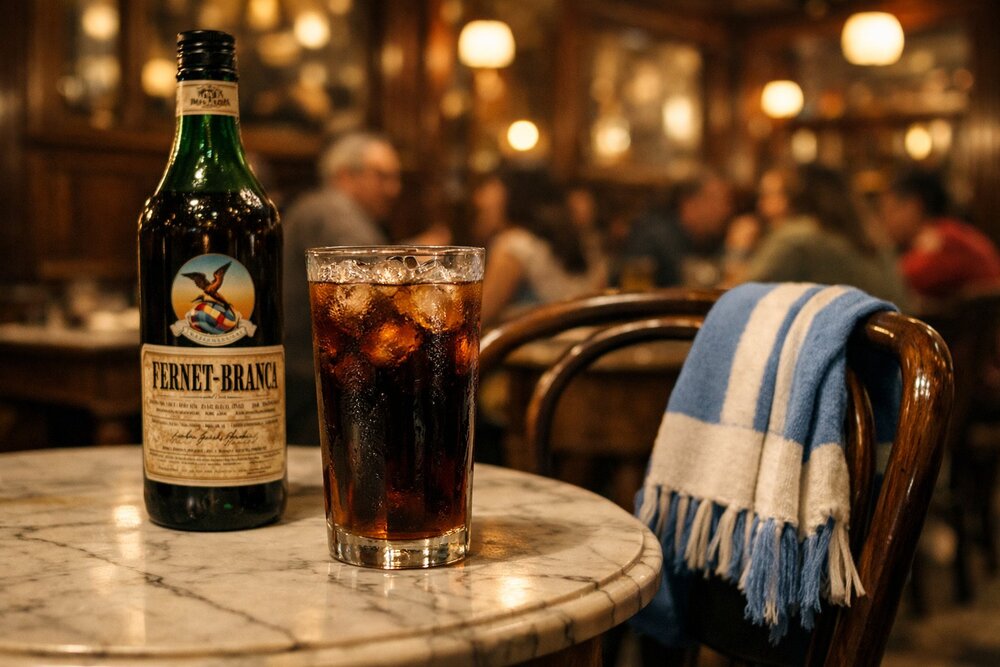
Roughly three-quarters of all Fernet-Branca produced globally ends up in Argentina. Mixed with Coca-Cola, it's the drink that defines a generation.
🥃 Tall glass · 🔨 Build
Ingredients: 60ml Fernet-Branca · 200ml Coca-Cola · ice · lime wedge
Preparation: fill a tall glass with ice. Pour Fernet-Branca over ice. Top slowly with Coca-Cola. Don't stir too much.
💡 The ratio is everything — Córdoba pours stronger than Buenos Aires. Start 1:3 and adjust.
Mate
The Sacred Ritual
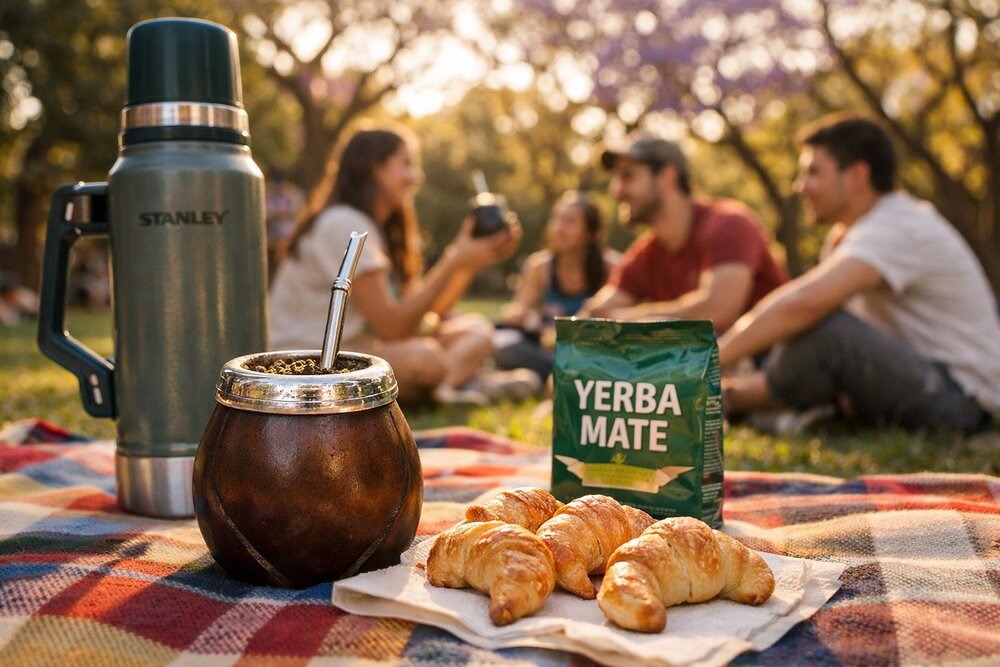
Not a cocktail, but the cultural cornerstone this section wouldn't be honest without — see People & Culture above for its full social meaning.
🥃 Mate gourd (calabaza) · 🔨 Infuse
Preparation: fill the gourd two-thirds with yerba mate, tilt to create a slope. Pour cool water on the lower side, insert the bombilla, then pour hot water (70–80°C, never boiling) slowly into the gap.
💡 Never stir the bombilla — it's the cardinal sin of mate etiquette. Don't say "gracias" until you've had enough.
Hesperidina Spritz
World's First Trademarked Spirit
Hesperidina — an orange-peel liqueur from 1864 Buenos Aires — holds the world's first spirit trademark. This spritz predates the Italian Aperol Spritz by over a century.
🥃 Wine glass · 🔨 Build
Ingredients: 60ml Hesperidina · 90ml sparkling wine · 30ml soda water · orange slice · green olive
Preparation: fill a wine glass with ice. Pour Hesperidina, then sparkling wine. Top with soda water. Garnish with orange slice and green olive.
💡 Created by Melville Bagley using bitter orange peels from Buenos Aires trees — Argentina built its trademark system partly to protect it.
Kaufmann Drinks Score (KDS)
| Drink | Style | KDS |
|---|---|---|
| Fernet con Coca | Argentina's Unofficial National Drink | 84 |
| Mate | The Sacred Ritual | 76 |
| Hesperidina Spritz | World's First Trademarked Spirit | 88 |
✦ Author's Note — Radim Kaufmann
In a San Telmo bar at midnight, the bartender poured Fernet into a tall glass with the precision of a surgeon and the pride of a gaucho. "Seventy percent of all Fernet Branca produced in the world comes to Argentina," he said, topping it with Coca-Cola. "We don't just drink it — we own it."
🍷 Wine, Spirits & Drinking Culture
Argentina is the fifth-largest wine producer on Earth and the spiritual home of Malbec — a grape France abandoned and Argentina transformed into one of the world's great red wines. With vineyards stretching from the Tropic of Capricorn to Patagonia, at altitudes ranging from 500 to 3,100 meters, Argentina possesses the most dramatic viticultural geography of any wine country. This is extreme winemaking: desert sun, Andean snowmelt irrigation, hailstorms that can destroy a vintage in minutes, and the ever-present zonda wind that roars down from the mountains like a hot furnace.
The numbers are staggering: 215,000 hectares under vine, 900+ wineries, over 1,200 million liters produced annually. Yet Argentina's wine revolution is barely two decades old — before the 2000s, most production was bulk wine for domestic consumption. The transformation into a world-class quality producer, led by Mendoza's Malbec, is one of the great stories in modern wine.
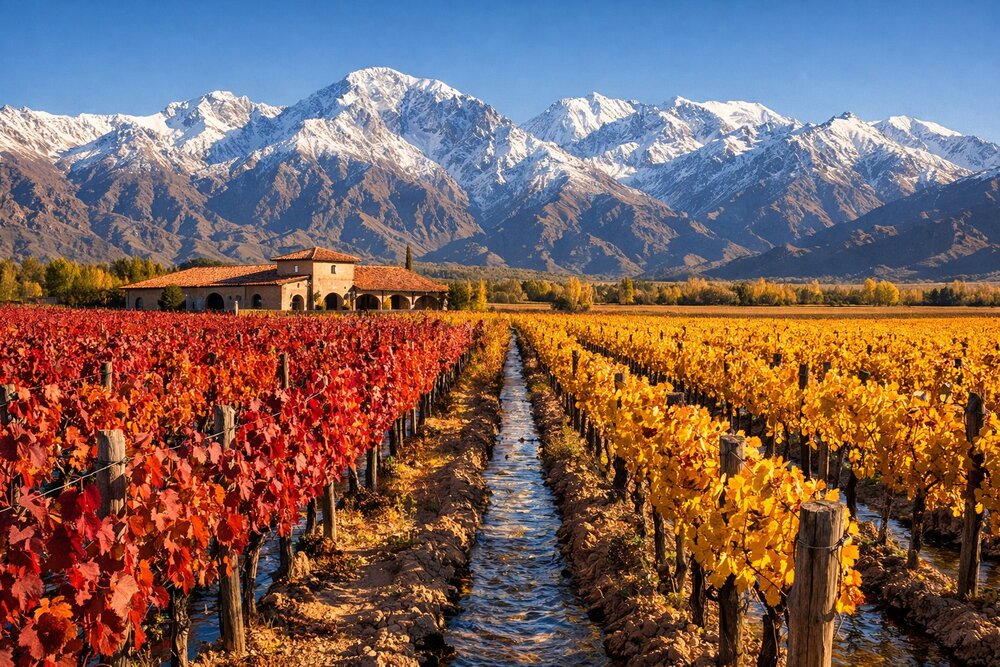
🏔️ The Wine Regions
🏔️ Mendoza — The Heartland (70% of production)
At the foot of the Andes, Mendoza is Argentina's Bordeaux — except at 800–1,500m altitude with 320 days of sunshine. Luján de Cuyo produces the most concentrated Malbecs from old vines planted in the early 1900s. Valle de Uco is the new frontier — cooler, higher, producing wines of extraordinary elegance that are redefining Argentine wine.
🌵 Salta & Cafayate — The Extreme Altitude
The Calchaquí Valley around Cafayate, at 1,700–3,100 meters, is home to the world's highest commercial vineyards — the kingdom of Torrontés, Argentina's signature white grape. Bodega Colomé at 2,300m and Altura Máxima at 3,111m push viticulture to its absolute limit.
🐧 Patagonia — The Cool Frontier
Neuquén and Río Negro represent Argentina's cool-climate revolution — Pinot Noir and Chardonnay of genuine Burgundian ambition. Bodega Chacra in Mainqué produces Argentina's most celebrated Pinot Noir from ungrafted 1930s vines.
☀️ San Juan — The Hot Producer
Argentina's second-largest wine region, hotter and drier than Mendoza, now producing excellent Syrah, Bonarda, and Malbec from Pedernal Valley at 1,400m.
🍇 The Key Grapes
🍷 Malbec — The King · KWS 92
Argentina's defining grape · 45,000+ hectares · Mendoza, Salta, Patagonia
In France (Cahors), Malbec is a tannic, rustic grape that never quite found its place. In Argentina, at altitude in desert sunshine irrigated by Andean snowmelt, it becomes something entirely different: deep violet-black, explosively fruity, with velvety tannins. The best Mendoza Malbecs from old vines rank among the world's great red wines — at $10–15, also the world's best everyday red wine value.
🥂 Torrontés — The Aromatic Queen · KWS 86
Argentina's unique white · Indigenous cross · Salta, La Rioja
A natural cross between Listán Prieto and Muscat of Alexandria that exists nowhere else. Torrontés from Cafayate is explosively aromatic — rose petals, jasmine, lychee — with a dry, crisp finish. Best served ice-cold with ceviche or spicy empanadas.
🍷 Bonarda — The Dark Horse · KWS 84
Argentina's second red · Italian origins · Mendoza, San Juan
Argentina's most planted red grape — surprisingly, not Malbec — produces juicy, fruity reds with soft tannins. At $5–8, it's the ultimate barbecue wine.
🍷 Cabernet Sauvignon · KWS 88
The noble backbone · Mendoza, Pedernal
Often overshadowed by Malbec, Argentine Cabernet at its best produces wines of genuine world-class quality. The Malbec-Cabernet blend is Argentina's answer to Bordeaux.
🥩 Wine & Asado — The Sacred Pairing
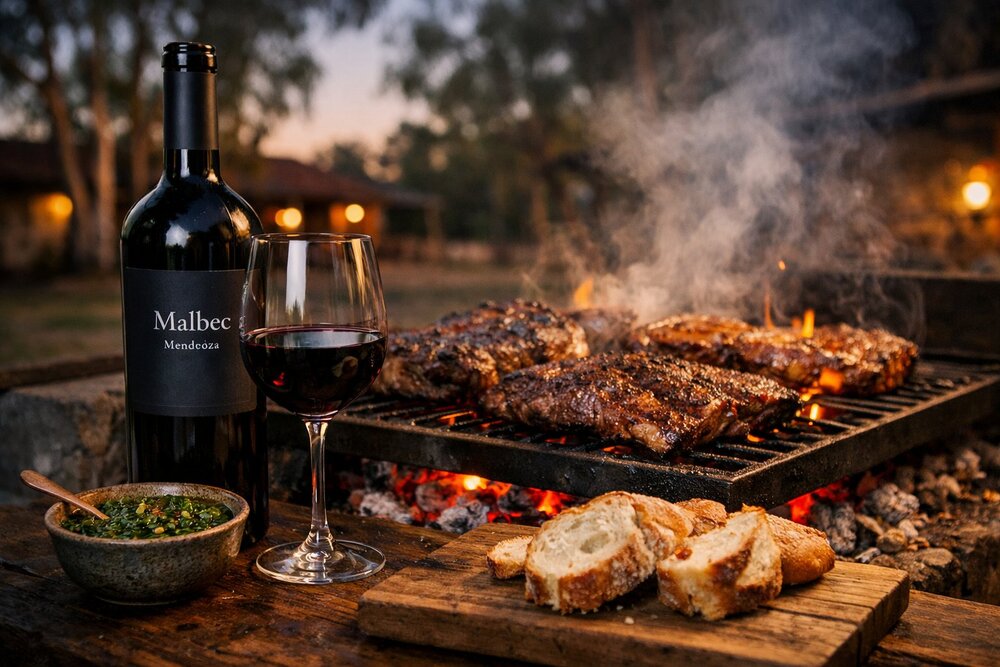
The Argentine asado is wine's greatest companion. A proper asado unfolds over 4–6 hours: provoleta cheese first, then chorizo and morcilla, then the main cuts — entraña, vacío, ojo de bife — all cooked slowly over wood embers. The wine flows throughout, progressing to the best Malbec for the main event. Wood-smoked beef and high-altitude Malbec is one of the world's perfect food-wine pairings.
🏆 Kaufmann Wine Score — Argentina
Rated on four criteria: Aroma (/25), Taste (/30), Finish (/20), Value (/25) — Total /100
| Wine / Grape | 🔴 Aroma | 🟡 Taste | 🟢 Finish | 🔵 Value | Total |
|---|---|---|---|---|---|
| 🍷 Malbec (Mendoza) | 24 | 28 | 17 | 23 | 92 |
| 🍷 Cabernet Sauvignon | 22 | 26 | 17 | 23 | 88 |
| 🥂 Torrontés (Cafayate) | 23 | 24 | 15 | 24 | 86 |
| 🍷 Bonarda | 20 | 25 | 14 | 25 | 84 |
| 🍷 Pinot Noir (Patagonia) | 21 | 24 | 16 | 22 | 83 |
✍️ Author's Note Radim Kaufmann
Argentina at 92 for Malbec is not a controversial score — it's a statement of fact. Mendoza Malbec from vines planted at 1,000+ meters in desert sunshine irrigated by Andean snowmelt is one of the world's great red wines. A $15 Argentine Malbec will outperform most $40 wines from anywhere else on Earth.
But the real Argentine wine experience is not in a tasting room. It's at an asado in someone's backyard — smoke rising from the parilla, a circle of friends passing mate, the asador opening a bottle of Malbec with a pocketknife because nobody can find the corkscrew, and the slow, beautiful Argentine afternoon stretching into evening. That is why this country, more than any other, understands that wine is not a product — it's a way of life.
