📊 The Economy at a Glance
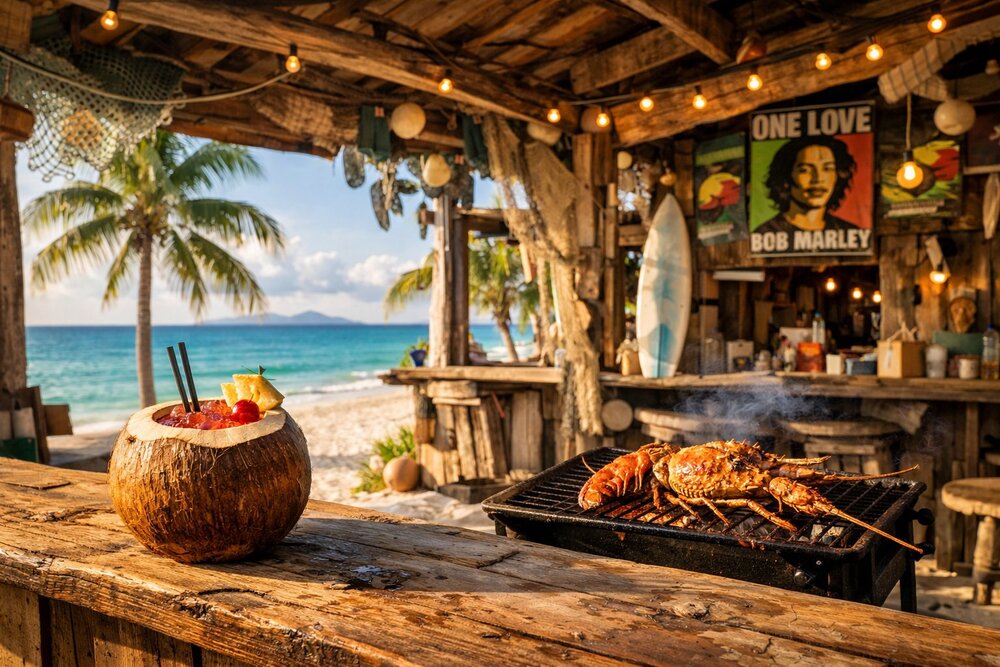
High-End Tourism
The other 37% of GDP — beach bars, grilled lobster, and the resort economy that defines Anguilla's brand.
Anguilla's economy has long rested on two legs: high-end tourism (around 37% of GDP) and offshore financial services. Both are genuinely significant, and both are genuinely fragile in ways that matter for understanding the island. Hurricane Irma wiped out an estimated 90% of Anguilla's GDP in 2017; COVID-19 crashed the travel sector shortly after, leaving the government facing a budget shortfall of roughly $100 million by 2021. A tourism-dependent micro-economy on a hurricane-prone island is, by definition, a vulnerable one.
Which is what makes the past three years so remarkable. A third leg has appeared, seemingly out of nowhere, and it now rivals tourism as a revenue source: the government's income from leasing out Anguilla's own two-letter internet domain, .ai.
💻 The .ai Windfall
The .ai Windfall
A routine 1995 ISO code assignment turned into a government revenue line nobody saw coming.
In 1995, the International Organization for Standardization assigned Anguilla the two-letter country code "AI" for internet infrastructure purposes — a routine administrative act with no more significance, at the time, than Tuvalu getting ".tv" or Montenegro getting ".me." For nearly three decades, .ai stayed a minor curiosity, opened to public registration and generating modest sums: about $2.9 million in 2018, under 4% of government revenue, from roughly 50,000 domains registered that year.
Then, in November 2022, OpenAI launched ChatGPT. Every founder building anything AI-adjacent suddenly wanted the two letters "ai" at the end of their URL, and Anguilla happened to own them. The numbers since read like a hockey stick: $32 million in 2023 (22% of government revenue, 354,000 domains registered), $39 million in 2024, and $85–93 million in 2025 — a staggering 47% of the government's total revenue in a single year. Registrations passed one million in January 2026, and the 2026 budget projected roughly $96.4 million, with total registrations potentially reaching 1.7 million by year's end.
The mechanics are simple: nobody buys a .ai domain outright, they lease it, typically two years at a time, at a wholesale price Anguilla sets and collects directly regardless of which retailer (GoDaddy, Namecheap, and others) handles the actual sale. A standard two-year registration runs about $140, and the renewal rate has stayed remarkably high — companies that adopt a .ai domain tend to keep it. The registry itself is managed on Anguilla's behalf by Identity Digital, a US-based company, under a revenue-sharing agreement; Vince Cate ran the domain independently for decades before that arrangement. The aftermarket has produced some startling individual sales: you.ai went for $700,000 in September 2025, wisdom.ai for $750,000 in October 2025, and bot.ai for $1.2 million in February 2026 — the highest publicly known .ai sale to date. Recognizable names running on the extension include Anthropic's own claude.ai, alongside x.ai, character.ai, and google.ai.
📈 Revenue Growth, Year by Year
| Year | .ai Revenue | % of Gov't Revenue |
|---|---|---|
| 2018 | $2.9M | ~4% |
| 2023 | $32M | 22% |
| 2024 | $39M | ~23% |
| 2025 | $85–93M | ~47% |
| 2026 (forecast) | ~$96.4M | ~45% |
Figures compiled from Anguilla government budget addresses, Domaintechnik, and financial press reporting; treat 2025–2026 figures as directional rather than final.
The government has, credibly, put the windfall toward durable things rather than just recurring spending: expansion of Clayton J. Lloyd International Airport, road development, expanded healthcare, and goods-and-services tax relief. Officials — including former Premier Ellis Webster and current Premier Cora Richardson Hodge — have been publicly cautious about over-relying on a boom that could, in principle, fade the way Tuvalu's .tv windfall cooled once the streaming-platform gold rush that drove it matured. Whether AI branding stays as fashionable a decade from now as it is today is genuinely an open question — but for now, a tiny Caribbean territory is banking more from two letters than most of its neighbors make from tourism alone.
🏢 Starting a Company in Anguilla
Signing the Paperwork
Lower costs and lighter scrutiny than the BVI or Cayman Islands, with the same offshore fundamentals.
Anguilla has quietly run an offshore financial services industry for decades, overshadowed by higher-profile neighbors like the BVI and the Cayman Islands — which, in practice, means lower costs and lighter scrutiny for entities that qualify. The two standard vehicles are the Business Company (BC), still commonly called an IBC (International Business Company) under its older name, and the Limited Liability Company (LLC). Around 80% of new formations choose the BC/IBC structure; LLCs are gaining ground, particularly for real estate and joint ventures involving US investors.
The realistic process looks like this: you cannot incorporate without a licensed local registered agent — this is a hard legal requirement, not a formality to skip. The agent files your Articles of Incorporation through ACORN (Anguilla's Commercial Online Registration Network), a government-run electronic registry that processes filings the moment KYC documentation clears, 24 hours a day, every day of the year. There's no paper queue and no waiting on a civil servant — Anguilla was genuinely early to instant electronic incorporation among Caribbean jurisdictions, and formation inside 24 hours is the operational norm rather than a marketing promise. You'll need: a proposed company name (with alternates in case of conflicts), at least one director and one shareholder (who can be the same person, resident anywhere, corporate entities permitted), and standard KYC — passport copies, proof of address, and a source-of-funds declaration for beneficial owners.
What you get: an IBC earning no Anguilla-sourced income pays no corporate tax, capital gains tax, withholding tax on dividends, or inheritance tax — it is tax-neutral at the corporate level, though your own country's tax and disclosure rules on foreign income still apply to you personally, whatever Anguilla itself charges. Director and shareholder details stay off the public registry — held privately by the registered agent, disclosed only on formal legal request from another government's authorities, not published for anyone to search. There are no mandatory shareholder or director meetings, no financial audit requirement for most structures, and no local business restrictions beyond the basic rule that IBCs operate outside Anguilla itself. In practice, these structures get used for holding companies, asset protection, intellectual property holding, and international trade — not for running a shop in The Valley, which requires a separate domestic business license entirely.
📈 The Stock Exchange — Honestly, There Isn't One
Anguilla has no stock exchange of its own, and there's no realistic near-term prospect of one — a market this size couldn't support meaningful liquidity even if a building went up tomorrow. As a member of the Eastern Caribbean Currency Union, Anguilla sits within the catchment of the Eastern Caribbean Securities Exchange (ECSE), based in Basseterre, Saint Kitts, which serves the whole eight-territory currency union as a shared regional market. In practice, essentially no Anguillian company lists there or anywhere else — the IBC and LLC structures that define Anguilla's corporate sector were built for privacy and asset protection, not for raising public capital, and that's simply not what they're for. If you're structuring a business in Anguilla with a public listing in mind eventually, plan for that listing to happen somewhere else entirely — Anguilla's role in that story is the incorporation, not the IPO.
🏗️ What Actually Runs the Economy
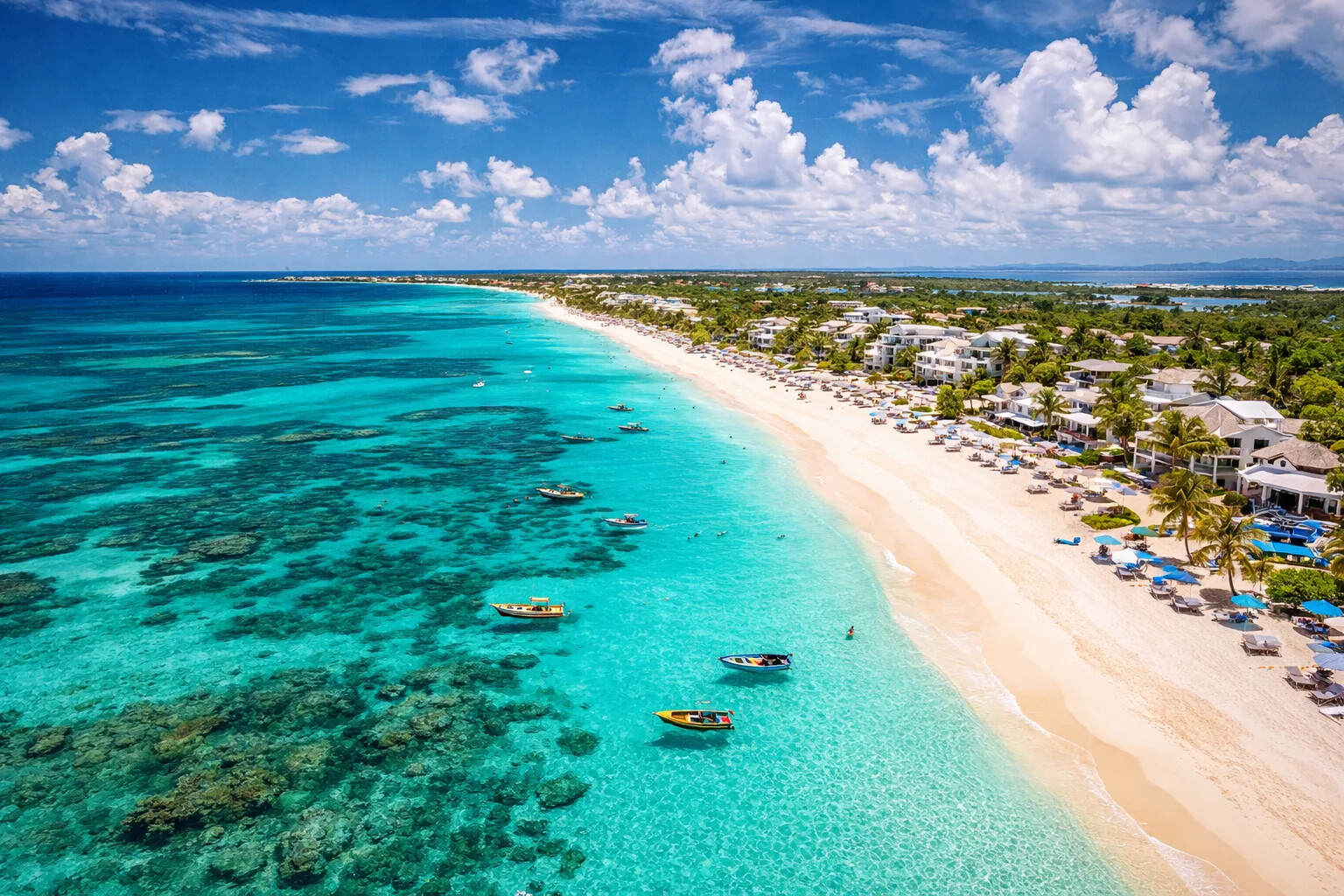
The Resort Economy
Four Seasons and other hospitality names line Anguilla's coastline — the visible face of the private sector.
Beyond the .ai revenue line and the offshore registry, Anguilla's visible private sector is dominated by the resort and hospitality names that also define the tourism experience: Four Seasons Resort Anguilla and Belmond Cap Juluca are the largest single private employers on the island, alongside CuisinArt Golf Resort & Spa, whose hydroponic farm also supplies produce beyond its own kitchens. National Bank of Anguilla and a handful of licensed offshore banks and insurers make up the financial sector proper — small by design, serving the IBC/LLC ecosystem rather than a domestic retail market of any size. Fishing remains an active small-scale industry, especially around Island Harbour, supplying the crayfish and reef fish that define the island's restaurant scene covered in the Food & Drink guide.
There is no manufacturing sector to speak of and no realistic prospect of one — a 91 km² coral island with no fresh water rivers and a workforce of roughly 15,700 was never going to build an industrial base, and nobody involved is pretending otherwise. What Anguilla has instead is a genuinely unusual combination for a territory this size: a luxury tourism brand strong enough to fill $2,500-a-night rooms, a discreet but functional offshore finance sector, and, as of the last three years, a domain-leasing income stream that would be the envy of countries a hundred times its population. It's an odd portfolio. It also, currently, works.
