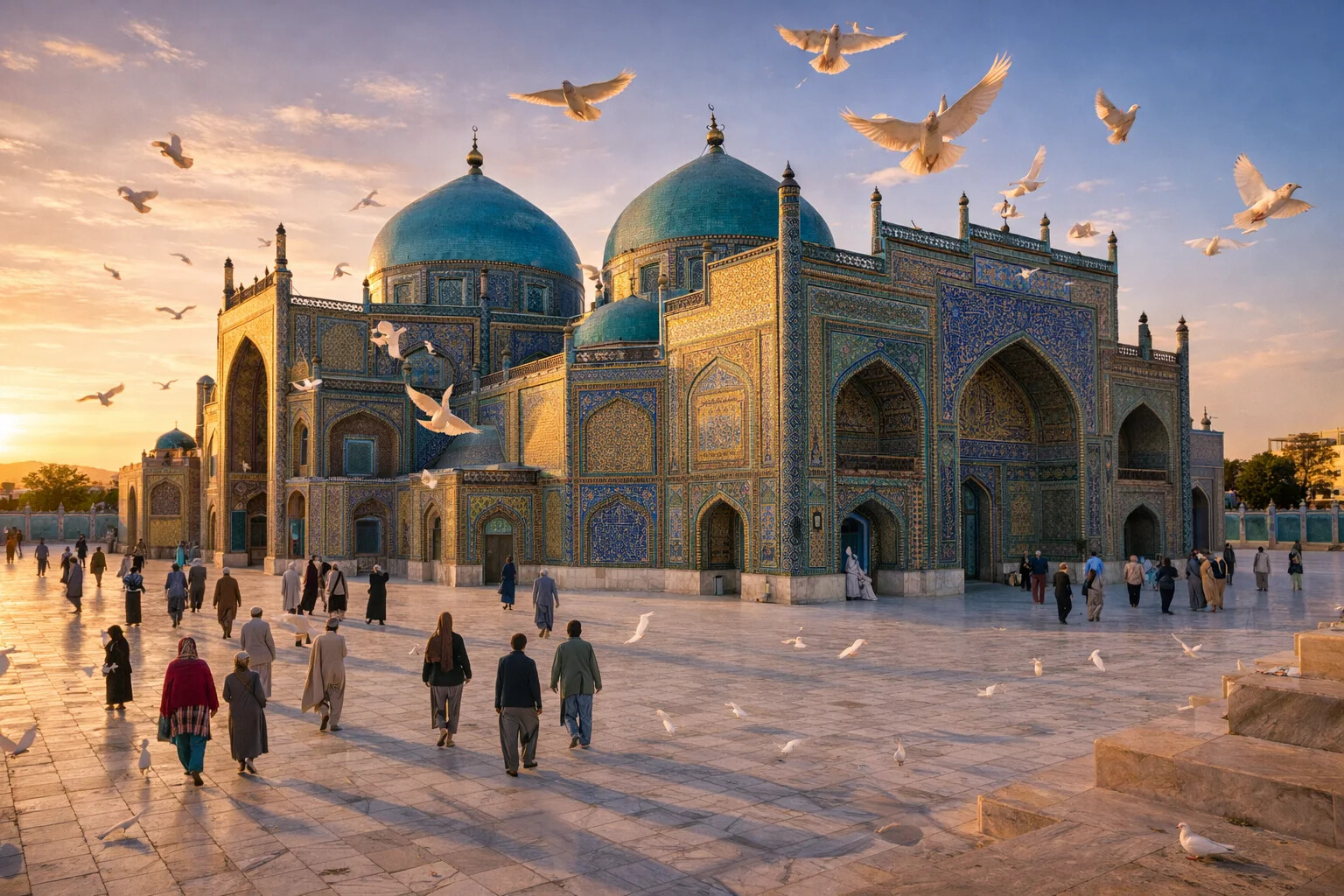
Do not travel to Afghanistan. The U.S. Department of State’s Level 4 advisory was verified on 8 October 2026. The heritage material below is provided for education and remote exploration.
Afghanistan holds two UNESCO World Heritage Sites — both inscribed for their extraordinary cultural significance, and both on the List of World Heritage in Danger.
Bamiyan Valley — Cultural Landscape and Archaeological Remains (inscribed 2003). Once home to two colossal standing Buddhas — 55 and 38 meters tall, carved into the cliffside in the 6th century — Bamiyan was a major stop on the Silk Road where Buddhist, Hellenistic, and Central Asian artistic traditions fused. The Taliban dynamited both statues in March 2001; only the niches and fragments remain, alongside hundreds of caves once used as monastic cells, many still decorated with fragments of the world's oldest known oil paintings. UNESCO listed the site as endangered the same year it was inscribed, citing the destruction plus ongoing risks from erosion, looting, and unstable cliff faces.
Minaret and Archaeological Remains of Jam (inscribed 2002). At 65 meters, this is the second-highest standing minaret in the world after Delhi's Qutb Minar, raised around 1190 CE by the Ghurid Sultan Ghiyath al-Din Muhammad, its surface covered in intricate geometric brickwork and a Kufic inscription band. It stands almost entirely alone at the confluence of the Hari and Jam rivers, in one of the most remote corners of the country — the isolation that helped it survive centuries of upheaval is the same isolation now threatening it, as river erosion undermines its foundations and its location makes conservation work extremely difficult. It is reachable only by a rough multi-day overland route from Chaghcharan or Herat, and very few travelers make the trip.
02
🗺️ Understanding the Sites — Not a Travel Recommendation
Safety notice, reviewed 8 October 2026: the U.S. Department of State lists Afghanistan at Level 4 — Do Not Travel — citing unrest, crime, terrorism, kidnapping or hostage taking, wrongful detention, health risks and natural disasters. This page is cultural and historical reference material; it is not advice to enter Afghanistan or attempt an overland circuit.
Bamiyan and Jam belong to different geographic worlds. Bamiyan lies northwest of Kabul in the central highlands, while the Minaret of Jam stands in an exceptionally remote valley of Ghor Province. Roads, communications, emergency support and access conditions can change without warning. Describing the two places as a normal visitor itinerary would understate the risks and the absence of dependable consular assistance.
Bamiyan Valley can be studied through UNESCO documentation, museum collections, archaeological publications and carefully sourced visual records. The surviving cliff niches, caves, fortified structures and painted remains illuminate a long encounter among Buddhist, Hellenistic, Iranian, Indian and Central Asian traditions. UNESCO continues to describe parts of the property as fragile after the destruction of the monumental Buddhas in 2001.
The Minaret of Jam is best understood as both a masterpiece of Ghurid architecture and an endangered conservation site. Its isolation helped preserve it, yet river erosion, flooding, instability and difficult access complicate monitoring and repair. Readers should use UNESCO’s official property records for conservation status rather than treating old travel reports as evidence that a route is currently safe or open.
If official travel advice changes in the future, verify it immediately before making any decision, consult the foreign ministry responsible for your nationality, and never rely on this historical guide as a real-time security service. Until authoritative warnings change, the responsible recommendation is not to travel.
Share Your Photo
Have an Afghanistan photograph you own? Attach it to your email and include the location and the name you want credited.