Turquoise domes and red desert sands — the Silk Road's greatest cities, and one of the richest gold deposits ever discovered, hidden for centuries beneath the dunes.
Expanded and reviewed September 28, 2026 · EN / CZ / UZ
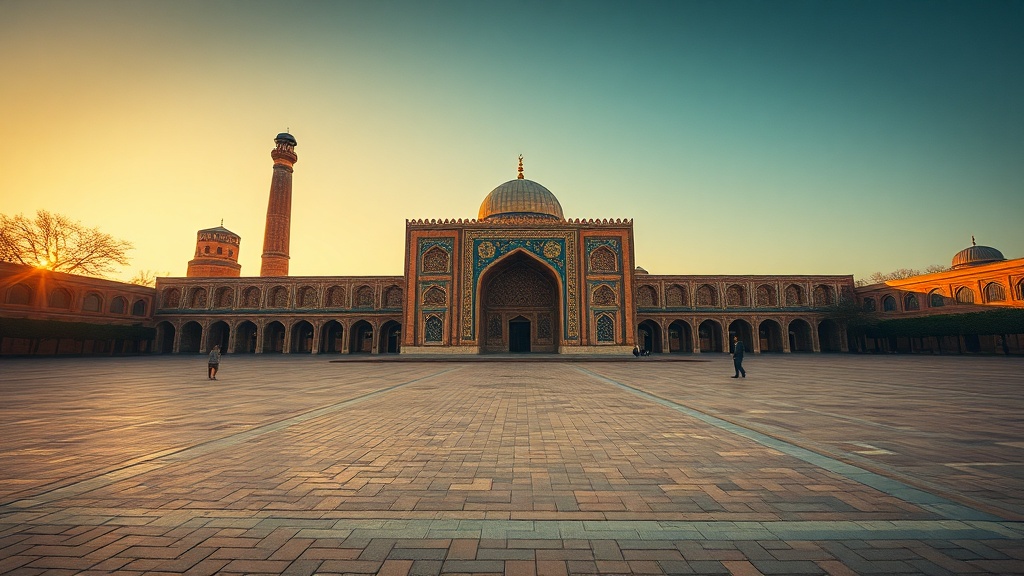
Uzbekistan is the beating heart of Central Asia's Silk Road — a land of turquoise-domed mosques, madrasas shimmering with tilework, and desert cities that once served as the intellectual and commercial crossroads of the medieval world. From the Registan in Samarkand to the walled museum-city of Khiva, Uzbekistan offers one of the world's great architectural and historical travel experiences.
It is also, by a wide margin, the most populous country in Central Asia. Preliminary results of the 2026 national census put the population at 39,047,321 as of 15 January 2026 — some 810,600 people more than the statistical estimates had projected, which is itself the more interesting number: Uzbekistan turned out to be bigger than its own bookkeeping suggested. Soviet-era apartment blocks stand alongside 14th-century masterpieces, bazaars sell mountains of dried fruit much as they did in Tamerlane's time, and a genuine cultural and economic reopening is underway.
That reopening shows in the visitor numbers. Uzbekistan received 11.7 million foreign visitors in 2025, up nearly 47% year on year and an all-time record, with tourism service exports passing USD 4.4 billion. From April 2025 onward monthly arrivals topped one million for the first time in the country's history. The government's stated target is 20 million international tourists by 2030.
Who runs the country: the head of state is President Shavkat Mirziyoyev, in office since 14 December 2016 and re-elected in 2023 to a term running to 2030. The head of government is Prime Minister Abdulla Aripov, also in post since 14 December 2016 — one of the longest-serving prime ministers in the region.
🟢 Travel advisory: the U.S. State Department rates Uzbekistan Level 1 — Exercise Normal Precautions (advisory dated 26 January 2026), its lowest and safest tier. A separate March 2026 worldwide caution asks travellers across Central Asia to stay alert, but no country-specific warning applies. Uzbekistan is one of the safest destinations in the region for visitors.
02
Name & Identity
The name "Uzbekistan" is generally traced to Özbeg Khan, the 14th-century ruler of the Golden Horde who made Islam the horde's state religion; his name attached to the Turkic tribal confederation that eventually settled the region. The suffix "-stan" means "land of" in Persian. The country's own name for itself is Oʼzbekiston Respublikasi.
Uzbek identity is rooted in the Timurid inheritance. Tamerlane (Amir Timur) is the national hero, and his statue replaced Lenin's in city squares across the country after independence in 1991 — a substitution so thorough it is now hard to find a provincial capital without one. Uzbek culture is a fusion of Turkic nomadic tradition and Persian sedentary civilisation, and both halves are visible in the language, the food and the architecture.
The mahalla — the traditional neighbourhood community — remains the fundamental social unit, sharing celebrations, grief and daily obligations. Mehmondoʼstlik (hospitality) is close to sacred: guests are treated with extravagant generosity, and refusing food or drink outright is read as an insult. Tashkent's mahallas are themselves on Uzbekistan's UNESCO Tentative List, submitted in 2021.
03
Geography
Uzbekistan is a doubly landlocked country — one of only two on Earth, along with Liechtenstein, where you must cross at least two international borders to reach any sea. Its 448,978 km² span three distinct landscapes: the fertile Fergana Valley in the east, the vast Kyzylkum Desert across the centre and west, and the mountains rising along the Kyrgyz and Tajik frontiers. (Some sources give 447,400 km²; the difference is a boundary-delimitation artefact rather than a factual dispute.)
The country borders five nations: Kazakhstan, Kyrgyzstan, Tajikistan, Afghanistan and Turkmenistan. The Fergana Valley, split between three of them, is Central Asia's most densely populated and agriculturally productive region. Summers are brutal — Bukhara and Khiva routinely pass 40°C — while winters bring snow to Tashkent and hard frost across the steppe. The Chimgan Mountains an hour from Tashkent offer skiing in winter and hiking in summer.
The Aral Sea. Once the world's fourth-largest lake, it has collapsed to a fraction of its former extent after decades of Soviet cotton irrigation diverted the Amu Darya and Syr Darya. The dried seabed inside Uzbekistan now covers 2.7 million hectares, most of it in Karakalpakstan — a new salt desert called the Aralkum. It is not a static ruin: under the UNDP-backed Green Aral Sea initiative, saxaul, saltwort, ephedra and tamarisk are being sown across the seabed to bind the salt and dust, with 823,000 trees planted over five years of the project and further planting stages continuing through 2025 and 2026.
04
🏜️ The Red Sands and the Gold Beneath Them
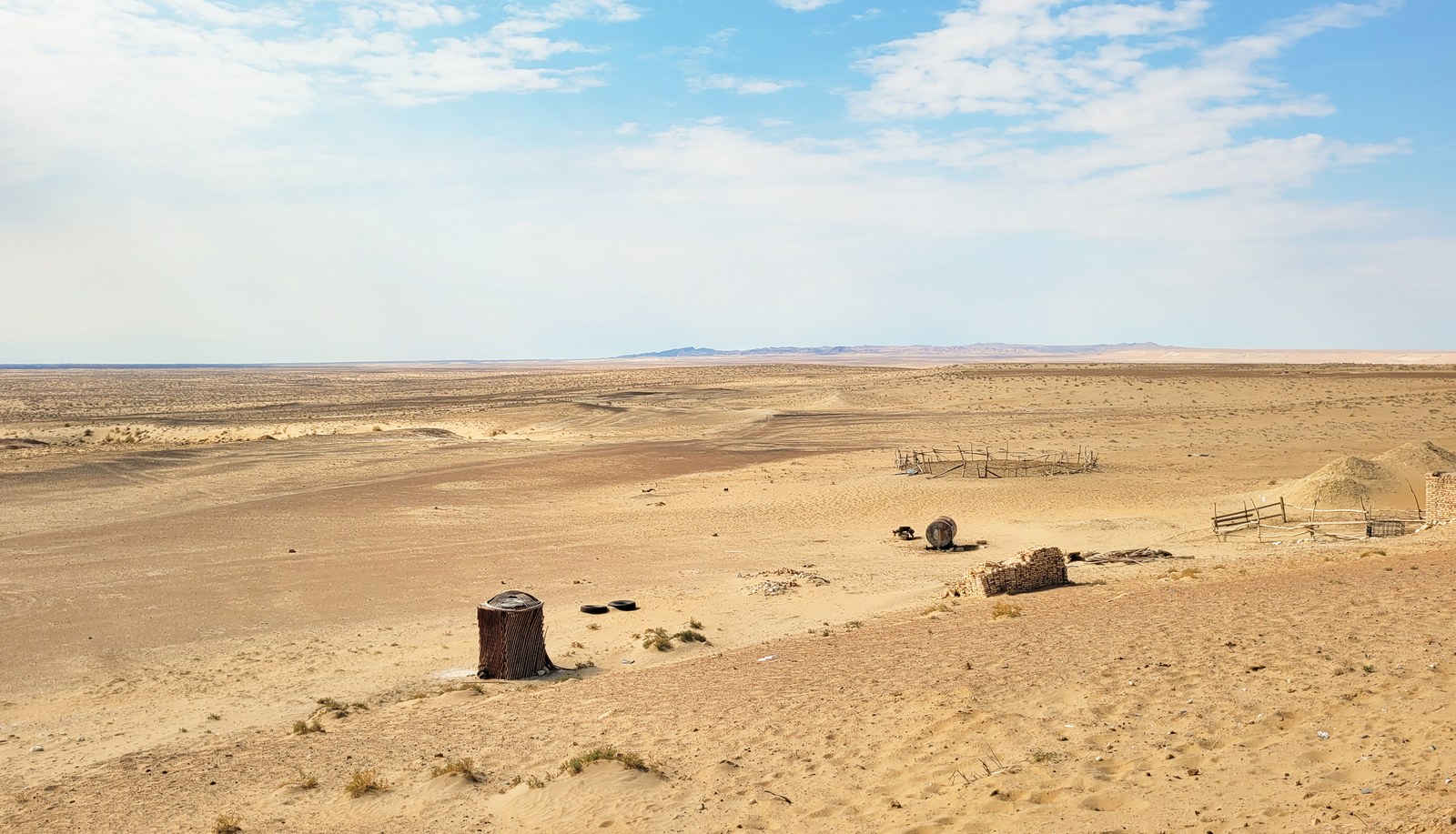
Kyzylkum — Qizilqum in Uzbek — simply means "red sand" in the Turkic languages, and the name describes real geology: iron-oxide-stained dunes covering roughly 300,000 km² between the Amu Darya and Syr Darya rivers, the world's 15th-largest desert and, at over half of Uzbekistan's entire territory, the landscape most of the country actually sits on. For a thousand years the Silk Road ran straight through it, linking Bukhara, Samarkand and Khiva; camel caravans, sun-cracked clay takyrs, wandering dune fields up to 75 meters high, and oasis settlements along the rivers are still exactly what a visitor finds today. What almost none of those caravans ever suspected is that they were walking over one of the richest concentrations of gold on the entire planet.
The Kyzylkum — "red sand" — near Ayaz-Kala in western Uzbekistan.
Turquoise, Not Gold
For centuries, the low mountains of the central Kyzylkum were known to locals for one thing: turquoise. There were no glittering veins, no dramatic outcrops, nothing that would make a prospector's pulse quicken. The gold that lay beneath — more of it than in any other single deposit ever found on Earth — gave no surface hint of its existence at all. It stayed invisible until well into the 20th century, when the tools needed to find it had nothing to do with a pickaxe.
Discovered by Chemistry, Not by Chance
Soviet geologists located the deposit in 1958 through systematic geochemical survey work — soil and rock sampling across the desert, hunting for chemical signatures rather than visible ore — and confirmed a discovery so large that even experienced geologists initially struggled to accept the numbers. Industrial mining began on 21 July 1969, near what is now the city of Navoi.
Where Two Faults Cross
The deposit's own geology explains why it sat hidden for so long — and why it's so enormous. The gold is hosted in the Besopan Suite, a five-kilometer-thick pile of turbidite siltstones and shales laid down roughly 450–490 million years ago, during the Cambrian and Ordovician periods. Gold-bearing fluids first moved through the rock along the Sangruntau–Tamdytau shear zone, a deep fault system following the boundary between two rock units. Later, a second fault system — the Muruntau–Daugyztau shear zone — activated at almost a right angle to the first, while molten granite intruded from below. Where those two fault systems crossed, the rock cracked open into countless small dilational fractures, and the intersection acted like a geological funnel: hydrothermal fluid, repeatedly refocused into the newly opened cracks, deposited gold there in concentrations found nowhere else on the planet. It is, in essence, a treasure buried at the intersection of two faults — precisely the kind of structural trap economic geologists now search for deliberately, using Muruntau itself as the textbook example.
The World's Deepest Gold Pit
What Soviet chemists found in 1958 has become the Muruntau mine — the largest open-pit gold mine on Earth, an excavated bowl roughly 3.5 km long, 2.5 km wide and, as of the mid-2020s, more than 600 meters deep, with plans to push past 1,000 meters. Total resources are estimated above 100 million ounces of gold (some 3,000+ tonnes), making Muruntau the largest single gold deposit ever discovered anywhere in the world. It's operated by the state-owned Navoi Mining and Metallurgical Company (NMMC), headquartered in the namesake city that grew up around the mine in the desert.
Uzbekistan's Golden Giant, Today
Muruntau alone still accounts for roughly 90% of Uzbekistan's national gold output, and NMMC has grown into the world's fourth-largest gold producer, overtaking Russia's Polyus in 2025 with 3.1 million ounces produced that year and a stated goal of reaching 4 million ounces by 2030 on the back of roughly $600 million in annual investment. NMMC is reportedly weighing a London stock listing — a striking modern chapter for a deposit that spent centuries as nothing more than a rumor of turquoise in the red sand.
05
🗺 Map of Uzbekistan
The classic Silk Road route runs west from Tashkent through Samarkand and Bukhara to Khiva, with Moynaq and the dried Aral seabed far to the northwest.
This territory has sat at the centre of world history for millennia. Samarkand, Bukhara and Khiva were key stops on the Silk Road linking China to the Mediterranean. Alexander the Great conquered the region in 329 BC and married the Sogdian noblewoman Roxana near modern Samarkand. Arab armies brought Islam in the 8th century, and the region became a centre of scholarship: al-Bukhari, al-Khwarizmi — whose name and whose book title gave English the words algorithm and algebra — and Ibn Sina (Avicenna) all came from what is now Uzbekistan or its immediate borderlands.
The 14th century brought Timur, who built an empire reaching from Delhi to Damascus and turned Samarkand into a capital rivalling any city on Earth. His grandson Ulugh Beg built an observatory there whose star catalogue remained the most accurate in the world for roughly two centuries. The khanates of Bukhara, Khiva and Kokand ruled until the Russian conquest of the 1860s–70s. Soviet rule (1924–1991) brought mass literacy and industry, and also the cotton monoculture that killed the Aral Sea.
Independence came on 1 September 1991. Islam Karimov governed until his death in September 2016; Shavkat Mirziyoyev succeeded him that December and began the reform programme — currency convertibility, visa liberalisation, the abolition of exit visas, an end to systematic forced cotton labour — that has defined the past decade.
07
People & Culture
Uzbekistan's roughly 39 million people are predominantly Uzbek (about 83.8%), with Tajiks (~4.8%), Kazakhs (~2.5%), Russians (~2.3%) and Karakalpaks (~2.2%) the largest minorities and the remaining few per cent spread across Tatars, Kyrgyz, Koreans, Turkmen and others. Karakalpakstan, the vast autonomous republic in the northwest, has its own language, parliament and distinct identity.
The country is overwhelmingly Muslim, mostly Sunni of the Hanafi school, but seventy years of Soviet secularism produced a moderate, culturally Muslim society in which alcohol is sold openly and relatively few women cover their hair outside religious settings. Family is the organising principle: extended families often live together, and weddings are multi-day affairs that can run to several hundred guests.
Traditional crafts are living trades, not museum pieces: Bukhara's gold embroidery (zarduzi), Margilan's ikat silk (atlas and adras), Rishtan's blue-and-white ceramics, and Samarkand's mulberry-bark paper, made by medieval method. The suzani, a large embroidered wall textile, is the most recognisable Uzbek art form.
On UNESCO's Intangible Cultural Heritage lists:Shashmaqom music, proclaimed a Masterpiece in 2003 and inscribed on the Representative List in 2008, shared with Tajikistan; and the art of bakhshi, the epic storytellers who perform dastans, inscribed in 2021. Navruz is inscribed as a multinational element. Kurash, the national belt wrestling, is often described online as UNESCO-listed — it is not; it remains a candidate element under consideration.
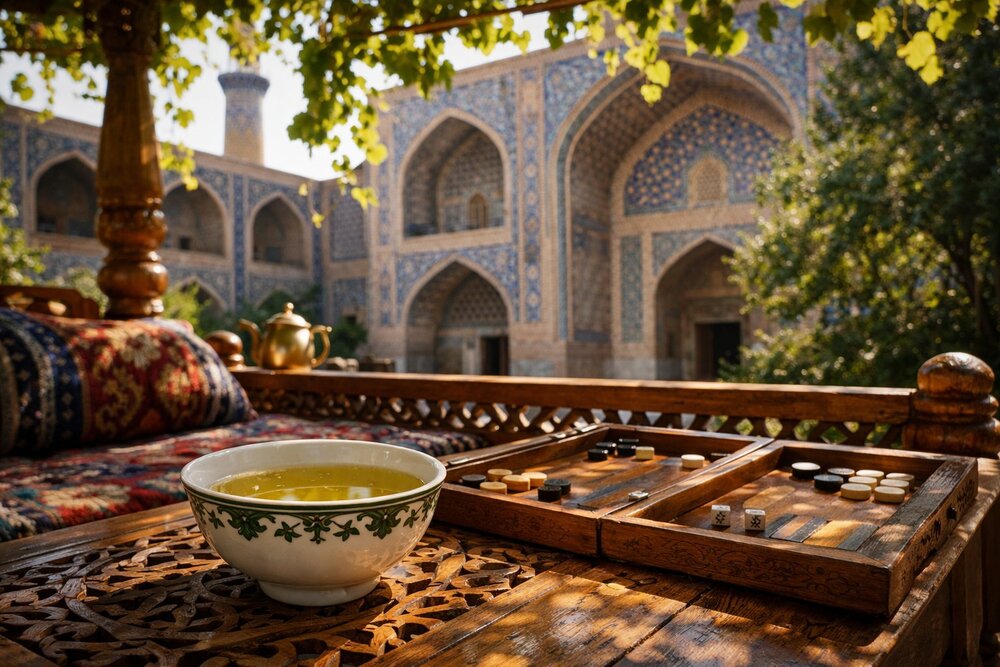
Chaikhanas — teahouses — remain the default social space, where green tea is drunk, backgammon is played and business is quietly transacted.
Samarkand is one of the world's oldest continuously inhabited cities, founded around the 7th century BC as Afrasiab (Greek Maracanda). Its UNESCO inscription, in 2001, is literally titled Samarkand – Crossroad of Cultures. The Registan — the Ulugh Beg (1417–1420), Sher-Dor (1619–1636) and Tilya-Kori (1646–1660) madrasas arranged around one vast square — is the crown jewel. The line "Everything I have heard about the beauty of Samarkand is true, except that it is even more beautiful than I imagined" is universally attributed to Alexander the Great; no ancient source records it, and it is best treated as a good line rather than a quotation.
Beyond the Registan, the Shah-i-Zinda necropolis is a corridor of tombs carrying the finest tilework in Central Asia. The Bibi-Khanym Mosque, commissioned by Timur in the 1390s as one of the largest mosques in the Islamic world, overreached its own engineering and began collapsing within decades; the present structure is a 20th-century restoration. Ulugh Beg's Observatory sits on the Afrasiab hill, its great sextant arc still sunk into the bedrock. The Siab Bazaar is the city's soul — golden non bread stacked in towers, dried apricots, and pomegranate juice pressed while you wait.
Samarkand was the subject of a UNESCO conference in November 2025 marking "3,000 Years of Heritage", and the property remains under active state-of-conservation monitoring over urban development pressure.
Bukhara — Bukhoro-i-Sharif, Noble Bukhara — was the great centre of Islamic theology and learning in Central Asia, and its scholars shaped Sunni jurisprudence far beyond the region. The Historic Centre was inscribed by UNESCO in 1993 and contains well over a hundred protected monuments spanning two millennia. The Kalyan Minaret, completed in 1127, is the emblem: Genghis Khan is said to have spared it in 1220 while razing nearly everything around it.
Walking the old town feels like stepping back centuries. The Lyabi-Hauz plaza, shaded by mulberry trees around a 17th-century pool, is the obvious place to sit with tea. The Ark fortress, residence of the emirs for a millennium, looms over the western edge. The covered trading domes still stand where they always did — Toki-Sarrafon for moneychangers, Toki-Telpak Furushon for hatmakers, Toki-Zargaron for jewellers — and still trade, if now more in suzanis than in silver. The Chor Minor, a four-towered gatehouse of a vanished madrasa, is the single most photographed structure in the country after the Registan.
Khiva's Itchan Kala — the walled inner city — was Uzbekistan's first World Heritage inscription, in 1990, and remains Central Asia's most completely preserved medieval town. UNESCO counts 51 monumental structures and around 250 historic dwellings inside the mud-brick walls, most of them 17th–19th century. The unfinished Kalta Minor minaret, squat and sheathed in vivid turquoise tile, is the postcard image: it was intended to be the tallest in the Islamic world and stopped dead at about 29 metres when Muhammad Amin Khan died in 1855.
Khiva was the capital of the Khanate of Khiva and a major slave-trading centre until the Russian conquest of 1873. The Juma Mosque is the strangest and best of its buildings — a flat-roofed hall held up by a forest of carved wooden columns, a handful of them recycled from structures a thousand years older. Sources disagree on the count: most guides and the mosque's own signage say 213, while other references give 212. The discrepancy is real and unresolved; treat any single figure with mild suspicion.
The Islam Khodja minaret gives the best view in the city. At night, once the day-trippers from Urgench have gone, Itchan Kala empties out and you can have the lanes largely to yourself.
11
Tashkent — The Capital
Tashkent is Central Asia's largest city, with about 3.18 million residents at the start of 2026. The 1966 earthquake destroyed much of the old fabric, and Soviet planners rebuilt it as a showcase of modernist urbanism — wide boulevards, monumental civic buildings, and a metro whose stations were built as public art and were, until 2018, illegal to photograph.
That modernist inheritance is now formally world-class: in 2026 UNESCO inscribed "Tashkent Modernist Architecture. Modernity and Tradition in Central Asia" on the World Heritage List — Uzbekistan's eighth property and its first devoted to the 20th century. The State Circus, the Panoramic Cinema and the Hotel Uzbekistan are among the buildings that make the case.
The old town (Eski Shahar) survived in patches and centres on the Khast Imam complex, which holds the Uthman Quran — a manuscript traditionally dated to the 8th or 9th century and long described locally as the world's oldest surviving Quran. Palaeographers put it later than that claim implies; it is genuinely one of the oldest substantial Qurans in existence, which is remarkable enough. Chorsu Bazaar under its great green dome is the most atmospheric market in the country, and the Museum of Applied Arts occupies a 19th-century Russian diplomat's house that is itself the exhibit.
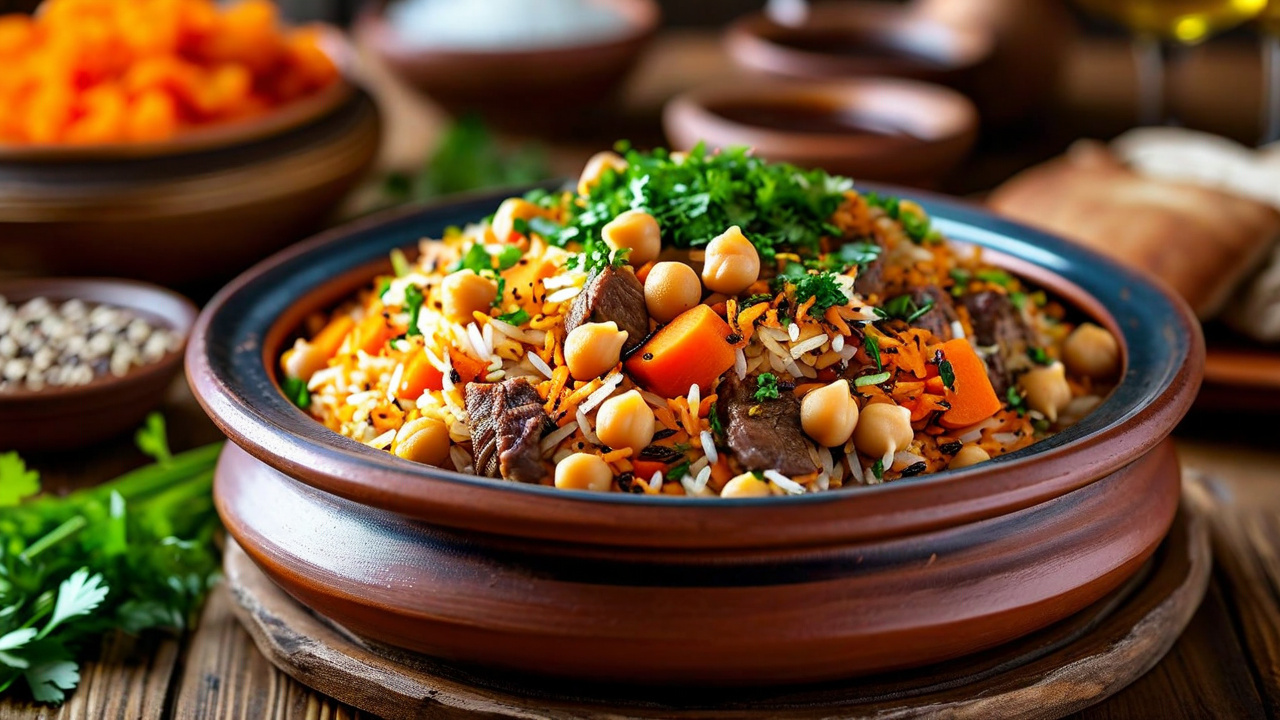
Uzbek cooking is the richest in Central Asia and it is organised around the cult of plov (osh) — rice cooked with lamb, carrot, chickpeas, whole garlic and cumin in a cast-iron kazan over open flame. Plov is not merely a dish. The oshpaz who makes it is a recognised professional, celebrations are measured in the size of the kazan, and Tashkent, Samarkand, Bukhara and Fergana each insist their version is the authentic one. They are all different and they are all correct.
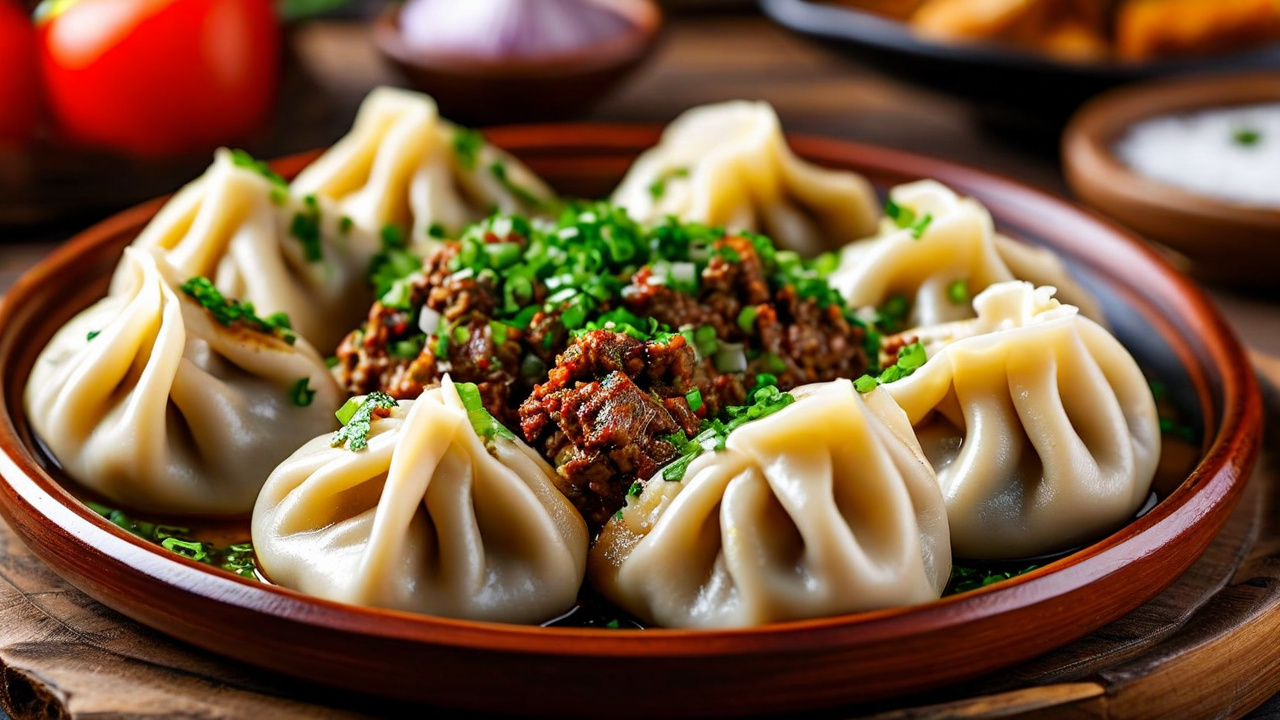
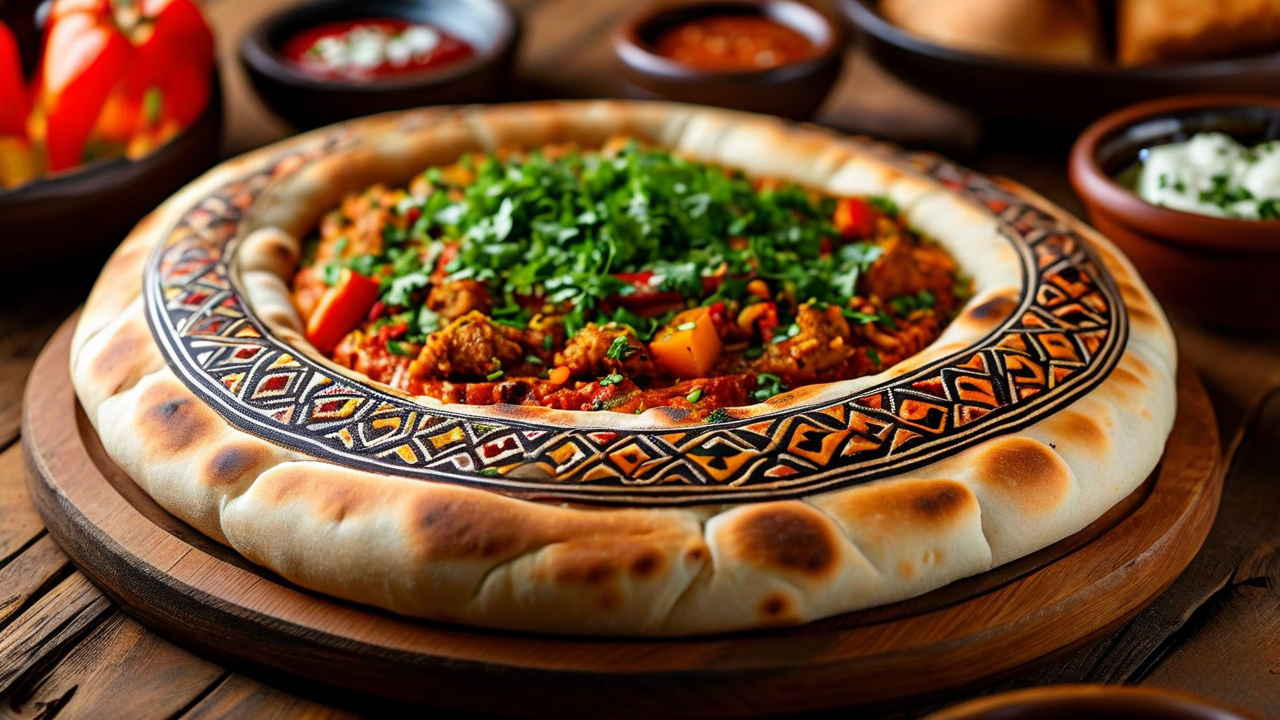
Beyond plov: shashlik straight off the mangal with raw onion and vinegar; manti, large steamed lamb dumplings; somsa baked against the wall of a tandoor; lagman, hand-pulled noodles in broth; norin, cold sliced noodle-and-horsemeat, a Tashkent speciality that divides visitors; and shivit oshi, Khiva's startling green dill noodles. Non — the round tandoor flatbread stamped with a chekich — accompanies every meal and must never be placed face down. The bazaars carry the best melons you will ever eat; Khorezm melons were shipped to Baghdad packed in ice and lead in the 10th century.
Heat the oil in a kazan or heavy casserole until it shimmers. Brown the lamb hard on all sides, then remove.
Fry the onion until deep gold — this is the colour of the finished dish, so do not rush it.
Return the meat, add the carrots and cook 10 minutes without stirring much.
Add cumin, coriander, chilli, salt and water just to cover. Simmer 40 minutes uncovered. This base is the zirvak.
Level the rice on top. Add hot water to about 2 cm above the rice. Do not stir.
Push the garlic heads and barberries into the rice. Boil hard until the water is at rice level.
Mound the rice, make a few steam holes with a chopstick, cover tightly and cook on the lowest heat 25 minutes. Rest 10 minutes off the heat.
Turn out onto a platter, meat on top, garlic in the middle.
🥪 Manti — Steamed Lamb Dumplings
Makes about 20. The filling is chopped, never minced — that is the whole difference.
Ingredients:
400 g plain flour, 1 egg, ~180 ml water, 1 tsp salt
500 g lamb shoulder, hand-chopped to 5 mm dice
100 g lamb fat, finely diced
3 onions, diced very fine
1 tsp cumin, black pepper, salt
To serve: sour cream (qatiq), chilli vinegar, dill
Instructions:
Make a firm dough with flour, egg, water and salt. Knead 10 minutes, rest covered 30 minutes.
Mix the chopped lamb, fat, onion and spices. Do not add water — the onion supplies it.
Roll the dough very thin and cut 12 cm squares.
Place a heaped spoon of filling on each, bring the four corners together, then pinch the adjacent corners in pairs.
Oil the steamer tiers. Steam 40–45 minutes.
Serve brushed with butter, with sour cream and chilli vinegar.
🥐 Non — Tandoor Flatbread
Makes 4 loaves. A home-oven adaptation: a real non needs a clay tandoor, but a pizza stone at maximum heat gets close.
Ingredients:
600 g strong white flour
350 ml warm milk (or half milk, half water)
7 g dried yeast, 2 tsp salt, 1 tsp sugar
30 g melted butter or lamb fat
Nigella and sesame seeds
1 egg yolk for glazing
Instructions:
Mix, knead 10 minutes to a smooth soft dough, prove 90 minutes until doubled.
Divide into 4, shape into balls, rest 20 minutes.
Press each out to a disc, leaving a thick raised rim and a flat centre about 12 cm across.
Stamp the centre all over with a chekich (or a fork) so it stays flat while the rim rises.
Glaze the centre with yolk, scatter nigella and sesame.
Bake on a preheated stone at 250°C for 12–15 minutes until deep gold. Never store it face down — in Uzbekistan that is an omen, not a preference.
14
🍷 Wine, Spirits & Drinking Culture
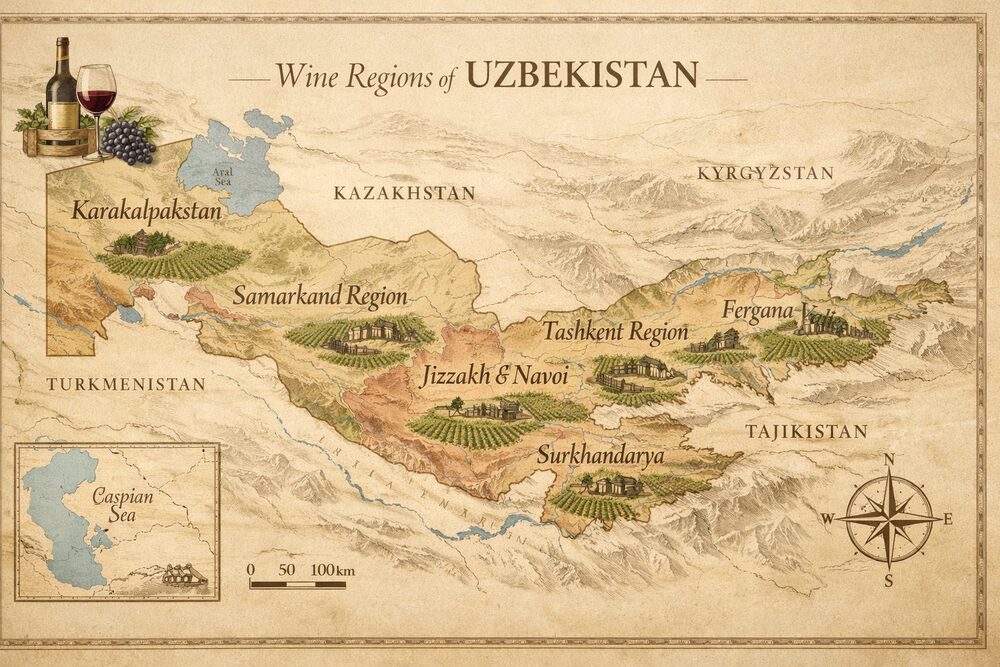
Uzbekistan has a far older winemaking tradition than most visitors expect. Grapes have been cultivated in the Zarafshan and Fergana valleys for well over two thousand years, and the modern industry dates to the 1860s–70s, when Russian settlers established commercial cellars. The defining figure is Mikhail Khovrenko, a chemist and oenologist who worked at the Samarkand winery from 1927 and developed the sweet and fortified styles — Gulyakandoz, Shirin, Uzbekiston — that still define the country's traditional output. The winery that carries his name in Samarkand keeps a small wine museum.
The dry-wine revival is newer and more interesting. Bagizagan, in the village of Bogizagon near Samarkand, is a fifth-generation family estate whose vines have been worked for more than 150 years; roughly 90% of its production is now dry wine, making it the country's second-largest dry producer. Grapes range from the Georgian imports Saperavi and Rkatsiteli through Cabernet Sauvignon, Merlot, Riesling and Pinot Noir to local varieties such as Bayan Shirey, Soyaki and Hindogny. The Aleatico dessert wine tradition was introduced to the Samarkand winery in 1939 and survives.
Despite being a Muslim-majority country, Uzbekistan is relaxed about alcohol — a Soviet inheritance. Beer is widely drunk (Sarbast and Pulsar are the common local brands), and vodka appears at celebrations. But the real social drink is green tea, koʼk choy, poured in chaikhanas across the country. The etiquette matters: the host pours a little into a bowl and returns it to the pot three times — the kaytar ritual — to mix and aerate the brew, then serves guests first. Cups are filled only a third full, deliberately, so that guests must ask again and the host is repeatedly honoured. A cup filled to the brim politely means the visit is over.
🏆 Kaufmann Wine Score — Uzbekistan
Rated on four criteria: Aroma (/25), Taste (/30), Finish (/20), Value (/25) — Total /100
Wine
🔴 Aroma
🟡 Taste
🟢 Finish
🔵 Value
Total
Hovrenko Aleatico (Samarkand, dessert red)
22
26
17
23
88
Bagizagan Cabernet–Saperavi (dry red blend)
21
25
17
22
85
Bagizagan Saperavi (dry red)
20
24
16
22
82
Samarkand Shirin (traditional dessert)
20
24
16
22
82
Gulyakandoz (sweet red, Khovrenko style)
19
23
15
21
78
Bagizagan Rkatsiteli (dry white)
18
22
15
22
77
95–100 Legendary · 90–94 Outstanding · 85–89 Very Good · 80–84 Good · 75–79 Average · <75 Below Average
15
🍵 Drinks & Tea Culture
Uzbekistan is not a cocktail country and it would be dishonest to pretend otherwise — but it has a serious drinking culture, and these are the four things you will actually be handed.
🍵 Koʼk Choy (Green Tea)
Rinse the pot with boiling water. One heaped tsp of green tea per two people, fill a third, wait 30 seconds, top up. Pour one bowl and return it to the pot — three times. Then serve, a third full, guests first.
🥛 Ayran / Chalop
Whisk 400 ml qatiq (sour yoghurt) with 300 ml iced water and a good pinch of salt. For chalop, add finely diced cucumber, radish, dill and coriander and serve as a cold summer soup-drink.
🍊 Kompot
Simmer 500 g dried apricots, apples and cherries in 2 litres of water with 100 g sugar and a cinnamon stick for 20 minutes. Cool completely. Served at every wedding and on every long-distance train.
🍸 The Samarkand Sour
A modern Tashkent bar drink, not a tradition: 50 ml Bagizagan Saperavi, 25 ml lemon juice, 15 ml pomegranate syrup, 20 ml vodka, shake hard, strain over ice, garnish with dried barberries. Claim no antiquity for it.
16
⛅ Climate & When to Visit
Sharply continental, with brutal swings. Summers (June–August) are scorching — Bukhara and Khiva regularly hit 40–45°C and sightseeing becomes genuinely punishing by 11 a.m. Winters (December–February) bring cold and snow to Tashkent, with lows below −10°C and colder on the steppe.
The best windows are April–May and September–October: comfortable temperatures, clear skies, and low golden light on the tilework. Late March catches Navruz. Note that April and May are now peak season — April 2025 was the first month in Uzbekistan's history to record over a million foreign arrivals — so book Khiva and Bukhara accommodation ahead.
Spring and autumn are usually the most comfortable seasons for a multi-city cultural route, but conditions vary between desert basins, irrigated valleys and mountain districts. Summer heat can make exposed monuments exhausting at midday, while winter nights may fall below freezing. Check a short-range forecast for every stop and plan indoor visits around the hottest hours.
17
✈ Getting There & Around
Islam Karimov Tashkent International Airport (TAS) is the main gateway, served by Uzbekistan Airways, Turkish Airlines, flydubai, Aeroflot, Air Astana and a growing list of Asian and European carriers. Samarkand, Bukhara and Urgench also take international flights. The departure terminal is being rebuilt in stages, roughly doubling peak throughput; separately, construction of an entirely new Tashkent International Airport near Yangiyul is scheduled to begin in June 2026, designed for up to 20 million passengers a year.
Trains are the right way to travel here. The Afrosiyob is a Spanish-built Talgo 250 running at up to 230 km/h. Real journey times: Tashkent–Samarkand about 2 h 08 min, Samarkand–Bukhara about 1 h 35 min, and Tashkent–Bukhara about 3 h 40 min end to end. Slower Sharq services and overnight sleepers cover Khiva/Urgench. Book online or through an agency — Afrosiyob seats sell out weeks ahead in spring and autumn.
Visas. Citizens of more than 90 countries enter visa-free for up to 30 days. Notably, U.S. citizens have been visa-free for tourism and business since 1 January 2026 — a change many older guides have not caught up with. Others can use the straightforward e-visa. Registration with the authorities is handled automatically by hotels; if you stay in a private home, keep the paperwork.
The classic Silk Road circuit — Tashkent → Samarkand → Bukhara → Khiva — takes 7–10 days and works entirely on trains and shared taxis. Yandex Go handles city rides.
18
ℹ Practical Info
The currency is the soʼm (UZS), trading at roughly 12,000 to the US dollar through mid-2026 (it ranged between about 11,930 and 12,320 over the year). ATMs accepting Visa and Mastercard are now common in cities; cards work in better hotels and restaurants, but bazaars, shared taxis and rural guesthouses are cash-only. Bring clean, uncreased US dollars if you plan to exchange.
Tap water is not safe to drink. Uzbekistan is very safe for visitors — violent crime against tourists is rare, and the State Department's Level 1 rating reflects that. Solo women travellers generally report feeling comfortable; modest dress is expected at religious sites and appreciated generally. Photography inside the Tashkent metro has been legal since 2018. Same-sex relations between men remain criminalised, which LGBTQ+ travellers should factor in.
Uzbek is the state language, written in Latin script since the 1990s reform though Cyrillic remains widespread; Russian is the practical lingua franca and English is increasingly common among younger people in tourism. The country runs on UTC+5 year-round with no daylight saving. Country calling code +998. Plugs are European type C/F, 220 V.
19
💰 Cost of Living
Uzbekistan remains one of Central Asia's best-value destinations, though prices in Samarkand and Bukhara have risen noticeably with the tourism boom. Figures below are mid-2026 and assume roughly 12,000 UZS to the dollar.
Item
UZS
USD
🍛 Plov at a local oshxona
30–60K
$2.50–5
🍽 Restaurant meal, mid-range
90–220K
$7–18
🛌 Hostel dorm bed
90–140K
$7–12
🏨 Boutique hotel, double
450–850K
$38–70
🚂 Afrosiyob, Tashkent–Samarkand (economy)
130–180K
$11–15
🏕 Registan entry ticket
65K
~$5.50
🍺 Local beer, 0.5 l
15–30K
$1.25–2.50
💡 Daily budget: backpackers $25–40 · mid-range $55–110 · comfortable $150+. Monument entry fees are revised most years — check current prices on arrival rather than trusting any published figure, including this one.
A realistic budget should separate international transport, intercity rail, local taxis, accommodation, meals, entrance tickets and guiding. Prices in heavily visited historic centres may differ from residential districts, and card acceptance is not universal. Keep a small contingency in Uzbek soʻm and verify what a quoted tour or room rate actually includes.
20
🏨 Accommodation
The accommodation scene has expanded enormously since the tourism reforms. The distinctive option is the boutique hotel in a converted madrasa, caravanserai or 19th-century merchant house — Bukhara and Khiva do this particularly well. Properties and prices below were current in 2026; hotel lists rot faster than anything else on a travel page, so confirm before booking.
🕌 Bukhara
🏨 Lyabi House — $65–130
🏠 Amelia Boutique — $45–90
🛌 Rumi Hostel — $9–16
🏛 Samarkand
🏨 Registan Plaza — $85–160
🏠 Jahongir B&B — $35–70
🛌 Bahodir B&B — $12–22
🏰 Khiva
🏨 Orient Star — $55–110, inside the walls in a former madrasa
🏠 Arkanchi Hotel — $32–65
🛌 Islambek — $10–18
Location matters as much as category. A restored guesthouse inside Bukhara or Khiva offers atmosphere and walkability, while a modern hotel near a railway station may simplify early departures. Read recent reviews for heating, air-conditioning, street noise, accessibility and payment arrangements, and reconfirm arrival details during festivals and public holidays.
21
🎉 Festivals & Events
Navruz (21 March) is the big one — the Persian new year and spring equinox, inscribed by UNESCO as a multinational intangible heritage element. Families and mahallas gather to stir sumalak, a wheat-sprout paste that must be tended over an open fire through the whole night, with the stirring passed hand to hand and wishes made over the pot.
The Silk and Spices Festival in Bukhara (late May) turns the old town into a craft fair. Sharq Taronalari ("Melodies of the East"), held biennially in Samarkand's Registan in late August, is a genuinely international music competition and the most spectacular thing that happens on that square. Independence Day (1 September) brings parades and concerts nationwide. Boysun Bahori, in the Surkhandarya mountains each April, is the folk-culture festival worth going out of your way for.
Festival dates and programmes can change, especially when events combine state ceremonies, regional competitions and tourism programming. Confirm the current schedule with an official organiser before making a special journey. At performances and religious sites, distinguish a public spectacle from community observance and ask before photographing participants at close range.
22
🌍 UNESCO World Heritage
Uzbekistan acceded to the World Heritage Convention on 13 January 1993 and now has 8 inscribed properties — 6 cultural and 2 natural — along with 37 sites on its Tentative List, one of the longest queues in Asia.
Site
Year
Type
Itchan Kala (Khiva)
1990
Cultural
Historic Centre of Bukhara
1993
Cultural
Historic Centre of Shakhrisyabz — In Danger since 2016
Cold Winter Deserts of Turan (with Kazakhstan & Turkmenistan)
2023
Natural
Tashkent Modernist Architecture. Modernity and Tradition in Central Asia — newest
2026
Cultural
The one most guides omit: Shakhrisyabz, Timur's birthplace 80 km south of Samarkand, has been on the List of World Heritage in Danger since 13 July 2016. The reason was demolition and redevelopment of the historic urban fabric around the Ak-Saray palace ruins to create a tourist park — the property lost much of the context that justified its inscription. It has generated more state-of-conservation reports than any other Uzbek site, most recently in 2025, and it is still on the danger list. It is well worth visiting; go with that history in mind.
Beyond the World Heritage List, Uzbekistan holds UNESCO Intangible Cultural Heritage inscriptions for Shashmaqom music (2003/2008, shared with Tajikistan), the art of bakhshi epic storytellers (2021), Navruz, Uzbek palov cooking traditions, and the atlas and adras silk-making crafts.
23
💎 Hidden Gems
Moynaq and the ship graveyard. Rusting trawlers sit on sand where the Aral Sea's shore used to be, roughly 150 km from the current water. The Savitsky Museum in nearby Nukus is the other reason to come north — Igor Savitsky assembled the world's second-largest collection of Russian avant-garde art in a desert town precisely because Moscow was not looking. Roughly 90,000 items; a fraction is on display.
The Nuratau Mountains run community-based homestay tourism in villages like Sentyab and Hayat, between the Kyzylkum and the range — walnut groves, spring-fed streams, and shepherds who will feed you far more than you can eat. Termez, on the Afghan border, has the country's major Buddhist archaeology: Fayaz Tepa, Kara Tepa and the Zurmala stupa, from when this was Kushan Bactria and the Buddha's image was first rendered in human form nearby.
The Fergana Valley — Kokand's Khudayar Khan palace, Margilan's Yodgorlik silk factory where atlas is still tied and dyed by hand, and Rishtan, where the blue-and-white ceramic tradition uses a glaze recipe held in a handful of families. It sees a small fraction of the visitors the big three cities do. Also worth the detour: the Sarmishsay petroglyphs near Navoi, thousands of rock carvings spanning the Bronze Age to the medieval period, added to the Tentative List in 2024.
24
✨ Fascinating Facts
Two borders from the sea
Uzbekistan and Liechtenstein are the world's only doubly landlocked countries. Uzbekistan's neighbours are all landlocked too — a fact that was not true before 1991.
Algebra and algorithm
Both English words trace to al-Khwarizmi of Khwarazm — al-jabr from his book's title, algorithm from a Latinisation of his name.
A census that found extra people
The 2026 census counted 39,047,321 — 810,600 more than official estimates had projected. Uzbekistan was 2.1% larger than it thought.
Photographing the metro was illegal until 2018
Tashkent's metro doubled as a designated nuclear shelter, so cameras were banned for decades. The ban lifted in 2018 and the stations turned out to be world-famous.
Bread is never face down
Placing non upside down is a serious taboo. Each city stamps its bread with a distinct chekich pattern; a Samarkand loaf is identifiable at a glance.
The avant-garde in the desert
Nukus holds around 90,000 works, the world's second-largest Russian avant-garde collection — saved by being 1,200 km from anyone who would have destroyed it.
The last great Eurasian steppe conqueror, and the builder whose Samarkand remains Central Asia's greatest architectural inheritance.
🔭
Ulugh Beg
1394–1449
Timur's grandson and a serious astronomer. His 1437 star catalogue of 1,018 stars stood as the most accurate in the world for roughly two centuries.
📜
Al-Bukhari
810–870
Compiler of the Sahih al-Bukhari, the most authoritative hadith collection in Sunni Islam. His shrine sits outside Samarkand.
📐
Al-Khwarizmi
c.780–850
From Khwarazm, in the Khiva region. Gave mathematics algebra and gave computing the word algorithm.
📖
Alisher Navoi
1441–1501
The poet who proved Chagatai Turkic could carry high literature against Persian. The national language, the opera house and half the streets carry his name.
🎭
Igor Savitsky
1915–1984
Painter turned collector who smuggled banned Soviet avant-garde canvases to Nukus and built a museum around them under the regime's nose.
🥊
Bakhodir Jalolov
b. 1994
Super-heavyweight who took Olympic gold at Tokyo 2020 and again at Paris 2024 — back-to-back titles, and the face of Uzbekistan's boxing era.
26
⚽ Sports
Boxing is where Uzbekistan is genuinely world-leading. At Paris 2024 Uzbek boxers won five of the seven men's gold medals — Hasanboy Dusmatov, Abdumalik Khalokov (57 kg), Asadkhuja Muydinkhujaev (71 kg), Lazizbek Mullojonov (92 kg) and Bakhodir Jalolov (+92 kg). No national boxing team had taken that many golds at a single Games since Cuba two decades earlier, and it was the first time Uzbekistan had managed five. Jalolov's was a successful title defence from Tokyo 2020.
Football is the mass-participation sport. Pakhtakor Tashkent is the historic club; the national team qualified for the FIFA World Cup for the first time ever on 5 June 2025, sealing it with a 0–0 draw away to the UAE in Abu Dhabi — the eighth attempt since Uzbekistan joined FIFA in 1994, and the first Central Asian side ever to reach a World Cup finals. Wrestling, judo and taekwondo also deliver medals reliably.
Traditional sports remain alive in the regions: kupkari (also called uloq), the mounted contest over a goat carcass played mainly in the south and in Surkhandarya and Kashkadarya at spring festivals; and kurash, the upright jacket-and-belt wrestling that has become an international competitive sport with its own federation and Asian Games status — though, contrary to a claim repeated widely online, it is not on any UNESCO heritage list. For visitors, the Chimgan and Amirsoy resorts near Tashkent offer skiing from December to March and hiking the rest of the year.
27
📰 Media & Press Freedom
Media remains substantially state-influenced, though the space has widened considerably since 2016. Kun.uz and Gazeta.uz are the two most-read outlets producing something close to independent reporting, and Repost.uz and Hook cover culture and social issues. BBC Uzbek and RFE/RL's Ozodlik provide external coverage. Telegram is the dominant news distribution channel by a wide margin — more people follow news channels there than read any website.
Uzbekistan continues to rank in the lower reaches of international press-freedom indices, and journalists and bloggers covering corruption or Karakalpakstan have faced prosecution. For a visitor none of this is an obstacle: mobile data is cheap, 4G coverage is good across cities and along the main highway and rail corridors, and 5G has been rolling out in Tashkent since 2021.
28
🏛️ Government & Public Life
Uzbekistan is a presidential republic divided into twelve regions, the autonomous Republic of Karakalpakstan and the capital city of Tashkent. Since 2016 the country has pursued a more outward-looking program of economic and administrative reform, while political power remains strongly centralized. Visitors encounter a society balancing rapid modernization with institutions shaped by the Soviet period and older traditions of neighborhood self-government.
Public life is also organized at street level through the mahalla, a neighborhood community that can coordinate ceremonies, mutual aid and local concerns. Its role varies from place to place: it can provide practical solidarity, yet it also reflects the close relationship between community structures and the state. For travelers, the mahalla is less a tourist attraction than a reminder that Uzbek cities function through intimate social networks behind their monumental avenues.
Administrative procedures are increasingly digital, but rules and implementation can still change quickly. Carry identification, treat official buildings and checkpoints respectfully, and verify permits or registration requirements with current official sources. Political discussion calls for tact: listen carefully, avoid assuming that private opinions are public positions, and remember that reform, economic opportunity and civil liberties are experienced differently across generations and regions.
29
🗣️ Languages & Communication
Uzbek is the official language and is normally written in the Latin alphabet, although Cyrillic remains widely understood and visible. Russian is common in Tashkent, business and communication between different communities; Karakalpak has official status in Karakalpakstan. Tajik is widely spoken in and around Samarkand and Bukhara, alongside smaller communities using Kazakh, Kyrgyz, Korean and other languages.
The change from Cyrillic to Latin script has been gradual rather than absolute. You may see the same name spelled in several ways on maps, timetables and signs, and older publications often use Cyrillic. Save destinations in both written form and on a map. In bazaars and shared taxis, a few words of Uzbek usually open more doors than perfect English.
Useful courtesies include salom or assalomu alaykum for greeting, rahmat for thank you and iltimos for please. Russian remains a practical bridge language, while English is expanding among younger people and in tourism. Speak simply, confirm prices and departure times, and treat translation apps as support rather than proof—warmth, patience and context matter enormously.
30
☪️ Religion & Sacred Places
Most Uzbeks identify as Sunni Muslims, while the country is constitutionally secular and also home to Orthodox Christian, Jewish and other communities. Religious practice ranges from deeply observant to primarily cultural, and family traditions often carry as much weight as formal institutions. Avoid reducing everyday Uzbek life to a single level of belief.
Historic mosques, madrasas and mausoleums are living places of memory as well as architectural monuments. Sufi lineages, pilgrimage to revered tombs and respect for scholars have shaped local religious landscapes for centuries. Bukhara preserves a long Jewish history, and synagogues, cemeteries and community stories add an essential layer to the city beyond its Islamic monuments.
Dress modestly at active sacred sites, remove shoes where requested and avoid interrupting prayer. Ask before photographing people, graves or ceremonies; some interiors restrict photography even when the courtyard does not. During Ramadan, restaurants in major cities generally continue operating, but discretion around those who are fasting is courteous.
31
🐫 The Silk Roads
Uzbekistan sat within a web of routes rather than on one single Silk Road. Caravans moved through the oases of the Zeravshan Valley, across the Kyzylkum and toward the Fergana Valley, carrying textiles, horses, paper, ceramics, precious metals, beliefs, technologies and stories. Samarkand and Bukhara prospered because they connected worlds, not because they stood in isolation.
Trade depended on water, credit, interpreters, caravanserais and political protection. Merchants rarely traveled the entire distance between China and the Mediterranean; goods passed through many hands and changed meaning along the way. Scholars, diplomats, pilgrims and displaced communities traveled beside commerce, helping spread Buddhism, Islam, artistic motifs and scientific knowledge.
Today the Silk Roads are both historical reality and tourism brand. The romantic image of camel caravans can obscure conquest, taxation, slavery and environmental limits, yet it also points to a durable culture of exchange. Read monuments as nodes in a wider network and look for continuities in bazaars, workshops, food and multilingual neighborhoods.
32
🏛️ Architecture & Decorative Arts
Turquoise tilework is Uzbekistan’s most recognizable visual language, yet its architecture is far more varied: baked-brick mausoleums, timber-columned mosques, monumental Timurid portals, domed bazaars and Soviet modernism all share the urban landscape. The strongest buildings use proportion, shadow and surface together, guiding the visitor from compressed entrances into luminous courtyards.
Look closely at carved doors, painted ceilings, geometric girih patterns, vegetal ornament and calligraphy. Glazed mosaics and majolica were not merely decoration: color, text and geometry created a symbolic skin for institutions of learning, worship and dynastic memory. In Khiva, carved wooden columns and packed urban walls produce a very different rhythm from Samarkand’s vast ceremonial ensembles.
Restoration quality differs from monument to monument. Some complexes preserve original fragments; others are heavily reconstructed or re-tiled. Soviet apartment blocks, metro stations and post-independence civic architecture deserve attention too, because Uzbekistan’s cities are layered rather than frozen in the Timurid age. Visit early or late, when angled light reveals relief and craftsmanship.
Shashmaqam, the classical tradition associated especially with Bukhara and Samarkand, combines poetry, instrumental music and song in elaborate suites. It demands attentive listening: melodies develop gradually, singers shape classical verse, and instrumental passages create a conversation rather than a simple accompaniment.
Regional traditions differ markedly. Khorezm is known for vivid dance and the energetic lazgi tradition; the Fergana Valley has its own lyrical styles, while epic storytellers and wedding ensembles preserve other repertoires. Instruments include the long-necked dutar, tanbur, bowed gijjak, surnay reed instrument and doira frame drum.
Performance is not confined to formal stages. Music accompanies weddings, seasonal festivals, family gatherings and public celebrations, while contemporary Uzbek pop, rap and film music fill taxis and cafés. Tourist shows can be enjoyable, but seek a cultural center, conservatory event or locally recommended performance when possible; context transforms spectacle into encounter.
34
🧵 Crafts, Textiles & Workshops
Uzbek craftsmanship rewards direct contact with working studios. Margilan is renowned for abrbandi ikat silk, Rishtan for blue-green ceramics, Bukhara for embroidery and metalwork, and Khiva for wood carving. Suzani embroidery, knife making, miniature painting, carpet weaving and gold embroidery add further regional vocabularies.
Technique matters. Hand-tied ikat reveals slight irregularities and complex dye alignment; wheel-thrown ceramics differ from molded souvenirs; hand embroidery shows decisions that machine work repeats mechanically. Ask who made an object, how long it took and whether the workshop controls dyeing, weaving or firing. These questions are more useful than searching for a single certificate of authenticity.
Buy directly from makers or transparent cooperatives when possible, and do not bargain so aggressively that skilled labor becomes invisible. Antique-looking objects may face export restrictions, so request documentation before purchasing older textiles, manuscripts, coins or archaeological material. The most valuable souvenir is often the explanation of process that accompanies it.
Beyond the monument cities lie the Chimgan and Nuratau mountains, tugai river forests, the Kyzylkum Desert and the high plateau of Ustyurt. Elevation and water create sharp contrasts: alpine meadows can sit only a few hours from hot plains, while river corridors hold dense habitats inside otherwise arid country.
These landscapes support goitered gazelles, wild sheep, raptors and desert-adapted plants, although sightings require patience and responsible local guidance. Protected areas and community-based guesthouses can connect conservation with rural income. Stay on established tracks, carry out waste and never treat wildlife encounters as guaranteed entertainment.
Spring brings flowers and comfortable hiking in many regions; autumn offers clear skies and cooler desert travel. Summer heat can become dangerous far from shade, and winter closes or complicates mountain routes. Water, communications and rescue capacity are limited outside settled areas, so share plans, check local conditions and hire knowledgeable guides for remote journeys.
36
🌊 The Aral Sea & Karakalpakstan
The retreat of the Aral Sea is one of the world’s starkest human-made environmental disasters. River diversion for irrigation shrank the water body, devastated fisheries and exposed salt- and chemical-laden seabed. Muynak’s stranded ships have become its best-known symbol, but the crisis is measured more honestly in health, livelihoods, migration and damaged ecosystems.
Responses include planting drought-resistant vegetation on the exposed seabed, restoring wetlands where possible and improving water management. Results are uneven and the southern Aral cannot be understood through one dramatic viewpoint. Climate change adds pressure through heat and water scarcity, while communities continue to adapt rather than existing only as victims of catastrophe.
Visit thoughtfully. Allow time for Nukus, the Savitsky Museum and Karakalpak culture instead of treating the region as disaster tourism. The distances are long, roads can be demanding and local guides add essential environmental and historical context. Ask before photographing residents, support local services and resist staging images among the ships.
High-speed Afrosiyob trains connect Tashkent with Samarkand and Bukhara, while conventional trains serve additional routes toward Khiva, the Fergana Valley and Karakalpakstan. Rail is often the most comfortable way to link the major cultural cities, combining reliable journey times with a useful view of the landscape.
Popular departures sell out, especially around weekends and holidays, so reserve early and keep the passenger details used for booking. Confirm the exact station: some cities are served by terminals outside the historic center, and transfer time can be substantial. Night trains provide berths on long routes, but carriage standards and temperatures vary.
Domestic flights save time on the longest distances. Within cities, metro, buses and licensed taxis are practical; agree on a price or use a recognized app where available. Shared taxis fill gaps between towns but may depart only when full. Road journeys are slower than maps suggest, so avoid building an itinerary around optimistic connection times.
38
🤝 Etiquette, Hospitality & Photography
Hospitality is a defining part of Uzbek social life. Guests may be offered tea, fruit, bread and a much larger meal than expected. Accept at least a little with courtesy, use the right hand when offering or receiving food, and never place non-food objects on bread. Meals often unfold slowly around shared dishes and repeated conversation.
Greetings matter. A handshake is common between men, while interaction between men and women depends on the other person’s lead and local context. Elders are shown particular respect in seating, serving and conversation. Remove shoes when entering a home if your host does so, and bring a small gift when invited for a meal.
Ask before photographing people, ceremonies, markets or interiors. Restrictions may apply at transport hubs, government facilities and some religious sites, and children require a guardian’s permission. Avoid turning daily life into costume or spectacle: show the image when appropriate, accept refusal immediately and spend time in conversation before raising a camera.
The illustrations appear alongside the relevant chapters. Select an image to enlarge it.
40
🎒 Packing Tips
👔 Clothing
Shoulders and knees covered for mosques and mausolea
Layers — a 20°C daily swing in spring is normal
Broken-in walking shoes; every old city is uneven brick
A light scarf for women at religious sites
Loose light fabrics and a hat for summer — 45°C is not rhetorical
📦 Essentials
Clean, uncreased USD for exchange
SPF 50+ and lip balm — dry desert air
Rehydration salts and a stomach remedy
Type C/F plug adapter, 220 V
Afrosiyob tickets booked weeks ahead in Apr–May and Sep–Oct
A refillable bottle plus a filter; tap water is not drinkable
Pack for strong temperature swings rather than a single national climate: breathable layers, sun protection, a warm layer, comfortable footwear and a light rain shell cover most cultural itineraries. Carry offline copies of bookings and identification, keep medicines in original packaging and choose clothing that is respectful at mosques, mausoleums and family homes.
41
🎬 Videos
Search these titles rather than trusting any embedded link — travel channels reorganise constantly.
🕌 Samarkand: Crossroads of Cultures
Documentary treatment of the city's layered history from Afrasiab to the Timurids.
🌊 The Aral Sea Disaster
The collapse, the Aralkum, and the saxaul planting now underway across the seabed.
🍚 The Art of Uzbek Plov
Oshpaz masters at the Tashkent Plov Centre, working kazans that feed hundreds.
🎭 The Desert of Forbidden Art
2010 documentary on Igor Savitsky and the Nukus collection. The best film made about Uzbekistan.
Video can convey architecture and landscape, but it can also hide distance, heat, crowds and access restrictions. Check the publication date, identify whether footage is promotional or independent and compare it with current transport and monument information. Drone images should never be treated as evidence that recreational drone use is permitted.
42
📚 Recommended Reading
📕
The Shadow of the Silk Road
Colin Thubron, 2006
The master travel writer walks the trade routes from Xi'an to Antioch. The Uzbek chapters are the book's spine.
📗
Tamerlane: Sword of Islam, Conqueror of the World
Justin Marozzi, 2004
Biography of Timur that takes both the architecture and the atrocities seriously.
📘
The Great Game
Peter Hopkirk, 1990
The Anglo-Russian contest for Central Asia, including the Bukhara emirate's infamous bug pit.
📙
Chasing the Sea
Tom Bissell, 2003
A returning Peace Corps volunteer travels to the Aral. Funny, and the best English-language account of the disaster.
Combine travel writing with scholarship and Uzbek voices in translation. Older accounts can illuminate the Russian imperial and Soviet periods, but their terminology and assumptions require context. For contemporary politics, environmental change and heritage management, compare publication dates and distinguish academic research, journalism, memoir and official promotion.
43
🔴 2025–2026 Updates
🛂 U.S. citizens visa-free since 1 January 2026
Americans may now enter for tourism or business for up to 30 days without a visa, joining the 90+ nationalities already exempt. Most guidebooks in print still say otherwise.
🌍 Eighth World Heritage site inscribed, 2026
"Tashkent Modernist Architecture. Modernity and Tradition in Central Asia" joined the List — Uzbekistan's first 20th-century property, and a sharp reversal after years of demolition of exactly these buildings.
📈 Record tourism: 11.7 million in 2025
Up almost 47% year on year, with tourism service exports above USD 4.4 billion. Kyrgyzstan (2.8M), Kazakhstan (2.3M) and Tajikistan (2.2M) led the source markets; arrivals from China rose 3.8-fold.
👥 2026 census: 39,047,321
Preliminary results as of 15 January 2026 — 810,600 more people than statistical estimates had assumed.
✈ New Tashkent airport breaks ground June 2026
A replacement airport near Yangiyul, designed for up to 20 million passengers a year. The existing TAS departure terminal is being rebuilt in three stages meanwhile.
Use official immigration, railway, airline, museum and regional administration sources for decisions that can change. Save confirmation numbers and addresses offline, and cross-check third-party booking platforms against the operator that will actually provide the service. A source list records where information was checked; it cannot guarantee that timetables or rules remain unchanged.
45
✍ Author's Note
✍ Author's Note
Radim Kaufmann
I went to Uzbekistan expecting the Registan and got ambushed by a teahouse. The square is everything people say — I stood there at dusk while the tilework ran from cobalt to gold to a dull amber and then went dark, and it is worth the flight on its own. But the memory that actually stayed is smaller. A chaikhana beside the pool at Lyabi-Hauz in Bukhara, an old man pouring the same bowl of green tea back into the pot three times before he would hand me anything, and then filling my cup only a third of the way — which I took, wrongly, for stinginess. It is the opposite. A third-full cup means come back, ask me again, stay. A full cup is a polite goodbye. I had been in the country four days before anyone explained this, and I have thought about it ever since as a decent model for hospitality generally: make the offer small and repeatable rather than large and final.
The other thing I did not expect was how much of Uzbekistan is about water that is no longer there. You feel it in Khiva, where the walls exist because the desert did, and you feel it hard at Moynaq, where trawlers sit on sand a hundred and fifty kilometres from the sea that floated them. It would be easy to write that up as pure tragedy. But there are people out on that seabed now planting saxaul, hundreds of thousands of small grey shrubs going into salt, and the honest thing to say is that this is a country in the middle of repairing several things at once — its ecology, its politics, its place in the world — and doing it faster than most visitors realise. Go before the crowds catch up. They are already catching up.