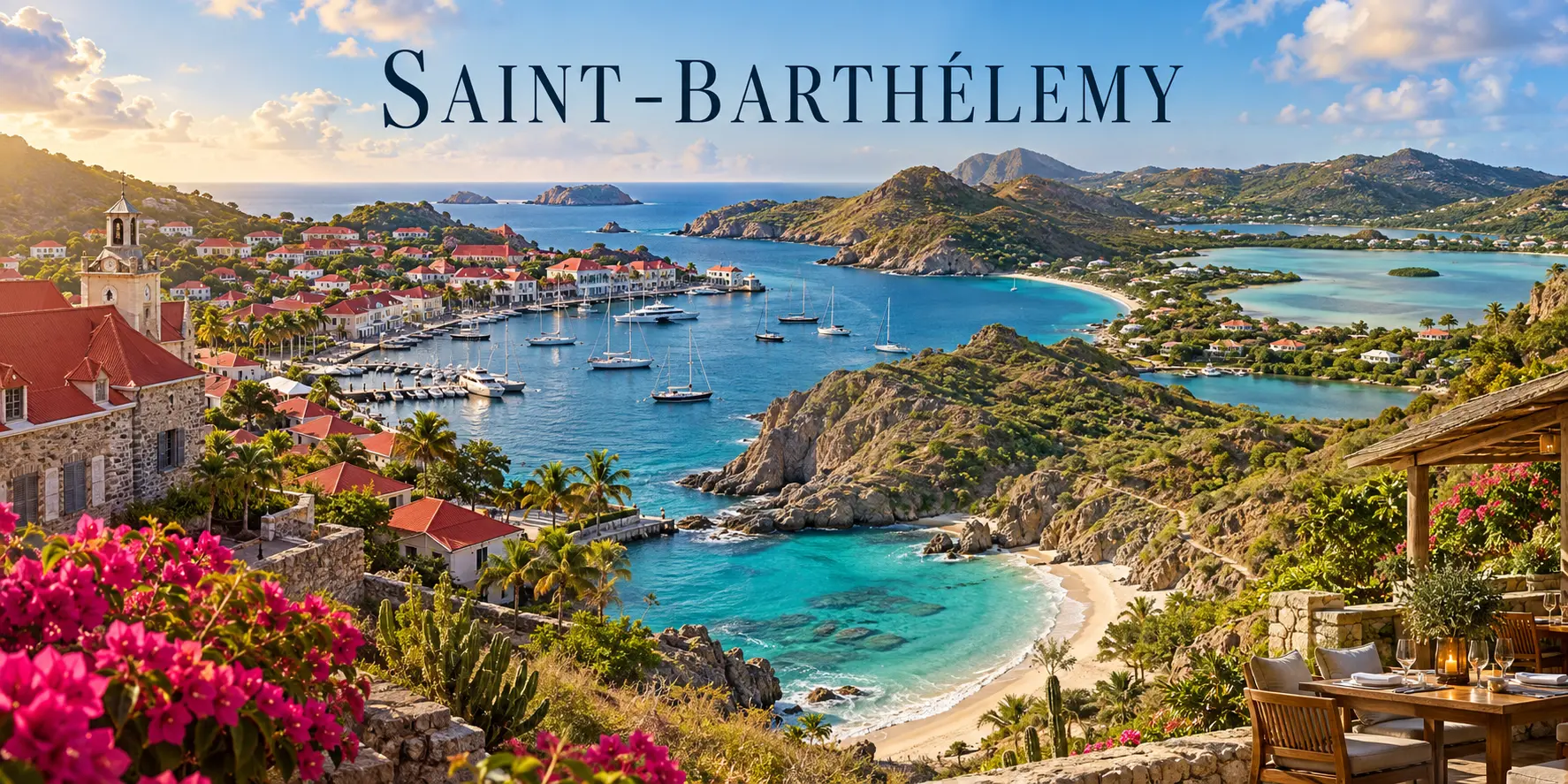
Saint-Barthélemy, often called St Barts, is a French overseas collectivity in the northern Lesser Antilles. Its land area is about 21 square kilometres, with Gustavia as the capital and a population of 10,660 in force from 1 January 2026. The island is known for high-end tourism, but its useful story also includes dry hills, working neighbourhoods, fishing traditions, a protected marine landscape and the logistical limits of a small territory.
🏷️ Name, status & language
The formal French name is Saint-Barthélemy. English travel writing often uses St Barts or St Barths. Since 2007 it has been a French overseas collectivity governed by a territorial council; it is associated with the European Union as an overseas country and territory, not part of the Schengen Area. French is the official language, while English is widely useful in tourism and international services. This edition therefore provides EN-US, Czech and French in full.
🗺️ Geography & water
Volcanic hills, shallow coves, rocky points and small satellite islets shape a compact but demanding landscape. The climate is comparatively dry, and there are no large rivers. Drinking water depends heavily on desalination, rainwater storage and careful infrastructure. Short distances on a map can involve steep bends, narrow lanes and slow traffic. The scarcity of land and fresh water makes development, waste handling and coastal protection central travel issues rather than abstract policy.
📜 History from Indigenous settlement to the collectivity
Arawak- and Taíno-speaking communities lived in the region before European colonisation. France attempted settlement in the seventeenth century, then transferred the island to Sweden in 1784. Gustavia became a free port under Swedish rule; street names, archives, forts and the three crowns on the coat of arms preserve that chapter. Following a local vote, Sweden returned the island to France in 1878. It remained linked to Guadeloupe until becoming a separate collectivity in 2007.
🏘️ Gustavia beyond the shop windows
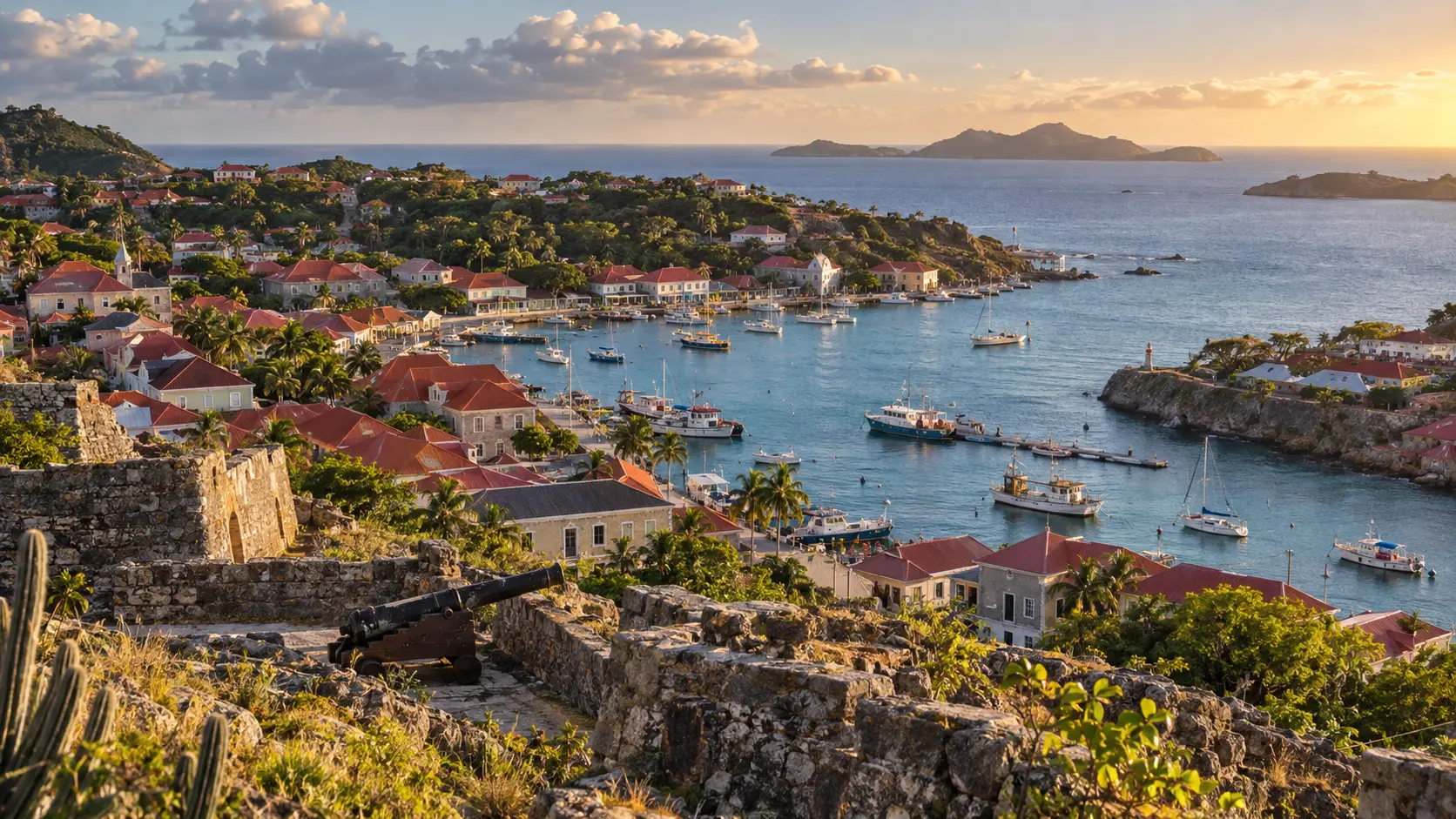
Gustavia is a harbour town, administrative centre and historic landscape rather than merely a luxury retail address. Walk between the harbour, Wall House, the Anglican church, Swedish-era street signs and the viewpoints of Fort Gustav and Fort Karl. Shell Beach lies just beyond the centre. Cruise and yacht activity can compress the waterfront in peak weeks, so early morning gives the clearest sense of scale, port work and local movement.
Lorient, Corossol, Colombier, Public, Saint-Jean and Grand Cul-de-Sac each reveal a different layer of the island. Corossol is associated with fishing and palm weaving; Lorient has a church, cemetery and family beach; Public retains visible port activity; Colombier sits near one of the island’s most rewarding coastal walks. These places are lived communities. Park carefully, keep noise low, cover swimwear away from the shore and ask before photographing people or private homes.
🏖️ Beaches, currents & access
Gouverneur and Saline offer open, dramatic shorelines; Saint-Jean is accessible and active; Shell Beach is close to Gustavia; Grand Cul-de-Sac is a sheltered lagoon; Colombier is reached by foot or boat. Conditions differ sharply with swell and wind. Many beaches have limited or no lifeguard coverage. Watch the sea before entering, follow local warnings, protect belongings and never treat a quiet cove as risk-free. Public access does not cancel the duty to respect neighbouring property.
🐢 Marine reserve & responsible wildlife watching
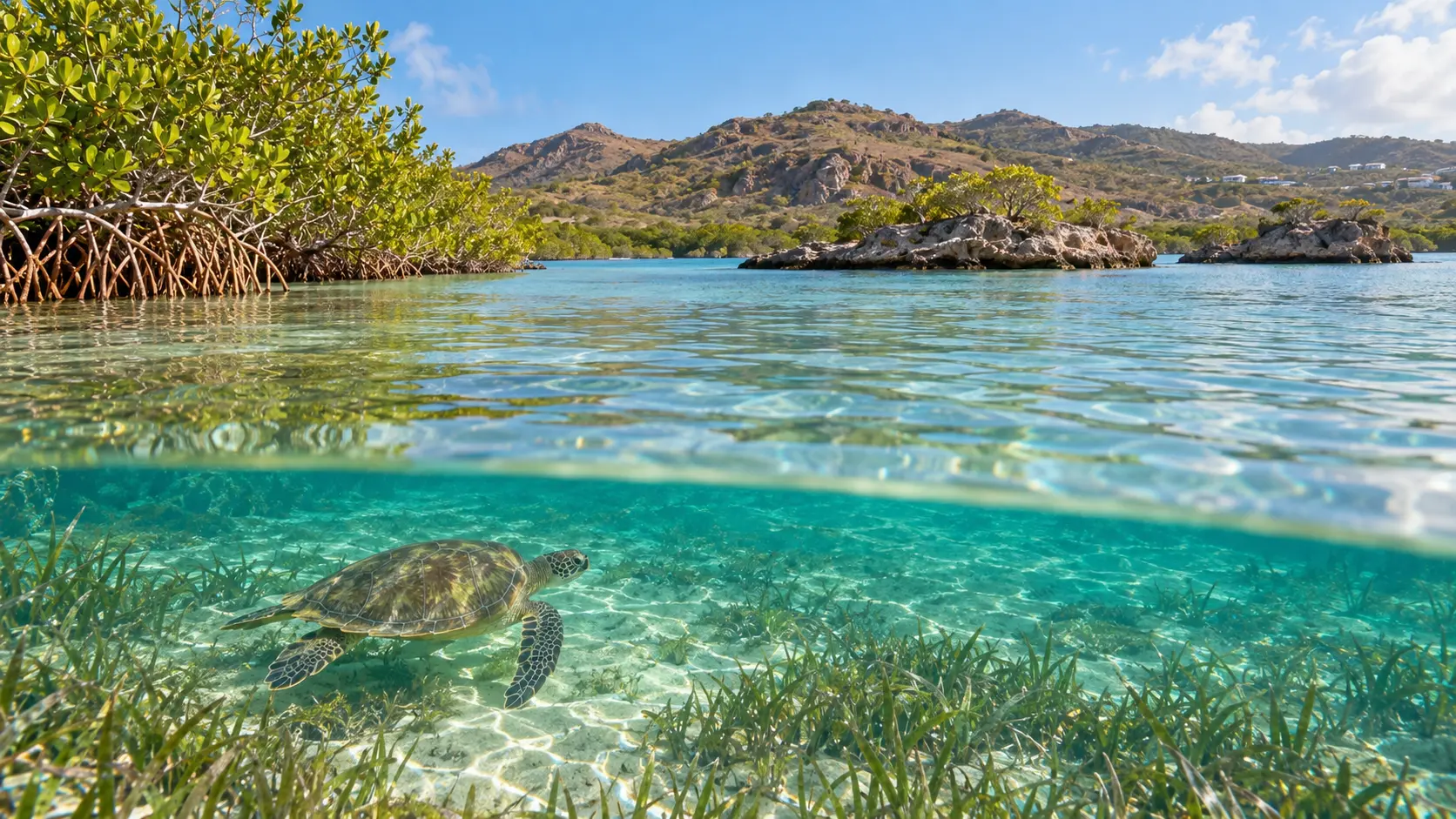
The Saint-Barthélemy Nature Reserve, created in 1996, protects about 1,200 hectares of marine habitat. Seagrass beds, mangroves, reefs and islets support turtles, seabirds, fish and corals. Choose licensed operators, use moorings instead of anchors, keep distance from turtles, never feed wildlife and do not stand on coral. Grand Cul-de-Sac is especially sensitive: a wildlife sighting is not permission to chase an animal for a photograph.
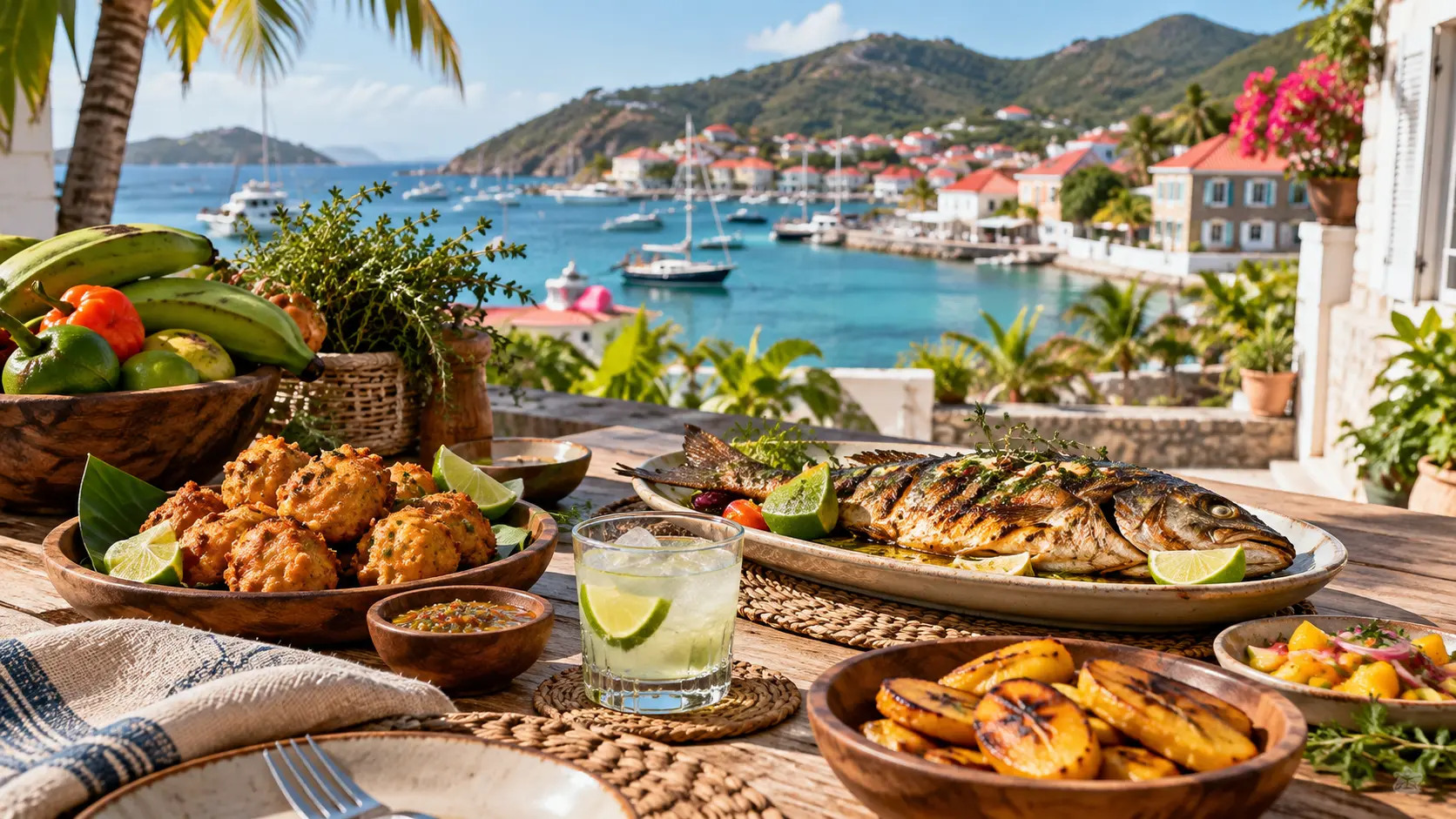
The island’s tables range from bakeries and modest lunch counters to ambitious restaurants. Look for accras, grilled fish, lobster when legally in season, plantain, lime, local herbs and Creole sauces alongside French breads, pastry and technique. Reservations matter during winter peaks, and imported ingredients affect prices. Ask whether fish is local, understand the price before ordering by weight and support kitchens that reduce waste rather than equating excess with quality.
Saint-Barthélemy has no significant wine production; its wine culture is based on importation, restaurants and private cellars. French wines are prominent, while rhum agricole generally arrives from Martinique or Guadeloupe. Ti-punch is part of the wider French Caribbean repertoire. Drink water in the heat, confirm prices before ordering rare bottles, and never combine alcohol with scooters, steep roads or swimming. Duty and tax rules should be checked for the traveller’s onward destination.
✈️ Arrival by air or sea
Gustaf III Airport handles small regional aircraft and has a short runway requiring specialised operations. Many travellers connect through Saint Martin or Sint Maarten, which may add another jurisdiction and an entry form even for transit. Ferries link Gustavia with both sides of the neighbouring island. Carry a passport for itineraries involving third-country or Dutch-side transit, verify every segment before departure and allow for weather-driven disruption.
🚗 Roads, cars, scooters & taxis
Driving is on the right. A small rental car is the usual visitor choice, but roads are narrow, steep and winding, with limited parking in Gustavia. Scooters suit experienced riders only; helmets are mandatory and wet roads are unforgiving. Taxis operate at the airport and ferry terminal, but there is no comprehensive public-bus network. Book transport early during high season and never stop on blind bends for a photograph.
📋 Practical information & health
The euro is the official currency; cards are widely used, though a small cash reserve is sensible. Electricity generally follows French standards at 220–230 V with Type E sockets. Emergency numbers are 112, medical 15, police 17 and fire 18. Medical care exists locally, but complex cases may require evacuation to Guadeloupe or elsewhere. Carry robust travel insurance including evacuation and repatriation, sun protection, regular medication and mosquito precautions.
Status
French overseas collectivity; EU overseas country and territory
Capital
Gustavia
Area
about 21 km²
Population
10,660 · in force 1 Jan 2026
Official language
French; English widely used
Currency
Euro (EUR)
Driving
Right
Power
220–230 V · Type E
Cyclone risk
June–November
Emergency
112 · medical 15 · police 17 · fire 18
🌦️ Climate & cyclone readiness
The drier high season generally runs from December into April. Heat and humidity increase later in the year, and the official cyclone-risk period is June through November. Forecasts do not guarantee that an island will be spared. Follow the Préfecture, FR-Alert and Météo-France, learn the location of the four official shelters, keep documents protected, maintain water and food reserves when instructed and use flexible bookings.
🏛️ Heritage without a UNESCO label
As of 9 October 2026, no property in Saint-Barthélemy is inscribed on UNESCO’s World Heritage List. That does not diminish its Indigenous archaeology, Swedish-period urban fabric, forts, churches, cemeteries, maritime knowledge or living traditions. The correct language is specific: a place may be historic or protected without being UNESCO-listed. Treat walls, graves and archaeological remains as heritage, not props.
✍️ Author's Note
Saint-Barthélemy is easiest to misunderstand when wealth becomes the only lens. The more durable story lies in water scarcity, working harbours, Swedish and French layers, neighbourhood etiquette and a marine reserve whose health cannot be purchased back once lost. Travel here can be comfortable without being careless. Kaufmann Travel Index: not scored; the approved scoring rubric has not yet been issued, so no provisional number is published. — Radim Kaufmann, 2026