

🇨🇮 Côte d'Ivoire at a Glance
🌍 Overview — Why Visit Côte d'Ivoire
Côte d'Ivoire produces roughly 40% of the world's cocoa. If you have eaten chocolate this week, some of it began on a smallholding here. That single fact has shaped the country's economy, its politics, its migration patterns and its international reputation more than anything else — and almost nobody comes to see it.
It is a country that was West Africa's showcase economy, lost a decade to two civil wars in the 2000s, and has since rebuilt into the commercial capital of francophone West Africa — under one man, Alassane Ouattara, president since 2011 and re-elected to a contested fourth term in October 2025 with his two main rivals barred from the ballot. Abidjan is a genuine metropolis of six million with a skyline on a lagoon, a restaurant scene that draws people from across the region, and a nightlife that exported coupé-décalé to the whole continent.
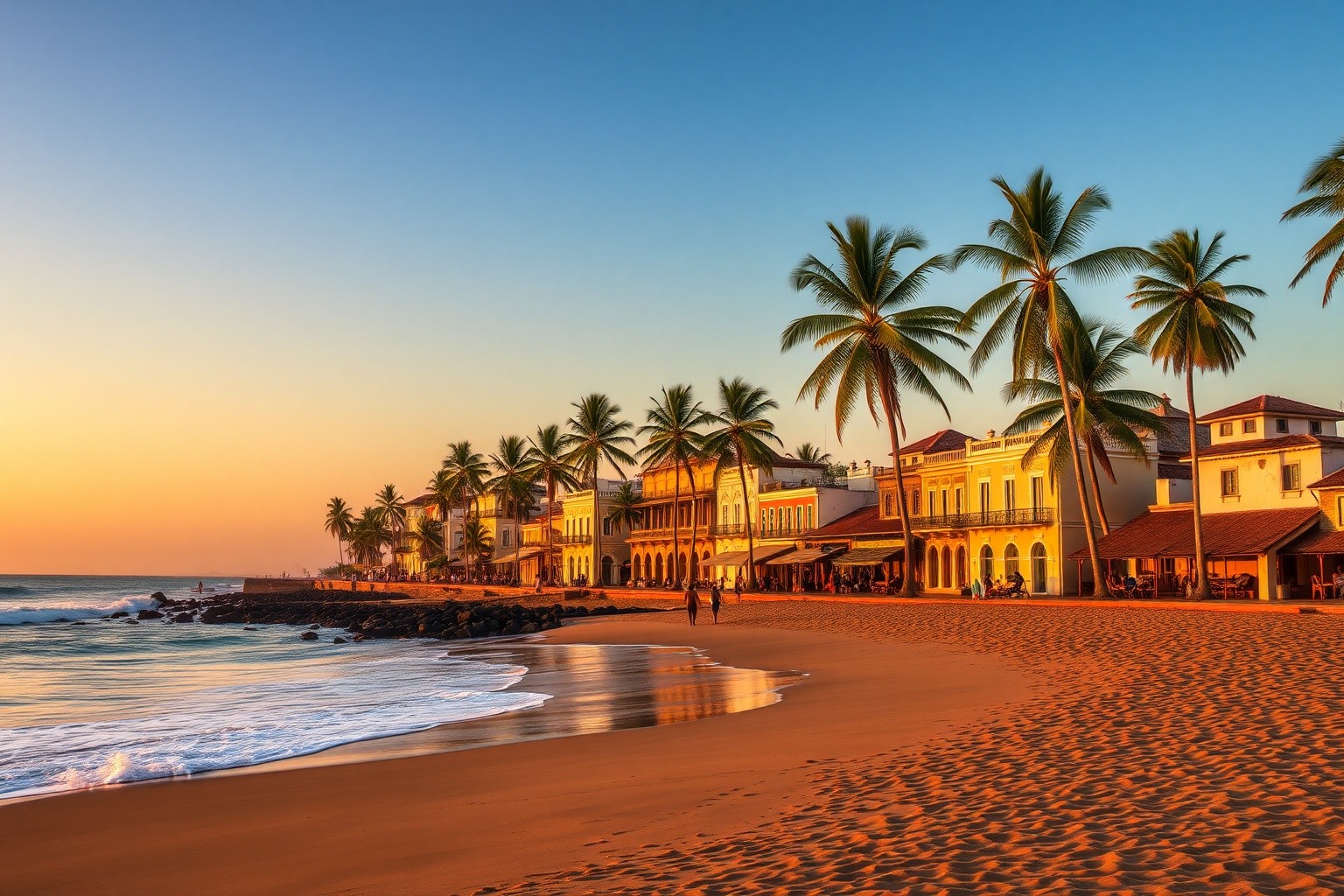
For a visitor the appeal is that almost nothing here has been arranged for you. Grand-Bassam, the first colonial capital, is a UNESCO-listed town of decaying French facades on an Atlantic beach. Yamoussoukro holds a basilica modelled on St Peter's and taller than it, standing in the savanna in a city built for a population that never arrived. Around Man, Dan communities still dance on stilts several metres high — at their own ceremonies, not for coach parties.
The honest framing: this is not an easy or a cheap destination, tourism infrastructure outside Abidjan and the beach strip is thin, and the northern border areas carry security warnings. What it offers instead is a large, complicated, self-confident West African country with very few other foreigners in it.
📛 Name & Identity
The country asks to be called Côte d'Ivoire in every language. In 1986 the government formally requested that the name not be translated — no Ivory Coast, no Elfenbeinküste, no Pobřeží slonoviny — on the grounds that translations produced confusion in international listings and that a country's name is its own. Most international bodies complied; ordinary usage in English and Czech has not entirely followed, and this page uses the official form.
The name itself comes from the 15th- and 16th-century European trade coasts of West Africa, catalogued by what could be taken from them: the Grain Coast, the Ivory Coast, the Gold Coast, the Slave Coast. The ivory ran out within a century. The name did not.
The demonym is Ivorian (Ivoirien). The flag's orange, white and green — savanna, peace and forest, in the usual reading — deliberately mirrors the Irish tricolour in reverse order, a coincidence that causes regular confusion at sporting events.
One concept worth knowing because it explains a great deal of recent history: ivoirité, "Ivorian-ness", a doctrine of national authenticity promoted in the 1990s that was used to exclude northerners and people of immigrant descent from political life. It contributed directly to the crises that followed and remains a loaded word.
🗺️ Geography & Regions
Côte d'Ivoire is a near-square of 322,463 km² — about four times Czechia — on the Gulf of Guinea, between Ghana to the east and Liberia and Guinea to the west, with Mali and Burkina Faso to the north. It has 515 km of Atlantic coast.
The lagoon coast
A chain of lagoons runs behind the shoreline, with Abidjan built around the Ébrié Lagoon. Sandbars, fishing villages and the beaches at Assinie and Grand-Bassam.
Southern rainforest
Once continuous across the south-west; much has been cleared for cocoa, which is the country's central environmental problem. Taï National Park protects what survives.
Western highlands
Around Man: forested hills, waterfalls, La Dent de Man, and Mount Nimba on the Guinean and Liberian border at 1,752 m — the country's highest point.
Central plateau
Baoulé country, Yamoussoukro, and the transition from forest to savanna. The cocoa and cashew belt.
Northern savanna
Drier Sudanian savanna: Korhogo, Senufo villages, baobabs, and Comoé National Park, one of the largest protected areas in West Africa.
Rivers
The Bandama, Sassandra, Comoé and Cavally run roughly north to south. The Kossou dam on the Bandama created a lake that displaced 75,000 people in the 1970s.
The country sits in the West African monsoon belt, so the south has two rainy seasons and the north one — a distinction that matters a great deal when planning.
🗺️ Map of Côte d'Ivoire
Abidjan is in the south-east corner on the lagoon; Yamoussoukro, the official capital, is 230 km inland at the centre. The motorway between them is good; most other roads are not.
A realistic first trip is Abidjan, Grand-Bassam and Assinie on the coast, then Yamoussoukro and Man inland — roughly ten days. Adding Korhogo and the north, or the national parks, needs more time and more planning, and the far north near the Burkinabè and Malian borders is subject to travel advisories.
📜 History
Before the French
The territory was never a single polity. The Kong Empire in the north, founded around 1710 by Dyula traders, controlled routes between the forest and the Sahel and was a centre of Islamic scholarship until Samori Touré destroyed it in 1897. In the east, Akan peoples — including the Baoulé, who arrived from what is now Ghana in the 18th century under Queen Abla Pokou — established kingdoms with elaborate court and goldworking traditions. The coast traded with European ships from the 15th century: ivory first, then, devastatingly, people.
French colony (1893–1960)
France declared a colony in 1893. Grand-Bassam was the first capital until a yellow fever epidemic in 1899 drove the administration to Bingerville and eventually to Abidjan. The colonial economy was built on forced labour, cocoa and coffee — and it was opposition to forced labour that made Félix Houphouët-Boigny, a Baoulé chief and doctor turned planter, into a political figure: the union he founded in 1944 secured its abolition two years later.
The Houphouët-Boigny era (1960–1993)
Houphouët-Boigny led the country to independence in 1960 and governed for 33 years until his death. The first two decades produced the "Ivorian miracle" — growth of around 7% a year, built on cocoa and coffee and on an open-door policy that drew millions of workers from Burkina Faso, Mali and Guinea. That migration built the economy and later became the fault line of the country's politics.
He moved the capital to his home village of Yamoussoukro and built the basilica there. When commodity prices collapsed in the 1980s, the model collapsed with them, and he left no succession arrangement.
Crisis and recovery
The 1990s brought the doctrine of ivoirité, used to bar the northern-linked politician Alassane Ouattara from standing for president, and with it a north–south rupture. A coup in 1999 was followed by a civil war from 2002 to 2007 that split the country in two, and then by a second conflict in 2010–11 when incumbent Laurent Gbagbo refused to accept his defeat by Ouattara. Around 3,000 people died in a few months. Gbagbo was tried at the International Criminal Court and acquitted in 2019.
Since 2011 the country has been stable and has grown fast — among the fastest-growing economies in Africa for much of the 2010s. The underlying questions about land rights, nationality and who counts as Ivorian have not been fully resolved, and elections remain tense. Jihadist attacks spilling over from Burkina Faso hit the north from 2020, which is why the border zone carries advisories.
The Ouattara decades (2011–)
Alassane Ouattara has governed since 2011. A 2016 constitution let him argue that the two-term limit had been reset, and his third-term run in October 2020 — after his chosen successor Amadou Gon Coulibaly died in office — was boycotted by the opposition and cost around 85 lives in street clashes. The 25 October 2025 election went further: former banker Tidjane Thiam, leader of the PDCI, was struck from the electoral roll in April 2025 over his former French nationality, Laurent Gbagbo was barred by a criminal conviction, rallies were banned, and Ouattara took a fourth term with roughly 90% of the vote on a 50% turnout. He was sworn in on 8 December 2025 and reconfirmed Robert Beugré Mambé as prime minister. Legislative elections on 27 December 2025 gave the ruling RHDP 197 of 255 seats while Gbagbo's PPA-CI boycotted. The economy keeps growing at 6–7% a year; the politics has narrowed. One symbolic marker of the period: France handed its last base in the country, Camp Port-Bouët in Abidjan, to the Ivorian army on 20 February 2025, ending a permanent French military presence that dated from 1978.
🎭 People & Culture
Around 32 million people live in Côte d'Ivoire, from more than sixty ethnic groups usually sorted into four families: Akan (Baoulé, Agni) in the east and centre, Krou in the south-west, Mandé in the north-west, and Voltaic or Gur peoples including the Senufo in the north. Roughly a quarter of the population are immigrants or of recent immigrant descent, mostly Burkinabè and Malian — a legacy of the plantation economy.
French is the official language and genuinely the lingua franca; Dioula is the trade language across much of the country. In Abidjan, listen for Nouchi — a street slang built from French, Dioula, English and whatever else is to hand, which began among young men in the 1980s and now supplies vocabulary to music, advertising and the national conversation.
Religion divides roughly between Islam (strongest in the north and among immigrant communities), Christianity (strongest in the south) and traditional practice, usually layered rather than exclusive. That geography is the same one the political crises ran along, which is why the country's religious coexistence is both real and carefully maintained.
Artistically the country is a heavyweight. Dan masks from the west and Senufo and Baoulé sculpture are in every major museum of African art in the world. Sacred forests near villages preserve both ritual sites and, incidentally, the last fragments of undisturbed vegetation in farmed districts.
🗣️ Language, Nouchi & Useful Phrases
French will get you everywhere. English will not, outside a few international hotels — this is one of the more thoroughly francophone countries in West Africa, and school French is genuinely enough.
Dioula — the trade language
I ni sogoma — good morning · I ni tile — good afternoon
I ka kene? — how are you? · Toro si te — no problem, all fine
I ni ce — thank you
Joli? — how much?
Nouchi — Abidjan street slang
C'est cadeau — it's free, a gift
Gbê — the truth, for real
Enjaillé — delighted, excited (from English "enjoy", now standard Ivorian French)
Djo / Djoss — mate, guy
Maquis — an open-air local restaurant. The word originally meant scrubland, then wartime resistance. Here it means dinner.
Nouchi is worth more than novelty value: it emerged among marginalised young men in 1980s Abidjan, became the language of coupé-décalé and Ivorian comedy, and now supplies words to mainstream French in the country. Using a word or two of it correctly will get you further than fluent Parisian French.
🏙️ Abidjan
Abidjan is the economic capital of francophone West Africa and a city of around six million, built around and across the Ébrié Lagoon. It stopped being the official capital in 1983 and has never for a moment stopped being the real one.
Le Plateau is the business district — towers, banks, ministries, and the pyramid of La Pyramide, a 1970s modernist landmark by the Italian architect Rinaldo Olivieri. Cocody is the leafy upscale district with the university and the presidential palace; within it, Riviera holds much of the expatriate and diplomatic community. Treichville and Adjamé are the dense, loud, commercial heart, with the great markets and the best maquis. Marcory and Zone 4 hold the restaurant and bar scene.
Things to actually do: the Musée des Civilisations de Côte d'Ivoire for the mask and sculpture collections; St Paul's Cathedral, a startling 1980s Aldo Spirito design where the roof is suspended from a figure of the saint; the Banco National Park, a patch of primary rainforest inside the city limits, with the extraordinary open-air fanico laundry where hundreds of men wash clothes by hand in the river; and a boat across the lagoon at dusk, which is the cheapest good thing in the city.
Nightlife is the city's export. Live music venues, rooftop bars over the lagoon and the coupé-décalé clubs of Yopougon and Zone 4 run very late. Abidjan is also, by a distance, the best place to eat in the country.
Practically: traffic is severe and should be planned around; use a ride-hailing app (Yango dominates; Uber gave up and left the country on 24 September 2025 after six years) rather than street taxis at night; and ordinary urban caution applies — phones out of sight, nothing valuable on display, no walking in unfamiliar areas after dark.
🏛️ Grand-Bassam
Grand-Bassam, 40 km east of Abidjan, was the first French colonial capital and was abandoned as such after the yellow fever epidemic of 1899 killed a large part of the administration. What survives is a UNESCO World Heritage Site inscribed in 2012: the Quartier France, a grid of colonial buildings — the governor's residence, the customs house, trading company offices, the first post office — in varying states of romantic decay between the lagoon and the sea.
The Musée National du Costume, housed in the former governor's palace, is the best single introduction to Ivorian ethnic dress and regalia in the country. The town is also a working fishing port, with pirogues drawn up on the sand, and a weekend beach destination for Abidjan, which means good seafood restaurants and a lively Sunday.
Two cautions. The Atlantic here has powerful rip currents and drownings happen; swim only where locals do, and preferably not at all if the sea is up. And Grand-Bassam was the site of a jihadist attack on the beach hotels in March 2016 in which 19 people were killed. Security was substantially increased afterwards and the town has been calm since, but it is a fact worth knowing rather than discovering later.
A short distance inland, Bingerville — the intermediate capital between Bassam and Abidjan — has a botanical garden and an arts centre in another set of colonial buildings, and sees almost no visitors at all.
⛪ Yamoussoukro
Yamoussoukro is one of the strangest cities in Africa and worth the trip for that alone. Houphouët-Boigny's home village was designated the official capital in 1983 and rebuilt with eight-lane boulevards, monumental institutions and street lighting for a metropolis. The population is around 300,000 and the roads are mostly empty. Most government business is still done in Abidjan.
The Basilica of Our Lady of Peace is the reason people come. Consecrated by Pope John Paul II in 1990, modelled on St Peter's in Rome and — by overall height including its cross-topped dome — taller than it, it is recorded by Guinness as the largest church in the world by total area. It holds 18,000 people, of whom 7,000 can be seated. The stained glass covers 7,400 m², was made in France, and includes a panel showing Houphouët-Boigny himself kneeling among the magi.
It cost an estimated 300 million dollars in a country whose economy was collapsing at the time, and Houphouët-Boigny insisted it was paid for from his personal fortune — a claim that satisfied few people then and fewer now. The Vatican accepted the gift only on condition that a hospital be built alongside; the hospital took until the 2010s to materialise. Whatever else it is, it is an extraordinary thing to stand inside, and it is almost always nearly empty.
Elsewhere: the presidential palace is ringed by a moat of sacred crocodiles, fed publicly in the late afternoon — a spectacle that acquired a grim footnote in 2012 when the keeper was killed by one of them. The Fondation Houphouët-Boigny pour la Recherche de la Paix is a vast marble conference complex, and the INP-HB polytechnic remains one of the best engineering schools in West Africa.
🎭 Man & the Western Highlands
The west around Man is the country's most scenic region and the heartland of Dan (Yacouba) culture. Forested hills rise to Mount Tonkoui (1,189 m), the second-highest peak in the country; La Dent de Man is a striking tooth of rock above the town; and waterfalls, liana bridges woven from forest vines and the sacred forests around villages fill the country between.
The stilt dancers — échassiers, called gué in Dan — are the region's signature. Dancers perform on stilts several metres tall, executing turns, splits and drops that are difficult to believe at ground level, let alone above it. This is masked ritual, not folklore: the stilt figure is a mask spirit, the dancer is not identified, and performances belong to ceremonies and festivals. Visitors can arrange to see one, and should do so through a local guide, pay properly, and ask before photographing anything.
The same applies to the sacred forests and mask houses. These are functioning ritual sites; several are closed to visitors entirely and others only with permission from village elders. Treating that as an obstacle rather than a boundary is the fastest way to be unwelcome.
The region borders Liberia and Guinea and was heavily affected by both civil wars, with population displacement that has not fully unwound. It is calm now, but check current advice before travelling to the immediate border districts.
🏖️ The Coast & National Parks
The 515 km of coastline is far less developed than Ghana's or Senegal's. Assinie, on a sandbar between lagoon and ocean east of Abidjan, is the weekend playground of the capital's wealthy — hotels, watersports and a genuinely beautiful spit of land. Sassandra further west combines a fishing port, colonial ruins and quieter beaches; San-Pédro is the country's second port, the outlet for western cocoa, with beaches nearby. Île Boulay in the Ébrié Lagoon is a car-free island half an hour from Abidjan by pirogue.
Rip currents along this coast are strong and lifeguards are rare. Ask locally, and take the answer seriously.
Taï National Park (UNESCO 1982)
One of the last major primary rainforests in West Africa. Pygmy hippos, forest elephants, and chimpanzees documented using stone tools — a landmark in primatology. Permits and guides required.
Comoé National Park (UNESCO 1983)
One of the largest protected areas in West Africa, 11,500 km² of savanna and gallery forest. Removed from the danger list in 2017 after wildlife recovered. Basic infrastructure, genuine wilderness.
Mount Nimba (UNESCO 1981/1982)
Shared with Guinea; a highland massif with species found nowhere else, including a toad that gives birth to live young. Access is difficult and partly restricted by mining.
Banco National Park
Primary rainforest inside Abidjan's city limits — an easy half-day and a genuinely odd experience.
Azagny & Ehotilé Islands
Coastal wetland parks with manatees, buffalo and mangrove birding, near the lagoons east and west of Abidjan.
Marahoué & Mont Sangbé
Parks that suffered badly from wartime encroachment and illegal cocoa farming; a reminder that protection here is contested, not settled.
🍫 Cocoa — the Country's Defining Crop
Côte d'Ivoire grows roughly 40% of the world's cocoa, more than any other country, on something like a million smallholdings averaging a few hectares each. Cocoa and its downstream trade account for a large share of exports and employ, directly or indirectly, a substantial fraction of the population.
The economics are brutally lopsided. Growers receive a small percentage of the final retail value of a chocolate bar; most of the value is added after the beans leave the country, in grinding, manufacturing and branding elsewhere. Côte d'Ivoire and Ghana, which together grow about 60% of world supply, introduced a joint Living Income Differential premium in 2019 to raise the farmgate price — a reasonable idea whose implementation has been contested by buyers ever since.
Two problems sit on top of that. Child labour is extensively documented in West African cocoa: large surveys have repeatedly found well over a million children working in hazardous conditions in the sector across Côte d'Ivoire and Ghana, despite two decades of industry pledges to end it. And deforestation — Côte d'Ivoire has lost the large majority of its forest cover since independence, much of it to cocoa expansion, including inside supposedly protected areas. The EU's deforestation regulation (EUDR), which requires supply chains to prove they are not linked to cleared land, is the most consequential external pressure on the sector in decades — though Brussels has postponed it twice, and large operators now only have to comply from 30 December 2026.
For a visitor: cooperative visits and small-scale bean-to-bar producers exist, mostly around Abidjan and in the cocoa belt, and are worth doing. Ivorian-made chocolate is a genuinely good souvenir and one of the few ways to leave money in the country's own value chain. Ask about the price per kilo the farmer received; the answer is the story.
🥘 Cuisine
Ivorian cooking is built on a starch and a sauce, and the starch is usually attiéké — fermented, grated cassava steamed into something between couscous and a pilaf, faintly sour, and the national dish in all but name. It is eaten with grilled fish, chicken, or almost anything else.
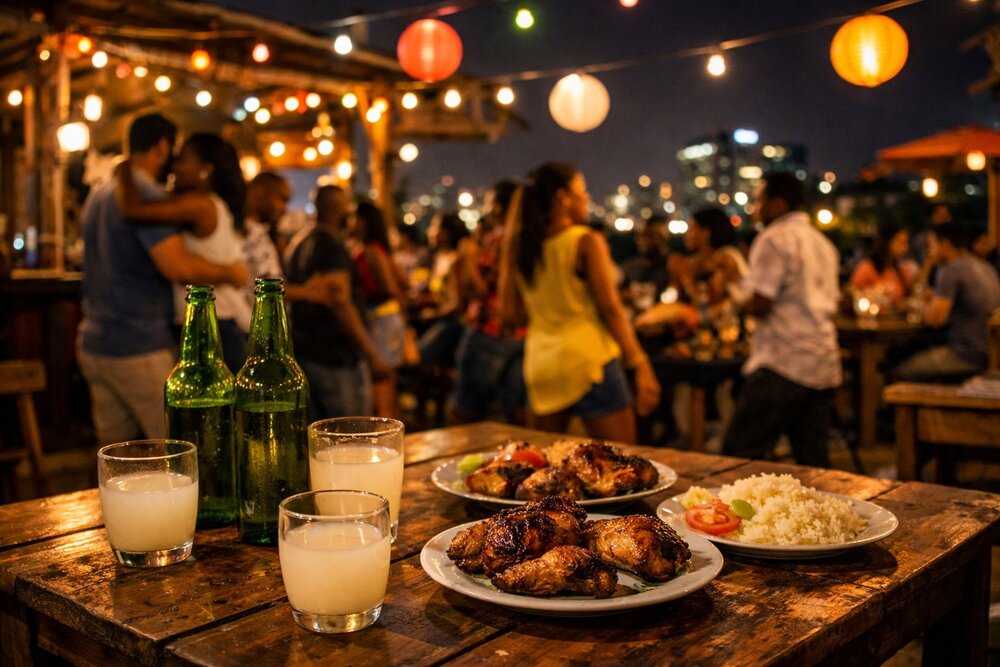
The place to eat is the maquis: an open-air restaurant, usually with plastic chairs, a charcoal grill and a fridge, serving fish and chicken with attiéké and alloco into the small hours. Abidjan has thousands of them, and they are consistently better and cheaper than restaurants with tablecloths.
🐟 Garba — attiéké with fried fish
Serves 2 · 30 minutes
Ingredients: 200 g attiéké (couscous at a pinch), 400 g whole fish — mackerel, tilapia or sardines, 30 ml vegetable oil, 1 onion finely sliced, 2 tomatoes diced, 1 cucumber sliced, 30 ml lemon juice, 1 stock cube crushed, salt, hot pepper sauce.
Method: Steam dried attiéké for about 15 minutes until fluffy; fresh attiéké only needs warming. Clean and score the fish on both sides, season generously with salt, crushed stock cube and a little oil, and grill or pan-fry over medium-high heat for 5–7 minutes a side until the skin is crisp. Meanwhile toss the sliced onion with the lemon juice and a pinch of salt and leave ten minutes to soften. Mound the attiéké, lay the fish alongside, top with the pickled onion, tomato and cucumber and serve with pepper sauce on the side.
💡 Garba is Abidjan's street food and is traditionally made with fried tuna. Real attiéké is slightly sour — if you are substituting couscous, add lemon juice to approximate it.
🍲 Kedjenou — the sealed-pot chicken
Serves 4 · 1 hour
Ingredients: 500 g chicken thighs and drumsticks, 1 large onion quartered, 2 tomatoes quartered, 1 small aubergine cubed, 2 cloves garlic crushed, 15 g fresh ginger sliced, bay leaf, thyme, 1 whole hot pepper, salt, pepper, 1 stock cube.
Method: Season the chicken and put it in a heavy pot with a tight lid. Pack the vegetables and aromatics around and over it, and add no water and no oil at all — every drop of liquid comes out of the ingredients. Seal the lid (traditionally with a flour-and-water paste) and cook on the lowest possible heat for 45–60 minutes, shaking the whole pot every quarter of an hour rather than lifting the lid or stirring.
💡 Kedjenou comes from a Baoulé word meaning "to shake". The result is chicken that has effectively steamed in its own juices, and it is the country's signature dish. Serve with attiéké, rice or foutou.
🍌 Alloco — fried plantains
Serves 4 · 20 minutes
Ingredients: 3 ripe plantains (yellow with black spots), oil for frying, salt. For the sauce: 2 tomatoes diced, 1 onion finely sliced, 1 hot pepper minced, 30 ml oil, 15 ml lemon juice, salt.
Method: Mix the sauce ingredients and leave them to marinate. Peel the plantains and cut them diagonally about 1.5 cm thick — the diagonal gives more surface to caramelise. Heat 3 cm of oil to about 175 °C and fry in batches, without crowding, 2–3 minutes a side until deep gold and caramelised at the edges. Drain, salt while hot, and serve with the raw sauce for dipping.
💡 Ripeness is everything: too green and they are starchy, too ripe and they collapse in the pan.
Foutou
Plantain, yam or cassava pounded to a smooth elastic dough — the accompaniment to the heavier sauces, eaten with the right hand.
Sauce graine
Palm nut sauce, rich and orange, usually with fish or beef. The Sunday sauce.
Sauce arachide
Groundnut sauce — thick, savoury and the most immediately likeable of the sauces to a foreign palate.
Poisson braisé
Whole fish grilled over charcoal with onion and chilli, the default order at any maquis.
Placali & sauce claire
Fermented cassava dough with a light peppery fish broth — the taste that most divides visitors.
French bread
The one durable colonial inheritance. Fresh baguette every morning, everywhere.
🍷 Drinks & Drinking Culture
There is no wine industry — the climate rules it out — and imported French wine is expensive. What the country has is beer, palm wine and a maquis culture that runs from late afternoon to very late at night.
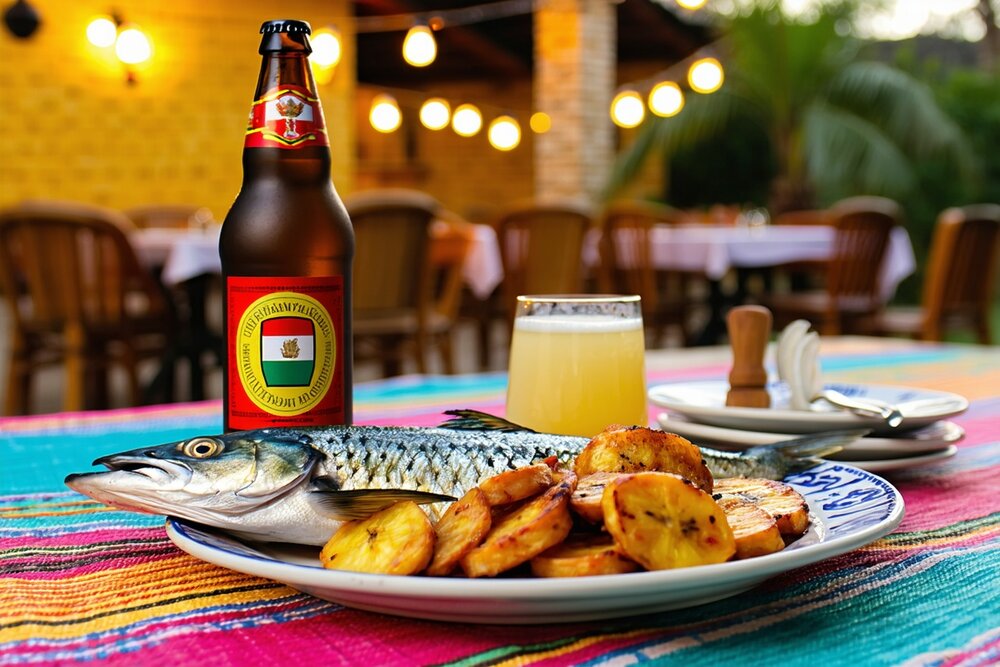
Bangui is palm wine: sap tapped from the palm at dawn, fermenting within hours, cloudy and sweet early in the day and sharply alcoholic by evening. It is a village and roadside drink rather than a bar product because it will not keep or travel. Koutoukou is the distilled version — a fierce, unregulated spirit of very variable quality that should be approached with caution and only from a source someone local vouches for.
Flag and Bock are the national lagers, sold everywhere in large shared bottles and drunk very cold. Ivoire and Tuborg brewed under licence fill out the fridge. Beer is a maquis drink and comes with grilled fish more or less automatically.
The non-alcoholic side deserves as much attention: bissap (hibiscus), gnamankoudji (ginger juice, often fierce), tamarind juice and baobab juice are sold chilled in bags and bottles on every street and are the best thing to drink at 33 °C. Coffee is grown here — Côte d'Ivoire is a significant robusta producer — but the everyday cup is usually instant, which is one of the country's small ironies.
🎵 Music & Coupé-Décalé
Coupé-décalé was invented by Ivorian exiles in Paris nightclubs around 2002, during the first civil war, and came home to conquer the continent. The name comes from Nouchi — roughly "cut and run", a wink at the hustling that funded the scene — and the music is built on fast percussion loops, sampled fragments, exhortation rather than singing, and dances that are named, taught and replaced every few months.
Its founding figure was Douk Saga (Stéphane Doukouré, 1974–2006) and his Jet Set crew; its biggest star, DJ Arafat (Ange Didier Houon), dominated the scene until his death in a motorbike crash in 2019; his funeral drew crowds that turned into a national event. Before him, the country's musical standing rested on Alpha Blondy and Tiken Jah Fakoly, two of the most important reggae artists Africa has produced, both of whom used the form for direct political criticism — Tiken Jah spent years in exile in Mali for it.
Older traditions run underneath: ziglibithy from the 1970s, the Bété rhythms of Ernesto Djédjé, and the mask and drum music of the Dan and Senufo, which is ritual rather than entertainment and is not performed on demand.
For a visitor, the practical version is a night out in Yopougon or Zone 4 in Abidjan, where the sound systems are enormous, the dancing is competitive, and nothing meaningful happens before midnight.
🏛️ UNESCO World Heritage
Mount Nimba Strict Nature Reserve (1981/82)
Shared with Guinea. Highland grassland and forest with endemic species, including a viviparous toad. On the danger list because of mining pressure and refugee settlement.
Taï National Park (1982)
The largest surviving block of primary rainforest in West Africa. Pygmy hippo, forest elephant, and tool-using chimpanzees.
Comoé National Park (1983)
Savanna and gallery forest across 11,500 km². Placed on the danger list during the conflict years and removed in 2017 after monitoring showed recovery — a rare good-news story.
Historic Town of Grand-Bassam (2012)
The first colonial capital: the Quartier France grid, the African quarter of N'zima, and the lagoon-to-ocean layout that shaped it.
Sudanese-style mosques (2021)
Eight small earthen mosques in the north — Kong, Tengréla, Kouto and others — the southernmost examples of a Sahelian building tradition.
Intangible heritage
Five inscriptions on the Representative List: the Gbofe transverse-trumpet music of the Tagbana (2008), the Zaouli mask dance of the Guro (2017), traditional loincloth weaving (2023), the Senufo balafon (2024, shared with Mali, Burkina Faso and Indonesia) and — the one everybody eats — attiéké production skills (December 2024). The Dan stilt dance and the Abissa are on the national inventory, not UNESCO's list. Tentative World Heritage list: two entries, both from 2006 — the Ehotilé Islands National Park and the Ahouakro archaeological park.
🌡️ Climate & Best Time to Visit
The country spans two climate regimes, and they do not share a calendar — planning around the wrong one is the most common trip-planning mistake here.
South · Abidjan, the coast
Two rainy seasons: a heavy one May–July and a lighter one October–November. 24–32 °C year round with high humidity. The main dry season is December–April.
North · Korhogo, Comoé
One rainy season, June–October, and a long dry season November–May. Hotter and drier: 35 °C and above in March, and cool nights in December and January.
Harmattan · December–February
The Saharan dust wind reaches the north and sometimes the coast. Hazy skies, poor photography light, dry air, and noticeably cooler nights inland.
Wildlife timing
Comoé is best late in the dry season, January–April, when animals concentrate at water. Taï's rainforest is walkable year-round but wetter May–July.
Best overall: December to March — dry in both halves of the country, though the harmattan can dull the light in the north. Avoid May to July if you are going anywhere unpaved: the heavy rains make secondary roads genuinely difficult and can cut off western and northern districts for days.
✈️ Getting There & Getting Around
Félix Houphouët-Boigny International (ABJ) in Abidjan is effectively the only gateway. Air France, Brussels Airlines, Turkish, Emirates, Royal Air Maroc, Ethiopian and Air Côte d'Ivoire all serve it, along with dense regional connections across West Africa.
From Prague there is no direct flight; the practical routings are via Paris, Brussels, Istanbul or Casablanca, with a total journey of roughly 10–14 hours and one connection.
Visas: Czech and most other European citizens require a visa. Côte d'Ivoire operates an e-visa system: apply online in advance, then collect the physical visa on arrival at Abidjan airport. It works reliably but the pre-approval must be done before departure — you cannot simply turn up. A yellow fever vaccination certificate is mandatory and is checked.
Getting around: the Abidjan–Yamoussoukro motorway is genuinely good, and the main roads to Man, San-Pédro and Korhogo are paved and reasonable. Everything else varies. Inter-city travel is by gbaka minibuses (cheap, crowded, uncomfortable) or better long-distance coach companies such as UTB, which are comfortable and worth the difference. Domestic flights link Abidjan with Korhogo, Man, San-Pédro and Bouaké.
In Abidjan, use Yango (Uber withdrew from Côte d\'Ivoire in September 2025); the orange metered taxis are fine by day if you agree the fare first, and the woro-woro shared taxis are cheap and local. Traffic is the binding constraint on everything. Line 1 of the Abidjan metro — 37 km and 18 stations from Anyama to Port-Bouët — has been under construction since 2022, the opening has slipped from 2023 to a projected 2027–28, and nothing is running yet.
📋 Practical Information
Electricity
230 V, 50 Hz, French type C/E sockets — identical to Czechia, no adapter needed. Supply in Abidjan is reasonably reliable; less so elsewhere.
Money
West African CFA franc (XOF), pegged to the euro at 655.957. Note it is not interchangeable with the Central African CFA (XAF) despite the same value. Cards work in Abidjan hotels and supermarkets; carry cash everywhere else.
Water
Do not drink the tap water. Bottled or filtered, including for teeth. Sachet water is ubiquitous and cheap but of variable provenance.
Health
Malaria is present year-round throughout the country and prophylaxis is essential. Yellow fever certificate mandatory. Typhoid, hepatitis A and B and meningitis worth discussing with a travel clinic.
Medical care
Good private clinics in Abidjan (PISAM, Hôtel-Dieu); very limited outside it. Travel insurance with medical evacuation cover is a genuine requirement.
SIM & data
Orange, MTN and Moov. Prepaid SIMs are cheap, registered on a passport, and data is fast in the cities. Mobile money is how the country actually pays for things.
Time
UTC+0 year round. One hour behind Czech winter time, two behind Czech summer.
Photography
Do not photograph military, police, ports, airports or government buildings. Ask before photographing people — and expect to be asked for payment at markets, which is fair enough.
Safety: Abidjan and the southern tourist areas are generally calm, with ordinary urban crime the main risk — bag snatching, phone theft, occasional armed robbery after dark. Foreign ministries advise against travel to the northern border zone with Burkina Faso and Mali because of jihadist activity that has produced attacks since 2020, and advise caution in the far west near the Liberian border. Road accidents are statistically the most likely thing to harm a visitor: avoid night driving between towns.
💰 Costs & Money
Abidjan is expensive — regularly ranked among the costlier African cities for expatriates — while the rest of the country is much cheaper. Budget for the city rather than the average.
Budget · €40–60/day
Simple hotel or guesthouse, maquis meals, shared taxis and gbaka minibuses. Perfectly workable outside Abidjan.
Mid-range · €100–180/day
Decent hotel, restaurant dinners, ride-hailing, a driver for day trips. This is the realistic figure for Abidjan.
Higher · €250+/day
International hotels in Plateau or Zone 4, private guide and 4×4 for the interior, Assinie resorts at weekends.
Typical prices
Maquis meal with fish and attiéké €4–8 · restaurant main €12–25 · large Flag €1.50–3 · Yango across Abidjan €3–6 · guide and 4×4 per day €80–150.
Cash matters. ATMs are plentiful in Abidjan and present in the larger towns, and international cards usually work — but nothing outside the cities should be planned on that assumption. Carry euros to change and keep a supply of small CFA notes; change for a 10,000 note is a recurring problem.
Bargaining is expected at markets and with unmetered taxis and is a friendly, unhurried process rather than a confrontation. Fixed prices apply in shops, supermarkets and maquis.
🏨 Accommodation
Abidjan has the full range, from international chains in Plateau and Zone 4 through good mid-range business hotels to simple guesthouses. Cocody and Zone 4 are the most comfortable bases for a visitor; Plateau empties at night and is best for a short business stay.
Grand-Bassam and Assinie have beach hotels ranging from modest to genuinely upmarket, and fill at weekends with Abidjan residents — book ahead for Saturday nights and stay midweek if you want the beach to yourself.
Yamoussoukro, Man, Korhogo and San-Pédro have functional hotels aimed at business and NGO travellers rather than tourists: clean, air-conditioned, unmemorable, and adequate. Around the national parks, accommodation means basic park lodging or camping arranged through the park authority, and needs organising in advance.
Booking platforms cover Abidjan and the coast well and the interior badly. For anything beyond the main towns, a local operator or a phone call is more reliable than a website.
🎭 Festivals & Events
Fêtes des Masques · Man region, February–March
The mask festivals of the west, when Dan and Wè villages bring out their mask figures and the stilt dancers perform. The single best reason to time a trip.
Fête de l'Abissa · Grand-Bassam, October–November
The N'zima new year: a week in which the community is licensed to criticise its own leaders publicly, in song and mockery, before order is restored. On the national heritage inventory (not, despite what the tourist office implies, on UNESCO's list) and genuinely extraordinary.
Carnaval de Bouaké · March
A week of parades and music in the country's second city, revived after the war years.
Popo Carnival · Bonoua, April
Masquerade and dance in the south-east, with colonial-era roots and a strong local following.
MASA · Abidjan, biennial, March
The Marché des Arts du Spectacle Africain — the continent's biggest performing arts market, drawing companies from across Africa.
Independence Day · 7 August
Military parade and national celebration, held in a different city each year.
Muslim and Christian festivals are both public holidays and both widely observed across communities — one of the more attractive features of Ivorian public life.
🎒 Packing Tips
Malaria protection
Prophylaxis started before arrival, DEET repellent, and long sleeves at dusk. This is the single most important item on the list.
Documents together
Passport with e-visa approval, yellow fever certificate, insurance. They are checked as a set at the airport and at road checkpoints.
Light, modest clothing
Cotton and linen for 30 °C and high humidity. Shoulders and knees covered in the north and at religious sites.
Cash in euros
To change, plus a stock of small CFA notes. Nothing outside the cities should depend on a card.
Rain shell
May–July in the south is genuinely wet, and it arrives fast.
Type C/E plugs
The same as Czechia — no adapter needed, which is a rare small mercy.
Leave the drone at home: flying without authorisation is restricted and invites confiscation.
🤔 Fascinating Facts
The world's largest church
The Basilica of Our Lady of Peace in Yamoussoukro holds the Guinness record by total area, and its dome and cross stand taller than St Peter's in Rome.
40% of the world's cocoa
More than any other country, grown on around a million smallholdings.
The name may not be translated
Since 1986 the government has asked that "Côte d'Ivoire" be used in every language, untranslated.
A capital almost nobody lives in
Yamoussoukro has been the official capital since 1983; government, business and diplomacy all remained in Abidjan.
Crocodiles at the palace
The presidential palace moat holds sacred crocodiles, fed in public every afternoon.
Chimpanzees with a stone age
Taï's chimpanzees crack nuts with stone hammers and anvils, a behaviour with an archaeological record going back thousands of years.
Coupé-décalé was invented in Paris
By Ivorian exiles during the civil war, then exported home and across Africa.
Nouchi is a real language now
The Abidjan street slang has moved into mainstream Ivorian French, advertising and literature.
⭐ Notable Ivorians
Félix Houphouët-Boigny (1905–1993)
Independence leader and president for 33 years; architect of the "Ivorian miracle" and of Yamoussoukro.
Didier Drogba (b. 1978)
Chelsea striker, and the man widely credited with helping halt the civil war by appealing for peace after qualifying for the 2006 World Cup.
Alpha Blondy (b. 1953)
One of the most important reggae artists Africa has produced, singing in Dioula, French, English and Hebrew.
Tiken Jah Fakoly (b. 1968)
Reggae musician and political critic; exiled for years for his lyrics about West African governments.
DJ Arafat (1986–2019)
The defining star of coupé-décalé, whose death brought Abidjan to a standstill.
Bernard Dadié (1916–2019)
Writer, playwright and one of the founding figures of francophone African literature.
Frédéric Bruly Bouabré (1923–2014)
Artist who devised an entire Bété syllabary and drew thousands of small cards documenting the world; internationally exhibited.
Yaya & Kolo Touré
Brothers who anchored the golden generation of Ivorian football alongside Drogba.
Alassane Ouattara (b. 1942)
Former IMF deputy managing director, prime minister under Houphouët-Boigny, president since 2011 and re-elected to a fourth term in October 2025 with his main rivals barred; the country's growth story and its narrowing politics both carry his name.
Tidjane Thiam (b. 1962)
Former chief executive of Prudential and Credit Suisse — the first African to run a FTSE 100 company — and leader of the PDCI since 2023; struck from the electoral roll in April 2025 over his former French nationality, he became the absent centre of the 2025 election.
Ruth Gbagbi (b. 1994)
Taekwondo fighter with Olympic bronzes at Rio 2016 and Tokyo 2020 and a world title in 2017 — the most decorated Ivorian Olympian.
⚽ Sports
Football is the national obsession and Côte d'Ivoire is one of Africa's genuine powers. Les Éléphants won the Africa Cup of Nations in 1992, 2015 and — as hosts, in a tournament they nearly exited at the group stage before winning it — in 2024. The 2000s "golden generation" of Drogba, the Touré brothers, Kalou and Zokora is remembered across the continent.
The single most-told story about Ivorian football is political: after qualifying for the 2006 World Cup, Drogba knelt on live television with the squad and appealed to the warring sides to lay down their arms, and a ceasefire followed within days. Football historians and political scientists argue about how much causal weight that carries; nobody in the country doubts it mattered.
Since then: the title defence at AFCON 2025 in Morocco (December 2025–January 2026) began with a stoppage-time 3–2 comeback against Gabon to top the group and ended in the quarter-final, 2–3 to Egypt. The Elephants then qualified for the 2026 World Cup in North America and made history there: a 2–0 win over Curaçao sent them into the knockout rounds for the first time ever, before Norway beat them 2–1 in the round of 32 in Arlington, Texas — Amad Diallo's equaliser undone by Erling Haaland's 86th-minute winner. The three previous appearances (2006, 2010, 2014) had all ended in the group stage; 2026 was the fourth.
Beyond football: Côte d'Ivoire has produced Olympic medallists in taekwondo — Cheick Cissé's gold at Rio 2016 was the country's first gold (Gabriel Tiacoh's 400 m silver in 1984 was its first medal), and Cissé and Ruth Gbagbi both took bronze at Tokyo 2020; the team left Paris 2024 without a medal — and in athletics, where Marie-Josée Ta Lou-Smith has been among the world's fastest sprinters for a decade. Basketball and handball have followings, and the country hosted the Africa Cup of Nations in 2024 with substantial new stadium construction, including the 60,000-seat Alassane Ouattara Stadium at Ebimpé.
📰 Media & Press Freedom
The media landscape is plural and politically aligned: most newspapers are openly attached to political parties, and readers choose accordingly. Fraternité Matin is state-owned, Le Patriote and Notre Voie sit at opposite political poles, and RTI is the state broadcaster. Private radio has expanded substantially, and Radio France Internationale is widely listened to.
Reporters Without Borders ranks Côte d'Ivoire 54th of 180 in its 2026 World Press Freedom Index (score 66.27), up ten places from 64th in 2025 — comfortably better than its Sahelian neighbours, and far better than the conflict years, when journalists were attacked and outlets closed. Imprisonment for press offences was abolished by the 2017 press law, which was a real reform; insulting the president remains a crime, the 2024 Electronic Communications Act criminalises disclosing electronic messages in a way that can be turned on reporters, and the National Press Authority (ANP) has suspended newspapers for up to three months several times since 2023. The election year brought its own case: Beninese journalist Hugues Comlan Sossoukpè was lured to Abidjan and handed to Benin in July 2025, and RSF took both governments to the ECOWAS Court in April 2026. Private television only arrived in 2019, ending RTI's half-century monopoly; most of the new channels belong to people close to the government.
For a visitor the practical points are that political conversation is open and lively but can be sharply divided along the old fault lines, and that photographing or filming anything official remains a bad idea regardless of what the law says.
📸 Photo Gallery
We hold only three photographs of Côte d'Ivoire. If you have been — Abidjan, the Man mask festivals, Comoé, a maquis at midnight — send yours to photos@kaufmann.wtf and we will feature them here with credit.
🌐 Useful Resources
Côte d'Ivoire e-visa
The official pre-approval system — apply before departure, collect on arrival at Abidjan: snedai.com
OIPR — national parks
The office managing Taï, Comoé and the other protected areas; permits and current access: oipr.ci
Côte d'Ivoire Tourisme
The official tourism board, with regional information in French: tourismeci.org
MZV ČR & DROZD
Czech travel advice — read the regional detail on the northern border — and pre-travel registration: mzv.gov.cz
📚 Recommended Reading & Watching
Allah is Not Obliged · Ahmadou Kourouma
The great Ivorian novel: a child soldier's account of West Africa's wars, told in furious, broken French. Prix Renaudot 2000.
The Suns of Independence · Ahmadou Kourouma
His first novel, and the book that changed what francophone African fiction could sound like.
Aya of Yop City · Marguerite Abouet & Clément Oubrerie
A graphic novel series set in 1970s Abidjan — warm, funny, and the best portrait of ordinary Ivorian life in any medium.
Climbié · Bernard Dadié
The colonial-era coming-of-age novel by one of the founders of the country's literature.
Run · Boubacar Boris Diop & Ivorian cinema
Look for Philippe Lacôte's Run (2014) and Night of the Kings (2020), the latter set in Abidjan's MACA prison and one of the best African films of recent years.
Chocolate Nations · Órla Ryan
Clear-eyed reporting on the cocoa economy of Côte d'Ivoire and Ghana and who actually gets paid.
Music
Alpha Blondy's Jérusalem, Tiken Jah Fakoly's Françafrique, Ernesto Djédjé for ziglibithy, and any DJ Arafat compilation for the coupé-décalé.
Bal poussière (1988)
Henri Duparc's comedy — the classic of Ivorian cinema and still very funny.
✍️ Author's Note
"Côte d'Ivoire grows the cocoa for something like two of every five chocolate bars on Earth, and receives almost no visitors at all. Those two facts sit oddly together, and the country is entirely aware of it."
"Yamoussoukro is the image that stays. A basilica larger than St Peter's, in polished Italian marble, air conditioned, seating eighteen thousand, standing in the savanna at the end of an eight-lane boulevard with no traffic on it. You can find it absurd or moving and most people manage both within ten minutes. What you cannot do is forget it."
"But the country is really in the maquis: plastic chairs on a pavement in Treichville, a whole fish off the charcoal, a mound of attiéké, a bottle of Flag with the label sweating off, and an argument about football that has been running since 2006. That is where Ivorians go, that is where the food is best, and that is where you will be invited to sit down within about four minutes of arriving. Enjaillé, they say. It means delighted, and it comes from the English word enjoy, and it is entirely the right word."
— Radim Kaufmann, September 2026
Support This Project 🌍
This World Travel Factbook is a labor of love – free to use for all travelers. If you find it helpful, consider supporting its continued development.
