🍸 Cocktails & Mixed Drinks
Australia's cocktail scene has come a long way from the pub schooner — Melbourne and Sydney now field internationally ranked bars, and a growing "native botanicals" movement is putting Australian bush ingredients into glassware the same way they've reshaped fine dining.
Bundy Dark & Stormy
The Queensland Classic
Bundaberg dark rum, Australia's most divisive spirit, meets ginger beer and lime for a punchier take on the Caribbean original.
🥃 Highball glass · 🔨 Build
Ingredients: 60ml Bundaberg dark rum · 15ml lime juice · ginger beer, to top · lime wedge
Preparation: fill a highball glass with ice, add rum and lime juice, and top with ginger beer. Stir gently and garnish with a lime wedge.
💡 "Bundy and Coke" is the everyday version, poured in country pubs nationwide — this is the slightly more grown-up cousin.
Lemon Myrtle Sour
The Native Botanicals Movement
Australian gin, increasingly distilled with native botanicals, shaken into a sour with lemon myrtle syrup — a showcase for the bush-ingredient movement reshaping Australian bars and kitchens alike.
🥃 Coupe glass · 🔨 Shake & strain
Ingredients: 50ml Australian native-botanical gin · 25ml lemon juice · 20ml lemon myrtle syrup · 1 egg white (optional) · dried lemon myrtle leaf, to garnish
Preparation: dry shake all ingredients without ice, then shake again hard with ice. Double strain into a chilled coupe glass.
💡 Lemon myrtle syrup: steep 2 tbsp dried lemon myrtle in 250ml simple syrup for 20 minutes, then strain.
Melbourne Espresso Martini
Coffee Culture, After Dark
The espresso martini wasn't invented in Australia, but Melbourne's coffee-obsessed bar scene has arguably perfected it, insisting on real espresso from a proper machine behind the bar rather than a bottled substitute.
🥃 Coupe glass · 🔨 Shake & strain
Ingredients: 50ml vodka · 30ml fresh espresso, cooled · 20ml coffee liqueur · 10ml sugar syrup · 3 coffee beans, to garnish
Preparation: shake all ingredients hard with plenty of ice — this is one cocktail where under-shaking shows immediately in a thin, foamless result. Double strain into a chilled coupe and float three coffee beans on top.
💡 Ask any Melbourne bartender about "proper crema" on top and be prepared for a genuine, strongly held opinion.
Kaufmann Drinks Score (KDS)
| Drink | Style | KDS |
|---|---|---|
| Bundy Dark & Stormy | The Queensland Classic | 81 |
| Lemon Myrtle Sour | The Native Botanicals Movement | 88 |
| Melbourne Espresso Martini | Coffee Culture, After Dark | 89 |
✦ Author's Note — Radim Kaufmann
A bartender in a Melbourne laneway bar with no sign out front handed me a gin sour with a leaf floating on top and said, "That's lemon myrtle, mate — grows wild about two hours from here." It tasted like nothing I'd had before: brighter than lemon, almost eucalyptus-sharp underneath. He shrugged when I asked why it wasn't more famous internationally. "Give it time."
🍷 Wine, Spirits & Drinking Culture
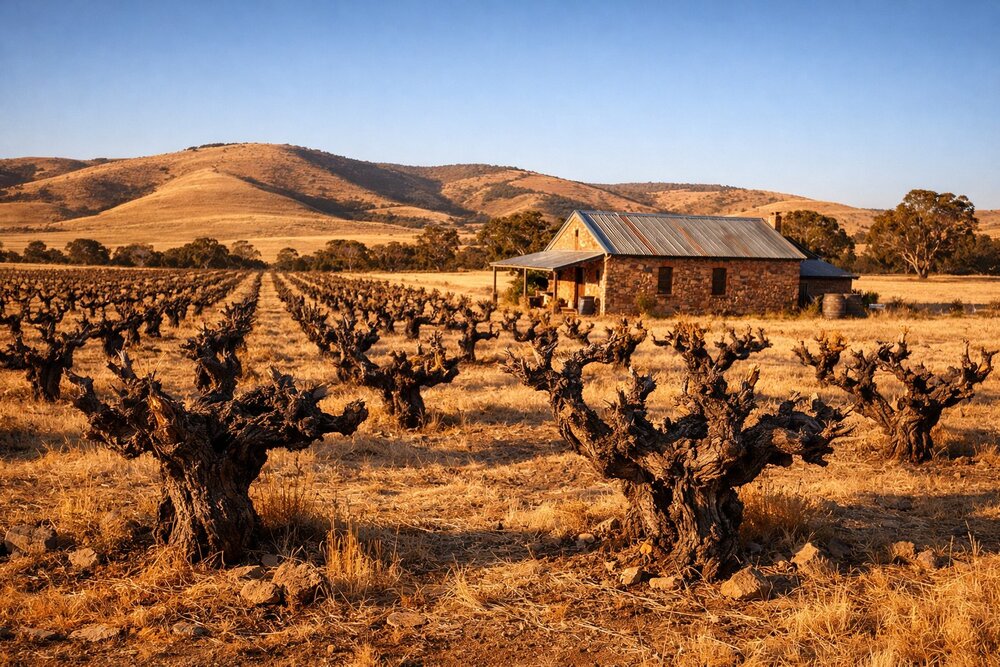
Australia is the world's fifth-largest wine exporter and home to some of the oldest continuously producing vineyards on Earth. While European vines were devastated by phylloxera in the 19th century, many Australian regions — particularly the Barossa Valley — escaped, preserving ungrafted Shiraz vines planted in the 1840s that are among the most valuable living grapevines anywhere. Australian wine is a study in extremes: continental desert heat in the Barossa, cool maritime influence in Tasmania, ancient soils in McLaren Vale, and altitude viticulture in the Adelaide Hills.
The Australian wine revolution of the 1980s–2000s — led by affordable, fruit-forward Shiraz and Chardonnay — conquered world markets but also created a reputation for "sunshine in a bottle" that obscured Australia's extraordinary diversity. Today, the country's best producers are crafting wines of genuine subtlety and terroir expression — cool-climate Pinot Noir, age-worthy Riesling, and single-vineyard Shiraz that rivals the finest Rhône — alongside a booming natural wine movement that makes Australia one of the most exciting wine countries on the planet.
📜 A Brief History of Australian Wine
The story begins with James Busby, a Scottish-born viticulturist who arrived in Sydney in 1824 and collected 362 vine cuttings from Spain and France — including the Syrah (Shiraz) cuttings that would become the foundation of Australia's greatest wine. Those vines were planted at the Royal Botanic Gardens in Sydney and distributed to the Hunter Valley, Barossa Valley, and beyond.
German Lutheran settlers fleeing religious persecution arrived in the Barossa in the 1840s, bringing winemaking traditions that persist to this day. Families like Henschke (1868), Yalumba (1849, Australia's oldest family-owned winery), and Seppeltsfield (1851, which has an unbroken line of Tawny vintages going back to 1878 — they open one barrel every year on its 100th birthday) built the foundations of Australian wine.
The modern revolution came in 1951, when Max Schubert, chief winemaker at Penfolds, returned from Bordeaux with a radical idea: create an Australian wine that could age like first-growth Bordeaux. The board told him to stop. He made it secretly. That wine became Penfolds Grange — now Australia's most famous and expensive wine, regularly selling for $800–1,000+ per bottle. A 1951 Grange sold at auction for $51,750 in 2004. Schubert's defiance changed Australian wine forever.
The phylloxera story is equally remarkable. When the root louse devastated European and most New World vineyards in the late 1800s, South Australia enacted strict quarantine laws that kept the pest out. The result: Barossa Valley Shiraz vines planted in the 1840s–1890s survive today, ungrafted, on their original rootstock — making them among the most valuable living grapevines anywhere. Some single vines are insured for over $10,000.
🏔️ The Wine Regions
🍷 Barossa Valley, SA — The Shiraz Cathedral
Australia's most famous wine region and the undisputed capital of Shiraz. Old vines planted in the 1840s–1890s — pre-phylloxera, ungrafted, some of the oldest in the world — produce wines of staggering concentration and complexity. The warm continental climate, ancient soils, and cool nights at altitude create Shiraz of deep colour, black fruit, dark chocolate, and savoury spice. Penfolds Grange, Henschke Hill of Grace, and Torbreck RunRig are among Australia's most iconic wines. The neighbouring Eden Valley produces world-class dry Riesling of extraordinary longevity.
🏛️ Don't miss: Seppeltsfield's 100-year-old Tawny tasting — you taste the wine from the year you were born, drawn from barrel. Henschke's Hill of Grace vineyard — a single block of 1860s Shiraz vines beside an old Lutheran church. Peter Lehmann Wines — named after "the Baron of the Barossa" who mortgaged his house to buy grapes from local farmers during the 1979 glut, saving the valley's vineyards.
🌊 Margaret River, WA — The Bordeaux of the South
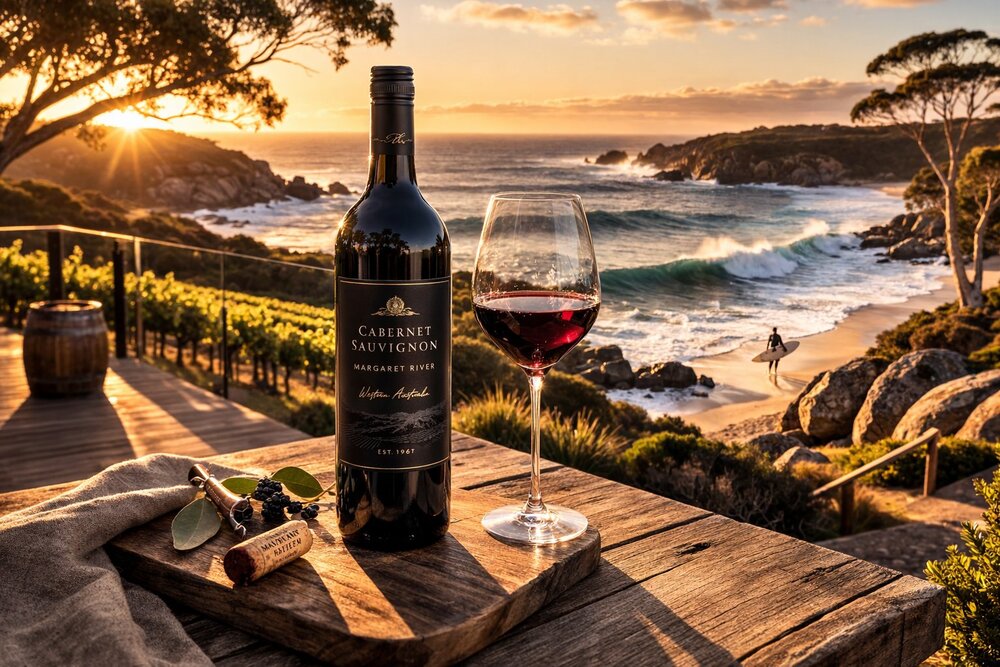
Western Australia's maritime jewel produces Australia's finest Cabernet Sauvignon and Chardonnay in an idyllic setting of surf beaches, karri forests, and gourmet restaurants. The maritime influence creates a long, even growing season — ideal for Bordeaux varieties. Leeuwin, Cullen, Vasse Felix, and Moss Wood produce wines that regularly compete with first-growth Bordeaux in blind tastings. The region contributes only 3% of Australia's production but 20% of its premium wine.
☀️ Hunter Valley, NSW — The Semillon Kingdom
Australia's oldest wine region (vineyards since the 1820s) produces the world's greatest Semillon — picked early at low sugar, bottled without oak, light and citrusy in youth, then ageing into one of wine's great transformations: honeyed, toasty, complex masterpieces at 10–20 years. Tyrrell's Vat 1, Brokenwood Graveyard, and Mount Pleasant are icons. The Hunter also produces excellent Shiraz — medium-bodied, earthy, and distinctive compared to Barossa's power.
🌿 Yarra Valley, VIC — Cool-Climate Elegance
Melbourne's backyard wine region produces Australia's finest Pinot Noir and Chardonnay — wines of Burgundian ambition from cool, elevated vineyards. Coldstream Hills (founded by wine critic James Halliday), De Bortoli, Giant Steps, and Yering Station produce Pinot of silky elegance. The neighbouring Mornington Peninsula adds maritime cool-climate character, and Tasmania is emerging as the premium source for sparkling wine and Pinot Noir.
🏖️ McLaren Vale & Adelaide Hills, SA
McLaren Vale, south of Adelaide, produces rich, generous Shiraz and Grenache from ancient Mediterranean-climate soils — the natural wine movement's Australian heartland, with producers like d'Arenberg, Bekkers, and SC Pannell. The Adelaide Hills above, at 400–700m altitude, deliver cool-climate Sauvignon Blanc, Pinot Noir, and some of Australia's finest sparkling wine. Clare Valley, further north, is a Riesling paradise — bone-dry, lime-juice Rieslings that rival the best of Alsace and Mosel.
🍇 The Key Grapes
🍷 Shiraz — The National Grape · KWS 93
Same grape as French Syrah · Barossa, McLaren Vale, Hunter Valley
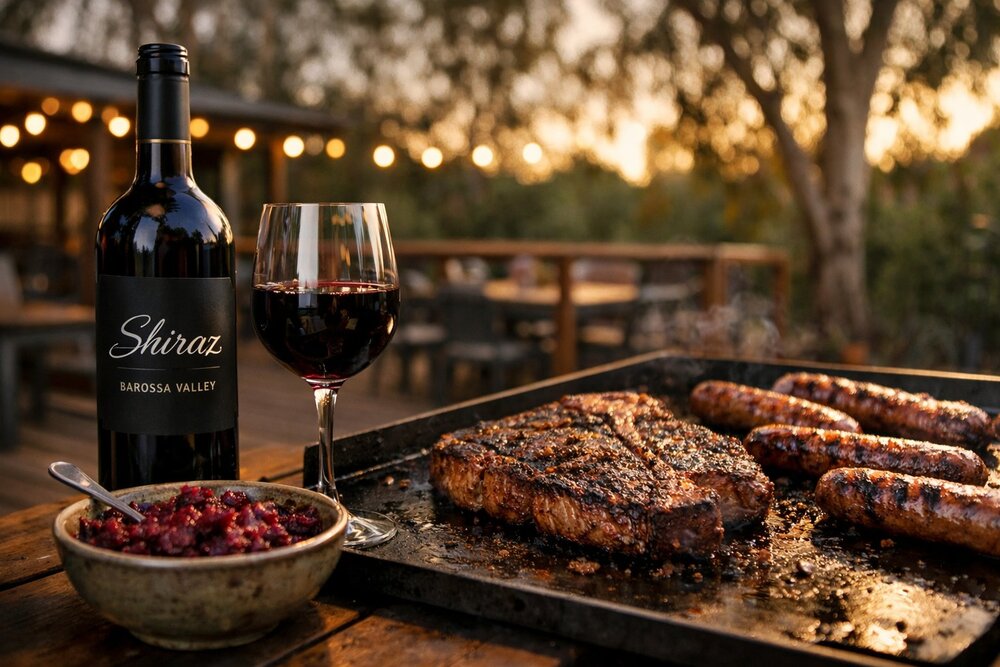
Australian Shiraz at its peak — from old Barossa vines, fermented in open stone lagars, aged in French and American oak — is one of the world's great red wines. Deep black-purple, with blackberry, dark chocolate, licorice, smoked meat, and pepper. The best examples (Grange, Hill of Grace, RunRig) are age-worthy for 30+ years. At $15–20, everyday Barossa Shiraz offers the world's best red wine value.
🏆 The Icons: Penfolds Grange — the wine made in secret that became a national treasure. Henschke Hill of Grace — single-vineyard Shiraz from 1860s vines beside Eden Valley's oldest Lutheran church. Torbreck RunRig — named after the Scottish ridge-and-furrow farming system, made from 160-year-old vines. At the other end: d'Arenberg The Dead Arm — named after the vine disease that kills one side of the vine, concentrating the surviving fruit — is extraordinary value at $30.
🥂 Riesling — The Hidden Treasure · KWS 90
Clare Valley, Eden Valley, Tasmania · Bone-dry style
Australia's greatest white wine secret. Clare Valley and Eden Valley Rieslings are picked early, fermented bone-dry under screwcap, and develop extraordinary lime, toast, and kerosene complexity over 10–20 years. Grosset Polish Hill, Pewsey Vale, and Jim Barry The Florita are benchmarks — proof that Riesling isn't just a German grape.
🍷 Cabernet Sauvignon · KWS 89
Margaret River, Coonawarra · Bordeaux rivals
Margaret River Cabernet — structured, elegant, with blackcurrant, eucalyptus, and fine-grained tannins — regularly outperforms Bordeaux in blind tastings. Coonawarra, on its famous terra rossa strip, produces Cabernet of distinctive mintiness and precision. Cullen Diana Madeline and Leeuwin Art Series are world-class.
🥂 Semillon & Chardonnay · KWS 87 / 88
Hunter Valley Semillon · Margaret River Chardonnay
Hunter Valley Semillon is one of wine's great originals: picked at 10.5% alcohol, no oak, lean and citric in youth, transforming into honeyed magnificence at 10+ years. Margaret River and Yarra Valley Chardonnays range from lean and mineral to rich and complex — Australia has moved far beyond the over-oaked stereotype of the 1990s.
🍺 Beer, Spirits & Pub Culture
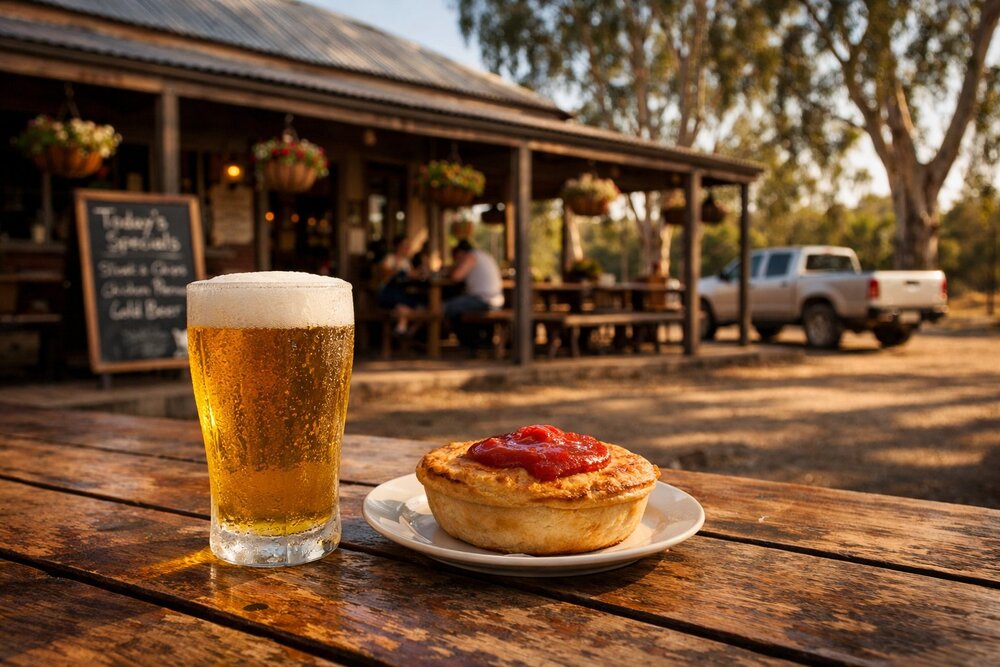
The Australian pub is a sacred institution. From inner-city gastro-pubs to corrugated-iron outback watering holes, the pub is where Australia socialises. A "schooner" (425ml) or "pot" (285ml, varies by state — don't get the terminology wrong) of draught beer remains the default order. Historically dominated by mass-market lagers (VB, Toohey's, XXXX, Carlton Draught), the craft beer revolution has transformed the scene — Stone & Wood Pacific Ale, Balter XPA, and hundreds of microbreweries now rival the old guard.
Australian whisky has emerged as a global force. Tasmania's Sullivan's Cove was named World's Best Single Malt in 2014, and producers like Starward (Melbourne), Lark, and Archie Rose are rewriting the rules. Bundaberg Rum ("Bundy") remains the quintessential Australian spirit — dark, molasses-heavy, divisive, and consumed in vast quantities mixed with Coke.
🧐 Did You Know?
🍷 The screwcap revolution started in Australia. In 2000, a group of Clare Valley winemakers, led by Jeffrey Grosset, decided to bottle their Rieslings under screwcap instead of cork — a radical move at the time. They proved that screwcaps preserved wine better and eliminated cork taint. Today, over 90% of Australian wine is bottled under screwcap, and the rest of the world is following.
🔥 The Barossa Old Vine Charter classifies vines by age: Old Vine (35+ years), Survivor Vine (70+ years), Centenarian Vine (100+ years), and Ancestor Vine (125+ years). The oldest confirmed vine, a Mourvèdre planted in 1853 at Langmeil Winery, is still producing wine — 170+ years and counting.
🏏 Beer state rivalries are as fierce as cricket: Victoria drinks VB (Victoria Bitter), Queensland drinks XXXX (pronounced "four-ex"), New South Wales drinks Toohey's, and South Australia drinks Coopers (the last major family-owned brewery, famous for its cloudy Pale Ale). Ordering the wrong beer in the wrong state is a minor social crime.
🏆 Kaufmann Wine Score — Australia
Rated on four criteria: Aroma (/25), Taste (/30), Finish (/20), Value (/25) — Total /100
| Wine / Grape | 🔴 Aroma | 🟡 Taste | 🟢 Finish | 🔵 Value | Total |
|---|---|---|---|---|---|
| 🍷 Shiraz (Barossa) | 24 | 28 | 18 | 23 | 93 |
| 🥂 Riesling (Clare/Eden) | 23 | 26 | 17 | 24 | 90 |
| 🍷 Cabernet (Margaret River) | 22 | 27 | 18 | 22 | 89 |
| 🥂 Chardonnay (Margaret River) | 22 | 26 | 17 | 23 | 88 |
| 🥂 Semillon (Hunter Valley) | 21 | 25 | 17 | 24 | 87 |
| 🍷 Pinot Noir (Yarra/Tas) | 22 | 25 | 16 | 22 | 85 |
