

🌍 Turkey at a Glance
🌏 Overview
Turkey straddles the Bosphorus at the hinge of continents — Europe meets Asia in geographic fact, not just metaphor, in a country where civilizations have collided, merged and layered on top of one another for eleven thousand years. Hittites and Greeks, Persians and Romans, Byzantines and Ottomans each left ruins that archaeologists are still uncovering, sometimes literally underneath each other. The modern republic, founded by Mustafa Kemal Atatürk in 1923 out of the wreckage of the Ottoman Empire, positions itself as simultaneously secular and Muslim, European and Middle Eastern — a productive, occasionally fractious tension that gives Turkey its distinctive energy and, not coincidentally, one of the world's richest concentrations of historical sites per square kilometer.
📜 Eleven Thousand Years in One Country
Few countries can claim a history this deep or this layered. Anatolia — the Asian bulk of modern Turkey — hosted some of the earliest experiments in settled human life anywhere on Earth, a story that starts, remarkably, before farming itself (see the next section). By the Bronze Age it was Hittite territory, rivaling Egypt as a regional superpower and leaving behind the ruined capital of Hattusa. Greek colonists lined the Aegean coast with cities like Ephesus and Troy; Persians, then Alexander the Great, then Rome absorbed the peninsula in turn.
When Rome split, its eastern half endured for another thousand years as the Byzantine Empire, ruling from Constantinople — a city so strategically placed that whoever held it effectively controlled trade between Europe and Asia. That prize fell to the Ottomans in 1453, under Sultan Mehmed II, who renamed the city Istanbul and built an empire that at its height stretched from Vienna's gates to the Arabian Peninsula. The Ottoman collapse after World War I could have fractured Anatolia entirely; instead, a war hero named Mustafa Kemal — later given the surname Atatürk, "Father of the Turks" — fought off partition, abolished the sultanate, and in 1923 declared a secular republic built on sweeping reforms: a new Latin alphabet, women's suffrage, and a deliberate turn toward Europe that Turkey has been negotiating, in one form or another, ever since.
The Trojan War — Myth, Excavation, and What's Actually True
Homer's version, composed some four centuries after the events it claims to describe, is the one everyone knows: Paris of Troy abducts (or elopes with) Helen, wife of the Spartan king Menelaus; a Greek coalition under Agamemnon besieges Troy for ten years; Achilles sulks in his tent, kills Hector, and is himself killed by an arrow to the heel; and the city finally falls not to force but to a trick — Greek soldiers hidden inside a hollow wooden horse, dragged inside the walls as a supposed peace offering. It's one of the oldest stories the Western world still tells, and for over two thousand years it was assumed to be exactly that — a story, with no real city behind it.
That changed in the 1870s. Frank Calvert, a British consular official and amateur archaeologist, had already identified a mound called Hisarlik, near the modern town of Çanakkale, as the likely site — and pointed the wealthy, self-taught German excavator Heinrich Schliemann toward it after Schliemann's own search elsewhere had failed. Digging in 1871–73, Schliemann tore through the upper layers of the mound (permanently destroying archaeological evidence in the process) until he reached what he declared to be the city of Priam, and announced he'd found "Priam's Treasure" — a hoard of gold jewelry, including a diadem he had his wife Sophia photographed wearing as "the Jewels of Helen." The story of the find was largely fabricated: Sophia wasn't even in the country that day. Worse for Schliemann's own claim, later stratigraphic work showed the layer he'd looted was Troy II — roughly a thousand years too early to have anything to do with any plausible Trojan War.
Hisarlik turned out to be not one city but at least nine, stacked on top of each other across four thousand years of continuous occupation, labeled Troy I through Troy IX by the archaeologists who untangled Schliemann's mess after him. The real candidates for a Bronze Age conflict are Troy VI (c. 1700–1250 BCE) and Troy VIIa (c. 1250 BCE) — both show fire damage and combat evidence dated to roughly the time Greek tradition placed the war. Independent confirmation came from an unexpected direction: Hittite royal archives, translated in the 20th century, repeatedly mention a city called Wilusa on the Anatolian coast, in exactly the right location and in diplomatic and military contexts consistent with a real, contested Late Bronze Age city — most scholars now accept Wilusa and Troy/Ilios as the same place. None of that proves Helen, Achilles or the wooden horse were real. What it does suggest is that Homer's epic likely preserves a folk memory, heavily mythologized over four centuries of oral retelling, of a genuine conflict fought over a genuinely important city at the mouth of the Dardanelles.
Priam's Treasure itself kept moving long after Schliemann smuggled it out of Ottoman Turkey: it went to Berlin, disappeared from a bunker in the chaos of 1945, and resurfaced decades later in Moscow's Pushkin Museum, where the bulk of it remains today — claimed by Turkey, Germany and Russia alike, and returned to none of them. Hisarlik itself became a UNESCO World Heritage Site in 1998, and a modern wooden horse — built for tourists rather than soldiers — now stands near the site outside Çanakkale, close to where the real one, if it ever existed, would have been wheeled through the gates.
🌍 Why Almost Every Empire Left Something in Anatolia
Anatolia contains some of the world's most important evidence for the transition from mobile hunter-gatherer societies to settled farming communities — a claim that needs no exaggeration, because the geography underneath it explains almost everything that follows on this page. This is a land bridge, not a cul-de-sac: the only overland route connecting the Balkans, the Caucasus, the Levant and Mesopotamia, wrapped in a coastline that made it a hub for Mediterranean and Black Sea trade at the same time. Add mountain ranges that offered natural fortresses, river valleys that supported large populations, and a plateau fertile enough to feed an empire, and the pattern of this page's History section starts to make sense: Hittites, Greeks, Persians, Romans, Byzantines, Seljuks and Ottomans didn't pass through Anatolia by coincidence. Geography kept making it worth taking.
🛡️ The Hittites — Anatolia's Bronze Age Superpower
Thirteenth-century BCE Anatolia had its own empire rivaling Egypt, and most visitors have never heard of it. The Hittites built their capital at Hattusa (UNESCO-listed, in modern Çorum province) and fought Ramesses II's Egypt to a standstill at the Battle of Kadesh around 1274 BCE — a war that produced what's often described as the earliest surviving written peace treaty between major states, a bilingual document (cuneiform and Egyptian hieroglyphs) whose Egyptian copy is carved on the walls of Karnak and whose Hittite copy was recovered from Hattusa's own royal archives. That archive, tens of thousands of clay tablets, is precisely how modern scholars know as much as they do about a civilization that otherwise vanished from popular memory along with the rest of the Bronze Age collapse around 1200 BCE.
🏛️ Anatolia Before "Greece" — Greeks, Persians & Romans
The coastline history books call "Greek" was Anatolian for millennia before any Greek city-state arrived. Luwians, Phrygians (King Midas's kingdom, centered on Gordion), Lydians (who minted the world's first coins at Sardis) and Urartians in the east all built their own civilizations here first. Greek colonists arrived from roughly the 8th century BCE onward, founding Ephesus, Miletus and Halicarnassus along the Aegean coast — a wave of settlement, not a conquest of empty land. Persia's Achaemenid Empire absorbed the whole peninsula in the 6th century BCE, ruling it as a set of satrapies until Alexander the Great swept through in 334 BCE. Rome arrived last and stayed longest, formally annexing the last independent Anatolian kingdom (Galatia) by 25 BCE and holding the peninsula for the next several centuries — the era that left Ephesus, Pergamon and Aphrodisias in the state that still draws visitors today.
👑 Byzantium Was Rome
Here's a fact that actually changes how the next thousand years of this page should be read: nobody living in the "Byzantine Empire" ever called it that. Its citizens called themselves Rhomaioi — Romans — and their state the Roman Empire, in unbroken continuity from Augustus, right up until Ottoman cannons breached Constantinople's walls in 1453. "Byzantine" is a label modern historians invented later, borrowed from the city's old Greek name Byzantion, partly to draw a tidy line between a "classical" Rome scholars found respectable and a Greek-speaking, Orthodox Christian, medieval Rome that made Western Europeans uncomfortable to call by the same name. The empire's own subjects would have found the distinction bizarre: as far as they were concerned, Rome never fell in the east at all — it just kept going, in Greek, for another millennium.
🏹 How Anatolia Became Turkish
The Battle of Manzikert in 1071, where Seljuk Turkish forces defeated a Byzantine army and captured Emperor Romanos IV, gets taught as the day Anatolia turned Turkish. It wasn't that simple, and the real story is more interesting: Turkic migration into Anatolia was already under way before Manzikert, and what the battle actually did was shatter Byzantine frontier defense, opening the interior to accelerated settlement over the following two centuries — not a single conquest, but a long, uneven process of migration, religious conversion, intermarriage, and the gradual rise of the Seljuk Sultanate of Rum from its capital at Konya. Greek, Armenian and Syriac populations didn't disappear; they continued for centuries under new rulers, in cities that slowly became more Turkic and more Muslim without any single point where one Anatolia ended and another began. When the Sultanate of Rum finally fractured after Mongol invasions in the 13th century, it splintered into competing Turkish principalities called beyliks — and one of the smallest and least likely of them, based around the town of Söğüt, was the House of Osman.
🌙 The Ottoman Empire — Bigger Than Its Most Famous Date
1453 gets all the attention, but the Ottoman state didn't begin there. By the time Mehmed II's forces breached Constantinople's walls, the Ottoman beylik founded around 1299 near Söğüt had already been expanding across Anatolia and the Balkans for over 150 years, ruling from earlier capitals at Bursa and then Edirne. The conquest of Constantinople didn't create the Ottoman state — it transformed it, turning an already-substantial regional power into the seat of an empire with a claim to universal legitimacy: Mehmed styled himself heir to Rome itself. What followed was the empire's real golden age, especially under Süleyman the Magnificent in the 16th century, when Ottoman territory stretched from the gates of Vienna to the Arabian Peninsula and from Algiers to the Persian Gulf — a multi-ethnic, multi-religious empire administered through a system that gave substantial autonomy to its Christian and Jewish communities (the millet system) in exchange for loyalty and taxes.
🌍 A Land of Many Peoples, Not Just One Story
It's tempting to tell Anatolian history as a relay race — Hittites hand off to Greeks, Greeks to Romans, Romans to Turks — but that flattens something important. For most of the last three thousand years, Anatolia was genuinely multi-ethnic at the same time, not just in sequence. Armenians built kingdoms and churches across eastern Anatolia for over two millennia. Greek communities remained a major presence along the Aegean and Black Sea coasts well into the 20th century. Syriac and Assyrian Christian communities, some of the oldest continuous Christian populations anywhere, held on in the southeast through Ottoman rule and beyond. Jewish communities, especially Sephardic Jews welcomed after their 1492 expulsion from Spain, built a lasting presence in Istanbul and Izmir. Kurds, Arabs, Circassians (many arriving as refugees from Russian expansion in the Caucasus during the 19th century) and Laz communities along the Black Sea all added to a demographic map that modern Turkey inherited rather than started from scratch.
⚫ 1915 and the End of Ottoman Anatolia's Christian Communities
A serious factbook cannot skip this. During World War I, as the Ottoman Empire fought on the losing side, the empire's Armenian population — concentrated for centuries in eastern Anatolia — was subjected to mass deportation and killing beginning in 1915. The mass deportations and killings of Ottoman Armenians during 1915–16 are recognised as genocide by a broad body of scholarship and by numerous states. The Turkish government rejects the genocide designation and disputes aspects of the interpretation and casualty framework, generally attributing the deaths to wartime conditions, disease and intercommunal violence rather than a deliberate, centrally organized extermination campaign. Estimates of the dead are commonly placed at roughly 600,000 to 1.5 million people; the wider effect was the near-total end of a Christian Armenian presence that had existed in eastern Anatolia for well over two thousand years. Assyrian and Greek Orthodox communities in the same period and region suffered their own, related waves of violence and displacement. The politics of memory around 1915 remain genuinely unresolved between Armenia, the Armenian diaspora and Turkey to this day — a live diplomatic and historiographical dispute, not a settled footnote.
⚔️ The War That Remade Two Countries
The Ottoman Empire's defeat in World War I could have ended with Anatolia carved up among the victors — and for a moment, it nearly did. Greek forces, backed by Allied powers, occupied Izmir in 1919, and what followed was three years of brutal war across western Anatolia between Greek forces and a Turkish national resistance movement led by Mustafa Kemal. The war ended in 1922 with a decisive Turkish victory and the catastrophic burning of Smyrna (Izmir), one of the era's great human disasters, as the city's Greek and Armenian populations fled or perished. The 1923 Treaty of Lausanne that followed didn't just draw the borders of the new Turkish Republic — it mandated a compulsory population exchange, moving roughly 1.2 million Orthodox Christians from Anatolia to Greece and around 400,000 Muslims from Greece to Turkey, sorted by religion rather than language or self-identification, with only Istanbul's Greek community and Western Thrace's Muslim community explicitly exempted. It remade the ethnic map of both countries within a few years, and its consequences — family stories of displacement on both sides of the Aegean — are still part of living memory in both Greece and Turkey.
✍️ Atatürk and the Making of the Republic
Mustafa Kemal emerged from the war against Greece as the only leader capable of holding a shattered Anatolia together, and he used that position to abolish the Ottoman sultanate in 1922 and the caliphate itself in 1924 — ending, in one stroke, both the empire and a 13-century-old Islamic institution that had claimed leadership over Muslims well beyond Turkey's borders. What followed was one of the 20th century's most rapid state-led social transformations: the 1928 alphabet reform replaced the Ottoman Turkish Arabic script with a modified Latin alphabet in a remarkably fast transition, civil law was secularized on a European model, women gained the right to vote and stand for office in 1934 (ahead of several Western European states), and citizens were required to adopt fixed surnames for the first time — Mustafa Kemal himself taking "Atatürk," Father of the Turks, from parliament in 1934. None of this happened through open democratic contest; it was imposed through a one-party state that brooked little dissent, a tension between rapid modernization and limited political pluralism that has shaped Turkish politics ever since, including a pattern of military intervention — coups or forced government changes in 1960, 1971, 1980, and a "post-modern coup" via military memorandum in 1997 — that Turkey's army justified as protecting Atatürk's secular republic.
🏔️ The Kurdish Question — and a 2025 Turning Point
Kurds make up somewhere around 15–20% of Turkey's population, concentrated in the southeast but present in every major city — Turkey's largest ethnic minority by a wide margin, with their own languages (Kurmanji and Zazaki are the main ones) and a distinct culture that Republican-era policy spent decades trying to suppress: Kurdish language broadcasting and publishing were banned outright for much of the 20th century, and Kurdish political and cultural expression was frequently treated as a security threat rather than an identity question. It's essential to separate the Kurdish population from the PKK (Kurdistan Workers' Party) — a Marxist-Leninist militant organization that launched an armed insurgency in 1984, initially seeking an independent Kurdish state. The resulting conflict killed an estimated 40,000 people over four decades and shaped Turkish security policy across the entire southeast.
That changed with genuine speed starting in late 2024. Following an unexpected overture from a Turkish nationalist party leader, imprisoned PKK founder Abdullah Öcalan called in February 2025 for the organization to disarm and dissolve. The PKK declared a ceasefire within days, and at its May 2025 congress formally voted to end its armed struggle. Fighters publicly burned their weapons in northern Iraq that July and completed a withdrawal of remaining forces from Turkish territory by October 2025. A cross-party parliamentary commission spent much of 2026 turning that momentum into law; the first concrete legislation, allowing suspended prosecution for some PKK-linked cases, took effect in August 2026, though PKK-aligned figures have publicly described the broader legal follow-through as slower than promised. It remains a genuinely live, unfinished process rather than a settled outcome — but a 40-year insurgency effectively laying down its arms is, by any measure, one of the most significant developments in modern Turkish history, and one most visitors have never heard of.
🗳️ Türkiye Today
Recep Tayyip Erdoğan has led Turkey continuously since 2003 — as prime minister until 2014, then as president, a role reshaped by a 2017 constitutional referendum that shifted Turkey from a parliamentary to a presidential system, concentrating executive power in the presidency from 2018 onward. Since the AKP came to power in 2002, the role of religion in public institutions and political identity has become more visible, while critics have raised concerns over democratic backsliding, judicial independence and media freedom — concerns sharpened by events like the March 2025 arrest of Istanbul's opposition mayor Ekrem İmamoğlu, widely seen as a likely presidential challenger, on charges his supporters call politically motivated. Supporters of the government emphasise infrastructure investment, expanded public services, and a more assertive, independent Turkish foreign policy across the Middle East, the Caucasus and Africa. A failed military coup attempt in July 2016 killed over 250 people and was followed by a sweeping state of emergency and purge of the military, judiciary, media and civil service. Turkey's constitution limits presidents to two terms, putting Erdoğan's eligibility for the next scheduled election in 2028 in genuine question — a live political question in a country where, whatever else is contested, elections since 1950 have been held with real regularity.
🕌 Istanbul: City of Empires
Fifteen million inhabitants spread across two continents — Byzantine churches became Ottoman mosques, and the Golden Horn has watched 2,500 years of human ambition pass through its waters.
Sultanahmet (Historic Peninsula)
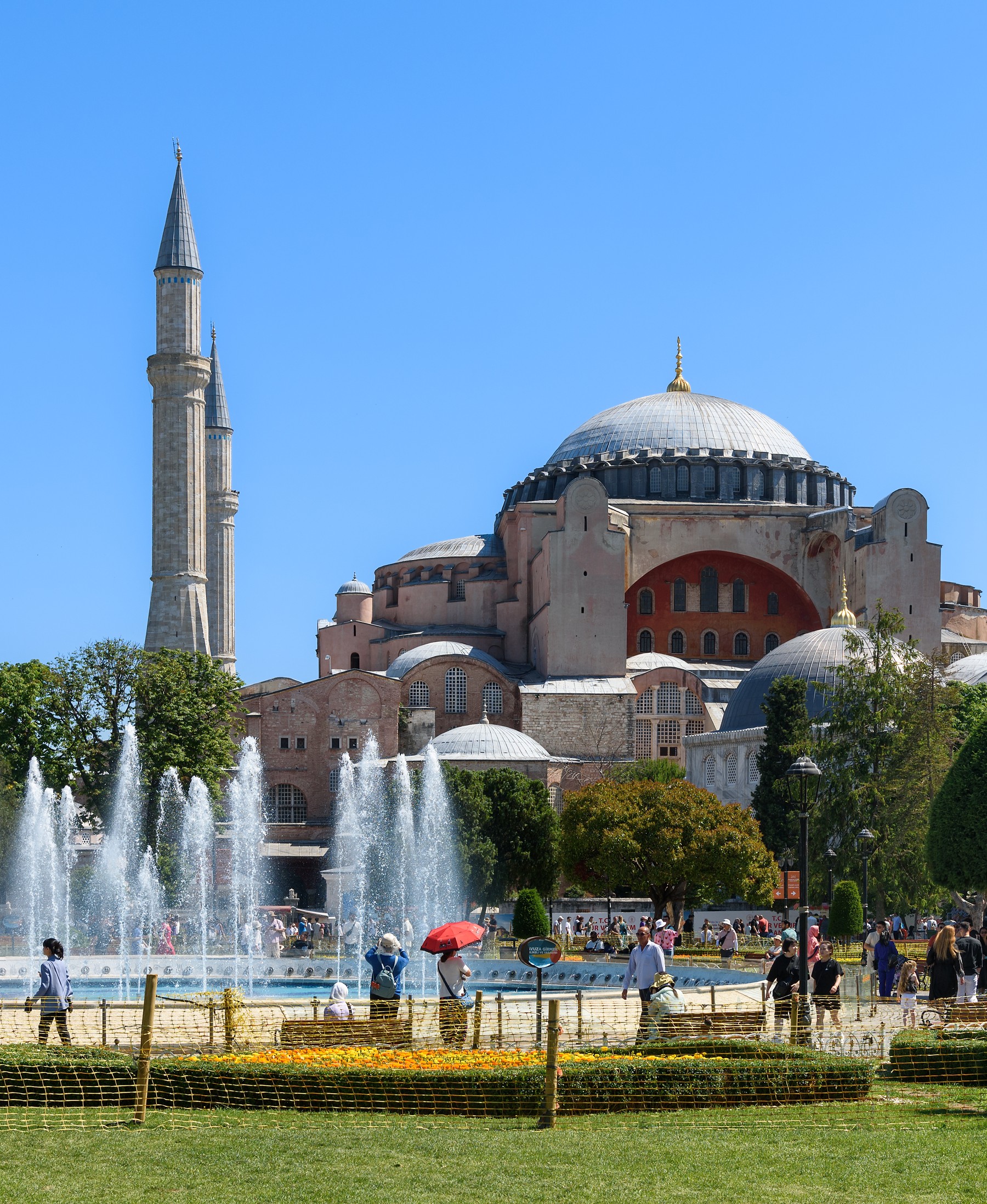
Hagia Sophia (Ayasofya): a 6th-century Byzantine church converted to a mosque, then a museum, then reconverted to a mosque in 2020 — its dome remained the largest in the world for nearly a thousand years. Non-Muslim visitors may enter outside prayer times.
Blue Mosque, Topkapı Palace and the Grand Bazaar complete the historic peninsula's core — the Bazaar traces its origins to the decades after the 1453 Ottoman conquest of Constantinople and has been rebuilt repeatedly after fires and earthquakes ever since.
🎈 Cappadocia
Central Anatolia's strangest landscape: volcanic tuff eroded into "fairy chimneys," rock-cut Byzantine churches with frescoes still visible after a thousand years, and entire underground cities carved by hand.
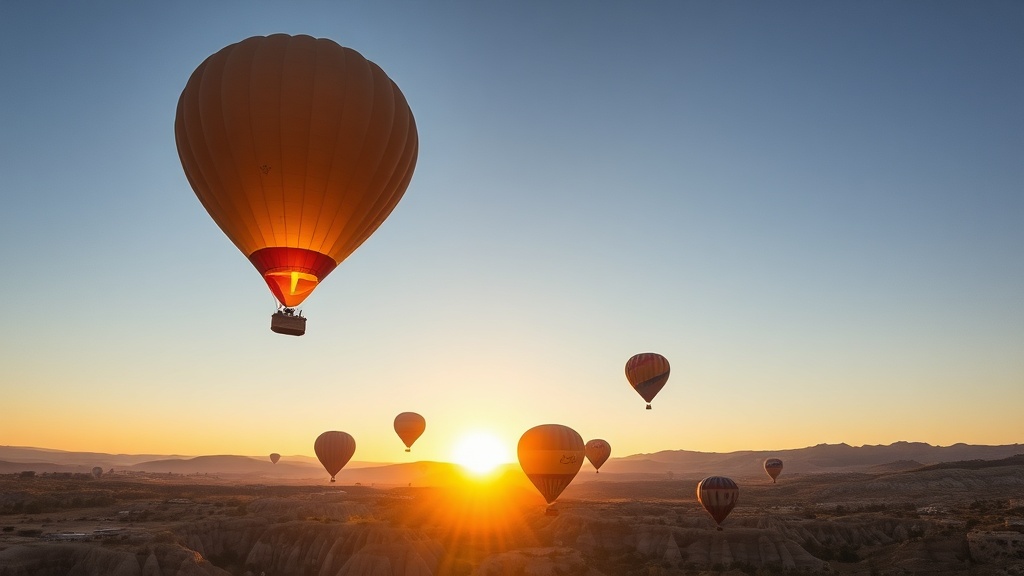
Hot air balloons: dawn launches over Göreme — $200–400, and reliably described as unforgettable even by travelers who've seen everything else. Göreme Open Air Museum: the densest cluster of rock-cut churches and frescoes in the region. Underground cities: Derinkuyu and Kaymaklı descend eight-plus stories, built to shelter entire communities from raiders — ventilation shafts and all.
🌊 Coastal Turkey
Ephesus is the best-preserved Roman city on the Aegean — the Library of Celsus, the Great Theater, and the excavated Terrace Houses of the wealthy still standing close to full height.
Tralleis (near Aydın) just gave Aegean itineraries a genuinely new stop: a 2,000-year-old Roman swimming pool — 37m long, 12m wide, 1.5m deep, built to hold roughly 300 bathers at once — was fully excavated in 2026 within a 40,000m² bath-gymnasium complex, fed by spring water carried nearly 56km via aqueduct. The pool (Latin: natatio) anchored a facility that doubled as athletic training grounds for the adjoining gymnasium, and it's now being restored and refilled as part of Türkiye's "Heritage for the Future" project — an easy hour from Ephesus and Kuşadası.
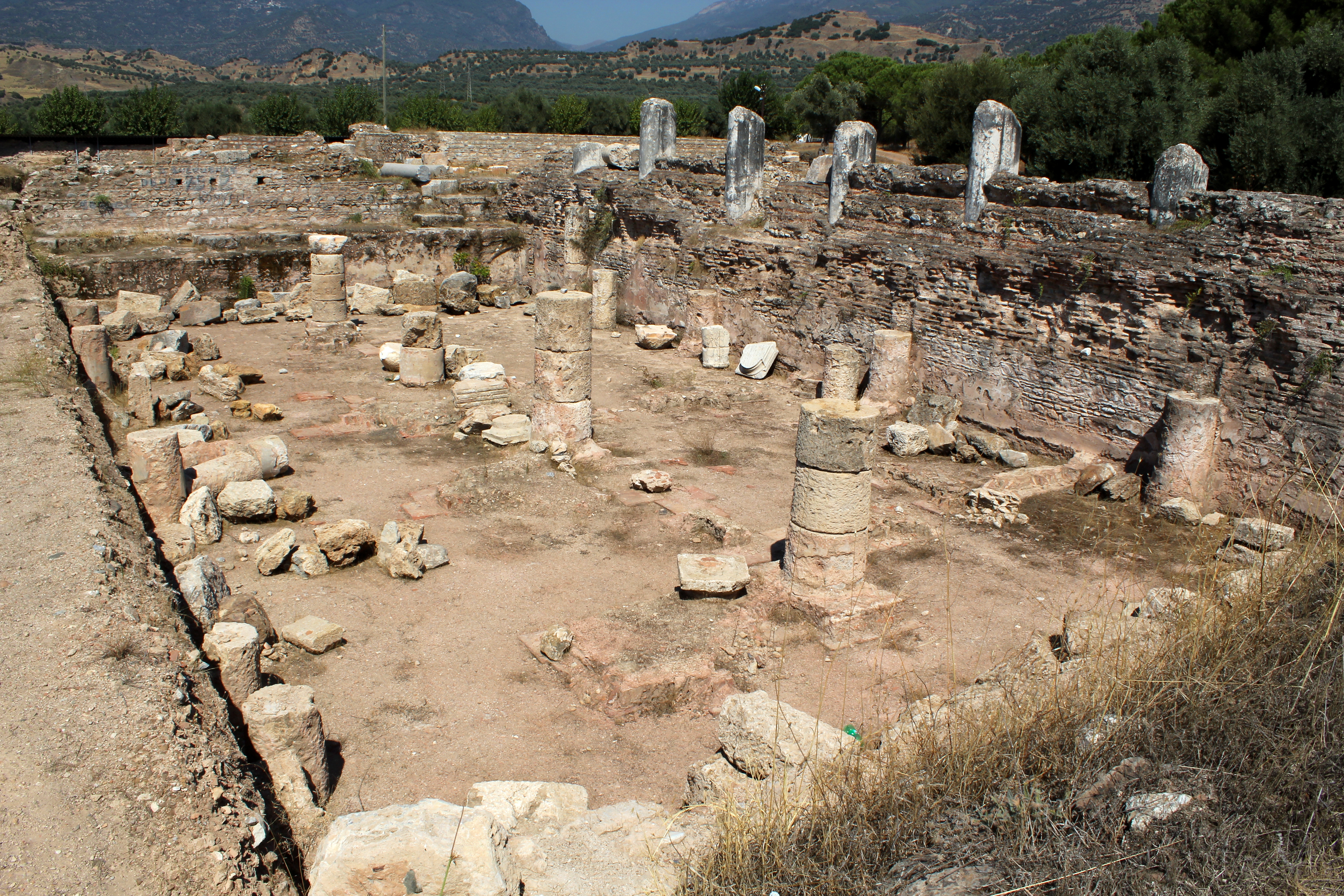
The newly excavated Roman gymnasium-bath complex at Tralleis, where the pool was uncovered.
Bodrum plays Turkey's St. Tropez, built around the ruins of the Mausoleum of Halicarnassus and a Crusader castle. Antalya anchors the Turkish Riviera with beach resorts alongside genuine Roman ruins at Perge and Aspendos. Fethiye and the Turquoise Coast offer sailing, the eerily abandoned Kayaköy ghost town, and the long-distance Lycian Way hiking trail. Further out: Pamukkale's white travertine terraces beside ancient Hierapolis, Kurdish-influenced Eastern Turkey beneath 5,137m Mount Ararat, and the Ottoman stone houses of UNESCO-listed Safranbolu.
🗿 Göbekli Tepe: The Hill That Rewrote History
On a bare limestone hilltop east of Şanlıurfa, in Turkey's southeast, sits the single most consequential archaeological discovery of the last half-century — and most travelers who fly into Istanbul or Cappadocia never hear its name. Göbekli Tepe ("Potbelly Hill" in Turkish) is a complex of massive T-shaped limestone pillars — some standing 5.5 meters tall and weighing up to 50 tons — arranged in circles up to 20 meters across. Geophysical surveys have identified more than 200 such pillars across roughly 20 circles, of which only a small fraction have actually been excavated; the rest remain deliberately buried, exactly as the site's original builders left them.
The number that matters most here is the date: the 10th to 9th millennium BCE — roughly 9600–8200 BCE. That makes Göbekli Tepe older than Stonehenge by about 6,000 years, older than the pyramids of Giza by some 7,000, and older than pottery, writing, metal tools, and the wheel. It predates the invention of agriculture itself.
Why This Breaks the Textbook Story
For most of the 20th century, archaeology told a tidy story: humans settled down, learned to farm, produced surplus food, and only then — with time and stability to spare — built temples, developed religion, and organized complex societies. Göbekli Tepe inverts that sequence entirely. Its builders were hunter-gatherers — there's no evidence of farming or permanent settlement at the site itself. Yet raising, carving and arranging pillars this massive required organizing hundreds of people over extended periods: quarrying stone, hauling it, feeding the workforce. That takes exactly the kind of large-scale social coordination archaeologists used to think only farming made possible.
The leading theory today runs the old story backward: it may have been the demands of building and maintaining a sacred gathering place — not the slow discovery of wild wheat — that pushed nearby communities toward deliberately cultivating grain, simply to feed the crowds who gathered here. If that's right, monumental religion didn't follow the agricultural revolution. It may have caused it.
Reading the Stones
Many of the T-shaped pillars are abstract human figures — the "T" reads as a head atop a body, with carved arms, hands and belts visible on the largest examples, as if the stones themselves are members of the community, watching. Others are covered in relief carvings of foxes, boars, snakes, scorpions, and vultures, rendered with a sophistication that has no obvious artistic precedent — this is, as far as anyone can tell, art appearing more or less fully formed. What any of it actually meant — ancestor worship, shamanic ritual, a calendar, a origin myth carved in stone — remains genuinely unresolved, argued over in academic journals to this day. That unresolved quality is part of the site's power: this is one of the only places on Earth where you can stand in front of an 11,000-year-old structure and know, honestly, that no one is entirely sure why it was built.
Buried on Purpose, Found by Accident
Local farmers had been clipping their plows on buried stones for decades before a 1963 survey dismissed the mound as an unremarkable medieval cemetery. It took German archaeologist Klaus Schmidt, revisiting the site in 1994–95, to recognize the tops of T-shaped pillars poking through the soil for what they were. Schmidt led excavations until his death in 2014, and his central puzzle remains the site's strangest feature: each circle of pillars appears to have been deliberately buried under rubble after a period of use, and a new circle built nearby — as if each generation ritually closed one sanctuary and opened another, layer after layer, for well over a thousand years.
Visiting
Göbekli Tepe was inscribed as a UNESCO World Heritage Site in 2018 and now has a proper visitor center and a protective, light-permeable tent structure that replaced the site's original crude wooden roof. It sits about 15 minutes from Şanlıurfa, itself roughly a 90-minute flight from Istanbul — far enough off the standard Istanbul–Cappadocia–coast circuit that it takes real intent to reach, which is exactly why it remains one of the least crowded major archaeological sites anywhere in the Mediterranean world. Combine it with the nearby Şanlıurfa Archaeology Museum, which houses the finest carved pillars and figures recovered from the site, for context that the open-air ruins alone don't fully provide.
🏛️ UNESCO World Heritage Sites
22 UNESCO World Heritage Sites — 20 cultural and 2 mixed — spanning Hittite capitals, Byzantine mosaics, Ottoman mosques and Troy itself. See the full UNESCO & World Heritage guide →
🍽️ Cuisine
Ottoman palace dishes, Anatolian home cooking, and the meze culture of sharing unify a cuisine that stretches from the Aegean to the Caucasus. Read the full Food & Drink guide →
🍷 Wine, Spirits & Drinking Culture
One of the world's most paradoxical wine countries — among the largest grape growers on Earth, yet a nation that mostly eats its harvest rather than fermenting it. See the full Wine, Spirits & Drinking Culture guide →
🌤️ Best Time to Visit
| Season | Conditions |
|---|---|
| Apr–May | Ideal — pleasant temperatures, wildflowers across Cappadocia and the coast |
| Jun–Aug | Hot, and crowded at beaches and in Cappadocia |
| Sep–Oct | Excellent — same warmth as spring, noticeably fewer crowds |
| Nov–Mar | Cold in the interior; Istanbul is quieter and genuinely atmospheric |
🛂 Entry Requirements
US citizens remain visa-free for tourism and short business trips as of 2026 — a policy in place since January 2024, when Turkey eliminated its $52 e-visa fee for American travelers entirely.
| Requirement | Detail |
|---|---|
| US citizens | No visa needed |
| Duration | 90 days within any 180-day period |
| Passport | Valid 6 months beyond entry recommended (60 days is the stated minimum) |
| Cost | Free |
Simply arrive with a valid passport — as straightforward as entering most of Western Europe. Border officers may still ask for proof of onward travel, accommodation, or sufficient funds.
✈️ Getting There & Around
Istanbul Airport (IST) is the main international hub, opened 2019, with direct US flights; Sabiha Gökçen (SAW) on the Asian side handles budget carriers. Domestically, Turkish Airlines and Pegasus run cheap, frequent flights; high-speed rail connects Ankara and Istanbul; long-distance buses are genuinely comfortable; and dolmuş shared minibuses handle local routes everywhere else. Get an IstanbulKart on arrival — it's essential for the city's metro, tram, bus and ferry network.
💰 Costs & Budget
Currency: Turkish Lira (TRY). The lira has depreciated sharply and steadily for years — it traded near 32–35 per US dollar in 2024 and sits around 48 per dollar as of August 2026, having weakened roughly 17% over the preceding twelve months alone. Rates move fast enough that any number printed here will be somewhat stale by the time you travel — check a live converter before you go. ATMs are widespread and generally the best exchange method.
| Item | Cost (USD) |
|---|---|
| Budget hotel | $30–50/night |
| Mid-range hotel | $60–120/night |
| Street food | $2–5 |
| Restaurant meal | $10–25 |
| Domestic flight | $30–80 |
| Cappadocia balloon ride | $200–400 |
Realistic daily budget: roughly $50–70 for a comfortable mid-range trip outside Istanbul, more in the capital and along the fashionable parts of the coast.
🤝 Safety & Culture
Security: the US State Department's guidance for Turkey has historically flagged terrorism concerns and advised against travel near the Syrian border; major tourist areas maintain a visible security presence. Check the current advisory before departure, as regional conditions shift. Political protests can occur with little notice — avoid demonstrations regardless of the cause. Mosques: cover shoulders and knees; women should carry a scarf for their hair. Alcohol is legal and widely available outside the most conservative areas. Bargaining is expected in bazaars, not in modern shops. Scams: be wary of unusually "helpful" strangers who steer you toward a specific shop or restaurant. LGBTQ+ travelers: legal status exists but social acceptance varies widely; discretion is advised outside cosmopolitan Istanbul neighborhoods.
✨ Essential Tips
1. No visa needed for US citizens — just arrive with a passport. 2. Get an IstanbulKart immediately for city transport. 3. Book Cappadocia balloon flights well in advance; the good operators sell out. 4. A few words of Turkish go a long way. 5. Dress modestly at mosques. 6. Bargain in bazaars; prices are fixed everywhere else. 7. Accept an offered tea — declining can read as impolite. 8. Check the lira exchange rate right before your trip; it moves fast.
📊 Tourism, By the Numbers
Türkiye closed out 2025 with its best year on record: 52.78 million foreign visitors (essentially flat, up just 0.3% on 2024, after several years of much sharper growth) and 63.94 million total visitors including returning Turkish citizens abroad, up 2.7%. Tourism revenue hit a record $65.2 billion, up 6.8% and comfortably ahead of the government's own $64 billion target — driven less by more visitors than by each one spending more, with average nightly spending rising to roughly $100. Istanbul and Antalya remain the clear leaders, drawing roughly a quarter and a third of foreign arrivals respectively.
2026 has told a more mixed story: foreign arrivals were down about 2.3% year-on-year through the first seven months, with regional tensions in the Middle East cited as a drag on demand from some markets even as others — Russia, Iran, and Asia broadly — kept growing. The government's 2026 revenue target sits at $68 billion regardless. Tourism remains a genuine pillar of the economy, contributing roughly 10% of GDP and around 5% of total employment.
📋 Quick Facts
| Category | Information |
|---|---|
| Capital | Ankara |
| Population | 86.09 million (end of 2025) |
| Area | 783,356 km² |
| Currency | Turkish Lira (TRY) — ~48/USD, Aug 2026 |
| Language | Turkish |
| Time Zone | TRT (UTC+3) |
| Driving Side | Right |
| Calling Code | +90 |
| Power | 230V, Type C/F plugs |
| Emergency | 112 |
🗺️ Map
📸 Photo Gallery
✍️ Final Reflection
Most visitors experience Turkey as a triangle — Istanbul's domes, Cappadocia's balloons, a coastal resort — and it's a genuinely great triangle. But the deeper story is one of accumulated time: a country where a Roman swimming pool can be "newly discovered" in 2026, where a mosque converted from a church converted from a mosque still functions as both monument and place of worship, and where, on a quiet hilltop near the Syrian border, a circle of carved stones older than agriculture itself sits mostly still buried, waiting. Turkey doesn't ask you to choose between its layers. It just keeps adding new ones on top of the old — and, occasionally, uncovering what's been waiting underneath all along.
💼 Business & Economy
The 17th-largest economy on Earth, a customs union with the EU since 1996 without EU membership itself, and a lira that's lost most of its value against the dollar this decade — Turkey's economy is genuinely hard to summarize in one line, which is exactly why it gets one. Read the full Business & Economy guide →
