

🇳🇷 Nauru at a Glance
🌍 Overview — Twenty-One Square Kilometres
Nauru is 21 km². That is smaller than the city of Liberec, smaller than Manhattan below Central Park, and about a third the size of Prague's Jižní Město. It is the third-smallest country in the world after the Vatican and Monaco, the smallest republic, the smallest island country, and the only country in the world with no official capital. The ring road is about 19 km long and you can drive the whole circumference in twenty minutes.
Roughly 12,500 people live on it, almost all of them on the narrow coastal strip, because the interior — four fifths of the island's surface — was dug out. Nauru sat on one of the purest deposits of rock phosphate ever found: seabird guano accumulated on a coral cap over millions of years and mineralised. Between 1907 and the 1990s essentially all of it was removed and shipped away, most of it to fertilise farmland in Australia and New Zealand.
What that bought, briefly, was one of the highest incomes per head on earth. What it left is a plateau of bare coral pinnacles known as Topside, a sovereign state with almost no natural resources, and a population with among the world's highest rates of diabetes. Nauru's entire modern history is a single, unusually legible parable about extraction, and the country is well aware of it.
Where it is
The central Pacific, 42 km south of the equator, in the middle of a very large amount of nothing. The nearest other land is Banaba (Ocean Island, Kiribati) 300 km east — itself a phosphate island mined to exhaustion by the same company. The nearest substantial neighbours are the Marshall Islands, Kiribati and the Solomon Islands, all of them a long flight away.
The shape of it
A flattened oval about 6 km by 4 km, ringed by a fringing reef with no natural harbour. A coastal strip 150–300 m wide holds every house, the airport, the government and the shops. Behind it the ground steps up to a central plateau 30–60 m above the sea; Command Ridge, the highest point, is about 65 m. There are no rivers, no streams and no permanent surface water except one brackish inland lagoon.
How it is governed
A parliamentary republic, independent since 31 January 1968. Nineteen MPs elected from eight constituencies elect the president from among themselves, which makes the presidency unusually easy to lose — Nauru went through a famous run of governments in the 2000s, several of them lasting days. Yaren is the district where parliament sits and is universally called the capital, but no law says so.
What it lives on now
Three things, and none of them is phosphate. Australia, for hosting the Regional Processing Centre and, since 2025, for a much larger deportation arrangement. Fishing licences — selling access to some of the richest tuna water on earth, which is now the most defensible income the country has. And the sale of sovereign decisions: diplomatic recognition, a citizenship programme, and sponsorship of deep-sea mining.
Who lives there
About 95% Nauruan and other Pacific Islanders, plus Chinese and Filipino workers, Australian contractors and a shifting population connected to the processing centre. Nauruans are divided into twelve traditional clans, represented by the twelve-pointed star on the flag; the single gold stripe is the equator and the island sits just below it.
Can you go?
Technically yes, practically almost never. There is no tourism industry, there are two or three places to stay, and — the real obstacle — a visa must be obtained in advance and Nauru grants very few. Journalists have been charged a non-refundable A$8,000 application fee since 2014, which was widely read as the point. See Visas.
🏷️ Names — Pleasant Island, Naoero, and the Twelve Clans
Naoero
The Nauruan name, and the one on the government's own letterhead as Republic of Nauru / Ripublik Naoero. The usual explanation is that it derives from anaoero, roughly "I go to the beach", though the etymology is not settled and several competing readings circulate on the island itself.
Pleasant Island
What Captain John Fearn of the whaler Hunter called it in 1798, the first European to record it, because the people who paddled out to meet him were friendly and the place looked green. The name stuck for a century. It has since acquired an irony nobody intended.
The Nauruan language
An Austronesian language that is hard to classify — clearly Micronesian in the broad sense, but so divergent that its exact position is disputed, probably because of long isolation. It has a large number of dialects for a population this size and a famously awkward relationship with the Latin alphabet: the orthography was reformed in 1938 and is still not used consistently.
English
Widely spoken, the working language of government, business and the courts, and the language of instruction in secondary school. Almost everyone is bilingual. Nauruan is not endangered in the way many Pacific languages are — it is spoken at home by most of the population — but it has few speakers in absolute terms, which is a different kind of fragility.
The twelve clans
Nauruan society is organised into twelve matrilineal clans — descent and, historically, land rights run through the mother. Two of the twelve are now extinct. The twelve-pointed star on the flag is them; the gold horizontal band is the equator and the star sits below it, which is a rather elegant piece of cartography for a flag.
Districts, not a capital
Fourteen administrative districts around the ring: Yaren, Aiwo, Boe, Denigomodu, Meneng, Anibare, Ewa, Anetan, Baitsi, Uaboe, Nibok, Buada, Ijuw, Anabar. Parliament, the courts and the airport are in or beside Yaren, which is why atlases print it as the capital. Nauru has simply never legislated one, and with a country this size the question is close to meaningless.
🗺️ Geography — A Coral Cap with the Middle Taken Out
Nauru is the top of a very old undersea volcano. The cone subsided, coral grew on it, the reef was lifted above sea level, and seabirds then spent a few million years on top of the result. The island's structure is a direct consequence of that sequence, and so is everything that happened to it in the twentieth century.
Bottomside
The coastal plain: a fertile sandy belt 150 to 300 metres wide running the whole way round, where every house, every shop, the airport, the hospital, the port facilities and the government all are. It is where the coconut palms and pandanus grow. In total it is perhaps a fifth of the island and it holds effectively 100% of the population.
Topside
The central plateau, and the reason Nauru is famous. Once a forested interior, it is now bare coral pinnacles up to 15 m high standing in a jumbled field where the phosphate between them was dug out. It covers roughly four fifths of the island's surface and is essentially uninhabitable in its present state. See Topside.
Buada Lagoon
The one body of standing water: a brackish inland lake of about 13 hectares in a depression in the south-west, fringed by palms and bananas and surrounded by the greenest part of the island. It has no outlet to the sea and its level rises and falls with rainfall. It is also the only place on Nauru that looks the way people expect a Pacific island to look.
No fresh water
There are no rivers and no streams, the coral is porous, and the freshwater lens is thin and easily contaminated. Nauru runs on rainwater tanks and desalination, and in drought years it has had to import water by ship. The Moqua Caves in the south-east hold an underground freshwater lake that was the island's emergency reserve for centuries.
The reef and the cantilevers
A fringing reef with no natural harbour and no lagoon. Ships cannot come alongside; for a century phosphate was loaded onto vessels moored offshore through enormous cantilever loaders that reached out over the reef, and those rusting arms at Aiwo are the single most recognisable structure on the island. The port was rebuilt in 2022 with Asian Development Bank and Australian funding — the largest infrastructure project in Nauru's history.
Climate
Equatorial: hot, humid, 25–35 °C all year, with a monsoon-influenced wet season roughly November to February and a rainfall figure that swings violently — from 300 mm to well over 4,000 mm depending on El Niño. Drought is the recurring emergency, not storms; Nauru sits outside the main typhoon belt.
⛏️ The Phosphate — How an Island Was Sold
In 1900 a man called Albert Ellis, working for the Pacific Islands Company in Sydney, took a lump of rock that had been holding a door open in his office — it had come from Nauru and was assumed to be petrified wood — and had it analysed. It was almost pure phosphate of lime. That doorstop is the hinge of the entire twentieth century for two islands: Nauru, and Banaba, 300 km away, which was tested next and found to be the same.
What the rock was
Millions of years of seabird guano deposited on a coral platform and mineralised into tricalcium phosphate, at concentrations among the highest ever mined. It lay in pockets between coral pinnacles, which meant it could not be taken by open-cut benching — it had to be dug out from between the pinnacles, leaving them standing. That extraction method is why Topside looks the way it does.
Who took it
Germany annexed Nauru in 1888 and licensed the Pacific Phosphate Company from 1906. After the First World War the island became a League of Nations mandate jointly administered by Australia, New Zealand and Britain, and the phosphate passed to the British Phosphate Commissioners — a body owned by those three governments, which sold the rock to their own farmers at below world prices.
What Nauruans were paid
Very little, for a very long time. Through the mandate and trusteeship periods royalties to landowners ran at a small fraction of the value shipped, while the three administering powers took the fertiliser. This is the substance of the grievance that Nauru eventually took to court, and the arithmetic is not seriously contested.
Independence and control
Nauru became independent on 31 January 1968 under Hammer DeRoburt, and in 1970 it bought the phosphate operation outright for A$21 million, creating the Nauru Phosphate Corporation. For the first time the island received the full value of its own rock. It had perhaps twenty-five years of it left.
The case against Australia
In 1989 Nauru sued Australia at the International Court of Justice over the pre-independence damage — Certain Phosphate Lands in Nauru. Australia's preliminary objections were rejected in 1992, and rather than fight the merits Australia settled in 1993 for A$107 million (A$57m up front, the rest over twenty years), with New Zealand and the UK contributing. It remains one of the very few cases where a small state extracted compensation from a large one for colonial resource extraction.
What was actually removed
Something in the region of 80 million tonnes of phosphate rock over ninety years, from an island of 21 km². Secondary mining of the lower-grade residual deposit has continued intermittently since the 2000s and still produces small volumes. The primary resource is gone.
📜 Before the Rock — Three Thousand Years, Then a Whaler
Settlement
Micronesian and Polynesian people settled Nauru perhaps 3,000 years ago. The society that developed was organised into twelve matrilineal clans, subsisted on fish, coconut, pandanus and cultivated ibija (a native fish, Chanos chanos, the milkfish) raised in the Buada Lagoon and in coastal ponds — an aquaculture system that is genuinely unusual for the region.
Frigatebirds
Nauruans caught and tamed frigatebirds, throwing a weighted line to bring a young bird down, then keeping it, feeding it fish, and using it as a homing and fishing companion. The practice is on the coat of arms and survives as a cultural memory rather than a living technology. It is the detail about pre-contact Nauru that everybody remembers, and it deserves to be.
First contact, 1798
Captain John Fearn of the whaler Hunter, on his way from New Zealand to China, recorded the island and named it Pleasant Island. Whalers and traders followed through the nineteenth century, and with them came beachcombers, alcohol and, decisively, firearms.
The Nauruan civil war, 1878–88
A dispute at a wedding feast escalated into a ten-year war between the clans, fought with the guns traders had sold them. Estimates suggest the population fell from about 1,400 to 900. It is the reason Germany was able to annex the island against essentially no resistance in 1888 — the Germans landed, confiscated the weapons, and imposed a peace.
German Nauru, 1888–1914
Administered as part of the Marshall Islands Protectorate of German New Guinea. Missionaries arrived — the island is now overwhelmingly Christian, mostly Nauru Congregational and Catholic — and so, from 1906, did the phosphate company. Australian troops took the island in 1914 without a fight.
The 1920 influenza
The global pandemic reached Nauru and killed roughly 18% of the population in a matter of weeks. It is the origin of the island's most important national holiday: see Angam Day, which commemorates the moment the population climbed back.
⚔️ 1942–1945 — The Occupation and the Deportation
Nauru's Second World War is short, almost unknown outside the Pacific, and proportionally one of the worst experiences any population had in that war. The Japanese occupied the island in August 1942, held it for three years, and in the process removed and killed a large fraction of the people living on it.
The occupation
Japanese forces landed on 26 August 1942 and built three airstrips using forced labour. The island was bombed repeatedly by American aircraft and then, as the Pacific war moved past it, bypassed and blockaded — the garrison and the remaining civilians were cut off and left to starve, which is exactly what happened.
The deportation to Chuuk
In 1943 the Japanese deported 1,200 Nauruans — the great majority of the population — to Chuuk (Truk) Lagoon, 1,600 km away, as labour. Conditions there were appalling and the islands were themselves under blockade. Only 737 survived to be repatriated on 31 January 1946, a date Nauru now marks as Independence Day by coincidence of the calendar rather than design.
The leprosy patients
In one of the war's less-known atrocities, the Japanese garrison put 39 patients from Nauru's leprosarium onto a boat, towed it out to sea and sank it. There is no serious dispute about the facts.
Liberation
The Australian ship HMAS Diamantina accepted the Japanese surrender of Nauru on 13 September 1945. The island was wrecked: the coastal settlements destroyed, the phosphate works damaged, and the people mostly still in Chuuk.
What is left to see
Command Ridge, the highest point, still has the Japanese six-barrelled anti-aircraft guns, a communications bunker and a rusting network of positions, reachable on foot and essentially unsupervised. Concrete bunkers and gun emplacements sit along the coast road at several points. It is the most substantial physical heritage on the island.
Angam Day again
The population had crawled back to 1,500 in 1932 and been celebrated for it; the war knocked it down again. It passed 1,500 for the second time on 31 October 1949, and that is the other date Angam Day commemorates. A national holiday for a demographic threshold tells you a great deal about the twentieth century here.
💸 The Boom — Briefly the Richest Country on Earth
Between roughly 1970 and the mid-1980s, Nauru had a GDP per head that various sources put at or near the top of the world table — at times quoted above Saudi Arabia's. For a country of under ten thousand people sitting on a resource being extracted at maximum rate, the arithmetic was not complicated. What happened to the money is the part worth understanding, because it was not simply stolen.
The trust fund
Nauru did the responsible thing, at least on paper. It set up the Nauru Phosphate Royalties Trust to invest the proceeds so that there would be an income after the rock ran out. At its peak in the early 1990s the trust was valued at somewhere around A$1.3 billion. By the early 2000s it was worth almost nothing.
Where it went, part one
Property, badly. The trust bought buildings across Australia and the Pacific, the flagship being Nauru House in Melbourne — a 52-storey tower, for a while the tallest in the city, bought in 1977 and sold in 2004 to pay debts. Much of the portfolio was acquired at the top of markets, managed from six thousand kilometres away, and mortgaged repeatedly.
Where it went, part two
An airline. Air Nauru at its height ran a fleet of Boeing 737s serving a dozen destinations, often with a handful of passengers, and was widely understood to function as the president's transport. It was a genuine public good for a remote population and a catastrophic commercial proposition, and by 2005 its last aircraft was repossessed on the tarmac in Melbourne, stranding the country without an air link.
Where it went, part three
Leonardo the Musical. In 1993 the trust put money — accounts vary between A$2 million and several times that — into a West End musical about Leonardo da Vinci and the Mona Lisa. It ran for about five weeks and closed. It has become the single most-cited emblem of the whole episode, which is slightly unfair: the property losses were an order of magnitude larger and far more boring.
Advisers
Nauru was a small government with an enormous sum of money and no institutional experience of managing one, in an era when that combination attracted a particular kind of visitor. A long line of consultants, brokers and promoters passed through. Very few of them lost money.
What it did buy
It is worth being fair about this. The boom paid for free healthcare and education, no income tax, housing, electricity and water at nominal cost, and a standard of living that was, for a generation, genuinely high. It also paid for the wholesale replacement of a fishing-and-gardening diet with imported processed food, at a cost the island is still paying — see Health.
📉 The Collapse — and the Things Sovereignty Could Be Sold For
By the late 1990s the primary phosphate was nearly gone, the trust was nearly gone, and Nauru had no other industry, no agriculture and an island four fifths of which was a moonscape. What it still had was a seat at the United Nations, a company register, a passport office and the ability to sign things. Over the following decade it sold all of them at least once.
Offshore banking
In the late 1990s Nauru licensed around 400 shell banks with no physical presence, for a few thousand dollars each. Russian organised crime is estimated by the Russian central bank to have moved something like US$70 billion through Nauru-registered entities in 1998 alone. The FATF blacklisted the country in 2000, the US Treasury cut it off from the dollar system under the PATRIOT Act in 2002, and Nauru repealed the licences. It was delisted in 2005.
Passports
Nauru sold passports through the 1990s and early 2000s, including — in the case that ended the programme — to two al-Qaeda members arrested in Asia in 2003. The scheme was shut down. A new, and far more carefully constructed, citizenship programme was launched in 2025 for entirely different stated reasons; see Higher Ground.
Recognition diplomacy
Nauru has switched recognition between Taipei and Beijing repeatedly — to Taiwan in 1980, to the PRC in 2002 (reportedly for around US$130 million), back to Taiwan in 2005, and back to the PRC on 15 January 2024, two days after Taiwan's presidential election, in a move whose timing nobody in the region read as coincidental. One UN vote is one UN vote regardless of the size of the country casting it, and Nauru has understood this longer than most.
Whaling votes
Nauru joined the International Whaling Commission in 2005 and has generally voted with Japan, alongside several other small Pacific and Caribbean states that receive Japanese fisheries aid. This is a documented pattern rather than an accusation; Nauru's position is that the aid and the votes are unconnected.
Abkhazia and South Ossetia
In 2009 Nauru became one of the handful of states to recognise Abkhazia and South Ossetia, reportedly in return for around US$50 million in Russian aid. Nauru has never denied the aid; it denies the linkage.
The honest reading
It is easy to write all of this as venality, and some of it was. It is also what happens when a country of twelve thousand people is left with a destroyed island, an exhausted trust fund and an international system that offers it almost no other way to raise revenue. Every one of these decisions was taken by a government with a budget to meet and very few instruments to meet it with.
🚧 The Regional Processing Centre
Since 2001, with a four-year gap, Nauru has held people who tried to reach Australia by boat. It is the largest single item in the national budget, the largest employer, the reason most foreigners have heard of the country, and by some distance the most contested thing about it.
The Pacific Solution
Australia's Howard government established offshore processing on Nauru and Manus Island in 2001 after the Tampa affair. The centre closed in 2008 under the Rudd government and reopened in 2012. Numbers peaked at roughly 1,200 people in 2014, including several hundred children.
The Nauru Files
In August 2016 The Guardian published 2,116 leaked incident reports written by staff at the centre between 2013 and 2015. Over half concerned children, who were about 18% of the detained population. The reports documented self-harm, assaults, sexual abuse allegations and severe mental deterioration. It remains the largest single disclosure about Australian immigration detention.
The medical question
Doctors' groups, the UNHCR, Amnesty and Médecins Sans Frontières — the last expelled from Nauru in 2018 after eleven months — documented a pattern of severe psychiatric illness, including resignation syndrome in children. The "Medevac" law of 2019, which let doctors rather than ministers decide on medical transfers, was repealed within the year.
Where it stands now
Numbers fell to almost nothing by 2023, then rose again as Australia resumed transfers. In 2025 Australia and Nauru signed a much larger and quite different arrangement: Nauru agreed to accept non-citizens deported from Australia, including people released from indefinite detention after the High Court's NZYQ ruling, under a deal reported at around A$2.5 billion over thirty years. That is roughly two hundred times Nauru's annual government revenue before the arrangement.
What it means on the island
The centre and its associated contracts have at times accounted for something close to half of government revenue and a very large share of formal employment — as guards, caterers, drivers, cleaners and administrators. It has also brought a large expatriate contractor population, inflated local prices, and tied the country's finances to a single customer whose domestic politics can change overnight.
How to think about it
Nauru's own position, stated consistently by successive governments, is that it is a sovereign state entering a commercial agreement, that the criticism belongs in Canberra rather than Yaren, and that the countries lecturing it have not offered an alternative source of revenue. Every part of that is defensible and none of it answers the incident reports. Both things are true at once.
⚓ Deep-Sea Mining — The Second Extraction
There is a certain bleak symmetry in the fact that the country most comprehensively hollowed out by mining is now the sponsoring state for the first attempt to mine the deep ocean floor. Nauru is entirely open about the logic: the land resource was taken by other people, and this time the country intends to be the one holding the licence.
What is down there
Polymetallic nodules — potato-sized lumps of manganese, nickel, cobalt and copper lying loose on the abyssal plain of the Clarion-Clipperton Zone in the eastern Pacific, 4,000–6,000 m down. They grow at a few millimetres per million years. The commercial case is that they are needed for batteries; the ecological case against is that the habitat they constitute cannot recover on any human timescale.
Nauru's role
Under the UN Convention on the Law of the Sea, a company can only work the international seabed if a state sponsors it. Nauru Ocean Resources Inc (NORI), a subsidiary of the Canadian-listed The Metals Company, is sponsored by Nauru, and Nauru holds the contract area.
The two-year rule
In June 2021 Nauru formally notified the International Seabed Authority that it intended to apply for a mining licence, triggering a clause obliging the ISA to finish its mining code within two years or consider applications under whatever rules existed. It was a deliberate legal detonation and it put a small country at the centre of a global argument. The deadline passed in 2023 with no code agreed.
The 2025 turn
With the ISA still deadlocked, The Metals Company moved in 2025 to seek permits from the United States under domestic US seabed legislation instead — the US is not a party to UNCLOS — bypassing the international process entirely. That manoeuvre drew objections from a long list of states and put Nauru in the odd position of having triggered a process its own contractor then went around.
Who objects
More than thirty states now support a moratorium or precautionary pause, including several Pacific neighbours — Palau, Fiji, Samoa, Vanuatu and the Federated States of Micronesia among them. The split inside the Pacific Islands Forum on this question is real and has been uncomfortable.
Nauru's answer
That its share of the revenue could fund the relocation of the entire population to rehabilitated land, that the nodules sit on an abyssal plain rather than a reef, and that a country whose own land was mined to nothing for other people's agriculture has heard the environmental sermon before. Whether that is a good argument is a genuine question. That it is a serious one is not really in doubt.
🌊 Higher Ground — Rebuilding the Island Inward
Nauru has a problem almost no other country has: its population lives on a coastal strip a couple of hundred metres wide that is exposed to sea-level rise, while four fifths of its territory sits 30–60 m above the sea and is uninhabitable because it was dug up. The solution the government has settled on is to fix the second problem in order to solve the first.
The Higher Ground Initiative
A long-term national programme to rehabilitate Topside and move most of the population up onto it — crushing and levelling the pinnacle field, restoring soil, and building a new inland settlement with housing, schools, a hospital and services. It is, in effect, relocating a country within its own borders. Cost estimates run into the hundreds of millions of dollars against a national budget a fraction of that size.
Why it is necessary
Nauru is not a low-lying atoll in the Tuvalu sense — it has elevation. But everything that matters is at sea level: the houses, the airport, the port, the power station, the hospital. Coastal erosion and inundation are already measurable. Retreating inland is the one adaptation option that does not require leaving the country.
The 2025 citizenship programme
In February 2025 Nauru launched a citizenship-by-investment programme explicitly tied to climate relocation — a contribution of around US$105,000 for a single applicant, with the proceeds earmarked for the Higher Ground Initiative. The government has been unusually direct that this is a funding mechanism for adaptation, and has built in vetting designed to avoid the failures of the 1990s passport scheme.
The obvious objection
Selling citizenship has a history here, and a bad one. Nauru's answer is that the earlier programme had essentially no due diligence and this one does, that the money is ring-fenced, and that the alternative funding routes — international climate finance for a country of twelve thousand — have not materialised at anything like the required scale. The programme will be judged on whether the vetting holds.
Rehabilitation so far
The Nauru Rehabilitation Corporation has been working since the 2000s, funded partly from the 1993 settlement. Progress is real but slow: crushing coral pinnacles and manufacturing soil on an island with no soil is expensive, and every tonne of material has to be moved with equipment that has to be shipped in.
What success would look like
A functioning inland town on ground that was a quarry, with the coastal strip given over to what it does best. Nauru would then be the only country to have repaired the damage of its own extraction and used the repair as its climate adaptation. It is a genuinely good plan. Whether it can be paid for is the whole question.
🗳️ Politics — Nineteen MPs and No Parties
Nauru's parliament has 19 members elected from eight constituencies, and they elect the president from among themselves. There are no strong political parties — politics runs on personal, family and district alliances — which makes governments both easy to form and easy to break.
The revolving door
Between 1989 and 2003 Nauru had something like seventeen changes of president, several of them lasting days, in a period when René Harris and Bernard Dowiyogo alternated repeatedly. It was not corruption so much as arithmetic: in a 19-seat chamber with no whips, two members changing their minds is a change of government.
The Dowd voting system
Nauru uses a distinctive modified Borda count in which voters rank every candidate and later preferences are weighted ½, ⅓, ¼ and so on. It is used by essentially no other national legislature and tends to reward broadly acceptable candidates over polarising ones — which, in a country where everyone knows everyone, is arguably the point.
The 2010s crisis
Between 2014 and 2016 the government suspended opposition MPs, cancelled the resident magistrate's visa, deported the chief justice, blocked Facebook and raised the media visa fee to A$8,000. Australia, its principal funder, said very little. It was the low point for Nauruan democracy and it coincided exactly with the peak of the processing centre.
Where it is now
David Adeang became president in October 2023 and it was under his government that Nauru switched recognition to Beijing, signed the expanded arrangement with Australia and launched the citizenship programme. The pattern is a government trying to convert every available sovereign asset into revenue, quickly, before the coastal strip gets worse.
Foreign relations
Member of the UN, the Pacific Islands Forum, the Commonwealth (as a member in arrears at various points) and the Parties to the Nauru Agreement. Deeply dependent on Australia; increasingly courted by China; a consistent and loud voice on climate in forums where a state of twelve thousand people gets the same microphone as one of a billion.
No army
Nauru has no military. It has a police force of a few dozen and a defence arrangement with Australia, which also provides the patrol boat that polices the exclusive economic zone — and that EEZ, at over 300,000 km², is roughly fifteen thousand times the size of the country it belongs to.
🪨 Topside — The Moonscape
Drive inland from any point on the ring road and within a few hundred metres the coconut palms stop and you are in it: a field of grey-white coral pinnacles, some of them over your head, standing in a landscape from which everything between them has been removed. This is Topside, and it is about four fifths of the Republic of Nauru.

Why it looks like this
The phosphate lay in pockets between coral pinnacles rather than in flat beds, so it could not be stripped by benching. It was dug out from between the columns, which were left standing. Ninety years of that, across the whole interior, produces a landscape that is often described as lunar and that satellite imagery makes look like a wound.
What it means practically
Topside is unbuildable without rehabilitation — you cannot lay a foundation or a road on a pinnacle field — it grows almost nothing, it holds no water, and it radiates heat. An island of 21 km² effectively has 4 km² of usable land, which is why the coastal strip is as crowded as it is.
Rehabilitation
The Nauru Rehabilitation Corporation crushes pinnacles, levels ground and builds soil. It is slow and expensive and every machine had to be shipped in. Some areas are now flat, planted and genuinely recovering. Against the scale of the problem it is a beginning.
Secondary mining
There is still lower-grade residual phosphate in and under the pinnacle field, and secondary mining has continued intermittently since the 2000s at modest volumes. Nauru is therefore simultaneously rehabilitating and re-mining the same plateau, which is exactly as awkward as it sounds and is a matter of open debate on the island.
Can you see it?
Yes, easily — it is the most accessible thing on Nauru. Several tracks run up from the ring road and the plateau is unfenced. Do not walk into the pinnacle field: the coral is razor-sharp, the gaps between columns are deep, there is no shade and no phone coverage, and people have been badly hurt. Look at it from a track.
The view from Command Ridge
The one place that puts the whole thing together: 65 m up, with the Japanese guns beside you, you can see the plateau, the strip, the reef and the open Pacific in a single turn of the head, and grasp the scale of both the island and what was taken out of it in about four seconds.
🏝️ Around the Ring — Everything There Is
The 19 km of ring road is the country's only through route, and every place worth mentioning is on it or a few hundred metres off it. What follows is, essentially, all of Nauru.
Yaren
The district where parliament, the courts and the government offices are, and where the airport runway runs — it bisects the south of the island, and the ring road crosses it, with a gate that closes when an aircraft is due. Also the location of the old Japanese pillboxes along the shore and of Nauru's small but serious war memorial.
Aiwo
The industrial district: the port, rebuilt in 2022, the power station, the phosphate works and the famous rusting cantilever loaders reaching out over the reef. Ugly, unmistakable, and the most photographed thing on the island after Topside.
Anibare Bay
The east coast, and the one genuinely beautiful stretch of shoreline — white sand, coral pinnacles standing in the surf, and a small boat harbour built with Japanese aid. Swimming is possible near the harbour and dangerous elsewhere because of the reef and the currents. This is where Nauruans go on a Sunday.
Buada Lagoon
Inland in the south-west: a brackish lake of about 13 hectares in a green bowl of palms, breadfruit and bananas, historically used to raise ibija milkfish. It is the only part of Nauru that matches the mental image of "tropical island", and it is four minutes from the moonscape.
Command Ridge
65 m, the highest point, reached by a short track. Japanese six-barrelled anti-aircraft guns, a bunker and a rusting communications post, all unattended and unfenced. The best viewpoint in the country and the best history lesson on it, in the same five minutes.
Moqua Caves and Well
In the south-east near Anibare: a limestone cave system holding an underground freshwater lake, Moqua Well, which was the island's water reserve in drought and a refuge during the war. Access is informal and it is genuinely dark; go with someone who knows it.
🩺 Health — The Other Thing the Boom Did
Nauru has among the highest rates of obesity and type 2 diabetes recorded anywhere in the world. Adult obesity figures are usually given at around 60–70% and diabetes prevalence at 25–40% depending on the survey. This is not incidental to the phosphate story; it is a direct consequence of it, and Nauruans generally say so more plainly than visitors do.
The mechanism
When the money arrived, subsistence stopped. Fishing, gardening and the pandanus-and-coconut diet were replaced within a generation by imported rice, tinned meat, sugar and soft drinks — the only things that ship economically to a place with no agriculture. The land that had produced food was, in any case, being dug up. There was no plan to destroy the diet; it was simply what happened when a resource economy replaced a subsistence one at speed.
The thrifty genotype
Pacific populations descended from people who crossed enormous distances by canoe appear to carry metabolic adaptations that were an advantage under famine and are a severe disadvantage under permanent caloric surplus. Nauru is the most extreme documented case, and is frequently cited in the medical literature for that reason.
Life expectancy
Around 60–65 years, low for a middle-income country, driven by cardiovascular disease, renal failure and diabetes complications. Amputation and dialysis rates are high. The hospital in Denigomodu handles what it can; anything complex means medical evacuation to Australia, which is expensive and slow.
What is being done
Public health campaigns, a sugar tax on imported drinks introduced in the 2000s, school nutrition programmes, and — the most promising piece — the replanting and food-security element of the rehabilitation programme, which aims to put agriculture back on land that has not grown anything for a century.
For a visitor
The practical consequence is that medical facilities are limited. There is a hospital; there is not a specialist. Comprehensive insurance with air evacuation to Australia is not optional, and you should carry any medication you need in quantity, because the pharmacy will not have it.
Why it is in this guide
Because it is impossible to describe what the phosphate did to Nauru without it. The island lost its interior and its diet in the same fifty years, for the same reason, and the second loss is the one still killing people.
👥 People — Twelve Thousand, Twelve Clans
The clans
Nauruan society is built on twelve matrilineal clans (tribes in local English), of which two are extinct. Descent, and historically land and fishing rights, pass through the mother. Land ownership is fractionally inherited and enormously subdivided — a single plot may have dozens of owners, which makes any development project a negotiation of real complexity.
Community
With 12,500 people on 21 km², everyone is related to or knows everyone. That produces the things you would expect — no anonymity, strong obligation, effective informal welfare — and the things you might not, including a politics with no parties and a policing problem that is mostly handled by family.
Religion
Overwhelmingly Christian: Nauru Congregational Church (from the American Board missionaries and later the LMS tradition) and Roman Catholic, plus smaller denominations. Sunday is genuinely observed and very little is open. There are also Buddhist and Baha'i communities among the resident foreign population.
The expatriate layer
A significant non-Nauruan population: Chinese shopkeepers and restaurateurs, Filipino and Indian workers, Australian contractors and officials, I-Kiribati and Tuvaluan families who came as phosphate workers, and the shifting population connected to the processing centre. Nauru's demographics move with its contracts.
Language in practice
Nauruan at home, English at work. Nearly everyone under fifty is comfortable in both. Nauruan has a reputation among linguists for being difficult and for a phonology that the Latin alphabet handles badly — the 1938 orthographic reform introduced diacritics that are widely ignored in practice.
Emigration
A substantial Nauruan community lives in Australia, particularly Melbourne and Brisbane, and in New Zealand and Fiji. For a population this small, the diaspora is proportionally enormous and the remittance and family links run constantly in both directions.
🎭 Culture — Angam Day, Frigatebirds and Australian Rules
🎉 Angam Day — 26 October
The most important date in the Nauruan calendar and one of the strangest national holidays anywhere. Angam means roughly "homecoming" or "celebration", and it marks the population passing 1,500 — the number believed necessary for the Nauruan people to survive as a group. It was reached on 26 October 1932 after the 1920 influenza, and again on 31 October 1949 after the war and the Chuuk deportation. A country that celebrates a census threshold has had a particular twentieth century.
🐦 Frigatebirds
The traditional practice of catching young frigatebirds with a weighted line, taming them and keeping them as fishing companions and messengers. It appears on the coat of arms with the tomano flower and the chemical symbol for phosphorus — a national emblem that puts a bird, a plant and an industrial mineral on the same shield, which is about as honest as heraldry gets.
🏈 Australian rules football
The national sport, and Nauru is generally reckoned to have the highest participation rate per capita in the world. The Linkbelt Oval in Denigomodu is the centre of national life on a Saturday. The game arrived with Australian administration and was thoroughly adopted; the national team plays in regional competition and losing to Papua New Guinea is a matter of state.
🏋️ Weightlifting
Nauru's great international sport. Marcus Stephen won seven Commonwealth Games gold medals across the 1990s, became a national figure, entered politics and served as President of Nauru from 2007 to 2011 — one of very few heads of state to have been a world-class athlete first. Reanna Solomon and others followed him onto the podium.
Music and dance
Traditional Nauruan music is built on reigen — chanted, rhythmic song performed at feasts and on Angam Day, sung in a style distinct from the rest of Micronesia. Much of the older repertoire was lost in the war and the deportation, and what survives is actively taught in schools as a matter of policy.
Everyday life
Sunday is church and family and the island effectively stops. Saturday is football. Fishing from the reef edge, still, by a lot of people. And a remarkable amount of driving — with a 19 km ring road and no public transport, Nauru has one of the highest rates of vehicle ownership per head in the Pacific, and circling the island is a genuine social activity.
🐟 Wildlife & the Reef
Nauru's land ecology was largely destroyed by mining and its marine ecology is, by contrast, in reasonable shape — which is a reversal of the usual Pacific pattern and a consequence of having almost no lagoon, almost no coastal development and almost no runoff, because there is nothing to run off.
The reef
A fringing reef dropping steeply into deep water very close to shore — the seabed falls to over 1,000 m within a couple of kilometres. That means big pelagic fish come remarkably close in, and it means there is no sheltered lagoon, so conditions are open-ocean almost everywhere.
Fishing
Nauru's EEZ of over 300,000 km² holds some of the richest skipjack and yellowfin tuna water on earth. Under the Nauru Agreement — signed on the island in 1982 and named after it — eight Pacific states coordinate access and sell fishing days to distant-water fleets. It is now Nauru's most defensible and least controversial income.
Birds
Frigatebirds, boobies, noddies and terns, plus the endemic Nauru reed warbler (Acrocephalus rehsei) — the island's only endemic land bird, which survives in the scrub and rehabilitated areas and is the single most important conservation responsibility the country has.
What was lost
The original interior forest, and with it the habitat of whatever lived in it. There is no baseline survey — nobody catalogued Nauru's biota before the mining, so the extinctions cannot be counted. That absence is itself part of the story of how the island was treated.
Land crabs and the pinnacles
The pinnacle field, for all its desolation, is not lifeless: land crabs, geckos, seabirds nesting on the columns and hardy scrub have colonised parts of it. Rehabilitation planners have had to think about whether restoring soil to the whole plateau would destroy the ecosystem that grew back in the ruins, which is an unexpectedly subtle problem.
Diving
There is genuinely good diving — steep walls, clear water, big fish, Japanese wrecks and aircraft from the war — and essentially no dive industry to take you to it. Equipment and arrangements are informal and you should treat any dive here as remote and unsupported, because it is.
🍽️ Cuisine — Coconut, Fish, Pandanus, and a Tin of Corned Beef
Traditional Nauruan food is Micronesian and built on four things: coconut, reef and ocean fish, pandanus and breadfruit, with the cultivated ibija milkfish from the Buada Lagoon as the one genuinely local speciality. Contemporary everyday food is largely imported, and the gap between those two sentences is the island's central health problem.
🥥 Coconut, all of it
Water, flesh, cream, oil, sap and the leaves and husk for everything else. Coconut cream is the base of most of the cooking, fresh nuts are the everyday drink, and the sap tapped from the flower stalk is toddy, which is drunk fresh and sweet, boiled to syrup, or fermented. On an island with no soil the coconut palm is not a crop, it is infrastructure.
🐟 Fish
Tuna, wahoo, mahi-mahi, snapper and reef fish, caught from the shore, from small boats off the reef edge and traditionally from canoes. Eaten grilled, in coconut cream, or raw in citrus and coconut as ika mata — the one dish everyone in the Pacific makes and everyone claims.
🌿 Pandanus and edru
Pandanus tectorius fruit — an orange, segmented, intensely tropical fruit — pounded and dried into portable cakes called edru, which kept for months and sustained people through drought and voyages. It is a real Pacific preserved food and it is now rarely made. Note: this is the fruit of the pandanus, not the green pandan leaf used as a flavouring in South-East Asia — they are different parts of related plants and get confused constantly, including in photographs.
🌽 Breadfruit and taro
Breadfruit roasted whole in coals, boiled or fried in thick wedges, and taro — both the corm and the leaves, the latter wrapped around coconut cream to make palusami. Both grow on the coastal strip and around Buada; neither grows on Topside.
🥗 Ibija
The milkfish (Chanos chanos) raised in the brackish Buada Lagoon and in coastal ponds — an indigenous aquaculture system that is genuinely distinctive for the region and that predates any European contact. Fry were caught at sea and stocked into the lagoon. It is one of the few things about pre-phosphate Nauru that has been properly documented.
🥫 What people actually eat
Imported rice, instant noodles, tinned corned beef and fish, frozen chicken, white bread and soft drinks, from a handful of Chinese-run shops, at prices set by shipping. There are a few restaurants, mostly Chinese, mostly attached to accommodation. Fresh vegetables arrive by plane and disappear within hours of the shop opening.
🍳 Three Nauruan Recipes

🐟 Ika Mata
Raw fish cured in citrus and coconut cream · serves 4 · 45 minutes, mostly waiting
Ingredients: 300 g very fresh tuna or mahi-mahi, cubed · juice of 4 limes · 150 ml coconut cream · 1 small onion, finely diced · 1 tomato, diced · ½ cucumber, diced · 1 red chilli, finely sliced · salt · fresh coriander · taro or rice to serve.
Method: Put the fish in a glass bowl and cover it completely with the lime juice. The acid denatures the protein — leave it 30 minutes, until the cubes have turned opaque and white the whole way through. Drain off most of the lime juice, leaving only a little; this step is what separates ika mata from a mouthful of neat acid. Add the coconut cream, onion, tomato, cucumber and chilli and fold gently. Salt to taste, then chill 15 minutes for the flavours to settle. Serve cold with coriander over the top, alongside taro or rice.
💡 This dish has nowhere to hide, so it is entirely a question of the fish. If you would not eat it as sashimi, do not use it here.

🌿 Palusami
Taro leaves baked in coconut cream · serves 4 as a side · 1 hour
Ingredients: 8 large taro leaves (spinach or chard at a pinch) · 250 ml thick coconut cream · 1 onion, finely chopped · 2 cloves garlic, minced · salt and pepper · foil or banana leaf for wrapping.
Method: Blanch the taro leaves first. Strip out the thick central stems and boil the leaves for 5 minutes — this destroys the calcium oxalate crystals that otherwise make your throat burn for hours, and it is not optional. Lay four leaves overlapping in a cross on a piece of foil. Mix the coconut cream with the onion, garlic, salt and pepper and spoon half into the centre. Fold the leaves over to enclose it completely and wrap the foil tightly. Repeat. Bake at 180 °C for 45 minutes, until the leaves have gone completely soft. Unwrap at the table.
💡 Never skip the blanching. Raw taro leaf contains needle-shaped oxalate crystals and the discomfort they cause is severe, immediate and entirely avoidable.
🥭 Edru — Pandanus Fruit Paste
Preserved pandanus · makes about 20 small cakes · 1 hour plus 2–3 days drying
Ingredients: 500 g ripe pandanus fruit keys (the individual orange segments) · 2 tbsp coconut cream · a pinch of salt · banana leaves for wrapping.
Method: Cut the fibrous outer part off each key. Pound the orange flesh in a mortar until it becomes a smooth paste — this takes real patience, and the traditional method was to chew the fibres to release the pulp; a food processor is a reasonable modern substitute. Work in the coconut cream and salt. Spread the paste thinly on banana leaves and dry it in the sun for 2–3 days, or in a dehydrator on low. As it dries it becomes chewy, dark and concentrated. Roll into balls or press into flat cakes and store wrapped in leaves.
💡 Pandanus fruit tastes like nothing else — intensely tropical, slightly resinous, almost floral. If what you have is bright green, you have pandan leaf, which is a completely different thing and will not work.
🥥 Toddy, Beer, and Why There Is No Wine
Nauru has no wine production and no possibility of it. A raised coral island 42 km from the equator, with phosphate-stripped ground, no fresh water and no seasons, is about as far from viticulture as land gets. What it has instead is the coconut palm, which produces an alcoholic drink without anyone having to plant anything.
🌴 Toddy
Sap tapped from the cut flower stalk of the coconut palm, collected in a container twice a day. Drunk fresh it is sweet, cloudy and non-alcoholic and is given to children; left to stand it ferments within a day into a sour, low-alcohol drink; boiled down it becomes a dark syrup used as a sweetener. Toddy-tapping is a skilled job, it is still done daily, and it is the one continuous food tradition that survived the phosphate century intact.
🍺 Beer
Imported, expensive and drunk cold. Australian and Pacific brands — Victoria Bitter, Fiji Bitter, Tusker and whatever the last ship brought. Beer prices on Nauru are a good proxy for the shipping schedule, and shortages happen.
🍷 Wine
Essentially nonexistent outside diplomatic functions and the small expatriate contractor community, imported at a price that reflects 4,000 km of airfreight. Nobody drinks wine on Nauru as a matter of course, and the country has never pretended otherwise.
⚠️ The alcohol question
This needs saying plainly. The phosphate boom brought cheap imported alcohol to a population that had not had it, and the collapse left the drinking behind. Alcohol-related harm is a serious and openly discussed public health problem, tangled up with unemployment and with the diabetes epidemic. Successive governments have restricted licensing and import volumes at various points.
What else you drink
Green coconut water, straight from the nut, everywhere and free if you know someone with a palm. Instant coffee. Tea. And a great deal of imported soft drink, which is the other half of the health story.
A note on the toddy cake
Toddy syrup — boiled-down coconut sap — is used in Nauruan baking the way molasses or palm sugar is used elsewhere, most often in a dense coconut cake. If you are offered something sweet, dark and faintly smoky at a feast, that is what it is.
🌡️ Climate & When to Go
The basic numbers
25–35 °C every single day of the year, humidity between 70% and 90%, sea temperature around 29 °C. Nauru is 42 km from the equator and has no seasons in any sense a European would recognise — only a wetter half and a drier half.
Wet season
Roughly November to February, with westerly monsoon influence and most of the year's rain falling in heavy short bursts. The ring road floods in places, the humidity is oppressive and the sea is rougher.
Dry season
March to October, with south-east trade winds, marginally lower humidity and much more reliable flying weather. If you have a choice — and given the flight schedule you may not — this is the half of the year to come.
⚠️ Drought
The real climate risk. Rainfall swings from under 300 mm to over 4,000 mm a year with El Niño, and in a dry phase an island that depends on rainwater tanks and one desalination plant runs genuinely short. Nauru has imported drinking water by ship within living memory, and water restrictions during a visit are entirely possible.
Cyclones
Nauru sits outside the main tropical cyclone belt — too close to the equator, where the Coriolis force is too weak for cyclones to form. It gets the swell from storms elsewhere rather than the storms. This is one of very few pieces of good geographical luck the island has had.
Sea level
Measurable and rising, against a coastal strip a couple of hundred metres wide holding the entire population and every piece of infrastructure. This is the driver behind the Higher Ground Initiative and it is discussed on Nauru as a practical engineering problem rather than an abstraction.
✈️ Getting There
There is one way in: Nauru Airlines, the state-owned carrier, into Nauru International Airport (INU), whose runway runs across the south of the island and which the ring road crosses at a level gate. There are no other scheduled operators and there is no ferry.
Nauru Airlines
Founded as Air Nauru in 1970, renamed Our Airline after the 2005 collapse and repossession, and Nauru Airlines since 2014. It runs a small Boeing 737 fleet and is the lifeline not just for Nauru but for several other Micronesian states — its route network is a genuine regional public service that happens to be owned by a country of twelve thousand people.
The routes
Brisbane is the main gateway, a few times a week. Beyond that the network runs to Nadi (Fiji), Tarawa (Kiribati), Majuro (Marshall Islands), Pohnpei and Chuuk (FSM) and Honiara (Solomon Islands). Schedules change seasonally and cancellations happen; do not plan a tight onward connection.
The realistic routing
From Europe: to Brisbane via Doha, Dubai, Singapore or Hong Kong — about 24 hours — then the Nauru Airlines flight. Total journey time from Prague with an overnight in Brisbane is realistically two days each way, and the return flight frequency means a minimum stay of several days whether you want one or not.
The Micronesia option
The more interesting approach, for people doing a Pacific trip: pick Nauru up as one leg of the Nadi–Tarawa–Nauru–Majuro–Pohnpei chain. It is slow, expensive and unreliable, and it is also one of the great remaining air journeys on earth.
At the airport
Small, one room, and the whole island knows when a plane is due — arrivals are a social event. Immigration will want your pre-approved visa, your return ticket and your accommodation booking, and will actually check all three.
By sea
Cargo vessels call at the rebuilt port at Aiwo and cruise ships do not come. There is no passenger ferry service to anywhere. Yachts occasionally call and find no sheltered anchorage — the reef drops straight off and there is nowhere to lie safely in bad weather.
🛂 Visas — The Actual Obstacle
This is the section that decides whether the rest of this page is a travel guide or a piece of reading. Nauru requires a visa in advance from almost everyone, there is no visa on arrival for tourism, and the country issues very few tourist visas. It is not hostile so much as uninterested: there is no tourism industry to protect and no mechanism built to process visitors.
How it works
Applications go to the Nauru Department of Multicultural Affairs / Immigration, by email, with a passport copy, a confirmed return flight, a confirmed hotel booking, proof of funds, a police certificate in some cases, and a letter explaining why you want to come. Processing is measured in weeks to months and the answer is often nothing at all.
The sponsor problem
In practice a visa is far more likely to be granted if you have a reason and a local contact — business, an official invitation, a conference, family, or a booking with the Menen Hotel that the hotel itself confirms to immigration. A bare tourist application with no connection to the island is the hardest category there is.
📰 The A$8,000 media visa
In January 2014, at the height of the processing centre controversy, Nauru raised the application fee for a journalist visa from A$200 to A$8,000, non-refundable whether or not the visa is granted. Between then and 2016 essentially no independent foreign journalist was admitted. The fee was later reduced but the signal was received, and reporting from Nauru remains rare and heavily managed.
Who does get in
Australian and New Zealand officials and contractors, aid and multilateral staff, regional diplomats, fisheries and mining people, Pacific Islanders visiting family, and a very small number of genuinely determined travellers — mostly people ticking off UN member states, a category Nauru is entirely aware of and mildly amused by.
What it costs
The tourist visa fee itself is modest (in the low hundreds of Australian dollars) compared with the flight and the hotel. The cost is the difficulty, not the price — except for journalists, where the price was explicitly made the difficulty.
Honest advice
Start three months out, book refundable where you can, expect silence, follow up politely and repeatedly by email, and have the hotel confirm your booking directly to immigration. And accept that a refusal is a common outcome and is not personal. If you are going to be annoyed by that, this is not the country for you.
📋 Practical Information
💰 Money
The Australian dollar. There is a Bendigo Bank agency and very limited ATM availability; card acceptance is patchy and unreliable. Bring Australian dollars in cash, enough for the whole stay plus a margin, because there is no realistic fallback if the one machine is empty or the link is down.
📱 Connectivity
Digicel Nauru provides mobile service across the island, and since the East Micronesia Cable and satellite upgrades of the 2020s the internet is far better than it was — which is to say it now works, rather than working well. Buy a local SIM. Expect data to be expensive and speeds to vary with what else the island is doing.
⚕️ Health
The RON Hospital in Denigomodu handles primary care and emergencies; anything serious means medical evacuation to Australia, which is a long way and an expensive flight. Insurance with air evacuation cover is essential, not advisable. Bring all medication you need plus a reserve, plus sunscreen and insect repellent, because the shops may simply not have them.
🛡️ Safety
Nauru is safe. Serious crime against visitors is close to unheard of and the social structure makes anonymity impossible. The real hazards are physical: the reef (strong currents, sharp coral, no lifeguards anywhere), the sun at the equator, dehydration, and walking into the pinnacle field, which is genuinely dangerous.
🔌 Practicalities
240 V with the Australian three-flat-pin Type I plug — bring that adapter specifically, a European one will not fit. Time is UTC+12, with no daylight saving. Driving is on the left. There is no public transport; there is a small number of hire cars and taxis, generally arranged through your accommodation.
📸 Etiquette
Dress modestly away from the beach — this is a conservative Christian society and Sunday is observed seriously. Ask before photographing people, always. Do not photograph the Regional Processing Centre, its buses, its staff or its perimeter: it is the most sensitive subject on the island, it is policed, and doing so will end your visit. And remember that everyone you meet knows everyone else you have met.
💵 What It Costs
Nauru is expensive and offers very little for the money, which is worth saying at the start. Everything except fish and coconuts arrives by ship or plane, accommodation is a near-monopoly, and there are no economies of scale anywhere. Figures are approximate for 2026 in Australian dollars.
| Item | AUD | CZK |
|---|---|---|
| Bottle of beer | 8–12 | ~120–180 |
| Meal, local Chinese restaurant | 20–35 | ~300–530 |
| Hotel room, per night | 150–250 | ~2 300–3 800 |
| Hire car, per day | 80–140 | ~1 200–2 100 |
| Brisbane–Nauru return | 1 200–2 000 | ~18 000–30 000 |
| Tourist visa fee | ~100–300 | ~1 500–4 500 |
| Journalist visa application (non-refundable) | up to 8 000 | ~120 000 |
A realistic four-night visit from Europe — flights, visa, hotel, food and a hire car — lands somewhere between 60,000 and 90,000 Kč per person, and there is no budget version of it. There are no hostels, no guesthouses in any meaningful sense and no camping. Nauru is the most expensive country per unit of sightseeing in this entire factbook, and everyone who goes knows that before they book.
🏨 Where to Stay
Menen Hotel
The main and for a long time effectively the only hotel, at Meneng on the south-east coast — a large, slightly faded property built in the boom years, with a restaurant, a bar and a view of the reef. It is where delegations, contractors and the occasional tourist all end up. Booking through it is also the most reliable way to get your visa application taken seriously.
Od'n Aiwo Hotel
In Aiwo, near the port and the industrial area. Smaller, basic, functional, and closer to the shops. Frequently full of workers.
Ewa Lodge and guesthouses
A small number of lodges and rooms, mostly linked to the processing-centre economy and mostly booked out by contractors. Availability moves with Australian policy in a way no other country's hotel market does.
What to expect
Air conditioning that matters, water that may be restricted in drought, power that occasionally is not, and food that is repetitive. Nothing here is a resort and nothing pretends to be.
Booking
Direct by email, well in advance, and get written confirmation — you will need it for the visa. Online booking platforms list Nauru properties inconsistently and the listings are often out of date.
The practical point
Confirm your room before you apply for the visa, and confirm your flight before you confirm the room. The three depend on each other, the flight runs a few times a week, and getting the sequence wrong is the usual reason people fail to make this trip happen.
🔬 Fascinating Facts
The only country with no capital
Nauru has never legislated one. Yaren is where parliament sits and is printed on every map, entirely by convention.
Third smallest on earth
21 km² — after the Vatican and Monaco. It is the smallest republic, the smallest island country, and the smallest UN member state by area outside Europe.
A doorstop started it
The phosphate was identified in 1900 when a lump of rock used to prop open an office door in Sydney — assumed to be petrified wood — was analysed and found to be nearly pure phosphate of lime.
Briefly the richest
In the 1970s and early 1980s Nauru's GDP per head was quoted at or near the highest in the world, above several oil states.
An island sold by weight
Something like 80 million tonnes of rock was shipped away from a country of 21 km², leaving four fifths of its surface as bare coral pinnacles.
A national holiday for a population figure
Angam Day celebrates the population reaching 1,500 — in 1932 after the influenza pandemic, and again in 1949 after the war and the deportation to Chuuk.
A weightlifter for president
Marcus Stephen won seven Commonwealth Games golds and then served as President of Nauru, 2007–2011.
The road crosses the runway
Nauru's ring road crosses the airport runway at grade, with a gate that closes for arrivals. The whole island can hear the plane.
A musical
The Nauru Phosphate Royalties Trust invested in "Leonardo the Musical" in London's West End in 1993. It closed after about five weeks.
An EEZ fifteen thousand times the country
Nauru's exclusive economic zone is over 300,000 km² of ocean — and it is now, through tuna licensing, the most reliable income the country has.
⭐ Notable Nauruans & Sport
Hammer DeRoburt (1922–1992)
Head Chief and first President of Nauru, 1968–1976 and again later. Survived the deportation to Chuuk as a young man, negotiated independence and the purchase of the phosphate operation, and set up the trust fund. The central figure of modern Nauru.
Marcus Stephen (b. 1969)
Seven Commonwealth Games gold medals in weightlifting across 1990, 1994 and 1998, then MP, then President of Nauru 2007–2011. He also wrote a widely-read New York Times op-ed in 2011 arguing that Nauru's phosphate history was a warning about climate and resource use, which is a rare thing for a sitting head of state to publish about his own country.
Bernard Dowiyogo (1946–2003)
President seven separate times across three decades — the emblematic figure of the revolving-door era. He died in Washington in 2003 while undergoing heart surgery, during the negotiations that ended the offshore banking sector.
René Harris (1947–2008)
Dowiyogo's principal rival and alternate, president five times, and the man who signed the original Pacific Solution agreement with Australia in 2001.
Baron Waqa (b. 1959)
President 2013–2019, in office for the processing centre's peak and for the judicial and media restrictions of that period, and since 2024 Secretary General of the Pacific Islands Forum — which put a Nauruan at the head of the region's central institution.
🏈 Sport
Australian rules football is the national game with, by most estimates, the highest participation per head anywhere. Weightlifting is the international sport and the source of every medal. Nauru has competed at the Olympics since 1996 without winning one, and at the Commonwealth Games with real success.
📰 Media, Press Freedom & Resources
Nauru has very little domestic media and a complicated relationship with foreign media. For a country whose most internationally significant activity is conducted on its territory by another country's contractors, that combination has consequences.
What exists
Nauru Media (the government broadcaster, radio and television), the Nauru Bulletin (a government publication), and social media. There is no independent newspaper and no independent broadcaster. In a country of twelve thousand where everyone is related to a minister, an independent press is structurally hard to sustain even without discouragement.
The Facebook block
Between 2015 and 2018 Nauru blocked Facebook, officially to prevent pornography and cyberbullying. It was widely understood, including by the opposition MPs whose main platform it was, to be about something else.
Reporting from outside
The serious journalism about Nauru has come almost entirely from Australia — The Guardian's Nauru Files, the ABC, the Saturday Paper, The Monthly — and from RNZ Pacific, ABC Pacific, Islands Business and The Guardian Pacific project. Most of it was produced without the reporter being allowed onto the island.
For the other side of it
Read the Government of Nauru statements and the Pacific Islands Forum communiqués. Nauru's own case — on the processing centre, on deep-sea mining, on the citizenship programme — is argued publicly and in detail, and it is consistently more coherent than the coverage tends to allow.
📚 Reading
Cait McMahon and others (eds.), the Nauru Files reporting for the detention story. Christopher Weeramantry, Nauru: Environmental Damage under International Trusteeship (1992) — the definitive legal and historical account, written by the lawyer who later sat on the ICJ. Luc Folliet, Nauru, l'île dévastée. And Jack Hitt's 2000 New York Times Magazine piece "The Billion-Dollar Shack", which is the best short thing ever written about the offshore banking episode.
🎬 Watching
Search terms that return genuinely useful material: "Nauru phosphate documentary" · "Nauru Topside drone" · "Nauru Files Guardian" · "Nauru Airlines 737 Micronesia route" · "Command Ridge Japanese guns" · "deep sea mining Clarion-Clipperton NORI". As with everywhere contested, watch the Australian and the Nauruan accounts in pairs.
🇨🇿 For Czech Readers
Nauru is, realistically, one of the hardest countries in the world for a Czech traveller to reach — not because of distance alone but because of the visa. It is worth reading this section before the flight section.
The route from Prague
There is no shortcut. Prague → Brisbane via Doha (Qatar), Dubai (Emirates), Singapore or Istanbul — around 24–28 hours — then an overnight in Brisbane, then Nauru Airlines to INU. Prague–Brisbane return runs 35,000–60,000 Kč; the Brisbane–Nauru leg adds 18,000–30,000 Kč on top. Two days of travel each way, minimum.
⚠️ The visa is the real problem
Czech citizens need a visa arranged in advance. There is no visa on arrival for tourism. Apply to Nauru immigration by email at least three months ahead with a confirmed return flight, a confirmed hotel booking, proof of funds and a letter of purpose — and be prepared for the application to go unanswered. Getting the Menen Hotel to confirm your booking directly to immigration is the single most effective thing you can do.
MZV ČR and DROZD
The Czech Ministry of Foreign Affairs issues no specific travel warning for Nauru — it is a safe country. Standard advice applies. Register in DROZD (drozd.mzv.gov.cz) before you go: for a destination this remote, with a hospital that cannot do complex surgery and a flight out three times a week, that registration is more useful than almost anywhere else.
Consular cover
There is no Czech representation in Nauru and none anywhere near it. Nauru falls under the Czech Embassy in Canberra, Australia — roughly 4,000 km and a connecting flight away. In a genuine emergency your practical first contact is the Australian High Commission in Yaren, which is the only substantial diplomatic mission on the island.
Money and budget
The currency is the Australian dollar; 1 AUD ≈ 15 Kč. Bring cash — cards and ATMs are unreliable. Budget 4,000–6,000 Kč per person per day on the island for hotel, food and a car, on top of the flights. A four-night trip from Prague realistically costs 60,000–90,000 Kč per person and there is no cheaper version.
Practical Czech notes
Plug is the Australian three-flat-pin Type I — a Czech adapter will not fit, buy the right one at home. Driving is on the left. Insurance must include air evacuation: check that your policy (Allianz, ČSOB, Generáli) does not exclude remote Pacific destinations, because a medevac from Nauru to Brisbane is the kind of bill that ends a family's finances.
One thing worth saying to a Czech reader in particular: Nauru is a country of twelve and a half thousand people — fewer than Český Krumlov — on 21 km², which is about the area of Prague 6. It has a seat at the United Nations, a national airline, an exclusive economic zone the size of Poland and a vote that counts exactly as much as China's. Whatever else this page is about, that is worth holding onto.
📸 Photo Gallery — and Three Files That Are Not What They Say
An authoritative listing of the image store on 14 September 2026 found eleven files for this entry. Four are used, each with a caption saying what it does and does not prove; three were rejected as showing something other than what their filename claims; and four were left out as generic or duplicative. On a page about a country that was mined to nothing on the strength of somebody else's description of it, getting the pictures honest seemed like the minimum.
❌ The hero that is not Nauru
01-hero.jpg shows limestone pinnacles — which are exactly right, the mined-out interior is a pinnacle field — but puts them at the surf line under a range of mountains. Nauru's highest point is 65 m and the island is 21 km²; there are no mountains and there is no range. It is not used as the hero. It appears in the Topside section with the error named, because the half it gets right is worth seeing.
❌ The edru that is pandan
nauru-edru.jpg shows bright green jelly discs. Edru is made from pandanus fruit and is deep orange. Green means pandan leaf, a South-East Asian flavouring from a related plant — different part, different use, different continent's kitchen. The colour gives it away at a glance. Not used.
❌ The flatbread that is a pizza
nauru-nauru-flatbread.jpg is a vegetable pizza on a wooden board with tomatoes and bell peppers. Nothing about it is Nauruan. Worth noting: the equivalently named file for Namibia turned out to be a tandoor naan. These look like a generated series that is generically wrong, and the whole set deserves an audit.
✅ What is used
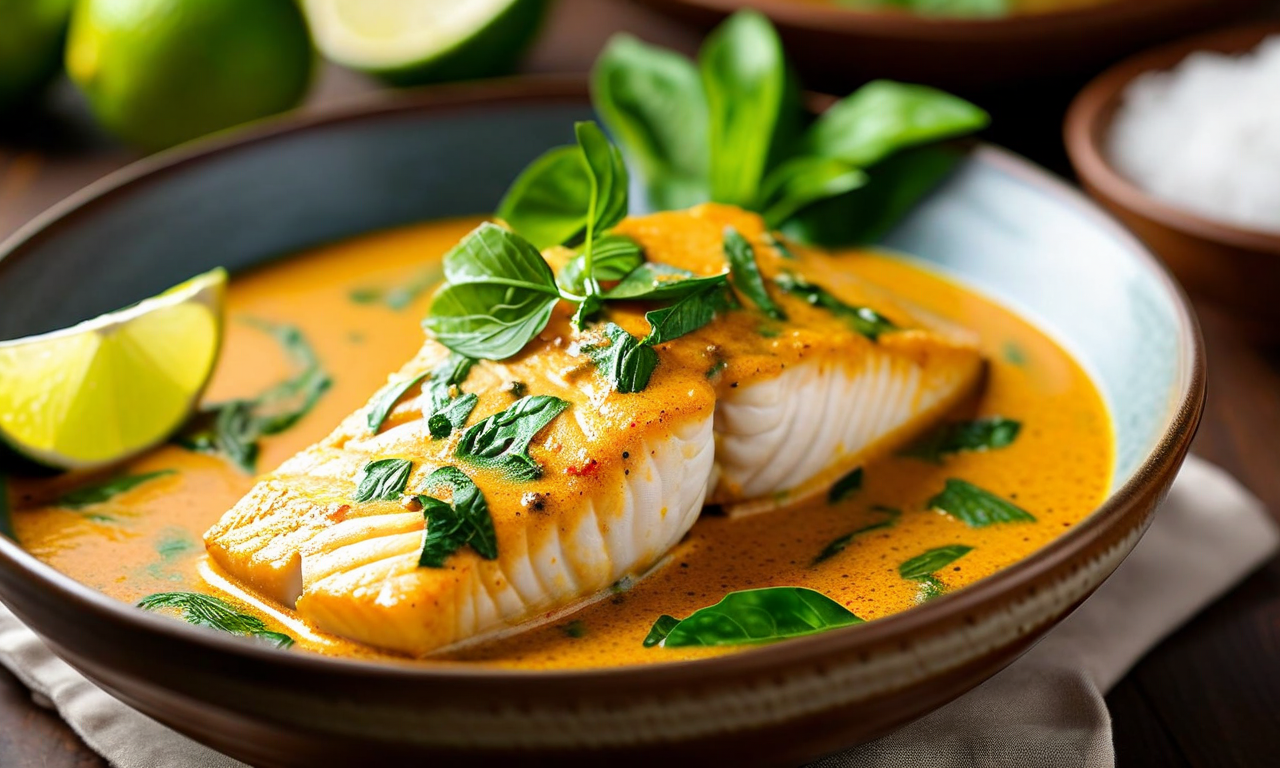
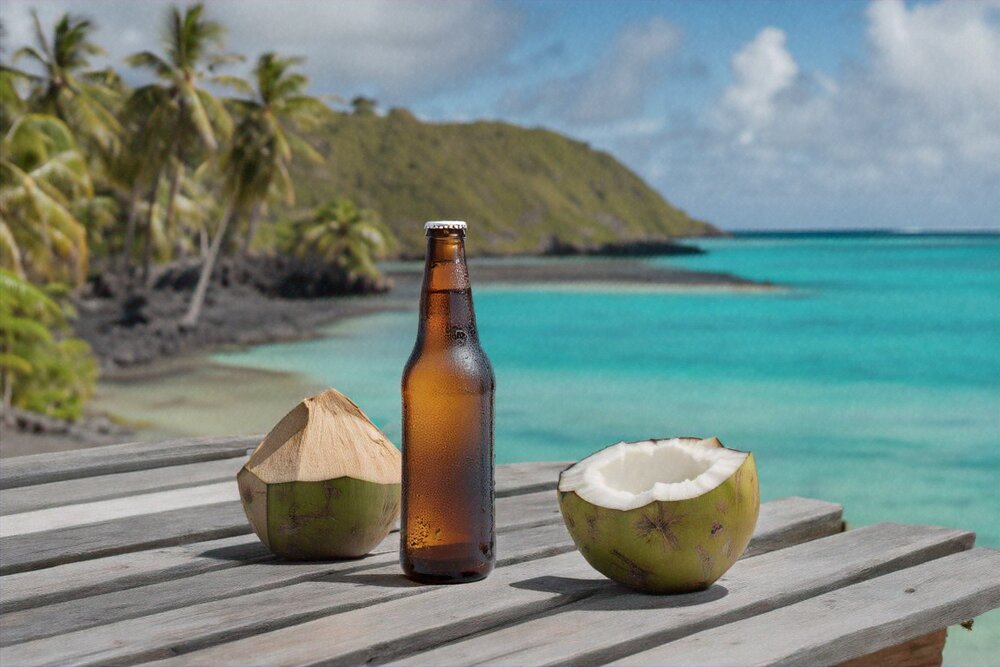
The ika mata and palusami images, which are both correct for their dishes; the coconut fish image, styled Thai but plausible; and the beer and coconuts, captioned to say that the drink is right and the lagoon behind it does not exist on Nauru.
⚠️ Four PNGs called .jpg
01-hero, coconut-fish-curry, fried-breadfruit and toddy-cake are PNG files served with a .jpg extension and an image/jpeg Content-Type, at 1.5–1.6 MB each. Browsers render them; the extension, the stored type and the bytes still disagree. The same fault appeared on Namibia, so it is a pattern rather than an accident. Logged for repair.
📩 If you have been
Photographs of Nauru are genuinely scarce because almost nobody is allowed to go. If you have been — on a contract, a delegation, a family visit or one of the very rare tourist visas — and hold your own pictures of Topside, Anibare, Command Ridge or Buada, this project would be glad to hear from you at photos@kaufmann.wtf.
✍️ Author's Note
There is a photograph of Nauru taken from the air that I have never been able to stop thinking about. The island is an oval. Around the edge there is a thin green ring, a couple of hundred metres wide, and in that ring is everything — the houses, the road, the runway, the church, the football oval, all twelve and a half thousand people. Inside the ring the whole interior is grey. It looks like something that has been eaten from the middle outwards, which is precisely what it is.
What gets written about Nauru is almost always a morality tale, and the moral is usually aimed at Nauruans: they had a billion dollars and they wasted it on a musical. That story is true and it is also a way of not looking at the other ninety years. For most of the time the phosphate was being removed, Nauruans were not the ones removing it or pricing it. Germany took the island in 1888. Britain, Australia and New Zealand ran it under a League of Nations mandate and sold the rock to their own farmers below market. Nauru got the operation in 1970 and had roughly twenty-five years of a resource that had been worked for sixty. A country that inherits the last quarter of its own asset and mismanages it has behaved badly. A country that took the first three quarters and left a moonscape has behaved worse, and only one of those countries had to go to the International Court of Justice to hear the word compensation.
And then there is the part that gets written least. Nauru now makes most of its money by holding people its neighbour does not want. It has signed away, sold, or rented nearly every attribute of sovereignty that could be monetised — a UN vote, a bank register, a passport, a seabed licence, a border. It is easy to be disgusted by that list and much harder to say what else a country of twelve thousand people with a destroyed interior and no other asset is supposed to do. The international system that lectures Nauru about the processing centre has not offered it an alternative budget. I do not think that excuses the incident reports. I do think anybody writing about them from Europe should be honest about which end of the transaction their own continent has historically been on.
What I keep coming back to, though, is the Higher Ground Initiative — the plan to crush the pinnacles, make soil where there is none, and move the whole population up onto the plateau that was destroyed to fertilise somebody else's fields, because the strip they currently live on is going under. If it works, Nauru will have repaired the wound of its own extraction and used the repair as its answer to the sea. No country has done anything like that. It is the most interesting plan in the Pacific and almost nobody outside the region has heard of it, because it is easier to write about the musical.
I have not been to Nauru. I applied, twice, and heard nothing, which is the ordinary outcome and not a grievance. Most people who write about this island have not been either, and I think a page about Nauru should say so out loud rather than borrow the authority of a visit it did not make.
— Radim Kaufmann, 2026
Support This Project 🌍
This World Travel Factbook is a labor of love – free to use for all travelers. If you find it helpful, consider supporting its continued development.