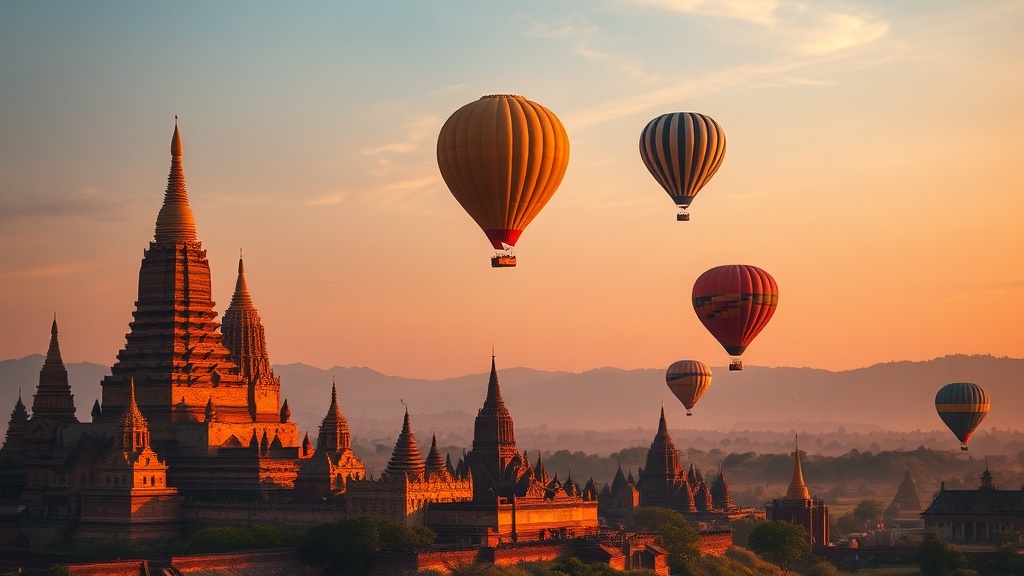



🇲🇲 Myanmar at a Glance
🌍 Overview — Big, Beautiful and Largely Beyond Its Government's Reach
Myanmar is 676,578 km² — the largest country in mainland Southeast Asia, bigger than France and Germany together — with about 54.9 million people, a 2,000 km coastline on the Bay of Bengal and the Andaman Sea, and a border with China, India, Bangladesh, Laos and Thailand. It contains one of the world's great archaeological landscapes and one of its longest-running civil wars, and it has done so simultaneously for most of living memory.
The essential fact about Myanmar in 2026 is that the state does not control most of it. Five years after the coup of 1 February 2021, independent trackers put the military's firm control at roughly a fifth of the country, with ethnic armed organisations and post-coup resistance forces holding something closer to two fifths and the rest contested. The government in Nay Pyi Taw nevertheless held an election, and in April 2026 the general who staged the coup had the resulting parliament elect him president.
Where it is
Between India and Bangladesh to the west, China to the north-east, and Laos and Thailand to the east, with the Bay of Bengal and the Andaman Sea to the south. It is the hinge between South Asia and Southeast Asia, which is most of the reason so many outside powers have taken an interest in it.
Two capitals
Yangon (Rangoon) is the largest city, the commercial centre and the only airport foreigners may fly into. The actual capital since 2005 is Nay Pyi Taw, a purpose-built administrative city 320 km north, built in secret and famous for twenty-lane highways with no traffic on them. Almost no visitor has any reason to go there.
Who lives there
Bamar (Burmans) are about two thirds of the population; the rest is one of the most ethnically complex populations in Asia — Shan, Karen, Rakhine, Chin, Kachin, Mon, Kayah and over a hundred smaller groups. The country's borders were drawn by the British around all of them at once, and that is the root of almost every war it has fought since 1948.
How it is governed
By the military, under a form it keeps changing. The State Administration Council ran the country from the 2021 coup; a staged general election in December 2025 and January 2026 gave the army-backed USDP 339 of 586 seats; and on 3 April 2026 that parliament elected Min Aung Hlaing president with 73.5% of the electoral vote. The form is civilian, the substance is not.
The economy in one line
GDP around $84 billion nominal, about $1,500 per head, with inflation the Asian Development Bank put near 24% for 2026 after peaking above 34% in 2025. Jade, rubies, gas, rice, beans and garments, plus an enormous illicit economy in drugs, timber and online fraud that nobody can measure but everybody agrees is large.
2026 in one line
Min Aung Hlaing made president in April; Aung San Suu Kyi moved from prison to house arrest at the end of April after a blanket sentence reduction; the earthquake reconstruction unfinished; the Arakan Army holding almost all of Rakhine; and more than 5,300 people still held in the scam compounds on the Thai border.
🏷️ Burma or Myanmar — and Why the Answer Is Political
This is the first thing anyone asks about the country and it has no neutral answer. Both names are old, both are Burmese, and the choice between them has been a political signal for thirty-seven years.
The two words
Myanma and Bama are the literary and the colloquial form of the same word — roughly the difference between writing and speaking. Neither is a foreign imposition and neither is new; both appear in inscriptions centuries old. "Burma" is the English rendering of the spoken form, "Myanmar" of the written one.
What happened in 1989
The military government that had just crushed the 1988 uprising renamed the country in English from Burma to Myanmar, along with Rangoon to Yangon, Pagan to Bagan and Irrawaddy to Ayeyarwady. The stated reason was decolonisation. The objection was that an unelected junta had no standing to rename a country a year after shooting thousands of its citizens.
Who says which
For decades the opposition, the US and the UK said Burma; the UN, ASEAN, China, India and Japan said Myanmar. After 2011 that eroded — Aung San Suu Kyi herself used both in office, and most media moved to Myanmar. Since the 2021 coup some outlets and exile groups have moved back to Burma as a deliberate refusal to accept the junta's legitimacy.
The inclusiveness argument
There is a real argument, separate from the junta one: Bama/Myanma both refer to the Bamar ethnic majority, so neither name includes the Shan, Karen, Kachin or Rakhine. Many ethnic organisations dislike both and use neither when they can help it. There is no version of this name that everyone in the country is happy with.
What this page does
Uses Myanmar, because it is the name the country is listed under internationally and the one a reader will search for, while noting that it is not a neutral choice and that Burma is used deliberately by people whose reasons are good. Where a historical period is being described — British Burma, the Burma Road, the Burmese Way to Socialism — the older form is used because that is what those things were called.
The city names
Yangon and Rangoon, Bagan and Pagan, Ayeyarwady and Irrawaddy are the same places. This page uses Yangon and Bagan, which have stuck, and Irrawaddy for the river, which mostly has not — the older spelling remains standard in English for the river and in the name of the exile news outlet The Irrawaddy.
🗺️ A Horseshoe of Mountains Around One Great River
Myanmar's shape explains its politics. A broad central lowland along the Irrawaddy, where the Bamar majority lives and the state is strong, ringed on three sides by a horseshoe of mountains and plateaus where the ethnic minorities live and the state has never been strong. Nearly every war in the country's history has been fought along that boundary.
The Irrawaddy
The Ayeyarwady (Irrawaddy) runs about 2,170 km from the Kachin mountains to a vast delta on the Andaman Sea, and it is the country's spine: its rice bowl, its main highway for two thousand years, and the axis along which Yangon, Bagan and Mandalay all sit. Kipling's "road to Mandalay" was this river, and he had never been there.
The Sagaing Fault
A major strike-slip fault runs almost the full length of the country, north to south, marking where the Indian Plate grinds past the Eurasian. It passes within a few kilometres of Mandalay, Sagaing and Nay Pyi Taw — that is, through the country's demographic and political core. It ruptured catastrophically in March 2025.
The Shan Plateau
East of the Irrawaddy the land rises to the Shan Plateau, around 1,000 m, cool and green, with Inle Lake in a basin at its heart and the vineyards near Taunggyi on its hills. It extends into the Golden Triangle on the Chinese and Lao borders, which has been one of the world's principal opium and now methamphetamine sources for seventy years.
The western ranges
The Chin Hills and Arakan Yoma divide the country from India and Bangladesh and cut Rakhine State off from the interior — which is why Rakhine has always been a partly separate world, and why the Arakan Army has been able to take almost all of it. Hkakabo Razi in the far north, at about 5,881 m, is contested as Southeast Asia's highest peak.
Climate
Tropical monsoon. A hot dry season roughly February to May, with central Myanmar reaching 40 °C and above; the southwest monsoon from late May to October, which drowns the coast and the delta; and a cool dry season November to February, which is the only sensible time to visit. The central dry zone around Bagan gets under 900 mm of rain a year while the Rakhine coast gets over 5,000.
Cyclones and the delta
The Irrawaddy delta is low, densely populated and exposed. Cyclone Nargis struck it on 2 May 2008 and killed an estimated 138,000 people — one of the deadliest cyclones ever recorded, made far worse by a junta that delayed foreign aid for weeks. Cyclone Mocha hit Rakhine in May 2023. The risk is structural and recurring.
📜 Pyu, Pagan and the Kingdoms Before the British
The Pyu city-states
From roughly the second century BCE to the ninth century CE, the Pyu built walled cities across the dry zone — Halin, Beikthano and Sri Ksetra, now collectively a UNESCO World Heritage site and Myanmar's first. They were Buddhist, irrigated, literate and traded with India and China. Their cities were destroyed by Nanzhao raids in the ninth century.
Pagan, 1044–1287
The Pagan Empire unified the Irrawaddy valley under Anawrahta from 1044 and spent two and a half centuries building. At its height the capital held perhaps 10,000 religious structures; over 2,000 survive. It was the crucible of Burmese Theravada Buddhism, the Burmese script and Burmese kingship, and it fell apart under Mongol pressure in the 1280s.
The long fragmentation
For roughly 250 years after Pagan the country was several countries: Shan states in the hills, the Mon kingdom of Hanthawaddy in the south with its great port at Pegu, Arakan in the west running its own maritime kingdom from Mrauk U, and Ava in the centre. Arakan's independence lasted until 1785 and is still a live political memory.
Taungoo and the biggest empire
The Taungoo dynasty under Bayinnaung (r. 1551–1581) assembled what was briefly the largest empire in Southeast Asian history, taking in most of modern Myanmar, Thailand and Laos. It was held together by conquest and did not long outlive him. Bayinnaung remains a nationalist icon, and the junta has put up statues of him in places that make the point deliberately.
Konbaung and the wars with Siam
The last dynasty, Konbaung, founded 1752, sacked Ayutthaya in 1767 — an event Thailand has not forgotten and which still shapes how the two countries see each other. Konbaung also pushed west into Arakan (1785) and Assam, which brought it up against the expanding British in India, with predictable results.
Mrauk U
The Arakanese capital from the fifteenth to the eighteenth century: a fortified city of stone temples in a landscape of hills and paddy, sometimes called a smaller, wetter, less-visited Bagan. It traded with the Portuguese and the Dutch and at its height was one of the richest cities in the Bay of Bengal. It is in the middle of the Arakan Army's territory and effectively inaccessible.
🇬🇧 British Burma — Three Wars, a Province of India, and Rice
Britain took Burma in three bites and then governed it as an afterthought of India. Both facts left permanent damage: the wars destroyed the monarchy that had held the country's idea of itself together, and the administrative arrangement imported a colonial economy and a large Indian population into a country that had not asked for either.
Three Anglo-Burmese wars
1824–26 cost Burma Arakan and Tenasserim and was, at the time, the most expensive war in British Indian history. 1852 took Lower Burma and the delta. 1885 took the rest in under a month: King Thibaw was deposed, packed onto a steamer and exiled to India, where he died. The monarchy was simply abolished, and with it the institution that had anchored Burmese Buddhism.
A province of India
From 1886 Burma was administered as a province of British India, not a colony in its own right — a status Burmese nationalists found humiliating and which lasted until 1937. Decisions were made in Calcutta and then Delhi, and Burmese affairs were consistently secondary to Indian ones.
The rice frontier
The British drained and cleared the Irrawaddy delta and turned it into the world's largest rice exporter — by the 1930s Burma exported more rice than any other country. The wealth went to British firms and to Chettiar moneylenders from South India, who ended up holding a large share of delta farmland after the Depression. Burmese cultivators ended up as tenants on land they had cleared.
Indian migration and the backlash
Large-scale migration made Rangoon a majority-Indian city by the 1930s, with Indians dominant in the civil service, the ports and moneylending. Anti-Indian riots in 1930 and 1938 were serious and deadly. The colonial economy manufactured an ethnic grievance that later governments would exploit for the next eighty years.
Divide and rule in the hills
The British governed the lowlands directly and the hill areas — Shan, Kachin, Chin — separately and indirectly, recruiting minorities heavily into the colonial army while distrusting the Bamar majority. Missionaries converted large parts of the Kachin and Chin to Christianity. That double structure handed independent Burma two populations with entirely different experiences of the colonial state.
The Second World War
Japan invaded in 1942 and Burma became one of the worst theatres of the war: the Burma Road, the Death Railway, the retreat to India, Kohima and Imphal in 1944, and the reconquest in 1945. Cities were destroyed twice over. It is also where the independence movement armed itself — with Japanese help first, and then by switching sides.
🕊️ Aung San, Panglong and the Assassination That Shaped Everything
Burmese independence has a founding figure and a founding wound, and they are the same event. Aung San negotiated both independence from Britain and a settlement with the hill peoples, and was murdered before either could be implemented by the man who had made them.
The Thirty Comrades
Aung San and twenty-nine other young nationalists trained with the Japanese in 1940–41 and came back as the Burma Independence Army. They fought with Japan against Britain, concluded by 1944 that Japanese occupation was worse, and switched sides in March 1945. That manoeuvre gave Burma both an army and a claim to have liberated itself — and gave the army a self-image it has never given up.
The Panglong Agreement
On 12 February 1947 Aung San met Shan, Kachin and Chin leaders at Panglong and agreed a federal union: full autonomy in internal administration for the frontier areas, and — critically — a right of secession after ten years for the Shan and Karenni. Union Day is still 12 February. Panglong was never implemented as written, and every ethnic armed movement since has invoked it.
Who was not at Panglong
The Karen, the largest minority after the Shan, and the Rakhine and Mon, were not parties to the agreement. The Karen had fought loyally for Britain, expected their own state, and got nothing. The Karen National Union went to war in 1949, which makes it one of the longest-running armed conflicts anywhere in the world.
19 July 1947
Gunmen burst into a meeting of the Executive Council in Rangoon and shot Aung San and six ministers dead. He was 32. The rival politician U Saw was convicted and hanged, though the question of who else was involved has never been settled. Martyrs' Day is still marked every 19 July, and the junta has spent years trying to make it a smaller occasion.
Independence, 4 January 1948
U Nu led the new Union of Burma, which — unlike India, Pakistan or Ceylon — left the Commonwealth entirely. Within a year it was fighting communists, Karen, and mutinying army units simultaneously, and the government's writ at one point barely extended past Rangoon. The civil war that began in 1948 has technically never ended.
The democratic decade
Burma was a parliamentary democracy from 1948 to 1962, and for a while a promising one — a free press, real elections, U Nu's Buddhist-socialist idealism, and U Thant going on to be UN Secretary-General from 1961 to 1971, the first from Asia. It was also chronically unstable, and in 1958 U Nu handed power to a military caretaker government. That precedent mattered.
⭐ Ne Win and the Burmese Way to Socialism
On 2 March 1962 General Ne Win took power in a coup and kept it for twenty-six years. What followed is the single largest reason Myanmar is poor: a country that in 1948 was the world's biggest rice exporter and one of the richest in the region was, by 1987, formally classified by the UN as a Least Developed Country.
The ideology
The Burmese Way to Socialism combined Marxism, Buddhism and nationalism into a doctrine nobody outside the country could quite parse. In practice it meant one-party rule by the Burma Socialist Programme Party, nationalisation of everything down to corner shops, and near-total isolation — tourist visas were limited to twenty-four hours for much of the 1960s, later stretched to a week.
The expulsions
Nationalisation in 1964 wiped out Indian and Chinese commercial families who had been in Burma for generations. Roughly 300,000 people of Indian origin left, mostly with what they could carry. It was popular, it was framed as decolonisation, and it destroyed the country's commercial class in a single stroke.
Rangoon University, 7 July 1962
Four months into the new regime, the army shot student protesters at Rangoon University and then dynamited the Students' Union building. The death toll was never established and the official figure of about fifteen is not believed by anyone. It set the pattern for the next sixty years: any organised civilian opposition would be met with live ammunition.
The demonetisations
Ne Win, who was seriously superstitious, cancelled banknotes three times. The last, in September 1987, voided the 25, 35 and 75 kyat notes without compensation and introduced 45 and 90 kyat denominations because they were divisible by nine, his lucky number. It destroyed the savings of most of the population overnight and was the direct trigger for the 1988 uprising.
What isolation preserved
One unintended effect: Myanmar did not get the concrete-and-billboard development that reshaped Bangkok and Jakarta. Yangon has the largest surviving stock of colonial architecture in Southeast Asia, the countryside was not industrialised, and the traditional culture was not commercialised. It is a terrible way to achieve heritage preservation and it did nonetheless achieve it.
The ethnic wars in the meantime
Throughout the Ne Win decades the army fought the Karen, Kachin, Shan, communists and half a dozen others, and developed the Four Cuts doctrine — cutting insurgents off from food, funds, intelligence and recruits by emptying and burning the villages that supplied them. It is still the army's operational method today, and it is why so much of the current war is fought against civilians.
✊ 1988, the 8888 Uprising and Aung San Suu Kyi
In 1988 the country rose, and for a few weeks it looked as though it had won. It had not. But the year produced the opposition movement, the leader and the symbols that defined the next three decades, and it is the reference point every Burmese political argument still returns to.
8.8.88
Protests that began among students in March spread into a general uprising, and a nationwide general strike was called for 8 August 1988 — four eights, chosen as auspicious. Monks, civil servants, doctors and customs officers marched. The army opened fire, and over the following weeks killed an estimated 3,000 or more people. The killing went on into September.
Aung San Suu Kyi arrives
She had come home in April 1988 to nurse her dying mother, having lived abroad for most of her adult life. On 26 August she spoke to a crowd of hundreds of thousands at the Shwedagon Pagoda, and the daughter of Aung San became the leader of the opposition in a single afternoon. She co-founded the National League for Democracy a month later.
The coup within the coup
On 18 September 1988 the army formally seized power as the SLORC, suspended everything and restored order by force. It was, in substance, the same institution replacing its own worn-out political front — Ne Win had resigned in July and stayed influential for years afterwards. The name of the country changed the following year.
The 1990 election
The junta held an election in May 1990 and lost it spectacularly: the NLD won about 392 of 492 seats. The result was simply never honoured. Parliament was never convened, hundreds of elected MPs were arrested or driven into exile, and the junta later claimed the vote had only been for a constituent assembly. It is the cleanest demonstration available of what elections mean under this army.
Fifteen years of house arrest
Aung San Suu Kyi spent roughly fifteen of the twenty-one years between 1989 and 2010 in detention, mostly at her house on Inya Lake. She was awarded the Nobel Peace Prize in 1991 and could not collect it; her husband Michael Aris died of cancer in Britain in 1999 after being refused a visa, and she did not leave the country to see him, knowing she would not be let back in.
The Saffron Revolution
In September 2007 a fuel price rise brought tens of thousands of monks onto the streets — the most serious challenge since 1988, and an extraordinarily difficult one for a Buddhist military to handle. It was crushed anyway: monasteries raided, monks beaten and jailed, at least thirty-one killed, including the Japanese photojournalist Kenji Nagai, shot at point-blank range on camera.
🔓 The Opening, 2011–2021 — Ten Years That Did Not Hold
For a decade Myanmar was the most optimistic story in Asia. Sanctions came off, investors flew in, Obama visited twice, and the NLD won two landslides. Understanding why it collapsed requires seeing what the opening actually was: a transition designed by the army, under a constitution the army wrote, which the army could end whenever it chose. In 2021 it chose.
The 2008 constitution
Written by the junta and passed in a referendum held days after Cyclone Nargis with a claimed 92% approval. It reserves 25% of every legislature for serving officers — enough to veto constitutional amendment, which requires more than 75%. It gives the army the defence, home affairs and border ministries outright, and Article 417 lets the commander-in-chief declare a state of emergency. Every part of the 2021 coup was pre-authorised by this document.
Thein Sein's reforms
From 2011 the quasi-civilian government of Thein Sein, a former general, released political prisoners, relaxed censorship, floated the currency, legalised unions and let the NLD back into politics. Much of it was real. Western sanctions were lifted, Coca-Cola and Ford arrived, and mobile SIM cards fell from $2,000 to about $1.50 — the country went from almost no phones to near-universal smartphones in about four years.
The 2015 landslide
The NLD won 390 of 491 contested seats. Aung San Suu Kyi was barred from the presidency by a constitutional clause written for her — children with foreign citizenship — so the post of State Counsellor was invented for her instead, and she governed as leader in all but title with Htin Kyaw and then Win Myint as president.
The Rohingya catastrophe
In August 2017 the army's clearance operations in Rakhine drove more than 700,000 Rohingya into Bangladesh amid mass killing, rape and village burning. Aung San Suu Kyi defended the military at the International Court of Justice in The Hague in December 2019, and her international reputation did not survive it. Inside Myanmar the position was popular, which is its own uncomfortable fact.
What the opening never touched
The army's budget, its business conglomerates MEHL and MEC, its immunity, its control of three ministries, its wars in Kachin and Shan — none of it. The civilian government ran the economy and the health service; the army ran itself. Ten years of reform left the institution that mattered entirely intact.
The 2020 election
The NLD did even better: about 396 of 476 contested seats, while the army-backed USDP took 33. The army claimed mass fraud, produced no evidence the election commission or observers accepted, and used the claim as the justification for the coup. The real problem was arithmetic — another five years of NLD government, and Min Aung Hlaing's mandatory retirement, were both due in 2021.
🪖 1 February 2021 — The Coup
At dawn on 1 February 2021, the morning the new parliament was to convene, the army detained Aung San Suu Kyi, President Win Myint and most of the NLD leadership, declared a one-year state of emergency under Article 417, and handed power to commander-in-chief Min Aung Hlaing. The one year has been extended repeatedly ever since.
Why then
The new parliament was to sit that morning and confirm a second NLD term. Min Aung Hlaing was approaching the mandatory retirement age of 65 in July 2021, after which he would have lost his command, his immunity and his route to the presidency. The fraud claim supplied a pretext; the calendar supplied the motive.
The aerobics video
The coup's most-shared image worldwide was an aerobics instructor filming her routine on a Nay Pyi Taw roundabout while the military convoy drove to parliament behind her. It was real, it was accidental, and it is a fair summary of how the day looked from inside the country — an enormous event happening behind an ordinary morning.
The Civil Disobedience Movement
Within days, doctors, nurses, teachers, railway workers, bankers and civil servants simply stopped working. The CDM was the largest and most effective non-violent response to any coup in recent memory, and it broke the health and banking systems as a deliberate act. Many of those people have never gone back to work and many are still in hiding.
The crackdown
Peaceful protest was met with live fire from February 2021. Mya Thwe Thwe Khaing, shot in Nay Pyi Taw on 9 February and dying on the 19th, was the first killed. By March the army was shooting people in the streets in daylight. By the end of 2025 the Assistance Association for Political Prisoners had verified over 7,000 civilians killed by the security forces and more than 29,000 arrested — both figures are undercounts.
The NUG and the PDFs
Elected MPs who escaped arrest formed the CRPH and then, in April 2021, the National Unity Government — a parallel administration recognised by no state but treated as a legitimate interlocutor by many parliaments. In May 2021 it announced People's Defence Forces. A generation of urban students who had expected office jobs went to the jungle to learn to fight, which is not something the army had anticipated.
Why this one did not work
Previous coups worked because the army could isolate the country and outlast the protest. In 2021 the population had smartphones, VPNs, encrypted messaging, offshore banking apps and a decade of expectations. Crowdfunding kept the CDM alive; footage reached the world in hours; and the resistance armed itself with 3D-printed parts and drones. The junta won the capital and lost the country.
⚔️ The War — Who Actually Controls Myanmar
What began as a crackdown became a nationwide war, and it is the largest armed conflict in Southeast Asia since Vietnam. More than 100,000 people are estimated killed and roughly 5.2 million displaced. Independent tracking in 2026 puts resistance and ethnic forces in control of around 42% of the country and the junta in firm control of about 21%, with the rest contested — a stalemate in which neither side can finish the other.
The ethnic armed organisations
Around twenty significant ones, some older than most of the world's current governments. The KNU (Karen, at war since 1949), the KIA (Kachin), the Arakan Army, the TNLA (Ta'ang), the MNDAA (Kokang), the Chin groups, and the UWSA — the United Wa State Army, with perhaps 30,000 troops, Chinese weapons and a de facto state on the Chinese border that answers to nobody.
Operation 1027
On 27 October 2023 the Three Brotherhood Alliance — MNDAA, TNLA and Arakan Army — launched a coordinated offensive in northern Shan State and took town after town, including the regional command at Lashio in August 2024, the first time in history an ethnic force had captured one. It was the junta's worst military defeat and it broke the myth that the army could not lose ground.
China's thumb on the scale
China wants stability, its pipelines and its border trade, and it is not sentimental about who provides them. Beijing pressured the northern alliances into ceasefires in 2024–25, closed border crossings and cut power to force compliance, and the MNDAA handed Lashio back to the junta in April 2025 under that pressure. No account of this war that leaves China out is complete.
Rakhine
The Arakan Army has had the most complete success of any force in the country: it holds all but three of Rakhine's seventeen townships, and the military is confined to Sittwe, the Chinese-backed deep-water port at Kyaukphyu, and Manaung island. It administers courts, schools and taxation across a near-contiguous territory. It also stands accused of serious abuses against Rohingya civilians, which complicates the sympathy considerably.
Airpower and the scorched earth
Unable to hold ground, the army has leaned on what the resistance cannot answer: airstrikes, artillery and village burning. Schools, monasteries, clinics, camps for the displaced and a concert in Kachin State have all been hit. There were documented airstrikes during the post-earthquake rescue period in April 2025, which even by this conflict's standards drew international condemnation.
Why it is stuck
The resistance cannot take defended cities without heavy weapons or air defence. The army cannot hold the countryside without manpower it does not have — hence the conscription law activated in February 2024, which sent tens of thousands of young men fleeing to Thailand and into the resistance. Neither side can win, and neither will negotiate, and that is the shape of 2026.
🗳️ The 2025 Election and the General Who Became President
The junta's answer to five years of war was to hold an election, and then to convert the result into a presidency for the man who staged the coup. It is worth setting out plainly, because the formal machinery is designed to be mistaken for a transition.
The vote
A multi-stage general election was held from 28 December 2025 into January 2026, in phases, because the government did not control enough territory to vote everywhere at once. Large parts of Rakhine, Chin, Kachin, Karenni and Sagaing did not vote at all. The NLD had been dissolved in 2023 for refusing to re-register, and its leadership was in prison or exile.
The result
The army-backed USDP took 339 of 586 seats in the national parliament, with the remaining seats split among smaller parties, several of them army-aligned. Western governments, the UN and ASEAN members described the process as neither free nor fair; the phrase most used was a sham. Turnout figures released by the commission are not independently verifiable.
3 April 2026
The new parliament elected Min Aung Hlaing president with 429 electoral votes, 73.46%. Nyo Saw and Nan Ni Ni Aye became vice-presidents. Having taken power as commander-in-chief in 2021, he now holds it as head of state under the constitution his own institution wrote — and the army retains its 25% of seats and its three ministries regardless.
Aung San Suu Kyi in 2026
She was serving 27 years on charges ranging from incitement to corruption to breaching the official secrets act. A mass pardon in April 2026 freed over 4,000 prisoners including former president Win Myint, and successive blanket reductions cut her sentence to about 18 years and 9 months. At the end of April 2026 she was moved from prison to house arrest. She is 81; more than thirteen years remain to serve. It is a life sentence with better furniture.
What it changes
On the ground, very little. The war continues, the ethnic armies hold what they held, and the NUG rejects the entire process. What it changes is the diplomatic packaging: China, Russia, India and some ASEAN members can now deal with a president and a parliament rather than a junta, which was the point of the exercise.
How to read it
Myanmar has done this before. The 2010 election, also boycotted and also won by the USDP, preceded the genuine reforms of 2011–2015 — which is the precedent the junta's defenders invoke. The difference is that in 2011 the army was negotiating from a position of confidence with an opposition it had not yet been at war with for five years. Nothing in 2026 resembles that.
🌋 28 March 2025 — The Supershear Earthquake
At 12:50 local time on 28 March 2025 the Sagaing Fault ruptured in a magnitude 7.7 earthquake about 16 km from Sagaing, at a depth of roughly 10 km. A magnitude 6.7 aftershock followed twelve minutes later. It was the most destructive natural disaster to hit Myanmar since Cyclone Nargis, and it hit a country with no functioning disaster response and an active war on several fronts.
The rupture
It was a supershear event — the rupture front travelled along the fault faster than the shear waves it was generating, which is rare and which concentrates shaking into a narrow, violent band along the fault trace. Reconstructions published in August 2025 confirmed it, and the rupture ran for hundreds of kilometres, one of the longest strike-slip ruptures ever recorded on land.
The toll
The military government reported over 3,600 dead and about 5,000 injured; independent assessments put fatalities above 4,900. Around 50,000 residential buildings were destroyed, along with thousands of monasteries and schools and hundreds of clinics and hospitals. The fault runs through the country's most densely populated corridor, which is exactly why the toll was what it was.
Mandalay and Sagaing
The worst damage was in the second city and its twin across the river. The Ma Soe Yein monastery collapsed, much of the reconstructed royal palace was wrecked, and the Ava (Inwa) bridge across the Irrawaddy came down. Centuries of brick and timber religious architecture in Sagaing — one of the great Buddhist landscapes of Asia — was very badly hit.
Bangkok
More than 1,300 km away, an under-construction 30-storey State Audit Office tower in Bangkok collapsed completely, killing at least 18 with dozens missing. A single building failing at that distance, when nothing else in the city did, became a major construction-standards scandal in Thailand — and it is the reason much of the world saw footage of this earthquake at all.
The war did not stop
The junta declared a ceasefire and then conducted airstrikes during the relief period, including in earthquake-affected areas. Aid access was restricted along political lines, and international teams were channelled through government-held areas while resistance-held districts with heavy damage received little. It is the Nargis pattern repeated with the same reasoning.
Where it stands now
Reconstruction is partial, underfunded and concentrated where the government wants it seen. Hundreds of thousands remain in temporary shelter into 2026, and the heritage damage in Sagaing, Mandalay and Inwa is largely unrepaired — restoration of that kind needs money, expertise and international cooperation, and sanctions plus civil war supply none of the three.
⚠️ Rakhine and the Rohingya
This is the hardest subject in the country and it deserves to be set out directly rather than gestured at. What happened in Rakhine State in 2016–17 is the subject of an ongoing genocide case at the International Court of Justice, and the situation of the people it happened to has not improved since.
Who the Rohingya are
A Muslim, Rohingya-speaking population of northern Rakhine, numbering perhaps a million before 2017. They have been in the region for generations — how many is itself politically contested — and the Myanmar state's position is that they are Bengali migrants. The 1982 citizenship law excluded them from the list of recognised national races, rendering most of them stateless in their own country.
What was done to them
Successive operations, above all from August 2017, drove more than 700,000 people across the Naf river into Bangladesh in a matter of weeks, following attacks by the armed group ARSA on police posts. UN investigators documented mass killings, systematic rape and the burning of hundreds of villages, and concluded there was intent to commit genocide. Satellite imagery showed the villages erased.
Cox's Bazar
Roughly a million Rohingya live in the camps around Cox's Bazar in Bangladesh — among the largest refugee settlements on earth, now in their ninth year, with funding falling and conditions deteriorating. Repatriation has been discussed repeatedly and has never happened, because nothing in Myanmar has changed that would make return safe or legal.
The Gambia case
The Gambia brought a case against Myanmar under the Genocide Convention at the ICJ. Aung San Suu Kyi personally led the defence in December 2019. The court rejected Myanmar's preliminary objections in 2022 and the case is proceeding on the merits. The ICC is separately investigating deportation as a crime against humanity, and in 2024 its prosecutor sought an arrest warrant for Min Aung Hlaing.
The uncomfortable part
Anti-Rohingya sentiment was and is widely popular inside Myanmar, including among people otherwise opposed to the army, and it was stoked by Buddhist nationalist movements such as Ma Ba Tha and by Facebook, whose failure to moderate Burmese-language hate speech Meta itself later acknowledged. This is not a crime a junta committed against the wishes of its population.
Since the coup
It has become more tangled, not less. The NUG has formally acknowledged Rohingya rights and promised citizenship, a genuine shift. The Arakan Army, which now governs almost all of Rakhine, stands accused of killings, forced displacement and drone attacks on Rohingya civilians — most seriously around Maungdaw in 2024. The junta has meanwhile forcibly conscripted Rohingya men into the army that expelled them, which is close to the darkest thing in this entire file.
💻 The Scam Compounds — Industrialised Trafficking on the Thai Border
In the last few years Myanmar has acquired a new export: online fraud at industrial scale, run out of fortified compounds on the Thai and Chinese borders and staffed substantially by trafficked people held against their will. Anyone who has received a wrong-number message that turned into a crypto investment pitch has met the output.
How it works
Victims are recruited worldwide with fake job adverts — data entry, customer support, in Bangkok — then moved across the border and locked into compounds where they run pig-butchering romance and investment frauds against targets in the West and East Asia. Quotas are enforced with beatings, electric shocks and resale between operators. The UNODC estimates at least 120,000 people have been forced into this work inside Myanmar.
Where they are
Mostly in Karen State opposite Mae Sot in Thailand: KK Park, a roughly 500-acre estate on the Moei river run by Chinese criminal networks; Shwe Kokko, a purpose-built city; Payathonzu and others. The territory is controlled by the junta-aligned Karen Border Guard Force, which is widely reported to take a cut. There are further operations in the Wa and Kokang areas on the Chinese border.
The 2025 crackdown
Under heavy Chinese and Thai pressure — Thailand cut electricity, fuel and internet across the border in early 2025 — the junta raided KK Park on 19 October 2025 and Shwe Kokko from 18 November, arresting 1,746 foreigners in six days and over 300 in one operation. State TV broadcast the demolition of compound buildings. It was the most visible action ever taken against the industry.
Why it did not work
The syndicates moved. Operations relocated to Kyauk Khet, Payathonzu and rented houses in Myawaddy town, running on generators and Starlink, and reporting in 2026 describes scam operations spread through the town rather than concentrated in compounds that can be raided. In June 2026 rights groups put the number still held at over 5,300. The buildings were demolished; the business was not.
The Wang Xing case
The Chinese actor Wang Xing was lured to the border in January 2025 by a fake film casting, trafficked into Myanmar and rescued after his girlfriend's posts went viral on Weibo. The case caused a collapse in Chinese tourism to Thailand and is the single reason the 2025 crackdown happened at all. It is a reminder that these operations end when a big enough government is embarrassed, and not before.
What it means for a traveller
Nothing directly — these places are hundreds of kilometres from anywhere a visitor goes, and the land borders are closed to foreigners anyway. It matters because it is now a real part of what the Myanmar war economy is, alongside jade and methamphetamine, and because the job offer in Bangkok that sounds too good is the recruitment channel. That warning is worth taking literally.
👥 135 Official Races and the Arithmetic of a Union
Myanmar's government recognises 135 "national races", grouped under eight major ones. The number is an artefact — assembled in the 1980s, splitting some groups arbitrarily and omitting others entirely — but the underlying diversity is real and it is the reason the country has never held together.
Bamar
About 68%. Buddhist, Burmese-speaking, concentrated in the Irrawaddy valley and the dry zone. The state, the army and the national culture are Bamar in language and outlook, and the Bamar heartland is also where the post-2021 People's Defence Forces sprang up — the first time in the country's history that the majority has taken up arms against its own army in large numbers.
Shan
About 9%. Tai-speaking, close cousins of the Thai and Lao, spread across the eastern plateau in what were once dozens of principalities under hereditary saopha princes. Shan State is the largest administrative division, holds most of the drug economy, and contains several mutually hostile armed groups — Shan, Wa, Kokang and Ta'ang — that fight each other as well as the army.
Karen and Karenni
About 7%. Heavily Christian in part, though most Karen are Buddhist, concentrated in the east and the delta. The KNU has been fighting since 1949. Hundreds of thousands have lived in camps in Thailand for decades. Neighbouring Karenni (Kayah) State, the smallest, became one of the most comprehensively resistance-held areas after 2021.
Rakhine
About 4%. Buddhist, speaking a dialect close to Burmese, with a proud memory of the independent kingdom of Mrauk U and a long grievance against Bamar rule dating to the conquest of 1785. The Arakan Army now governs nearly all of their state. Rakhine State is also home to the Rohingya, and relations between the two communities are extremely bad.
Kachin and Chin
Kachin in the far north — largely Baptist, thanks to nineteenth-century American missionaries — sit on the world's best jade and have fought the state on and off since 1961. Chin in the western hills are also largely Christian, are among the poorest people in the country, and mounted one of the most complete post-coup resistances anywhere; much of Chin State is out of the army's hands.
Mon, Indians, Chinese, Gurkhas
The Mon gave Burma Theravada Buddhism, its script and much of its classical culture, and were absorbed politically. There are long-settled Indian, Chinese, Nepali (Gurkha) and Anglo-Burmese communities, many of them not on the list of 135 and several of which have faced periodic expulsion. Panthay and Kaman Muslims are Burmese-speaking and Burmese-born, and have their own difficulties.
☸️ Theravada Buddhism, and What It Does Day to Day
Around 88% of the population is Theravada Buddhist, and the country is one of the most visibly devout on earth. Understanding a few things about how that works makes almost everything a visitor sees make sense.
Merit
The organising idea is kutho — merit, accumulated by giving, and carried into future lives. This is why an extremely poor country is covered in gold: gilding a stupa, feeding monks, building a rest house or donating a bell are the highest-return investments available in a merit economy. Myanmar consistently ranks at or near the top of the world's charitable giving indices, which is not a small thing for a country this poor.
The Sangha
Several hundred thousand monks, plus thilashin nuns in pink robes. Almost every Buddhist boy goes through shinbyu — temporary ordination as a novice, often at eight or nine, celebrated as the most important family occasion there is. Many men re-ordain later for weeks or months. Monasteries feed, house and educate children the state does not.
Nats
Alongside Buddhism runs the older worship of nats — thirty-seven officially recognised spirits, most of them historical figures who died violently and badly. Anawrahta failed to suppress them in the eleventh century and settled for installing them at the Shwezigon under the Buddha instead. The Taungbyone festival near Mandalay is the biggest nat gathering, run largely by spirit mediums, and is one of the few spaces where Myanmar's transgender and gay communities are publicly visible and respected.
Astrology and numbers
Taken seriously at every level. The day of the week you were born determines your corner of the pagoda platform and much of your name; Ne Win's nine-divisible banknotes were an act of state astrology; the capital was moved to Nay Pyi Taw on a date and at a time chosen by astrologers. Dismissing it as folklore misreads how decisions actually get made.
Other faiths
About 6% Christian — overwhelmingly among the Kachin, Chin and Karen, a direct legacy of American Baptist and other missions — and about 4% Muslim, including Rohingya, Kaman, Panthay and long-settled Indian Muslim communities. There are Hindu temples and a synagogue in Yangon, Musmeah Yeshua, maintained by a community now numbering about twenty people.
Buddhist nationalism
The dark side. Ma Ba Tha and the monk Ashin Wirathu pushed an explicitly anti-Muslim politics through the 2010s, with real influence and real consequences, and the "race and religion protection laws" of 2015 were their product. Monks have also been at the centre of resistance to the army — the Saffron Revolution was theirs. The Sangha is not one political thing, and assuming it is leads to mistakes in both directions.
🎭 Thanaka, Longyis, Puppets and Betel
Myanmar looks and feels unlike its neighbours within about ten minutes of arrival, and that is mostly down to a handful of everyday things that half a century of isolation left intact while Bangkok and Hanoi modernised.
Thanaka
The pale yellow paste worn on the face by most women and many children and some men, ground from the bark of the thanaka tree on a circular stone with a little water. It is sunscreen, cooling agent, astringent and cosmetic at once, it has been in use for over two thousand years, and it is applied in patterns — circles, leaves, stripes — that carry a certain amount of personal style.
The longyi
The wrapped cylinder of cloth worn by nearly everyone as everyday dress — paso for men, knotted in front, htamein for women, folded and tucked at the side. Worn to the office, to court and to parliament. A visitor who buys one and learns the knot will be received noticeably more warmly, and it is genuinely the most comfortable thing to wear in that climate.
Betel
The red-stained smiles and the red splashes on every pavement are kun-ya — betel leaf wrapped around areca nut, slaked lime and often tobacco, chewed constantly and spat. It is mildly stimulant, thoroughly carcinogenic, and completely woven into social life, offered the way tea or cigarettes are elsewhere. Myanmar has one of the world's highest rates of oral cancer as a direct result.
Puppets and dance
Yoke thé marionette theatre was court art and mass entertainment, with a fixed cast of characters and puppets worked on as many as eighteen strings; it survives as a much-reduced tourist performance in Mandalay and Bagan but the craftsmanship is real. Classical zat pwe theatre runs all night at festivals, and the hsaing waing percussion ensemble — tuned drums in a circle — is a genuinely distinctive musical tradition.
Chinlone and lethwei
Chinlone is the national game: a woven rattan ball kept airborne by a circle of six players, scored on grace rather than competition — closer to dance than sport. Lethwei is its opposite: bare-knuckle boxing that permits headbutts, traditionally won only by knockout, and considered one of the most brutal combat sports in the world.
Thingyan
The water festival in mid-April, marking the new year: four days in which the entire country throws water at everybody else, with stages, hoses, music and no exemptions for foreigners. It is joyful, exhausting and by some distance the best time to be in the country if you can tolerate being soaked for four days straight. It has been muted since 2021, with some years seeing calls to boycott it in mourning.
🏙️ Yangon — Shwedagon, Colonial Brick and a Circle Line
Yangon is not the capital and has not been since 2005, but it is the country's only real city: about 5.5 million people, the only airport foreigners may enter through, and the place where almost every visit begins and ends.
The Shwedagon
A gilded stupa about 99 m high on a hill above the city, said to enshrine eight hairs of the Buddha and to be two and a half millennia old; the structure as it stands is largely from the fifteenth to eighteenth centuries. It is plated in genuine gold and topped with thousands of diamonds including one of 76 carats. Go at sunset and stay into the dark — it is the single most impressive thing in the country and it is not close.
The colonial downtown
The largest concentration of British colonial architecture in Southeast Asia, block after block of it between Sule Pagoda and the river: the Secretariat where Aung San was assassinated, the High Court, the Strand Hotel of 1901, custom houses and banks. Much of it is decaying spectacularly, some has been restored, and the Yangon Heritage Trust has fought a long uphill campaign to keep it standing.
The Circle Line
A 46 km loop of colonial-era railway around the city, about three hours for the full circuit, costing a trivial sum. It runs through suburbs, markets, paddy fields and vendors selling from the aisles, and it remains the single best introduction to ordinary Yangon life available to a visitor. Sit by an open door and watch.
Markets
Bogyoke Aung San Market (still widely called Scott Market) for jade, lacquer, longyis, textiles and art, in a 1926 colonial hall. Better, if you want to see how the city actually eats, are the street markets of Chinatown around 19th Street, which comes alive at night with grills, beer stations and enormous crowds.
The other sights
Sule Pagoda on its roundabout in the middle of downtown, and a focal point of both 1988 and 2007. The huge reclining Buddha at Chaukhtatgyi. Kandawgyi and Inya lakes, the second with Aung San Suu Kyi's house on University Avenue. The Musmeah Yeshua synagogue and the Armenian church, both survivors of a far more cosmopolitan city.
Yangon since the coup
Quieter and poorer. The nightly curfew was lifted in December 2025, having run for years. Power cuts are routine and long, many businesses closed and did not reopen, and the visible international presence has thinned out. It is not a dangerous city for a visitor in ordinary terms, but it is a subdued one, and conversations about politics do not happen with strangers.
🛕 Bagan — Two Thousand Temples on a Dry Plain
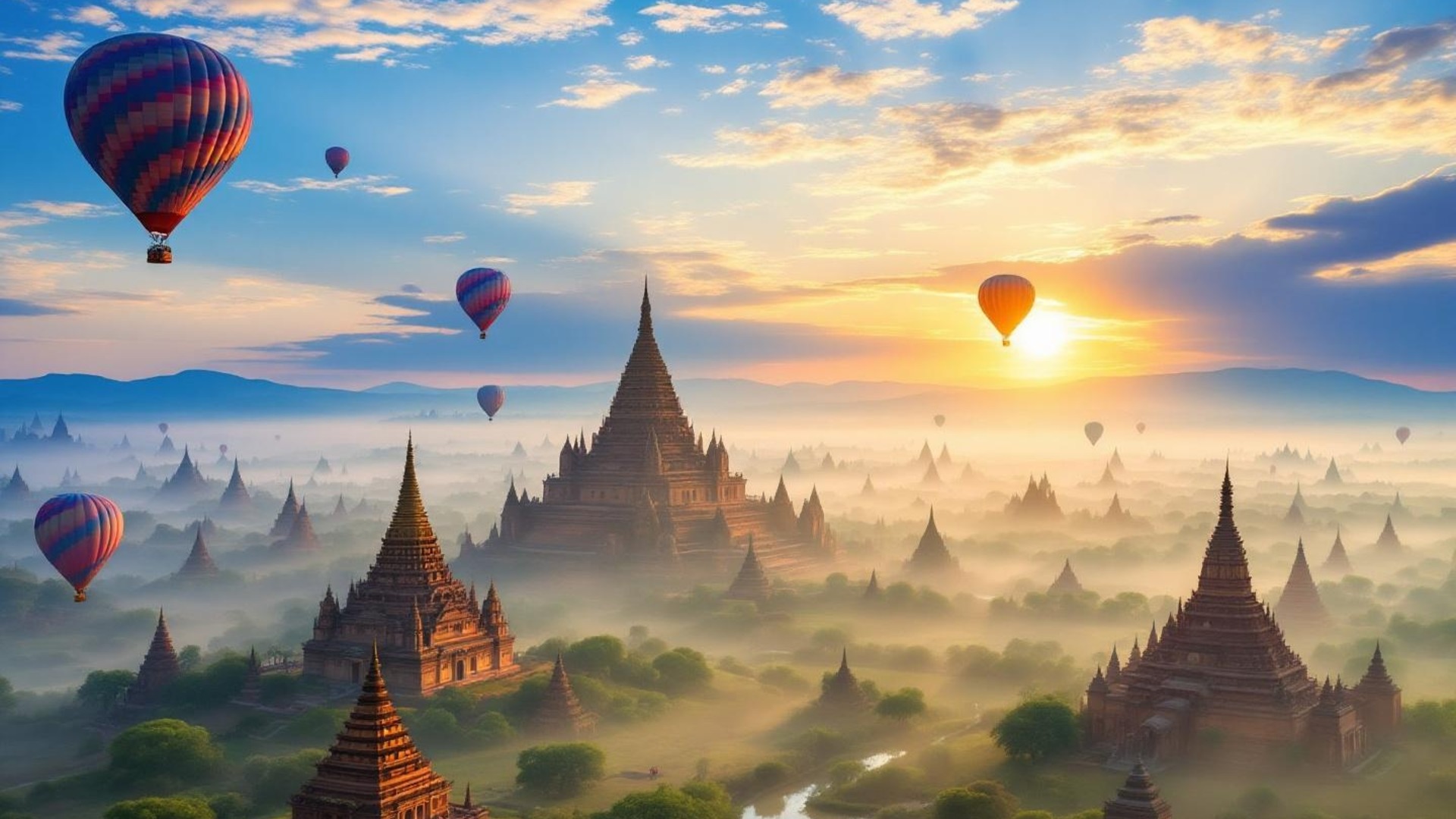
Bagan is one of the great sights of Asia and arguably the most concentrated archaeological landscape in the world after Angkor: somewhere between 2,000 and 3,500 surviving brick monuments on roughly 100 km² of dry plain beside the Irrawaddy, built between about 1044 and 1287.
The scale
The capital of the Pagan Empire may have held 10,000 religious structures at its height, built in a construction boom that ran for 250 years and was funded by the merit economy — kings, queens, ministers and merchants each building their own. What survives survived because brick lasts and because nobody had the resources to clear the plain for farming.
The individual temples
Ananda (1105), the most perfectly proportioned, with four standing Buddhas in a cross plan. Dhammayangyi, the largest and most brutal-looking, built by a king who murdered his father and whose bricklayers were reportedly executed if a needle fitted between the courses. Thatbyinnyu, the tallest. Shwezigon, gilded and still an active pilgrimage site. Sulamani and Htilominlo for the frescoes.
UNESCO, eventually
Bagan was only inscribed in 2019, decades after it obviously qualified, because the junta had spent the 1990s and 2000s "restoring" it with concrete, inventing structures on old foundations, and building a golf course and a 61 m viewing tower in the middle of the archaeological zone. The listing came with conditions, and the damage is permanent.
Earthquakes
Bagan sits in an active zone and has been shaken repeatedly — badly in 1975, again in August 2016 when nearly 400 temples were damaged, and again in March 2025, when the supershear event caused further damage across the plain and to the wider region's heritage. Restoration capacity in 2026 is minimal.
No more temple climbing
Since 2018 climbing the temples has been banned, after damage and several deaths. The classic sunrise-from-a-stupa photograph is no longer legally obtainable. There are purpose-built viewing mounds, and the balloons — when they are flying, which depends on the season and the security situation — remain the other way to see the plain from above, at serious expense.
How to see it
E-bike, universally. They are cheap, silent, and the dirt tracks between the minor temples are where Bagan actually happens — the famous five are worth seeing and the empty ones with a caretaker and a bat colony are what people remember. Allow three days. The zone fee is payable in kyat or dollars and goes to the government, which is part of the ethical question dealt with further down.
👑 Mandalay, Sagaing and the Last Royal Capital
Mandalay was the capital for only twenty-six years, from 1859 until the British took it in 1885, but it remains the cultural and religious heart of Bamar Myanmar — and it is the city the 2025 earthquake hit hardest.
The palace and the hill
King Mindon's palace inside its square moat was destroyed by Allied bombing in 1945 and rebuilt in the 1990s by the army using forced labour, which is a fair summary of modern Myanmar in one sentence. Mandalay Hill, climbed barefoot up covered stairways, gives the view over the city; the 2025 earthquake destroyed much of the reconstructed palace.
Mahamuni
The Mahamuni Buddha is the most venerated image in the country after the Shwedagon — a seated bronze brought from Arakan in 1785 and now so thickly encrusted with gold leaf applied by male devotees over two centuries that its original shape is lost. Its face is washed ceremonially every morning at four. Women may not approach the image itself.
Kuthodaw and the crafts
Kuthodaw Pagoda holds the "world's largest book" — the entire Tripitaka carved onto 729 marble slabs, each in its own white stupa. Mandalay is also where things are still made by hand: gold leaf beaten by hammer in Gold Pounders' District, stone Buddhas carved in Kyauk Sit Tan, marionettes, tapestry and silk.
U Bein Bridge
At Amarapura, a 1.2 km footbridge of teak posts salvaged from a dismantled palace, built around 1850 and generally described as the longest teak bridge in the world. It is heavily photographed at sunset and genuinely worth it, mostly because it remains a working bridge used by monks, cyclists and fishermen rather than a monument.
Sagaing
Across the Irrawaddy, a hillside of hundreds of white and gold stupas and monasteries — the monastic centre of the country, with several thousand monks and nuns in residence. It is the most purely beautiful thing near Mandalay. It is also where the March 2025 earthquake had its epicentre, and much of that landscape of brick and stucco was damaged or destroyed.
Inwa and Mingun
Inwa (Ava) was capital on and off for four centuries and is now a quiet ruin field of teak monasteries and a leaning watchtower, reached by ferry and toured by pony cart. Mingun, upriver, holds the colossal unfinished stupa that King Bodawpaya began in 1790 and never completed, split by earthquakes, plus one of the largest working bells in the world.
🚣 Inle Lake, Shan State and the Hills
The Shan Plateau is where the country goes to be cool, green and quiet, and Inle Lake is its centrepiece — about 22 km long, shallow, at roughly 880 m, with a way of life built entirely on the water.
Leg-rowing
The Intha fishermen row standing on one leg with the oar wrapped around the other, which frees both hands for a conical net and lets them see over the reeds. It is a genuine working technique and not a performance, though the men who pose in silhouette for photographs at the lake's edge are, and they expect payment for it.
Floating gardens and villages
Whole villages stand on stilts, and the Intha farm floating gardens — beds of matted weed and silt anchored with bamboo poles, growing tomatoes on the lake surface. There are stilted monasteries, markets that rotate between villages on a five-day cycle, and workshops making lotus-stem silk, a fabric produced almost nowhere else on earth.
Indein and Phaung Daw Oo
Indein, up a creek from the lake, is a hillside of hundreds of crumbling overgrown stupas — much smaller than Bagan and arguably more atmospheric for it. Phaung Daw Oo holds five Buddha images so thickly gilded they have become featureless spheres, and they are paraded around the lake in a golden barge in an October festival.
Kalaw and trekking
Kalaw is a former British hill station at 1,300 m, cool and pine-scented, and the usual start for the classic two or three day trek to Inle through Pa-O, Danu and Palaung villages, sleeping in monasteries and homestays. Before 2021 this was one of the best walks in Southeast Asia. Its availability now depends entirely on the current security situation and must be checked locally.
Hsipaw and the north
Hsipaw, further north, has the Shan Palace and its own trekking, and was a traveller favourite. Northern Shan State has been a principal theatre of the war since Operation 1027 in late 2023 — Lashio, Hsenwi, Kyaukme and Namtu have all changed hands. It is not a place to travel to on the basis of an old guidebook.
The wine country
The hills around Taunggyi, the Shan capital, hold Myanmar's two wineries. This is the surprise of the country's food and drink and it gets its own section further down — the altitude, roughly 1,200 m, and the dry season make it genuinely viable, and the wine is better than the premise suggests.
🏖️ Ngapali, the Mergui Archipelago and the Golden Rock
Myanmar has about 2,000 km of coastline and almost no developed beach tourism, which is either a tremendous opportunity or a warning, depending on which part you are looking at and what year it is.
Ngapali
The best-known beach: a few kilometres of white sand and palms on the Rakhine coast, with a handful of resorts and fishing villages, and no high-rises. It was Myanmar's one genuinely polished beach destination. It sits in Rakhine State, now almost entirely controlled by the Arakan Army, and access is contingent on flights and on the front line — check very carefully before assuming it is reachable.
The Mergui Archipelago
Around 800 islands in the far south off Myeik, almost entirely uninhabited, with coral, rainforest and empty white beaches. It was closed to foreigners until 1997, opened for expensive liveaboard diving and a few resorts, and remains one of the genuinely unexplored coastlines of Asia. It is home to the Moken sea nomads, whose way of life is disappearing fast under pressure from all sides.
Chaungtha and Ngwesaung
The delta beaches, four or five hours from Yangon by road, and the ones Burmese families actually go to. Ngwesaung is quieter and prettier, Chaungtha livelier and cheaper. Neither is a postcard, both are real, and they are much the most accessible sea from the main tourist route.
The Golden Rock
Kyaiktiyo: a granite boulder plated in gold leaf, perched on the edge of a cliff at 1,100 m, apparently held in place by a single hair of the Buddha. Pilgrims reach it on open truck benches up a hair-raising road, and it is one of the three most sacred sites in the country. Only men may cross the bridge to touch the rock and apply gold leaf. It is a short detour from the Yangon–Mawlamyine road and easily done.
Mawlamyine
The old Moulmein, Britain's first capital in Burma, a faded riverside town of colonial buildings, churches, mosques and pagoda-topped ridges, with Kipling's "old Moulmein pagoda" somewhere in the mix. Orwell's family had roots here and he served nearby as a colonial policeman — the raw material for Burmese Days and Shooting an Elephant.
Hpa-An
In Karen State: limestone karst towers rising straight out of rice paddy, caves full of Buddha images, a lake with a monastery on an island, and a climb up Mount Zwegabin. It is one of the most beautiful landscapes in the country and it sits in a state with an armed conflict older than most of its visitors. Check status before going.
🏔️ Kachin, Chin and the Far North
The parts of Myanmar almost nobody sees, partly because they are hard to reach and mostly because they have been at war for as long as the country has existed. Included here for completeness and because the reader should know what is up there, not as a suggestion.
Putao and Hkakabo Razi
The far northern tip of Kachin State runs into the eastern Himalaya. Hkakabo Razi, around 5,881 m, is claimed as Southeast Asia's highest mountain, though a 2014 expedition measured a neighbouring peak as possibly higher and the question is open. Access has always required permits and is effectively impossible now.
The Kachin war
The KIA fought the state from 1961, signed a ceasefire in 1994 that lasted seventeen years, and went back to war in 2011 — during the democratic opening, which tells you how much of the opening reached the hills. Since 2021 the KIA has taken substantial territory, including much of the jade belt, and the army has answered with airstrikes on civilians.
Hpakant and jade
The Hpakant mines in Kachin State produce most of the world's imperial jadeite, in an industry valued in the tens of billions of dollars a year and almost entirely off the books. Freelance miners scavenge the tailings of mechanised operations, and landslides regularly kill dozens or hundreds — over 170 died in a single collapse in July 2020. Heroin and methamphetamine addiction in the mining camps is severe.
Chin State
The poorest state in the country, in high forested hills on the Indian border, largely Baptist, famous for the facial tattoos worn by women of several Chin groups — a practice ended generations ago, so the last women bearing them are now very old. The Chinland Defence Forces mounted one of the most complete post-coup resistances in the country, and much of the state is out of the army's control.
Naga
In the hills where Sagaing Region meets Nagaland in India, the Naga live across a border neither side of which they had any say in. The Naga New Year festival in January was one of the very few times outsiders could visit, under permit. The 2025 earthquake's fault trace runs through the Sagaing plains below.
The Wa
The United Wa State Army runs an unrecognised de facto state on the Chinese border with an army of perhaps 30,000, Chinese weapons and air defences, Chinese currency and mobile networks, and no functional relationship with Nay Pyi Taw. It is the most heavily armed non-state actor in Southeast Asia. It has stayed largely out of the post-coup fighting and is a significant player precisely because of that.
🍽️ Burmese Food — the Underrated Cuisine of Southeast Asia
Burmese food sits between India, China and Thailand and is not much like any of them. It is sour, salty, oily and fermented rather than sweet or fiery, it is built on a foundation of pulses that no neighbouring cuisine shares, and it includes the only major salad in the world made from fermented tea leaves. It is also, by a wide margin, the least known of the region's cuisines.
The flavour base
Almost everything starts with a sī-byan — onion, garlic, ginger and turmeric fried in a generous quantity of peanut or sesame oil until the oil separates and floats clear on top. That floating oil is the mark of a curry properly made, not a fault, and it acts as a seal that keeps the dish safe through a day in the heat.
Ngapi
Fermented fish or shrimp paste, and the single most important ingredient in the country. It ranges from a firm block to a pungent liquid, it smells alarming to the uninitiated, and it is in nearly everything as the source of salt and depth. Ngapi yay, a thin dip served with raw and blanched vegetables, is the everyday centre of a Burmese meal.
The pulses
Myanmar is one of the world's biggest producers and consumers of beans and pulses, which is unusual for Southeast Asia and is a clear Indian influence. Chickpea flour, yellow split peas, tofu made from chickpeas rather than soy (Shan tofu) — this is the thing that most distinguishes Burmese cooking from Thai or Lao.
How a meal works
Rice in the middle, several dishes around it — a curry, a soup, a fried vegetable, a salad, ngapi yay with raw vegetables — all served at once, not in courses, and eaten with the right hand or a spoon. Soup is drunk throughout the meal rather than at the start. In a restaurant, small side dishes arrive unasked and are usually free.
The salads
Thoke — salads — are where Burmese cooking is at its most distinctive: shredded things dressed with lime, fish sauce, roasted chickpea powder, fried garlic oil, chilli and crunch. Lahpet thoke (fermented tea), gin thoke (ginger), shwe pyi thoke and the ubiquitous tomato salad. They are the best entry point for a sceptical visitor.
Regional cooking
Shan food is lighter and more herbal, with Shan noodles and Shan tofu. Rakhine food is much hotter and far fishier than anywhere else in the country. The delta and Mon areas cook more seafood; Mandalay is drier and more Bamar; and the Indian and Chinese quarters of Yangon have their own long-established cooking that is not a transplant but a Burmese variant.
👨🍳 Three Recipes — Mohinga, Lahpet Thoke, Ohn No Khao Swè
Three dishes that between them cover most of what Burmese cooking does: the national breakfast, the national salad, and the dish most visitors end up missing afterwards. All three are achievable from a Czech or Central European kitchen with one trip to an Asian grocer.
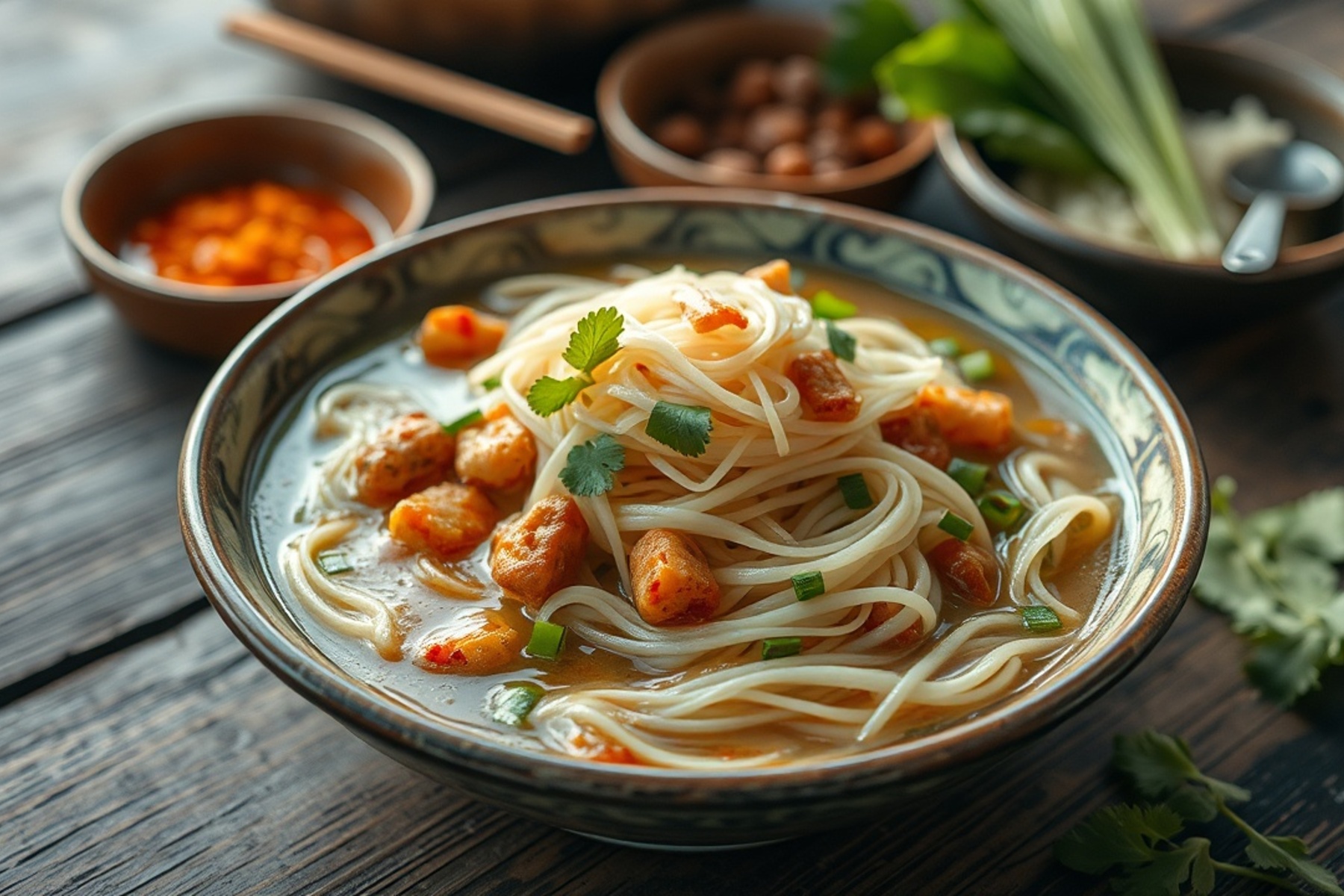
Mohinga — catfish and lemongrass noodle soup
The national dish · breakfast · serves 4–6 · about 90 minutes
Ingredients: 500 g catfish or any firm white fish (carp works); 250 g rice vermicelli; 4 stalks lemongrass, bruised; 1 large onion; 6 cloves garlic; 4 cm ginger; 1 tsp turmeric; 2 tbsp fish sauce; 1 tsp ngapi (shrimp paste), optional but proper; 100 g rice flour; 50 g chickpea (gram) flour; 1 banana stem or 2 tender leek hearts, finely sliced; 5 tbsp peanut oil; to serve — boiled eggs, coriander, sliced onion, lime, chilli flakes, split-pea fritters
Method: Simmer the fish with two stalks of lemongrass and a slice of ginger in 2 l water for 15 minutes; lift out, flake, discard skin and bones, and keep the stock. Blend onion, garlic, ginger and turmeric to a paste and fry in the oil over a medium heat until it darkens and the oil separates — this takes longer than you think, about 15 minutes. Add the flaked fish and the ngapi, fry 5 minutes, then pour in the stock with the remaining lemongrass and the sliced banana stem or leek. Whisk the rice and chickpea flours into a little cold water and stir in to thicken; simmer 30 minutes until it coats a spoon. Season with fish sauce. Serve over softened rice vermicelli and let everyone add their own egg, coriander, onion, lime, chilli and fritter.
💡 The thickening flours are not optional — mohinga is a soup with body, not a clear broth. If it thins on standing, whisk in a little more rice flour slurry.
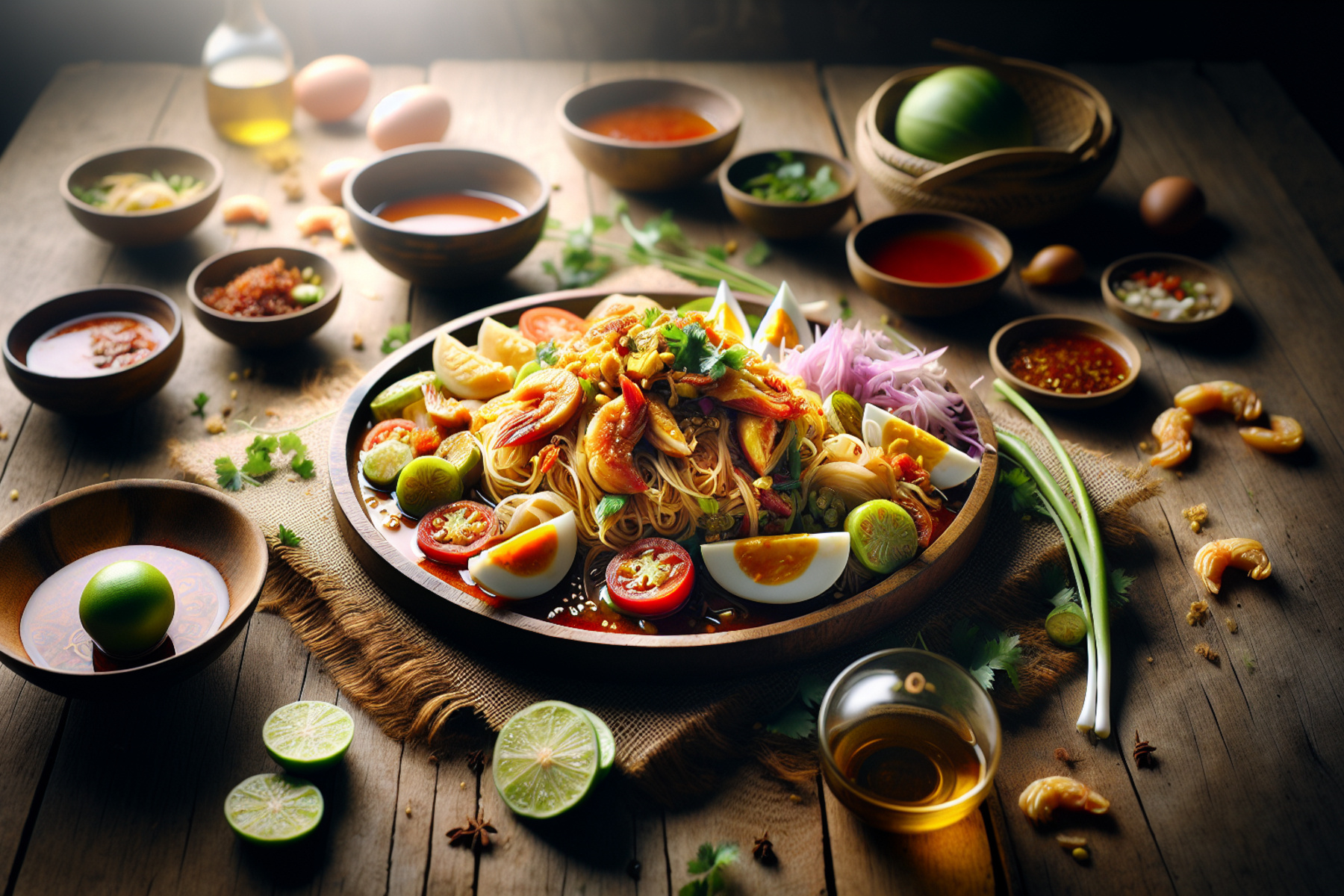
Lahpet thoke — fermented tea leaf salad
The national salad · a dish and a ceremony · serves 4 · 15 minutes plus sourcing
Ingredients: 4 tbsp lahpet (pickled tea leaves, from a Burmese or Thai grocer or online); 3 tbsp fried broad beans; 3 tbsp roasted peanuts; 2 tbsp fried yellow split peas; 1 tbsp toasted sesame seeds; 4 cloves garlic, thinly sliced and fried crisp; 2 tbsp garlic oil from the frying; 1/4 small cabbage, finely shredded; 2 tomatoes, diced; 2 green chillies, sliced; juice of 1–2 limes; 1 tbsp fish sauce; dried shrimp, optional
Method: If your lahpet is strongly bitter, rinse it briefly and squeeze it dry. Arrange it in a mound in the centre of a round plate and set the beans, peanuts, split peas, sesame, fried garlic, cabbage and tomato around it in separate piles — the presentation is half the dish. At the table, pour over the garlic oil, lime juice and fish sauce, add the chilli, and toss everything together thoroughly with the hands or two spoons until every leaf is coated and the whole thing is uniform.
💡 There is no substitute for lahpet. Green tea leaves will not do it — the flavour is a genuine lactic fermentation, sour and savoury and slightly astringent, and the salad is built around it. It is also strongly caffeinated: this is a stimulant that happens to be a salad.
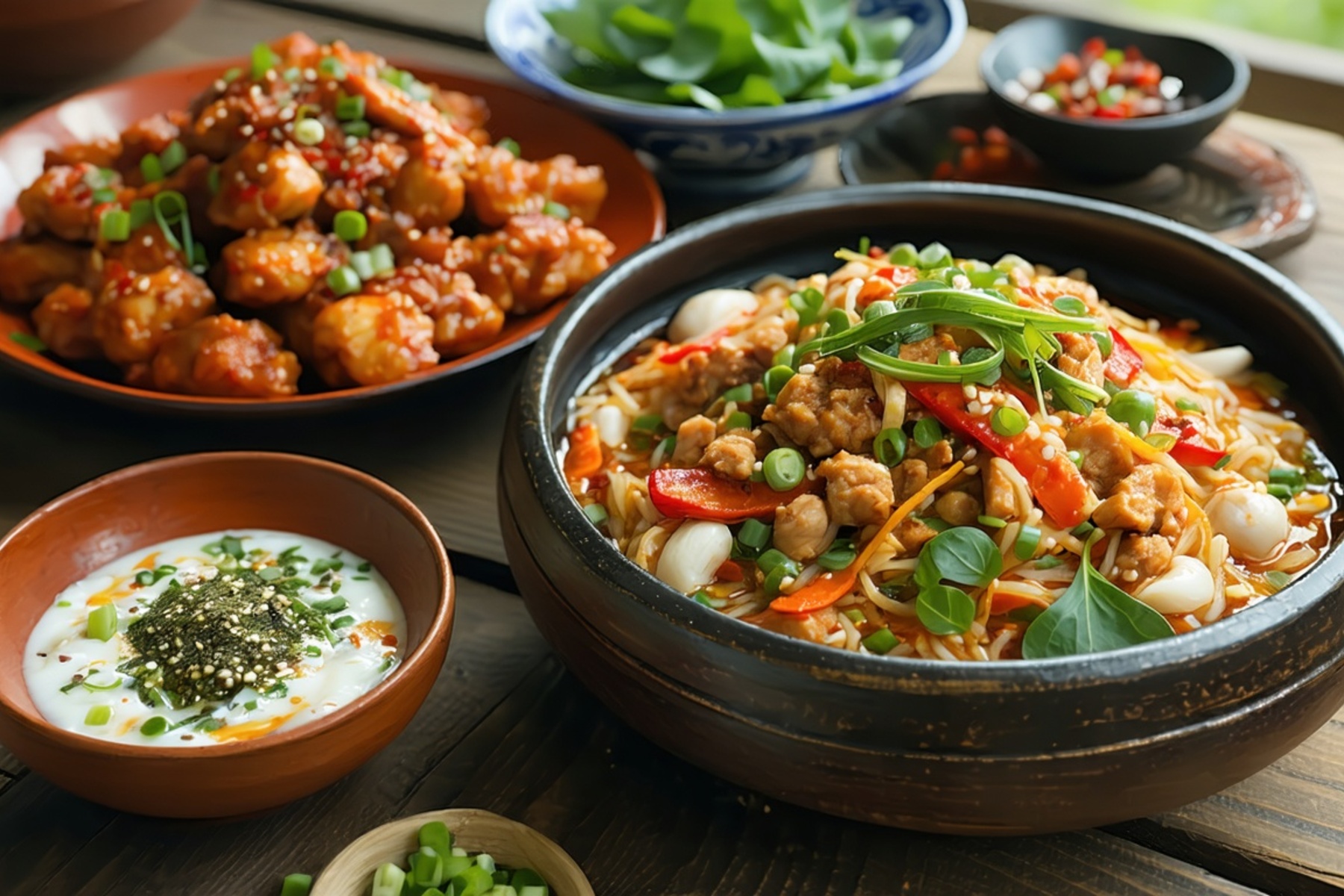
Ohn no khao swè — coconut chicken noodles
Lunch, and the dish most visitors miss afterwards · serves 4 · 45 minutes
Ingredients: 600 g chicken thighs, boned and cut into bite pieces; 400 ml coconut milk; 700 ml chicken stock; 400 g fresh wheat egg noodles; 1 large onion; 5 cloves garlic; 3 cm ginger; 1 tsp turmeric; 1 tsp paprika; 3 tbsp chickpea (gram) flour; 2 tbsp fish sauce; 4 tbsp peanut oil; a handful of the noodles deep-fried for the topping; to serve — boiled eggs, coriander, sliced red onion, lime, chilli flakes
Method: Blend onion, garlic and ginger to a paste. Fry it in the oil with the turmeric and paprika over a medium heat until the oil separates, about 10 minutes. Add the chicken and turn it in the paste for 5 minutes, then add the stock and simmer 20 minutes. Whisk the chickpea flour into the coconut milk until smooth, pour it in, and simmer gently another 10 minutes — do not let it boil hard or it will split. Season with fish sauce. Serve over boiled wheat noodles with egg, coriander, raw onion, lime, chilli and a generous handful of the crisp fried noodles.
💡 Fry a small nest of the raw noodles in hot oil until golden and drain them on paper. It takes two minutes and it is the difference between the real dish and a coconut chicken soup.
🍺 Tea Shops, Lahpet Yay and Myanmar Beer
The tea shop is the central social institution of Burmese life — low stools, a tin table, a pot of free weak green tea and a glass of something sweet — and it is where you should spend a good portion of any visit, because it is where everything is discussed and where the food is cheapest and best.
Lahpet yay
Burmese milk tea: strong black tea with condensed and evaporated milk, ordered by sweetness and strength — cho bawk less sweet, kyauk padaung strong and sweet. It arrives with a pot of free plain green tea (yay nway jan) that is refilled indefinitely and costs nothing. You can sit in a tea shop for two hours on a single order and nobody minds.
What to eat with it
Samosas and samosa salad, e kya kway (Chinese fried dough) for dipping, nan bya flatbread with pea curry, mont lin ma yar ("husband and wife snack", batter balls with quail egg), and steamed sticky rice parcels. Burmese tea-shop snacking is heavily Indian and Chinese-influenced and it is very good.
Myanmar Beer
The dominant lager, a decent unremarkable pale lager, produced by a brewery long part-owned by the army conglomerate MEHL — which is why Kirin withdrew from the joint venture after the coup and why some visitors deliberately avoid it. Dagon, Andaman Gold, Mandalay and ABC stout are alternatives; the Dagon and Mandalay brands have their own ownership questions. There is no perfectly clean beer in Myanmar.
Toddy
Htan yay, palm toddy, tapped from the sugar-palm and drunk fresh and sweet in the morning or fermented and sour by the afternoon. The dry zone around Bagan is toddy country — climbers go up the palms at dawn, and the palm-sugar jaggery and toddy sweets sold beside the road are a local speciality. Htan yay gyi, the distilled version, is strong and rough.
Shan and rice spirits
Rice and millet wines in the Shan and Kachin hills, often home-made, often drunk from a communal jar through straws at festivals. Quality is entirely unpredictable and the strong stuff should be treated with respect. Commercial Myanmar rum (Mandalay Rum) exists and is cheap.
Non-alcoholic
Fresh sugarcane juice pressed at the roadside, lime soda, avocado shakes in the hills, and coconut water on the coast. Tap water is not drinkable; bottled is everywhere and cheap, and the big clay pots of drinking water set out beside roads for travellers are a charitable institution (a merit-making act) that is safe for locals and not recommended for visitors.
🍷 Myanmar Makes Wine, and It Is Better Than You Expect
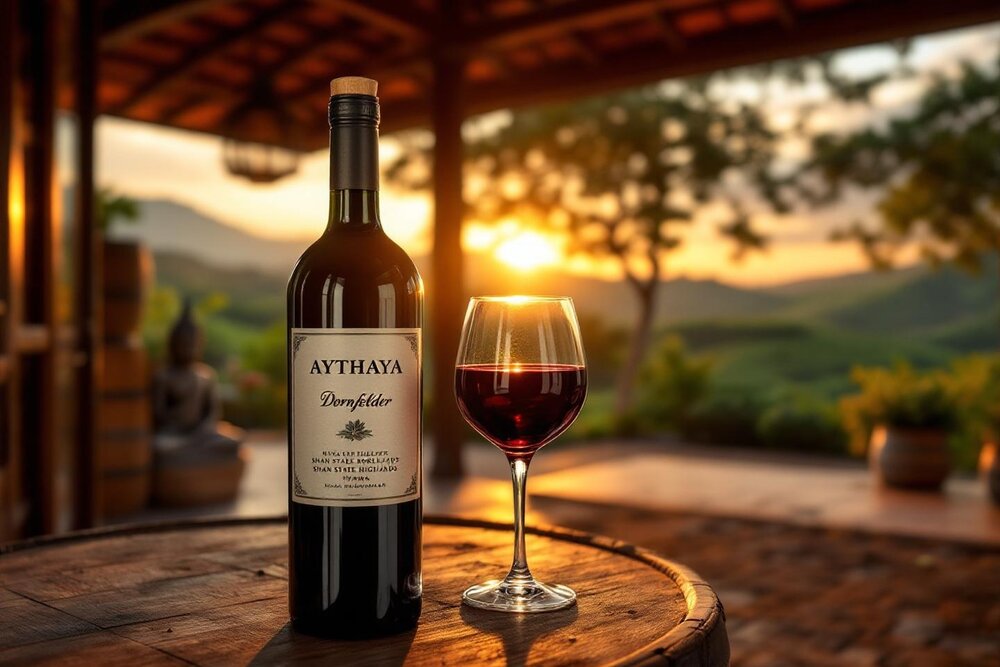
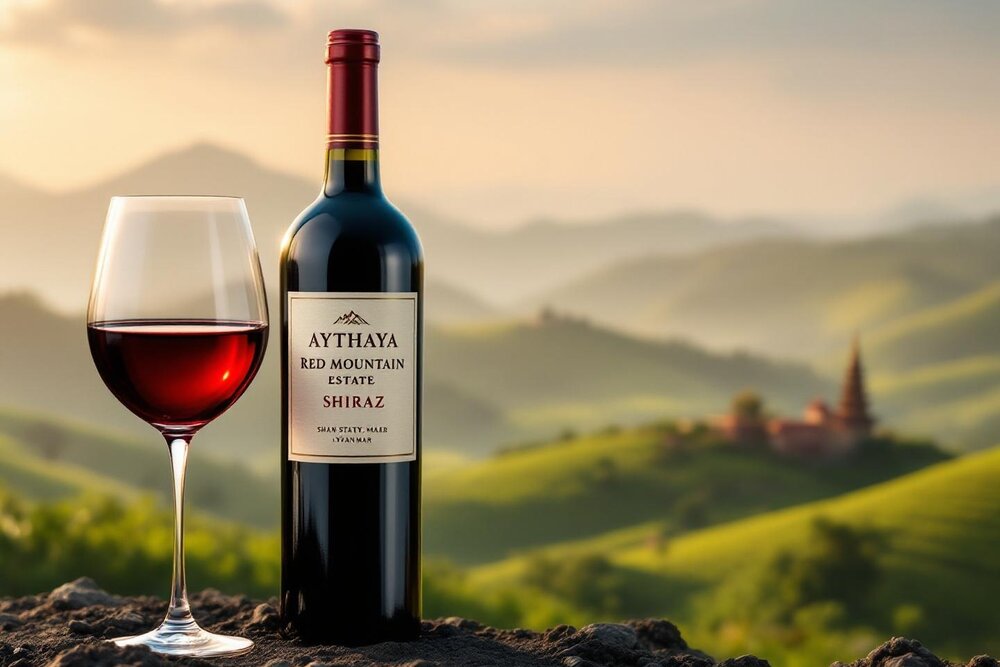
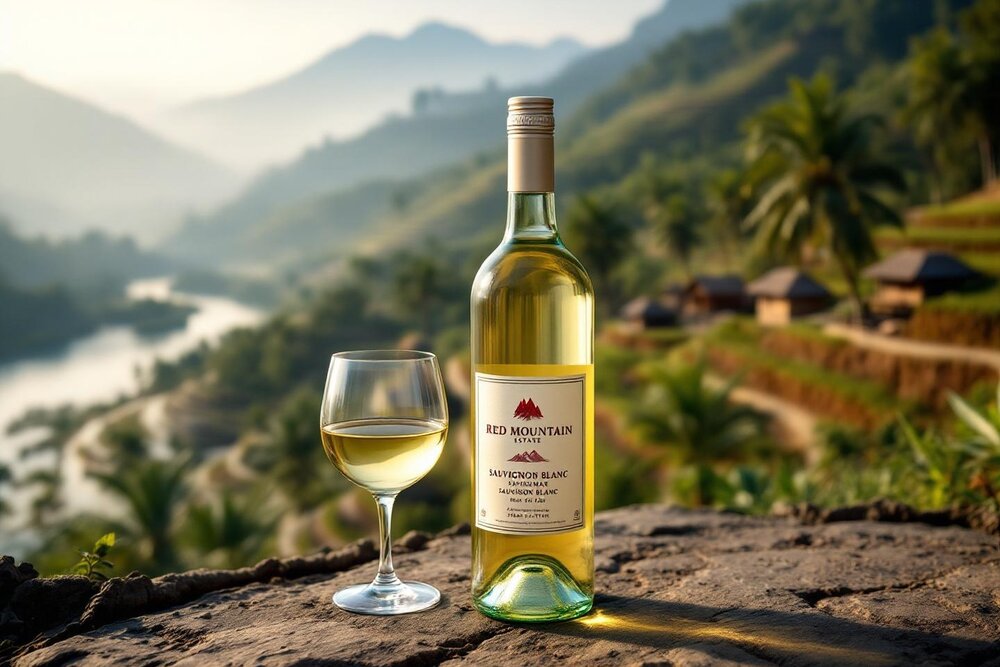
This is the genuine surprise of the country. At about 1,200 m on the Shan Plateau near Taunggyi, in a latitude that should make viticulture impossible, two estates have been making perfectly serious wine since the turn of the century. The altitude gives cool nights, the monsoon pattern gives a dry harvest window, and the result is a small wine industry nobody outside Myanmar has heard of.
Why it works at all
Latitude 20° N should be hopeless for Vitis vinifera. What makes it possible is altitude — around 1,200 m, giving a diurnal swing that preserves acidity — plus a monsoon that delivers its rain well before harvest, and limestone soils. The vines are trained high and the canopy is managed for airflow, because fungal pressure in that climate is the real enemy.
How to visit
Both estates are near Taunggyi and are usually done as a half-day from Nyaungshwe at Inle Lake, by taxi or scooter. Both have tasting rooms and restaurants with terraces over the hills, and both are used to visitors. It is one of the most pleasant and least expected afternoons the country offers — subject, like everything else, to the current security situation in Shan State.
Is it good?
Honestly: the whites are better than the reds, the Sauvignon Blanc and the late-harvest are the ones worth carrying home, and nothing here is competing with the Loire. But it is real wine, competently made, from grapes grown a few kilometres away, in a country where almost no institution works. Judged on that, it is remarkable.
The rejected map
There is a tenth image in this country's folder — myanmar-wine-regions-map.jpg, an "antique" map of the wine regions — and it is not used on this page. It labels the Andaman Sea as the "Atlantic Ocean", gives a scale bar reading "0 25 50 50 km", renders Taunggyi as "Lniera (Taunggy)", puts Yangon in the wrong place and draws a coastline that is not Myanmar's. A decorative map that invents an ocean is not decoration, it is misinformation, and it was rejected. The full reasoning is in the gallery.
The trade problem
Neither estate exports meaningfully. Sanctions, banking restrictions, freight costs and the sheer difficulty of doing anything commercial in Myanmar mean that in practice the only way to drink these wines is to be in the country, or occasionally in Bangkok or Singapore. Production has also been hit by the war, fuel costs and the collapse in tourism.
What to drink instead
If you are eating Burmese food and want something to drink with it, the honest answer is usually beer or the green tea. The salads and the ngapi are hard on wine, and the fried-oil base of the curries wants something cold and simple. Keep the Sauvignon Blanc for the terrace at the winery, which is where it makes complete sense.
💎 Jade, Rubies, Opium and the Economics of the War
Myanmar's wars are not funded by ideology. They are funded by things that can be dug out of the ground or grown on a hillside and carried across a border in the dark, and any account of the conflict that leaves out the money leaves out the mechanism.
Jade
Myanmar produces the overwhelming majority of the world's imperial jadeite, almost all of it from Hpakant in Kachin State. Global Witness put the value of a single year's production at up to $31 billion — around half of official GDP at the time — with almost none of it reaching the state budget. Control of the mines is a central war aim for both the army and the KIA, and most of the stone goes straight to China.
Rubies
The Mogok valley produces the finest rubies in the world — the "pigeon's blood" stones that set auction records — along with sapphires and spinel. The trade is opaque, the labour conditions are poor, and US import bans on Burmese rubies have been in place at various times since 2003. If you are offered a spectacular stone at a market price, it is either not what it is claimed to be or its provenance will not bear examination.
Opium and heroin
The Golden Triangle — Shan State with Laos and Thailand — was the world's principal heroin source for decades. Cultivation fell sharply in the 2000s and then rose again after the 2021 coup, with the UNODC reporting Myanmar back at or near the top of global opium production as farmers with no other cash crop and no functioning state returned to poppy.
Methamphetamine
The bigger story now. Shan State is one of the largest producers of crystal meth and yaba tablets on earth, made in industrial quantities from imported precursors and shipped across Asia and the Pacific. It needs no farmland and no season, and it has largely displaced heroin as the region's major criminal income.
Timber, gas and rare earths
Burmese teak is prized and heavily illegally logged. Offshore gas — the Yadana and Shwe fields — supplies Thailand and China and is one of the junta's largest sources of hard currency, which is why sanctions campaigners have targeted it. Since 2021 Kachin State has become a major source of heavy rare earths for China, mined with leaching chemicals in conditions that are wrecking the watersheds.
Who takes the cut
Every armed actor. The army's conglomerates MEHL and MEC hold stakes across mining, banking, beer, tobacco and telecoms. Ethnic armed organisations tax what crosses their territory. Border militias run the casinos and, now, the scam compounds. This is why ceasefires do not hold — the fighting is not only about politics, and in several places it is not mainly about politics.
🤔 Should You Go at All? An Honest Answer
Most country guides skip this. Myanmar is the case where it cannot be skipped, because there is a real argument on both sides and a reader deserves to see it rather than be nudged toward whichever conclusion is more comfortable.
The case against
Your visa fee, airport tax, archaeological zone fees and hotel licensing reach a government that seized power by force, has killed thousands of civilians, bombs schools and clinics, and is the subject of an ICC prosecutor's arrest-warrant application. The NUG and many exiled activists ask visitors to stay away, and the argument that tourism confers normality on an illegitimate government is not a weak one.
The case for
Tourism employed hundreds of thousands of people — guides, drivers, cooks, boatmen, hotel staff, craftspeople — and its collapse has ruined them. Many inside the country say plainly that they want visitors back, and that being seen and talked to matters. Arrivals collapsed from about 4.3 million in 2019 to a small fraction of that, and the people who lost those jobs are not the generals.
The honest position
Both things are true and they do not resolve into a clean answer. What can be said without hedging: if you go, go with your eyes open — knowing what you are funding, choosing where your money lands, and not treating the country as a backdrop. If that sounds like too much work, that is itself a reasonable reason not to go.
If you do go
Use locally owned guesthouses rather than the military-linked hotel chains; hire independent guides and drivers directly and pay them properly; eat in family restaurants; buy crafts from the people who made them. Avoid government hotels, the army's beer and telecom brands where you have a choice, and anything operated by MEHL or MEC. The difference between a well-chosen and a careless trip is most of the money.
What not to do
Do not photograph soldiers, police, checkpoints or protests. Do not post photographs of people you have talked to politics with — you leave, they do not. Do not ask locals about the junta in public places or in the hearing of others; let them raise it if they want to. Do not travel to conflict areas to see a conflict. And do not put your guide in a position where refusing you is risky for them.
Where it stands in 2026
The main circuit — Yangon, Bagan, Mandalay, Inle — is functioning and is described as stable by tour operators, and the e-visa works. At the same time the Czech Ministry of Foreign Affairs and the Czech embassy in Yangon advise against travel to Myanmar, in line with most Western governments. Those two statements are both accurate and you should weigh the second more heavily than an operator's marketing.
📋 Practical — Visas, Money, Flights and the Things That Catch People Out
The e-visa
Applied for online, currently around $50 for a 28-day single-entry tourist visa, usually issued within a few working days. It is valid for entry by air only, and in practice through Yangon International Airport. Print the approval letter; do not rely on showing it on a phone.
Land borders are closed
The land crossings with Thailand, India, China and Laos are closed to foreigners and have been since 2020. The old Mae Sot, Tachileik and Tamu crossings and the India overland route are not options. Anyone telling you otherwise is working from pre-pandemic information.
Cash, and only cash
This is the single most important practical fact. International cards do not work — Myanmar is cut off from Visa and Mastercard networks, ATMs will not serve foreign cards, and there is no way to get money once you are inside. Bring all the money you need in cash US dollars, in notes that are new, unfolded, unmarked and unstained, ideally 2013-series or later. A crease or a pen mark will get a note refused.
Exchange rates
There is an official rate and a much weaker parallel rate, and the gap has been large and volatile. The kyat appreciated roughly 15% against the dollar by January 2026 after tighter controls. Change money at licensed dealers or your hotel rather than on the street, expect the rules to have changed since anything you read, and never hand notes over before you have the kyat in your hand.
Getting there
There is no direct flight from Europe. The normal routings are via Bangkok (Thai Airways, Myanmar Airways International, Myanmar National Airlines), Singapore, Kuala Lumpur or Doha to Bangkok and onward. From Prague, expect one or two stops and somewhere around 18–26 hours door to door depending on connection.
Internet and phones
Local SIMs are cheap and coverage is decent in the main towns. Expect blocks on Facebook, Instagram, WhatsApp and VPNs, periodic mobile-internet shutdowns in conflict areas, and a VPN law that in principle criminalises using one. Download offline maps and anything you need before arriving. Assume your connection is monitored and do not do anything on it you would not do in public.
When to go
November to February — cool, dry, and by far the best conditions, which is why it is also the busiest and priciest window. March to May is punishingly hot in the dry zone, with Bagan and Mandalay routinely above 40 °C. June to October is the monsoon: the coast and delta are drenched, but Bagan stays relatively dry and the country is green and empty.
Health
No compulsory vaccinations for direct arrivals, but hepatitis A and B, typhoid, tetanus, rabies and Japanese encephalitis are all worth discussing with a travel clinic. Malaria is present in rural and border areas; dengue is present everywhere, including cities, and there is no prophylaxis for it — use repellent day and night. Drink only bottled or treated water.
Medical care
This is the serious one. The health system was broken by the CDM, the war and the earthquake, and serious illness or injury means evacuation to Bangkok. Take insurance that explicitly covers medical evacuation from Myanmar and check that it does not exclude countries under a government travel warning — many standard policies do, which would leave you uninsured for the whole trip.
Etiquette
Shoes and socks off at every pagoda, temple and monastery — including the whole platform, not just the shrine — and this is enforced without exception. Cover shoulders and knees. Never point your feet at a Buddha image or a person, never touch anyone's head, and hand things over with the right hand supported at the elbow by the left. Do not touch monks if you are a woman, and do not hand things directly to them.
Photography
Ask before photographing people, especially monks and nuns, and accept a refusal cheerfully. Never photograph military personnel, police, government buildings, checkpoints, bridges or airports — this is the thing most likely to get a foreigner into genuine trouble, and the tolerance for it since 2021 is zero.
Getting around
Domestic flights connect Yangon, Mandalay, Bagan, Heho (for Inle) and Thandwe (for Ngapali), and are the normal way to cover distance, though schedules are unreliable and safety records are uneven. Overnight buses on the Yangon–Mandalay expressway are good and cheap. The trains are slow, scenic and famously rough, and the Goteik viaduct ride is memorable if the line is running.
🇨🇿 For Czech Travellers
MZV ČR advice
The Czech Ministry of Foreign Affairs and the Czech embassy in Yangon warn against travel to Myanmar because of the security situation and the ongoing civil war. This is a standing warning, not a regional one, and it has direct consequences for insurance. The MZV country page is the thing to check immediately before booking anything, because conditions and curfews change.
The Czech embassy in Yangon
The Czech Republic has a full embassy: No. 109/B2, Aung Taw Mu Lane, Than Lwin Road, Bahan Township, 11041 Yangon, tel. +95 123 061 74–76, Yangon@mzv.gov.cz, consular section Yangon.Consulate@mzv.gov.cz. The MZV's round-the-clock emergency line is +420 222 420 222. Having an embassy in the country is unusual for Czechia in this part of the world and is worth knowing about.
DROZD
Register the trip in DROZD (drozd.mzv.cz) before you leave. This is standard advice everywhere and it is not standard here — in a country with a live conflict, closed borders, a broken health system and periodic internet shutdowns, DROZD registration is the mechanism by which the embassy knows you exist. Do it.
Visas and entry
Czech citizens use the same e-visa as everyone else — about $50, 28 days, air entry via Yangon only. Passport valid at least six months beyond arrival. There is no visa on arrival for tourism and no land entry. Health insurance including Covid-19 cover and a health declaration on arrival have been required.
Insurance — read the exclusions
Most Czech travel policies exclude countries where the MZV advises against travel, or exclude war and civil unrest. Since Myanmar is under exactly such a warning, a standard policy may pay nothing at all. You need a policy that names Myanmar as covered and that includes medical evacuation, and you may need a specialist provider. Check this in writing before you buy the flight, not after.
Getting there from Prague
No direct route. Practical options are Prague–Doha–Bangkok–Yangon with Qatar Airways, Prague–Istanbul–Bangkok with Turkish, or via Singapore or Kuala Lumpur. Budget roughly 25,000–40,000 Kč return depending on season and how far ahead you book, plus the domestic flights inside Myanmar, which must generally be arranged locally in cash.
Money for Czech travellers
Take US dollars in cash, obtained in Czechia before departure — crisp, unmarked, large denominations get better rates. Do not plan on using a Revolut or a Czech bank card anywhere in the country; they will not work. Budget the entire trip in advance including the emergency margin, because there is no way to top up once you are inside.
Rough costs
Myanmar is cheap when you are there. A good guesthouse 500–1,200 Kč a night, a proper meal in a local restaurant 60–150 Kč, a tea shop breakfast under 40 Kč, an e-bike for a day in Bagan around 150 Kč, a domestic flight 2,000–3,500 Kč. The Bagan zone fee is about 25,000 kyat and the Inle zone fee around 15,000 — both go to the government.
Language
Burmese, in its own round script, is not related to anything a Czech speaker will recognise and is tonal. English is reasonably widespread in the tourist trade and among older educated people, much less so elsewhere. Mingalaba (hello), kyay zu tin ba de (thank you), hote ke (yes), ma hote bu (no). Numbers written in Burmese numerals will catch you out on price tags.
Time and practicalities
Myanmar is UTC+6:30 — one of the few half-hour offsets in the world, 4.5 hours ahead of Czech summer time and 5.5 ahead in winter. Plugs are a mix of types C, D, F and G at 230 V, so a universal adapter is needed. Power cuts are frequent and long; a decent power bank is not optional.
Czech-relevant history
Czechoslovakia had a genuine relationship with Burma — Škoda and Zbrojovka supplied it in the 1950s, and a Czechoslovak-built arms plant near Rangoon became part of the Burmese defence industry. Czechoslovakia was also among the countries that armed the early Burmese army. It is an uncomfortable footnote and it is real.
If something goes wrong
Contact the embassy in Yangon first; the MZV emergency line +420 222 420 222 operates around the clock. For anything medical and serious, the realistic plan is evacuation to Bangkok — Bumrungrad and Samitivej are the hospitals evacuation companies use. Keep a scan of your passport and visa in offline storage, and keep enough cash separate from the rest to buy a flight out.
📸 Gallery — Ten Files, Nine Used, One Rejected
The image inventory for this country comes from an authoritative S3 ListObjectsV2 listing, not from guessing filenames. There are ten files relating to Myanmar. Every one was downloaded and looked at, and every one is a genuine JFIF JPEG — the first country in this series with no format mismatch at all. Nine are used on this page. One was rejected, and it represents a new category of fault.
The rejected file — a fabricated map
images/myanmar/myanmar-wine-regions-map.jpg is an "antique" map of Myanmar's wine regions and it is comprehensively wrong. It labels the Andaman Sea as the "Atlantic Ocean". Its scale bar reads "0 25 50 50 km". Taunggyi is rendered as "Lniera (Taunggy)". The country outline is not Myanmar's and Yangon is in the wrong place. A decorative bottle label that invents a word is a curiosity; a map that invents an ocean is misinformation, because a map is read as a statement of fact. Rejected.
A new category of fault
This is worth recording as a distinct finding. Across this series the faults so far have been generic placeholders (Mozambique's "stew"), wrong dishes under right names (Montenegro's pršut), format mismatches (WebP as .jpg), mangled-diacritic duplicates (Moldova's three mămăligă files) and fabricated Wikimedia hotlinks (Montserrat and four others). A plausible-looking map with fabricated geography is a sixth kind, and it is the most dangerous, because it is the one a reader would most readily believe. Mongolia and Montenegro both have a *-wine-regions-map.jpg in the same template family — those should be re-examined.
The other seven used files
countries/images/myanmar/hero.jpg — the wide misty Bagan plain, used at the top of the overview. Three accurate recipe photographs: recipes/myanmar-mohinga.jpg, recipes/myanmar-lahpet-thoke.jpg and recipes/myanmar-ohn-no-khao-swe.jpg, all three of which match the dishes they are named for — the mohinga has its fritter and egg, the lahpet thoke is correctly laid out in segments. And three wine bottle shots used in the wine section.
On the wine images
Unusually, these are on-topic: Myanmar really does have two wineries in the Shan hills, Aythaya really does grow Dornfelder and Shiraz, and Red Mountain really does make a Sauvignon Blanc. The images are generated and their label text should not be read as authentic, but the premise is sound, which cannot be said of most generated content in this collection. They are used with that caveat stated in the captions.
What is missing
There is no picture of the Shwedagon, none of Yangon at all, none of Mandalay or Sagaing, none of Inle Lake or the leg-rowers, none of thanaka or a longyi, and no photograph of a single human being. For a country whose defining images are a gilded stupa, a fisherman balanced on one leg and a child with painted cheeks, the collection contains none of them. Six of the ten files are alcohol. The text has to carry all of that alone and should be read knowing it.
Method
Nothing appears on this page that was not opened and looked at first. Where a picture is good it is used and said to be good; where a caption cannot be supported — the unlabelled beer bottle — the page says less rather than inventing more; and where a file actively misinforms, it is rejected and the rejection is recorded here rather than quietly dropped. That is the standard applied across this series, and this is the first country where it turned up a fake map.
Support This Project 🌍
This World Travel Factbook is a labor of love – free to use for all travelers. If you find it helpful, consider supporting its continued development.