🎯 Why Chile — The Short Version
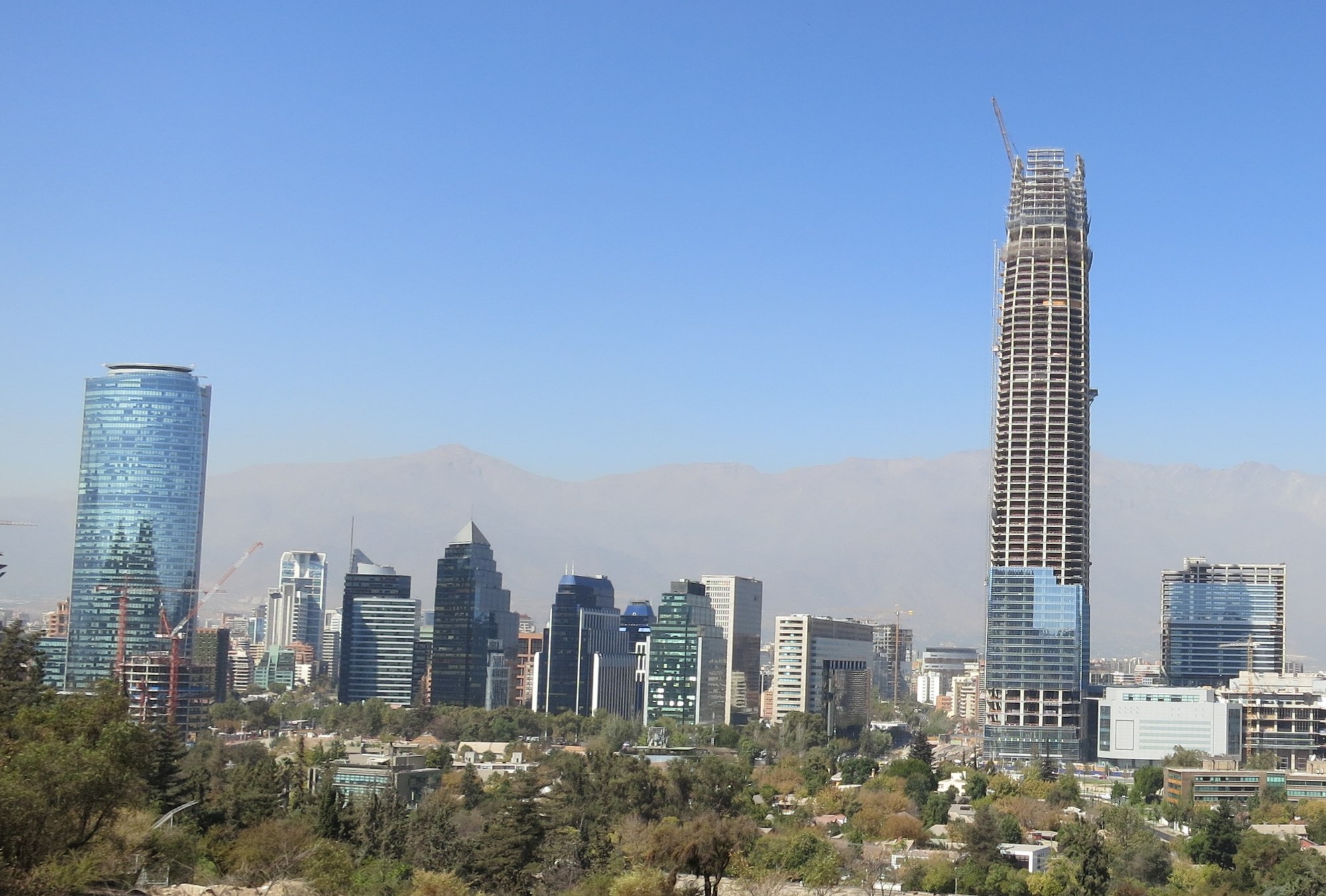
Photo: Kyle Pearce / Wikimedia Commons, CC BY-SA 2.0
If South America intimidates you, Chile is where you start. For three decades it has quietly run the most predictable economy on the continent: low corruption, enforceable contracts, an independent central bank, and a currency that doesn't evaporate overnight. The World Bank and OECD consistently rank it Latin America's easiest place to do business, and it shows — this is the one country in the region where a foreigner can own a company outright, sign digitally from abroad, and expect the tax office to actually process paperwork on schedule.
The engine underneath is copper — Chile digs up more of it than any nation on Earth — but the story in 2026 is diversification: lithium (the "white gold" of the EV battery boom), salmon farming, wine, fruit exports, fintech, and a data-center gold rush as global tech giants chase Chile's cheap solar power. Real GDP growth has settled into a steady 2–2.5% band, unspectacular but bankable.
Foreign ownership
Permitted in almost every sector, with minimal restrictions — rare in Latin America.
To incorporate
From drafting documents to receiving your tax ID (RUT), under normal conditions.
Minimum capital
No minimum capital requirement for the most common company structures.
🚀 How to Start a Company — Step by Step
Chile's flagship vehicle for foreigners is the SpA (Sociedad por Acciones) — a simplified stock company that needs only one shareholder, allows 100% foreign ownership, has no board requirement, and lets you transfer shares easily. Think of it as Chile's answer to the Delaware LLC, purpose-built for founders chasing outside investment. The older SRL (Sociedad de Responsabilidad Limitada) works like a U.S. LLC but needs two-plus partners and unanimous consent to move shares; the S.A. is the heavyweight corporation for larger operations. For most American founders, the SpA is the answer.
- Draft the articles of incorporation. For an SpA these can be short — no board, flexible rules. Digital signatures have been legally recognized since 2025, so remote setup from the U.S. is genuinely possible.
- Register the company in the electronic commercial registry.
- Obtain your RUT (Rol Único Tributario) from the SII, Chile's IRS. This tax ID is mandatory before you can invoice or bank; it typically clears in up to three business days.
- Open a corporate bank account. Budget 2–4 weeks — Chilean banks run strict AML/KYC checks, especially on foreign shareholders.
- Register for VAT and payroll where applicable, and secure a Chilean fiscal address for legal correspondence.
American reality check: foreign direct investments above USD 5 million fall under specific regulatory frameworks. And note a 2026 labor shift — the standard legal workweek dropped to 42 hours in April 2026 (heading to 40 by 2028), with no pay cut allowed, so model your shift structures accordingly.
🌱 Start-Up Chile — Free Money for Founders
Here's Chile's not-so-secret weapon, and the reason it punches far above its weight in Latin American tech: Start-Up Chile, the government accelerator run by the development agency CORFO. It hands out equity-free grants plus a two-year startup visa — one of the most accessible on-ramps for foreign founders anywhere in the world. You give up no ownership; the state is simply buying ecosystem density.
BUILD
Idea to prototype stage.
IGNITE
For teams with a working MVP.
+ Visa
Startup visa bundled with the grant.
The Kaufmann take: no serious founder builds a company because of a grant, but a no-strings check and a legal runway to live in Santiago for two years is about as founder-friendly as government programs get. It's why the Chilean capital hums with expat entrepreneurs.
📈 The Bolsa de Santiago
Chile's stock market — the Bolsa de Comercio de Santiago — was founded in 1873 and is the beating heart of South America's most sophisticated capital market. The floor still exists, but everything trades electronically now. Roughly 180–280 companies are listed depending on how you count, and the benchmark IPSA index tracks the 40 most-traded names.
For an American investor, the crucial detail is access: many blue-chip Chilean names cross-list as ADRs on the NYSE, so you can own a slice of Chilean copper or lithium without ever opening a Santiago brokerage account. The exchange also plugs into MILA (the Integrated Latin American Market linking Chile, Peru, Colombia, and Mexico), and in 2026 launched "ScaleX" with CORFO to give high-growth startups a public-market path.
Founded
One of the oldest exchanges in Latin America.
Benchmark index
Tracks the 40 most-traded Chilean stocks.
U.S. access
Buy top Chilean names as ADRs in New York.
🏢 The Giants — Who Runs Chilean Business
Chilean capitalism is famously concentrated: a handful of conglomerate dynasties — the Luksic, Angelini, Matte, and Solari families — sit behind a striking share of the market. Understanding the country's business means knowing these names and the flagships they control.
| Company | Sector | Why it matters | U.S. access |
|---|---|---|---|
| SQM | Lithium & specialty chemicals | A global lithium heavyweight — the EV-battery play | NYSE ADR (SQM) |
| Banco de Chile | Banking | One of the largest, most profitable banks in Chile | NYSE ADR (BCH) |
| Falabella | Retail | Latin America's retail titan — stores, Sodimac, banking | Bolsa de Santiago |
| Empresas Copec | Energy & forestry | Angelini-controlled — fuel stations + global pulp (Arauco) | Bolsa de Santiago |
| LATAM Airlines | Aviation | The continent's dominant airline group | NYSE (LTM) |
| Cencosud | Retail | Supermarkets & malls across Latin America | Bolsa de Santiago |
| Codelco | Copper mining | State-owned — the world's largest copper producer | State enterprise (bonds) |
Codelco deserves its own line: owned by the Chilean state, it is the single largest copper producer on the planet, and its output quietly underwrites the national budget. When copper prices move, Chile's economy — and its currency — moves with them.
✍️ The Kaufmann Bottom Line
Chile won't dazzle you with explosive growth or a billion-consumer market — that's not the pitch. The pitch is boring in the best way: a place where the rules hold, the courts work, your shares are yours, and a foreign founder is treated as an asset rather than a suspect. For an American entrepreneur testing Latin America, it is the softest possible landing — a stable base camp from which to reach the harder, larger markets to the north. Start in Santiago, learn the terrain, then climb.
Business conditions, tax rules, and grant amounts change. Figures reflect 2026 reporting; verify current requirements with the SII, CORFO, and a Chilean attorney before incorporating. Last checked: August 2026.
