

🌍 Ceuta at a Glance
🌏 Overview
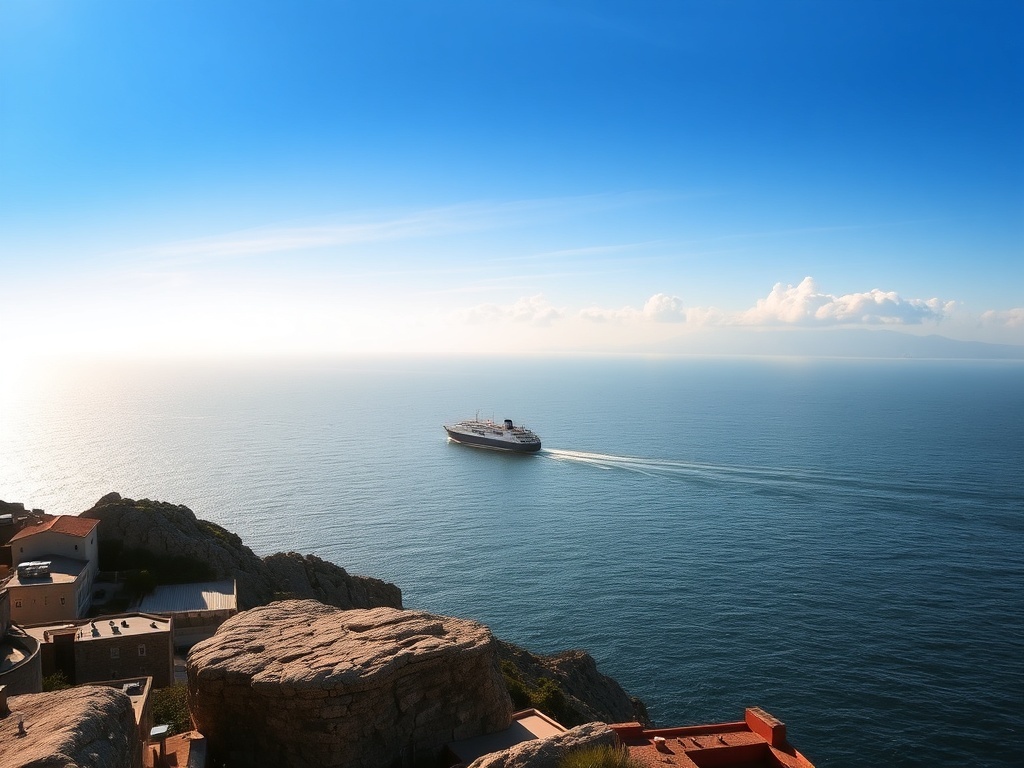
Standing at the Mirador San Antonio atop Monte Hacho, you can see two continents simultaneously—the rugged coast of Morocco stretching south, the distant silhouette of Gibraltar and mainland Spain to the north, and the Mediterranean meeting the Atlantic in the legendary Strait below. This is Ceuta, a Spanish autonomous city perched on the African coast, where Europe and Africa exist in perpetual dialogue across just 14 kilometers of water.
Ceuta occupies a narrow peninsula jutting into the Mediterranean, connected to the Moroccan mainland by an isthmus guarded by massive 16th-century fortifications. Ceuta is administered by Spain as an autonomous city and is part of the European Union, uses the euro, and has Spanish as its official language. Morocco disputes Spanish sovereignty over Ceuta. Yet the muezzin's call mingles with church bells, Arabic and Spanish flow interchangeably in the markets, and the cuisine blends paella with couscous.
For over 600 years, Ceuta has been European—first Portuguese, then Spanish. The massive Royal Walls that protected the city through a legendary 30-year siege still stand sentinel over the harbor. The Cathedral of St. Mary of the Assumption rises from Plaza de África, named not for the continent it sits upon but for the patron Virgin who, legend holds, protected the city through countless battles. This is a place where history isn't confined to museums but lives in every fortified wall, every watchtower, every narrow street within the old quarter.
🏷️ Name & Identity
The name "Ceuta" derives from the Latin "Septem" (seven), referring to the seven hills of the peninsula—or perhaps the seven brothers (Septem Fratres) who according to legend founded the ancient settlement. In Arabic, the city is known as "Sabta" (سبتة), and this Moorish name persisted through eight centuries of Islamic rule before the Portuguese conquest in 1415.
Today, Ceuta holds the official title "Ciudad Autónoma de Ceuta" (Autonomous City of Ceuta), one of only two such territories in Spain alongside Melilla further east along the African coast. The city earned the honorific "La Muy Noble, Leal, y Fidelísima" (The Most Noble, Loyal, and Most Faithful) for choosing to remain Spanish when Portugal regained independence in 1640.
The identity question in Ceuta is nuanced rather than contested. Unlike other territorial enclaves, there is no significant independence movement—the population overwhelmingly identifies as Spanish. Yet this is a distinctly multicultural Spanish identity. Roughly half the population is Christian and half Muslim; there are small but historic Jewish and Hindu communities. Spanish dominates public life, but Darija (Moroccan Arabic) echoes through neighborhoods and markets.
Morocco does not recognize Spanish sovereignty over Ceuta and claims the city. Spain rejects that claim and regards Ceuta as an integral part of Spanish territory. The sovereignty dispute is a diplomatic issue distinct from the day-to-day experience of most visitors.
🗺️ Geography
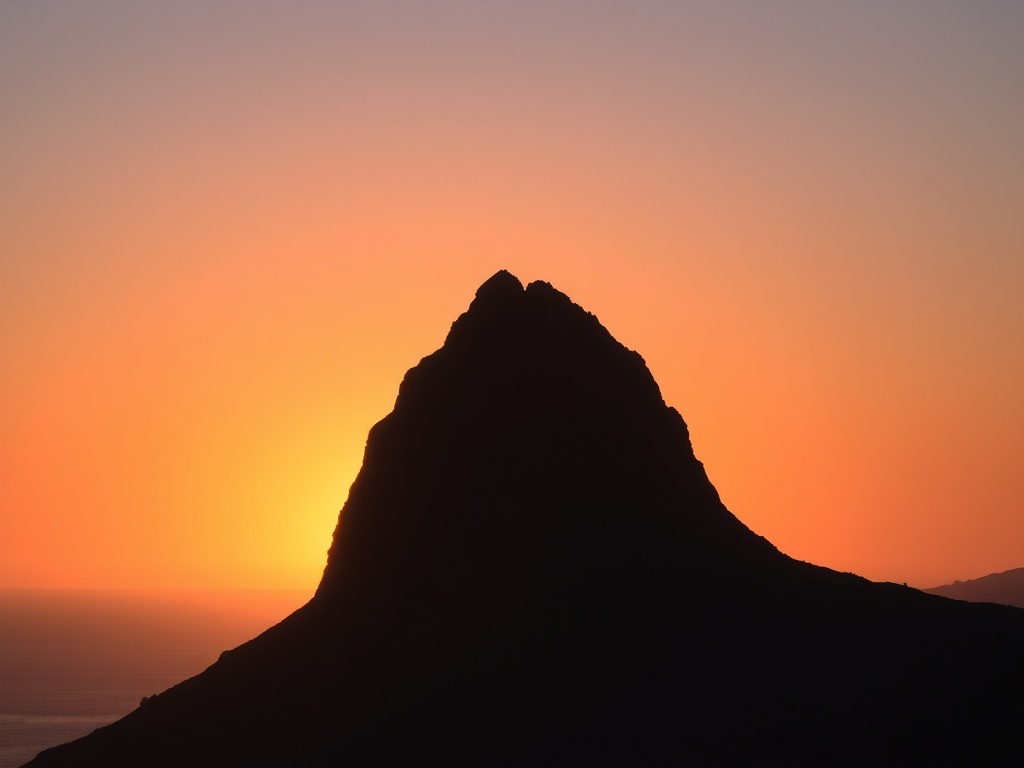
Ceuta occupies just 19 square kilometers of the Almina peninsula, making it one of the smallest autonomous territories in the world. The peninsula juts northeast into the Mediterranean, connected to mainland Morocco by a narrow isthmus where the border crossing stands. Monte Hacho (204 meters) dominates the eastern tip, rising dramatically from the sea and traditionally identified as one of the mythical Pillars of Hercules.
The coastline offers a mix of rocky cliffs, small coves, and urban beaches. Playa de la Ribera and Playa del Chorrillo provide swimming spots within the city, while the dramatic coastal road around Monte Hacho reveals hidden viewpoints overlooking the Strait of Gibraltar. On clear days, the Rock of Gibraltar is visible to the north, and the Moroccan Rif mountains stretch to the south.
Despite its tiny size, Ceuta supports surprising biodiversity. The waters around Monte Hacho host diverse marine life, and the mountain itself provides habitat for migratory birds crossing between continents. The city sits on one of the world's great avian flyways, making spring and autumn particularly rewarding for birdwatchers.
The Strait of Gibraltar, just 14 kilometers wide at its narrowest point, creates powerful currents as water exchanges between the Atlantic and Mediterranean. These currents bring nutrient-rich waters that support exceptional marine biodiversity—dolphins are frequently spotted from Ceuta's shores.
🗺️ Map
📜 History
Human settlement at Ceuta stretches back to Paleolithic times, but recorded history begins with Phoenician traders who established a trading post around the 7th century BCE. Greeks, Carthaginians, and Romans followed, each recognizing the strategic value of this peninsula controlling the Strait. Under Rome, the settlement of Septem became a significant port, and remnants of Roman baths and a basilica survive beneath the modern city.
The Arab conquest in 710 CE transformed Ceuta into a major Islamic port. It was from here that Tariq ibn Ziyad launched his invasion of Iberia in 711, giving his name to Gibraltar (Jabal Ṭāriq, "Mountain of Tariq"). For the next seven centuries, Ceuta changed hands among various Moorish dynasties—Umayyads, Almoravids, Almohads, Marinids—each leaving architectural traces that persist today.
August 21, 1415 marked a turning point not just for Ceuta but for world history. A Portuguese expedition led by King John I captured the city in a surprise attack, establishing the first permanent European foothold in Africa. This conquest inaugurated the Age of Discovery—the beginning of European colonial expansion that would reshape the globe. The young Prince Henry, later known as "the Navigator," was knighted in Ceuta after the battle.
When Portugal and Spain united under one crown in 1580, Ceuta came under Spanish rule. After Portugal regained independence in 1640, Ceuta's population voted to remain with Spain—a loyalty that earned the city its honorific titles. The Great Siege of Ceuta (1694-1727) saw Moroccan forces besiege the city for over 30 years without success, the Royal Walls proving impregnable. Spain has maintained continuous control ever since.
👥 People & Culture
Approximately 83,000 people call Ceuta home, creating one of the highest population densities in Spain at over 4,000 people per square kilometer. The demographic composition reflects centuries of coexistence: roughly 50% Christian and 48% Muslim, with small Jewish and Hindu communities maintaining centuries-old presences. This religious diversity is visible in the cityscape—the Cathedral, the Muley El Mehdi Mosque, a historic synagogue, and a Hindu temple all within walking distance.
Spanish is the official language and dominates public life, but Darija (Moroccan Arabic) is widely spoken, particularly in neighborhoods with majority Muslim populations. Many residents are fluently bilingual, switching between languages depending on context. About 68% of Ceuta's residents were born in the city, creating strong local identity.
The culture blends Andalusian Spanish traditions with North African influences. Flamenco and Moorish music both have devotees; tapas bars serve alongside Moroccan tea houses; Semana Santa processions and Eid celebrations are equally important on the social calendar. The annual Festival of the Virgen de África in August draws crowds for religious processions that blend Catholic ceremony with Mediterranean exuberance.
Military tradition runs deep—the Spanish Legion (Legión Española) was founded in Ceuta in 1920, and military service remains a significant employer and cultural presence. Yet the city has evolved into a commercial and administrative center, its duty-free status attracting shoppers from mainland Spain and Morocco alike.
🗣️ Useful Phrases
Spanish (official):
- Hola — Hello
- Gracias — Thank you
- Por favor — Please
- ¿Dónde está...? — Where is...?
- La cuenta — The bill
Darija Arabic (widely spoken):
- Salam (سلام) — Hello/Peace
- Shukran (شكراً) — Thank you
- Bslama (بسلامة) — Goodbye
- Labas? (لاباس؟) — How are you?
🏔️ Monte Hacho — Pillar of Hercules
Rising 204 meters above the Mediterranean at the eastern tip of Ceuta, Monte Hacho has been identified since antiquity as one of the legendary Pillars of Hercules—the markers at the edge of the known world where the hero completed his tenth labor. Whether this mountain or Morocco's Jebel Musa across the Strait holds the true claim remains debated, but standing at the summit, you understand why ancient mariners saw these promontories as gateways to the unknown.
The fortress complex crowning Monte Hacho dates from Byzantine origins, expanded through Arab, Portuguese, and Spanish rule. Today it houses a military installation (not open to visitors), but the surrounding areas offer some of Ceuta's most spectacular experiences. The Mirador de San Antonio provides the iconic viewpoint—a curved concrete platform with a compass-rose floor from which you can see Gibraltar, Morocco, and mainland Spain simultaneously on clear days.
The small Hermitage of San Antonio de Padua stands beside the viewpoint, a peaceful chapel that rewards the climb or drive up the winding mountain road. Further around the peninsula, the Castillo del Desnarigado (Fort of the Noseless One) offers additional fortification ruins and viewpoints. The coastal road circling Monte Hacho makes for an excellent drive or ambitious walk.
For the more adventurous, hiking trails wind through Monte Hacho's Mediterranean scrubland. The mountain sits on a major migratory bird route, and spring or autumn visits may coincide with massive raptor migrations overhead. The waters below the cliffs support diverse marine life and offer excellent diving opportunities.
🏰 Royal Walls — Murallas Reales
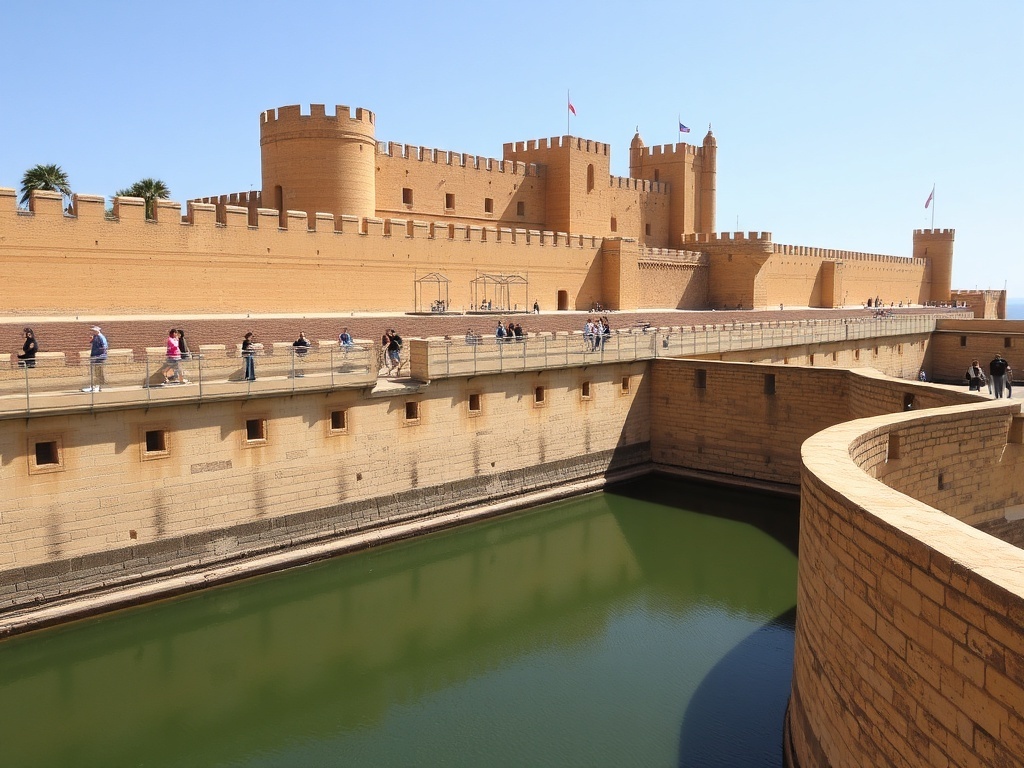
The Royal Walls (Murallas Reales) rank among the finest examples of Renaissance military architecture in Africa, a massive defensive complex that protected Ceuta through centuries of siege warfare. The fortifications stretch across the isthmus connecting the Almina peninsula to the mainland, effectively creating an island fortress that proved impregnable during the Great Siege of 1694-1727.
Construction began under Portuguese rule in the 15th century and continued under Spanish administration through the 18th century. The walls feature multiple defensive lines, bastions, moats, and tunnels designed to withstand both land assault and naval bombardment. The Foso de San Felipe—a navigable moat connecting the Mediterranean and Atlantic sides—allowed defenders to move supplies and reinforcements without exposure to enemy fire.
Today, the Royal Walls are freely accessible and beautifully maintained. Walking the ramparts offers views of the harbor, Monte Hacho, and the beaches beyond. The Museo de las Murallas Reales occupies chambers carved into the fortifications, displaying contemporary art in a dramatic medieval setting. Information panels in multiple languages explain the walls' history and construction.
Visiting at sunset is particularly rewarding—the walls glow golden in the evening light, and the illuminations after dark create a magical atmosphere. The moat is now used for kayaking and boat trips, offering unique perspectives on the fortifications from water level. Allow at least an hour to explore thoroughly.
⛪ Plaza de África & Cathedral
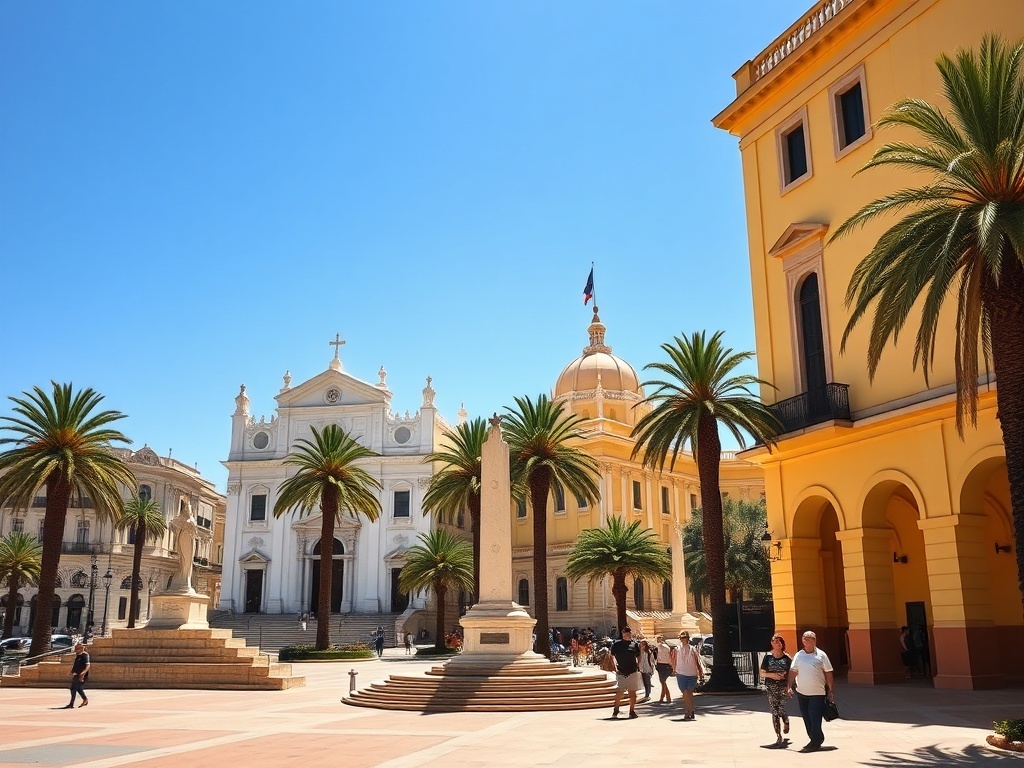
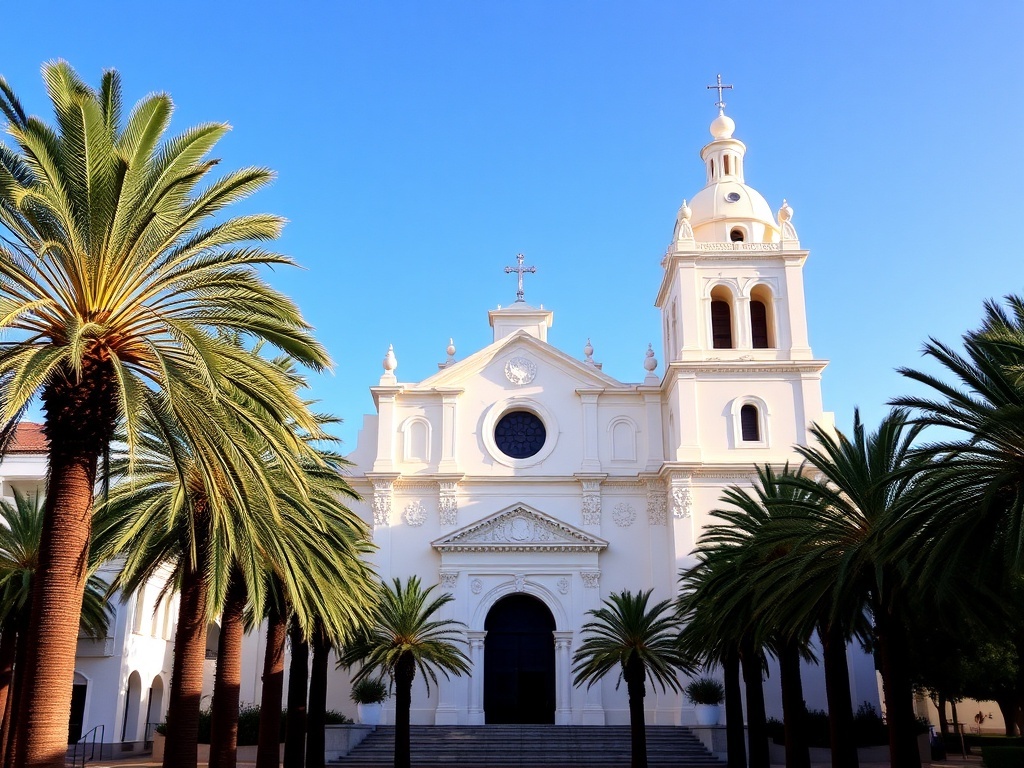
Plaza de África forms the ceremonial heart of Ceuta, an elegant palm-lined square dominated by monuments to the city's complex history. The name refers not to the continent but to the Virgen de África, patron saint of the city, whose bright yellow Sanctuary stands on one side of the plaza. The War Memorial at the center—a neo-Gothic monolith commemorating the 1859-60 African War—rises 13 meters high and contains a crypt with Spanish soldiers' remains.
The Cathedral of St. Mary of the Assumption (Catedral de Santa María de la Asunción) faces the plaza, its baroque-influenced façade dating from the 18th century though it stands on the site of earlier mosques and churches. Construction began in 1686 but wasn't completed until 1726 due to the Great Siege—the building served as military barracks during the conflict. Inside, the Capilla del Santísimo contains fine baroque altarpieces.
The Parador Hotel de Ceuta overlooks the plaza, offering perhaps the finest accommodation in the city with views of the Cathedral and direct access to the Royal Walls. Surrounding streets contain the main shopping areas, restaurants, and pedestrianized zones that make central Ceuta pleasant for evening strolls.
Other architectural highlights include the Casa de los Dragones (House of Dragons), an Art Nouveau building topped by four bronze dragons, and the Plaza de los Reyes with its distinctive green triumphal arch. The Palacio de la Asamblea hosts civic events.
🏊 Parque Marítimo del Mediterráneo
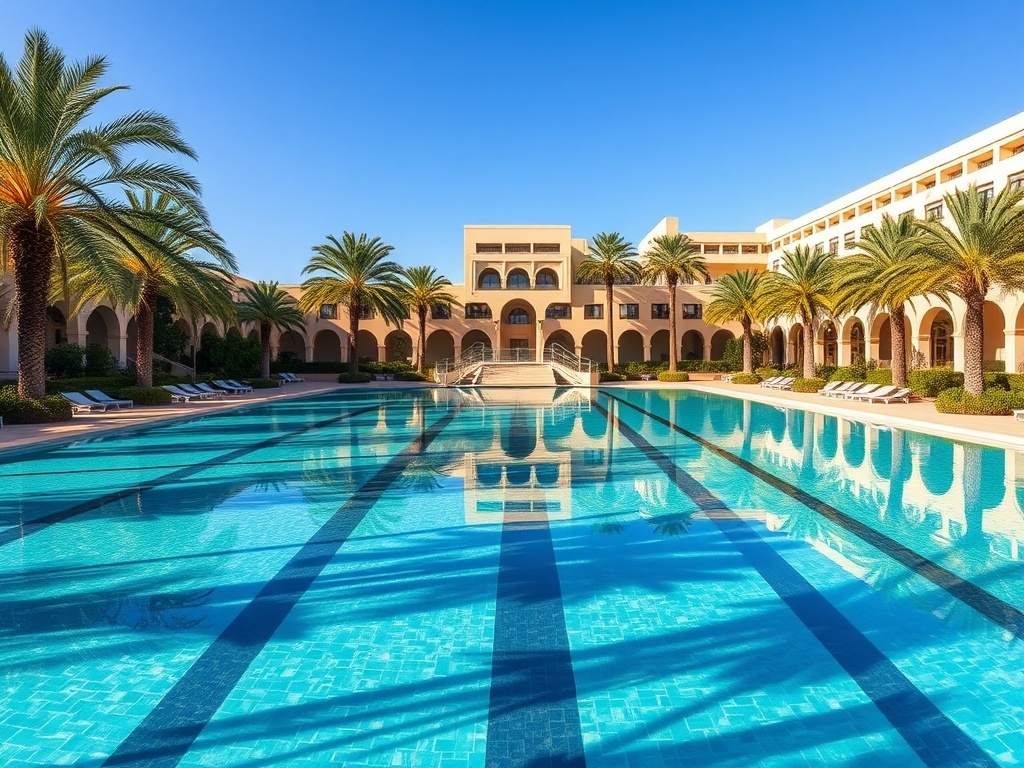
The Parque Marítimo del Mediterráneo deserves special mention—an architect-designed leisure complex by César Manrique (of Lanzarote fame) featuring saltwater swimming pools, landscaped gardens, restaurants, and palm-fringed sunbathing areas. This beautiful space, opened in 1995, is modeled on his famous Lago Martiánez in Tenerife.
Entry to the park is free, making it popular with families and visitors seeking resort-style relaxation without hotel prices. Three interconnected saltwater pools offer swimming for all ages, while the surrounding terraces provide ample space for sunbathing. Several restaurants and bars serve everything from quick snacks to full meals with sea views.
The park occupies reclaimed land along the waterfront, with the dramatic backdrop of Monte Hacho rising behind. Palm trees, cascading water features, and carefully landscaped volcanic rock create an oasis atmosphere. In summer, the park hosts concerts and cultural events, transforming into Ceuta's primary outdoor entertainment venue.
For photographers, the contrast between the modernist park design and the ancient fortifications visible beyond creates compelling compositions. Sunset is particularly photogenic, with the pools reflecting golden light against the darkening sea.
🏖️ Beaches
While Ceuta isn't primarily a beach destination, several pleasant swimming spots allow visitors to combine sightseeing with Mediterranean relaxation. Playa de la Ribera, the main city beach, stretches along the western shore with views of the Royal Walls. Facilities include showers, lifeguards in summer, and easy access from the city center through tunnels carved into the old fortifications.
Playa del Chorrillo on the eastern side offers a more local atmosphere with similar amenities. Both beaches feature the remarkably clear waters of the Strait of Gibraltar, with visibility often exceeding 20 meters—excellent for snorkeling despite urban locations. Water temperatures range from 16°C in winter to 24°C in late summer.
For more secluded swimming, the coves around Monte Hacho reward exploration. Access requires some walking, but the crystal-clear waters and relative solitude justify the effort. Playa de Benítez, near the border area, offers another option with a more neighborhood feel.
For serious divers, the waters around Ceuta offer excellent underwater exploration—the meeting of Mediterranean and Atlantic creates unique marine ecosystems. Several dive operators offer trips to sites around Monte Hacho and the offshore islands, where visibility often exceeds 30 meters.
🍽️ Cuisine
Spanish tapas culture meets North African flavors here — grilled sardines and jamón ibérico a few streets from couscous and mint tea, with the strait’s seafood tying it together. Read the full Food & Drink guide, with recipes →
🍷 Wine, Spirits & Drinking Culture
No vineyards on 19 km² of city, but duty-free pricing and a genuinely bicultural drinking scene — tapas bars and Moroccan tea houses a few hundred metres apart. See the full Wine, Spirits & Drinking Culture guide →
🌤️ Climate & Best Time to Visit
Ceuta enjoys a Mediterranean climate moderated by the Strait of Gibraltar's powerful maritime influence. This creates milder conditions than much of southern Spain—less extreme summer heat, warmer winters, and more moderate seasonal variation overall. The city averages over 300 sunny days annually with yearly precipitation around 850mm, mostly in winter months.
Summer (June-August): Warm and dry, with temperatures typically 24-30°C. Sea breezes keep the coast comfortable even when the interior bakes. Excellent for beaches and outdoor exploration, though accommodation prices peak. Water temperature reaches 22-24°C.
Autumn (September-November): Perhaps the ideal season—warm enough for swimming through September, fewer crowds, and spectacular bird migrations overhead. Occasional rain returns in November. Temperatures 16-24°C.
Winter (December-February): Mild by European standards—average temperatures 10-16°C—but rainy periods occur. Still pleasant for sightseeing between showers. Water temperature drops to 15-17°C. Hotel rates at their lowest.
Spring (March-May): Increasingly warm and dry, with wildflowers blooming on Monte Hacho. Another excellent window for birding as migrants return north. Temperatures 15-22°C, rising steadily.
Wind note: The Strait channels powerful winds—the easterly Levante and westerly Poniente. These can blow strongly for days, affecting ferry services and making coastal walks bracing. Check forecasts if planning water activities.
✈️ Getting There
By ferry from Spain: The most common approach is via ferry from Algeciras in Andalusia. Multiple companies (Trasmediterránea, Baleària, FRS) operate frequent services (approximately hourly in summer), with crossing time of 30-40 minutes. Fares start around €25 one-way for passengers, €80-120 for cars. Book in advance during peak periods (August, Spanish holidays). Ferries dock at the port near the Royal Walls.
From Morocco: The Tarajal land border connects Ceuta with Fnideq on the Moroccan side. Following the exceptional mass crossings of July 30–31, 2026, Spanish authorities introduced reinforced security and reception measures, so border procedures and waiting times may change at short notice. Check current official Spanish and Moroccan notices before crossing and allow substantial extra time. Entry into Morocco and re-entry to Ceuta require the appropriate passport and visa status for each side.
No airport: Ceuta has only a heliport—no commercial flights operate. The nearest airports are Tangier (1 hour drive plus border crossing), Gibraltar (ferry + drive), or Málaga (3-4 hours by road and ferry combined). Some visitors combine Ceuta with a broader Moroccan or Andalusian itinerary.
Getting around Ceuta: The city is compact enough to explore on foot—you can walk from the Royal Walls to Monte Hacho viewpoint in under an hour. Local buses serve the wider area, and taxis are readily available. Car rental is unnecessary unless you're continuing to Morocco.
📋 Practical Information
Documents: Ceuta is Spanish/EU territory. EU citizens need only an ID card; US, UK, Canadian, and Australian citizens need a passport valid for at least 3 months. No visa required for stays up to 90 days. If planning to enter Morocco, check that country's visa requirements separately.
Money: The Euro (€) is the official currency. ATMs are widely available, and credit cards accepted at most establishments. Ceuta's special tax status means some goods (alcohol, tobacco, electronics) are notably cheaper than mainland Spain—bring extra bag space for shopping.
Communications: Spanish mobile networks provide coverage; EU roaming applies for EU residents. WiFi is available in hotels, cafés, and many public spaces. Time zone: CET (UTC+1), same as mainland Spain.
Safety: Normal urban precautions apply. As of September 2026, Ceuta is managing an exceptional migration and border-security situation following the late-July mass crossings; avoid crowds and restricted security operations near the border, follow local instructions, and check current official notices before approaching Tarajal. Military installations, particularly on Monte Hacho, should not be photographed.
Healthcare: Spanish public healthcare applies; EU citizens should carry their EHIC/GHIC card. Private clinics and pharmacies are readily available. No specific vaccinations required.
Electricity: Standard European 230V/50Hz with Type C/F plugs. US/UK travelers will need adapters.
💼 Business & Economy
A free port running on IPSI instead of VAT, a 50% corporate tax break for companies with real local substance, and a small but real digital-services cluster drawn by the lowest IPSI rate on the books. Read the full Business & Economy guide →
💰 Costs & Budget
Budget travelers (€40-60/day): Stay in hostels or budget pensions, eat menu del día lunches and tapas dinners, use public transport, enjoy free attractions (Royal Walls, beaches, walking Monte Hacho). Duty-free alcohol and tobacco offer savings for those inclined.
Mid-range travelers (€80-120/day): Comfortable 3-star hotels, mix of restaurants and cafés, occasional taxi, entrance fees for museums. Can include a half-day dive trip or kayaking excursion.
Comfort/Luxury (€150+/day): Parador Hotel or equivalent, fine dining, private tours, spa treatments. The ceiling is lower than most Spanish destinations—Ceuta doesn't have the ultra-luxury infrastructure of major cities.
💶 Sample Prices (2026)
🏨 Accommodation
Parador Hotel de Ceuta: The standout option—a modern Parador (government-run luxury hotel chain) overlooking Plaza de África with views of the Cathedral and direct access to the Royal Walls. Pool, restaurant, and the quality assurance of the Parador brand. €120-180/night.
Mid-range hotels: Several 3-star options cluster around the center. Hotel Tryp Ceuta and Hotel Ulises offer reliable comfort with central locations. Expect €70-100/night for double rooms with breakfast.
Budget options: Pensiones and hostales provide basic but clean accommodation from €35-50/night. Look along the main commercial streets near Plaza de África. Apartment rentals through Airbnb and similar platforms offer good value for longer stays or groups.
Booking tips: Reserve well ahead for August (Spanish holidays) and Semana Santa (Easter). Winter offers the best rates. The Parador often has promotions for off-season stays. Most hotels include breakfast; confirm when booking.
🎉 Festivals & Events
Festival of the Virgen de África (August 5): Ceuta's most important celebration honors the city's patron saint. Religious processions carry the Virgin's statue through the streets, followed by concerts, fireworks, and festivities that last for days. The entire city participates, regardless of religion—a testament to Ceuta's multicultural character.
Semana Santa (March/April): Holy Week brings elaborate Catholic processions through the historic center. Cofradías (brotherhoods) carry ornate pasos (floats) depicting scenes from the Passion. The processions blend Andalusian tradition with local character, smaller and more intimate than those in Seville but equally moving.
Eid al-Fitr & Eid al-Adha: The Muslim community celebrates these major Islamic festivals with family gatherings, special prayers, and festive meals. Restaurants serving halal food are particularly busy; some non-Muslim establishments close in acknowledgment.
Carnival (February): Pre-Lenten carnival brings costumes, parades, and parties to the streets. Less famous than Cádiz's legendary carnival across the Strait but equally enthusiastic. Día de Ceuta (September 2): The city's official day commemorates the 1415 Portuguese conquest with civic ceremonies and cultural events.
🎒 Packing Tips
Essential: Valid passport or EU ID, comfortable walking shoes (cobblestones and fortress ramparts require good footwear), sunscreen and hat (Mediterranean sun is strong year-round), light layers (sea breezes can be cool even in summer).
Clothing: Casual European dress is appropriate everywhere. For religious sites, cover shoulders and knees—this applies to both the Cathedral and any mosques you might visit. Swimwear is fine at beaches and the Parque Marítimo but not appropriate in town.
Useful items: Reusable water bottle, rain jacket (particularly November-March), binoculars (for birdwatching and views), snorkeling gear if you're a swimmer, power adapter (EU Type C/F). If planning to cross to Morocco, pack a photocopy of your passport separately.
What NOT to bring: Excessive luggage (most visitors stay only 1-3 days), camera drones (restricted near military installations), expensive jewelry (unnecessary and attracts attention at the border). If driving across the border, check Moroccan import regulations for your vehicle.
🌐 Useful Resources
Official Tourism: turismo.ceuta.es — The city's official tourism portal with events, maps, and booking links. Available in Spanish and English.
Ferry Services: Trasmediterránea (trasmediterranea.es), Baleària (balearia.com), FRS (ffrrssiibberria.es) — Compare schedules and prices for Algeciras-Ceuta crossings.
Emergency Numbers: General Emergency 112, Police 091/092, Ambulance 061, Fire 080. Hospital Universitario de Ceuta is the main medical facility.
Maps: Google Maps works well; download offline maps before arrival if crossing from Morocco (data roaming can be expensive). OpenStreetMap offers good coverage.
Online Communities: r/spain on Reddit occasionally discusses Ceuta; TripAdvisor forums have active threads. Spanish-language blogs like "Viajeros en Ceuta" offer local perspectives.
📚 Recommended Reading
History: "The Forgotten Frontier: A History of the Sixteenth-Century Ibero-African Frontier" by Andrew C. Hess provides essential context for understanding Ceuta's strategic importance. For the Portuguese conquest, seek out "The Conquest of Ceuta" by Gomes Eanes de Zurara, the near-contemporary chronicle.
Travel Literature: Paul Bowles' writings on Morocco often touch on the Spanish enclaves. Jan Morris' "Spain" includes evocative passages on Ceuta and Melilla. For a contemporary take, try Aatish Taseer's "Stranger to History."
Fiction: While few novels focus specifically on Ceuta, the city appears in works dealing with Spanish-Moroccan themes. María Dueñas' "The Time In Between" touches on North African Spanish territories during the Civil War era.
Online: El Faro de Ceuta (elfarodceuta.es) is the main local newspaper. For broader context, El País and El Mundo occasionally cover Ceuta affairs. Academic journals on borderlands studies frequently examine the Ceuta case.
🎬 Videos About Ceuta
Discover Ceuta through these carefully selected documentaries and travel videos. From ancient fortifications to modern border controversies, these films capture the enclave's unique character.
🤯 Fascinating Facts
🏛️ Pillars of Hercules
Monte Hacho may be one of the legendary Pillars of Hercules that marked the edge of the known world for ancient Mediterranean civilizations. The other pillar is the Rock of Gibraltar, visible from Ceuta on clear days.
🚢 Age of Discovery
The 1415 Portuguese conquest of Ceuta is considered the starting point of the Age of Discovery—the first permanent European foothold in Africa that launched five centuries of colonial expansion.
⚔️ 33-Year Siege
The Great Siege of Ceuta (1694-1727) lasted over 33 years—one of the longest sieges in history. Moroccan forces never breached the Royal Walls, proving them virtually impregnable.
🗳️ Chose Spain
When Portugal regained independence from Spain in 1640, Ceuta was the only Portuguese territory that voted to remain Spanish—earning the title "Most Faithful City."
👥 Four Faiths
Ceuta hosts active communities of Christians, Muslims, Jews, and Hindus—all with their own places of worship within walking distance. Few cities this size have such religious diversity.
🏅 Spanish Legion
The famous Legión Española (Spanish Foreign Legion) was founded in Ceuta in 1920. The city remains closely associated with military tradition, and Legion parades are local highlights.
🛒 Duty-Free Paradise
Ceuta's special tax status makes it one of the few duty-free zones in Europe. Alcohol, tobacco, and electronics cost significantly less than on the Spanish mainland—locals call it "Europe's bargain basement."
⭐ Notable People
Al-Idrisi (1100-1165) — The great Arab geographer and cartographer was born in Ceuta. His "Tabula Rogeriana" was the most accurate world map for three centuries, and his geographic works remained authoritative references in Europe until the Age of Discovery. A true son of Ceuta's multicultural heritage.
Juan Sebastián Elcano (c.1476-1526) — While not born in Ceuta, this navigator who completed the first circumnavigation of Earth after Magellan's death had close ties to the city. The Strait of Gibraltar that Ceuta guards was central to Spain's age of exploration.
Franco's Launch: General Francisco Franco launched his 1936 military uprising partly from Ceuta, airlifting troops across the Strait to begin the Spanish Civil War. This dark chapter links the city to Spain's 20th-century tragedy.
Modern Figures: Nayim (Mohamed Ali Amar), the footballer famous for his incredible goal against Arsenal in the 1995 Cup Winners' Cup Final, hails from Ceuta. Several Spanish military leaders and administrators have roots in the city.
⚽ Sports
AD Ceuta FC: The city's football club competes in the Spanish football pyramid, with passionate local support that belies the city's small size. Matches at the Alfonso Murube Stadium create an electric atmosphere, particularly for derbies against other North African Spanish teams.
Water Sports: The Strait of Gibraltar offers exceptional conditions for diving, snorkeling, and kayaking. Strong currents require respect, but the meeting of Atlantic and Mediterranean creates unique underwater environments. Windsurfing and kitesurfing are possible when the Levante or Poniente winds blow.
Fishing: Both recreational and commercial fishing remain important. Sport fishing charters target tuna, swordfish, and other pelagic species in the rich Strait waters. Local anglers fish from the rocks around Monte Hacho year-round.
Running: The compact city and spectacular scenery make Ceuta perfect for runners. The circuit around Monte Hacho is a local favorite, and the annual Ceuta Half Marathon draws participants from both sides of the Strait.
📸 Photo Gallery
Share your Ceuta photos! Send to photos@kaufmann.wtf to be featured.
✍️ Author's Note
Ceuta defies easy categorization—a European city on African soil, a Spanish enclave with Arab roots, a Mediterranean port facing the Atlantic. In an age of hardening borders and cultural divides, this small peninsula offers a different vision: civilizations meeting rather than clashing, identities overlapping rather than excluding, history as inheritance rather than burden.
Visitors expecting either Spanish normality or exotic otherness will find both and neither. Ceuta is simply itself—a place where the muezzin's call and cathedral bells mark the same hours, where paella and couscous share restaurant menus, where you can stand on the Pillar of Hercules and contemplate what it meant to ancient mariners to sail beyond the known world.
The warmth of Ceutí hospitality transcends the divisions that outsiders might expect. Here at the crossroads of continents, the ancient imperative of welcoming travelers remains alive. That, perhaps more than the fortifications or the views, is what makes Ceuta worth the journey.
"Sabta" — Where the World Meets
—Radim Kaufmann, 2026
